
Sellers of charging products targeting the Thai market have most likely heard of NBTC certification, but they are often confused about whether their own products need it: Do pure wired GaN chargers need it? What about smart chargers with Bluetooth? Is certification mandatory for wireless chargers? Do USB-C cables need to comply? They either worry that missing the certification will lead to customs detention or e-commerce platform delisting, or worry that getting unnecessary certification wastes money. Today, we will thoroughly explain the scope of application of Thailand’s NBTC, from quick self-checks to in-depth judgment logic, and then common pitfalls, to help you figure out which category your products belong to.
First-Screen Quick Answer: 3 Conclusion Categories + Core Quick Reference Table
First, here is a quick judgment conclusion for everyone, so you can have a general idea without reading the entire article:
Category 1: **Usually requires NBTC screening (note: screening does not mean a certificate must be obtained, it only means that the rules need to be checked first): All independently sold electronic products with enableable wireless communication functions such as Bluetooth, Wi-Fi, cellular network, NFC, etc., or terminal devices connected to the public telecommunication network (such as optical modems, IP phones), must first go through the screening process.
Category 2: **Requires technical verification for specific models (conclusions cannot be drawn directly based on product category)**: For example, products that only have wireless charging function and no other communication functions, devices with Ethernet function or PoE switching devices, as well as products with built-in wireless modules that are not enabled at the factory but can be remotely turned on via software or OTA — these cannot be directly said to require or not require certification, and specific parameters must be checked for verification.
Category 3: **NBTC is usually not a core requirement**: For example, pure wired chargers, USB/USB-C charging cables/data cables, pure wired power banks — as long as they have no wireless or telecommunication terminal functions, there is basically no need to consider NBTC. However, note that such products still need to verify other Thai market access requirements, such as TISI electrical safety certification.
For your convenience, we have compiled a core judgment quick reference table:
| Product Type | Initial NBTC Handling Direction | Follow-up Actions |
| Pure wired chargers/charging cables/wired power banks | Usually no NBTC screening required | Verify other Thai access requirements such as TISI |
| Products with enableable Bluetooth/Wi-Fi/cellular/NFC functions | Must undergo NBTC screening | Check parameters to match the corresponding compliance procedure |
| Products with only wireless charging and no other communication functions | Requires model-level technical verification | Confirm whether functional parameters are within the regulated scope |
| Devices with Ethernet function or PoE switching devices | Requires model-level technical verification | Verify in accordance with NBTC data terminal equipment rules |
| Products with built-in wireless modules that can be enabled via software/OTA | Must undergo NBTC screening | Confirm the actual configuration of the Thai sales version |
Finally, a reminder: This quick reference table is only for preliminary classification, and cannot replace technical verification of specific models. Especially for charging products, which have particularly many functional combinations and are a high-incidence area for judgment errors, you must carefully check the actual functions and not just look at the product name.
Core Judgment Logic: 4 Model-Level Screening Dimensions + 2 Principles
After clarifying what NBTC regulates, let’s talk about the core judgment logic — it’s not about what the product is called, but about its actual functions and version. To sum it up, it is “one premise, four dimensions, two principles”.
Judgment Premise: Based on the Final Version Sold in Thailand
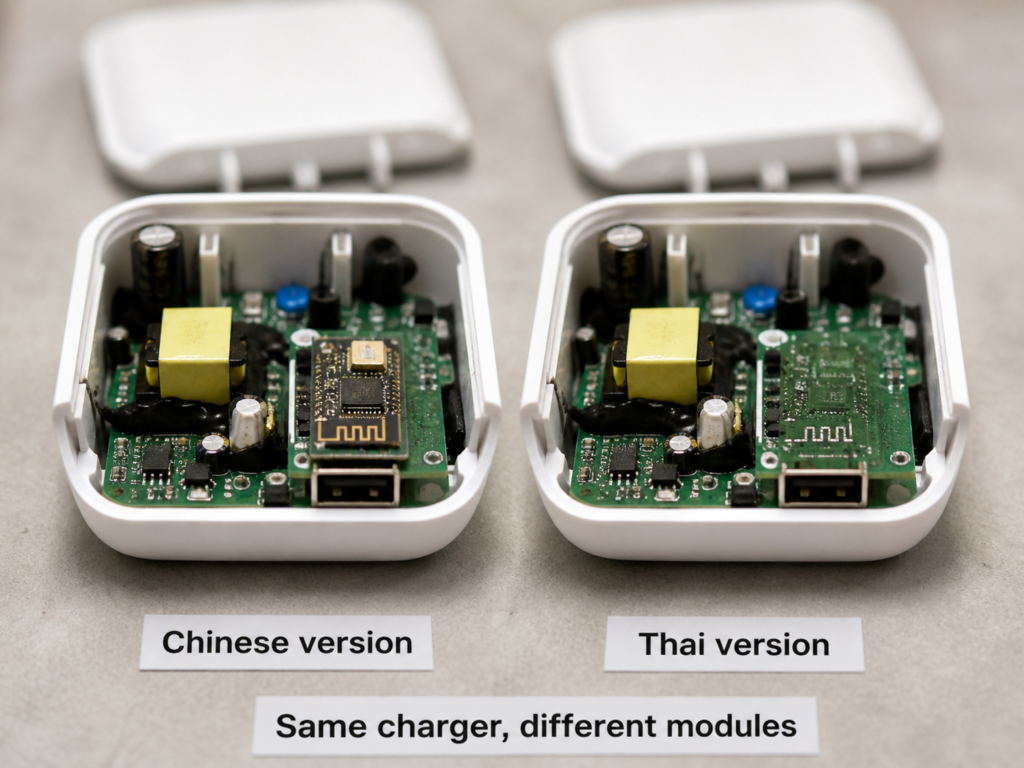
Many people make a mistake: they use the parameters of the Chinese version or global version to judge the requirements of the Thai version, which is incorrect. For models with the same appearance, configurations in different markets may be completely different — for example, for the same charger, the Chinese version has Bluetooth network configuration function, while the Thai version removes the Bluetooth module to save costs, so the NBTC requirements for the two are completely different. Even for the same SKU, as long as configurations that affect wireless or interface functions, such as firmware, frequency band, and antenna, change, a re-evaluation is required. Therefore, when making a judgment, you must lock in the parameters of the final version that you plan to import into Thailand and actually sell, and cannot apply those of other markets.
Four Screening Dimensions (Comprehensive Judgment Required)
You cannot look at only one dimension; you must combine them to make a judgment:
1. Does the Thai version of the model have radio communication or regulated telecommunication terminal functions? Can this function be enabled by the user?
2. If it has wireless functions, what is its operating frequency band? What is the transmission power? If it is a telecommunication port, what is its function type?
3. What are the current compliance requirements of NBTC for this category of equipment? Is it Class A, Class B, or only an SDoC declaration?
4. First determine whether SDoC, Class A or Class B applies based on the equipment category, frequency band/interface and applicable technical standards of the Thai sales version; scenarios such as import, sale, exhibition, and personal use are additionally used to judge whether there is conformity exemption, and whether separate import, use or radio station setup permits must be handled.
2 Key Judgment Principles
Remember these two principles, and you can avoid most misunderstandings:
First principle: **Look at the actually realizable functions, not the product name**. For example, a product is called a “charger”, but if it has Bluetooth function, it must be screened as a wireless device, and cannot be excluded just because its main function is charging.
Second principle: **Wireless functions are not divided into primary and secondary**. Even if this wireless function is only auxiliary, such as Bluetooth network configuration, NFC tap-to-transfer data, as long as it is enableable, it must be included in the screening scope. You cannot say “this function is not important, so it doesn’t count.”
Precautions for Scenario Judgment
As long as it is **commercial sale**, whether it is online e-commerce, offline stores, or promotional giveaways and free trials, you must first complete the compliance assessment. You cannot say “I’m giving it away, so I don’t need to do it.”
Under general conformity assessment rules, **personal use** items that simultaneously meet conditions such as being temporarily imported as personal items, not for commercial use, and being re-exported after use, may fall under conformity assessment exemption scenarios; however, this does not automatically exempt from equipment-specific rules, nor obligations such as import, use, registration or declaration of radio equipment. In particular, special categories such as drone radio equipment shall be subject to ODoC, registration or other requirements in accordance with special announcements, and cannot be generally deemed as fully exempt.
As for non-commercial scenarios such as **exhibition, testing, and maintenance**, you cannot directly say they are exempt. You must conduct specific verification in combination with the entry method and whether it involves radio operation or use permits, and do not take it for granted.
NBTC Compliance Procedure Selection (Class A/Class B/SDoC)
If your product does fall within the NBTC regulated scope, the next step is to match the corresponding compliance procedure — many people think NBTC only has one type of “certification”, but in fact it is divided into three different procedures, with very different requirements and costs.
First, a premise must be clarified: **You must first confirm that the product is an NBTC-regulated device before matching the compliance procedure**. Equipment subject to conformity assessment is legally divided into two categories: Class A and Class B. There is also a procedure called SDoC (Supplier’s Declaration of Conformity), which applies to equipment for which clear technical standards have been established but which are not required to undergo Class A or Class B assessment.
Here we need to correct a common misunderstanding: there are no absolute rules such as “Class A is mandatory, Class B is voluntary” or “low-risk products must do SDoC, high-risk products must do Class B”. Which category applies specifically depends entirely on the official NBTC equipment category list and technical standards.
We have compiled the core differences of the three procedures into a table for your comparison:
| Compliance Procedure | Applicable Conditions | Submission Requirements | Compliance Result |
| Class A (Registration Category) | Equipment categories that NBTC stipulates require registration management | Submit test reports and other materials to NBTC for registration | After registration is completed, you must also fulfill label and documentation requirements in accordance with applicable NBTC labeling and accompanying conformity information rules; if it additionally involves import, trade, use or radio station setup permits, these must also be handled separately |
| Class B (Certification Category) | Equipment categories that NBTC stipulates require certification management | Applicable tests shall be completed by relevant conformity assessment bodies that meet NBTC requirements or accepted laboratories. Test reports and application materials shall be submitted, and NBTC shall review and certify | After certification is completed, you must also fulfill label and documentation requirements in accordance with applicable NBTC labeling and accompanying conformity information rules; if it additionally involves import, trade, use or radio station setup permits, these must also be handled separately |
| SDoC (Supplier’s Declaration of Conformity) | Equipment for which technical standards have been specified and Class A/B assessment is not required | The supplier prepares technical documentation, submits a written declaration to NBTC and assumes responsibility | After the declaration is completed, you must also fulfill label and documentation requirements in accordance with applicable NBTC labeling and accompanying conformity information rules; if it additionally involves import, trade, use or radio station setup permits, these must also be handled separately |
There is another easily confused concept: **radio use permit**. Many people think that once a product passes NBTC compliance, everything is fine, but that’s not the case — NBTC compliance of a product is for “whether the product itself can be sold in the market”, while for some professional equipment (such as walkie-talkies, vehicle-mounted radios), in addition to the product being compliant, a separate radio use permit or radio station setup permit is required for use.
Consumer-grade products generally do not need to apply for an additional use permit, as long as the product’s conformity procedure is completed. However, the specific situation must be confirmed separately according to equipment category, frequency band, and use, and cannot be generalized.
Common Misconceptions & Pitfall Avoidance Guide
Finally, we have compiled the most common pitfalls, divided into cognitive and operational categories, to help you avoid 90% of problems.
Cognitive Misconceptions (Avoid Wasting Money or Missing Required Procedures)
1. **Misconception: All electronic products/charging products need NBTC certification**
Correct answer: Only products with regulated wireless communication or telecommunication terminal functions need screening; pure wired charging products basically do not.
2. **Misconception: NBTC only has two types: Class A mandatory and Class B voluntary**
Correct answer: Regulated equipment is legally divided into two categories: Class A and Class B, and there is also a compliance procedure called SDoC. There are not only two types, nor is there such a thing as Class B being voluntary. All regulated equipment must complete the corresponding procedure as required.
3. **Misconception: Wireless charging products must/must not do NBTC**
Correct answer: Products with only wireless power supply function need to verify whether their technical parameters fall within the regulated scope of NBTC, and cannot be generalized; if they also have communication functions such as Bluetooth and Wi-Fi, they definitely need screening.
4. **Misconception: Docking stations with Ethernet ports are pure wired and do not need NBTC**
Correct answer: Devices with Ethernet function and PoE switching devices shall be verified in accordance with NBTC data terminal equipment rules. The current NBTC SDoC page has listed Ethernet Device and PoE Switch as declaration items. NBTC requirements cannot be excluded solely based on whether there is independent network control, modulation and demodulation, direct access to the public network, or whether it is an interface conversion.
5. **Misconception: Low-power wireless products do not need NBTC**
Correct answer: Whether compliance is required depends on the equipment category and operating frequency band, not just power. Even if the power is very low, as long as it belongs to the regulated category, the procedure must be followed.
6. **Misconception: Wireless functions are off by default so they don’t need to be included in NBTC scope**
Correct answer: As long as the wireless module is already installed in the hardware and the user can enable it through settings, software or OTA, verification must be carried out according to the actual configuration of the Thai version, and it cannot be excluded just because it is off by default.
Operational Misconceptions (Avoid Penalties)
1. **Misconception: CE/FCC wireless certification can replace NBTC**
Correct answer: CE or FCC certificates themselves cannot replace Thailand NBTC’s SDoC, Class A or Class B procedures; however, if their underlying test reports come from laboratories that meet NBTC’s current acceptance conditions, and the test items and product version meet Thai technical requirements, they may be used as part of the application materials, which must be confirmed on a case-by-case basis.
2. **Misconception: Selling only on e-commerce platforms does not require NBTC**
Correct answer: Online sales are also commercial sales, and compliance obligations are not exempted just because it is e-commerce. If discovered, goods will be detained, fines will be imposed, and products will be delisted.
3. **Misconception: If the wireless module is already certified, the whole device doesn’t need to be handled**
Correct answer: Module certification is not equal to whole-device certification. It is necessary to verify the applicable conditions of the module certificate, the radio frequency configuration of the whole device, model consistency, etc. Only those that meet the requirements may have simplified procedures, but it is not completely unnecessary to handle.
Pitfall Avoidance Tips
• For products you are unsure about, prioritize checking with a compliance agency with NBTC qualifications. Do not judge based on your own feeling, to avoid wasting money or missing required procedures.
• Function check is always the first step. Do not draw conclusions just by looking only at the product name or promotional page; you must look at the actually realizable functions.
Summary & High-Frequency FAQ
Summary
By now, you should be able to independently judge the following: whether your charging products need to enter the NBTC scope for screening, the basic differences between the three types of NBTC compliance procedures, the verification direction and materials to prepare for borderline products, as well as common cognitive and operational misconceptions.
We have divided the final conclusions into three levels, and you can match them to your products:
1. **Level 1: NBTC is usually not a core requirement**: For example, pure wired chargers, charging cables, wired power banks, etc. Focus on verifying other access requirements such as TISI.
2. **Level 2: Must enter NBTC scope for screening**: For example, products with enableable wireless communication functions such as Bluetooth, Wi-Fi, cellular, NFC, etc., as well as telecommunication terminals connected to the public network, need to further match the compliance procedure.
3. **Level 3: Need to verify with NBTC or compliance agency**: For example, products with only wireless charging function, devices with Ethernet function or PoE switching devices, products with edge functions such as built-in unenabled wireless modules and unclear parameters, need to be checked with specific parameters.
It should be noted that all preliminary judgments are only references based on current rules and do not constitute absolute conclusions. The final requirements shall be subject to the official regulations of Thailand’s NBTC.
High-Frequency FAQ
**Q1: Do ordinary wired chargers need Thailand NBTC certification?**
A: Usually they do not need to enter NBTC screening, but they need to verify other Thai market access requirements such as TISI electrical safety, plug specifications, etc.
**Q2: Do smart chargers with Bluetooth need NBTC?**
A: They are independently sold products with enableable wireless communication functions, and must enter NBTC screening, then match the corresponding compliance procedure according to the product category and parameters.
**Q3: Must wireless chargers have NBTC certification?**
A: Products with only wireless charging function cannot be directly judged. It is necessary to first verify whether their technical parameters fall within the current regulated scope of NBTC; if they also have communication functions such as Bluetooth and Wi-Fi, they must enter screening.
**Q4: Do USB-C charging cables/data cables need NBTC certification?**
A: USB/USB-C cables for pure charging or wired data transmission, even with E-Marker chips, do not need NBTC assessment. Just pay attention to verifying other Thai access requirements.
**Q5: What is the difference between NBTC’s SDoC, Class A, and Class B?**
A: Simply put, Class A is the registration category, where test reports and other materials are submitted to NBTC for registration; Class B is the certification category, where applicable tests are completed by relevant conformity assessment bodies that meet NBTC requirements or accepted laboratories, test reports and application materials are submitted, and then NBTC reviews and certifies; SDoC is the Supplier’s Declaration of Conformity, where the supplier prepares technical documentation, submits a written declaration to NBTC and assumes responsibility. No matter which procedure applies, after completing registration, certification or SDoC declaration, you must also meet the applicable NBTC labeling and accompanying conformity information requirements; if it additionally involves import, trade, use or radio station setup permits for radio equipment, these must also be completed separately. Which category applies specifically shall be subject to the official NBTC equipment category list, and there is no absolute corresponding relationship of “which is stricter”.
**Q6: Do docking stations with Ethernet ports need NBTC?**
A: It cannot be judged solely by the presence of an Ethernet port. Devices with Ethernet function and PoE switching devices shall be verified in accordance with NBTC’s data terminal equipment rules. The current NBTC SDoC page clearly lists Ethernet Device and PoE Switch. Whether it is called a docking station, whether it has modulation and demodulation functions, whether it is directly connected to the public network, or whether it is an interface conversion, cannot be directly used as a basis for excluding NBTC requirements; pure physical accessories that do not have Ethernet data terminal or PoE switching functions shall be judged according to actual technical characteristics.
**Q7: Do personal use products with wireless functions need NBTC when entering Thailand?**
A: Under general conformity assessment rules, telecommunication equipment that is temporarily imported as a personal item, has no commercial purpose, and is re-exported when no longer used, may fall under exemption scenarios; however, it is still necessary to verify equipment-specific rules, as well as import, use, registration or declaration obligations. Special categories such as drone radio equipment cannot be directly deemed fully exempt based on this, and may still require ODoC, registration or other requirements.
Overall, the core logic of judging whether Thailand NBTC is required is never “what product category it is”, but “whether there are enableable regulated wireless/telecommunication functions” and “whether it is the final version sold in Thailand”. For sellers of charging products, pure wired products basically do not need to deal with NBTC, and products with wireless functions must honestly go through the screening process. For borderline products you are unsure about, do not draw conclusions by feeling; verify with a qualified compliance agency, which can both save unnecessary costs and avoid customs clearance and sales risks.