
Sellers of charging products for the North American market almost always ask this question: I already have US FCC certification, can I sell the products directly in Canada? After all, the US and Canadian markets are adjacent, and many rules seem similar, but the answer is neither “completely yes” nor “completely no” — the core is to understand the true meaning of “mutual recognition” and the specific requirements for different charging products. In this article, we only cover charging products (including USB/USB-C chargers, data cables, power adapters, wireless charging devices, adapters, etc.), and do not involve other categories such as toys, home appliances, and industrial equipment. After reading this, you will be able to judge most situations by yourself.
Core Conclusion for Entry-Level Users First
First, make it clear: **FCC certification documents cannot directly replace Canadian compliance requirements, but if existing FCC test materials are sufficient to cover the applicable Canadian requirements, they can be used as technical materials or a basis for difference analysis, and full retesting is not necessarily required, which can save a lot of costs**.
Here we first clarify two most easily misunderstood premises to avoid subsequent comprehension deviations:
First, what we call “direct use” refers to **legally conducting commercial import and sales in Canada solely with FCC certification without any additional adjustments** (including e-commerce listing, overseas warehouse stocking, offline distribution, etc.), which is not allowed. The tax, customs, and law enforcement scenarios for personal carry-on for self-use are different from those for commercial import and sales, but not being inspected does not equal technical compliance exemption; for devices involving radio, WPT, or other devices subject to ISED standards, it is necessary to first verify whether there is a clear exemption for the device and its usage scenario.
Second, what exactly does the “mutual recognition” between the US and Canada recognize? Many people think it means “FCC certificates are directly recognized by Canada”, but that is not the case. The **Electromagnetic Compatibility/Radio Frequency Mutual Recognition Agreement (MRA)** between the US and Canada essentially recognizes the conformity assessment results completed by third-party certification bodies (professionally called conformity assessment bodies, abbreviated as CAB) recognized by the other party in accordance with the technical requirements of the importing country, rather than directly recognizing the other party’s certificates. Simply put, the MRA does not automatically convert reports completed in accordance with FCC rules into Canadian compliance reports; it is necessary to first confirm whether existing materials cover the required requirements in accordance with the applicable Canadian ICES or RSS standards, current versions, test methods, and product configurations.
To use existing FCC test materials as technical support for Canadian compliance, four core conditions must first be met:
1. The Canadian standard corresponding to the product is within the scope of US-Canada mutual recognition, or existing test materials are sufficient to cover the applicable Canadian requirements;
2. For items requiring Canadian Certification or DoC, the relevant test laboratories or certification bodies shall be within the scope of ISED recognition; however, for SDoC of ICES and other Category II devices, regulations do not require that tests must be completed by ISED-recognized laboratories;
3. The version of the product actually to be sold is within the scope explicitly covered by existing test reports, SDoC, or certification documents;
4. Complete the compliance process in accordance with Canadian requirements, and do not sell only with FCC documents.
Applicable Scenario Boundary: Personal Self-Use ≠ Commercial Sales
Many people will use the example of “I brought a charger to Canada last time and nothing happened”, but these are two different scenarios:
• Personal carry-on of a small amount for self-use entry: The customs and tax treatment of personal items may be different from that of commercial goods, but not being inspected does not mean that the product is automatically granted technical compliance exemption. For devices subject to ISED standards, it is necessary to first verify whether there is a clear applicable exemption.
• Commercial scenarios (import, sales, e-commerce, overseas warehouses, distribution): Must fully comply with all applicable Canadian compliance requirements, and cannot rely solely on FCC certification.
Core Basis and Scope of Mutual Recognition
The US-Canada Electromagnetic Compatibility/Radio Frequency Mutual Recognition Agreement mentioned just now is the basis for all of this. Its function is to reduce repeated testing between the US and Canada and lower enterprise costs, but its coverage is very limited: **it mainly includes electromagnetic compatibility (EMC, simply put, the product does not randomly emit electromagnetic waves to interfere with other devices when working, and is not easily interfered with by other devices), radio frequency (RF, that is, the wireless transmission function of the product, such as Bluetooth, WiFi, wireless charging) and applicable RF human exposure requirements**. Electrical safety such as electric shock prevention, fire prevention, insulation, energy efficiency, and language labels of products are not within the scope of mutual recognition and need to separately comply with Canadian regulations.
Must-Know for Beginners: What Exactly Do FCC and ISED Regulate?
Many people cannot distinguish the difference between these two access requirements of the US and Canada. We will first explain the basics thoroughly so that subsequent judgments will not be confused. Here is a simple comparison table for quick understanding:
| Comparison Item | US FCC Certification | Canada ISED Certification (commonly referred to as IC Certification in the market) |
| Competent Authority | US Federal Communications Commission | Innovation, Science and Economic Development Canada (formerly Industry Canada, IC) |
| Jurisdiction | Mainly regulates RF, interference/EMC, and applicable RF human exposure requirements; does not replace the electrical safety approval system | Mainly regulates RF, interference/EMC, and applicable RF human exposure requirements; does not replace the electrical safety approval system of Canadian provinces or territories |
| Common Compliance Types for Charging Products | 1. Unintentional radiating devices are usually subject to Supplier’s Declaration of Conformity (SDoC)<br>2. Most intentional communication transmitters such as Bluetooth and WiFi usually require formal Certification and obtain an FCC ID<br>3. WPT/ISM devices must be judged in accordance with Part 15 and/or Part 18 and specific operating modes, not just based on whether they have wireless functions | 1. Supplier’s Declaration of Conformity (SDoC)<br>2. Declaration of Conformity (DoC): Usually only applicable to telecommunications equipment directly connected to the public switched telephone network<br>3. Formal Certification: When applicable, an ISED ID must be registered and the device must be listed in the REL public directory of certified devices<br>*The specific type to use is determined by the ICES/RSS standard corresponding to the product and the device category |
| Examples of Charging Products | Ordinary wired chargers usually follow SDoC in accordance with applicable rules; charging docks with Bluetooth usually require formal certification | Ordinary wired chargers or external power adapters, if subject to applicable ICES standards, usually adopt SDoC; smart chargers with WiFi usually require an ISED ID |
Here we particularly need to clarify a common misunderstanding: **The device access rules of FCC and ISED mainly deal with radio frequency, interference/EMC, and applicable RF human exposure requirements, but they are not equivalent to the electrical safety approval system**. For example, electrical safety issues such as whether a charger will cause electric shock, catch fire, or have reliable insulation must be separately verified in accordance with the applicable electrical safety rules of the Canadian province or territory where the product is intended to be sold or used.
Judgment by Category: Can Your Charging Product Reuse FCC Materials?
Charging products all seem to be “for charging”, but the compliance requirements for different types vary greatly. We divide them into the three most common categories:
Pure Wired Charging Products (Without Any Wireless Transmission Function)
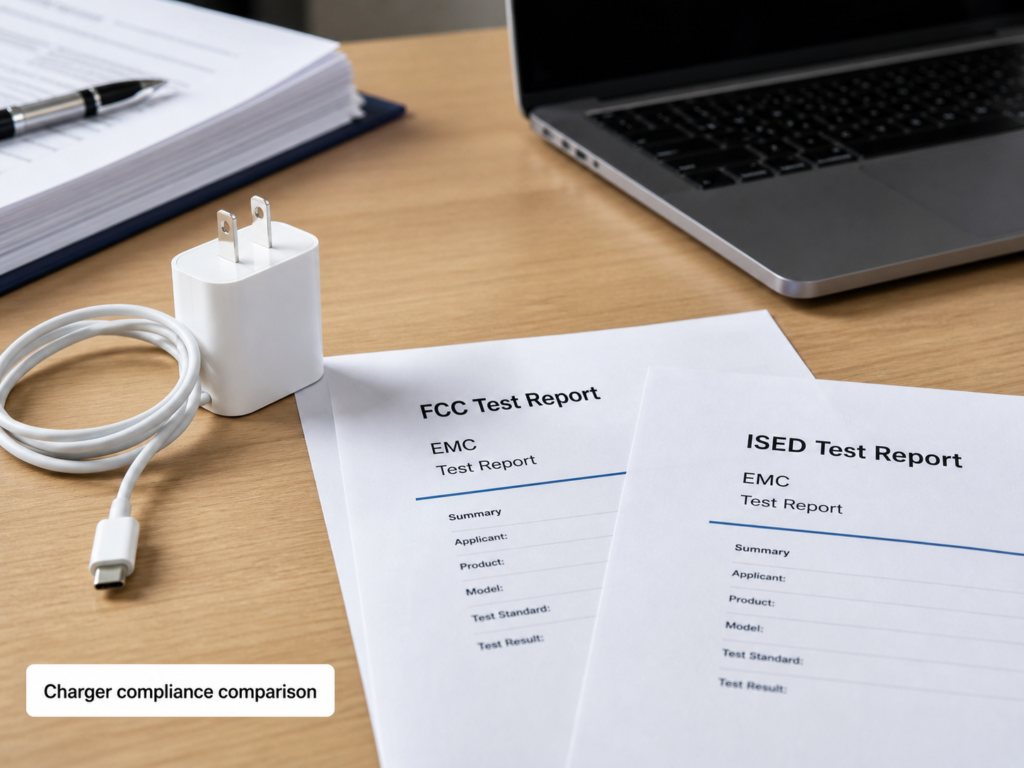
This type of product includes ordinary USB/USB-C chargers, wired power adapters, passive data cables, wired power banks, etc., and is the most common type.
Their corresponding FCC certification is usually SDoC (belonging to the unintentional radiating category, that is, the product does not actively transmit wireless signals when working, only has a small amount of electromagnetic leakage).
Many people think that the rules for all wired charging products are the same, but that is not the case. We must first look at the applicable Canadian EMC standard:
• If it is an independently sold external power adapter, the ICES-001 standard may apply;
• If it is a power supply sold with digital devices (such as mobile phones, tablets), the ICES-003 standard may apply.
The final confirmation must be based on the product’s structure, sales method, and corresponding specific standards, and cannot be generalized.
So can FCC materials be reused? First confirm whether the test methods, versions, configurations, and data in the FCC materials cover the requirements of the applicable Canadian standards; if they can cover, they can be used as technical materials or a basis for difference analysis, and retesting is not necessarily required. For ordinary wired chargers or external power adapters, if subject to applicable ICES standards, they usually fulfill the requirements of test material retention, labeling, and other administrative requirements in accordance with SDoC, and cannot only affix the FCC mark.
Charging Products with Wireless Functions: WPT/Qi and Wireless Communication Must Be Judged Separately
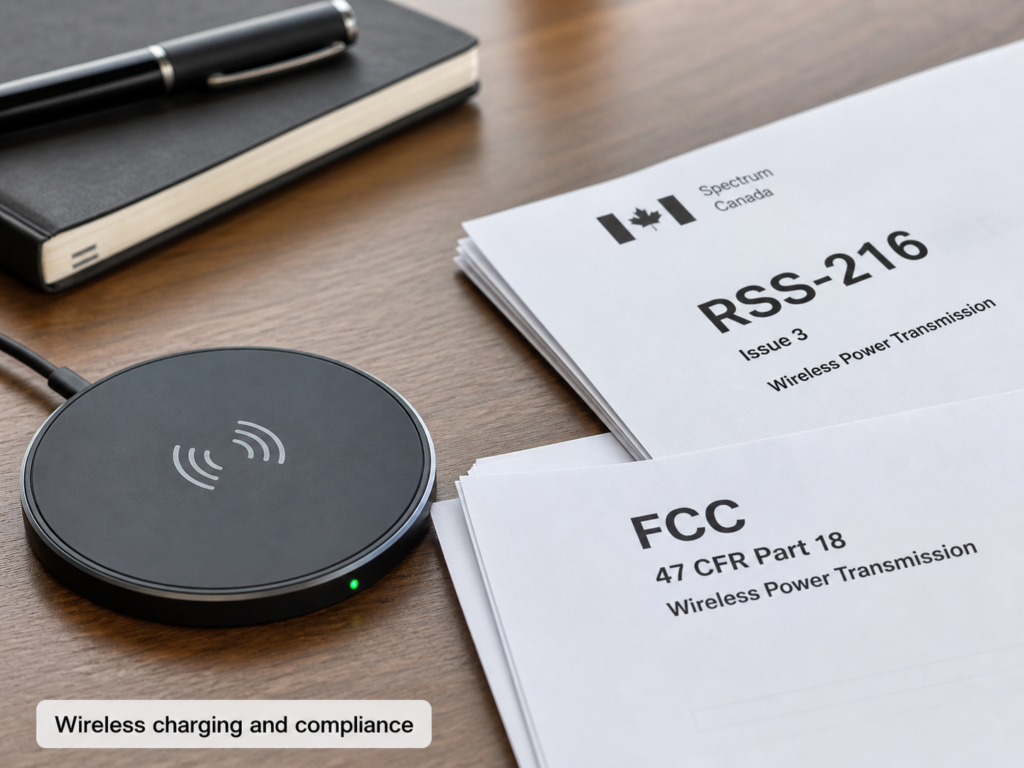
This type of product is slightly more complicated, because charging products with wireless functions may have two different wireless functions: one is wireless power transfer (that is, WPT, such as Qi wireless charging pads, which transmit power through electromagnetic fields), and the other is wireless communication (such as Bluetooth, WiFi, NFC, used to transmit data). These two must be judged separately.
First, let’s talk about wireless power transfer (WPT/Qi) itself, which is subject to Canada’s RSS-216 standard. Type 1, Type 2, and Type 3 in RSS-216 are not divided by power level or whether they are labeled as Qi, but must be determined according to the WPT frequency communication method, basic transmission frequency, radiated emission conditions, and whether alternative limits are used as specified in Section 3.1 of the standard:
• Type 1 and Type 2: Adopt SDoC, exempt from certification and registration;
• Type 3: Must undergo formal certification and be listed in the REL list before sale;
• Specific Qi products should be classified according to their WPT communication and emission test results, and cannot be directly classified as Type 1 or Type 2 just because they are “ordinary low-power Qi charging pads”.
Before verifying compliance in accordance with RSS-216, if the WPT transmission power exceeds 500 W, the transmission distance for electric vehicles exceeds 50 cm, the transmission distance for non-electric vehicles exceeds 20 cm, or the WPT basic frequency exceeds 40 GHz, notification must be given to ISED first and the procedures shall be handled in accordance with the RSP-102 special authorization procedure.
If the product also has wireless communication functions such as Bluetooth, WiFi, NFC, etc., this part must also be judged separately in accordance with the corresponding RSS standards, and cannot be confused with WPT.
The FCC type corresponding to this type of product: Only the WPT part must be judged in accordance with Part 15 and/or Part 18 and specific operating modes; the communication part usually corresponds to FCC formal certification (with FCC ID).
Can FCC materials be reused? FCC materials that meet Canadian applicable standards, test methods, and configuration requirements can be used as technical support, but a difference analysis is required to confirm whether there are any non-conformities with Canadian standards, and products cannot be sold directly with an FCC ID.
There is another common pitfall here: If your complete machine uses a wireless module that has obtained FCC/ISED certification, does the complete machine no longer need certification? No, several conditions must be verified: the certification scope of the module, the type and gain of the antenna used, the installation method of the module, whether there will be co-location interference with other transmitting circuits, and whether the hardware and firmware versions are consistent with those at the time of certification. Only when the host integration requirements of RSS-Gen/RSP-100 are met can the module’s certification materials be reused; otherwise, complete machine testing is still required.
Charging Accessories (Adapters, Connectors, Data Cables)
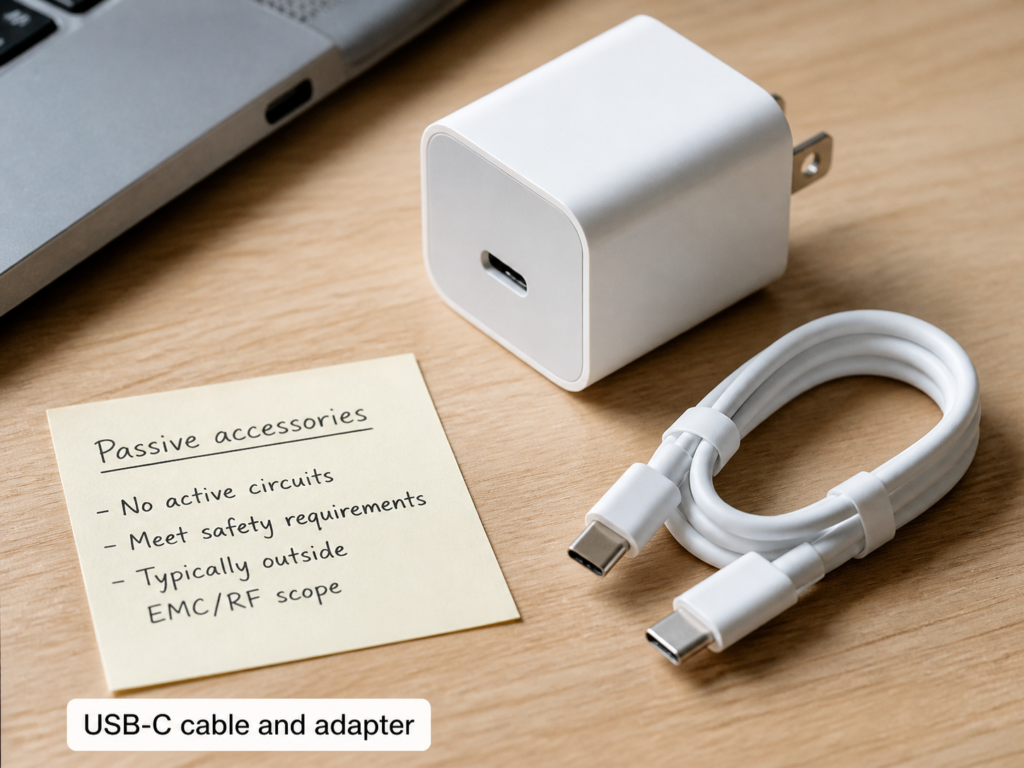
This type of product is small in size and easy to ignore, but not all accessories can be ignored. They are divided into passive and active:
• Passive accessories: That is, those without any active circuits, such as ordinary passive USB-C data cables and adapters without chips, usually do not fall within the EMC/RF regulatory scope of FCC and ISED, as long as they meet safety requirements.
• Active accessories: Those with active circuits inside, such as USB-C cables with E-Marker chips and adapters with conversion circuits, need to be judged whether compliance is required according to circuit type, function, and sales method, and cannot be defaulted to be unregulated.
Here is a supplementary note: Many people confuse the current carrying capacity, overheat protection, and terminal quality of USB-C cables with FCC/ISED compliance. In fact, these belong to the category of safety and quality, and have nothing to do with electromagnetic compatibility/radio frequency access. Don’t mix them up.
5 Necessary Prerequisites for Reusing FCC Materials
We mentioned 4 core conditions earlier, here we expand them into 5 more specific necessary prerequisites, each of which must be clearly verified, otherwise the FCC materials may not be usable:
1. Confirm the Applicable Canadian Standards and Mutual Recognition Scope
First, you need to figure out which ICES (Interference-Causing Equipment Standard) or RSS (Radio Standards Specification) in Canada corresponds to your product, then check the mutual recognition list on the ISED official website to see if this standard is within the coverage of the US-Canada MRA. More importantly, it is necessary to confirm whether existing materials cover the current version, test methods, and product configuration of the applicable Canadian standards; if they are not within the scope of mutual recognition or the materials cannot cover the requirements, the FCC report cannot be directly used as the basis for Canadian compliance.
2. Confirm that the Report/Certification Body Meets Canadian Requirements
Not all bodies that can do FCC certification can directly replace the conformity assessment procedures required by Canada. For items requiring Canadian Certification or DoC, the relevant test laboratories or certification bodies must be within the scope of ISED recognition, and overseas bodies can obtain recognition through the applicable MRA; however, for SDoC of ICES and other Category II devices, regulations do not require that tests must be completed by ISED-recognized laboratories.
Moreover, the report itself must cover all test items required by Canadian standards, and not any random FCC report can be used. If there are differences, a difference analysis is required. The core contents to be verified include: standard version, transmission frequency band, limit requirements, test setup method, power supply mode, antenna parameters, SAR/RF exposure requirements, etc.
3. Ensure that the Product is Consistent with the Coverage of Test Materials
The actual shipping model, key hardware, and firmware version must be within the product scope explicitly covered by existing test reports, SDoC, or certification documents, and must remain continuously compliant with applicable standards.
If key components are replaced later, circuit design is modified, or firmware is upgraded, especially changes that may affect EMC, radio frequency, or RF human exposure, an engineering assessment must be carried out; depending on the device category and the nature of the change, supplementary testing, updating of technical materials, or handling of applicable certification changes may be required, and the original report cannot be defaulted to continue to be used.
4. Complete Canadian Compliance Procedures, Listing, and Labeling Requirements
Even if test materials can be reused, you still need to complete the SDoC, Certification, or DoC process (only applicable when the device is directly connected to the public switched telephone network) in accordance with the system to which the product belongs. Radio equipment that requires formal certification must be listed in the REL before sale.
The labels on the product must also be affixed in accordance with the requirements of the corresponding ICES/RSS standards, and cannot only affix the FCC label, otherwise it will still be non-compliant if inspected.
5. Separately Verify Other Compliance Obligations (Non-EMC/RF Category)
The US-Canada mutual recognition only covers EMC and RF, and other requirements must separately comply with Canadian regulations, mainly including three categories:
• **Safety requirements**: For chargers and power adapters connected to AC mains, it is necessary to confirm whether a recognized Canadian electrical safety certification or on-site assessment is required in accordance with the electrical safety system of the target province or territory of sale or use. It is necessary to verify whether the certification or assessment body is accredited by the SCC (Standards Council of Canada), and whether the product mark explicitly covers Canadian standards, such as the applicable CSA, cUL, or cETL Canadian marks; judgment cannot be made solely based on US certification marks or brand names. Battery-powered products, cables, and low-voltage accessories also need to be verified for applicable safety, transportation, and consumer product requirements.
• **Energy efficiency requirements**: Only some external power adapters and battery chargers fall within the scope of Canadian energy efficiency regulations. You must first judge whether your product is within the scope, and cannot default that all need to be done, nor that none need to be done.
• **Language and consumer information**: Requirements vary by province. You must verify the language requirements for labels, packaging, manuals, and e-commerce pages according to your target sales province. Especially in Quebec, there are special French language rules, and it cannot be assumed that English-French bilingualism meets all requirements.
Common Misconceptions to Avoid
Sellers in the North American market can easily fall into these pitfalls. Let’s explain them one by one:
Misconception 1: Having FCC Certification Means You Can Sell Charging Products in Canada
This is the most common mistake. In essence, it treats “mutual recognition of test materials” as “universal certificates”, and also ignores other compliance requirements such as safety, energy efficiency, and language. The correct approach is: FCC documents cannot directly replace Canadian compliance. Only when test materials and product configuration are sufficient to cover Canadian requirements can they be used as technical materials or a basis for difference analysis, and the applicable Canadian compliance process must still be completed.
Misconception 2: All Wired Charging Products Follow SDoC with Unified Rules
Many people think that wired products are all low-risk and just need SDoC directly, but they actually ignore the impact of product sales methods and applicable standards on the compliance path. For example, independently sold power supplies and bundled sold power supplies may have different applicable standards, and cannot be generalized. Ordinary wired chargers or external power adapters, if subject to applicable ICES standards, usually adopt SDoC; DoC is not a regular path for this type of product.
Misconception 3: Qi Wireless Charging Pads Without Communication Functions Do Not Need ISED Certification
This confuses “wireless communication” with “wireless power transfer”. Even without communication functions such as Bluetooth and WiFi, wireless charging itself must be judged according to the classification of RSS-216. Type 1, Type 2, and Type 3 depend on the WPT communication method, basic transmission frequency, and radiated emission conditions, not on whether it is “ordinary Qi” or the power level; Type 3 WPT devices still require formal certification and listing.
Misconception 4: Using a Certified Wireless Module Means the Complete Machine Does Not Need ISED Certification
Many people think that buying a certified module and installing it is all good, but in fact, the module’s certification is conditional, such as requirements for antenna type, installation method, and firmware version. If the host design changes these conditions, the radio frequency performance may change, and complete machine testing is still required. Only when all integration conditions are verified to be met can the module’s certification be reused.
Misconception 5: Products That Individuals Can Bring Back to Canada Can Be Imported and Sold in Bulk
This confuses the regulatory scenarios of personal self-use and commercial sales. Personal carry-on for self-use and commercial import and sales may be subject to different customs and tax treatments, but not being inspected does not constitute technical compliance exemption. Commercial sales must fully comply with all applicable compliance requirements, and cannot be judged by the standards of personal self-use.
Charging Product Compliance Self-Check Steps (Follow Them to Judge by Yourself)
If you already have FCC certification and want to know if it can be used in Canada, just follow these steps to check:
Step 0: Confirm the Sales Entity and Sales Location
Don’t rush to look at the product, first figure out two basic questions: First, who is the responsible entity? Brand owners, importers, distributors, and e-commerce sellers all need to retain compliance materials and bear corresponding responsibilities. You cannot think that it has nothing to do with you just because the supplier did the certification. Second, where is the target sales province? Language and safety regulatory requirements vary by province; for example, Quebec’s French language requirements are different from those of other provinces.
Step 1: Clarify Product Type and Usage Scenario
First classify the product: Is it for personal self-use or commercial sales? Is it pure wired, with WPT wireless charging, or with wireless communication functions such as Bluetooth/WiFi? Is it an active accessory or a passive accessory? Is it sold independently or bundled with other digital devices? Corresponding to the previous category-based judgment content, first make a preliminary judgment on the applicable ICES/RSS standards and compliance system.
Step 2: Verify Existing FCC Certification and Test Materials
Take out your FCC documents and check these points:
• Certification type: Is it SDoC, or formal certification with FCC ID?
• Applicable standards and configuration: Does the report cover relevant requirements in accordance with the applicable Canadian ICES/RSS standards, current versions, test methods, and actual product configuration?
• Issuing body: If the product requires Canadian Certification or DoC, is the relevant test laboratory or certification body within the scope of ISED recognition? If it is SDoC for ICES or other Category II devices, testing does not have to be completed by an ISED-recognized laboratory;
• Report content: Do the test items in the report cover the relevant requirements of the Canadian standard you intend to apply?
• Consistency: Are the actual shipping model, key hardware, and firmware version within the scope explicitly covered by the report, SDoC, or certification documents?
Step 3: Verify Canadian EMC/RF Compliance Requirements
• Check the scope of mutual recognition: Confirm whether the standard corresponding to your product is in the US-Canada mutual recognition list;
• Verify the compliance path: According to the applicable standard, confirm whether to follow SDoC, Certification, or DoC (only applicable when directly connected to the public switched telephone network), and whether REL listing is required;
• If it is a product with wireless functions and uses a certified wireless module, it is also necessary to verify whether the module’s integration conditions meet the host requirements.
Step 4: Verify Other Compliance Requirements
In addition to EMC/RF, you also need to check requirements such as safety, energy efficiency, and language, which have been mentioned earlier and will not be repeated here.
Step 5: Inquiry Channels When Uncertain
If you are not sure, don’t guess randomly. Find official or formal third-party channels to verify:
• Official channels: The certification database and mutual recognition list on the ISED official website, and the mutual recognition page on the FCC official website;
• Third-party channels: Formal certification bodies with corresponding Canadian recognition scopes. Note that you should find reliable ones, not small intermediaries that dare to promise anything.
Summary
Finally, we will sort out the most common situations and core principles again for your quick judgment:
Common Situations That Can Be Directly Confirmed
1. Ordinary passive data cables and adapters without circuits: Usually do not fall within the EMC/RF regulatory scope of FCC/ISED, as long as they meet safety requirements;
2. Ordinary wired charging products: If the test data, product configuration, and standard version of the existing FCC report can cover the applicable Canadian standards, they can be used as technical materials or a basis for difference analysis, and retesting is not necessarily required;
3. Charging products with only Type 1/2 WPT: Do not need an ISED ID, just do SDoC in accordance with the corresponding standard; but whether they specifically belong to Type 1/2 must be judged according to the classification conditions of RSS-216, and cannot be determined solely by “ordinary Qi” or low power;
4. Charging products with communication functions such as Bluetooth and WiFi: Cannot be sold directly with FCC ID, and need to apply for Canadian certification after evaluation;
5. Personal carry-on for self-use and commercial sales are different scenarios, but not being inspected does not equal obtaining technical compliance exemption; commercial sales must be fully compliant.
Situations That Require Further Verification
1. Products with WPT transmission power exceeding 500 W, transmission distance for electric vehicles exceeding 50 cm, transmission distance for non-electric vehicles exceeding 20 cm, or WPT basic frequency exceeding 40 GHz;
2. Complete machine products using certified wireless modules;
3. Power adapters sold with digital devices;
4. Old FCC materials with unclear issuing body qualifications and incomplete report content;
5. Customized or special industry charging products.
Core Principles
1. The US and Canada have mutual recognition of EMC/RF conformity assessment results, not direct universal use of FCC certificates;
2. Requirements other than EMC/RF such as electrical safety, energy efficiency, and language need to separately comply with Canadian regulations;
3. Compliance judgment must be based on the applicable standards of the product, sales scenarios, and qualification documents, and cannot be generalized based on experience.
High-Frequency FAQ
Can FCC ID Replace ISED Certification?
No. FCC ID is a formal US certification number. Canada has its own radio certification requirements. After evaluation in accordance with the corresponding RSS standards, you need to apply for a Canadian ISED ID (if applicable), and you cannot sell in Canada directly with an FCC ID.
Do Qi Wireless Chargers Definitely Need an ISED ID?
Not necessarily. Type 1 and Type 2 WPT products do not need an ISED ID, just do SDoC as required; Type 3 WPT products need an ISED ID. For Qi chargers with wireless communication functions such as Bluetooth and WiFi, their communication part also needs to be judged according to the corresponding RSS standards. It should be noted that Type 1, Type 2, and Type 3 must be classified according to the communication and emission conditions specified in RSS-216, and cannot be judged solely based on the “Qi” name or power level.
Can US FCC Reports Be Used in Canada?
Existing FCC reports can be used as technical materials or a basis for difference analysis for Canadian compliance, but first confirm: First, whether the test data, methods, standard version, and product configuration of the report cover the applicable Canadian standards; second, if Canadian Certification or DoC is applicable, whether the relevant laboratory or certification body is within the scope of ISED recognition; third, whether the actual shipping version is covered by existing test materials, SDoC, or certification documents. The MRA does not make FCC reports automatically become Canadian compliance documents.
What Else Is Needed for a Charger with FCC Certification to Be Sold in Canada?
The following things still need to be completed: First, complete the applicable EMC/RF compliance process in accordance with Canadian requirements, such as SDoC or formal certification; second, for products connected to mains electricity, confirm whether an electrical safety certification or on-site assessment mark issued by a recognized body and explicitly covering Canadian standards is required in accordance with the rules of the target province or territory of sale or use; third, if the product falls within the scope of Canadian energy efficiency regulations, it must also meet energy efficiency requirements; fourth, meet the regulations on language labels, consumer information, etc. in accordance with the requirements of the target sales province.