
Sellers of charging products targeting the Canadian market, or people shopping for wall chargers locally, have most likely come across the two certification marks CSA and cUL. Many people wonder: are they the same thing? Can they replace each other? Which is more authoritative? We will put the core conclusions first, then break down the details step by step, to help you recognize, verify, and choose correctly.
Here are two most practical quick conclusions: First, consumer electrical products that connect directly to the mains, such as wall chargers and external power adapters, usually need to bear a safety certification mark applicable to Canada for terminal sale or installation in Canada; Second, specific requirements are always subject to the regulations of the place of sale/installation, product use, and customer or platform rules — there is no absolute statement that “products with certification can definitely be sold.”
The Standards Council of Canada (SCC) is Canada’s national accreditation body, which provides accreditation to eligible conformity assessment bodies; certification bodies such as CSA Group and UL Solutions can carry out product certification within their accredited scopes. Whether the CSA or UL Canada mark is accepted by the place of sale or installation shall also be confirmed in accordance with the rules of the local competent authority. These certifications usually apply to consumer electrical products that connect directly to the mains, such as wall chargers and external power adapters.
The core essential difference is actually very simple: CSA is a certification mark issued by the Canadian local institution CSA Group that meets Canadian safety standards. It is not the only statutory certification in Canada, and many other SCC-accredited bodies can also issue compliance certifications. cUL is a UL certification mark specifically for the Canadian market under the US UL Solutions system, which is a common abbreviation in the market, and its mark style has differences between old and new versions. The Canadian geographic indication is one of the clues to judge Canadian coverage, but it is also necessary to verify the mark type, product or model, listing subject and certification records. You cannot judge that the certification is valid or that it is a whole-unit certification solely based on the presence of a Canadian indication.
As for whether they can replace each other? There is no official difference in safety level between the CSA Canada mark and the UL Canada mark, but you cannot conclude that they are interchangeable solely based on a few superficial conditions. It is also necessary to confirm whether the certification body and its product scope are accepted by the local authority, the specific listing and model scope, applicable standards and locally adopted versions, installation purposes, as well as the requirements of local competent authorities, customers or platforms. The judgment framework will be explained in detail later.
Comparison of Core Dimensions (Taking Consumer-Grade Wall Chargers as an Example
Next, we will compare the core dimensions that everyone is most concerned about, using ordinary consumer-grade wall-mounted USB-C chargers and external power adapters of 65W and below as unified samples. The premise of the comparison is that both are Canada-wide whole-unit safety certifications, excluding certifications for special industries such as components, medical, and industrial. The conclusions only apply to products of the same category and same applicable standards, and special situations shall be subject to actual certification records.
Issuing Body and Brand Background
CSA is issued by the local Canadian CSA Group, and is more familiar to local consumers and established offline supermarkets. For example, some local Canadian chain supermarkets and government projects may be more accustomed to seeing the CSA mark. cUL is issued by the US UL Solutions system, which has higher global recognition and is more commonly used by cross-border practitioners with global multi-market layouts.
What the two have in common is: within their accredited product certification scopes, there is no official difference in the level of compliance access effectiveness; it is not that CSA is higher-level than cUL.
Exception: Local Canadian government projects and some established offline supermarkets may have institutional preferences, such as specifying CSA certification. In this case, it is necessary to confirm in advance and cannot replace it on your own.
Applicable Regions and Coverage Scope
In terms of single-market versions, both the CSA Canada version and the cUL Canada version correspond to the Canadian scope, but they do not automatically cover all provinces, all projects, and all installation scenarios. For example, some provinces have different local regulations, or a project has additional requirements, so it is still necessary to verify in advance.
In terms of dual-market versions, both CSA C/US and cULus can cover the applicable standards of the United States and Canada at the same time. If you target both markets, choosing the dual-scope version is more cost-effective.
What the two have in common is: both are marks that can be used for product certification in the Canadian scope, but whether they are accepted by the specific place of sale or installation still depends on local rules.
Exception: Local competent authorities, bidding documents or retailers may put forward additional requirements, which need to be verified in advance.
Core Framework for Interchangeability Judgment
Many people ask “can cUL replace CSA?” The answer is: there is no official difference in safety level between the two, but you cannot directly conclude that they are interchangeable in most scenarios solely based on the same product category, same standard, same certification level, and same geographic scope. In actual judgment, the following situations should be confirmed item by item:
1. **Whether the certification body and product scope are accepted by the local authority**: It depends on whether the certification body can carry out accepted certification for the product scope locally.
2. **Whether the mark and certification level apply to the whole unit**: For example, both are wall-mounted USB-C chargers with whole-unit certification; component certification cannot replace whole-unit certification.
3. **Whether the model, structure and certification category are listed**: The certification record shall cover the specific model and corresponding product category being sold or installed.
4. **Applicable standards and locally adopted versions**: For example, the product may involve CAN/CSA-C22.2 No. 62368-1, but different standard versions are not necessarily unacceptable; it also depends on the version adopted by local regulations, transition arrangements and certification records.
5. **Installation purpose and additional requirements**: Local competent authorities, installation specifications, customers, projects or platforms may have additional requirements.
Therefore, there is no question of which is higher-level between CSA and cUL, but whether they can be used depends on actual certification records and specific scenarios, not just the mark name.
Exception: Special products such as medical-grade and industrial-grade products apply different standards and cannot be directly compared.
Mark Style and Common Locations
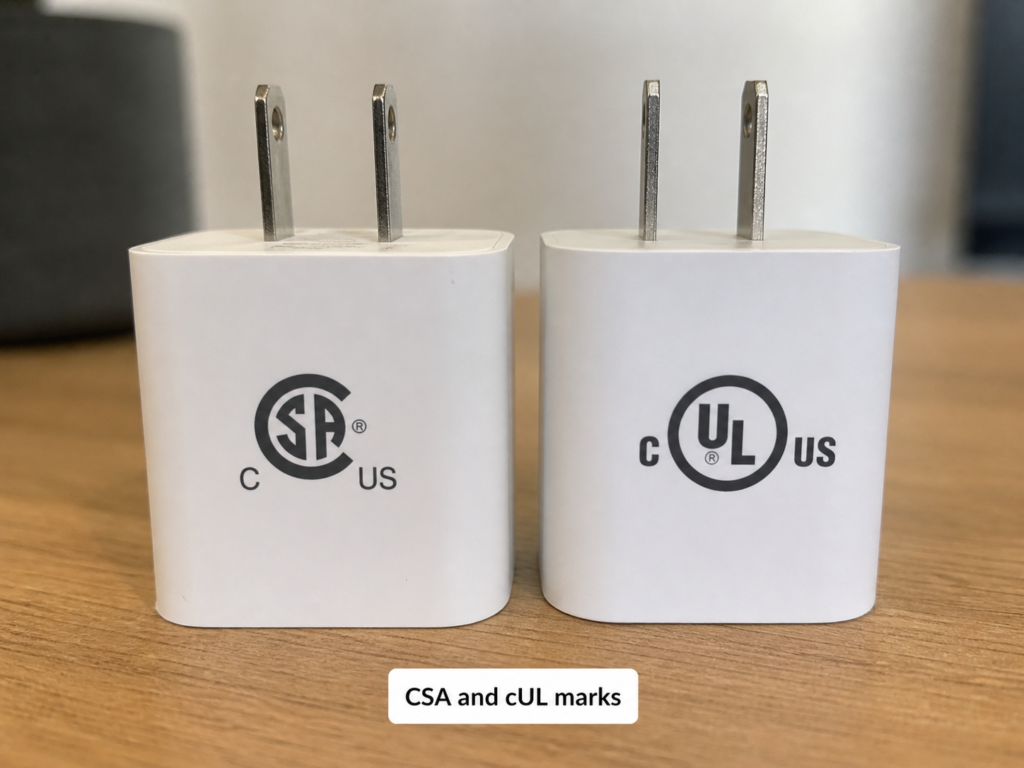
The core of the CSA mark is a circular mark with the word “CSA”, accompanied by listing information and regional identification. For example, with C/US means dual scope of the United States and Canada.
The core of the cUL mark is the classic UL mark, accompanied by a Canadian scope indication (such as the letters c, CA). There are differences between old and new styles: the old version usually has a small c on the left side of the UL circle, and the new version may have a clearer regional label. The Canadian scope indication only indicates a clue of geographic coverage; it is still necessary to further confirm whether it is Listed, Recognized or another certification type, and whether it corresponds to the specific product.
In terms of common locations, the certification mark of a charger is generally on the body nameplate or the side of the plug pins. The listing information of detachable AC power cords is usually embossed on the cord body, and may also be on labels, hang tags, packaging or accompanying documents.
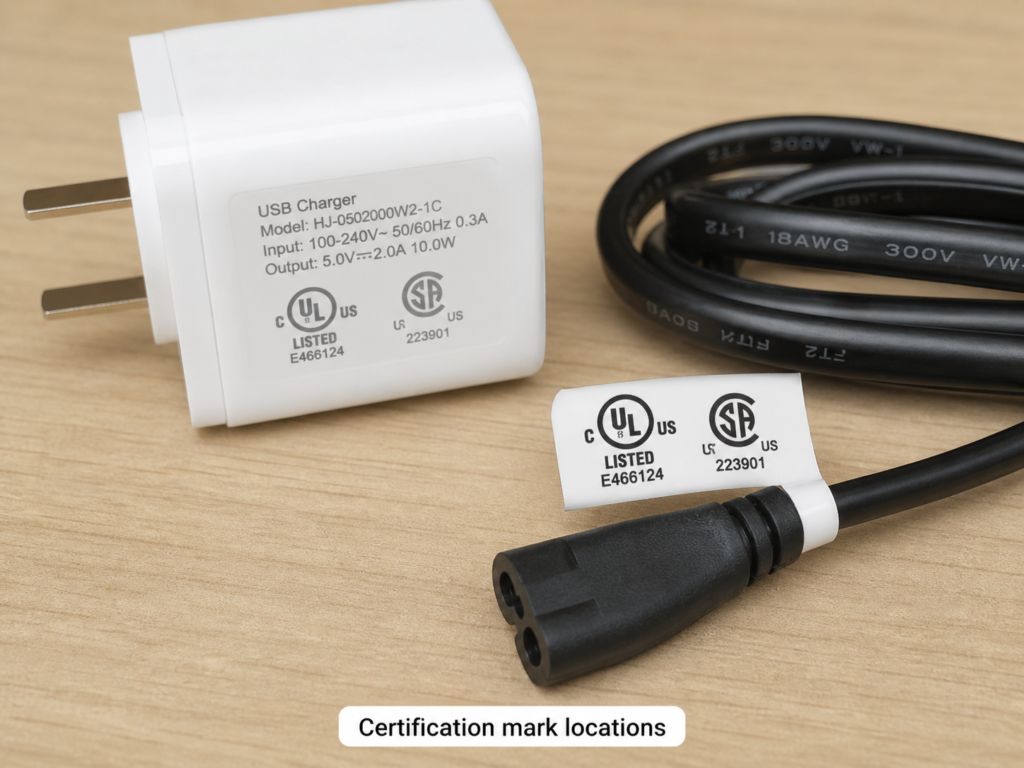
Exception: If the mark is blurry or the information does not match the certification record, both CSA and cUL need to be verified for authenticity, regardless of the issuing body.
Certification Inquiry Channels
To check CSA certification, log in to the certification database on the official website of CSA Group and enter the product model or listing number to query.
To check cUL certification, log in to the Product iQ database on the official website of UL Solutions to query.
No matter which one you check, you should pay attention to verifying whether the product category, model, and manufacturer match; you cannot assume it is correct just by looking at the listing number.
Project Cycle and Cost Influencing Factors
Many people ask “which is more expensive and which is faster between CSA and cUL?” In fact, there is no fixed and unified cycle and cost; both are subject to the written evaluation of the certification body for specific models. Do not believe absolute statements like “CSA must be more expensive than cUL” that are spread online.
Common influencing factors include: whether there is an existing test report, whether key components already have compliance certification, whether the sample needs rectification, factory follow-up service requirements, whether to apply for dual-market certification, etc.
For products that already have US UL certification, if you supplement the Canadian scope certification, a lot of test data can be reused, and the cycle and cost will be lower. The specific situation shall still be subject to the evaluation of the certification body.
Common Misconceptions and Pitfalls
Let’s talk about a few pitfalls that people are most likely to fall into, so you don’t get misled.
Misconception 1: cUL is a US certification, and CSA can only be used in Canada
Correction: cUL is a certification specifically for the Canadian market under the UL system. It is independent of US UL, uses Canadian safety standards, and is not a US certification. CSA can also issue the CSA C/US mark with dual scope for the US and Canada, covering applicable US standards at the same time, so it is not only usable in Canada.
For example: a 65W charger with the cULus mark, even if issued by UL, meets Canadian requirements, but before sale, you still need to verify the model, category, label and local/platform requirements; you cannot say that with cULus it can definitely be sold.
Misconception 2: CSA is safer and has a higher certification level than cUL
Correction: Both are certification marks usable within Canada, and there is no official level difference when the actual applicable conditions are met. Certification effectiveness is related to whether the certification body is accepted by the local authority, applicable standards, product scope, certification level, and listing status, etc., and cannot be judged solely by the name of the issuing body.
Tip: Do not judge safety solely by the certification body’s brand; you should verify the matching degree between the certification and the product. For example, a component-level certification with the CSA mark is not as reliable as a whole-unit certification of cUL.
Misconception 3: Fast charging cables with E-Marker must have CSA/cUL certification
Correction: Independently sold USB data cables do not connect directly to the mains, and there is no unified mandatory certification requirement in Canada, which shall be confirmed according to scenarios and local rules. E-Marker is an identification device or mechanism in USB-C electronically marked cables, used to report cable capabilities and characteristics to connected devices, such as allowable current, voltage capabilities and some data capabilities; it is not equivalent to Canadian electrical safety certification, nor can it alone prove that the cable is safe or compliant in performance.
Tip: AC power cords/cord sets that connect to the mains usually require separate safety certification; don’t confuse them.
Misconception 4: Products with CSA/cUL marks are fully compliant good products
Correction: The mark only means that electrical safety meets the corresponding standards. First of all, you must verify whether the certification scope matches the product to avoid problems such as fraudulent use of certification and authorization termination. Moreover, safety certification does not represent performance indicators such as charging speed, durability, and protocol compatibility. For example, a 65W charger with the CSA mark may not support your phone’s fast charging protocol, which has nothing to do with safety certification.
Supplement: The wireless power transmission function of wireless chargers does not uniformly require ISED certification; compliance obligations shall be evaluated in accordance with the RSS-216 standard. Don’t think that having safety certification means full compliance.
Compliance Notes Beyond Certification
Finally, we would like to remind everyone that safety certification is only part of compliance, not the whole.
Product Performance Not Covered by Safety Certification
Both CSA and cUL are electrical safety certifications, which only cover safety risks such as electric shock and fire. They do not represent performance indicators such as compatibility with fast charging protocols like USB-PD/QC, actual charging power, service life, and durability. These need to be checked separately in the product parameter descriptions, and have nothing to do with safety certification. Don’t think that having certification means it must be fast charging.
Other Possibly Involved Compliance Requirements
• Products with radio frequency functions such as wireless charging, Bluetooth/Wi-Fi: Applicable requirements shall be determined according to the actual wireless technology, operating frequency band, transmission function, and module/host combination. Bluetooth and most 2.4GHz or 5GHz Wi-Fi usually involve RSS-247; indoor 6GHz Wi-Fi/RLAN involves RSS-248; RSS-Gen and other possibly applicable standards shall also be considered at the same time.
• External power adapters: May also involve independent compliance requirements such as energy efficiency labels, bilingual labels (English + French), and plug specifications. AC plugs, detachable power cords and cord sets shall apply corresponding standards according to their specific structures. For example, general-purpose attachment plugs usually involve CSA C22.2 No. 42, flexible power cord bodies involve CSA C22.2 No. 49, and molded plugs or cord sets may also involve CSA C22.2 No. 21. Do not generally interpret No. 49 as a plug standard.
• Specific requirements depend on product category, sales province, and platform rules; not all products are the same.
In general, the core difference between CSA and cUL is that the issuing bodies are different, and there is no official difference in safety level between the two in Canada. For ordinary users and small and medium-sized sellers, as long as you master these core capabilities, it is enough to meet daily shopping and compliance needs: being able to accurately identify CSA, cUL and related derivative marks, and quickly eliminate invalid proofs that are non-Canadian scope, component-level, or self-declared by manufacturers; being able to verify the authenticity of certification through official databases, understand the troubleshooting logic when it cannot be found, and not mistakenly take the certificate issuance date as a unified expiration date or mistakenly believe that certification is permanently valid; being able to judge whether CSA and cUL are acceptable by combining whether the certification body and product scope are accepted by the local authority, certification type, specific model, applicable standards, installation purpose and local requirements; being able to choose charging product certification with the corresponding geographic scope according to your own use or sales scenarios; being able to distinguish the boundaries between safety certification and other requirements such as product performance and radio compliance; and being able to clarify the relationship between the four levels: certification body, mark, standard, and local final approval, so as not to be misled by one-sided publicity.