
If you are a merchant or purchaser of charging products operating in the Canadian market, or an ordinary consumer who wants to confirm whether the charging products you own meet energy efficiency requirements, this content is just for you. It should be noted first: this article only discusses NRCan energy efficiency requirements at the Canadian federal level, and does not cover the full process of electrical safety certification in each province; safety-related requirements need to be checked against local rules separately.
Basic Knowledge: First Understand the Core Common Sense of NRCan Energy Efficiency
Before diving into determination, let’s clarify a few most easily confused concepts to avoid detours later.
What Exactly is NRCan?
The full name of NRCan is Natural Resources Canada, which is the official federal agency responsible for energy efficiency regulation in Canada. Energy efficiency requirements are **mandatory market access regulations**, with the core goal of reducing product standby power consumption and improving energy utilization efficiency; they are not voluntary energy-saving labels that can be affixed or not at will.
Assessment Logic for Two Categories of Regulated Products (Cannot Be Mixed Up)
Canadian federal energy efficiency regulations divide charging-related regulated products into two major categories, with completely different assessment indicators; they must never be confused:
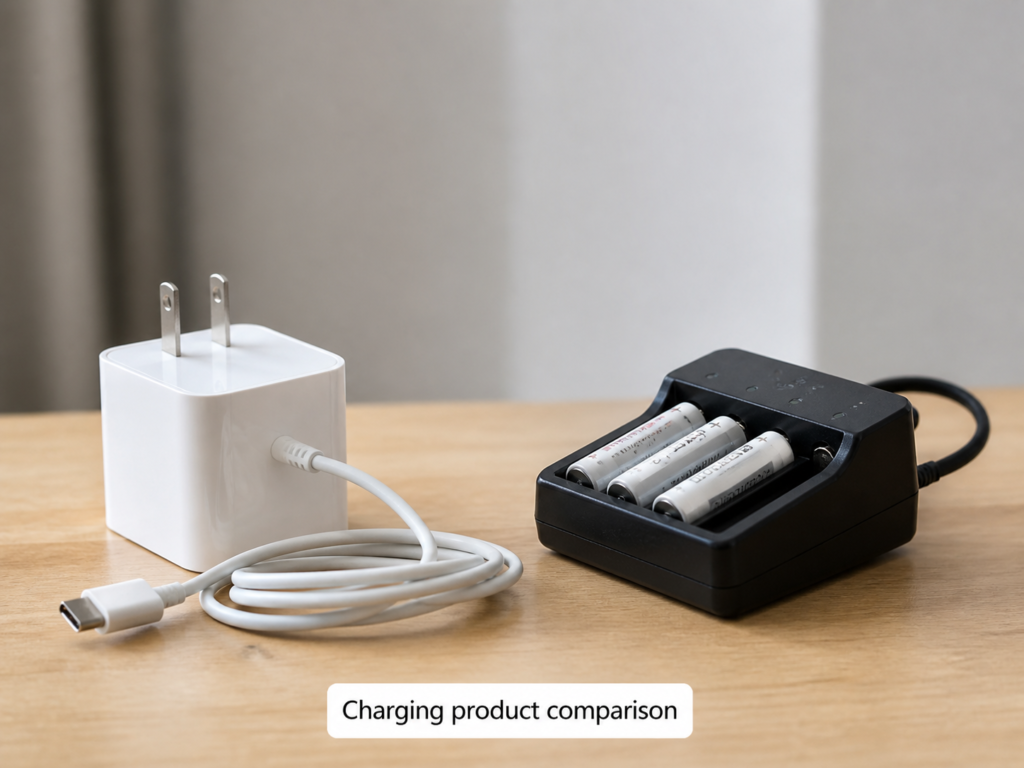
• **External Power Supply (EPS for short, commonly known as charging heads, power adapters)**: The core assessment covers two indicators: one is **standby power consumption** — when plugged into a wall socket with no load, power consumption must not exceed the specified threshold; the other is **average conversion efficiency** — when charging, the ratio of alternating current (AC) to direct current (DC) conversion must not be lower than the specified value, and excessive power waste is not allowed.
• **Battery Charger (BC for short)**: Refers to a device used to charge rechargeable batteries of end products. Whether it has an external structure or uses AC mains input is not a necessary condition for the definition of a BC. Its core assessment covers **Unit Energy Consumption (UEC)**, as well as energy consumption/power consumption in different states such as operation, maintenance, and standby. The specific limits shall be determined according to product category, manufacturing date, and regulation version, and cannot be applied across categories.
Most Commonly Confused Boundaries
This is the area where novice users make the most mistakes, so we will clarify it all at once:
1. NRCan Energy Efficiency vs Electrical Safety Certification
They are completely different matters: NRCan regulates “whether it saves electricity”, which is a federal mandatory requirement; electrical safety regulates “whether there is a risk of electric shock or fire”, which is under the jurisdiction of each province/territory. cUL, CSA, and ETL are common safety certification pathways. The two are independent of each other and cannot replace each other. The vast majority of plug-in charging power supplies need to meet both types of requirements. Safety certification marks cannot be used as proof of NRCan energy efficiency compliance, and safety access requirements in each province need to be checked separately against the rules of the local Authority Having Jurisdiction (AHJ).
2. Differences Between Common Energy Efficiency Labels
There are many energy-saving labels on the market, but not all of them can be used as proof of NRCan compliance:
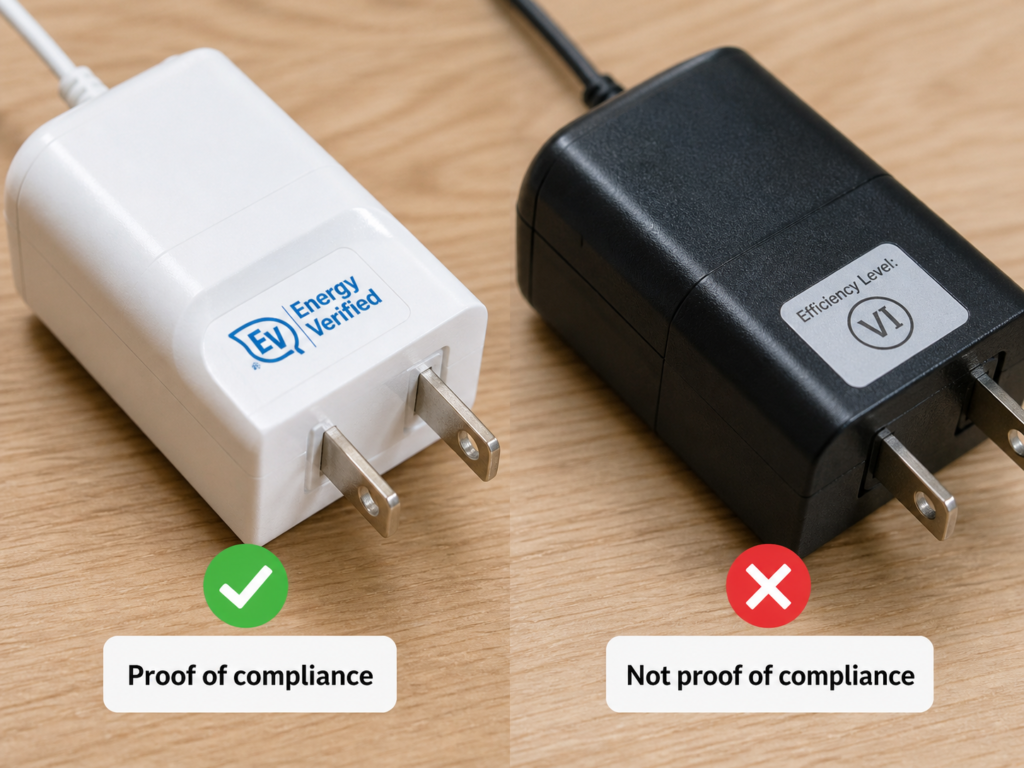
• **Energy Efficiency Verification Mark**: Can be issued by a certification body accredited by the Standards Council of Canada (SCC for short) that operates an energy efficiency certification program for this product; for provinces with energy efficiency standards equal to or higher than federal standards, provincial verification marks may also be accepted, and are one of the important proofs of compliance.
• **Roman Numeral Efficiency Mark (such as Level VI)**: Is only a label of efficiency grade, not an inherent proof of compliance; only external power supply (EPS) products may be eligible for an exception.
• **ENERGY STAR Canada**: Cannot replace NRCan mandatory energy efficiency requirements; moreover, ENERGY STAR Canada currently does not cover external power supplies (EPS) or adapters themselves. Whether other charging-related products fall under ENERGY STAR certifiable categories needs to be confirmed according to the current product categories of the program.
• **EnerGuide**: An energy efficiency label for specific large household appliances, not applicable to ordinary charging power supplies.
3. Canadian NRCan vs US DOE Energy Efficiency
The US DOE (Department of Energy) is the energy efficiency regulatory agency of the United States. Although the test methods for external power supplies are similar to those of NRCan, the compliance systems of the two countries are completely independent and not interoperable; US DOE compliance is not directly equivalent to NRCan compliance.
How to Accurately Check Regulations?
The core reference documents are NRCan’s official **Regulated Product List** and the . The applicable version is based on the effective regulation corresponding to the **product manufacturing date**, not the sales date. If you encounter ambiguous boundary cases, first check the official definition; if you are unsure, you can consult an SCC-accredited certification body, or directly contact NRCan official for confirmation.
Core NRCan Compliance Requirements for Regulated Products
Many people think that “completing a test counts as compliance”, but in fact, the complete compliance chain has 6 steps, and testing is only one of them.
Complete Compliance Chain (6 Steps, Testing ≠ Verification)
1. **Category Determination and Rule Confirmation**: First confirm the product classification and applicable regulation version; if the classification is wrong, all subsequent work will be in vain.
2. **Energy Efficiency Testing**: Complete testing in accordance with the test procedures specified in the regulations to obtain energy efficiency test data.
3. **Third-Party Verification**: Energy efficiency verification shall be completed by a certification body accredited by the SCC that operates an energy efficiency certification program for this product; where applicable, a qualified provincial verification mark pathway may also be used, and testing by any random laboratory does not count.
4. **Energy Efficiency Report and Import Documentation Processing**: Confirm whether the model is listed in the NRCan database; if not, submit the energy efficiency report as required. When importing, provide the required information in the release declaration as required by the CBSA (Canada Border Services Agency).
5. **Affixing of Labels**: Affix the corresponding energy efficiency label in accordance with product category rules, which shall usually be completed before the product or the distributor/consignee transfers possession of the product.
6. **Record Keeping**: Keep relevant files of product consistency and change assessment for random inspection.
Special attention should be paid here: **NRCan itself does not issue certification certificates**. Energy efficiency verification marks may be issued by qualified certification bodies, or by eligible provinces where applicable.
Core Documents to Prepare for Two Categories of Products
• **EPS products**: Output voltage, rated output power, single/multi-output type, average conversion efficiency, no-load power consumption test value, third-party or applicable provincial verification mark information, Roman numeral efficiency grade (if applicable), brand, full model number, manufacturer information.
• **BC products**: Product category, compatible battery type, battery rated energy, Unit Energy Consumption (UEC) test value, power consumption/energy consumption test values for each mode required by regulations, information of the certification body or applicable provincial verification mark issuer, brand, full model number.
Labeling Rules: Applicable Boundaries Between Verification Marks and Level VI
Labeling is the most error-prone part, and the requirements for the two categories of products are completely different:
• **BC products**: The Roman numeral efficiency mark replacement rule for EPS products shall not be used. Their verification mark may be issued by a certification body accredited by the SCC that operates an energy efficiency certification program for this product, or by a province whose energy efficiency standards are equal to or higher than federal standards.
• **Exception for EPS products**: Products that meet all three of the following conditions may be exempted from affixing a special energy efficiency verification mark, and may use a Roman numeral efficiency mark (such as Level VI) instead:
1. The product bears an internationally accepted Roman numeral efficiency mark
2. The energy efficiency data of this model has been verified by a certification body and submitted to NRCan
3. The actual model of the product is completely consistent with the verified and reported model
Please remember: **The Level VI mark printed on the product alone cannot prove compliance with NRCan energy efficiency requirements at all**; this exception only applies when third-party verification and applicable document submission have been completed simultaneously.
Compliance Document Retention Requirements
Compliance is not a one-and-done task; relevant documents need to be retained for customs and market random inspections:
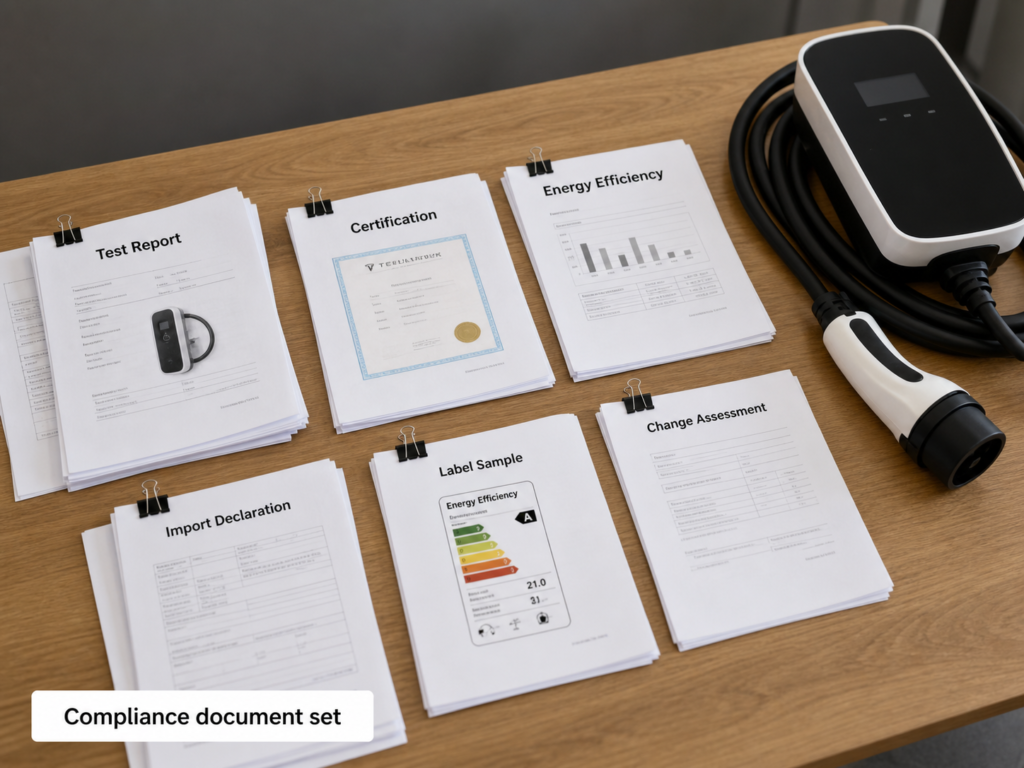
• Core retained documents include: third-party test reports, certification or applicable provincial verification certificates, applicable energy efficiency report submission records or database records, import declaration documents, product label samples, and change assessment records.
• Product model and parameters must be completely consistent with the reported information; similar appearance does not mean compliance can be shared.
• If making external performance claims such as “energy saving”, “high efficiency”, or specific power saving effects, it shall be ensured that the claims are true and not misleading, and where applicable, there are sufficient and appropriate tests or other corresponding evidence completed before the claim. Such requirements mainly fall under the scope of Canadian competition law and advertising compliance, and shall not be regarded as NRCan document retention rules.
• The retention period shall be subject to current regulations, and needs to meet the audit requirements of customs and market random inspections.
Responsible Parties, Action Sequence and Change Management
• **Responsibilities of each party**: Canadian importers/distributors are the first responsible parties for compliance, responsible for applicable reports, import declarations and product consistency control; manufacturers need to provide complete and accurate product technical documents and cooperate with testing and verification; third-party certification bodies complete verification in accordance with Canadian standards and issue legal and valid certificates; brand owners shall ensure that the model and parameters of products on sale are consistent with the verification or declaration information.
• **Sequence of compliance actions**: First confirm product classification and applicable rules → then conduct energy efficiency testing and certification body verification → confirm whether an energy efficiency report needs to be submitted and complete the documents required for import declaration → affix labels at the applicable time and arrange for distribution. The statutory time points for energy efficiency reports, import declarations and labeling are not exactly the same, and cannot be simply combined into “all actions must be completed before import”.
• **Change management**: Not all product changes require full retesting, but a change assessment must be conducted first — if the change affects the verified model, rated parameters, energy efficiency data, applicable product category or label correspondence, the corresponding process needs to be repeated. High-risk change points include: port combination, output rating, hardware version, model number, consistency between brand and label model.
How to Verify Whether a Product’s NRCan Energy Efficiency is Compliant?
People with different identities can perform different levels of verification, so we will explain them separately.
Limited Verification for Ordinary Consumers
Ordinary consumers cannot obtain complete compliance files, and can only conduct preliminary verification:
1. **Check the label**: Check whether there is a Canadian-recognized energy efficiency verification mark on the product or packaging, or an EPS Roman numeral efficiency mark that meets the exception conditions.
2. **Check the public database**: Log in to NRCan’s official public product database for auxiliary verification.
Here we need to clarify the correct usage and boundaries of database queries to avoid misuse:
• Cross-comparison must be done using brand, full model number, and rated input/output parameters; you cannot only search for product names
• Database results are only for auxiliary verification, and cannot replace certification body certificates, physical product model verification, and importers’ compliance files
• Not finding a result does not necessarily mean non-compliance; it may be due to delayed reporting updates or differences in model naming
• Even if a result is found, you must verify the model, brand, rated parameters and document validity to avoid misattribution
• The public scope and update mechanism of the database may change, and everything shall be subject to the latest official NRCan rules
Complete Evidence Chain Verification for Merchants/Purchasers
If you are a merchant or purchaser and need to verify whether a supplier’s products are truly compliant, you need to check the evidence of four links:
1. **Test report**: Model, parameters, port configuration, and hardware version are completely consistent with the actual shipped products
2. **Verification certificate**: The certification body’s qualification is accredited by the SCC and applicable to this product, or the verification mark is from an eligible province, and the scope of application of the mark meets Canadian requirements
3. **Report submission or database records**: Confirm that the brand, model, and rated parameters in the NRCan database match the product; where applicable, also check the energy efficiency report submission documents
4. **Change records**: After product revision, confirm whether compliance documents have been re-evaluated and updated
4 Types of Materials That Cannot Be Used as Compliance Proof
There are several types of materials that suppliers often use to mislead people, so don’t take them seriously:
1. Energy efficiency certifications from other countries (such as US DOE, EU ERP)
2. Electrical safety certification reports (such as cUL, CSA, ETL)
3. Standalone Roman numeral efficiency marks that do not meet the three EPS exception conditions (such as only a Level VI mark printed)
4. Self-issued declarations of conformity by suppliers without third-party verification
Pitfall Avoidance Guide: Common Misconceptions and Non-Compliance Risks
Actual Risks of Non-Compliance
• For distributors/importers, it is prohibited to import or circulate non-compliant products across provinces for the purpose of sale/lease; once found, they will face compliance penalties and the products may be detained.
• For ordinary consumers, there is no direct legal risk, but they may buy products with high standby power consumption and low conversion efficiency, which wastes electricity bills in the long run.
Clarification of 10 Common Cognitive Misconceptions
We have sorted out the most common pitfalls to help you avoid them:
1. **Misconception: Only high-power power supplies need compliance** → Wrong: Low-power charging heads need compliance as long as they fall under regulated EPS/BC; for example, a 20W mobile phone charging head may also need compliance.
2. **Misconception: All products with USB ports need compliance** → Wrong: Passive cables, passive hubs, etc. that do not have AC-DC conversion functions are not within the regulated scope.
3. **Misconception: Adapters in sets do not need separate compliance** → Wrong: Detachable external power supplies need to meet requirements separately, even if they are sold as part of a set with a mobile phone or laptop.
4. **Misconception: All car chargers are not regulated** → Wrong: Car chargers with only DC input usually do not fall under EPS; but BC cannot be excluded just because of DC input, and judgment still needs to be made based on the BC definition and exclusions. Dual-use home/car chargers with AC plugs also need separate assessment.
5. **Misconception: All power banks are not regulated** → Wrong: Energy storage power banks without AC input usually do not fall under EPS, but the charging function of their built-in batteries cannot exclude BC just because there is no AC input; judgment still needs to be made based on the BC definition, exclusions, manufacturing date and applicable product category; for power banks with built-in AC plugs, it is also necessary to assess whether their AC-DC part falls under regulated EPS.
6. **Misconception: Having safety/ENERGY STAR/US DOE certification equals meeting NRCan requirements** → Wrong: These all belong to different systems and cannot directly replace NRCan energy efficiency requirements.
7. **Misconception: Small cross-border e-commerce packages will not be randomly inspected** → Wrong: Commercial direct mail or FBA warehousing may constitute commercial import, and the specific responsible party needs to be confirmed based on the import record subject and transaction arrangement. Regulated products shall be declared truthfully and meet applicable requirements; CBSA and NRCan may verify import documents and carry out compliance enforcement, and it cannot be assumed that small packages are inherently exempt from regulation.
8. **Misconception: For products of the same appearance and series, if one is compliant, the whole series can use it** → Wrong: After changes to parameters or circuits, the original compliance documents may become invalid, and each model needs to be verified and reported separately.
9. **Misconception: Affixing Level VI equals NRCan compliance** → Wrong: Only EPS products that meet three conditions at the same time can replace the verification mark; BC products cannot use this EPS-exclusive replacement rule, and verification and applicable document submission must be completed.
10. **Misconception: Old products can always use old compliance documents** → Wrong: After regulation updates or product revisions, it is necessary to re-assess whether they still meet the requirements.
Practical Tools: Self-Checklist + Typical Cases
Charging Product Compliance Document Self-Checklist
If you are already working on compliance, you can use this table to check whether the documents are complete:
□ Product classification determination records (including verification basis for boundary products)
□ Third-party energy efficiency test reports and SCC-accredited body or applicable provincial verification certificates
□ Energy efficiency labels comply with category rules (verification mark / EPS Level VI exception)
□ Applicable energy efficiency report submission records or NRCan database records
□ Import declaration documents
□ Product labels are completely consistent with verification and declaration information
□ Change assessment records (if there is a revision)
Typical Cases of Common Charging Product Classification
We have selected 6 of the most common products and listed the determination paths for your reference:
1. **USB-C plug-in 20W mobile phone charging head**: AC civilian wall socket input, core function is AC to low-voltage DC, directly powering the terminal. Initial screening is EPS; recheck whether the output architecture and purpose meet the definition and whether it falls under exclusion scenarios. Usually, it needs to be assessed as a regulated EPS.
2. **Pure USB-C charging cable**: No AC-DC conversion, only transmits electric energy, core function is passive conduction. Initial screening is unregulated; recheck whether there is a built-in active conversion circuit. Passive charging cables are not within the scope of NRCan regulation.
3. **Car charger with only 12V DC input**: DC input, no AC mains conversion, core function is DC to low-voltage DC. Usually not initially judged as EPS; recheck whether it comes with an AC input adapter, and it still must be judged whether it falls under BC based on the BC definition and exclusions. DC-only input can support that it usually does not fall under the scope of federal EPS regulation, but cannot exclude BC alone.
4. **Ordinary Qi standard wireless charging base with AC input**: AC civilian wall socket input, core function is to wirelessly charge the built-in battery of a mobile phone. Initial screening usually does not fall under regulated BC (ordinary wireless chargers are a statutory exclusion); recheck whether it is inductive and designed for humid environments, and whether the power supply part independently constitutes an EPS. Usually not regulated as BC, and the power supply part needs to be separately assessed whether it falls under EPS.
5. **Active USB Hub with AC input (powering external terminals)**: AC civilian wall socket input, core function is AC to low-voltage DC, directly powering multiple terminals. Initial screening is EPS; recheck whether it has a battery charging function and whether it falls under exclusion scenarios. Usually, it needs to be assessed in accordance with EPS regulatory requirements.
6. **Ordinary power bank without AC input**: DC input (requires external power supply for charging), core function is energy storage and discharge, no AC-DC conversion. Usually not initially judged as EPS; recheck whether it comes with an AC input plug, and it must be independently judged whether the charging function of its built-in battery meets the BC definition, falls under BC exclusions, as well as the manufacturing date and applicable product category. No AC input cannot be used as a basis for directly excluding BC.
Escalation Path for Boundary Issues
If you encounter uncertain boundary issues, you can handle them in these three steps:
1. First compare with NRCan’s official regulated product list and regulatory definitions
2. Submit product technical documents to a Canadian SCC-accredited certification body for classification determination
3. If there are still doubts, you can submit a consultation application to NRCan official
Frequently Asked Questions
Do chargers in Canada definitely require NRCan energy efficiency compliance?
Not necessarily; it depends on the product type and sales scenario. If it is a plug-in external power supply or a qualified battery charger, and is imported or transported across provinces for the purpose of sale/lease, it needs to meet NRCan federal energy efficiency requirements; passive charging cables are usually not within the federal regulated scope. Car chargers with only DC input usually do not fall under EPS, but should still be independently judged based on the BC definition and exclusions.
Is Canadian NRCan a mandatory certification?
NRCan energy efficiency is a mandatory market access requirement at the Canadian federal level, not a voluntary energy-saving label. Regulated products need to complete testing, verification, energy efficiency report or import declaration document processing in accordance with applicable rules, and meet labeling requirements at the specified time points before they can be imported or circulated across provinces.
What energy efficiency requirements do power adapters need to meet in Canada?
Power adapters belong to the external power supply (EPS) category, and the core assessment covers two indicators: standby power consumption and average conversion efficiency. The specific limits are implemented in accordance with the effective regulation version corresponding to the product manufacturing date. They need to go through the applicable verification pathway, and process energy efficiency reports and import declaration documents as required.
Can US DOE certification be used in Canada?
It cannot be used directly. The US DOE and Canadian NRCan are two independent energy efficiency regulatory systems, and US DOE compliance is not directly equivalent to NRCan compliance. However, US DOE test reports for EPS products can be used as the technical basis for Canadian verification, and can reduce repeated testing after being reviewed and approved by an SCC-accredited body.
Do charging cables need NRCan energy efficiency compliance?
Passive charging cables (ordinary USB/USB-C cables, adapters, etc.) do not have AC-DC conversion functions and are not within the scope of NRCan federal energy efficiency regulation.
Do car chargers need NRCan energy efficiency compliance?
Ordinary car chargers with only DC input (the kind that plugs into a cigarette lighter) do not have AC mains conversion functions and usually do not fall under the scope of federal EPS regulation; but the possibility of them falling under BC cannot be excluded solely based on DC input, and judgment still needs to be made based on the BC definition, explicit exclusions, manufacturing date and applicable product category. If it is a dual-use home/car charger with an AC plug, it is also necessary to assess whether its AC-DC part meets the requirements of regulated EPS.
Summary
After reading this content, you should be able to use the 4-step initial screening method to quickly judge whether common charging products need further NRCan energy efficiency assessment, distinguish the definitions, exclusion clauses and regulatory thresholds of EPS and BC, and understand the core differences between NRCan and safety certification, various energy efficiency labels, and US DOE.
In particular, remember: no AC input can usually support that a product does not fall under EPS, but BC cannot be excluded solely based on this. For boundary products such as car chargers, power banks, and wireless charging bases, judgment still needs to be continued in accordance with the BC definition, explicit exclusions, manufacturing date and applicable product category.
If formal compliance is required, you can proceed step by step in accordance with the process of “collect documents → compare with definitions → determine category → determine trigger scenarios → determine rule version”, and you can also verify the authenticity of compliance through label checking, database query and other methods to avoid common cognitive misconceptions.
If you encounter uncertain boundary products, do not make a determination on your own; prioritize consulting an SCC-accredited certification body or NRCan official to avoid compliance risks caused by classification errors.