
If you do business in chargers or charging cables in the US, or buy digital accessories in the US, you have most likely heard the term TSCA. Many people’s first reaction is, “Another electrical certification?” But that is not the case at all. TSCA has nothing to do with charging speed, electric leakage risk, or security clearance compliance. It regulates whether chemical substances in products pose health or environmental risks.
What Exactly is TSCA
TSCA stands for the Toxic Substances Control Act, a federal-level chemical control law enacted by the US Congress, with the US Environmental Protection Agency (EPA) responsible for its specific implementation and enforcement. It was first promulgated in 1976 and underwent a major revision in 2016, which strengthened the risk assessment and restriction mechanisms for high-risk chemical substances. All current specific rules are based on the 2016 revised version as the legal foundation.
Its core logic is to conduct full-life-cycle risk control over chemical substances that are not within the statutory exclusion scope and are produced, imported, processed, or used within the United States: for new chemical substances, manufacturers or importers are required to submit a notification before commercialization, and the EPA conducts a risk review; for chemical substances already included in the existing inventory, the EPA continuously assesses risks and issues special restriction rules for substances confirmed to be high-risk. Attributes such as product functional performance and electrical safety are completely outside the scope of TSCA’s jurisdiction.
Two groups of people need to pay special attention to TSCA: one group is cross-border practitioners, including sellers, manufacturers, and importers. Non-compliant products will be detained, returned, or even face high fines. Even a change in the plastic formula in the supply chain may affect compliance; the other group is ordinary consumers. If products contain excessive restricted chemical substances and there are exposure routes, long-term contact may pose health risks.
Will Your Product Be Regulated by TSCA?
Many people think, “I sell finished charging cables, not chemical raw materials, so I don’t need to worry about TSCA.” This understanding is wrong. The core of TSCA regulation is the chemical substance itself, not the product form. In principle, as long as a chemical substance is produced, imported, processed, or used within the United States and is not within the statutory exclusion scope of TSCA, it will be bound by the corresponding TSCA rules. However, specific obligations need to be comprehensively judged in combination with the substance’s use, product form, and exemption conditions. Not all products containing chemical substances bear the same responsibilities.
Core Differences Between the Two Types of Regulated Objects
TSCA divides regulated objects into two major categories, with very different corresponding obligations:
The first category is chemical substances/mixtures, that is, chemicals in raw material form, such as uncured potting adhesive, plastic pellets, and unsprayed coatings. These are directly subject to the full TSCA process.
The second category is finished articles, which refer to formed product components with a fixed shape and purpose, such as cured charger housings, entire charging cables, and the plastic part of USB-C plugs. When such products meet the condition that “they do not release controlled chemical substances under normal and foreseeable use scenarios”, they can be exempted from some general TSCA obligations (such as the pre-manufacture notification requirement for new chemical substances). However, other rules such as special restrictions and import notifications still need to be checked separately, and this cannot be directly equated with “completely unregulated”.
Typical Regulated Scenarios for Chargers/Charging Cables
Specifically in the field of digital accessories, TSCA regulation mainly focuses on the chemical additives in these components:
- Plastic parts (charger housings, USB interface plastic parts): flame retardants and plasticizers contained therein;
- Cable parts (outer sheath, inner insulation layer): additives and heavy metal components of PVC materials;
- Electronic components (circuit board solder, potting adhesive, waterproof coating): various controlled chemical substances.
These Contents Are Not Directly Regulated by TSCA – Quick Exclusion
If your issue falls into the following categories, prioritize corresponding other regulations or systems, and do not look for TSCA rules first:
- Functional attributes such as electrical safety, fire prevention, and electric leakage prevention: mainly corresponding to relevant requirements through third-party safety certification systems such as UL/NRTL;
- Electromagnetic compatibility and signal interference: mainly regulated by the FCC (Federal Communications Commission) for relevant requirements of radio frequency equipment and unintentional radiation equipment;
- Categories such as food, drugs, cosmetics, and pesticides that are regulated by special federal laws are subject to statutory exclusion under TSCA, or their use-related chemical substances are preferentially regulated by corresponding laws. However, non-use-related materials in products (such as plastic packaging for drugs) still need to be judged for TSCA applicability according to the actual situation, and TSCA cannot be directly excluded for the entire product.
Common Situations of Limited Exemption
All TSCA exemptions have clear legal basis and applicable conditions, and there is no general “low content equals exemption” rule:
First, the exemption of some general obligations for finished articles, as mentioned earlier: formed articles that meet the condition of “not releasing controlled chemical substances during normal and foreseeable use” can be exempted from some general requirements such as pre-manufacture notification for new substances. However, rules such as Section 6 special restrictions and SNUR still need to be checked separately;
Second, impurity exemptions under specific rules: only when a chemical substance exists as an impurity and meets the conditions such as clearly specified content thresholds and no exposure risk in the corresponding regulations can the corresponding exemption apply. Compliance cannot be self-determined solely based on “unintentional addition” or “very low content”.
4-Step Judgment Method for Product TSCA Obligations
Faced with a charger or charging cable, you don’t have to guess the compliance requirements randomly. Follow this order to clarify the boundary of obligations:
- First determine the type of regulated object: confirm whether what you need to evaluate is raw materials (chemical substances/mixtures) or formed finished articles;
- Check general exemptions for finished articles: if it is a finished article, first determine whether it meets the condition of “not releasing controlled chemical substances during normal and foreseeable use”, and confirm whether it can be exempted from some general notification obligations;
- Investigate the applicability of special rules: regardless of whether the general exemption is met, separately check whether special restrictions such as Section 6 (e.g., PBT substance restrictions) and SNUR (Significant New Use Rule) apply to the chemical substances in the product;
- Confirm obligations for specific scenarios: finally, combine different scenarios such as production, import, and sales to determine specific requirements such as corresponding notifications and record retention.
5 Must-Know TSCA Keywords for Beginners (Electronics Scenarios)
When you first come into contact with TSCA, it is easy to be confused by a bunch of abbreviations. Here we only talk about 5 core terms related to chargers and charging cables. Understanding them will help you handle 80% of scenarios.
1. TSCA Chemical Substance Inventory
In the scenario of chargers and charging cables, if a supplier says that a new type of flame retardant or plasticizer is used, the first step is to confirm the name or CAS number of the corresponding chemical substance, check whether it is in the Inventory, and whether there are additional restriction rules. If the substance is not in the inventory, the upstream manufacturer/importer needs to confirm whether the PMN notification has been completed, whether it meets specific exemption conditions, or whether it falls under the category of the confidential inventory. It cannot be directly put into commercial use.
2. PMN (Premanufacture Notice)
PMN is the abbreviation for Premanufacture Notice, which is a review document that manufacturers/importers must submit to the EPA before a new chemical substance is commercially produced or imported in the United States, equivalent to an “entry application” for new substances.
After receiving the PMN, the EPA will conduct a risk review. The review result may be approval for production/import without objection, or may attach conditions such as use restrictions and exposure requirements. Not all notifications will receive “unconditional approval”.
For sellers and brand owners who make finished products, they usually do not need to submit PMN directly by themselves, but they cannot rest assured just by hearing the supplier say “it has been notified”. You need to ask the supplier to provide the name/CAS number of the corresponding chemical substance, use description, and EPA review status documents (including whether there are additional restrictions), and confirm that the current use scenario meets the review requirements, which counts as completing the basic verification.
3. SNUR (Significant New Use Rule)
Some chemical substances are already in the Inventory, and their original uses are permitted after evaluation. However, if manufacturers use them in new scenarios, which may bring new exposure risks, the EPA will issue the Significant New Use Rule (SNUR for short), requiring manufacturers/importers of this new use to submit a notification in advance, which can only be used after passing the EPA review.
Take an example in the electronics scenario: a certain flame retardant was originally only allowed to be used in construction and furniture. Now the manufacturer wants to add it to the plastic housing of a charger, so it is necessary to first check whether there is a corresponding SNUR for this substance and whether the new use triggers notification requirements.
4. PBT Substance Restrictions (Section 6(h))
PBT is the abbreviation for three high-risk attributes: Persistent, Bioaccumulative, and Toxic. Such substances are difficult to degrade naturally, easy to accumulate in organisms, and pose great threats to health and the environment in the long run. Section 6(h) of TSCA is a special restriction rule specifically formulated for such PBT substances.
At present, the EPA has clearly included five types of PBT substances under the control of Section 6(h). The restricted behaviors, applicable products, concentration thresholds, and exceptions of each type of substance are different, and cannot be generalized. In the supply chain of chargers and charging cables, flexible PVC cables, plastic housings with flame retardant requirements, rubber seals, potting adhesives, and recycled material components are high-risk investigation directions for PBT substances. However, this does not mean that these materials must contain restricted PBT substances; it depends on the formula and process.
5. TSCA Compliance Declaration vs. “TSCA Certificate”
Many people think that TSCA, like UL, has a unified official certification mark and a standard “TSCA certificate”, but in fact there is none at all. TSCA compliance is reflected through import notification declarations, supply chain documents, and enterprise retained records. The so-called “TSCA certificates” on the market are mostly compliance declarations issued by enterprises themselves in essence. There is no unified certification certificate issued by the EPA. Don’t be misled by bad service providers.
TSCA Red Lines for Chargers/Charging Cables to Focus On: PBT Restricted Substances
Among the various special rules of TSCA, PBT substance restrictions are the content that the supply chain of chargers and charging cables needs to focus on screening. After all, materials commonly used in such products, such as plastic, PVC, rubber, and potting adhesive, often used some PBT substances as flame retardants, plasticizers, or processing aids in the past. Of course, whether a specific product triggers restrictions depends on the actual material formula, use purpose, and import form, and cannot be generalized.
Two Types of High-Risk Common Substances
Among the materials of chargers and charging cables, the two most commonly involved types of PBT restricted substances are the focus of compliance investigation:
The first is Decabromodiphenyl ether (DecaBDE, CAS number 1163-19-5), which was a very widely used brominated flame retardant in the past. It is often added to the plastic formula of charger plastic housings and charging cable sheaths to improve the flame retardant performance of materials.
According to the 40 CFR Part 751 rules corresponding to the current EPA TSCA Section 6(h), the manufacture, import, processing, commercial distribution, and other behaviors of DecaBDE are strictly restricted: intentional addition in plastic parts of consumer electronic products usually falls within the restricted scope; for DecaBDE unintentionally remaining during the production process, the threshold specified by the EPA is 0.1% by weight, but this threshold only applies to the unintentional residual scenario of DecaBDE and cannot be applied to other substances or other forms of existence. The specific scope of application and exceptional uses (such as specific industrial and military scenarios) shall be subject to the latest effective rules of the EPA.
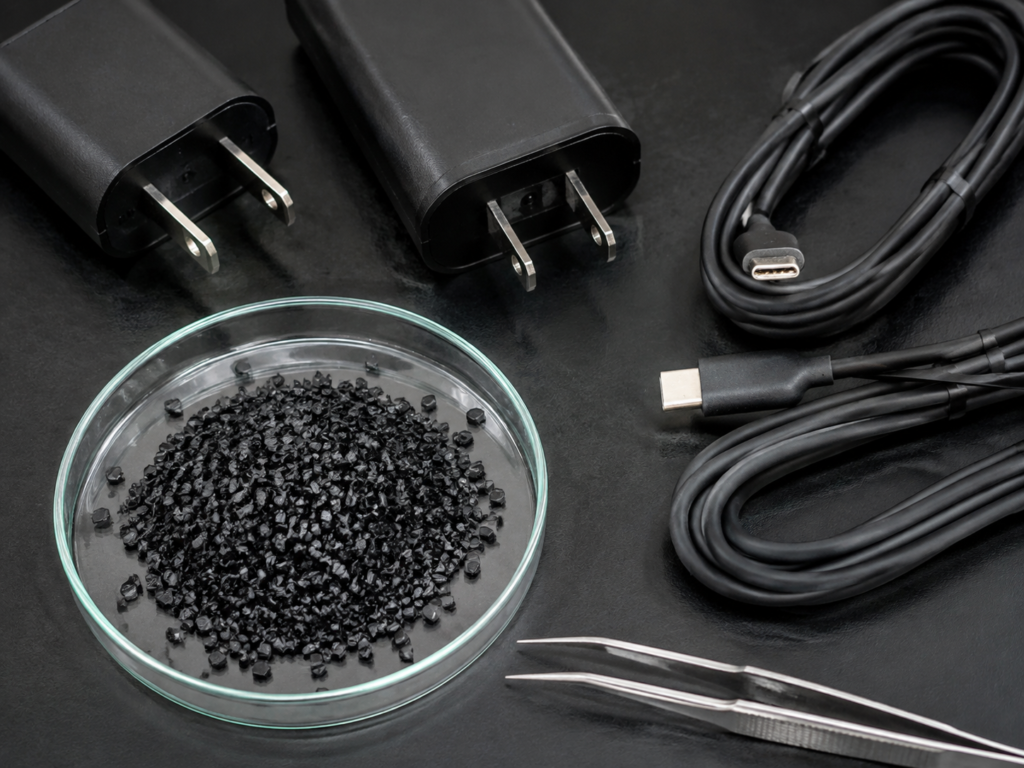
The second is Isopropylated triphenyl phosphate (PIP 3:1, CAS number 68937-41-7), which is a phosphorus-based flame retardant and plasticizer. It was often used in the insulation layer of flexible PVC charging cables and the plastic or potting adhesive formula inside adapters in the past.
The EPA has formulated phased restriction rules for PIP 3:1, gradually tightening control over its manufacture, import, processing, commercial distribution, and other behaviors. Relevant exemptions or transitional arrangements for some electronic and electrical components shall be subject to the current effective rules of the EPA, and cannot be judged solely based on past experience. Its high-risk involved components include flexible PVC charging cables, adapter potting adhesives, connector plastic parts, etc., which need to be focused on investigation in combination with material formulas.
Other PBT Substances to Pay Attention To
In addition to the above two, there are three other types of PBT substances included in the control of Section 6(h) that may be involved in the supply chain of chargers and charging cables. They need to be investigated based on the material formula and ingredient information provided by suppliers. The specific restrictions shall be subject to the corresponding rules of the EPA:
- 2,4,6-Tri-tert-butylphenol (2,4,6-TTBP): may appear in some plastic and rubber formulas as related components of antioxidants and lubricants. It needs to be verified in combination with the actual formula during the processing of rubber seals and plastic housings of chargers;
- Hexachlorobutadiene (HCBD): mostly a by-product or impurity that may be generated during the processing of PVC and rubber. Residues may exist if the process control of the PVC outer sheath of charging cables is improper;
- Pentachlorothiophenol (PCTP): may be used as some rubber processing aids. Components such as rubber sealing rings inside chargers and cable rubber layers need to be confirmed based on supplier information.
Preliminary Judgment Method for High-Risk Products
You don’t need to send samples to the laboratory for testing. You can first conduct a preliminary risk screening based on these three points to help you quickly identify products that need key verification:
- Look at materials: flexible PVC cables, plastic housings with clear flame retardant requirements, and components using recycled materials generally have a higher risk of restricted substances;
- Look at claims: only marking “halogen-free” or “eco-friendly” cannot prove compliance with TSCA requirements. The compliance of specific restricted substances must be checked;
- Look at the supply chain: low-cost materials of unknown origin, and products that cannot provide compliance declarations and ingredient information have significantly higher risks.
Don’t Confuse! Differences Between TSCA and Other Common Electronics Regulations
People who are new to US market compliance can easily confuse TSCA with common requirements such as FCC and UL. In fact, their regulatory dimensions are completely different, and most of them are applicable in parallel. Here is a table to help you quickly distinguish:
| Comparison Dimension | TSCA (US) | FCC (US) | UL/NRTL (US Safety System) | RoHS/REACH (EU) | California Prop 65 (California, US) |
|---|---|---|---|---|---|
| Core of Regulation | Health and environmental risks of chemical substances | Electromagnetic compatibility of radio frequency/unintentional radiation equipment | Product electrical safety, fire and electric leakage prevention and other functional safety | Chemical restriction, registration, evaluation, authorization | Exposure warning of harmful chemical substances |
| Regulatory/Implementation Body | EPA (US Environmental Protection Agency) | FCC (Federal Communications Commission) | Third-party testing institutions recognized by NRTL (such as UL) | EU ECHA and other institutions | California Office of Environmental Health Hazard Assessment |
| Applicability Logic | All products involving chemical substances need to be verified | For applicable radio frequency equipment, intentional radiators or unintentional radiators, adopt corresponding procedures such as certification and supplier declaration in accordance with FCC regulations | Usually a third-party safety certification/evaluation system; whether it is mandatory depends on applicable regulations, installation specifications, purchaser or platform requirements | Electronic and electrical products sold in the EU market need to comply | Products sold to California need to meet warning requirements |
| Relationship with TSCA | – | Applicable in parallel, not inclusive of each other | Applicable in parallel, not inclusive of each other | Belong to different jurisdictions, cannot replace each other | Applicable in parallel, dual federal + local requirements |
There are a few easily misunderstood points that need special explanation:
First, TSCA does not involve requirements for functional attributes such as electrical safety and electromagnetic compatibility, but this does not mean that these attributes of related products do not need to be compliant. They are just regulated by other regulations or systems respectively and need to be confirmed separately.
Second, CPSIA (Consumer Product Safety Improvement Act) only applies to children’s products designed for or mainly used by children under 12 years old. Ordinary chargers and charging cables do not fall into the category of children’s products and do not need to comply with CPSIA; however, if they are charging accessories clearly designed for children (such as cartoon charging cables dedicated to children’s watches), it is necessary to judge whether they trigger CPSIA requirements based on the actual use of the product and the target population, and conclusions cannot be drawn solely based on appearance or marketing names.
Finally, here is a quick way to judge the scope of TSCA: as long as it involves chemical substance risks and is under the jurisdiction of the EPA, it falls within the scope of TSCA; anything that regulates electrical performance, electromagnetic compatibility, or functional safety has no direct relationship with TSCA.
TSCA Practical Guides for Different Roles
People with different identities need to focus on completely different TSCA work priorities. You can find the one that applies to you.
Cross-Border Sellers/Manufacturers: 4-Step Introductory Self-Inspection
If you are a seller or factory that has just entered the US market, follow these four steps to achieve basic compliance:
Step 1: First sort out the high-risk components in the product – charging cable outer sheath, charger housing, USB interface plastic parts, circuit board solder/potting adhesive. These are the key investigation objects;
Step 2: Ask the supplier for the TSCA compliance declaration signed by the supplier, the CAS number and Inventory status description of core chemical substances, and SDS (Safety Data Sheet), to confirm that the restricted substances in the product meet the requirements, and all core chemical substances used are in the TSCA Inventory and their uses comply with the rules. Note: SDS is a standardized hazard communication document, which mainly discloses information such as hazard classification, composition range, and operation protection. It is not equivalent to a complete formula, nor can it be used alone as sufficient proof of TSCA compliance. Finished articles especially cannot complete compliance verification solely by SDS;
Step 3: If new materials are used (such as new flame retardants, new plastic formulas), require the supplier to provide EPA notification status documents for the corresponding chemical substances (such as PMN approval certificate, exemption basis), and confirm that the current use scenario meets the requirements;
Step 4: Confirm the import notification requirements with the US importer before shipment, and prepare all compliance documents in advance to avoid detention at the port of arrival.
Core Requirements for Import Procedures
Many people are unclear about the responsibility division and notification requirements for TSCA imports. Here we first clarify the core rules:
First, the importer within the United States is the main responsible entity for TSCA notification in the import process, but TSCA has corresponding obligation requirements for all entities in the supply chain such as manufacturers, processors, and distributors. Different entities need to bear their own compliance responsibilities, and it is not only the importer that needs to be responsible.
Second, TSCA import certification does not have unified requirements applicable to all products. Importers need to confirm whether they need to submit a positive certification, negative certification, or apply other notification rules based on the type of imported objects (chemical substances/mixtures/finished articles), the inventory status of contained chemical substances, whether special restrictions are triggered, and whether they meet the relevant exemption conditions for finished articles. The same notification template cannot be applied to all finished articles such as chargers and charging cables.
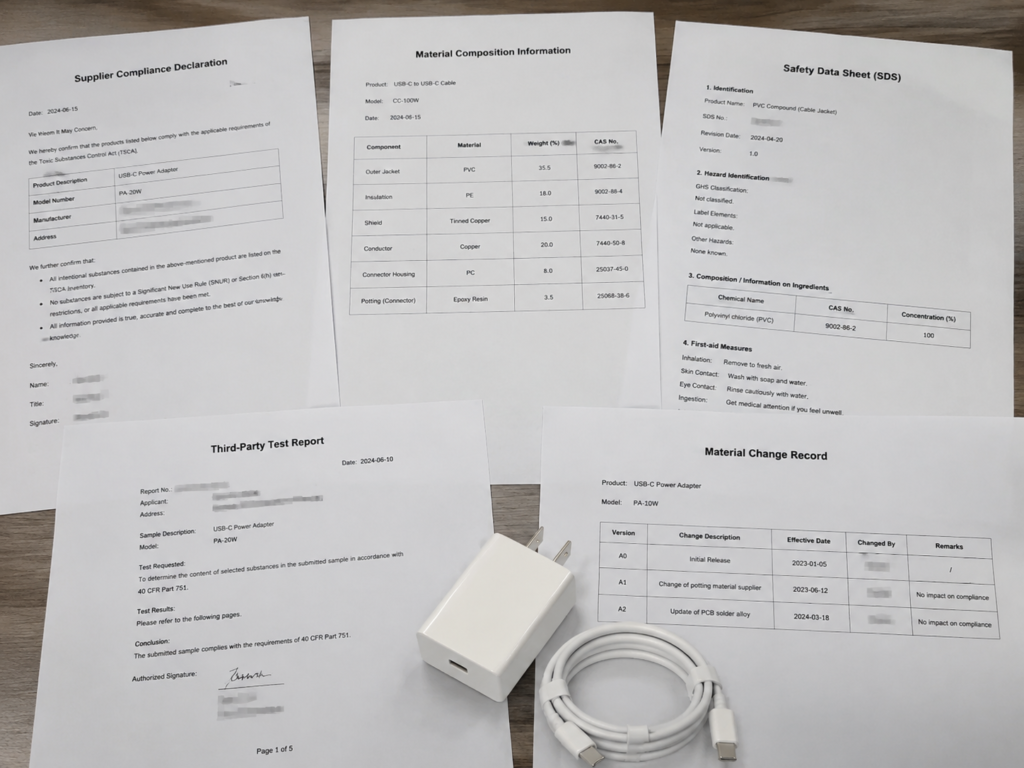
In practice, the compliance documents that importers need to retain usually include supplier compliance declarations, material composition information, SDS, third-party test reports (if any), material change records, etc. The record retention period shall be determined according to the specifically applicable TSCA provisions and EPA rules. Different obligations correspond to different retention requirements. It is recommended to check the corresponding rules in advance to avoid violations due to insufficient retention period. If non-compliant, the light consequence is detention and return of goods, and the serious one is facing fines. The specific amount is determined according to the severity of the case, and the maximum fine can be calculated on a daily basis.
Semi-Proficient Compliance Decision Logic
Practitioners who have been in the industry for a period of time can master this set of decision logic, and don’t need to spend money on testing in every situation:
- Scenarios where third-party testing needs to be considered: Third-party testing is an auxiliary means of risk verification, not a general mandatory requirement of TSCA. It is usually recommended to prioritize arrangements in these scenarios: materials of unknown origin and unable to provide reliable composition certificates, use of recycled materials without compliance traceability documents, explicit requirements from customers such as platforms/supermarkets, and inability to confirm the compliance of restricted substances through supply chain documents.
- Scenarios where compliance needs to be re-evaluated: When changing suppliers, modifying core material formulas such as flame retardants/coatings, or updating relevant EPA rules, previous compliance documents cannot be directly used. The applicability of regulations and material compliance must be re-evaluated, and testing should be arranged if necessary.
- Special risks of recycled materials: Recycled plastics and recycled cables may contain unknown residual controlled substances, and the risk is much higher than that of new materials. Be sure to additionally confirm the composition and content of restricted substances, and cannot directly default to meeting TSCA requirements.
Tips for Ordinary Consumers to Avoid Pitfalls When Purchasing
For ordinary consumers, there is no need to study complex regulatory provisions. Just remember two practical risk screening methods:
First, try to buy products with clear brands and complete production information from formal channels. The compliance probability of such products is usually higher, but this is only a reference for risk screening and cannot be directly equated with TSCA compliance proof;
Second, avoid buying low-cost no-name products without brands, production information, or unknown sources. The material formula and process of such products are usually not guaranteed, and the potential chemical exposure risk is higher.
Common TSCA Misconceptions to Avoid
Finally, let’s talk about a few pitfalls that people are most likely to fall into. Don’t make these low-level mistakes.
Cognitive Misconceptions
- “TSCA only regulates chemical raw materials, and finished products are completely exempt” – Wrong. Finished articles are only exempted from some general obligations (such as pre-manufacture notification for new chemical substances). If the restricted substances in the product do not meet the requirements of special rules, they will still be punished.
- “TSCA is a product certification with a unified certificate” – Wrong. TSCA does not have a unified official certification mark. Compliance is reflected through notification declarations, supply chain documents, and retained records. There is no “TSCA certificate” uniformly issued by the EPA.
Practical Misconceptions
- “All restricted substances have a unified 0.1% limit” – Wrong. Different substances and different forms of existence (intentional addition or unintentional residue) have different limits. 0.1% is only the unintentional residue threshold of DecaBDE and cannot be applied to other substances.
- “RoHS/halogen-free/eco-friendly materials automatically comply with TSCA” – Wrong. Different regulations have different substance scopes, limits, and applicable objects, and belong to different jurisdictions. They cannot be equated.
- “Small-batch sales don’t need to worry about TSCA” – Wrong. As long as products enter the US market, regardless of the batch size, they need to meet TSCA requirements. There is no such thing as “small-batch exemption”.
- “One TSCA test is valid for life” – Wrong. If materials change, suppliers are replaced, or EPA rules are updated, compliance needs to be re-evaluated. It is not a once-and-for-all matter.
- “Only manufacturers need to be responsible” – Wrong. TSCA stipulates corresponding obligations for different entities such as importers, manufacturers, processors, and distributors. When problems occur, all relevant responsible parties may face penalties.
In general, TSCA is not some esoteric “certification”. In essence, it is a federal control rule for the risk of chemical substances entering the market in the United States. For practitioners in the charger and charging cable industry, grasping four core actions can handle most entry-level needs: first, sort out the high-risk materials and chemical substances of the product; second, check the applicability of the Inventory and special restriction rules; third, request and retain complete compliance documents from suppliers; fourth, cooperate with importers to complete notifications and conduct re-evaluation of material changes. If you encounter uncertain situations, such as using new materials, updated rules, or insufficient supply chain information, it is recommended to check the latest official EPA rules or consult professional compliance service agencies to avoid errors caused by empirical judgment.