
If you have bought chargers or charging cables imported from South Korea, or are in the business of charging accessories for the Korean market, you have most likely seen various Korean certification marks with the letter “K”, which many people generally call “K-Mark”. However, the K-Mark eco-label we often refer to is a highly officially recognized environmental certification in South Korea, and it is not the same as K-prefixed certifications for safety or energy efficiency. This article will clarify the definition, function, scope of application, and identification methods of K-Mark, focusing on charging products.
First, get it straight: What exactly is K-Mark
The official name of K-Mark is Korea Eco-Label, commonly known as K-Mark in the market, and it is an official “top environmental performer” mark launched by the South Korean government. Its competent authority is the Ministry of Environment (MOE) of South Korea, and the specific review, certification issuance, and daily management are handled by the Korea Environmental Industry & Technology Institute (KEITI), a professional executive agency under the MOE.
From the perspective of international rules, K-Mark meets the requirements of Type I third-party eco-labels defined by ISO 14024 — the core feature of such labels is that they are reviewed by an independent third party based on multi-dimensional criteria and the full life cycle impact of products, and cannot be used by enterprises simply by printing the word “eco-friendly” on their own. Its core certification logic is clear: Certified products have a lower overall environmental impact than the average level of the same category throughout their full life cycle from production to disposal.
First, avoid a name pitfall
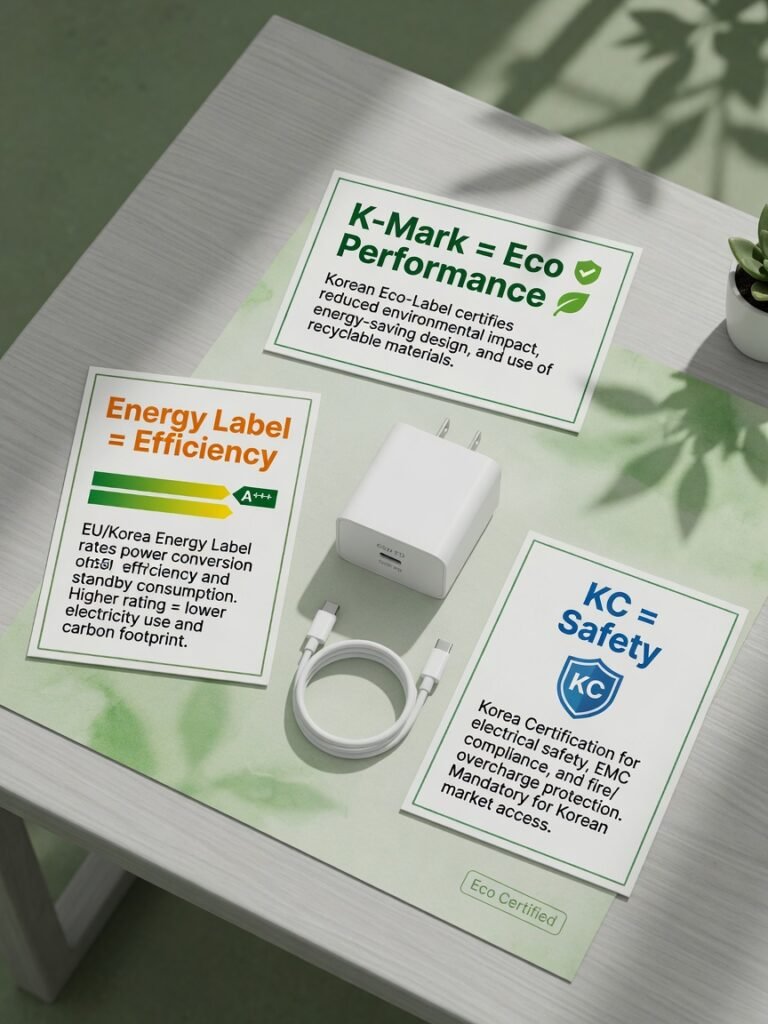
In the market, all Korean K-prefixed certifications are often called “K-Mark”, such as KC safety certification and K-MEPS energy efficiency certification, which is actually a confusion of concepts. The K-Mark mentioned in this article specifically refers to the Korea Eco-Label. If you see a product with only the text “K-Mark” printed on it and no official eco-friendly graphic mark, be sure to verify its certification type first to avoid being misled.
Be clear: The certification boundary of K-Mark
Many people have misunderstandings about the boundary of eco-certifications. Here are the core conclusions first:
- What it can certify: The product’s environmental performance throughout the entire process is better than the average level of the same category, and it is an officially recognized eco-friendly model.
- What it absolutely does not certify: Electrical safety, charging speed, interface compatibility, product quality, or durability — these fall under the scope of KC safety certification or the product’s own performance, and have nothing to do with K-Mark.
The position of K-Mark in the regulatory system for Korean charging products
People who are new to the Korean market are most likely to confuse the mandatory nature of various certifications. The core attribute of K-Mark is a voluntary eco-label, not a mandatory threshold for market access. Simply put: charging products without K-Mark can still be legally sold in South Korea as long as they meet mandatory requirements such as KC; enterprises voluntarily apply for K-Mark for differentiated competition in environmental protection, and it cannot replace any mandatory certification.
For easy distinction, we compare three common types of mandatory-related certifications for Korean charging products with K-Mark (note: the latter two certifications only have mandatory requirements for products included in the official management list):
| Certification Type | Nature | Core Function | Relationship with K-Mark |
|---|---|---|---|
| KC Certification | Mandatory access for electronic and electrical products included in the mandatory list | Verifies electrical safety and electromagnetic compatibility (will not interfere with other devices nor be interfered with) | Products within the mandatory KC scope must first meet KC requirements before applying for K-Mark; K-Mark cannot replace KC in any way |
| K-MEPS Energy Efficiency Label | Mandatory access only for products included in Korea’s energy efficiency management list | Requires products to meet the minimum energy consumption threshold | For charging products subject to energy efficiency requirements, K-Mark’s energy efficiency indicators are usually higher than the mandatory passing line |
| E-Standby Standby Power Label | Mandatory warning only for products included in Korea’s standby power management list | Requires labeling of the product’s standby power level | For applicable products, standby power consumption is one of the items in K-Mark’s comprehensive environmental assessment |
| In the actual market, the application scenarios of K-Mark are very clear: it is a common environmental bonus item for eco-friendly zones on Korean e-commerce platforms, public procurement, and large enterprise bidding, and it is also an important access qualification for Korea’s green procurement list. Charging accessory brands that focus on eco-friendly positioning usually take the initiative to apply for K-Mark to improve market competitiveness. |
Which charging products can apply for K-Mark? What are the boundaries
Not all charging-related products can apply for K-Mark; it has a clear category scope and application boundaries. The specific applicable categories for application are subject to the applicable product categories, standard numbers, and certification scope published on the official KEITI eco-label website.
Common charging-related categories eligible for application
Among common consumer-grade charging-related products for civilian use, mobile phone chargers, USB/USB-C power adapters, and fast chargers are usually within the application scope; boundary categories such as USB/USB-C charging cables, data cables, car chargers, wireless charging bases, and small consumer electronic accessories with charging ports (such as wireless earbud charging cases) need to be confirmed for applicability according to the official specific classification rules.
Boundaries of inapplicable products
The following types of products are explicitly ineligible to apply for K-Mark:
- High-power industrial charging equipment, such as electric vehicle charging piles and industrial-grade power supplies;
- Second-hand, refurbished, or non-brand-new mass-produced batches of products;
- Products only exported to markets outside South Korea and not sold within South Korea;
- Customized or brand-new category products not included in the official category list.
Judgment rules for sets/combined products
Many charging products are sold in the form of “charger + charging cable” sets, and the certification scope of such products is easy to fall into pitfalls. Remember several core judgment criteria:
- First confirm whether the certificate covers the entire set of products or only individual components. If the certificate only certifies the adapter, then neither the cable nor the packaging can use the K-Mark mark alone;
- If the product’s plug specification, cable length, or packaging material is changed, it is necessary to reconfirm whether it is within the scope of the original certificate, and it cannot be used directly;
- For OEM/ODM products, when selling under a different brand, formal authorization from the certificate holder must be obtained, and the K-Mark certification of the original brand cannot be used without permission.
What exactly does K-Mark assess? It’s not just material eco-friendliness
Many people think that eco-certification is just “materials are non-toxic”, but in fact, K-Mark’s assessment is multi-dimensional, and the assessment focus of different categories has obvious differences.
Hazardous substance restrictions: Stricter than ordinary electronic standards
K-Mark’s restrictions on hazardous substances are stricter than the general standards for ordinary electronic products, and the assessment covers all core components such as PCB circuit boards, plastic shells, charging cable sheaths, solder, and connectors. Restricted substances include lead, mercury, cadmium, hexavalent chromium, phthalates, some flame retardants, etc. Its assessment approach is similar to the EU RoHS Directive, but the specific limits and test requirements are different. EU RoHS reports cannot be used directly for application, and there is no mutual recognition.
Energy efficiency and standby power consumption: Core assessment items for some products
For products with power conversion functions such as external power supplies, chargers, and wireless charging bases, no-load standby power consumption and conversion efficiency are core assessment items — these products are used frequently in daily life and are often plugged in for a long time, so the environmental impact of cumulative energy consumption is very prominent. Specific requirements include:
- No-load standby power consumption has a strict upper limit to reduce useless waste from long-term plugging in;
- Products with different power levels have corresponding conversion efficiency requirements, and the higher the power, the stricter the requirements usually are;
- Fast charging products need to be assessed for energy efficiency at multiple output levels at the same time, and cannot only meet the standard at one level.
For products without power conversion functions such as cables and small accessories, energy efficiency-related requirements are not included in the core assessment, and the evaluation focus will be on dimensions such as materials and recyclability.
Recyclability and easy disassembly design
K-Mark also assesses the recycling friendliness of products: it requires shells and connectors to be easy to sort and recycle, and minimizes non-detachable adhesive structures; it encourages the use of recyclable materials and clearly labels material composition. Products with universal interfaces such as USB-C have more advantages in the evaluation because they can reduce electronic waste caused by interface iteration.
Packaging and full life cycle assessment
In addition to the product itself, K-Mark also covers the environmental impact of packaging and the full life cycle:
- Packaging level: Excessive packaging is restricted, recyclable materials are required to account for a certain proportion, and hazardous substances in inks and adhesives are also restricted;
- Full life cycle assessment: That is, the environmental load must be calculated for the entire complete cycle from raw material extraction, production and manufacturing, transportation and sales, consumer use to final disposal and recycling, and enterprises need to submit assessment reports and supporting materials that meet the requirements.
How to identify a genuine K-Mark? How to verify its authenticity
Due to the high market recognition of K-Mark, there are also many cases of counterfeiting or illegal use, so it is very important to master identification and query methods.
Visual characteristics of a genuine mark
A genuine K-Mark has three indispensable elements: the official exclusive “K-shape + leaf” graphic, the standard “Korea Eco-Label” text, and a unique traceable certification number. The color, proportion, and graphic elements of the mark are fixed, and enterprises cannot modify them on their own. Looking only at the graphic is not enough; it must be verified with the certification number to avoid counterfeiting.
Requirements for the marking position of charging products
The marking position of charging products must comply with the KEITI mark usage guidelines and the scope of certification authorization: for charger products with sufficient body space, the mark and certification number can usually be marked on the bottom, side, or nameplate by printing, laser engraving, etc.; for small or space-limited products such as charging cables, they can be marked on the packaging, cable body label, or instruction materials; the outer packaging and instructions must clearly display the mark and the certification number of the corresponding product.
Common characteristics of invalid/illegal marks
In the following cases, it can basically be determined as an illegal or invalid mark:
- Only the text “K-Mark” is present, without the official K-shaped leaf eco-friendly graphic;
- There is no corresponding certification number, or the number does not match the product model;
- The color or proportion of the mark is modified without permission, or it is used beyond the certification scope (for example, only the charger is certified, but the cable is also marked).
Official authenticity query method
The authenticity of K-Mark can be queried through the official KEITI eco-label website, which supports an English interface and has a low operation threshold. When querying, you only need to enter the certification number on the product body or packaging. There are three key points for judging the result: whether the certification holder is consistent with the brand, whether the certification is within the validity period, and whether the covered product models match.
If it cannot be found, it is not necessarily counterfeit. Common non-counterfeit reasons include: a 1-2 month lag in official system entry, incorrect number input, or the product is a non-Korean version and has not applied for K-Mark for the Korean market.
Basic rules for applying for K-Mark
If you are a merchant of charging products doing business in the Korean market, understanding the basic application rules can help you avoid detours.
Basic application thresholds
Not all products can apply; several core prerequisites must be met:
- The applied product must comply with applicable Korean regulatory requirements: products such as chargers and adapters that fall within the scope of mandatory KC certification should first complete KC compliance, and relevant certificates usually need to be submitted when applying;
- The product is a brand-new mass-produced consumer-grade charging product for civilian use;
- The applicant is usually a local Korean manufacturer, importer, or a formally authorized local agent of an overseas brand. The specific subject qualification requirements are subject to the application rules officially issued by KEITI;
- The product is within the corresponding category list officially published.
Basic application process
The general process of applying for K-Mark is: first confirm the product category and the corresponding standard version, prepare materials such as KC compliance certificate, eco-test report, material list, and packaging information, submit them to KEITI for document review first. If necessary, sampling testing or factory inspection will be arranged. After passing the review, the certificate will be issued and the authorization to use the mark will be obtained.
The entire cycle is usually 1-3 months, and the costs include application fee, testing fee, and supervision annual fee. The specific amount varies greatly depending on the product type, test items, and institution, and there is no unified fixed price.
Validity period, renewal, and invalidation rules
The validity period of K-Mark certification is subject to the officially issued certificate and the standard requirements of the corresponding product. It will not be automatically renewed upon expiration, and you need to resubmit materials such as eco-test reports and production inspection documents to apply for renewal as required.
If the product’s design, core materials, or production process changes, the enterprise needs to report to the official in advance, and re-evaluate if necessary. Common certification invalidation scenarios include: failing supervision spot checks, changing products without reporting, failing to renew upon expiration, and failing to re-evaluate after standard updates.
Common misconceptions and scenario-based decision-making
Finally, we have sorted out the most common cognitive misconceptions about K-Mark, as well as the criteria for whether to pay attention to it in different scenarios.
6 common cognitive misconceptions
- Having K-Mark = fast charging/good quality: Wrong. K-Mark only assesses eco-friendly attributes, and does not involve performance and quality indicators such as charging speed, durability, and interface compatibility.
- K-Mark is a mandatory certification: Wrong. It is a voluntary mark, and mandatory certifications such as KC are the prerequisite for access to the Korean market. The absence of K-Mark does not affect the legal sale of products.
- If one model passes the review, all similar products can use it: Wrong. Even for chargers of the same power, as long as the shell material, interface type, cable length, or even packaging material is changed, it may exceed the certification scope and needs to be reconfirmed.
- K-Mark is the same as KC and energy efficiency labels: Wrong. The three are responsible for environmental protection, safety, and energy efficiency respectively, with completely different functions and cannot replace each other.
- Having EU RoHS/CE means you can directly get K-Mark: Wrong. The standard limits and assessment dimensions of different countries are different, and there is no direct mutual recognition. It must be re-reviewed in accordance with Korean requirements.
- Environmental protection only depends on whether the materials are toxic: Wrong. For products with power conversion functions, energy efficiency performance is one of the core assessment items, with a weight no lower than that of hazardous substance restrictions in materials.
Which scenarios require attention to K-Mark
- If you are a consumer or purchaser who wants to buy low-hazard, power-saving charging products, or participate in Korean public procurement or large enterprise bidding, K-Mark is a very reliable environmental reference;
- If you are a charging product enterprise exporting to South Korea, focusing on the mid-to-high-end eco-friendly market, wanting to enter the eco-friendly zone of e-commerce platforms, or your customers are large Korean retail enterprises and public institutions, K-Mark will be an important competitiveness bonus;
- If you are a supply chain practitioner who needs to confirm that the supplier’s charging product environmental qualifications meet the requirements of Korean customers, K-Mark is the core verification basis;
- If you are considering whether to apply for K-Mark, the cost-effectiveness of the application will be higher when you have complete KC, energy efficiency, and material data, and the product model is stable.
Which scenarios do not need to refer to K-Mark at all
- Self-use charging products temporarily entering South Korea do not need to meet K-Mark requirements;
- Non-civilian industrial charging equipment is not within the scope of K-Mark application;
- Second-hand and refurbished charging products cannot apply and do not need to be referred to;
- Products only sold in markets outside South Korea do not need to be considered at all;
- If the product only needs to meet the minimum market access requirements of South Korea, it only needs to pass mandatory certifications such as KC, and there is no need to apply for K-Mark.
Overall, K-Mark is the most recognized voluntary eco-label in the field of charging products in South Korea, and its core value is to prove that the product’s full life cycle environmental performance is better than the average level of the same category. Whether you are buying eco-friendly charging accessories or developing a presence in the Korean charging product market, as long as you clarify its application boundaries, identification methods, and differences from mandatory certifications, you can avoid the trap of false publicity and accurately judge its actual value. If you need to verify K-Mark qualifications with suppliers or partners, you only need to focus on confirming three core pieces of information: the product models covered by the certification, the validity period, and the included components.