
If you are in the business of chargers or power adapters for the Canadian market, or shop for electronic accessories in Canada, you have most likely heard of the term “NRCan testing”. Many people confuse it with safety certification, and are unclear about whether their products need it, what is tested, and how to determine compliance. Today we will thoroughly explain the NRCan testing requirements for external power supplies, covering basic concepts to compliance judgment, so that both ordinary users and cross-border sellers can understand.
First, Understand: What Exactly Does NRCan External Power Supply Testing Regulate
The full name of NRCan is Natural Resources Canada, the official agency responsible for energy efficiency regulation in Canada. For external power supplies (that is, devices independent of equipment, such as commonly used charging heads and power adapters, which are plugged into the mains to supply power/charge devices), the core of NRCan’s regulation is only one: power utilization efficiency — the regulatory purpose is to reduce meaningless power consumption in standby mode. For example, a charging head that is plugged into the wall all year round will quietly consume power even when no device is connected, and the accumulated waste will be huge.
Many people easily confuse NRCan with other common certifications. Here is a table to clarify the boundaries:
| Certification/Item | Core Content | Relationship with NRCan |
| Canadian Safety Certification (CSA, cUL, etc.) | Product safety (electric shock prevention, fire prevention, etc.) | Completely independent, need to be applied for separately; passing energy efficiency does not mean passing safety |
| U.S. DOE Energy Efficiency | External power supply energy efficiency requirements for the U.S. market | Test methods are basically harmonized, but they cannot be used directly; data reuse must meet Canadian qualification and regulatory requirements |
| ENERGY STAR | Voluntary high-efficiency certification | NRCan is a mandatory market access requirement in Canada, while ENERGY STAR is a higher-standard voluntary certification |
Also note that NRCan’s energy efficiency regulations are updated regularly, and the current version has stricter limits on no-load power consumption and average efficiency than older versions. Older products from a few years ago may have met the requirements of that year, but if they want to enter the Canadian market now, they must be tested for compliance in accordance with the currently effective version, and old reports cannot be used as a substitute.
How to Judge: Whether Your Product Needs NRCan Testing
Not all charging-related products need NRCan testing. You can quickly check using the four-step judgment method:
1. Is it a detachable external power supply? Simply put, it is not built into the device. For example, a mobile phone charging head is separate, so it counts; the power board inside a computer host is built-in, so it does not count.
2. Does it have AC to low-voltage function? It must have active voltage transformation and rectification circuits that convert AC mains to low-voltage AC/DC. Pure charging cables and adapters that only perform physical transfer do not have this function, so they do not count.
3. Is it used for consumer terminals? Products that supply power/charge ordinary consumer electronics such as mobile phones, tablets, and laptops count; those in special fields such as industry and medical care need to be checked separately for exemption clauses.
4. Is it not in the exemption category? Products explicitly exempted by regulations do not need to be tested, and the specific items must be compared with the current clauses.
Product Classification: Different Types Have Different Limits
NRCan’s energy efficiency limits are set according to product classification. There are four common classification dimensions, and you can correspond to your own products:
• By output type: AC-DC type (the most mainstream, which converts alternating current to low-voltage direct current, such as mobile phone charging heads and laptop power supplies), AC-AC type (only converts to low-voltage alternating current without rectification, which is relatively rare now, such as old desk lamp transformers)
• By output voltage: Single-voltage type (such as old 5V1A charging heads, with only one output voltage), multi-voltage type (such as USB-PD fast charging heads, with multiple gears such as 5V, 9V, 12V, etc.)
• By usage form: Wall-plug type (directly plugged into the socket, no input cable, such as low-power charging heads), desktop type (with input power cable, needs to be placed on the table for use, such as high-power laptop power supplies)
• By compatibility: Universal type (can charge a variety of devices, such as multi-port USB charging stations), dedicated type (can only be used for specific devices, such as the exclusive power supply of a certain brand of laptop)
Typical Products Requiring Testing and Exempt Products
Common daily products such as mobile phone/tablet/headphone chargers, USB fast charging heads, laptop power adapters, multi-port USB charging stations, and integrated chargers with cables all fall within the scope of testing. Independent wireless chargers with AC input will be regulated as external power supplies only if they have a built-in AC-DC conversion circuit, meet the core definition of external power supplies as “independent AC input to low-voltage power supply”, and do not fall into other product categories or exemption scopes; if it is a wireless charging base that only needs an external USB power supply and does not have AC-DC conversion function itself, it does not belong to the category of external power supplies.
The following products are either exempt or need to be checked separately for clauses:
• Pure charging cables, data cables, adapters without active circuits
• Power modules built into equipment
• Special power supplies for low-power, industrial, medical, and spare parts categories (need to check specific exemption clauses)
Judgment Rules for Confusing Boundaries
There are clear judgment standards for several vague questions that people often ask:
• Multi-port chargers are judged by the whole product, and cannot be split into individual interfaces corresponding to limits. For example, a 65W dual-port charger is calculated according to the total power of 65W, not 30W per port.
• An external charging head for charging a power bank, as long as it is an independent AC-DC power supply, falls within the regulatory scope, regardless of what device it charges; the power bank itself is a product with a built-in battery and does not belong to the category of external power supplies.
• Conventional regulation covers consumer external power supplies with rated output ≤250W. Those exceeding 250W need to be checked separately against regulatory requirements.
Core Test Content: Two Key Energy Efficiency Indicators
NRCan testing is not done casually; it must be carried out in accordance with the standard methods cited in Canada’s , which clearly specify requirements such as input conditions, load points, and instrument accuracy. Only test results that comply with the method have compliance validity. There are only two core test indicators:
1. No-Load Power Consumption
It refers to the power consumption when the power supply is plugged into the mains and not connected to any load (not charging, not supplying power to equipment), which is simply “standby power consumption”. The purpose of the test is to reduce this meaningless energy consumption from long-term wall plugging — don’t underestimate the difference of a few tenths of a watt. If a household has five or six charging heads that are plugged in all year round, it can waste several kilowatt-hours of electricity a year, and the figure across the country is huge.
The limit of no-load power consumption should be compared with current regulations according to product category, power, and voltage type. The common limit for low-power AC-DC power supplies is ≤0.1W. This value is for reference only, and the specific shall be subject to the current requirements of the corresponding power gear.
2. Average Conversion Efficiency
It is the ratio of the power supply converting mains power into output power. For example, if 100W of alternating current is input and 88W of direct current is output, the conversion efficiency is 88%, and the remaining 12W is wasted as heat. The higher the efficiency, the less electricity is wasted.
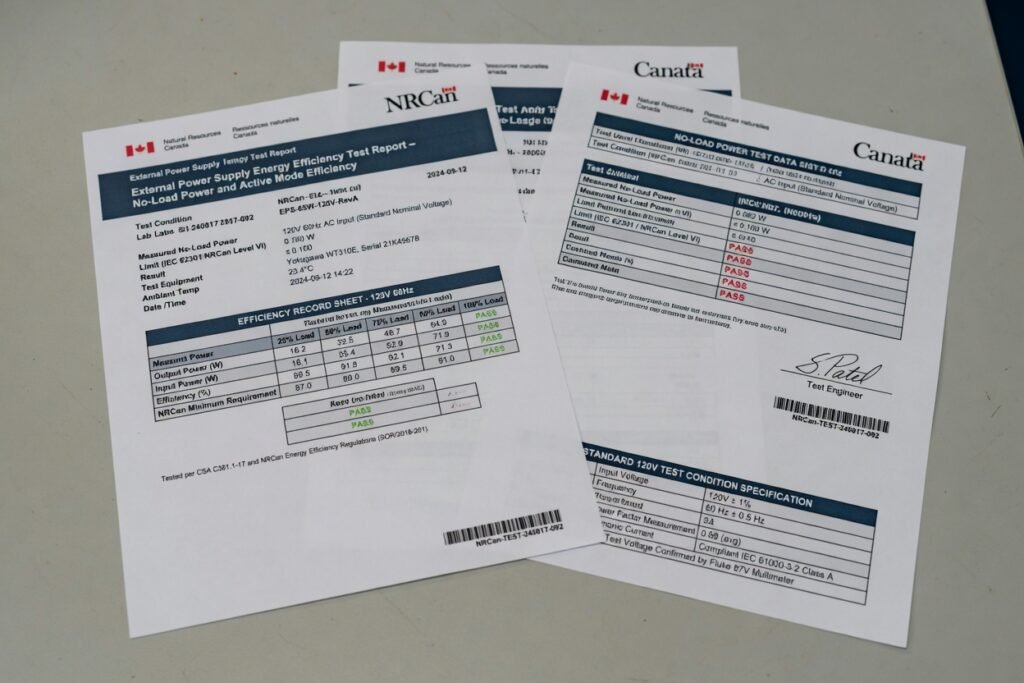
During the test, the efficiency at four load points: 25%, 50%, 75%, 100% will be measured, and then the average value will be taken, instead of only looking at the full-load efficiency — because in daily use, the power supply rarely runs at full load all the time, and most of the time it is in a medium-light load state. The average efficiency can better reflect the power saving level in real usage scenarios. The limits are also divided according to power gears and product types. Only when the average value meets the standard can it be considered qualified; high full-load efficiency alone is useless.
These Items Do Not Need to Be Tested
Many people ask whether power factor, EMC (electromagnetic compatibility), and safety items are tested. The answer is: none of these are mandatory test items for NRCan external power supply energy efficiency. EMC and safety belong to the scope of other certifications and have nothing to do with NRCan at all.
Before Testing: Prerequisites and Influencing Factors
Basic Sample Requirements
Samples submitted for testing must meet three requirements:
• They are mass-produced qualified finished products, not engineering prototypes or hand-made samples — engineering prototypes may be specially optimized, and their circuits and components are different from mass-produced ones, so the test results do not represent the actually sold products.
• The quantity is usually 2-3 units, and different testing institutions may adjust it according to the situation.
• Product parameters, manuals, and packaging must be attached, and must be completely consistent with the actually sold version.
Standard Test Environment
Testing must be carried out under standard conditions, otherwise the results are invalid:
• The input grid is Canadian standard mains 120V/60Hz — many wide-voltage power supplies have different efficiency and no-load power consumption at 120V and 220V, so they must be tested according to the grid of the target market.
• The ambient temperature is around 25°C at room temperature. Temperature will affect the performance of components, so testing must be carried out at standard temperature.
• Pre-aging stabilization is required before testing, that is, let the power supply work for a period of time after power-on, and test after the performance of components is stable, to avoid the value fluctuation in the initial stage of power-on affecting the results.
Special Rules for Fast Charging/Multi-Port Products
Now there are more and more fast charging heads and multi-port charging products. For such products, it is not necessary to exhaust all private protocol handshake scenarios, but it is necessary to strictly follow the test methods cited in the regulations, combined with the rated output gears and maximum output combinations declared on the product nameplate and manual, and the formal test plan shall be confirmed by a testing institution with compliance qualifications. The rated output modes and maximum load combinations required by the regulations shall not be omitted:
• Multi-gear fast charging heads: It is not necessary to cover all private protocol handshake scenarios such as QC, PD, SCP, etc. The core is to select test points according to the rated voltage and current gears marked on the nameplate.
• Products with adjustable voltage such as USB-PD and PPS: Test shall be carried out after confirming the specific test configuration with the testing institution according to the rated output range declared by the product.
• Multi-port chargers: It is not necessary to test all interface combinations. The core needs to cover key working conditions specified in the test plan, such as the maximum rated output of a single port and the typical full-load combination declared by the product. For example, a 65W three-port charger needs to cover two core working conditions: the maximum 65W output of a single port and the simultaneous full-load output of three ports.
• All working conditions confirmed by the test plan must meet the standards before the entire product is considered qualified. If even one working condition fails to meet the standard, it will be judged as unqualified.
Variables Affecting Test Results
Sometimes the value measured by yourself is different from that of the laboratory, mostly because of these variables:
• Input voltage/frequency: Wide-voltage products have different values under different inputs, which is why testing must be carried out according to the 120V/60Hz standard.
• Load size: Light-load efficiency is usually lower than medium-load efficiency. For example, the efficiency at 25% load is generally lower than that at 50% and 75%, so four points are measured to take the average.
• Ambient temperature: Temperature changes will cause changes in component parameters, which in turn affect efficiency and no-load power consumption.
• Component batches: There are slight differences in components of different batches during mass production, which may lead to fluctuations in energy efficiency values, so mass-produced finished products must be used for submission.
Compliance and Import: Responsibilities, Documents and Declaration
Division of Responsible Subjects
Many people think that the manufacturer is the first responsible party, but that is not the case — NRCan regulates the Canadian market, so the first responsible parties are Canadian importers and distributors. That is to say, if you are a Chinese cross-border seller and find a Canadian importer to clear customs, the importer shall bear the primary responsibility for compliance, so they will require the seller to provide compliant test materials. The manufacturer’s responsibility is to provide compliance test reports and technical materials to cooperate in completing compliance.
Compliance Document Requirements
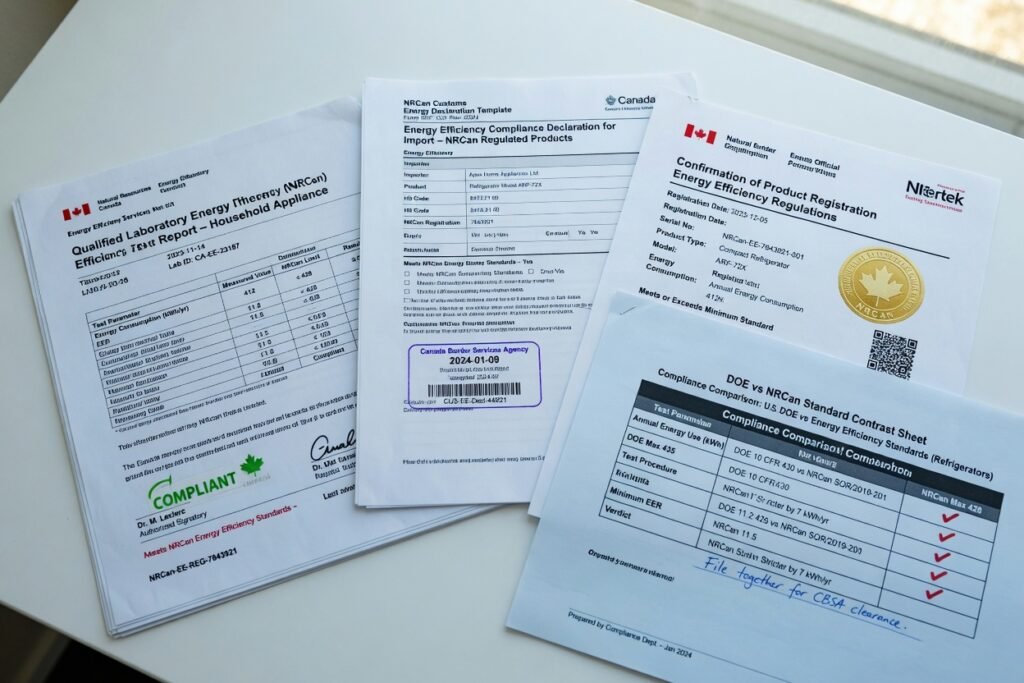
• Must hold an energy efficiency test report that meets the requirements of Canada’s . The qualification of the testing institution, test process and methods must meet the relevant requirements of the NRCan energy efficiency compliance system. Reports issued by institutions without corresponding qualifications have no compliance validity.
• The report must contain all test data and information required by the regulations, including input conditions, no-load power consumption, conversion efficiency at each load point, product model parameters, judgment conclusions, etc., and no items shall be missing.
• Compliance documents shall be properly filed. NRCan may request submission at any time. They do not need to be directly affixed to the product, but must be available for inspection at any time.
Notes on Labeling and Declaration
It should be particularly emphasized here: there is no unified “NRCan energy efficiency label”. Many people think there is a special NRCan mark to paste, but there is not. Approved verification marks can be marked on the product, but they must be consistent with the compliance report of the corresponding model. False marking is not allowed, nor can you just print “NRCan Qualified” as a compliance certificate.
When products are imported into Canada, it is necessary to fill in energy efficiency compliance information, model and other fields in the declaration documents. The declaration information must be consistent with the actual product and compliance documents, otherwise the goods may be detained or even fined.
Report Sharing Rules for Same Series Products
If there are multiple similar models, one report can be shared if the following conditions are met: only the shell, packaging, and plug appearance are different, and the circuit scheme and core parameters (output power, voltage gears, etc.) are completely consistent. For example, a charging head with the same circuit can share the report if it changes the shell color or replaces the US standard plug with a Canadian standard plug.
If there are differences in output power, circuit scheme, or output gears, they cannot be shared and must be retested.
How the Test is Conducted: Process and Qualification Judgment
The NRCan test process is not complicated, and it is mainly divided into four steps after simplification:
1. Sample verification: After receiving the samples, the laboratory first checks whether the model, parameters, and configuration are consistent with the declaration, and whether the manuals, packaging, etc. are brought complete, to avoid wrong samples or samples that do not meet the requirements.
2. Benchmark verification: First test whether the actual output capacity and function of the product are consistent with the nameplate marking. For example, for a product marked 65W, it is necessary to confirm whether its rated output capacity meets the declaration. If the measured output capacity is inconsistent with the marking, it will first constitute a compliance risk of inconsistency between the nameplate information, test report and import declaration parameters; the application of limits must be strictly determined in accordance with the rated output power, product category and declaration parameters confirmed by the regulations and test methods, and it is not allowed to evade stricter limit requirements by falsely marking power.
3. Formal testing: According to the standard method, test the no-load power consumption and the conversion efficiency of each load point in turn. For multi-gear and multi-port products, each selected working condition must also be tested.
4. Data judgment: Compare the tested no-load power consumption and average efficiency with the limits of the corresponding power gear and product category to get a conclusion of qualified or unqualified.
Common Reasons for Unqualified
Most unqualified cases are due to the following reasons. Paying attention in advance can avoid them:
• No-load power consumption exceeds the standard. For example, the no-load power of a low-power charging head reaches 0.2W, exceeding the limit requirement of the corresponding power gear.
• The average conversion efficiency does not meet the standard, and the average value of the four load points is lower than the requirement of the corresponding power gear.
• False power marking not only violates the authenticity requirements of nameplate information, but also may lead to deviations in the judgment of rated output power and the application of limits, ultimately resulting in unqualified tests.
• Missing test of specified working conditions. For example, a multi-port charger only tests a single port and does not test the simultaneous full-load condition of multiple ports required by the test plan.
How to Read Reports and Labels: Judgment Methods for Different Groups
Four Key Points for Sellers/Purchasers to Read Reports
When you get an NRCan-related energy efficiency test report, focus on checking these four points:
1. Basic information: Whether the product model, test method, power gear, and input conditions are correct. For example, whether the input is 120V/60Hz, and whether the model is your own product.
2. Measured data: The specific values of no-load power consumption and average conversion efficiency, and whether they meet the limit requirements.
3. Final conclusion: Whether the report has a clear qualified/unqualified judgment.
4. Report validity: Whether the qualification of the testing institution issuing the report, the test method and process meet the requirements of Canada’s and the NRCan energy efficiency compliance system. Reports issued by institutions that do not meet the requirements have no compliance validity.
Preliminary Judgment Method for Ordinary Users
If you buy a charging head in Canada and want to know whether it meets the energy efficiency requirements, you can do this:
1. Look at the energy efficiency verification mark or compliance statement on the product packaging or nameplate. Products with formal verification marks are relatively reliable.
2. Check the product information in NRCan’s public compliance directory. In addition to the model, you should also check whether the manufacturer/brand, model suffix, rated output power, voltage gears and other information are consistent with the packaging and nameplate, to avoid misjudgment caused by OEM models or similar models.
3. Remember that there is no unified NRCan energy efficiency label. You can’t just believe that the packaging says “compliant with NRCan”. It is best to verify in the official directory to avoid buying products with false markings.
Trigger Conditions for Retest
NRCan does not stipulate a fixed validity period for the report, but retesting is required in the following cases:
• The regulation version is updated, the limits change, and the old report does not comply with the new regulations.
• The product has changed its circuit, power, or output gears, for example, changing 20W to 30W, or changing the power supply scheme.
• If only the shell, packaging, or plug is changed, and the circuit and core parameters remain unchanged, there is no need to retest, and the original report can continue to be used.
Common Misconceptions and Pitfall Avoidance Guide
Common Cognitive Misconceptions
1. Misconception: All charging heads need NRCan
Correct answer: Only those that meet the definition of external power supply and are within the regulatory scope need it. Special categories such as industrial and medical may be exempted, and it should be judged according to the four-step method.
2. Misconception: Passing the U.S. DOE is equivalent to passing NRCan
Correct answer: The test methods of the two are basically harmonized, but Canada has its own compliance requirements. You cannot directly use the DOE report as an NRCan report. Data reuse needs to meet Canadian qualification and regulatory conditions.
3. Misconception: The higher the energy efficiency, the faster the charging speed
Correct answer: Energy efficiency only represents the utilization rate of electric energy, that is, less wasted electricity and less heat generation, which has nothing to do with charging speed; charging speed depends on output power and charging protocol. A 65W fast charger, even if its efficiency is a little lower, charges faster than a 20W high-conversion charging head.
4. Misconception: NRCan testing includes safety testing
Correct answer: NRCan only manages energy efficiency, and safety is the matter of safety certifications such as CSA and cUL. The two are completely independent and must be handled separately.
5. Misconception: Pure charging cables also need NRCan testing
Correct answer: Pure charging cables do not have active circuits for voltage transformation and rectification, so they are not external power supplies and do not need testing.
6. Misconception: Wireless chargers with AC input must be external power supplies
Correct answer: It must be checked according to the regulatory definition. Only those with built-in AC-DC conversion circuits, meeting the core definition of external power supplies as “independent AC input to low-voltage power supply”, and not falling into other product categories or exemption scopes are included in the regulation; if it is a wireless charging base that needs an external USB power supply and does not have AC-DC conversion itself, it does not count.
Pitfall Avoidance for Sellers in Test Preparation
• Don’t use engineering prototypes for testing: The circuits and components of engineering machines and mass-produced versions may be different. If the engineering machine passes the test, the mass-produced version may not be compliant. Mass-produced qualified finished products must be used for submission.
• Don’t falsely mark power: False marking is not only illegal in itself, but also may lead to deviations in rated power judgment and limit application, which will fail the test instead, and the gain is not worth the loss.
• Don’t miss the test of specified working conditions for multi-gear/multi-port products: If the test is missed, the report will be invalid, or the product will actually be non-compliant.
• Don’t make the nameplate parameters inconsistent with the report: For example, the model on the report is A, the product nameplate is B, or the output parameters are different, the report is useless, and there will be problems with import.
Pitfall Avoidance for Ordinary Users in Purchasing
• Prioritize products with formal energy efficiency verification marks. Compliant products have low standby power consumption and are more power-saving when plugged into the wall for a long time.
• The standby power consumption of non-compliant products may be several times higher. For example, a charging head with 0.5W no-load power consumes more than 4 kWh of electricity a year if plugged in 365 days a year. If there are five or six at home, it will be tens of kWh a year, and the amount adds up.
• Don’t equate fast charging and high power with high energy efficiency. The two have nothing to do with each other. High-power fast charging heads may also fail to meet energy efficiency standards and waste electricity.
Summary
The NRCan test for external power supplies is a mandatory energy efficiency access requirement for the Canadian market, and the core can be summarized into four key matters that can be independently judged:
First, use the four-step method of “detachable external → with AC to low-voltage function → for consumer terminal use → non-exempt category” to quickly judge whether the product is within the regulatory scope;
Second, the core test indicators are no-load power consumption and average conversion efficiency, both of which must meet the limit requirements of the corresponding product category and power gear;
Third, the first responsible parties in the Canadian import link are importers and distributors, who must hold an energy efficiency test report that meets the regulatory requirements, and the declaration information must be completely consistent with the actual product;
Fourth, the energy efficiency compliance of products can be preliminarily judged through the core information of the test report, product energy efficiency labels and NRCan’s public compliance directory.
As long as you sort out these core logics and avoid common cognitive and compliance misconceptions, both cross-border sellers and ordinary consumers can easily handle related needs.