
Many merchants selling charging products to the South Korean market must have heard of the term “K-Mark” — some say it is a must-have for market entry, some say it is a bonus point for environmental protection, and others confuse it with KC certification. In fact, the most widely recognized K-Mark in the market is an official voluntary environmental label in South Korea, which is practically helpful for the competitiveness of charging products in the South Korean market. However, many people have only a smattering of its scope of application, application process and precautions, and even fall into many pitfalls.
First, figure out: What exactly is K-Mark?
Newcomers who have just come into contact with K-Mark are easily confused by its name and various types of certifications. Let’s first clarify the core concepts:
The K-Mark referred to in this article specifically refers to the Korea Eco-Label, whose policies are formulated by the Ministry of Environment of the Republic of Korea and which is uniformly certified and managed by the Korea Environmental Industry & Technology Institute (KEITI). It is a voluntary environmental certification label launched by the South Korean government — simply put, it is an official proof that a product is a “top student in environmental protection”.
Here we first clarify a common name misunderstanding: Occasionally, other South Korean voluntary safety and performance labels are also called “K-Mark” in the market, but those are completely different from the environmental K-Mark discussed in this article. The quick identification method is very simple: as long as the competent authority is not KEITI and the assessment content is not environmental attributes, even if the name contains “K”, it is not the label we are talking about.
As a voluntary label, the core attribute of K-Mark is very clear: it is not a mandatory threshold for market entry. It only assesses the environmental performance of the product throughout its entire life cycle from production, use to disposal, and has no direct relationship with the product’s charging speed, safety performance, and durability. For charging product merchants, the actual value of obtaining K-Mark is mainly to enhance competitiveness in the South Korean market. For example, there is an opportunity to be included in the South Korean government procurement list and ESG-related preferred directories, and it can also impress consumers who care about environmental protection. But you must pay attention to its value boundary: K-Mark cannot replace mandatory certifications such as KC, nor does it mean that the product’s charging speed and quality are better than those without the label.
To make it clearer for you to distinguish it from other common South Korean charging product certifications, we have compiled a comparison table:
| Certification/Label Type | Mandatory or Not | Core Assessment Direction | Role for Charging Products |
|---|---|---|---|
| KC Mandatory Safety Certification | Yes | Electric shock, fire, electromagnetic compatibility (EMC), etc. | A necessary threshold for market entry; products cannot be sold in South Korea without it |
| KS Voluntary Quality Certification | No | Product performance, durability | Proves that the quality meets South Korean industrial standards; it is a quality bonus point |
| Standby Power Consumption Energy Efficiency Label | Mandatory for some categories | Energy consumption level in standby state | A mandatory energy consumption indicator that affects consumer choice |
| K-Mark (Environmental Category) | No | Full life cycle environmental attributes (hazardous substances, recyclability, etc.) | An environmental protection bonus point that enhances product premium and competitiveness |
Finally, let’s clarify a few entry-level high-frequency misunderstandings to avoid going astray at the beginning:
- Misunderstanding: K-Mark is a mandatory access certification → Correct answer: It is a voluntarily applied environmental label, not a requirement for market entry.
- Misunderstanding: K-Mark includes safety and fast charging performance testing → Correct answer: It only assesses environmental attributes, and has nothing to do with safety, charging speed, or performance.
- Misunderstanding: All charging products can apply for K-Mark → Correct answer: Only categories with corresponding environmental standards in the KEITI catalog can apply.
How to judge whether your charging product can apply for K-Mark
To judge whether a charging product can apply, you can refer to this general judgment method and common boundary descriptions.
Three-step general judgment method
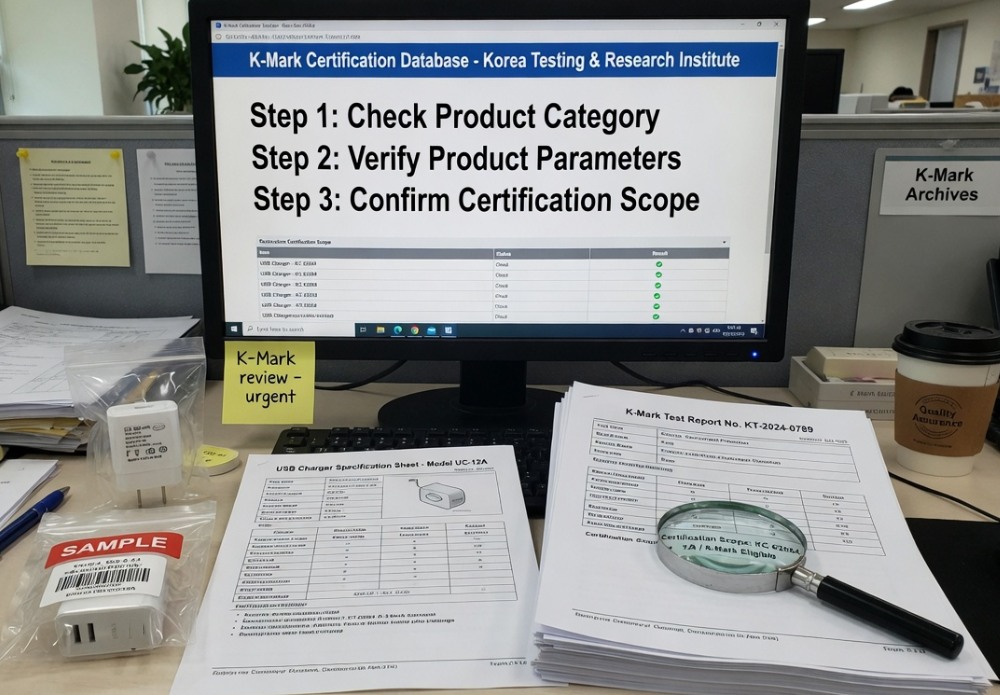
To judge whether you can apply, don’t guess, follow these three steps:
- Step 1: Check the official catalog: First go to the K-Mark product standard database on KEITI’s official website to confirm whether your product has a corresponding category and current standards.
- Step 2: Check product parameters: Confirm that your product’s use, sales form, and core parameters are all within the coverage of the corresponding standards. You can’t just think it’s okay because the general category matches.
- Step 3: Confirm the scope of coverage: The specific models to be applied for and all accessories in the set must be within the scope of the standards, and none can be omitted.
If there is no corresponding category in the catalog, you cannot apply directly. You can first apply for a pre-classification consultation with KEITI or a designated institution to confirm whether you meet the conditions.
Common applicable categories for charging products
The following are only common matching directions for charging products. Whether you can apply is still subject to KEITI’s latest product standard catalog, standard scope of application, and official classification reply:
- Charger/power adapter category: Common ones such as mobile phone chargers, PD fast chargers, car chargers, wireless charging pads, desktop power adapters, etc. The assessment covers the full life cycle environmental indicators of the product itself.
- Charging cable/data cable category: Common ones such as USB-C cables, USB-A to C cables, separately sold magnetic charging cables, etc. The assessment covers the environmental attributes of the cables and connectors.
- Plug/interface component category: Common ones such as KC-certified detachable plugs, travel adapters, independently sold USB-C adapters, etc., provided that they are sold to consumers as independent products.
- Digital products with charging function: Common ones such as power banks, small digital accessories with charging function. For this category, the environmental attributes of the whole machine are assessed, and the charging module in it will be evaluated according to the standards of corresponding charging products.
Confusing boundaries exclusive to charging products
Many merchants fall into pitfalls in boundary judgment, especially for charging products which have many accessories and various models. You must pay attention to these points:
- Sold separately vs. given as a free gift: Charging cables and adapters sold separately to consumers can apply for K-Mark separately; if they are accessories given away when buying a mobile phone or charger, they can only be applied for together with the main product, and the K-Mark label cannot be used alone.
- Different models of the same series: Even if the appearance is exactly the same, as long as the power, interface type, and plug specifications are different, you must confirm whether they are within the scope of the standards respectively, and you cannot apply uniformly based on “same appearance”.
- Internal components vs. independent products: Charging port modules and circuit board components installed inside chargers and power banks can only be assessed together with the whole machine, and cannot apply for K-Mark alone, nor can they claim to have certification separately.
- Products sold in sets: For example, for a “fast charger + charging cable” set, every component in the set must be within the coverage of K-Mark certification before the entire set can be labeled.
These situations cannot be applied for
There are several types of charging products that are clearly not eligible to apply for K-Mark, don’t waste your effort:
- Industrial-grade chargers that are only used in industrial scenarios and not sold to ordinary South Korean consumers;
- Temporarily imported non-sale items for testing and exhibition;
- Second-hand refurbished or modified products;
- Niche special charging categories without corresponding environmental standards.
Official query method
If you are not sure, the most reliable method is to directly check the official database: Open the Korea Eco-Label product standard database on KEITI’s official website, first select the “Electrical and Electronic Equipment” category in the classification, then select the “Charging Related Products” subcategory, and you can find the current standards for the corresponding category to check whether your product parameters meet the requirements. If the boundary is still unclear, you can apply for a pre-classification consultation with KEITI or its designated institution, and prepare the application after getting an official reply.
Self-check before applying: Do you meet all these conditions?
After confirming that the product meets the application scope, it is recommended to complete the pre-self-check before submitting materials, which can save a lot of detours. Overseas applicants also have exclusive requirements to pay attention to.
Subject requirements for overseas applicants
If you are an overseas manufacturer or seller, you cannot directly apply for K-Mark from KEITI. You must meet the following conditions:
- You must designate a formal authorized representative in South Korea (often called “Korean agent” in the industry), who will be responsible for the whole process of application, communication, random inspection response, etc.;
- The applicant entity (manufacturer) has no major environmental violation records and has legal business qualifications;
- The Korean agent shall bear the responsibility for compliance docking in South Korea, such as liaison during official random inspections, follow-up of problem rectification, etc.
Pre-hard requirements for charging products
In addition to the subject requirements, your product must also meet these hard conditions, otherwise the application is difficult to pass:
- You should first confirm and obtain the applicable South Korean mandatory access certification or registration for the product (such as KC safety/EMC, energy efficiency, etc.), and the certificate is within the validity period; if the mandatory requirements for the applicable category are not met, it is not appropriate to start the K-Mark application;
- The core environmental indicators initially meet the requirements of the corresponding standards, and the specific limits shall be subject to the current version of the standards;
- Mass production consistency is guaranteed: the test prototype must be exactly the same as the final mass-produced goods, the source of key components is traceable, and materials cannot be changed casually;
- The models, specifications, and Korean labels to be applied for have all been finalized, and there are no plans for frequent changes — if you change them back and forth during the application process, it is easy to be rejected or required to make corrections.
5-step quick self-check before application
You can do a quick self-check according to these 5 steps, and start the application after confirming that there is no problem:
- Check the official KEITI catalog to confirm that the product belongs to the applicable category and the corresponding environmental standards are currently valid;
- Check the validity of the mandatory access certificate for the corresponding category, and confirm that the certificate covers all models to be applied for;
- Conduct a preliminary self-test of core environmental indicators. If you are not sure, you can find a qualified third-party laboratory to do a pre-test to avoid wasting costs if the formal test fails;
- Secure a qualified Korean agent (required for overseas applicants);
- Sort out the list of all application models, and list clearly the differences of products in the same series (such as power, interface, plug, cable length), so as to facilitate subsequent judgment on which can be applied for together.
Full K-Mark application process
The full K-Mark application process is roughly divided into 5 steps, which are explained below in combination with common problems of charging products:
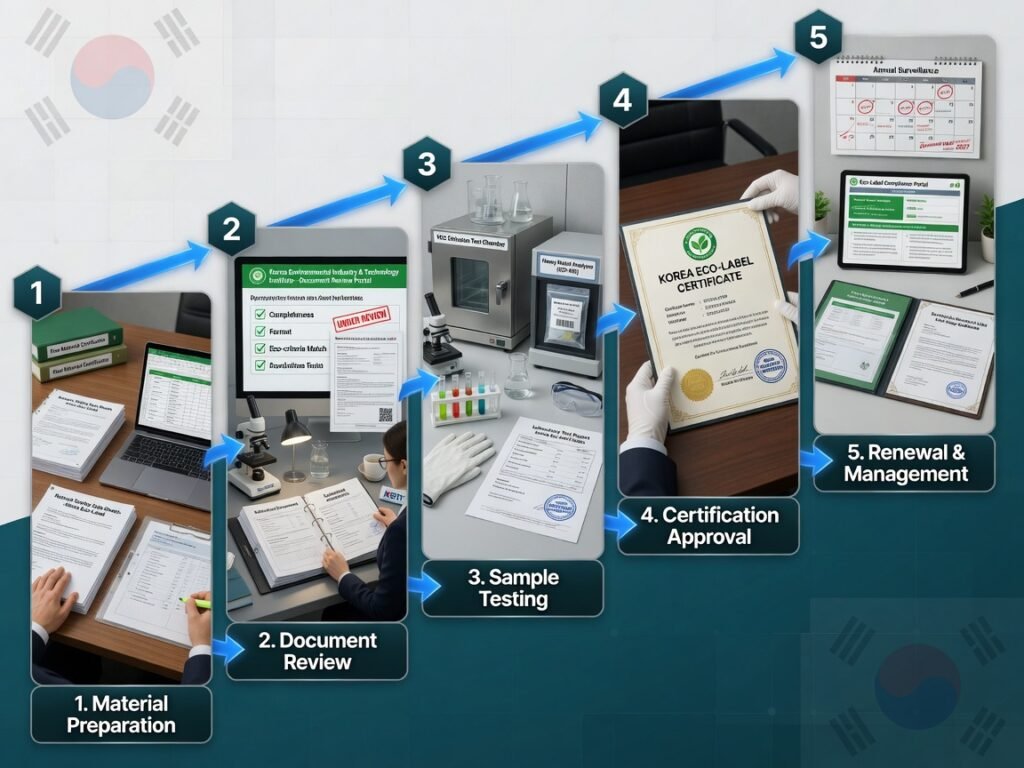
Step 1: Material preparation and submission
First, you need to sort out all necessary materials, mainly including: product model detail list, mandatory access certification certificate for the corresponding category, environmental pre-test report or pre-assessment materials (formal testing is still subject to KEITI accredited laboratories and official notifications), bill of materials (BOM) for key components, environmental certification documents for production links, etc.
After all materials are prepared, submit them through the official online application platform for South Korea’s K-Mark. Before submitting, be sure to check these points: the models and parameters in the materials are completely consistent, all documents are within the validity period, and the wording of Korean materials meets official specifications; do not use casually translated content.
There are two most common material omissions for charging products: first, the material certification of the charging cable does not correspond to the actually used cable; second, for chargers of the same series with different powers, no clear difference description is submitted. These two points must be checked in advance.
Step 2: Document review and correction
After submission, KEITI will first conduct a document review, mainly checking the completeness and compliance of the materials, as well as the consistency of product parameters and models.
If there is a problem with the materials, the official will issue a correction notice. Common reasons for correction include: missing pages of materials, conflicting parameters before and after, non-standard label design, unclear environmental certification documents, etc. After the correction is passed, it will enter the next stage. If the correction is not made within the time limit or still does not meet the requirements after correction, the application will be rejected.
Step 3: Sample testing and factory inspection (on demand)
After the document review is passed, the samples need to be sent to a KEITI accredited laboratory for environmental testing.
Not all applications require factory inspection. Generally speaking, situations such as high-power chargers and multi-model series applications may trigger factory inspection, which mainly checks the factory’s environmental management system and the consistency between mass-produced products and submitted materials.
If the test or inspection fails, you can apply for a retest after rectification within the specified time, and the specific number of retests shall be implemented in accordance with official rules. Here is a special reminder: The test samples must be exactly the same as the mass-produced goods, and you must never make a special “optimized version” prototype for testing. Once a consistency problem is found, not only will the application be rejected, but it may also affect subsequent application qualifications.
Step 4: Review and certification
After both the sample test and the factory inspection (if any) are passed, KEITI’s review committee will conduct a final review, and after the review is passed, the K-Mark certificate will be issued.
The certificate will clearly mark the covered product models, validity period, and applicable standard version. You must check carefully to ensure that all models for which you want to use the label are within the scope of the certificate.
If the materials are complete, all stages are passed at one time, and no factory inspection is required, the conventional application cycle is about 2-4 months, and the specific time will vary according to the applied category and the number of corrections.
Step 5: Renewal and change management
The validity period of the K-Mark certificate is usually 3 years, and the specific period shall be subject to the mark on the certificate.
If you want to renew, you need to submit an application 6 months before expiration. The official will recheck whether the product’s environmental indicators meet the current standards, and may require additional tests for some items.
During the validity period of the certificate, if the product’s materials, core components, power, interface, plug, or production address change, you must report to KEITI in advance. For major changes, re-testing is required, and you cannot continue to use the label after making changes without permission.
Cost composition and influencing factors
Many people care about how much it costs to apply for K-Mark. In fact, there is no unified public pricing. The cost is mainly composed of the following parts: application fee, sample testing fee, factory inspection fee (if any), and annual label usage fee.
The specific cost will be affected by these factors: product category, number of items to be tested, whether factory inspection is required, and the certification service agency you choose. If you want to know the exact price, it is recommended to directly inquire with the certification body designated by KEITI, and do not trust the so-called “fixed price” promises.
Label usage rules and pitfalls to avoid
Obtaining the K-Mark certificate is just the beginning. Improper use may result in revocation of certification and penalties. The following are the label usage rules and key points for avoiding pitfalls for charging products.
Correct usage specifications for charging products
First, let’s talk about the correct way to use it. There are these specific requirements for charging products:
- Usage position: It can be printed on the charger shell, the minimum sales package of the charging cable, e-commerce product detail pages, and product manuals;
- Usage requirements: It must not be deformed or discolored, and must not be used beyond the model range marked on the certificate;
- Online labeling requirements: When selling on South Korean e-commerce platforms, the K-Mark certificate number must be marked simultaneously for consumers to check;
- Special requirements for small accessories: If it is a very small adapter or thin charging cable, and there is not enough space on the body to print the label, it can only be marked on the packaging and manual, and does not need to be printed on the product body.
Common violations and consequences
These types of violations must be avoided:
- Printing or labeling the K-Mark without obtaining certification;
- Using the label beyond the certified model and category range, for example, only the 25W charger is certified, but the 65W charger is also labeled;
- Continuing to use the label after the certificate has expired or become invalid;
- Product changes are not reported, and the actually sold product is inconsistent with the certified version.
Depending on the circumstances of the violation, you may face penalties such as fines and product removal; if the circumstances are serious, you may also be included in the dishonesty list, and subsequent K-Mark or related environmental compliance applications may be affected.
Quick method to judge authenticity
If you want to verify whether a product’s K-Mark is real, you can use these three methods to quickly judge:
- Check the certificate number: Enter the certificate number in KEITI’s official system to verify whether the certificate is valid;
- Check the model: The model on the certification certificate must be exactly the same as the actually sold product model, not even a single letter difference;
- Check the category: The product category on the certificate must match the function of the actual product. For example, you cannot use a charging cable certificate to label a charger.
Common characteristics of fake labels include: deformed label pattern, no corresponding certificate number, and inconsistent model or parameters with the certificate.
Exclusive pitfalls for overseas applicants
As an overseas applicant, there are several exclusive pitfalls to pay attention to:
- Choose a Korean agent carefully: You must choose a Korean agent with formal qualifications and experience in charging product certification, otherwise the docking efficiency will be low, and it is easy to make mistakes due to unfamiliarity with the rules;
- Sample consistency is key: The test samples must be exactly the same as the mass-produced goods. Don’t take chances with optimized prototypes. Once inconsistency is found in subsequent random inspections, all previous investments will be wasted;
- Pay attention to standard updates: South Korea’s environmental standards (such as K-RoHS, standby power consumption requirements) are updated from time to time. You should pay attention to them in advance and make adaptations before renewal to avoid renewal failure;
- Coordinated preparation for multiple certifications: Some materials for KC certification, energy efficiency labels, and K-Mark can be shared, and test reports that meet the qualification requirements can also be reused. They can be prepared simultaneously to save time and cost.
Common misunderstandings and decision-making framework
In addition to usage rules, you also need to avoid several advanced cognitive misunderstandings. The following practical decision-making framework can help you judge whether it is worth applying and reduce risks.
High-frequency cognitive misunderstandings for charging products
Many merchants who have been in the business for a while also fall into these pitfalls, so you must pay attention:
- Misunderstanding: Once you get the certificate, it’s done once and for all → Correct answer: K-Mark has ongoing compliance requirements such as annual random inspections, standard updates, and certificate renewal. It’s not that you don’t have to worry about it anymore after getting the certificate.
- Misunderstanding: Products with the same appearance can share the certificate → Correct answer: As long as there are changes in power, interface, plug, cable length, or materials, the certification scope may be affected. Only models clearly listed on the certificate can use the label.
- Misunderstanding: Having a RoHS report means you can pass K-Mark → Correct answer: RoHS hazardous substance testing is only part of the K-Mark assessment. K-Mark’s test items, limits, and test methods may be different from RoHS, so RoHS reports cannot be directly used as a substitute.
- Misunderstanding: K-Mark testing and KC testing are completely duplicated → Correct answer: Only some hazardous substance test items can be reused if the report meets KEITI’s qualification requirements, and most environmental-related tests still need to be done separately.
Practical decision-making framework for overseas merchants
Whether to apply for K-Mark, don’t follow the trend, judge according to this framework:
First, check “whether you can apply”
Only when you meet these three conditions are you eligible to apply:
- The product is in KEITI’s latest catalog and has currently valid environmental standards;
- The applicable South Korean mandatory access certification or registration for the product has been obtained, and the certificate is valid;
- The product is a stable mass-produced version, and there will be no frequent design or material changes in the short term.
Then, check “whether you should apply”
After meeting the application conditions, then judge whether it is worth investing the cost to apply, mainly depending on these three points:
- Your South Korean customers, cooperative platforms, and purchasers explicitly require or recognize K-Mark, for example, you are doing government procurement orders or focusing on the high-end market;
- Your product does have environmental selling points, such as using recyclable materials, and the content of hazardous substances is far lower than the standard. Obtaining certification can form differentiated competition;
- The cost and cycle of the application match your product launch plan. Don’t wait until the certificate is issued and the product is already outdated.
Finally, check “how to reduce risks”
If you decide to apply, you can use these methods to reduce risks and save costs:
- First sort out the difference table of all application models, clarify which models can be applied for together, and there is no need to apply for each model separately;
- Confirm the stability of the supply chain of key components in advance to avoid the need for re-testing due to material changes during the application process;
- Finalize the Korean labels and manuals in advance according to the requirements, reduce the number of corrections, and shorten the application cycle;
- Clarify the division of responsibilities with the Korean agent, such as who is responsible for preparing materials, who is responsible for docking with the official, and who is responsible for responding to random inspections, to avoid mutual shirking of responsibilities.
Summary
At this point, the scope of application and application process of K-Mark for charging products are finished. From entry to advanced level, you should have mastered these core abilities: you can distinguish the different roles of K-Mark, KC, KS, and energy efficiency labels, you can use the three-step method to judge whether your charging product meets the application conditions, you can independently complete the pre-application self-check and material preparation, you know the exclusive requirements for overseas applicants, you can identify the illegal use of the label and its authenticity, and you can also judge whether to apply and how to reduce application risks according to your actual situation.
As a voluntary environmental label, K-Mark is not omnipotent, but for charging product merchants who want to differentiate themselves in the South Korean market, take the high-end route, or connect with government procurement, it is indeed a very valuable bonus point. Whether to apply or not depends on your product positioning and market demand.