
If you often buy small accessories like chargers and fast charging cables, or run a cross-border e-commerce business targeting the South Korean market, you may have recently heard a lot about the “update to South Korea’s WEEE system”. Many people wonder: isn’t this a European recycling system? Does South Korea have it too? What does it have to do with me? In fact, South Korea has long had its own independent waste electrical and electronic equipment recycling system. This adjustment focuses on supplementing the relevant rules for small charging accessories, which will affect both ordinary consumers and cross-border sellers. Starting from basic concepts, this article sorts out the background, scope, rules and practical judgment methods of this adjustment. After reading it, you can make a preliminary judgment on compliance by yourself and avoid common misunderstandings.
Basics for Beginners: First Understand What South Korea’s WEEE Is
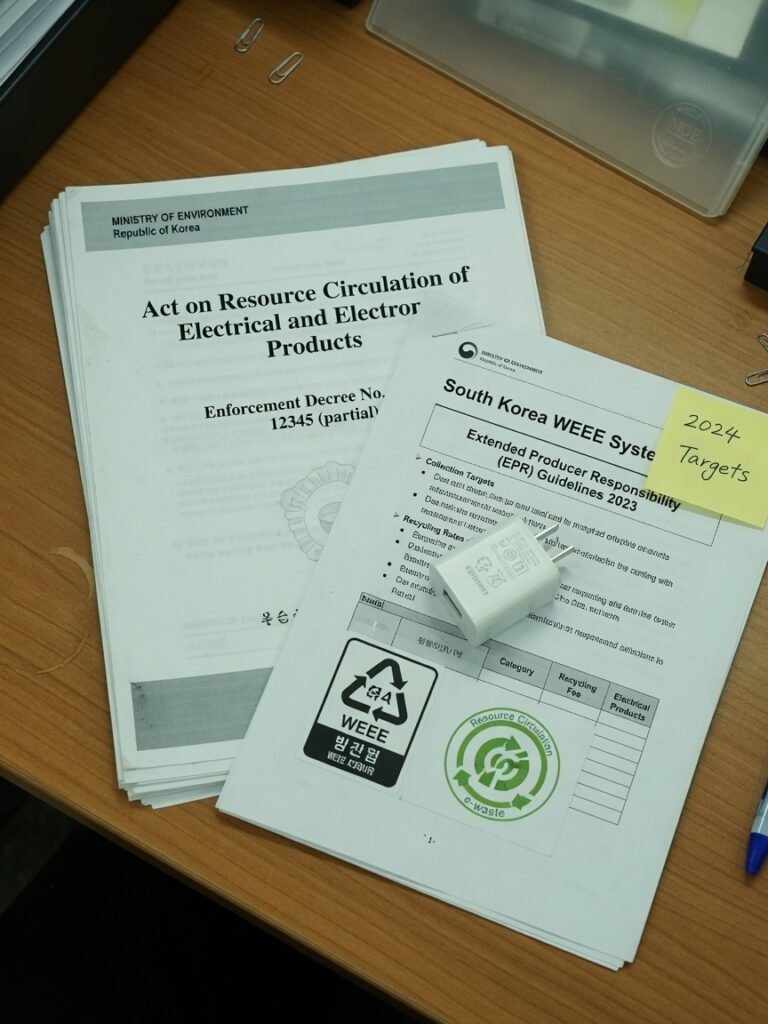
The legal name of South Korea’s WEEE-related system is the “Electrical and Electronic Products Resource Circulation System”, which falls under the internationally accepted category of waste electrical and electronic equipment (WEEE) recycling, but the rules are completely independently formulated by South Korea. Its core logic is called “Extended Producer Responsibility” (EPR). In plain terms: whoever puts a product on the South Korean market is responsible for the recycling and treatment of the product after it is scrapped, bears the corresponding costs and management responsibilities, and cannot leave the entire burden of recycling to the government and consumers.
The core regulation of this system is South Korea’s Act on the Resource Circulation of Electrical and Electronic Products and Automobiles. Its jurisdiction only covers the “scrap and recycling” link — it is not a safety certification, nor does it regulate product quality or performance. It only manages whether products can be properly recycled after they are broken and whether resources can be recycled.
Connection with Charging Products
The core reason why this adjustment has attracted attention is that the e-waste from small charging accessories has grown extremely rapidly in recent years: products such as fast chargers, wireless chargers, and power banks have fast replacement cycles and large discard volumes, but the original system had gaps in coverage. Before the adjustment, South Korea’s WEEE clearly covered power adapters with circuits, mobile phone chargers, and portable power banks, but purely passive products without any electronic components (such as travel adapters with only metal prongs, ordinary charging cables without chips) were not within the scope of supervision.
Core Differences from EU WEEE (Common Pitfalls)
Sellers who have worked in the European market tend to mistakenly believe that WEEE is a unified standard, and that an EU WEEE registration number can be directly used in South Korea. This is completely wrong.
South Korea’s WEEE and EU WEEE are two completely independent systems: the regulations, competent authorities, product classification catalogs, and declaration systems are all different. The EU’s WEEE registration number and the general crossed-out trash bin logo are not recognized in South Korea, and must never be directly applied. South Korea places more emphasis on localized assessment targets such as resource recycling rates in the declaration and implementation links, and EU compliance results cannot directly replace South Korea’s requirements.
Why Pay Attention to This Adjustment
For ordinary consumers, understanding this adjustment can help them judge whether charging products have fulfilled their recycling responsibilities, whether they can use formal recycling channels later, and avoid troubles caused by buying non-compliant products.
For small cross-border sellers, this adjustment is directly related to whether products can be legally sold in the South Korean market. Non-compliance may lead to risks such as product removal and fines. Understanding it in advance can avoid unnecessary losses.
Update Background and Effective Rules
Core Driving Factors
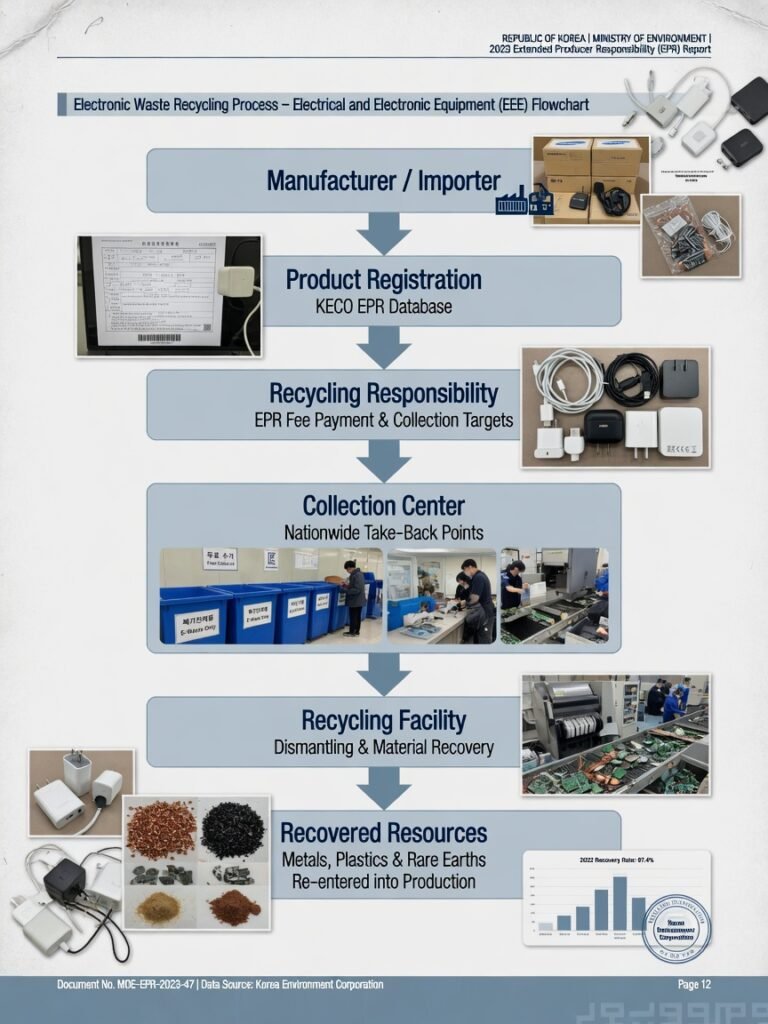
This adjustment is mainly driven by three aspects:
First, internal demand: Small charging e-waste is growing too fast, the original system has incomplete coverage and gaps in responsibility division. For example, the responsibility boundary for cross-border direct mail products was previously vague, making it difficult to implement recycling responsibilities.
Second, external alignment: South Korea needs to match international environmental protection rules, clarify recycling responsibilities in cross-border e-commerce scenarios, and fill regulatory loopholes.
Third, policy direction: The core of this adjustment is four things — expanding the covered product categories, clarifying responsible entities, unifying labeling specifications, and gradually increasing recycling targets.
Effective Rules for Charging Products
This adjustment is carried out in phases. The effective time of different sub-categories and the officially announced trigger conditions for registration and recycling obligations shall be subject to the latest announcements of the South Korean Ministry of Environment and official implementing agencies. Trigger conditions may vary by category, placement quantity/weight, type of responsible entity, or implementation year. The general promotion logic is to roll out in batches based on product sales volume and popularity, first covering categories with high ownership, and then expanding to niche accessories.
Transition Period and Old Inventory Handling Rules
A transition period is set for this adjustment. The duration of the transition period for different categories and the saleable period of old inventory shall be implemented in accordance with the official announcement of the corresponding category. The general principle is: old inventory legally produced or imported during the transition period can continue to be sold within the specified period; after the transition period ends, all charging products of the corresponding categories circulating in the South Korean market must comply with the new version of the rules. Cross-border sellers should note that they should not stock up on large quantities of goods printed with old-version labels near the end of the transition period to avoid losses from unsold inventory.
Update on Scope of Application: Which Charging Products Are Subject to Supervision
This is the part that everyone is most concerned about. A preliminary judgment can be made from two dimensions: product function and sales form. The final conclusion shall be subject to the official product classification catalog of the South Korean Ministry of Environment.
Inclusion/Exemption Situations Divided by Product Function
From the perspective of the system logic, as long as it is a charging product with circuit, chip, power conversion or electronic identification functions, it is highly likely that it needs to be verified whether it falls within the scope of mandatory recycling — for example, common fast chargers, wireless chargers, USB-C cables with smart identification functions, portable power banks, desktop charging stations and other categories need to be confirmed against the official catalog.
There are four types of situations that can be exempted according to the rules:
- Purely passive product exemption: Products without any electronic components, such as travel adapters with only metal prong conversion functions and ordinary passive charging cables without chips, are usually not handled according to the recycling responsibility caliber of electrical and electronic products because they do not have circuit, chip or electronic control functions.
- Personal use exemption: Charging accessories purchased overseas for personal use that meet the quantity requirements stipulated by South Korean official regulations can be exempted from mandatory recycling responsibilities; if purchased in bulk for resale, they do not fall into the category of personal use.
- Sample/repair part/exhibition item exemption: Charging accessories that are only used for testing, repair replacement, exhibition display and not sold to end consumers can be exempted from mandatory recycling responsibilities.
- B2B component exemption: Charging accessories that are only used as industrial supporting components and not directly sold to end consumers (such as power modules built into industrial equipment) can be exempted from mandatory recycling responsibilities.
The above exemptions are only for the preliminary judgment of the WEEE recycling responsibility registration/declaration caliber, and do not replace customs, KC, K-RoHS, or platform sales rules; if samples, exhibition items, or repair parts are converted to sales or bulk circulation, they shall be re-judged as products placed on the market.
Responsibility Attribution Divided by Sales Form
According to different sales forms, responsibility attribution can be divided into four categories:
- Independently sold charging accessories: For example, a 20W fast charger sold separately, the brand owner or importer shall bear the recycling responsibility.
- Original charging accessories included with the main device: For example, the charger included in the box when buying a mobile phone is usually incorporated into the recycling responsibility of the main product, and shall be borne by the main device brand owner according to the official declaration caliber; whether it is necessary to list accessory data separately or declare according to the set caliber shall be subject to the official catalog and the requirements of the implementing agency.
- Charging products sold in sets: For example, a “fast charger + fast charging cable” set, the brand owner or importer of the set shall bear the overall recycling responsibility.
- Brand-new charging accessories given as promotional gifts: For example, a fast charger given when buying a Bluetooth speaker, the gifted product is also within the scope of responsibility, and shall be borne by the responsible entity corresponding to the event organizer. Responsibility cannot be exempted just because it is a gift.
Update on Declaration Requirements: Changes in Responsible Entities and Rules
The core adjustment direction of this declaration rule is to further clarify the responsibility boundaries under different sales scenarios, especially to supplement the responsibility judgment logic for new channels such as cross-border e-commerce.
Adjustment of the Scope of Responsible Entities
One of the core adjustments of this system update is to include entities that sell charging products to South Korean consumers through cross-border e-commerce and overseas direct mail into the scope of responsibility verification. The core of the judgment of responsible entities for South Korea’s WEEE follows the principle that “the entity that first places the product on the South Korean market bears the recycling responsibility”, which needs to be comprehensively judged in combination with the manufacturer, importer, brand owner, agency arrangement, sales channel and official declaration caliber. In traditional trade scenarios, locally registered South Korean brands and officially authorized general distributors are usually the responsible entities; in scenarios such as cross-border e-commerce and overseas direct mail, if there is no local South Korean importer, authorized general distributor or other entity that has assumed responsibility, overseas sellers usually need to complete registration and declaration through local South Korean agents, recycling agencies or platform recognition mechanisms, subject to the sales channel and official caliber.
Division of Responsibilities of All Parties (Exclusive for Charging Products)
- Brand owner/importer (responsible entity): Responsible for all compliance work such as recycling responsibility registration, payment of recycling fees, regular data declaration, and retention of relevant vouchers.
- OEM/ODM factories: Only cooperate in providing basic data such as product weight and material, and do not bear the responsibility for declaration and fee payment.
- E-commerce platforms: Bear the obligation of compliance supervision, and do not replace sellers/brand owners to bear the statutory recycling responsibility.
Declaration and Data Retention Requirements
Details such as the specific declaration cycle and data retention period shall be subject to the latest official announcement. The general requirement is to declare sales and recycling data according to the specified cycle, and retain relevant vouchers until the period required by the official.
Update on Labeling and Recycling Rules: Core Requirements
Labeling is the most intuitive manifestation of compliance, and it is also the adjustment point that many people first notice.
WEEE Labeling Requirements
This update has made clear adjustments to the labeling of charging products included in the electrical and electronic products resource circulation catalog (note that this is different from the separate recycling label on product packaging; this refers to the recycling responsibility label on the product itself). Most of the old-version labels previously implemented were trash bin patterns paired with the old logo of the South Korean Ministry of Environment. The new version uniformly uses the recycling label designated by the South Korean government, accompanied by South Korea’s local recycling classification code. The format, size, and durability requirements of the code shall be subject to the official classification catalog and labeling specifications, and labels from other countries/regions shall not be designed or applied without authorization.
The general principle for the printing position of labels on charging products is:
- For products with sufficient surface area such as chargers, wireless chargers, and desktop charging stations, the label shall be printed on a conspicuous position of the body;
- For products that are too small to be printed on the body (such as thin-diameter charging cables), they can only be printed on the outer packaging;
- For set products, the outer packaging must be marked with recycling-related information for the entire set.
EU WEEE labels and self-made patterns have no compliance effect, and printing them does not count as compliance.
Adjustment of Recycling Rules and Billing Methods
The specific recycling rate targets and billing values shall be subject to the latest announcement of the South Korean Ministry of Environment. Judging from the publicly available policy direction, the adjustment mainly focuses on three aspects:
First, the recycling rate target is gradually increasing, and subsequent recycling requirements will become higher and higher.
Second, the billing rules will more scientifically reflect the recycling and treatment costs, and will no longer only refer to product weight. Products with easy-to-disassemble and recyclable designs may have lower overall costs for subsequent recycling and treatment; while products with complex structures, large amounts of sealant, and difficult disassembly may face higher pressure on recycling compliance costs in the long run.
Third, recycling channels have been further expanded. In addition to community recycling points, they can also be processed through various channels such as e-commerce door-to-door recycling and brand trade-in, which is more convenient.
This policy orientation has also directly affected the product design ideas of brands: now many brands try to reduce the use of sealant when making fast chargers, and switch to easy-to-disassemble snap-on designs, which not only complies with environmental protection requirements, but also helps reduce long-term recycling compliance costs.
Practical Judgment Guide
For different scenarios such as daily purchase and cross-border sales, compliance can be judged, basic self-inspection can be completed, or official judgment can be applied for through corresponding methods:
Ordinary Consumers: 3 Steps to Judge Whether Charging Products Are Compliant
When ordinary consumers buy charging products, they can quickly judge whether they meet South Korea’s WEEE requirements through 3 steps:
Step 1 Check the label: First check whether there is a new version of the recycling label designated by the South Korean government and a local recycling classification code on the product body or packaging. If there is no standard label at all, it is highly likely that the recycling responsibility has not been fulfilled.
Step 2 Check information: Verify the responsible entity, brand or product information through the query portal published by the South Korean Ministry of Environment, K-eco or official implementing agencies; whether English is supported and whether search by model is available shall be subject to the actual page. If the corresponding information cannot be found, you can directly ask the seller for the WEEE responsibility registration certificate.
Step 3 Ask the seller: If it is an overseas direct mail product, it is recommended to ask the seller in advance before placing an order to confirm whether the other party has completed the South Korea WEEE recycling responsibility registration, so as to avoid buying non-compliant products.
If you don’t want to go through the trouble, prioritize purchasing from formal and compliant channels. Usually, such channels will implement relevant compliance requirements in advance, and subsequent scrap recycling will be more guaranteed.
Small Cross-border Sellers: Basic Compliance Self-inspection Checklist
Sellers operating in the South Korean market can complete the basic self-inspection against these 5 items:
- Category verification: First, compare with the official catalog of the South Korean Ministry of Environment to determine whether the product falls within the scope of inclusion.
- Confirmation of obligation trigger conditions: Check whether your own situation meets the officially announced trigger conditions for registration, declaration or recycling obligations (trigger conditions may vary by category, placement quantity/weight, type of responsible entity, or implementation year); if the mandatory conditions are not met, you can evaluate voluntary registration or prepare for compliance in advance.
- Label inspection: Confirm whether the pattern, code, and printing position of the product label meet the new version requirements.
- Responsibility implementation: Whether a formal agreement has been signed with a recycling agency or responsible agent recognized by the South Korean government — most overseas sellers do not have local South Korean qualifications and need to find an agent to handle declaration and fee payment matters.
- Material preparation: Whether the basic materials required for declaration are prepared to avoid omissions during declaration.
Full Process of Official Compliance Judgment (Applicable to Gray Area Products)
If the product is in a gray area (such as an adapter with an indicator light, and you are not sure if it counts as having a circuit), you can go through the official compliance judgment process, which has 5 steps:
Step 1, confirm whether the product enters the South Korean market — whether it is stocked in a local warehouse, overseas direct mail, or sold locally in South Korea, as long as it enters the South Korean market, compliance needs to be judged.
Step 2, check the official catalog: Compare with the latest recycling classification catalog of the South Korean Ministry of Environment to verify the product’s category and whether it is within the scope of inclusion.
Step 3, confirm the sales form and responsible entity: Combine the sales channel and import chain to judge whether you are the responsible entity and whether you have the obligation to register and declare.
Step 4, prepare materials and submit for verification: Organize product information, sales data, etc., and submit them to the official implementing agency or authorized agent for verification.
Step 5, gray area review: If you have questions about the judgment result, or the product is indeed relatively ambiguous, you can apply for official pre-judgment, and proceed with compliance work after getting a clear answer.
List of Basic Materials Required for Declaration
Four types of materials are mainly required for declaration:
- Basic product information: including model, unit weight, material composition, function description, etc.
- Sales data: vouchers such as sales volume and import records in the South Korean market during the corresponding declaration cycle.
- Entity qualifications: registration information of the brand owner or importer, and if an agent is entrusted, an authorization document shall also be provided.
- Packaging and labeling materials: including packaging design drawings and description of label printing position.
Common Consequences of Non-compliance
For ordinary consumers, purchasing products that have not fulfilled WEEE recycling responsibilities may make it impossible to dispose of scrapped products through formal public recycling channels. If some non-compliant products are involved in platform compliance verification, it may also affect relevant after-sales rights and interests.
For sellers or brand owners, those who fail to perform WEEE obligations in accordance with regulations may face consequences such as supplementary registration, supplementary payment of fees, removal of products from platforms, and administrative penalties. In serious cases, they may be restricted from selling in the South Korean market. The specific punishment standards shall be subject to relevant South Korean regulations and the implementation rules of the corresponding platforms.
Connection with Other South Korean Environmental Protection/Access Systems
Connection with South Korea’s Environmental Label (Voluntary)
South Korea’s Environmental Label is a voluntary environmental certification launched by the government, which is not a mandatory access requirement. Its evaluation dimensions cover multiple environmental indicators throughout the product life cycle, which is wider than WEEE, which only covers the scrap and recycling link. The two are completely independent systems. Obtaining the South Korea Environmental Label cannot replace the mandatory registration, declaration, and fee payment obligations of WEEE. The two also have overlapping requirements, such as both encouraging easy-to-disassemble designs and controlling the content of hazardous substances. For charging products, the environmental label can be used as a reference for consumers to purchase, and can also be used as a differentiated promotional point for sellers.
Core Differences from Mandatory Access/Environmental Protection Systems
The ones that people are most likely to confuse are KC certification, K-RoHS and WEEE. The core differences between the three are as follows:
- Difference from KC certification: KC certification manages product safety and electromagnetic compatibility, and is a mandatory requirement for market access — without KC certification, products cannot be sold in the South Korean market at all; while WEEE manages scrap recycling, which is a mandatory environmental protection requirement, and does not care about product safety, only the recycling and treatment after scrapping.
- Difference from K-RoHS: K-RoHS is also a mandatory environmental protection requirement, but it manages the restriction of hazardous substances in products (such as lead, mercury, etc. cannot exceed the standard); while WEEE manages the recycling and treatment of products after scrapping. Both are environmental protection requirements, but they are completely independent and cannot replace each other.
All voluntary environmental labels cannot replace WEEE mandatory compliance obligations.
Common Misunderstandings and Pitfall Avoidance Tips
Misunderstandings of Concept Confusion
- Misunderstanding: WEEE label represents product safety → Correct explanation: WEEE only manages the compliance of the scrap and recycling link, and has nothing to do with product safety and performance. To judge product safety, you need to look at KC certification.
- Misunderstanding: EU WEEE label/registration number is universal in South Korea → Correct explanation: South Korea’s WEEE and EU WEEE are two completely independent systems. EU qualifications and labels are not recognized by South Korean officials and cannot be directly applied.
- Misunderstanding: South Korea’s Environmental Label can replace WEEE obligations → Correct explanation: The two are independent systems. The voluntary environmental label cannot exempt the mandatory WEEE compliance obligations.
Misunderstandings of Scope Judgment
- Misunderstanding: All charging cables do not need to be compliant → Correct explanation: Charging cables with electronic control/identification functions (such as high-power USB-C fast charging cables with smart identification chips) need to be checked against the official catalog to confirm whether they are included in the mandatory scope. Not all charging cables are exempt.
- Misunderstanding: Small-sized charging products do not need to be compliant → Correct explanation: Whether it is included in supervision depends on whether the product has electronic functions such as circuits/chips, and has nothing to do with the size. Products with circuits such as mini fast chargers and small wireless chargers need to be checked for compliance requirements.
- Misunderstanding: All personally purchased overseas charging products need to be compliant → Correct explanation: Products for personal use that meet the official quantity requirements can be exempted, while those purchased in bulk for resale need to be compliant in accordance with regulations.
Misunderstandings of Responsibility and Practice
- Misunderstanding: Just printing the WEEE label counts as compliance → Correct explanation: Full compliance requires completing the entire process such as recycling responsibility registration, regular declaration, and fee payment. Only printing the label without authorization not only does not count as compliance, but may also face more severe penalties for false labeling.
- Misunderstanding: The platform will bear all compliance responsibilities → Correct explanation: The main body of recycling responsibility is the entity that first places the product on the market, such as the brand/seller. The platform only bears the obligation of compliance supervision and will not replace the seller to bear the statutory recycling responsibility.
- Misunderstanding: The original WEEE qualification is valid for a long time → Correct explanation: After the system adjustment, it is necessary to re-check the product coverage, labeling requirements, rate rules and other content, and it cannot be done once and for all.
- Misunderstanding: Low sales volume means automatic exemption → Correct explanation: Whether the mandatory registration conditions are met needs to be judged against the officially announced standards, and exemption cannot be determined by oneself.
Core Summary
- South Korea’s WEEE (Electrical and Electronic Products Resource Circulation System) is a mandatory environmental protection system for the recycling of waste electrical and electronic products. Its core is extended producer responsibility, and it only governs the scrap and recycling link. It is an independent system from KC certification (safety and electromagnetic compatibility, mandatory access), K-RoHS (hazardous substance restriction, mandatory environmental protection), and South Korea Environmental Label (voluntary environmental certification), and they cannot replace each other.
- Whether charging products are included in the mandatory recycling scope needs to be preliminarily judged based on product functions (whether they have circuit/chip/electronic identification functions) and sales forms. The final decision shall be subject to the official product classification catalog and effective batches of the South Korean Ministry of Environment; purely passive products, personal items that meet the requirements, non-sales samples/repair parts/exhibition items, and B2B components can be exempted according to the rules (the exemption is only for WEEE registration and declaration obligations, and does not replace other regulatory requirements).
- The responsible entity is comprehensively judged based on the principle of “first placement on the South Korean market” in combination with sales channels and import chains. This update has included sales entities of cross-border e-commerce and overseas direct mail into the scope of responsibility verification; overseas sellers without local responsible entities usually need to complete declarations through local agents or platform recognition mechanisms.
- Ordinary consumers can judge product compliance through 3 steps: checking labels, checking official information, and asking sellers; cross-border sellers can complete basic self-inspection through 5 steps: category verification, obligation trigger condition confirmation, label inspection, responsibility implementation, and material preparation. Gray area products can apply for official pre-judgment.
For policy developments, you can first follow the latest announcements of official implementing agencies such as the South Korean Ministry of Environment and K-eco, then refer to the guidelines of relevant South Korean electronics industry associations, and finally pay attention to the supporting rules of cross-border platforms. The specific implementation requirements shall be subject to the latest official announcements.