
If you often buy charging accessories on South Korean e-commerce platforms, or engage in the business of charging products expanding to the South Korean market, you have most likely seen, in addition to the KC safety label, another “high-efficiency energy-saving” label printed with the KEA logo. Many people have questions: Is this the same thing as the mandatory energy efficiency grade? Is it printed casually by merchants? Is it necessary to look for this label when buying chargers?
1. System Positioning: Not a Market Access Threshold, but an Advanced Energy-Saving Certification
To understand the voluntary energy efficiency label, it is necessary to first clarify the positioning of different systems in the compliance system related to South Korean electronic and electrical appliances:
- KC Safety/EMC Certification: Mandatory safety access requirement, which assesses safety risks such as electric shock, fire, and electromagnetic interference. It is the basic access condition for products to be sold in the South Korean market, and belongs to an independent compliance chain from energy efficiency.
- Mandatory Energy Efficiency Grade Label: Mandatory market access requirement. Covered categories need to be marked with energy efficiency grades 1 to 5 (grade 1 is the best). Products that do not meet the standards cannot be sold, and it is the most basic energy efficiency threshold.
- Voluntary High-Efficiency Energy Equipment Certification: That is the voluntary energy efficiency label which is the core of this article, managed by the Ministry of Trade, Industry and Energy of South Korea and implemented by the Korea Energy Agency (KEA, the official English name shall be subject to the latest public announcement). It is an advanced energy-saving certification issued for products whose energy efficiency is higher than the basic standard of the same category, and is not a mandatory requirement for market access.
- Standby Power Consumption Reduction Plan: A semi-voluntary special plan that only assesses the power consumption of products in standby mode, and is not equivalent to comprehensive energy efficiency certification.
- South Korea Environmental Label (EL Mark): A voluntary certification managed by the Ministry of Environment, which assesses the environmental protection of products throughout their life cycle from production to scrapping, and energy efficiency is only one of the assessment contents.
Simply put, products that have not applied for the voluntary energy efficiency label can be legally sold in South Korea as long as they meet KC and corresponding mandatory energy efficiency requirements (if they are in the mandatory catalog); certified products represent that their energy efficiency level is higher than the basic standard of the same category.
Let’s first clarify three misunderstandings that beginners are most likely to have, to avoid errors in subsequent judgments:
First, it is not “voluntary = can be pasted freely”. The label must be used after official review by KEA and authorization obtained. Unauthorized printing is a violation and will face penalties.
Second, it is not “having KC = having energy efficiency label”. KC is in charge of safety, and voluntary energy efficiency is in charge of energy saving. They belong to different compliance chains. Passing KC does not mean that energy efficiency meets the standards, let alone that there is voluntary energy efficiency certification.
Third, it is not “certified = power saving in all scenarios”. The energy efficiency parameters on the label are test results under 220V/60Hz normal temperature laboratory conditions. In actual use, conditions such as unstable voltage, extreme temperature, and poor quality of the matching charging cable will cause deviations in actual efficiency.
2. Application Scope: Which Charging Accessories Can Apply for This Label?
The first question for many people who make charging accessories is: Can my product apply for the voluntary energy efficiency label? The final scope shall be subject to the catalog published by KEA in the current period, but the general coverage rules for charging products can be prioritized for verification in the following directions.
Basic Scope of Priority Verification and Non-Applicability
Charging categories for priority verification:
- USB-A/C port chargers, laptop/monitor external power adapters: They are common categories covered by voluntary energy efficiency, but whether they are included depends on the current product category rules, rated power range, output interface type and product definition.
- Multi-port desktop charging stations, charging docks with power management: Need to check whether the specific power and output type meet the requirements of the current catalog, and eligible products can apply.
- Wireless charging pads, power banks, car chargers: The coverage is dynamically adjusted, and you need to check the latest KEA catalog one by one before applying to confirm whether they are included.
Clearly inapplicable products:
- Pure USB/USB-C charging cables, extension cords, adapters, interface accessories: These products are only responsible for conducting electricity or transmitting signals, and have no power conversion process (such as converting 220V AC to 5V DC), so they are not within the scope of energy efficiency assessment and cannot apply. If a merchant claims that a pure charging cable has this energy efficiency label, it is false publicity.
- Large home appliances, toys, non-charging consumer electronic products: They are not within the scope of charging accessories, and have their own catalog rules, which will not be expanded here.
Compliance Path Diversification Table for Charging Accessories
To facilitate everyone to quickly judge the compliance requirements of different products, a comparison table is sorted out:
| Product Type | Mandatory Compliance Requirements (Must Be Met) | Eligible for Voluntary Energy Efficiency Label | Other Notes |
|---|---|---|---|
| External power adapter / single-port charger | KC safety/EMC + mandatory energy efficiency (if in the mandatory catalog) | Eligible for most power ranges | Need to meet the energy efficiency threshold of the corresponding specific power range |
| Multi-port charger / desktop charging station | KC safety/EMC | Eligible if meeting catalog requirements | Need to assess the comprehensive efficiency of single-port and multi-port simultaneous output |
| Wireless charger | KC safety/EMC + wireless compatibility requirements (if applicable) | Subject to the current catalog | Assess wireless conversion efficiency and standby power consumption |
| Power bank | KC safety/EMC + battery-related mandatory requirements (if applicable) | Subject to the current catalog | Coverage is dynamically adjusted, need to query in advance |
| Car charger | KC safety/EMC or relevant requirements for vehicle power interfaces (subject to product attributes) | Subject to the current catalog | Coverage is dynamically adjusted, need to query in advance |
| Pure charging cable / adapter | KC safety (if applicable) + interface standards | No | Only conducts electricity, no power conversion, energy efficiency is not assessed |
3 Key Conditions for Application Eligibility Judgment
No matter what product it is, to apply for the voluntary energy efficiency label, the following core conditions must be met at the same time, and the specific implementation shall be subject to KEA rules:
- The product belongs to the voluntary energy efficiency coverage categories recently announced by KEA. This is the major premise, and products not in the catalog cannot apply.
- Separately sold accessories need to apply for certification separately; chargers sold as配套 with the main unit may be evaluated according to the rules of the main unit or the whole machine. If sold as a separate SKU, replacement part or independent packaging, it is still necessary to check whether a separate application is required as an accessory.
- The product must first meet the applicable mandatory compliance requirements of the South Korean market (such as KC safety, mandatory energy efficiency, etc.), and products that do not meet the mandatory threshold are not eligible to apply.
There are two special boundaries to note: If products of the same series have different power or use different main control chips, they cannot share the same label authorization and must apply separately; the energy efficiency assessment of multi-port chargers not only tests the single-port full-load efficiency, but also tests the comprehensive efficiency of multi-port simultaneous output, and cannot only use single-port results as the application basis.
3. Basic Label Reading: How to Understand the Label and Quickly Identify Authenticity
Formal South Korean voluntary energy efficiency labels have fixed official elements. You don’t need to memorize all parameters, just focus on the core information.
Core Components and Verification Items of the Label
The relevant information of formally certified products includes three types of key content:
The first is official label elements: There must be KEA’s exclusive logo and the official wording of “Voluntary High-Efficiency Energy Equipment Certification”. Special note: The voluntary high-efficiency certification itself does not adopt the 1-5 grade classification of mandatory energy efficiency; if a 1-5 grade label appears on the product packaging or sales page, it should be confirmed whether it is a mandatory energy efficiency grade label, and the mandatory grade cannot be equated with the voluntary high-efficiency certification.
The second is core product information: including certification number, registered product category, product model, rated input and output parameters, and applicable test standards.
The third is authorization status information: such as authorization validity period, issuing authority (KEA).
It should be noted that information such as certification number, registered category, model, rated parameters, validity period, and issuing authority can be verified through the product label, certification certificate or KEA registration query system, and not all of them are necessarily printed on the small label on the product body.
Key Parameters of Different Charging Accessories
Different types of charging accessories have different core energy efficiency parameters. You don’t need to understand all of them, just focus on these:
- Ordinary chargers and power adapters: Look at “conversion efficiency” (how much of the input AC power can be converted into output DC power, the higher the ratio, the more power saving) and “no-load standby power consumption” (the power consumption when plugged in without connecting a device, the lower the better, this parameter has a greater impact on products that are plugged in all year round).
- Wireless charging pads: Focus on “wireless conversion efficiency” (how much power from the transmitter can be transmitted to the receiver, wireless charging itself has more loss than wired, the higher this parameter is, the more power saving), and no-load standby power consumption.
- Multi-port chargers: In addition to single-port efficiency, be sure to look at the comprehensive efficiency of multi-port simultaneous output — many merchants only mark the highest single-port efficiency, but the actual efficiency when charging with multiple ports at the same time may be much lower, which is the real performance in daily multi-device charging.
- As for pure charging cables, as mentioned in the previous application scope, they are not within the assessment scope of this label; although line loss will affect the charging experience, it has nothing to do with this certification.
3-Step Quick Preliminary Judgment of Suspicious Labels
Ordinary users do not need to understand complex test standards, and can initially排查 most suspicious labels through 3 steps:
Step 1, check model consistency: The product model on the label should be exactly the same as that marked on the physical nameplate, packaging, and sales page; if the model is inconsistent, be alert to the risk of misappropriation.
Step 2, verify official label elements: Regular labels have KEA’s official exclusive logo with a unified style; those without KEA official label are highly suspicious and need further verification through official channels.
Step 3, verify registration through official system: The most accurate method is to use KEA’s official energy efficiency query system, enter the certification number on the label to check whether there is a corresponding registration, and whether the registered model, category, and validity period completely match the product.
4. Value Analysis: What Is the Use of This Voluntary Label?
Since it is not a mandatory requirement, why do both consumers and merchants value it? We explain it for two types of users:
Benefits for Consumers/Individual Purchasers
First, long-term use can reduce cumulative electricity costs. The savings depend on the difference in standby power consumption, daily plug-in duration, actual load efficiency, local electricity price and service life. The cumulative difference is more obvious for products that are frequently plugged in for a long time (such as mobile phone chargers, laptop adapters, and desktop charging stations that are plugged into sockets all year round).
Second, heat generation is usually lower. Under the same output power, products with high energy efficiency have less power loss, so less is converted into heat, and the heat generation during charging is usually lower — but this is only a general rule, cannot replace safety certification, nor does it mean that the service life is necessarily longer. Safety performance shall still be subject to KC certification.
Third, more efficient product selection. If mainstream South Korean e-commerce platforms and offline stores have special screening zones or exclusive labels for energy-saving products in the current period, recognizing this label can quickly screen high-quality energy-saving products without comparing parameters one by one.
Value for Charging Product Merchants Expanding to the South Korean Market
First, meet the participation conditions for policy-related projects. If official projects such as the South Korean government’s current energy-saving subsidies, green procurement bonus points, and public procurement access include this certification as a requirement, obtaining the label can get corresponding participation qualifications, and specific rules are subject to official announcements.
Second, increase product exposure opportunities. If e-commerce platforms have energy-saving product screening labels in the current period, products with the label can enter the corresponding screening pool and get more exposure possibilities.
Third, form differentiated competition. At present, charging accessories are highly homogeneous, and most products focus on selling points such as fast charging and multiple ports. Having official energy-saving certification can differentiate from ordinary products, and is easier to impress users who pay attention to environmental protection and energy saving.
5. Application Basics: Core Requirements and Simplified Process
If a merchant wants to apply for this label for their charging accessories, the core thresholds and processes are actually very clear.
3 Core Thresholds for Application
- The product belongs to KEA’s current voluntary energy efficiency coverage categories, which is the premise of the application.
- The product’s energy efficiency meets the KEA high-efficiency threshold of the corresponding category and power range — the threshold of voluntary energy efficiency is generally higher than the mandatory energy efficiency requirements of the corresponding category, and specific values are subject to KEA’s current catalog and standard documents of the corresponding category.
- A real energy efficiency test report issued by a South Korean accredited laboratory is required, and self-tested results are invalid.
Core Content of Energy Efficiency Testing for Charging Accessories
All tests are conducted in accordance with South Korean local standards, focusing on the following contents:
- Basic efficiency indicators: average conversion efficiency, low-load efficiency (such as efficiency at 10% load, after all, charging is not at full load most of the time), no-load/standby power consumption.
- Basic test conditions: uniformly adopt South Korean standard rated input (220V/60Hz) and normal temperature laboratory environment. Therefore, products targeting other voltage markets must be retested in accordance with South Korean standards.
- Special requirements for charging accessories: shall cover declared output gears, representative voltage and current combinations and specified load points according to applicable standards; products supporting USB PD and PPS shall check test items for multi-gear, dynamic output or programmable gears according to standard requirements; multi-port chargers shall test efficiency under different multi-load combinations (such as dual-port full load, one port full load and one port half load); sample consistency shall also be assessed to avoid inconsistency between test samples and mass-produced products.
Simplified Application Process
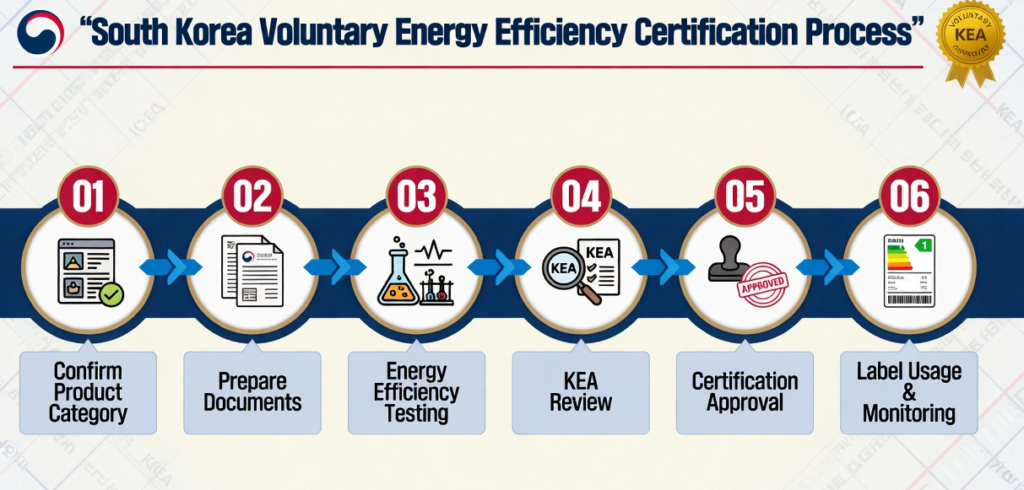
The whole process is not very complicated, and it is simplified into four steps:
Step 1, confirm coverage scope and applicant entity. First check KEA’s latest catalog to confirm the product is within the coverage; overseas brands usually need a local South Korean responsible party or agent to cooperate in submitting the application, and the applicant subject qualification is subject to KEA and specific product category rules.
Step 2, prepare materials and submit. Sort out product materials, mandatory compliance certificates (such as KC certificate), and energy efficiency test report, and submit them to KEA or its designated agency.
Step 3, official review and sample recheck. KEA first reviews the materials. If there are questions, it may require sending samples for recheck to verify whether the actual energy efficiency is consistent with the submitted report.
Step 4, issuance of authorization and supervision spot check. After passing the review, the label use authorization is issued, and the validity period is usually 3-5 years, depending on the category; during the authorization period, KEA will conduct irregular market spot checks, and the authorization will be revoked if it fails to meet the standards.
Basic Rules for Label Use
Many merchants are prone to make mistakes in this part, so be sure to pay attention:
- Authorization renewal is required before expiration, and the label cannot be used after expiration.
- Product modification (such as changing the main control chip, adjusting power, changing the heat dissipation structure) must be re-applied, and the old authorization cannot be used, because these changes will affect energy efficiency.
- It is not allowed to arbitrarily expand the scope of label use to unregistered models or categories.
- The label information on sales pages, packaging, and product nameplates must be completely consistent with the registered content, and parameters or models shall not be modified without permission.
6. Pitfall Avoidance Guide: Common Tricks and Compliance Judgment
Whether it is consumers buying products or merchants selecting products, the most common problems are label fraud or misleading publicity. Here are some common tricks:
- Falsely marking high-efficiency qualifications: The product does not meet the KEA high-efficiency threshold at all, or even has not applied for certification, but prints its own label claiming to be a high-energy-efficiency product, and the actual conversion efficiency and standby power consumption do not meet the standards.
- Misappropriation of certification: Use the certification authorization of model A on model B. For example, use the certificate of a 65W single-port charger for a 100W multi-port charger of the same series. Ordinary consumers can hardly find it if they do not check the number.
- Confusing concepts: Use KC safety labels and mandatory energy efficiency labels to pretend to be voluntary high-energy-efficiency certification. For example, call the mandatory energy efficiency level 1 label “the highest level energy-saving certification”, deliberately confusing the nature and assessment direction of different certifications.
- False publicity: For example, claim that pure charging cables have this energy efficiency certification, or equate fast charging compatibility with high energy efficiency — fast charging is power transmission capacity, which is a completely different product dimension from energy efficiency level. For example, if a 100W fast charger has low efficiency, its actual power consumption may be higher than that of a 65W high-energy-efficiency product.
Judgment Method for Label-Product Matching
To confirm whether the label and the product really correspond, you can start from the following aspects:
First, the energy efficiency threshold is subject to the current catalog, standard documents and registration query results issued by KEA or the competent authority. You can compare the official high-efficiency threshold of the same category and power range to check whether the product test parameters meet the standards.
Second, pay attention to test conditions: all energy efficiency parameters are measured in a 220V/60Hz normal temperature laboratory. If used in an environment with unstable voltage or extreme temperature, it is normal for efficiency to have deviation, which does not mean the label is fake.
Third, query the registration through KEA’s official energy efficiency system (for specific verification methods, refer to the 3-step preliminary judgment method above), confirm that the certification number, model, category, and validity period are completely corresponding, which is the most accurate verification method.
Fourth, multi-port chargers must check the test data of multi-load scenarios, and cannot only look at the highest single-port efficiency marked by merchants. High single-port efficiency does not mean high efficiency when charging with multiple ports at the same time.
4 Common Situations of Label Invalidation
The label is not permanently valid once obtained. It will be invalid in the following four situations, and continued use is a violation:
- The product is modified but the authorization is not re-applied.
- Official spot check finds that the actual energy efficiency does not meet the standards, and the authorization is revoked.
- The authorization validity period expires and is not renewed.
- Arbitrarily expanding the scope of label use to unregistered objects, and the authorization is revoked after being found.
Publicity Compliance Boundaries
Whether it is merchant publicity or consumer identification, pay attention to these boundaries:
- It is not allowed to directly publicize fast charging protocols, low temperature rise, safety certification, and environmental labels as the results of energy efficiency certification. These are product attributes of different dimensions and cannot be confused.
- It is not allowed to publicize the entire series as high-energy-efficiency products only with the certification of one model. Only the registered models count.
- All energy-saving publicity content must be completely consistent with the registered specific model and parameters, and shall not be exaggerated.
Decision Logic for Purchase and Product Selection
You don’t have to pursue this label for all products, just choose according to your needs:
- Consumer side: For high-frequency, long-term plugged-in products (such as mobile phone chargers, laptop adapters, desktop charging stations that are plugged into sockets all year round), prioritize certified products, which are more worry-free for long-term use; for low-frequency, low-power accessories (such as 5W small chargers for Bluetooth headsets), prioritize safety and compatibility, and there is no need to blindly pursue the certification.
- Merchant product selection side: Prioritize products with formal KEA registration. Be sure to verify the supplier’s label authorization documents. It is best to verify by yourself through KEA’s official system (the method can refer to the above) to avoid being punished for getting fake labels.
- Inventory management side: Confirm renewal in time before the authorization expires, to avoid continued use of expired labels on products or packaging.
7. Comparison of Easily Confused Labels: Differences from Other South Korean Labels
Many people tend to confuse the voluntary energy efficiency label with other South Korean certifications. We can clearly distinguish them by comparing one by one:
Differences from Mandatory Energy Efficiency Labels
- Different nature: Mandatory energy efficiency is a market access threshold, and products that do not meet the standards cannot be sold; voluntary energy efficiency is an advanced energy-saving certification, and not applying is not illegal.
- Different presentation forms: Mandatory labels use a general 1-5 grade (grade 1 is the best); voluntary energy efficiency only proves that the high-efficiency threshold is met, and there is no general grade classification.
- Coverage difference: Some charging products may not be included in the mandatory energy efficiency catalog, but whether they can apply for voluntary energy efficiency is still subject to KEA’s current voluntary energy efficiency catalog.
Differences from South Korea Environmental Label (EL Mark)
- Different assessment focus: Voluntary energy efficiency only assesses electric energy utilization efficiency (whether it saves electricity); the environmental label assesses the environmental protection of the product throughout its life cycle (such as whether there are harmful substances, whether it can be recycled), and energy efficiency is only one of the assessment contents.
- Different competent authorities: Voluntary energy efficiency is under the Ministry of Trade, Industry and Energy; the environmental label is under the Ministry of Environment, and they are two independent systems.
- Connection: Both belong to the voluntary standard system and can be applied for at the same time. Energy efficiency data may be used as the assessment basis for the environmental label, but the two cannot replace each other.
Differences from KC Safety/EMC Certification
- Different assessment directions: KC is in charge of safety (electric shock, fire, electromagnetic compatibility, etc.); voluntary energy efficiency is in charge of energy-saving level, and they are completely two directions.
- Different nature: KC is a mandatory access requirement; voluntary energy efficiency is a voluntarily applied bonus item.
- Connection: Applying for voluntary energy efficiency usually requires meeting KC requirements first. Specific rules are subject to the rules of the corresponding product categories, and the vast majority of charging accessories need to pass KC first.
Differences from International Energy Efficiency Labels (such as Energy Star)
- Different test calibers: South Korean energy efficiency has local test standards, which are different from the parameter requirements and test conditions of other countries.
- Not universal: Overseas energy efficiency reports cannot directly replace the requirements of the South Korean side, and cross-border sales to South Korea must be re-tested and registered.
- The same product may obtain different energy efficiency evaluation results in different markets, which is a normal phenomenon caused by different test standards.
8. Competency Summary: Practical Judgment Skills You Can Master
After reading this content, you can master three types of practical judgment skills:
First, basic identification ability: can quickly distinguish the different positioning of South Korea’s voluntary energy efficiency label, mandatory energy efficiency label, environmental label, and KC safety certification, understand the actual meaning of core energy efficiency parameters of charging accessories, and can initially judge whether different charging products are eligible for voluntary energy efficiency certification.
Second, authenticity verification ability: can use the three-step method of model checking, label element preliminary screening, and KEA official system verification to排查 suspicious labels, and confirm the authenticity and validity of the certification.
Third, decision-making judgment ability: consumers can choose whether to prioritize certified products according to usage frequency and scenarios; overseas merchants can avoid compliance risks such as label fraud and illegal use, and can clearly distinguish that energy efficiency, fast charging compatibility, and safety performance are product attributes of different dimensions, and will not be misled by confusing publicity.
In general, the voluntary energy efficiency label for South Korean electronic products is not a mandatory requirement for market access, but an official advanced energy-saving certification for specific product categories. Whether it is consumer purchase or merchant’s overseas layout, the core is to first confirm whether the product is in the coverage catalog, then verify the authenticity of the registration information through official channels, judge its value combined with actual needs, and avoid being misled by publicity that confuses concepts.