
If you have just moved to Canada, or do business in charging products for the Canadian market, you have most likely heard of the term “NRCan energy efficiency”. Many people confuse it with safety certification, do not know whether the chargers they buy or sell need to meet this requirement, and even fall into pitfalls without realizing it. In fact, NRCan’s rules are not complicated. As long as you figure out what it regulates, which products are subject to regulation, and how to judge compliance, both ordinary consumers and small businesses can avoid most troubles.
First, Understand: The Relationship Between NRCan and Charging Products
First of all, it should be clear that NRCan is the abbreviation of Natural Resources Canada. The energy efficiency rules it formulates are mandatory market access requirements — simply put, they are the “passing line”, and products that fail to meet them cannot be legally sold in Canada. The official name of this passing line is Minimum Energy Performance Standards (MEPS), whose core is to regulate whether products consume electricity and how high their efficiency is. It should be noted that NRCan is a regulatory authority, not a certification body. It does not directly issue certificates for products, but recognizes test results from third-party laboratories and then conducts official registration and filing.
The reason why charging products are regarded as a key regulatory target is closely related to our living habits. Nowadays, almost every household has several charging heads, and many people are used to leaving them plugged into the wall for a long time, even if they are not connected to a device, they are in standby mode. The standby power consumption of a single charging head seems negligible, but when millions of them across Canada are added up, the wasted electricity every year is very staggering. In addition, low-efficiency charging products convert a large amount of electrical energy into heat, which not only wastes electricity, but also accelerates the aging of internal components and shortens the service life of the product.
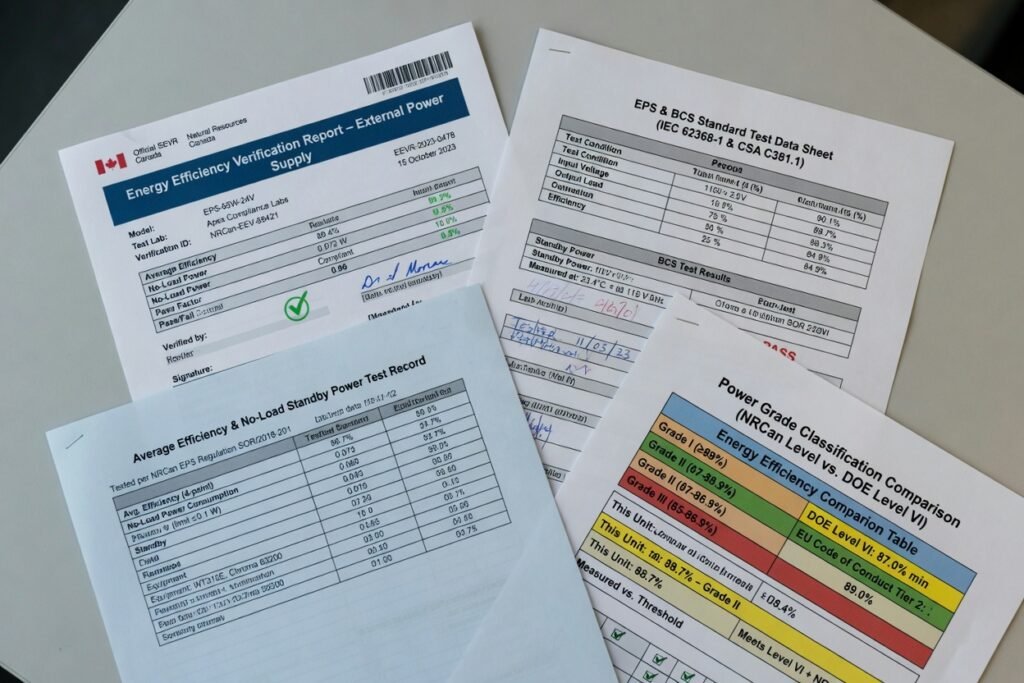
Before looking at the specific rules, first understand a few high-frequency terms, so you won’t get confused later. The first is External Power Supply (EPS), which is what we usually call wall-plug charging heads, laptop power adapters — any independent device that is directly plugged into the wall and converts high-voltage alternating current into low-voltage direct current to power equipment falls into this category. The second is Battery Charging System (BCS), which refers to a complete set of equipment with a complete charging circuit, such as wireless charging bases, desktop chargers with charging functions, and complete charging solutions for laptop computers. It is not a single charging head, but a complete system including a charging control circuit. The third is Energy Efficiency Verification Report (EEVR), which is the core document proving that a product meets NRCan requirements, issued by a third-party laboratory recognized by NRCan, equivalent to the “energy efficiency report card” of the product. The fourth is Level VI, which is a very common external power supply efficiency level mark on the market, and many charging heads will print this mark, but it should be noted: it is not a mandatory requirement of NRCan, it can only be used as a reference, and cannot be equated with NRCan compliance.
Many people think that NRCan regulates all charging-related issues, but in fact its regulatory boundaries are very clear. What it regulates includes: the power consumption efficiency of products, the power consumption during no-load/standby, whether the compliance documents are complete, and whether the product identification is consistent with the actual parameters. What it does not regulate is also very clear: safety risks such as electric shock and fire (which are under the control of safety certification), whether fast charging protocols are compatible (which are under the control of industry organizations such as USB-IF), electromagnetic interference issues, and the transmission quality of data cables. A special reminder here: for charging products to be legally sold in the Canadian market, they must meet both energy efficiency requirements and safety requirements. The two are independent, and neither is dispensable.
Draw Clear Boundaries: Which Charging Products Need Compliance
After clarifying the basic positioning and regulatory boundaries of NRCan, let’s sort out the specific scope of application: which charging products must be compliant, which are not under control, and the boundary scenarios that are easy to misjudge.
First, there are three types of charging products that are clearly included in the regulation. The first type is External Power Supply (EPS), including ordinary wall-plug USB charging heads, laptop power adapters, and separately sold PD fast charging heads. As long as they are independent wall-plug power devices that convert to low voltage, they are within the scope of regulation. The second type is Battery Charging System (BCS), such as wireless charging bases, desktop chargers with charging circuits, and complete charging systems for laptop computers. Such products with complete charging control circuits are regulated according to BCS requirements. The third type is active fast charging cables, that is, USB-C cables with power conversion or power control chips that can be directly plugged into the wall for use — note that this is not the ordinary data cable we usually use. Ordinary data cables only transmit power and data, have no voltage conversion function, and are not within the scope of regulation.
There are several types of charging-related products that do not need to meet NRCan energy efficiency requirements. The first is purely passive charging cables or data cables, which have no voltage conversion, no power control chips, and are just simple wires, such as ordinary USB-A to C cables, C to C cables, which are not regulated. The second is built-in charging modules of equipment, such as the charging circuits inside mobile phones and laptop computers. Pure internal circuits are usually not treated as independent charging products, and are regulated along with the whole machine; however, external adapters included with the whole machine, separately sold charging bases, or complete charging devices that constitute a BCS still need to be judged according to EPS or BCS. The third is micro charging products with an output power of less than 1W, whose power is particularly small and standby loss can be ignored, so they are not regulated. The fourth is custom chargers exclusively for industrial and medical scenarios that meet the clear exemption conditions of regulations. If they are not sold to the public through ordinary consumer channels, they may not be regulated according to ordinary consumer-grade EPS/BCS requirements; for external power supplies or charging systems sold to the Canadian market, the scope of application still needs to be checked item by item, and exemption cannot be directly determined solely on the basis of “industrial/medical” use. The fifth is products for personal use and non-commercial entry. For example, if you bring two or three charging heads for your own use when going abroad, or buy one for your own use via overseas online shopping, you do not need compliance, but if you import them in batches for sale, they must meet the requirements.
There are several boundary scenarios that are particularly easy to misjudge, so you must pay attention. The first is chargers included in sets: even if the charging head is sold together with a mobile phone or tablet, it itself needs to meet NRCan requirements separately. It is not that the whole machine has passed the certification and everything is fine. The second is multi-port chargers: their power level is calculated based on the total output power, not the maximum power of a single port. For example, a four-port charger with a maximum single port of 65W and a total output power of 100W is required according to the high-power level of 100W, not 65W. The third is docking stations with charging function: if the charging part is sold separately, it needs to be compliant separately; if it is sold together with the equipment and cannot be split, it is assessed together with the whole machine. The fourth is the shape of USB interfaces or plugs, and safety requirements: these are under the control of safety specifications. NRCan only manages energy efficiency, and does not care about the shape of the interface, whether it is plugged in firmly, or whether it will cause electric shock.
Core Requirements: Energy Efficiency Indicators and Compliance Rules
After confirming that the product is within the scope of regulation, you need to check the specific energy efficiency requirements accordingly. NRCan manages the energy efficiency of charging products by power levels. The higher the power, the stricter the requirements of the corresponding level are usually. The core indicators are divided into four categories.
The first is average conversion efficiency, which simply refers to the proportion of the electricity actually delivered to the device during charging to the total electricity taken from the wall — the higher the proportion, the less wasted electricity and the less heat generated. There are three common levels: low power of 10W and below (such as ordinary 5V2A charging heads), medium power of 10W to 49W (such as 20W, 30W fast charging heads), and high power of 49W and above (such as 65W, 100W laptop charging heads). The specific efficiency values will be adjusted according to the version of the regulation and the product category. You don’t have to memorize them by rote, just know that the higher the power, the stricter the requirements.
The second is no-load power consumption, which is the power consumed by the charger when it is plugged into the wall and not connected to a device. Don’t underestimate this little bit of power consumption. If it is plugged into the wall for a long time, the cumulative waste over a year is considerable. The specific limit of no-load power consumption is determined according to the product category, rated output power and applicable regulation version; the no-load power consumption of most common consumer-grade external power supplies needs to be controlled at a very low level, and the common limit can reach the order of 0.1W. The specific requirements shall be subject to the currently effective NRCan regulations and product test reports.
The third is the special requirement for multi-port chargers: when multiple ports are working at the same time, they must meet the energy efficiency requirements of the level corresponding to the total power, and it is not enough to only test that a single port meets the standard.
There is also an indicator for BCS products called annual energy consumption (UEC), which is the estimated total annual power consumption based on the actual use scenario of the complete set of equipment. It is closer to the real use situation than simply testing efficiency. For example, wireless chargers are often in standby state, so this indicator will be used for assessment.
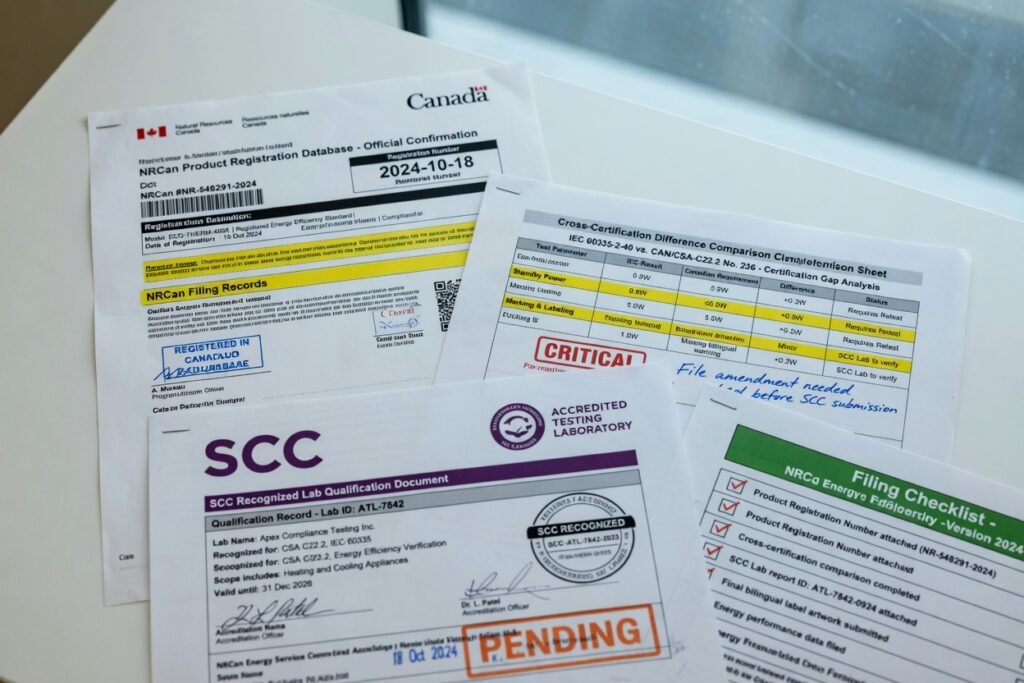
In addition to meeting the energy efficiency indicators, there are two mandatory requirements. First, the product itself and its packaging must be clearly marked with power parameters, and must be consistent with the promotional content. You cannot write 65W on the detail page but only mark 45W on the product. Second, the seller must hold an EEVR (Energy Efficiency Verification Report) issued by an NRCan-recognized laboratory, and the product must complete the mandatory registration in the NRCan official database, with information publicly available — it is not enough to just have a report, registration is a mandatory step, which many small businesses will miss.
If you are doing charging products for the Canadian market for the first time, the compliance process is actually very clear: first confirm which category the product belongs to and which power level it is in; then find a third-party laboratory recognized by NRCan to conduct energy efficiency tests and get the EEVR report; then submit the materials to NRCan to complete the official registration, and keep all documents for inspection; finally, ensure that the product identification, packaging, and promotional information are completely consistent with those in the report, and you cannot change the model or parameters at will.
How to Judge: Quickly Identify Compliant Products
Whether it is ordinary consumers choosing products or merchants selecting products, you can judge whether a product meets NRCan requirements through several methods of different accuracy.
The most basic is to make a quick initial judgment by looking at the markings, which can be done in 10 seconds. If the product is printed with an efficiency level mark such as Level VI, it only means that the product may have been marked or tested according to a certain set of external power supply efficiency levels, and cannot prove that it has completed NRCan registration. It can only be used as a clue for initial screening. Then check whether the power parameter marking is clear and consistent with the promotion. For those with vague parameters that only mark “fast charging” without specific power, you should be careful. In addition, regularly imported products usually mark the information of local Canadian importers or distributors. If not, you should be more vigilant.
The most authoritative and reliable verification method is to query the NRCan official database. Directly log in to the energy efficiency product query page on the NRCan official website, select the corresponding product category, and enter the complete brand and model to search. When querying, you need to check that the brand, complete model (including suffix), rated input and output parameters, power, product category, and registration status are all completely consistent with the physical product and the EEVR report, then it is considered valid. It should be noted that similar models are not acceptable. Products with the same shell but different power and different internal solutions cannot share the same report. For example, a charging head with the same appearance has two versions of 20W and 30W. If the 20W one is registered, it does not mean that the 30W one is also compliant.
If it is not convenient to check the database, ordinary users can also use two simple methods to initially avoid pitfalls, but it should be noted that these are only empirical judgments and cannot be used as a basis for compliance. First, if the charger is obviously hot after being plugged in for 1 hour under no-load, it indicates low efficiency or quality risks, but it cannot be directly judged as non-compliant with NRCan — after all, temperature rise is also affected by factors such as ambient temperature, shell material, and heat dissipation design. Second, if the shell is too hot to touch during charging at the same power, it also indicates that the efficiency may be low, but it also cannot be used as a compliance conclusion. The final judgment shall be based on the information in the NRCan official database, the EEVR report and formal test results.
There are several common non-compliance tricks on the market, which should be avoided whether you are buying or selling. The first is false power marking, where the actual output power is lower than the marked one, failing to meet the energy efficiency requirements of the corresponding level — for example, marked 65W but actually only 45W. It may pass the test according to the 45W standard, but false marking itself is a violation, and users cannot get the due fast charging power. The second is passing off with US standards, where there is only the energy efficiency report of the US DOE, and no NRCan registration, thinking that North American standards are universal — in fact, although the indicators of the two are close, the test details, product definitions, and registration requirements are different. DOE compliance is not equal to NRCan compliance. The third is multi-port cheating, where multi-port chargers only test the efficiency of a single port, and when multiple ports work at the same time, the energy efficiency requirements corresponding to the total power cannot be met at all. The fourth is shell-copy report fraud, where products with the same generic mold shell, different power and different internal solutions, misuse the same report and registration information. They look the same in appearance, but the internal components are completely different.
Don’t Confuse: Differences from Other Certifications
Many people confuse NRCan with other certifications, but in fact they manage completely different things and cannot replace each other.
First is the difference from safety certification (CSA, cUL, UL, etc.). NRCan manages “whether it consumes electricity”, that is, the level of energy efficiency and how much electricity is consumed; safety certification manages “whether it will cause accidents”, such as safety risks like electric shock, fire, and excessive temperature rise. The two are completely independent regulatory systems. For charging products to be legally sold in Canada, they must meet both requirements, and neither can replace the other.
Then is the difference from US DOE energy efficiency. Many people think that North American energy efficiency standards are universal, but they are not. The energy efficiency indicators of the US DOE and NRCan look very similar, but there are differences in test details, product classification definitions, and registration processes. Products that are DOE compliant may not meet NRCan requirements. If you are selling the same product in both North American markets, it is recommended to prepare compliance materials separately, and don’t think that one report can cover everything.
Next is the difference from USB-IF protocol certification. USB-IF certification manages the specifications of USB interfaces and the compatibility of fast charging protocols, such as whether it can trigger PD fast charging and whether the Type-C interface meets the standards. Having a fast charging mark or USB certification mark only means protocol compatibility, not that energy efficiency meets the standards. Protocol issues go to USB-IF, power consumption issues go to NRCan, they are completely different things.
Finally, the difference from Energy Star. Energy Star is a voluntary energy-saving program, equivalent to the title of “top energy-saving student”, while NRCan is a mandatory market access requirement, which is the “passing line” — products that fail cannot be sold at all. Products with the Energy Star mark do not mean that they automatically meet the NRCan registration requirements, and they still need to complete the NRCan registration process separately.
Practical Key Points: Pitfall Avoidance Guide for Different Identities
After understanding NRCan’s rules and common misunderstandings, let’s talk about the key points that people of different identities should pay attention to in actual operation, and what risks to avoid.
If you are an ordinary user buying a charger for your own use, you should first choose products from regular brands with complete markings and regular sales channels in Canada, such as local supermarkets and official flagship stores on regular e-commerce platforms, which will greatly reduce the probability of falling into pitfalls. There is no need to worry that too much power will waste electricity — compliant high-power chargers will automatically match the power required by the device. For example, using a 65W head to charge a 20W mobile phone will only output 20W, and will not consume more electricity than a 20W head. In addition, a small number of non-compliant products for personal use will not cause any problems. For example, if you buy a favorite charging head via overseas online shopping for your own use, you will not be punished, but if you buy in batches for resale, it may involve violations.
If you are a small business or cross-border seller doing the Canadian market, you must check 4 things before listing: whether the product category is within the scope of regulation, whether the corresponding model has an EEVR report recognized by NRCan, whether the official NRCan registration has been completed, and whether the parameters of the product identification/packaging/promotion are completely consistent with the report. There are several high-frequency risk points that are particularly easy to step on: products of the same series with different powers mix reports, for example, 20W and 30W have the same appearance, so they use the 20W report to pass off; multi-port chargers only test a single port, not the situation where multiple ports work at the same time; the advertised power is higher than that on the product nameplate, for example, the detail page says 65W, but the actual product is marked 45W. It should also be noted that whether it is cross-border direct mail or overseas warehouse delivery, as long as it is a commercial import and sold to Canadian consumers, it needs to meet NRCan requirements. It is not that direct mail does not need to be managed. If it is non-compliant, the consequences may be customs detention of goods, fines, and even removal from e-commerce platforms.
Finally, pay attention to the revision of regulations and transition rules. NRCan’s energy efficiency regulations for charging products are revised from time to time, and each revision will clearly specify the effective date and corresponding transition arrangements. When purchasing products with new solutions such as fast charging and multi-port, you should focus on checking the currently effective EPS/BCS definitions, test methods and registration requirements. After the new requirements take effect, newly produced and newly imported products need to meet the latest standards. Old products that have been legally launched usually have a transition period, but before purchasing or importing old stock, you still need to check the current effective standards in advance to avoid being unable to sell after the transition period ends.
Overall, the NRCan energy efficiency standard is a mandatory access threshold for charging products in Canada, with its core being the regulation of product power consumption efficiency and standby waste. After reading this article, you should be able to distinguish the applicable boundaries of NRCan for charging products, understand core terms such as external power supply and energy efficiency verification report, initially judge compliance through three methods: checking markings, querying the official database, and simple self-testing, recognize common non-compliance tricks such as false power marking and shell-copy report fraud, and also clarify the core compliance points for different identities such as ordinary consumers and merchants, so as to avoid the vast majority of related risks.