
If you sell products in the North American market, or have purchased small electrical appliances from the United States via overseas shopping, you have most likely seen a small logo with the letters “ETL” on the nameplate at the bottom of the product. Many people think it is an unfamiliar U.S. safety standard, some confuse it with UL certification, and some even regard it as a “Quality Gold Award” issued by the U.S. government to products—actually none of these understandings are quite accurate.
First, Understand: What Exactly is ETL
Put simply, ETL is a widely recognized third-party product safety “seal of compliance” in the North American market. It is operated and issued by the international testing organization Intertek, and its core only checks one thing: whether the product has safety risks such as electric shock, fire, overheating, or structural injury.
Many people treat ETL as a separate set of safety standards, which is one of the most common misunderstandings. In fact, the name ETL comes from Edison Testing Laboratories, which was later acquired by Intertek and is now its certification service brand, not an independent set of testing standards. The basis for testing products is still the common North American safety standards such as UL, CSA, and ANSI—this is like when you go to a restaurant to eat: ETL is the restaurant’s signboard, and the ingredients (standards) used to cook the food are still those commonly used in the industry.
Regarding the attributes of ETL, there are two key points you must remember, which can help you avoid 90% of cognitive biases:
First, it is exclusively for safety, only managing safety and nothing else. Whether the performance is good, the service life is long, or the energy efficiency is high, these have nothing to do with ETL. It only verifies whether the product will cause safety accidents.
Second, it is a third-party neutral certification, not a certificate directly issued by the U.S. government. The U.S. official only issues “practice qualifications” to certification bodies, and the specific testing and certification are done by third-party institutions. So do not treat ETL as “the U.S. government endorsing the product”; it is just a compliance certificate issued by a third party.
Legal Effect of ETL: Where It Comes From, When It Is Required
The question many people care about most is: Is ETL certification mandatory in the United States? To answer this question, we must first understand the U.S. safety certification system.
Root of Legal Effect: NRTL Qualification
The United States has a system called NRTL (Nationally Recognized Testing Laboratory), which you can think of as a “practice license” issued by the U.S. government to third-party safety testing institutions. This system is managed by the federal Occupational Safety and Health Administration (OSHA). Only institutions that have obtained the NRTL license can issue safety certifications with workplace safety regulatory effectiveness within the product categories authorized by OSHA.
Intertek is one of the NRTL institutions authorized by OSHA, so the legal effect of ETL certification essentially comes from this officially recognized qualification. It should be noted that: only under the premise that the authorized product category, corresponding safety standard and certification scope are consistent, the same type of safety certification issued by different NRTL institutions is equivalent under the caliber of U.S. workplace safety regulation; however, customers, sales channels, local authorities having jurisdiction (AHJ) or insurance parties may still specify specific certification brands such as UL and CSA, in which case the specified requirements must be followed.
In Which Cases Is ETL (or Similar NRTL Certification) Required
ETL is not a mandatory certification for all product categories, and its mandatory nature is divided into three scenarios:
The first is statutory mandatory: For electrical equipment used in U.S. workplaces, OSHA explicitly requires NRTL certification, including ETL and UL. If it is found that there is no such certification, the employer may face fines.
The second is rule-based mandatory: Some local building codes, electrical installation codes, or insurance company claim requirements will stipulate that related equipment must have NRTL certification, otherwise acceptance will not be granted or claims will not be paid.
The third and most common is commercial mandatory: For example, large offline chains such as Walmart and Home Depot, mainstream e-commerce platforms such as Amazon, and large engineering procurement all regard ETL or similar NRTL certification as an access threshold. Without it, you may not be able to pass platform review, engineering acceptance or procurement access.
Scope of Validity of ETL: Not a Universal Certificate
Of course, the validity of ETL is not unlimited. First, Intertek can only issue certificates within the product categories authorized by OSHA, not all products can obtain ETL certification. Second, the validity of the certification only covers the country/region, product model, purpose and manufacturing factory marked on the logo—for example, selling in Canada with an ETL certificate that only covers the U.S. market, or pasting the certificate of model A on model B, are both violations, and the certification is directly invalid.
What Products Does ETL Cover? What Does It Not Cover
Now that we have clarified the validity, let’s talk about the scope of application of ETL, do not apply ETL to all products.
Main Covered Categories
The core of ETL coverage is products with safety risks, especially electrical products:
- Consumer electrical products: such as small household appliances, lamps, mobile phone chargers, power tools, power sockets and other common daily items;
- Commercial and industrial products: such as commercial kitchen equipment, industrial motors, power distribution equipment, HVAC equipment, etc.;
- Some non-electrical high-risk products: such as gas appliances, fire-resistant furniture, etc., but only for categories authorized by Intertek.
Completely Inapplicable Scope
There are several types of products that are not under the jurisdiction of ETL at all, do not confuse them:
- Food, drugs, cosmetics, medical devices, these are under the jurisdiction of the U.S. FDA (Food and Drug Administration);
- Radio frequency interference and electromagnetic compatibility performance of wireless products are under the jurisdiction of the FCC (Federal Communications Commission);
- ETL does not involve other compliance dimensions such as energy efficiency, environmental protection, chemical substance restrictions, and complete vehicle safety.
Common Scenarios Requiring Combined Certification
Precisely because different certifications cover different scopes, many products need to apply for multiple certifications at the same time to comply with regulations and enter the North American market:
- Electrical products with WiFi/Bluetooth, such as smart sockets: require ETL (safety) + FCC (wireless/electromagnetic compatibility);
- Products such as lamps and large household appliances: require ETL (safety) + DOE/CEC (energy efficiency, DOE is a U.S. federal requirement, CEC is a California requirement);
- Personal care products that come into contact with the human body, such as electric beauty devices and electric toothbrushes: only when the product is classified as a medical device regulated by the FDA, or involves components that need to meet food contact material requirements, is it necessary to supplement the corresponding FDA compliance requirements; ordinary low-risk personal care appliances do not need to apply for FDA-related compliance according to medical or food contact categories, and only need ETL to cover electrical safety.
How to Identify the ETL Mark? How to Check Its Authenticity
There are many fake ETL marks on the market, so it is very important to learn to identify and verify them.
3 Core Components of a Formal ETL Mark
A real ETL mark has three core components:
- The “ETL” letter logo. The formally authorized logo usually has the registered trademark symbol ®, but the logo style may be affected by the product size, material, and Intertek’s specific authorization specifications. You cannot directly judge it as a fake just because the ® symbol is missing;
- A unique Control Number, which is equivalent to the ID number of this certification and is the core basis for checking authenticity;
- The identification code of the applicable country/region, used to distinguish the applicable market.
If the mark lacks a control number, region code or the style is suspicious, you should further check the Intertek official database and authorization documents. You cannot judge the authenticity only based on promotional pictures or packaging.
The Meanings of Different Marks Are Very Different, Do Not Confuse Them
Many people do not know that different small print under the ETL mark represents completely different certification types:
- ETL Listed: This is the most common complete machine safety certification, which means that the complete product has passed all safety tests. When we usually say “the product has ETL certification”, we generally refer to this.
- ETL Classified/Verified: It only evaluates a specific performance or specific use of the product, which does not mean that it has passed all safety certifications. Do not treat it as a complete machine safety certification.
- ETL Recognized Component: It only applies to components such as power modules and wires, which means the parts are qualified, but it does not mean that the complete machine equipped with this part is also qualified.
- ETL Semko: This is a certification for the European market, which does not belong to the North American NRTL system and cannot be used to prove that the product meets the safety requirements of the United States and Canada.
Differences Between Different Market Versions
In addition to the certification type, the region code on the mark is also very important, representing the standard scope covered by the certification:
- ETL US: Only proves compliance with U.S. safety standards, and does not automatically cover the compliance requirements of the Canadian market;
- cETL: Only proves compliance with Canadian safety standards, and does not automatically cover the compliance requirements of the U.S. market;
- cETLus: Meets the safety standards of both the United States and Canada, and is universal in both markets. Sellers targeting the North American market generally prefer this one.
3 Steps to Quickly Check Authenticity
It is very simple to verify the authenticity of ETL certification. You don’t need to find an institution, you can check it yourself:
Step 1, Find the number: Prioritize the control number on the product’s own nameplate, permanent label or Intertek official authorized identification document. The mark on the outer packaging and promotional page can only be used as auxiliary clues and cannot be used alone as the basis for valid certification;
Step 2, Check the official website: Log in to Intertek’s official certification query page and enter the control number;
Step 3, Verify information: Check whether the found product model, manufacturer, applicable standards, and market scope are consistent with the product you have. If they don’t match, it is an invalid certification.
Differences Between ETL and Common North American Certifications, Can They Replace Each Other
Many people confuse ETL with certifications such as UL, FCC, and CSA. Here we will clarify their differences and replacement logic at once. For easy comparison, I have compiled a table:
| Comparison Dimension | ETL Certification | UL Certification | FCC Certification | CSA Certification |
|---|---|---|---|---|
| Jurisdiction Scope | Product safety (electric shock, fire, etc.) | Product safety (electric shock, fire, etc.) | Electromagnetic compatibility, radio frequency radiation | Product safety (electric shock, fire, etc.) |
| Regulatory System | U.S. NRTL system, recognized by OSHA | U.S. NRTL system, recognized by OSHA | Mandatory by the U.S. Federal Communications Commission | U.S. NRTL system, recognized by OSHA |
| Core Features | May have advantages in quotation or scheduling in some projects | Higher brand awareness, cost and cycle vary with product conditions | Exclusive for wireless/electromagnetic, unrelated to safety | High acceptance in the Canadian market |
| Replacement Logic | – | Equivalent under regulatory caliber when the authorized category and standard are consistent and no brand is specified; cannot be replaced if UL is specified | Completely irreplaceable, different jurisdiction scopes | Equivalent under regulatory caliber when the authorized category and standard are consistent and no brand is specified; need to confirm acceptance in advance if CSA is specified |
Let’s focus on a few of the most concerned points:
- Comparison with UL: Both belong to the NRTL system recognized by OSHA. Under the premise that the authorized category, corresponding standard are consistent and the customer, local authority having jurisdiction (AHJ), and sales channel do not specify the certification brand, the legal effect at the workplace safety regulation level is exactly the same. The difference is mainly in brand awareness and project implementation: UL entered the market earlier and has higher popularity; ETL may have advantages in quotation or scheduling in some projects, but the final cost and cycle depend on product complexity, test items, rectification times and institution scheduling, which shall be subject to the official quotation of the institution.
- Comparison with FCC: They are completely two categories of things, with no replacement relationship at all. FCC is a federal mandatory electromagnetic/radio frequency certification, which tests whether the product will interfere with other equipment and whether there is excessive radio frequency radiation; ETL tests safety risks. For electrical products with wireless functions, both certifications must be obtained, and missing either one is non-compliant.
- Comparison with CSA: CSA is also a certification within the NRTL system. Under the premise that the authorized category and standard are consistent and no brand is specified, the legal effect at the regulatory level is equivalent to that of ETL. The difference is that CSA has higher acceptance in the Canadian market, but cETLus certification is also officially recognized by Canada. If Canadian customers, local regulators or channels explicitly require CSA, you need to confirm acceptance in advance; under the premise of no clear specification, cETLus can meet the safety compliance requirements of the Canadian market.
- Comparison with FDA, DOE, etc.: The jurisdiction scopes are completely different, and there is no replacement relationship. FDA manages the safety of food, drugs, and medical devices, DOE manages energy efficiency, and ETL only manages the safety of ordinary products. Products with cross-functions can be handled in combination as needed.
Core Logic and Basic Rules of ETL Certification
If you plan to apply for ETL certification, or need to judge the validity of the certification, it is enough to understand its core logic and basic rules, and you don’t need to understand the specific operations of the laboratory.
Core Judgment Logic of Certification
ETL certification is not “just send a sample and finish the test”. Its core logic is three steps:
- Sample testing: Test the sample according to the North American safety standards corresponding to the product to confirm that it meets the safety requirements;
- Factory inspection: Check the management and control ability of the manufacturing factory to ensure that the mass-produced products are consistent with the test samples, and there will be no situation of “qualified samples but shoddy mass goods”;
- Continuous supervision: After obtaining the certificate, the institution will conduct regular spot checks to maintain the validity of the certification.
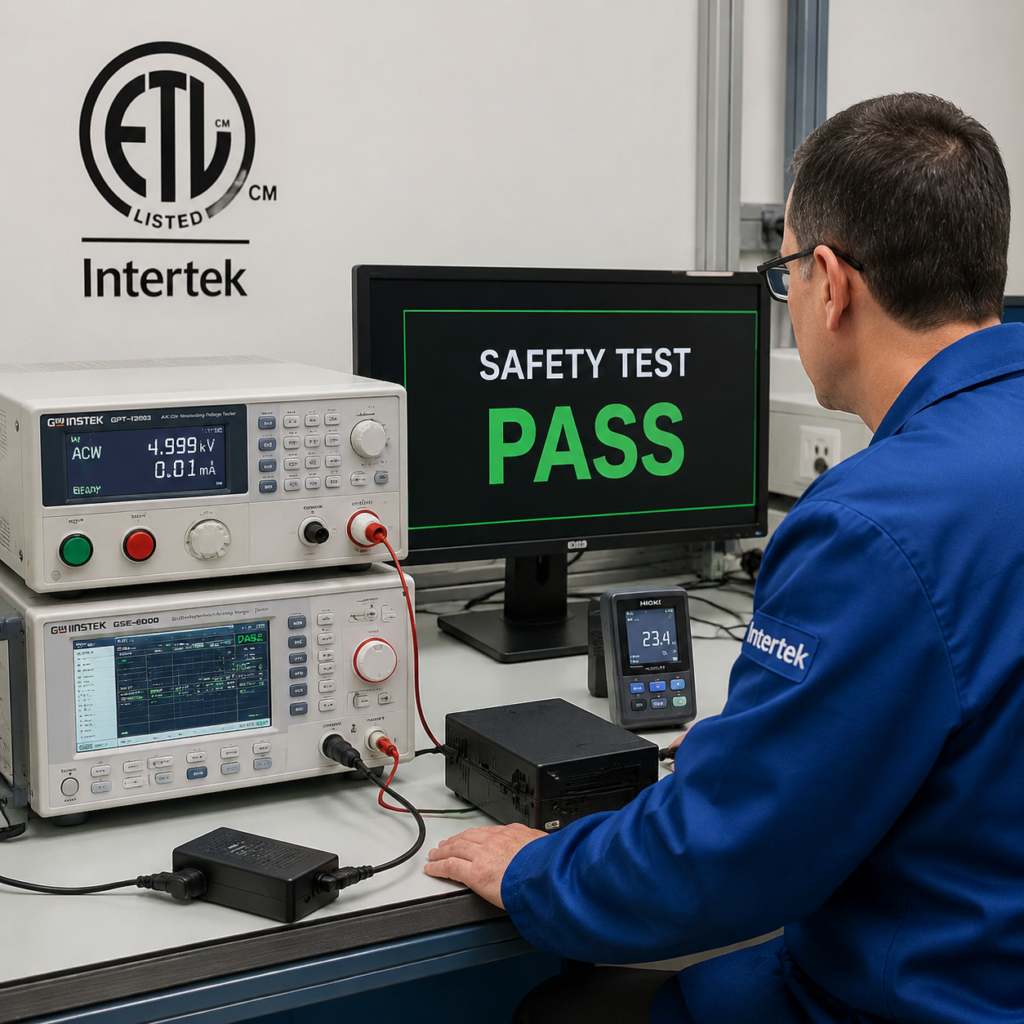
Plain Language Version of the Application Process
The ETL application process is complicated if you say it’s complicated, and simple if you say it’s simple. The core is three steps:
First, submit product information and samples, and the institution will judge what standards apply to the product and give you a quotation;
Then enter the testing phase. If the test fails, you need to rectify the product and then retest;
After passing the test, the institution will go to the factory for an initial inspection. After confirming that there is no problem with production consistency, it will issue the certificate and authorize you to use the ETL mark on the product.
Validity Period and Maintenance Requirements
ETL certification has no fixed validity period—as long as the product has not been revised, the corresponding safety standards have not been updated, and each supervision spot check is qualified, the certificate will remain valid.
The supervision frequency is determined by the product category, risk level and certification institution requirements, which may be regular or irregular spot checks. The higher the product risk, the stricter the spot checks usually are. For example, high-risk products that are prone to fire such as heaters will have stronger supervision than ordinary low-risk products.
If the product replaces key components, changes its structure or purpose, or changes the manufacturing factory, you must report to the institution in advance and go through the change process, otherwise the certificate will be directly invalidated.
Basic Rules of Cost and Cycle
Many people ask “how much does ETL cost and how long does it take to get the certificate” as soon as they come up, but there is no unified answer. The cost and cycle mainly depend on the complexity of the product, the number of test items, the number of models, and the rectification situation—the simpler the product, the fewer the models, and no rectification is needed, the lower the cost and the shorter the cycle. Generally speaking, simple consumer electronic products can be done in a few weeks to a month or two, and complex industrial equipment may take several months. The specific cost is accurate only after sending the product information to the institution for quotation.
Common Misunderstandings and Pitfall Avoidance Tips
Regarding ETL certification, there are several particularly easy pitfalls that both sellers and consumers should pay attention to.
4 Most Common Cognitive Misunderstandings
- Misunderstanding: ETL is a U.S. federal mandatory certification for all product categories
Correction: It is not required for all products. It is only required in statutory scenarios, rule requirements or commercial channel requirements, and is not mandatory for all categories. - Misunderstanding: ETL certification is less authoritative than UL
Correction: Both are NRTL institutions recognized by OSHA. Under the premise that the authorized category and corresponding standard are consistent and no brand is specified, the legal effect at the regulatory level is exactly the same. The difference is mainly in brand awareness and project implementation. - Misunderstanding: Having an ETL mark means the product is of good quality
Correction: ETL only covers the product safety dimension, and does not involve quality indicators such as performance, service life, and user experience. Passing safety does not mean good quality. - Misunderstanding: ETL certification is permanently valid
Correction: Certification requires continuous supervision and spot checks to maintain. Failure to report product revisions, out-of-scope use, and unqualified spot checks will all lead to invalidation of the certificate.
Pitfall Avoidance Tips for Sellers/Manufacturers
If you are a seller or manufacturer targeting the North American market, you must remember these points:
- Never buy “certificate borrowing”: using other people’s product certificates to pretend to be your own can be seen through as long as you check the control number. At that time, the goods will be detained and the fine will not be worth the loss;
- Product revisions and replacement of key components must be reported in advance. Do not directly paste the mark after modifying without permission, otherwise the certification will be invalid;
- Don’t believe the publicity of “100% guaranteed pass”: formal certification is strictly tested according to standards, and if it does not meet the requirements, it must be rectified. Those who say guaranteed pass are either liars or the certificate issued has problems;
- The use of the mark must comply with Intertek’s specifications, and you cannot print, modify the style or position without permission.
Pitfall Avoidance Tips for Consumers/Procurement Novices
If you are an ordinary consumer or a novice in procurement, these points can help you avoid most pitfalls:
- Don’t just look at the ETL mark on the packaging or promotional page, prioritize checking the control number on the product’s own nameplate;
- Be wary of vague publicity such as “meets UL standards” and “uses ETL certified parts”. Qualified parts do not mean the complete machine is qualified, and meeting standards does not mean passing third-party certification;
- When purchasing high-risk electrical products such as heaters, chargers, electric blankets, and lamps, prioritize those with ETL or similar NRTL certification for better safety guarantee;
- Certification only means that the product meets basic safety requirements under normal use. Problems caused by abuse not in accordance with the instructions (such as using a hair dryer to blow clothes with the air inlet blocked) are not within the scope of certification protection.
Summary
In general, ETL is a mainstream third-party product safety certification relying on the U.S. NRTL qualification, which only covers the safety dimension, and has equivalent effect with similar certifications such as UL and CSA under the premise of compliance. You only need to remember three core judgment logics: first, judge whether the certification is needed according to the use scenario and channel requirements; second, verify the authenticity through official channels using the control number on the product body; third, judge whether other certifications such as FCC and energy efficiency are needed according to product functions. Then you can avoid most compliance traps and publicity routines.