
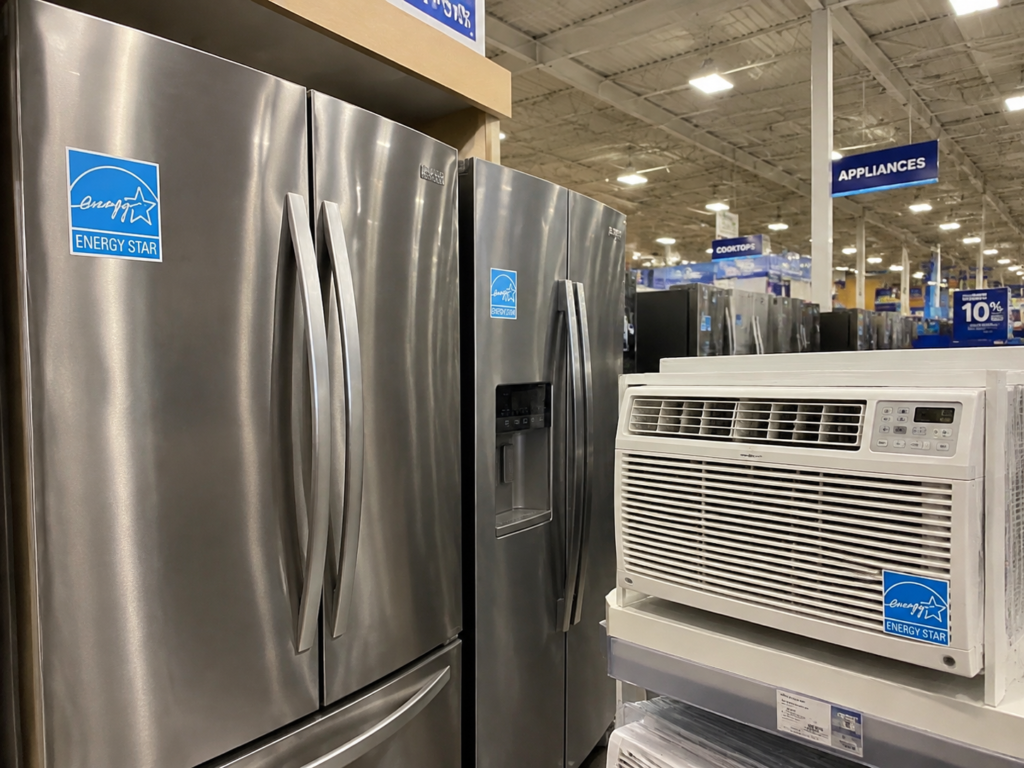
If you visit a home appliance store in the U.S., or search for power-consuming products like refrigerators and air conditioners on Amazon, you will most likely see the “ENERGY STAR” logo with a white star on a blue background on many products. Some people say it is an official U.S. quality certification, and products without it cannot be sold in the U.S.; others say it is just a marketing gimmick that manufacturers pay for, with no practical use. What exactly is ENERGY STAR certification? How valuable is it? Should you prioritize products with this label when choosing items? This article covers everything from basic concepts to practical purchasing methods, and after reading it, you will be able to judge for yourself.
First, understand: What exactly is ENERGY STAR?
The full name of Energy Star is ENERGY STAR, which is essentially a voluntary energy-saving label launched by the U.S. government. Simply put, it is a unified blue-and-white star label affixed to products or buildings with sufficiently high energy efficiency, so that ordinary users do not have to calculate energy consumption themselves, and can recognize which models are more power-saving at a glance.
This program was first launched by the U.S. Environmental Protection Agency (EPA) in 1992. Later, the U.S. Department of Energy (DOE) joined in and played an important role in standard setting and testing rules for some product categories. There were two original intentions for its launch at that time: first, to reduce energy waste and greenhouse gas emissions; second, to solve the pain point that ordinary users cannot calculate the energy efficiency of products — after all, when most people buy home appliances, they cannot figure out which one is more power-saving when faced with a bunch of power parameters. With a unified label, the decision-making cost for product selection is much lower. At the same time, this label can also guide manufacturers to actively upgrade energy-saving technologies and promote the improvement of energy efficiency levels across the entire industry.
Many people confuse ENERGY STAR with certifications such as UL and FCC, but in fact, their positions in the U.S. regulatory system are completely different. ENERGY STAR is a federal-level voluntary energy-saving program, and it does not fall into the category of mandatory safety or quality certifications. That is to say, products without this label can still be sold in the U.S. market as long as they meet the minimum energy efficiency standards set by the DOE and corresponding mandatory requirements such as safety and electromagnetic compatibility. Its more common role is as a reference condition for state-level energy-saving subsidies and some government procurement projects. For example, home appliance energy-saving rebates in many states are only given to products with the ENERGY STAR label.
It is particularly important to clarify what it does not cover first to avoid misunderstandings from the start:
First, it does not certify the safety, quality, or durability of products, nor does it cover after-sales service quality; these are the responsibilities of safety certifications and manufacturer warranties.
Second, it is not a comprehensive environmental protection score. It does not assess whether the product’s materials are environmentally friendly, its carbon footprint, or whether it can be recycled; it only focuses on energy efficiency levels related to energy consumption.
Third, it is not a star rating system. There is no distinction between “3-star” or “5-star” ratings; there is only a “pass/fail” threshold. Products that meet the energy efficiency requirements of the corresponding category can use the label, and those that do not cannot.
Which products and scenarios can get ENERGY STAR certification?
ENERGY STAR has a wide coverage, but not all power-consuming items can apply. Its covered categories and scenarios are mainly divided into several types.
The most frequently contacted by daily consumers are consumer products, including major home appliances such as refrigerators, washing machines, air conditioners, water heaters, dishwashers, and dehumidifiers; consumer electronics such as computers, monitors, printers, TVs, and routers; and lighting and home products such as LED bulbs, smart lamps, smart thermostats, and energy-saving doors and windows. These common categories basically have corresponding ENERGY STAR energy efficiency specifications.
In addition to ordinary consumer products, it also covers many non-consumer scenarios:
One category is commercial and industrial general-purpose equipment, such as office equipment, pool pumps, general industrial energy-saving equipment, etc. As long as the EPA has issued energy efficiency specifications for the corresponding category, certification can be applied for.
The other category is building and facility projects, and different types of buildings are subject to completely independent application rules. Residential buildings are mainly certified for new homes, which need to comply with the whole-house energy efficiency specifications for the corresponding unit type, with the core assessment being the overall energy consumption level of the entire residence; existing residences may participate in energy-saving renovation, energy management, or local cooperation projects, and whether they belong to the official ENERGY STAR certification/labeling program shall be subject to the corresponding project rules currently issued by the EPA. Commercial buildings include various commercial properties such as office buildings, shopping malls, and hotels, which are mainly reviewed through building energy efficiency scoring, energy consumption data verification, etc., and must meet the energy efficiency threshold of the corresponding type of building to obtain certification; industrial projects only cover general industrial facilities for which the EPA has issued special review rules, and niche customized industrial plants are not included. It is particularly important to note here: no matter what type of building certification it is, the assessment is for the overall actual energy performance of the building. Even if all internal electrical appliances and equipment have the ENERGY STAR label, it does not mean that the entire building is automatically certified; it must go through the review process of the corresponding project separately.
In addition, some ENERGY STAR programs also involve service scenarios such as energy-saving renovation and energy management services, and the specific application requirements and qualification determination are also subject to the corresponding project rules issued by the EPA.
Of course, there are also areas it does not cover: for example, niche customized products without unified energy efficiency standards and non-general-purpose equipment exclusively for industrial use are not within the coverage; large transportation equipment such as automobiles, and products unrelated to energy consumption such as food, clothing, and furniture also do not have ENERGY STAR certification. Simply put, as long as the EPA has not issued energy efficiency specifications or project rules for the corresponding category, you cannot apply for this certification.
There are also several concepts that are easily confused with it, which should be clarified in advance:
First, the “energy-saving products” promoted by manufacturers themselves are not equivalent to ENERGY STAR certification. Ordinary energy-saving promotions have no unified official standards and are entirely up to the manufacturers to claim, with varying credibility.
Second, green building certifications such as LEED are also not equivalent to ENERGY STAR. LEED assesses the comprehensive environmental performance of buildings, including many dimensions such as materials, water quality, and lighting, while ENERGY STAR building certification mainly evaluates energy performance, does not involve comprehensive environmental dimensions, and has its own project review requirements.
Finally, there is a list called “ENERGY STAR Most Efficient”, which is an annual high-efficiency sub-list under ENERGY STAR. Its threshold is higher than the basic certification, equivalent to the selection of “top energy-saving students”, and it is not an independent basic certification.
What is the use of ENERGY STAR certification?
Since it is a voluntary application program, why do both manufacturers and consumers value it so much? Its core value is actually very practical.
For ordinary consumers, there are three most direct benefits: First, it saves time in product selection. You don’t have to calculate which one is more power-saving by yourself facing a bunch of parameters; just check if there is a label, and you can quickly screen out energy-saving models in the same category. Second, it can save electricity bills in long-term use: compared with products that only meet the DOE’s minimum energy efficiency standards, the common energy-saving range of qualified products in the same category is about 10%-30%, but the specific savings ratio depends on the category, model, usage habits, and comparison baseline. For products used year-round or frequently, such as refrigerators and air conditioners, the electricity bills saved over the long term are usually more substantial. Third, you can get subsidies. Many state governments and power companies in the U.S. provide subsidies or electricity bill rebates to users who purchase ENERGY STAR products, and sometimes the subsidies can cover the product’s price premium or even more.
For enterprises and building owners, the value is also clear: First, products with the ENERGY STAR label are more in line with the energy-saving preferences of U.S. consumers and have stronger market competitiveness. Second, some federal, state, and local government procurement projects list ENERGY STAR qualification as a technical specification or priority condition, and the specific requirements are subject to official procurement documents. Finally, commercial buildings that obtain ENERGY STAR certification can use it as an energy efficiency endorsement when renting or selling, and lower energy consumption can also reduce daily operating costs.
However, it is also necessary to understand its value boundary: ENERGY STAR only means that the energy efficiency meets the standard, it does not mean that the product is the lowest priced, most durable, or most advanced in function, nor does it guarantee that all users can get the same energy-saving benefits — after all, the actual electricity consumption is related to personal usage habits and the environment.
How is certification evaluated: thresholds and rules
Many people are curious: how exactly is ENERGY STAR certification evaluated? Is it very lax? In fact, its rules are very clear.
The core judgment logic is: products or projects must meet the currently effective energy efficiency specifications of the corresponding category/type. The eligibility standards adopted by different product categories are not unified: some take the energy efficiency level of similar products as a reference, while others set specific energy consumption caps, efficiency indicators, or functional requirements; there is no unified ranking ratio applicable to all categories. However, for beginner readers, you can first have a general idea: many categories set the threshold in the relatively top range of energy efficiency performance of the same type of product, for example, about the top 15%-30%, but the specific ratio and indicators depend on the specification version of the corresponding category, and cannot be generalized. The formulation of these specifications follows a strict process, based on the official test rules of the corresponding category, and is officially released after market research and public comment. It only assesses energy efficiency-related dimensions, and other attributes are not within the scope of review.
These energy efficiency specifications are not static, and there is no unified update cycle applicable to all categories. The EPA will revise the standards for each category in a timely manner according to technological progress, market changes, and relevant regulatory adjustments. Judging from the common rhythm, most categories are usually adjusted about every 2-5 years, and electronic products often have shorter update cycles due to rapid technological iteration. When new specifications are released, the effective date and transition arrangements will be clarified. If old models that have been certified do not meet the new specifications, they will lose their certification eligibility and can no longer use the label. The specific status shall be subject to the real-time information of the official directory.
For ordinary users, there is no need to know the complicated process of manufacturers applying for certification, just understand the general logic: manufacturers first confirm that the product meets the currently effective specifications of the corresponding category, then obtain energy efficiency test data according to the prescribed test procedures. Usually, the certification process needs to be completed through an EPA-recognized certification body or laboratory, and a partnership agreement must be signed with the EPA. After the product is included in the official qualified directory, the manufacturer can use the ENERGY STAR label according to the rules. After the product is launched, the EPA will also supervise the continuous compliance of the product through market sampling testing, document verification, and other methods.
Special attention should be paid to the binding rules of certification: ENERGY STAR certification is only valid for the specific model applied for, not by brand or series — if the product is redesigned, or the core parameters are adjusted, it is necessary to re-apply for certification. If the sampling test fails, or the manufacturer uses the label in violation of regulations, the EPA will directly revoke the certification and make it public.
How to confirm that the ENERGY STAR certification is real
Since the label has value, it is inevitable that some unscrupulous manufacturers will make fake labels. How to confirm that the ENERGY STAR certification you see is real? You can start from these aspects.
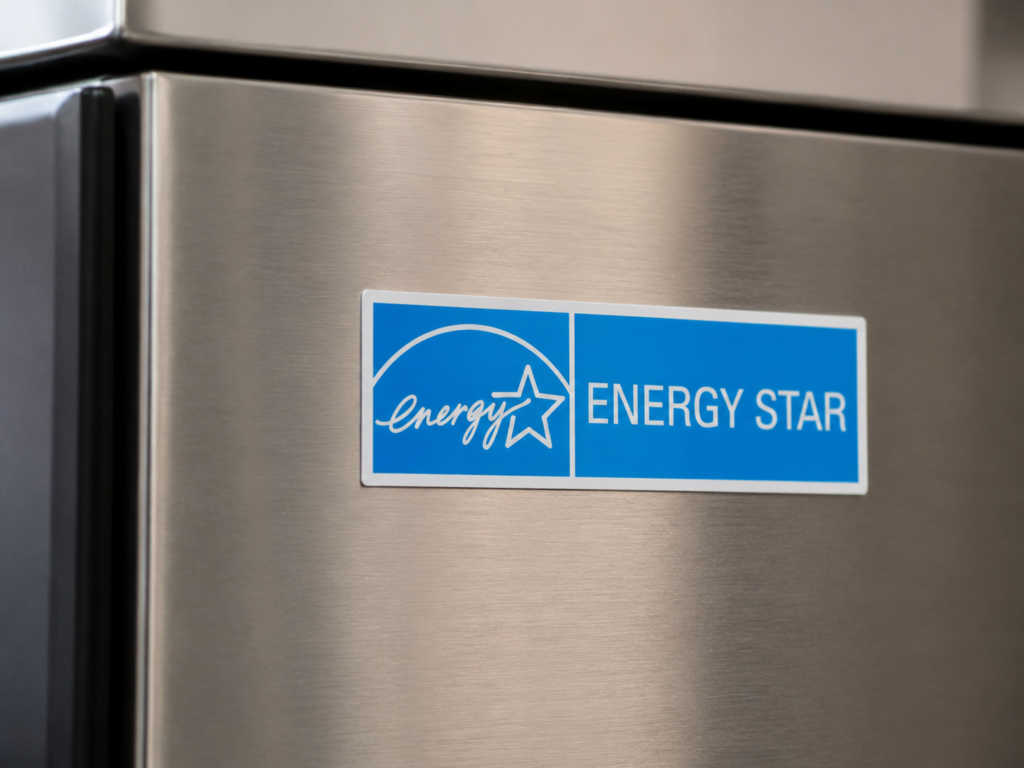
First, look at the core features of the genuine label: the official ENERGY STAR label is a unified pattern of a white star on a blue background, with the English words “ENERGY STAR” next to it, without other fancy designs; the label only corresponds to specific qualified product models or building projects, and there is no vague authorization of “universal for all brands” or “universal for all series”. Normally, the label will appear on the front of the product, the outer packaging, the energy efficiency label, or the brand’s official product detail page.
The most reliable method is to directly query through the EPA’s official channels: for products, you can use the “Energy Star Product Finder” tool on the EPA’s official website, enter the complete brand and specific model (including variant number) to check, and you can find core information such as the product’s official qualification status, energy efficiency parameters, and applicable specification version; some entries will show the certification date, status remarks, or related specification descriptions. Purchase judgment shall be subject to the current status of the official directory and the model matching result. For buildings, you can use the building certification database on the EPA’s official website, enter the building address or project name to query the certification record, certification year, and valid status of the corresponding project. As long as the corresponding model/project cannot be found in the official directory, or the query result is inconsistent with the product’s labeled information, it is uniformly regarded as not having obtained valid certification.
If it is inconvenient to check the official website for the time being, there are also a few quick tips for identifying fakes: for example, if it only promotes “energy saving” or “meets ENERGY STAR standards” but does not mark the specific model and dares not affix the complete official label, you need to be vigilant; if the label pattern is deformed, the color is wrong, or the English words “ENERGY STAR” are missing, it is most likely a fake label; if it claims to be “universal for the whole series” but cannot provide a specific model for query, do not believe it easily; if the price is significantly lower than qualified products of the same type and specification, and at the same time cannot provide a specific model for official query, you should also be wary of fake labels or label misappropriation — of course, low price is only a risk signal, it does not mean that the certification must be fake, and the final judgment shall still be subject to the official directory query result.
To help you quickly distinguish several types of easily confused labels, here is a comparison table:
| Label/Certification Name | Initiator | Mandatory/Voluntary | Core Assessment Direction | Scope of Application |
|---|---|---|---|---|
| ENERGY STAR | Led by the U.S. EPA, with the DOE participating in part of the standards and testing | Voluntary | Energy efficiency level of products/buildings (higher than the DOE’s minimum energy efficiency standard) | Power-consuming products, buildings and facility projects that meet the corresponding EPA specifications |
| EnergyGuide Yellow Label | U.S. Federal Trade Commission (FTC) | Mandatory (for specific product categories and sales scenarios specified by the FTC) | Disclose product energy consumption data for consumers to make horizontal comparisons | Products of specified categories that comply with FTC labeling rules |
| LEED Certification | U.S. Green Building Council (USGBC) | Voluntary | Comprehensive environmental performance of buildings (multiple dimensions such as materials, water quality, energy consumption, etc.) | Various new construction and renovation building projects |
| UL Listing/UL Safety Mark (third-party safety mark) | UL third-party organization | Depends on product category, region, and sales channel requirements | Product safety performance (only focuses on safety, does not involve energy efficiency; UL is a third-party certification mark, not equivalent to the statutory mandatory requirement itself) | Multi-category products such as electronics, electrical appliances, and machinery |
| Ordinary “energy-saving” promotion | Marked by manufacturers themselves | No unified requirements | No unified standard, defined by manufacturers themselves | No restrictions |
The 5 most common cognitive misconceptions
After understanding the basic rules, you also need to avoid several of the most common cognitive misconceptions, which are also the core of judging whether you really understand ENERGY STAR.
The first misconception, which is also the most believed: “ENERGY STAR is a mandatory certification, and products without it cannot be sold in the U.S.”
Clarification: This is completely wrong. ENERGY STAR is a voluntary energy-saving program. Products that have not obtained certification can be legally sold in the U.S. as long as they meet the DOE’s mandatory minimum energy efficiency standards and corresponding statutory requirements such as safety and electromagnetic compatibility. Only some government procurement, state-level subsidy, or utility rebate programs list it as a qualification or priority condition, and the specifics are subject to the program rules.
The second misconception: “Products with ENERGY STAR are the best quality and most power-saving.”
Clarification: ENERGY STAR only assesses energy efficiency-related indicators, and does not involve dimensions such as quality, safety, or durability at all; these are guaranteed by safety certifications and brand warranties. At the same time, it is not a representative of “the most power-saving” — the qualification thresholds for different categories are different. If you want to find the top energy-saving products in the same category, you can check the ENERGY STAR Most Efficient annual list, whose threshold is higher than the basic certification.
The third misconception: “ENERGY STAR products are definitely more expensive, and the payback is very slow.”
Clarification: Qualified products do not necessarily have a high price premium. With the popularization of energy-saving technology, many affordable products can also meet the requirements. Whether it is worth buying cannot only depend on the selling price; the payback period should be calculated in combination with the actual price difference, usage frequency, local electricity price, and subsidy policy, and cannot be generalized.
The fourth misconception: “If a brand has ENERGY STAR certification, all its series of products are qualified.”
Clarification: Certification is only granted for specific models, and has nothing to do with brand or series. Models with different configurations in the same series may be partially qualified and partially unqualified. The specifics shall be subject to the model query result in the official directory.
The fifth misconception: “Certification is permanently valid once obtained.”
Clarification: Certification qualification is not valid for life. Updates to energy efficiency standards, product redesigns, or adjustments to core parameters may cause the original certification to become invalid, which can be verified through the official directory.
Understand 4 boundaries, don’t use the wrong judgment criteria
In addition to avoiding misconceptions, you also need to understand the applicable boundaries of ENERGY STAR — many judgment conclusions have premises, and they will be inaccurate if separated from the premises.
The first is the geographical boundary: ENERGY STAR is an official U.S. certification, mainly valid within the U.S. Only a few countries/regions such as Canada and Japan have cooperation and mutual recognition agreements with it, and it is not compatible with the energy-saving certification systems of other countries. For example, products you buy in other countries with local energy-saving labels are not recognized in the U.S., and vice versa.
The second is the category boundary: the energy efficiency standards and test methods of different categories vary greatly, and you cannot compare energy-saving levels across categories — for example, you cannot say “an ENERGY STAR refrigerator is more energy-efficient than an ENERGY STAR air conditioner”, because their energy consumption bases and test scenarios are completely different, and there is no comparability. You can only compare products of the same category and specification.
The third is the effect boundary: the energy efficiency data labeled on products are all measured in a standard laboratory environment. The actual power-saving effect during use will be affected by factors such as usage habits, ambient temperature, whether the installation is standardized, and maintenance status — only with correct installation and regular maintenance can the labeled energy-saving level be approached. For example, if an air conditioner leaks refrigerant during installation, or the filter is not cleaned all year round, the energy consumption will be much higher; if a refrigerator is opened frequently or has too many things inside, it will also consume more electricity.
For buildings that have obtained ENERGY STAR certification, the actual energy consumption will also be affected by the occupancy rate and operation and maintenance management level. The certification only means that the building’s own energy efficiency foundation meets the requirements, and does not mean that it will definitely reach the energy consumption level during testing in actual operation.
The fourth is the time boundary: certification qualification only corresponds to the currently effective specification version. Meeting the standard this year does not mean it will still meet the standard next year — if it happens to coincide with a specification update, the previous old models may no longer be in the valid directory. You can confirm the current valid status through the official directory before purchasing.
Should you choose ENERGY STAR models: practical decision-making methods
After talking so much, let’s finally get to the practical question: when buying things, should you prioritize models with ENERGY STAR? In fact, there is no need to struggle, just judge according to the following methods.
In the following situations, it is more cost-effective to prioritize certified models: First, products that run for long hours every day and are used frequently, such as refrigerators, air conditioners, water heaters, and routers that are on all year round — the more they are used, the greater the potential for saving electricity bills. Second, if your state government or power company provides subsidies or electricity bill rebates for certified products, in many cases the subsidies can directly offset the product’s price premium, or even save more. Third, if you plan to keep the product for a long time, such as major home appliances that you plan to use for five to ten years, the electricity bills saved over the long term are more substantial. Fourth, if government procurement or commercial projects explicitly require ENERGY STAR qualification, then you must choose it.
In the following situations, you can weigh flexibly and do not have to force a choice: First, products that are used temporarily or have a very low frequency of use, such as dehumidifiers that are only used a few times a year, or small appliances for temporary rental housing — with less use, the electricity bills saved may not even cover the price difference. Second, if the price difference between the certified model and the ordinary model with the same configuration is particularly large, far greater than the electricity bill you expect to save, then it is unnecessary. Third, if the capacity and functions of the certified model do not meet your actual usage needs, after all, energy efficiency is only one dimension of purchase, and what suits you is the most important.
If you are not sure whether it is worth it, you can use a simple formula to calculate the payback period: Payback period = (Price of ENERGY STAR model – Price of ordinary model with the same configuration – Amount of subsidies/rebates available) ÷ Estimated annual electricity savings. When calculating, you need to select an ordinary model with similar capacity and functions as the comparison baseline. The estimated annual electricity savings can be calculated by referring to the product’s energy efficiency label or the energy consumption data in the official database, combined with the local electricity price and actual usage time. For frequently used major home appliances such as refrigerators, air conditioners, and water heaters, the common payback period is mostly 1-3 years, depending on the actual scenario.
Overall, ENERGY STAR is a very practical official energy-saving screening tool. It is neither the “all-purpose quality certification” that some people say, nor a useless “marketing gimmick” — its core function is to help you quickly find products with good energy efficiency in the same category and reduce the decision-making cost of product selection. After reading this article, you should have mastered four core abilities:
First, you can accurately define the positioning of ENERGY STAR, and clearly distinguish its boundaries from mandatory access, safety and quality certification, EnergyGuide, LEED, and ordinary energy-saving promotions.
Second, you can verify the authenticity and valid status of certification through EPA official channels (product query tool, building certification database), and know that qualification should be judged by specific model rather than brand or series.
Third, you can avoid common cognitive misconceptions such as “mandatory certification”, “best quality”, and “lifelong validity”, understand its applicable geographical, category, effect, and time boundaries, and will not make random judgments without premises.
Fourth, you can independently judge whether it is worth paying for the certified model through simple payback calculation, combined with your own usage frequency, budget, local subsidy policy, and electricity price level.
Whether you are buying home appliances, renting an office, or applying for energy-saving subsidies, you no longer have to be confused by various statements and can make appropriate decisions on your own.