
If you have ever purchased Japanese home appliances via cross-border shopping or paid attention to Japanese imported cars, you have most likely seen labels such as “Top Runner” and “Unified Energy Saving Label”. Two core conclusions need to be clarified first: Top Runner is not an official certification for individual products, and the values on Japanese energy efficiency labels cannot be directly horizontally converted with overseas energy efficiency labels.
Basic Knowledge: What Top Runner Is and Why It Matters to Overseas Users
First, Clarify Three Easily Confused Core Concepts
Many people wonder “is Top Runner a certification?”, which essentially comes from mixing up three related but different concepts. Let’s explain them in plain language first:
• Top Runner System: This is a dynamic energy efficiency benchmark system led by the Ministry of Economy, Trade and Industry (abbreviated as METI, Japan’s core department in charge of energy and industrial policies) under the framework of Japan’s . Simply put, it takes the most energy-efficient mass-produced models currently on the market as the benchmark, and requires the entire industry to catch up to this level within a few years based on sales-weighted average — it does not award certificates to individual products, but sets catch-up goals for the entire industry.
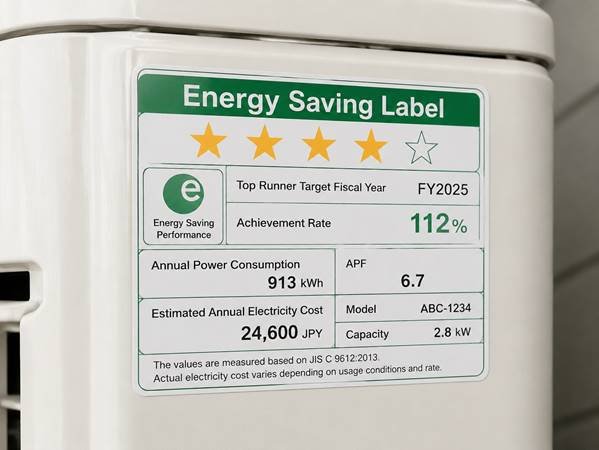
• Unified Energy Saving Label: This is the official standard energy efficiency label carrier that consumers can directly see, affixed to the product surface or product detail pages, which marks information such as the Top Runner target fiscal year and achievement rate. It is not a “Top Runner certification seal”, but only a display channel for system information.
• Top Runner Achievement Rate: It is the relative ratio of a product’s energy efficiency level to the current leading benchmark. The calculation method is determined by the official rules for the corresponding product category — indicators where “higher is better” such as energy efficiency ratio, and indicators where “lower is better” such as annual power consumption, are all converted into achievement rates according to a unified formula. A final rate of ≥100% means that the product meets the current leading requirements, and the higher the value, the better the energy efficiency relative to the benchmark.
Why Overseas Users Need to Understand It
Some people may say, I don’t live in Japan, what’s the use of understanding this? In fact, for overseas users, this system is more practical than you think:
First, Japan exports a huge volume of home appliances and automobiles. Cross-border purchased models and parallel imported models often mark relevant energy efficiency information. Only by understanding it can you avoid being fooled by merchants’ “Japan’s top energy-saving” publicity.
Second, energy efficiency testing standards and working conditions vary from country to country. You cannot directly horizontally compare Japanese values with your home country’s energy efficiency labels. Only by clarifying the rules can you avoid misjudgment.
Third, if you want to buy Japanese domestic version home appliances or cars, this system can help you more accurately judge long-term electricity and fuel costs, and choose more suitable products.
Responsibility Chain of the System
The reliable operation of this system relies on a four-party division of labor responsibility system:
• Government (Agency for Natural Resources and Energy under METI): Responsible for formulating standards, updating covered product categories, and conducting supervision and spot checks. It is the maker and supervisor of the rules.
• Manufacturers/Importers: Must measure energy efficiency and declare data in accordance with the official unified testing method, and also ensure that the overall average energy efficiency of all their products on sale, weighted by sales volume, meets the standard — it is not enough for a single model to meet the standard; the more a model sells, the greater its impact on the overall performance.
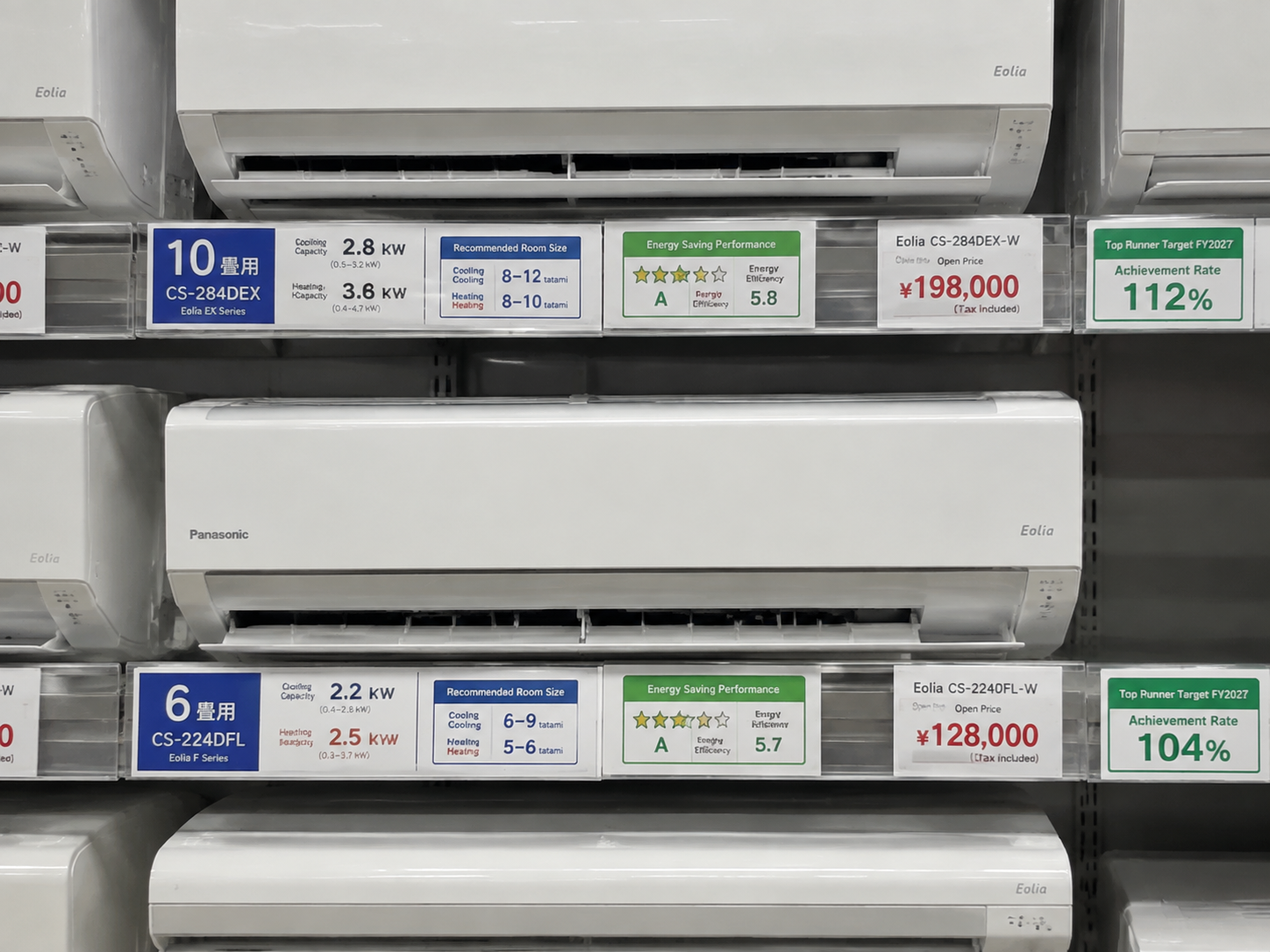
• Retailers: For product categories included in Japan’s domestic retail energy efficiency labeling requirements, they must mark the corresponding energy efficiency labels at product display positions as required; specific labeling requirements and display methods vary by product category and sales scenario. Not all products included in the Top Runner system need to display a unified standard label at the retail end.
• Consumers: Compare energy efficiency through labels and choose products based on their own needs. They are the end users of the system.
Common Misconceptions for Beginners to Clear Up
People who are new to this system are most likely to have these core misunderstandings. Let’s explain them all at once:
• Not an official certification for individual products: It is an industry benchmark system + enterprise self-declaration. There is no certification process of testing and stamping each unit. The authenticity of data is guaranteed by government spot checks, and there is no such thing as a “Top Runner certification certificate”.
• Not available for all Japanese products: It only covers specified high-energy-consumption categories, and only newly sold products included in retail labeling requirements will display the corresponding label; whether a product meets Top Runner requirements shall be subject to the achievement rate and corresponding target fiscal year on the label.
• Not valid for life: Standards are regularly upgraded with technological progress. Products that meet the standard under the old standard may not even reach the baseline under the new standard, so you need to check the corresponding target fiscal year.
• Not available for all Japanese-branded products: Japanese-branded products exclusively for export are not subject to Japan’s domestic Top Runner system — for example, a Panasonic TV you buy in China is produced exclusively for the Chinese market, uses Chinese energy efficiency standards, and has nothing to do with Japan’s Top Runner.
• Not a quality/safety certification: It only verifies the energy efficiency level of products, and has nothing to do with durability, safety, or workmanship. Do not equate “energy saving” with “good quality”.
Coverage: Which Product Categories Are Applicable to the Top Runner System
Core Logic for Including Product Categories
Not all products are included in this system. There are two core logics for inclusion: First, they are commonly used in residential and commercial scenarios, account for a high proportion of total social energy consumption, and the overall benefit of improving energy efficiency is large; second, they have fast technological iteration and large room for energy efficiency improvement, so setting standards can truly promote industry progress. Simply put, only categories with “large usage and improvement potential” will be under key management.
Currently Covered Common Categories and Query Boundaries
The applicable product categories of Top Runner are dynamically adjusted according to the evaluation of Japan’s Agency for Natural Resources and Energy. This article only lists the categories most commonly encountered by overseas users (not a complete statutory catalog). The complete coverage catalog, target fiscal years and judgment rules for each category shall be subject to the latest energy conservation system documents issued by the Agency for Natural Resources and Energy of Japan’s Ministry of Economy, Trade and Industry:
• Residential home appliances: Air conditioners, refrigerators/freezers, washing machines, televisions, water heaters, and lighting fixtures are all major power consumers in households.
• Commercial/office equipment: Commercial air conditioners, LED lighting, copiers, servers, vending machines, and computer monitors. These types of equipment are used in large quantities and for long hours, so their total energy consumption is no lower than that of residential ones.
• Transportation category: Gasoline/hybrid/electric passenger cars, light trucks — the vehicle fuel efficiency target system is managed separately from home appliances, and the consumer-side label format is different. Do not confuse them.
Three Common Types of Labels for Consumers
Energy efficiency label formats vary by product category. There are three types that consumers most commonly encounter:
• Unified Energy Saving Label: Applicable to specified home appliances and some commercial equipment sold at retail, with complete information such as star rating, achievement rate, and annual power consumption. It is the most familiar style; not all commercial equipment needs to display this label, and the specific situation shall be subject to the labeling rules of the corresponding category.
• Simplified Energy Saving Label: Applicable to some small high-energy-consumption products, with more concise information and only core energy efficiency parameters marked. The specific display content is adjusted according to different categories.
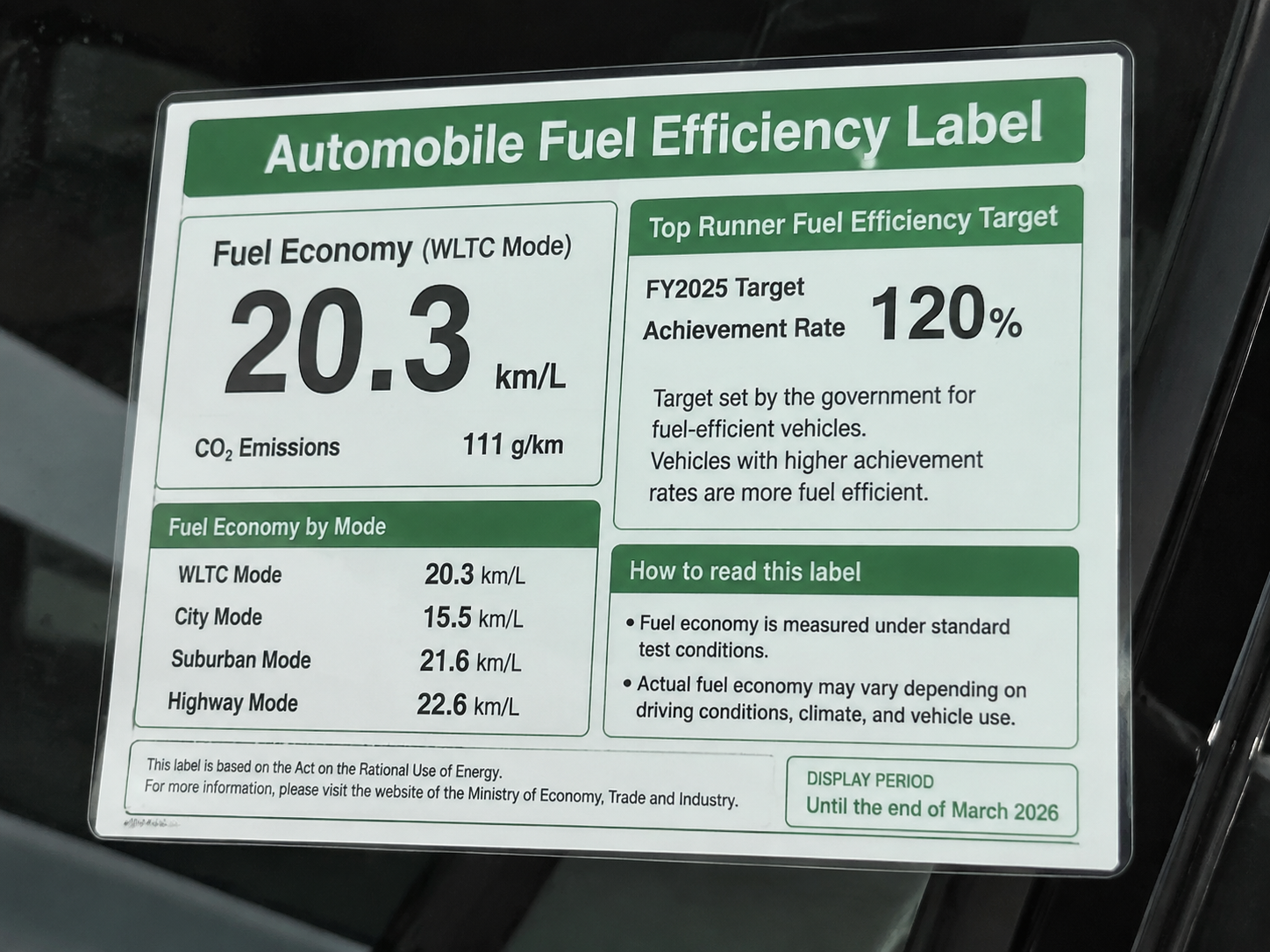
• Automobile Fuel Efficiency Label: Exclusively used for passenger cars and light trucks, marking fuel consumption/power consumption and corresponding Top Runner fuel efficiency targets. Its format is quite different from home appliance labels.
Products Not Subject to the System’s Constraints
The following products are not within the scope of specified newly sold domestic products in Japan subject to the Top Runner system. Do not directly apply the system rules to judge them:
• Low-energy-consumption niche small home appliances (such as electric toothbrushes, small desktop fans) and other products not included in the system’s coverage catalog;
• Industrial custom-made special equipment;
• Second-hand products (the system only restricts the energy efficiency declaration of newly sold products; the energy efficiency status of second-hand products cannot be judged according to new product standards);
• Japanese-branded products exclusively for export (not subject to Japan’s domestic energy efficiency rules);
• Products that enter the market through non-official import channels in Japan (it is impossible to confirm that their energy efficiency declaration meets the system requirements).
Scope Update Rules
The coverage of the system is not static: covered categories are regularly evaluated, and the evaluation cycle varies by category, generally 3 to 5 years, subject to official announcements; when adding new categories, a transition period will be announced 1 to 2 years in advance to reserve time for enterprises to make technical adjustments and preparations, and it will not be implemented suddenly.
Operation Logic: How the Top Runner Standard Is Set and Why It Is Reliable
Understanding the Top Runner Rules in Plain Language
Many people think this system is very complicated, but in fact its core logic is particularly simple, summarized in three sentences:
First, take the current top performers as the future average: set the top energy efficiency level of mass-produced models on the current market as the future catch-up goal for the entire industry.
Second, standards are dynamically upgraded: as technology advances, standards are raised accordingly, always using the cutting-edge mass production level to drive the entire industry forward, never being a one-and-done thing.
Third, not every product must meet the standard: what is required is that the overall average energy efficiency of enterprises, weighted by sales volume, meets the standard — for example, a brand sells 100,000 refrigerators a year, 60,000 of which are high-end models that exceed the top runner standard, and 40,000 are entry-level models. Because high-end models sell more, the overall average can meet the standard. This way, enterprises can both produce high-end energy-saving products and retain entry-level models to meet different needs.
Standard Formulation and Update Process
Standards are not decided arbitrarily by the government; there is a rigorous process: first, the government investigates the energy efficiency data, technical level, and achievable improvement space of market products in included categories, then organizes industry experts and enterprises to conduct repeated demonstrations, then solicits public opinions openly, and finally officially releases them.
The top runner standards for each category are dynamically updated with technological progress. The update cycle varies by category, mostly 4 to 5 years, and each new standard has higher requirements than the old one. After the new standard is released, a transition period of 3 to 5 years will be set (the specific duration varies by category), and enterprises need to meet the sales-weighted average compliance requirements before the end of the transition period.
Calculation Logic of Top Runner Achievement Rate
Many people think that only the “number one” counts as Top Runner, but that’s not the case at all: as long as the achievement rate is ≥100%, it meets the current top runner benchmark. The higher the value, the better the energy efficiency relative to the benchmark.
The calculation method of the achievement rate is determined by the official rules of the corresponding category, and there is no general algorithm that directly divides product energy consumption by the benchmark. The achievement rate is bound to a specific product model and only corresponds to the current target fiscal year — for example, a product with an achievement rate of 110% for the 2025 target fiscal year may have its achievement rate drop below 90% by the 2030 target fiscal year due to tighter new standards. You cannot apply the results of the old standard to the new standard.
Supervision and Penalty Boundaries
Some people may ask, since enterprises declare the data themselves, will they exaggerate the performance? In fact, there is a clear supervision mechanism in the system:
Energy efficiency data is measured and declared by manufacturers or importers in accordance with the official unified testing method, and does not require full third-party certification. This can reduce enterprise compliance costs and ultimately benefit consumers. The government can conduct spot checks and require enterprises to submit original test data. Supervision will adopt tiered measures based on the type of obligation and the severity of the case: usually starting with reporting requirements, administrative guidance/suggestions, and rectification orders. Only in serious cases such as false labeling and refusal to execute orders will more severe handling links such as public announcement of violators and fines be initiated. Therefore, the credibility of the overall data is guaranteed by the system.
Reading Energy Saving Labels: How to View Top Runner Related Information
After talking about the system itself, let’s return to the question everyone is most concerned about: how exactly do you read the energy saving label affixed to the product? How to quickly find a truly energy-saving model?
Core Components of the Unified Energy Saving Label
The most common unified energy saving labels for home appliances and commercial equipment have four core pieces of information:
• Energy saving performance mark: The green and orange marks on the label correspond to Japan’s statutory basic energy saving benchmark (a grading benchmark above the minimum access requirement). Green usually means energy efficiency is higher than the basic benchmark requirement, and orange means it does not meet the basic benchmark; note that this color mark only corresponds to the basic benchmark and cannot be directly used to judge whether the Top Runner leading benchmark is met.
• Top Runner target fiscal year and achievement rate: Clearly mark which version of the leading standard this product is compared against and how much it has achieved. For example, “FY2025 target achievement rate 112%” means it is 12% higher than the FY2025 leading benchmark.
• Core energy efficiency values: Such as annual power consumption, energy efficiency ratio (including annual comprehensive energy efficiency ratio APF, coefficient of performance COP, etc. Simply put, it is how much work 1 kWh of electricity can do; the higher the value, the more power-saving).
• Star rating, estimated electricity cost, matching model: The star rating is a 1-5 grade classification. The estimated electricity cost is a reference value calculated based on Japan’s domestic electricity price. The model must be consistent with the product you are looking at to avoid confusing different models.
Plain Language Explanation of Key Indicators
Don’t be afraid of the professional terms on the label. Let’s translate them into plain language one by one:
• Annual power consumption/fuel consumption/power consumption: Measured values under Japanese standard working conditions (that is, the environmental conditions and usage scenarios during testing). The lower the value, the more energy-saving. Note that this is a reference value, not the actual value you use at home.
• Energy efficiency ratio (APF/COP, etc.): Different categories use different indicators. For example, air conditioners use the annual comprehensive energy efficiency ratio (APF, an indicator measuring the comprehensive cooling and heating energy efficiency of air conditioners throughout the year). The core is always “how much utility 1 kWh of electricity can generate”, and the higher the value, the more power-saving. The core energy efficiency indicators of different categories are not unified: for refrigerators/freezers, the main indicators are usually annual power consumption and achievement rate; for lighting, it is power or luminous efficiency under the same luminous flux; for vehicles, it is standard cycle fuel consumption/power consumption. Don’t force yourself to find a “energy efficiency ratio” value that is universal for all categories. Key reminder: Energy efficiency ratios of different categories cannot be directly compared, which is completely meaningless.
• Top Runner achievement rate: The ratio relative to the current leading benchmark. ≥100% means compliance, and the higher the better. It is more accurate than the star rating.
• Star rating: The 1-5 grade classification of the unified energy saving label. For most categories, 5 stars correspond to an achievement rate of ≥100%, but the thresholds for different categories and different years may be adjusted. So you can’t just look at 5 stars and think it must meet Top Runner standards; the most accurate way is to look at the achievement rate.
3 Steps for Quick Reading
You don’t have to read the label word by word. Follow these three steps, and you can get a rough judgment in 10 seconds:
1. Confirm the leading compliance status: First find the Top Runner target fiscal year and achievement rate fields on the label. An achievement rate of ≥100% means meeting the current leading benchmark; do not judge only by the color mark. Green only means meeting the basic energy saving requirements, which is not equivalent to Top Runner compliance.
2. Lock the comparison scope: Only compare products of the same category, same specification (for example, same refrigerator capacity, same air conditioner horsepower, same TV size), and same target fiscal year. If any of the three conditions is missing, the comparison is meaningless.
3. Compare core parameters: On the premise that the product specifications, functions, and prices all meet your own needs, choose the model with a higher achievement rate and lower core energy consumption values.
Key Information Easily Overlooked
Many people only look at the stars when reading labels, ignoring these important pieces of information, which can easily lead to wrong judgments:
• Product specifications: Capacity, horsepower, size are the prerequisites for comparison. For example, a 1-horsepower air conditioner is definitely more power-saving than a 3-horsepower one, so comparing their achievement rates is meaningless.
• Assumed electricity price for estimated electricity cost: The electricity cost on the label is calculated based on Japan’s domestic electricity price. Overseas users cannot use it directly and need to recalculate it with their local electricity price.
• Test working condition description: The values on the label are all measured under specific conditions, such as the test temperature of air conditioners and the ambient temperature of refrigerators. When conditions are different in actual use, there will be deviations in energy consumption, so you should be aware of this.
Key Judgment Points by Category: What to Look for in Different Products
For products of different categories, the prerequisites and core indicators for energy efficiency comparison are different. We have sorted out the key judgment points for common categories for your reference:
| Product Category | Comparison Prerequisites | Core Reference Indicators | Main Sources of Deviation in Actual Use |
| Refrigerators/Freezers | Same capacity, same number of temperature zones | Annual power consumption, Top Runner achievement rate | Ventilation conditions, door opening frequency, ambient temperature |
| Air Conditioners | Same horsepower, same function type (cooling and heating/cooling only) | Annual comprehensive energy efficiency ratio (APF), achievement rate | Room area, thermal insulation, set temperature, local climate |
| Televisions | Same screen size, same resolution | Annual power consumption, Top Runner achievement rate | Brightness settings, usage duration, standby power consumption |
| Lighting Equipment | Same luminous flux (brightness), same applicable scenario | Power, energy efficiency value | Usage duration, dimming settings, standby power consumption |
| Passenger Cars/Light Trucks | Same power type (fuel/hybrid/battery electric), same class | WLTC cycle fuel consumption/power consumption, fuel efficiency target achievement rate | Road conditions, temperature, driving habits |
| Commercial Office Equipment | Same performance grade, same function configuration | Standby power consumption (for long-term standby types), typical load energy efficiency (for printing types) | Usage frequency, load rate, standby time |
Here are some unique reminders for each category:
• Air conditioners: The applicable area marked on Japanese models is calculated based on domestic residential thermal insulation conditions and climate. Overseas users should combine factors such as local climate, house thermal insulation, floor height, and orientation to choose a model with corresponding capacity according to the actual cooling and heating load, and do not directly apply the applicable area marked in Japan (Note: “horsepower” is a common term in the Chinese market; Japanese air conditioners usually use cooling/heating capacity (kW) as the marking unit).
• Lighting equipment: You cannot only compare rated power. You need to compare power consumption under the premise of the same luminous flux (unit: lumen, representing the actual luminous brightness of the lamp) to accurately judge the level of energy efficiency.
• Passenger cars/light trucks: Adopt an independent fuel efficiency label system. The core reference is fuel consumption/power consumption under the WLTC cycle (Worldwide Harmonized Light Vehicles Test Cycle, used to measure fuel consumption or power consumption levels under standard working conditions). The values are measured under laboratory standard working conditions, and actual use will be affected by road conditions and driving habits.
• Commercial office equipment: For long-term standby equipment such as servers and monitors, focus on the proportion of low-load/standby power consumption; for intermittent working equipment such as copiers and printers, refer to the energy efficiency under typical working load (a test mode that simulates daily common tasks, and the measurement results are closer to the energy consumption of real usage scenarios), rather than only looking at the rated power.
Comparison and Pitfall Avoidance: Don’t Be Fooled by Fake Labels/Cross-level Comparisons
After understanding the labels, you also need to learn to avoid pitfalls — many merchants use information asymmetry to mislead consumers with fake labels and cross-level comparisons. Overseas users, in particular, are more likely to fall into traps because they are not familiar with the Japanese system.
Differences from Other Domestic Energy Efficiency Labels in Japan
There are many other energy efficiency-related labels in Japan. Don’t confuse them with Top Runner:
• Differences from ordinary energy efficiency grading: The 1-5 stars of the unified energy saving label cover all energy efficiency grades, from the lowest to the highest. An achievement rate of ≥100% means meeting the current Top Runner target benchmark, which usually belongs to the high energy efficiency echelon in the market; whether it corresponds to 5 stars depends on the specific category and the threshold setting of that year. In most cases, it corresponds to 5 stars, but it is not absolute — for example, 5-star products under the old standard may not meet the requirements of the new cycle’s Top Runner target benchmark.
• Differences from eco-labels: Top Runner only manages the energy efficiency of products during the use phase, that is, whether they save electricity or fuel; while Japan’s Eco Mark covers the entire life cycle, including whether materials are environmentally friendly, whether they can be recycled, energy consumption in the production process, etc., with a wider scope.
• Differences from self-proclaimed “energy saving awards” by enterprises: Many enterprises carry out their own publicity such as “Energy Saving Grand Prize” and “Best Award”. These have no official system endorsement. Only the Top Runner achievement rate and target fiscal year on the official standard label are reliable.
Comparison with Common International Energy Efficiency Labels
Many people like to directly compare Japanese energy efficiency labels with those of their own countries. Here we must first state a major premise: Energy efficiency test working conditions (voltage, climate, usage scenarios, test cycles) vary from country to country. There is no official conversion relationship, and they cannot be directly equated. They can only be used as a reference that “this product belongs to the high energy efficiency echelon”.
| Country/Region | Highest Grade of Energy Efficiency Label | Core Difference from Japan’s Top Runner |
| China | Grade 1 | Different test working conditions and standard systems, no official conversion relationship, can only be referenced as high energy efficiency echelon products |
| European Union | Grade A | Different test cycles and usage scenario settings, no official conversion relationship, can only be referenced as high energy efficiency echelon products |
| United States | ENERGY STAR (voluntary certification) | Different nature: US ENERGY STAR is a voluntary certification, while Japan’s Top Runner is the highest energy efficiency target for product categories for manufacturers/importers under a mandatory system (assessed by sales-weighted average) |
If the product category is different, the standard version is updated, or your usage scenario is very different from Japan’s (for example, you use an air conditioner in a tropical region, and Japan’s test temperature may not be that high), then the reference value of this high energy efficiency will decrease, and you should not take it too seriously.
7 Most Common Pitfalls for Overseas Users
We have sorted out the specific pitfalls that overseas users most often encounter when purchasing. Be sure to avoid them:
1. Credulously believing the publicity of “official Top Runner certification certificate”: The system does not have a single product certification process of testing and issuing certificates for each unit. Energy efficiency data is declared by enterprises according to official standards and supervised by government spot checks. There is no such thing as a “Top Runner certification certificate”.
2. Cross-dimensional comparison of energy efficiency values: For example, comparing the achievement rate of refrigerators with different capacities, comparing the star rating of products from the old target fiscal year with those from the new target fiscal year, and comparing the energy efficiency ratio of air conditioners with that of televisions. These comparisons have no reference value. Only products of the same category, same specification, and same target fiscal year can be compared.
3. Taking label energy consumption/electricity cost as actual usage value: The label values are reference values under Japanese standard working conditions. Actual energy consumption will be affected by factors such as usage duration, ambient temperature, and voltage conversion losses. You cannot directly convert the Japanese domestic electricity cost on the label into local cost by exchange rate.
4. Equating 5 stars with Top Runner compliance: For most categories, 5 stars correspond to an achievement rate of ≥100%, but the star thresholds for different categories and different years may be adjusted. The most accurate basis for judging compliance is whether the Top Runner achievement rate is ≥100%, not the star rating.
5. Thinking that all Japanese-branded products comply with Top Runner rules: Japanese-branded products exclusively for export and products not imported through official Japanese channels are not subject to Japan’s domestic Top Runner system, and their energy efficiency cannot be judged by the standards of this system.
6. Directly applying Japan’s domestic applicable parameters: For example, directly using the applicable area of Japanese air conditioners to choose a model, or directly estimating local fuel consumption based on Japanese fuel consumption values. These will have large deviations due to differences in residential conditions, climate, and road conditions.
7. Only looking at energy efficiency and ignoring basic adaptability: The rated voltage of Japanese domestic version electrical appliances is 100V. Overseas use requires a compliant transformer, which itself will generate energy consumption losses and may also affect the operating efficiency of the equipment; in addition, you need to confirm whether the functions are adapted to the local climate and usage habits to avoid the situation of high energy efficiency but no practical use.
Practical Decision-Making Process for Overseas Users
After talking so much, how exactly should overseas users use this system to choose when buying Japanese imported products? We have sorted out a set of practical decision-making processes.
4-Step Judgment Method for Japanese Imported Products
Follow these four steps, and you can not only choose high energy efficiency products, but also avoid most pitfalls:
1. First confirm adaptability and version: First confirm that the product is a regular on-sale version in Japan, not an export-exclusive model. At the same time, check basic adaptability such as voltage, plug, and warranty — if the voltage is wrong and there is no warranty, no matter how energy-saving it is, it’s useless. You can confirm by checking the Japanese domestic model number, viewing Japanese domestic sales pages, etc.
2. Lock the fair comparison scope: Only compare products of the same category, same specification, and same Top Runner target fiscal year to avoid cross-level comparisons. For example, if you want to buy a 600-liter refrigerator, only look at models of around 600 liters with the same target fiscal year, don’t compare with 500-liter ones.
3. Read labels to screen high energy efficiency models: On the premise that product functions and prices meet your own needs, prioritize models with an achievement rate of ≥100%, then compare core energy consumption values under the same specification, such as annual power consumption and energy efficiency ratio, and combine price and functions to choose the most suitable one for you.
4. Estimate local usage cost: The basic calculation formula is: annual reference electricity cost = annual power consumption marked on the label × local electricity price; annual reference fuel cost for fuel/hybrid vehicles = annual fuel consumption marked on the label × local fuel price. It should be noted that the actual use of products such as air conditioners and vehicles is quite different from Japanese standard working conditions. You should adjust the estimate based on your expected usage duration, local climate or road conditions, and cannot directly convert the Japanese domestic electricity/fuel cost on the label by exchange rate for use.
Authoritative Information Query Channels
If you have doubts about the information provided by merchants, you can verify it through two official channels:
• Official page of the “Energy Conservation Performance Labeling System” of the Agency for Natural Resources and Energy (METI) of Japan’s Ministry of Economy, Trade and Industry: You can query the latest coverage catalog of each category, system rules, and the energy-saving product performance database registered by manufacturers.
• Product Energy Efficiency Search System of the Energy Conservation Center, Japan (ECCJ): It is an officially related public search tool. You can query the energy efficiency details of specific products by brand, category, and model. The queryable fields for different categories are subject to the actual display of the system.
When querying, you need to focus on verifying core information such as whether the product model is completely consistent, the corresponding Top Runner target fiscal year, and the achievement rate, to avoid confusion with similar models or old standard models.
Situations Where You Don’t Need to Refer to Top Runner
Not all situations require reference to the Top Runner system. You don’t have to struggle with it in the following situations:
• Purchasing Japanese-branded products exclusively for export: such products are not subject to Japan’s domestic energy efficiency standards, and even if they are marked with relevant words, they have no reference value for the system.
• Products with extremely short usage time and very low energy consumption proportion: for example, small electrical appliances used occasionally, the energy saving difference has little impact on the total cost, so there is no need to spend time researching.
• Unable to confirm whether the product is a regular on-sale version in Japan: for example, purchasing agent products of unknown origin, the authenticity of energy efficiency information cannot be guaranteed, so the reference value is low.
Summary
Finally, let’s sort out several core conclusions:
First, Top Runner is a dynamic energy efficiency benchmark system led by the Ministry of Economy, Trade and Industry under Japan’s . It assesses the overall average energy efficiency of specified product categories of manufacturers/importers, weighted by sales volume, and is not a single product certification. The standards for each category are dynamically updated with technological progress.
Second, consumers can view energy efficiency information through the unified energy saving label (for home appliances/commercial equipment) or automobile fuel efficiency label. The core basis for judging whether the Top Runner leading benchmark is met is that the achievement rate of the corresponding target fiscal year is ≥100%, which is more accurate than star rating judgment.
Third, this system only applies to specified high-energy-consumption products newly sold in Japan. Energy efficiency comparison must meet the prerequisites of same category, same specification, and same target fiscal year, and cannot be directly equated with energy efficiency labels of other countries.
After mastering these contents, you can independently complete three types of judgments: First, you can distinguish the Top Runner system from energy saving labels, identify fake labels and edge-cutting publicity, and understand the core parameters of labels; second, you can focus on key points to compare energy efficiency by category, and avoid common pitfalls such as cross-dimensional comparison, false labeling, and export models pretending to be domestic models; third, you can judge whether you need to refer to this system when purchasing Japanese imported products, roughly estimate the local usage cost, and make basic purchasing decisions.