
Cross-border sellers and foreign trade practitioners operating in the US market have almost all heard of the term “CPSC certification”: it is required for customs clearance, platform listing, and wholesaler procurement. Many people’s first reaction is “to get an official certificate issued by CPSC”, only to end up spending money and falling into pitfalls — the core problem is that their understanding of this concept is fundamentally wrong.
First, dispel the myth: “CPSC certification” is an industry common name, not an official certificate
Many people think that “CPSC certification” is a unified certificate issued by an official body like ISO certification, but this is not the case.
CPSC is a US federal regulatory agency, with the full name of the Consumer Product Safety Commission. Its core responsibilities are to enforce multiple consumer product safety laws, formulate or implement relevant safety rules, and carry out market law enforcement. It never directly issues “certificates of conformity” for products.
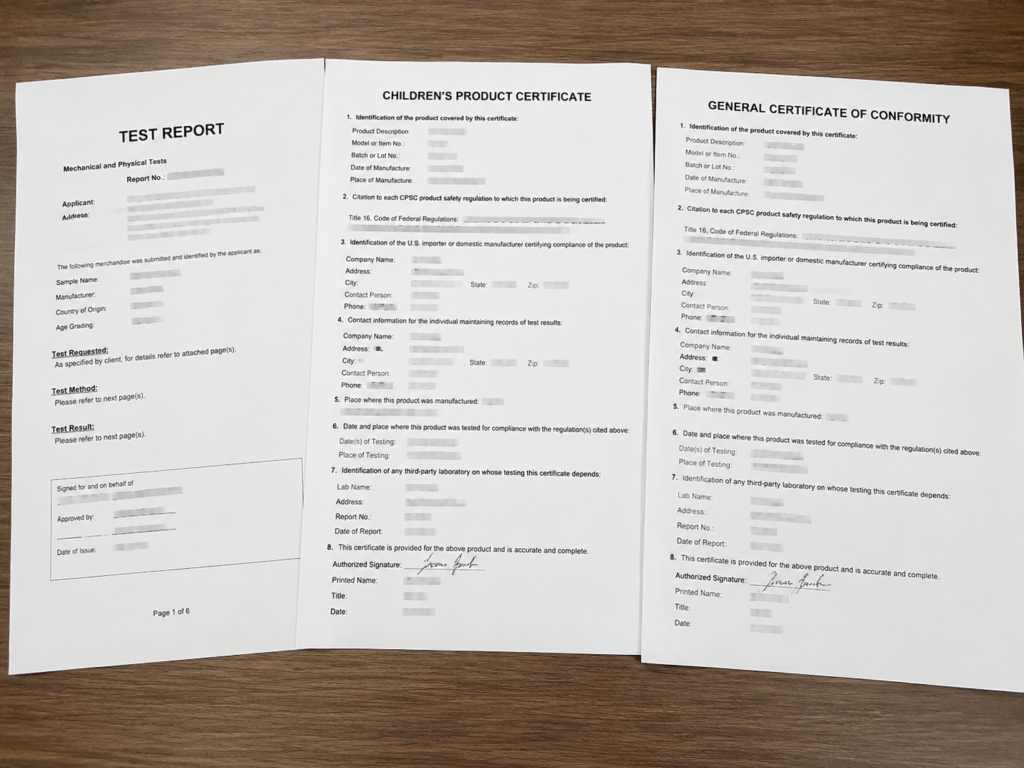
The “CPSC certification” often mentioned in the market is just a common name in the industry, and its essence is a general term for “products meeting various safety requirements under CPSC supervision”. People often mistakenly refer to three types of real compliance documents as “CPSC certification”: test reports issued by third-party laboratories, Children’s Product Certificate (CPC), and General Certificate of Conformity (GCC).
This common name is indeed more convenient in daily communication about foreign trade, customs clearance, and platform audits, but when formally judging compliance, you must never just listen to the statement “has CPSC certification”; you must correspond to specific products, specific documents, and specific applicable standards.
The core regulatory logic of US consumer product safety is enterprise self-certification and ex post supervision: enterprises must first confirm by themselves that their products meet all applicable safety rules before they can be sold in the US market; CPSC does not inspect and issue certificates one by one in advance, but enforces laws ex post through methods such as market spot checks, consumer complaint verification, and recalls.
Core role division: understand 4 terms at once
Many people cannot distinguish the differences between CPSC, CPSIA, CPC, and GCC. In fact, they are four roles with clear division of labor, which together constitute the compliance framework for US consumer product safety. The specific division of labor can be seen in the table below:
| Term Abbreviation | Full Name/Identity | Core Responsibilities |
|---|---|---|
| CPSC | Consumer Product Safety Commission (federal regulatory agency) | Formulates consumer product safety rules in accordance with laws, carries out market law enforcement, and initiates recalls; continuously conducts spot checks on consumer products such as toys and household goods and releases recall information, and the number of recalls varies with year, category, and statistical caliber; it is the formulator and enforcer of rules, and does not issue product certifications |
| CPSIA | Consumer Product Safety Improvement Act (core legislation) | Strengthens the safety requirements for products for children aged 12 and under, and is the main legal basis for children’s product compliance |
| CPC | Children’s Product Certificate (enterprise self-certification document) | For products for children aged 12 and under that are subject to children’s product safety rules, it is issued by the enterprise itself, which bears full responsibility for the authenticity of the content |
| GCC | General Certificate of Conformity (enterprise self-certification document) | For products that are subject to CPSC specific safety rules, bans or standards and are not children’s products, it is issued by the enterprise itself, which bears full responsibility for the authenticity of the content |
In short: CPSC clarifies “what requirements products must meet” based on laws such as CPSIA, third-party test reports are evidence that “products actually meet the requirements”, and CPC/GCC are the formal compliance statements after sorting out.
Applicable boundaries: how to judge whether your product needs compliance
The question many people ask most often is “does my product need CPSC compliance?” In fact, you can use a two-step method for initial screening, and then further confirm the details. It should be noted that: the two-step method can only be used for initial screening, and finally must be checked against the specific mandatory rules, bans or standards enforced by CPSC according to the specific use, target age, structure and materials of the product; the same product may also be subject to other federal or state requirements at the same time.
Two-step judgment method
Step 1: First determine whether the product is a consumer product, that is, a product purchased daily by ordinary consumers for personal or household use. If it is special equipment or tools only used in industrial/professional scenarios and not sold to ordinary consumers at all, it usually does not fall into the category of consumer products regulated by CPSC; but if the same product is also sold to ordinary consumers, even if there is a professional version, it may be recognized as a consumer product.
Step 2: Check whether CPSC has applicable specific safety rules, bans or standards, and at the same time confirm whether there are exclusive or parallel regulatory requirements from other federal agencies such as FDA, NHTSA, and ATF. If the product is mainly designed or intended for use by children aged 12 and under, it must be separately verified in accordance with children’s product rules.
Common covered categories
We can establish a general understanding of the regulatory scope through several types of common products:
- Children’s products category: Products mainly for children under 12 years old, such as toys, children’s clothing, strollers, children’s tableware, cribs, and student stationery, are mostly subject to strict children’s product safety rules.
- General consumer products category: Civilian products such as furniture, household goods, adult clothing, sports equipment, and consumer electronics casings may fall within the scope of consumer products regulated by CPSC. Whether testing, certificates and specific labels are required depends on the specific applicable rules; among them, if consumer electronics involve attributes such as electrical safety and wireless communication, they may be subject to other federal rules at the same time, which need to be verified simultaneously.
- Non-children’s products with special mandatory rules: For categories such as adult pajamas, lighters, and bicycles, CPSC has clear mandatory safety rules; product safety matters for consumer fireworks may also involve CPSC.
Products whose supervision by other agencies should be prioritized for verification
For some products, the main regulatory responsibility is not with CPSC, or there is a multi-agency division of labor. Do not blindly apply CPSC rules:
- Food, drugs, cosmetics, and medical devices: mainly regulated by the FDA (US Food and Drug Administration).
- Automobiles, motorcycles and core accessories: mainly regulated by NHTSA (National Highway Traffic Safety Administration).
- Firearms and ammunition: mainly regulated by ATF (Bureau of Alcohol, Tobacco, Firearms and Explosives).
- Fireworks and firecrackers: matters such as explosive permits, operation, and transportation are regulated by agencies such as ATF, and the product safety requirements for consumer fireworks may involve CPSC, which need to be verified according to specific matters.
- Equipment and tools only used in industrial/professional scenarios and not sold to ordinary consumers at all: do not fall into the category of consumer products, and usually do not apply CPSC consumer product safety rules.
Responsible subjects and common compliance scenarios
After clarifying the product scope, it is also necessary to clarify the division of responsibilities: US domestic manufacturers are usually responsible for the issuance of certificates and compliance implementation of domestically manufactured products; US importers usually bear the responsibility for issuing GCC/CPC for imported products and managing relevant compliance records; even if brand owners, OEM parties, and platform sellers do not directly produce, they may bear corresponding compliance responsibilities due to participation in product design, brand control, sales and other links, and cannot shift all responsibilities to overseas foundries.
In daily operations, there are four most common scenarios where compliance documents need to be provided: first, US customs clearance, where goods may be directly detained if there are no documents meeting the requirements; second, listing audits or annual compliance audits on platforms such as Amazon and Temu; third, supplier reviews before procurement by US wholesalers and retailers; fourth, verification after CPSC market spot checks and consumer complaints.
Graded requirements: compliance obligations vary greatly for different products
CPSC compliance requirements are not unified. The core judgment logic is: first check whether the product is subject to a specific safety rule, ban or standard enforced by CPSC, and then correspondingly determine the testing and certificate obligations. The higher the risk of the product, the stricter the rules usually are.
Category 1: Products for children aged 12 and under subject to children’s product safety rules
The compliance requirements for such products are usually stricter, but the specific test items and labeling obligations must be confirmed according to product category, materials, structure and applicable rules. Not all children’s products automatically apply exactly the same requirements, which usually include the following core contents:
- Toxic and hazardous substances: lead, phthalates (a common plasticizer with potential harm to children’s development), etc. must meet the limit requirements in the corresponding rules.
- Mandatory third-party testing: usually, a third-party laboratory accredited by CPSC must complete the corresponding item tests in accordance with applicable rules.
- CPC certificate: issue a Children’s Product Certificate based on valid test reports.
- Tracking label: affix a permanent tracking label on the product body and/or packaging as required by the corresponding rules. The specific carrier and content are determined according to product characteristics, and need to include relevant content of traceable production information.
- Additional requirements for durable infant and toddler products: durable infant and toddler products defined by laws and regulations (such as cribs, strollers, child safety seats, etc.) also need to be accompanied by a product registration card to facilitate subsequent proactive recall notifications.
Category 2: Non-children’s products subject to specific safety rules
For such products, it is necessary to determine whether mandatory third-party testing is required and whether a GCC certificate needs to be issued according to the requirements of the corresponding rules. For example, categories such as adult pajamas, lighters, and bicycles all have clear mandatory rules and corresponding GCC requirements.
Category 3: Ordinary low-risk non-children’s products not subject to specific certificate rules
Such products do not require mandatory third-party testing or GCC just because they are civilian consumer products. Enterprises can self-assess to ensure that the products meet the general requirement of “no unreasonable safety risks”, but self-assessment cannot rely solely on subjective judgment. It is necessary to at least check applicable mandatory rules, bans, product design and structure, warning labels, materials and processes, accident and complaint information, and form written assessment records.
It should be noted that: if the product is subsequently included in the scope of specific mandatory rules, it is necessary to supplement testing and documents as required by the rules, and low-risk self-assessment cannot replace mandatory obligations.
Comparison of core differences between CPC and GCC
Many people cannot distinguish between these two types of certificates. The core differences can be seen in the table below:
| Comparison Item | CPC (Children’s Product Certificate) | GCC (General Certificate of Conformity) |
|---|---|---|
| Applicable objects | Products for children aged 12 and under subject to CPSC children’s product safety rules | Products subject to CPSC specific consumer product safety rules, bans or standards and not classified as children’s products |
| Testing requirements | Usually must be tested by a CPSC-accredited third-party laboratory in accordance with applicable rules | Depends on the rule requirements of specific categories, some require mandatory third-party testing |
| Regulatory strictness | Higher law enforcement priority for corresponding children’s products, and greater penalties for violations | Depends on product risk and rule requirements, overall relatively lenient |
Practical operation process: 5 steps from judgment to completing compliance
After clarifying the requirements, the specific implementation can be carried out in 5 steps to complete basic compliance.
Step 1: Clarify the specific compliance requirements of the product
First determine the product category using the two-step judgment method mentioned above, then query the CPSC safety rules and mandatory test items applicable to the corresponding category; when the classification is uncertain, you can refer to the product classification guide on the CPSC official website.
Step 2: Select a compliant laboratory and send samples for testing
For products that require third-party testing subject to rules, a CPSC-accredited third-party laboratory must be selected, and it is necessary to check whether the laboratory has obtained CPSC accreditation for the product category and specific test items; laboratories on the accreditation list do not mean that they automatically cover all standards. Testing of children’s products must be completed by a CPSC-accredited third-party institution.
Test items are determined according to the material, structure, use and applicable rules of the product. There is no unified “CPSC testing package” at all. Those that quote a fixed price regardless of the product are most likely a pitfall. The cost and cycle are determined by factors such as laboratory qualification, number of test items, sample complexity, and whether rectification is required, and you need to inquire with the laboratory item by item.
It should be noted that the samples sent for testing must be able to represent the material, structure, and process of mass-produced products; if there are changes in formula, materials, structure, suppliers or production processes that may affect compliance, a re-evaluation should be conducted, and supplementary testing or re-certification should be carried out in accordance with applicable rules.
Step 3: Issue compliance declaration documents (CPC/GCC)
The certificate is issued by the US domestic manufacturer or US importer itself, which bears full responsibility for the authenticity of the content, and does not require CPSC approval or seal. Overseas manufacturers can provide product and test materials, but documents issued by factories alone cannot replace certificates that should be issued by US importers or qualified responsible subjects.
The certificate should be in English and list product identification information, specific applicable regulations/rules/standards, manufacturing date and location, test date and location, name, address and contact information of the responsible party, name and address of the laboratory, etc. in accordance with current CPSC requirements; model, batch or other tracking information should be sufficient to correspond the certificate to the actually sold products, and the specific fields are subject to current official requirements and product rules. Vague expressions such as “meets CPSC requirements” cannot be written alone.
Step 4: Complete product labeling
Children’s products subject to rules need to be affixed with permanent tracking labels in accordance with corresponding requirements. The labels must be eye-catching, not easy to fall off, clear and legible, and the information must be consistent with the product information in the certificate and test report.
Durable infant and toddler products defined by laws and regulations need to be accompanied by a product registration card and meet the corresponding permanent labeling requirements.
Step 5: Keep documents to respond to reviews
Test reports, CPC/GCC and related compliance records are usually kept for at least 5 years (CPSIA has clear requirements for records related to children’s products), and the specific retention period should still be confirmed according to product categories and current regulations.
Certificates and test materials should be completed and kept before sales, import and platform audits; when required by customs, CPSC or platforms according to specific rules, spot checks or audit requirements, they should be submitted in a timely manner. Whether it needs to be submitted with the goods shall be subject to the specific category and customs requirements. Missing documents may lead to risks such as customs clearance delays, cargo detention, or platform audit failure.
Advanced pit avoidance: document verification and risk identification
After understanding the entry-level process, you also need to learn to judge whether the documents in hand are really effective and understand the level of risk, otherwise what you spend money on is waste paper, and you still have to take responsibility when something goes wrong.
5 steps to judge whether compliance documents are valid
You can check according to these 5 steps:
- Check product matching: Whether the information such as model and material on the certificate is consistent with the actually sold products; if the product has changes, whether there are corresponding supplementary assessment or test records.
- Check standard matching: Whether the specific applicable safety rule/standard number is listed, instead of just writing empty words such as “meets CPSC requirements”.
- Check laboratory qualification: For products that require third-party testing, whether the laboratory issuing the report has the corresponding qualification; whether the testing institution for children’s products is on the CPSC accreditation list and covers the corresponding test items.
- Check responsible subject: Whether the certificate clearly marks the name and contact information of the US importer or US domestic manufacturer, instead of only listing overseas foundry information.
- Check time and batch matching: Verify whether the test date is earlier than the production date of the corresponding batch of products, and whether the production batch, model, material, and version are fully covered by the report and certificate; if the test is later than production, or the batch correspondence cannot be proved, the use of the document should be suspended and the applicability should be reconfirmed.
The 6 most common compliance myths
Almost every novice has stepped on at least one, so be sure to avoid them:
- Believing in “agent processing of CPSC official certificates”: Any service that claims to be able to handle unified certification certificates directly issued by CPSC, or promises to obtain official compliance certificates without testing, should be highly vigilant. Third-party institutions can legally provide testing, document guidance or compliance consulting services, but CPC/GCC are always issued by the responsible subject itself and bear full responsibility for authenticity.
- Having a test report equals completing compliance: The test report can only prove the test results of the samples sent for testing. Complete compliance also includes multiple links such as issuing corresponding certificates, product labeling meeting requirements, and mass-produced products being consistent with the samples sent for testing.
- All products need third-party testing: Only products that are subject to corresponding rules and clearly require third-party testing need it. Ordinary low-risk non-children’s products do not require mandatory testing, and self-assessment and record keeping are sufficient.
- One test is valid for life: When products are remodeled, raw materials are replaced, applicable safety standards are updated, or other changes that may affect compliance occur, re-evaluation and testing as required are needed.
- Factory compliance has nothing to do with yourself: US importers and brand owners often bear core compliance responsibilities. Even if suppliers provide documents, they must verify the authenticity and product matching by themselves, and cannot only rely on verbal promises.
- Platform requirements equal regulatory requirements: Platform compliance requirements may be stricter than regulations, and they also have their own internal audit rules, so it is necessary to meet both the regulatory bottom line and the platform threshold at the same time.
Judgment logic of compliance risk level
The review priority of CPSC and customs is not fixed, and is usually dynamically adjusted in combination with the following factors. Operators can also assess their own compliance risk level based on this and prepare in advance:
- Product risk attributes: Products for children aged 12 and under, and high-risk categories with known injury risks, usually have higher law enforcement priority.
- Sales channel characteristics: Products sold through cross-border e-commerce platforms usually require more complete documents prepared in advance because the platform has an independent compliance audit mechanism; the probability of review triggering for offline wholesale and private transactions is relatively lower, but they still need to meet regulatory requirements.
- Subject compliance records: Subjects with previous recalls, violation penalties or multiple consumer complaint records will have a higher probability of being spot-checked in the future.
- Product source and supply chain integrity: The probability of customs clearance review for imported products is usually higher than that of US domestically produced products. If the supply chain documents are incomplete and the responsible subject is unclear, it is also more likely to trigger verification.
The above factors only affect the relative level of review priority and operational risk, and do not represent a fixed spot check probability or legal liability level. All regulated products need to meet the corresponding compliance requirements.
Real consequences of violations
The specific consequences of violations need to be determined in combination with product risks, illegal matters, the situation of the responsible subject and law enforcement decisions. Common handling methods mainly include according to the severity:
- Mild: Goods may be detained by US customs. If the documents meeting the requirements can be supplemented and the products have no safety hazards, they may be released, but the operator needs to bear additional costs such as port detention and storage.
- Moderate: Products may be required to stop selling or be recalled. Costs related to recalls such as refunds, repairs, destruction, and consumer notifications are usually borne by the responsible subject according to the requirements of the case.
- Severe: Civil fines may be imposed. The upper limit of fines will be adjusted regularly according to law, and the specific amount shall be subject to the current standards announced by CPSC and the actual situation of the case; if there are serious illegal acts such as intentionally submitting false information, criminal risks may also be involved.
- Long-term impact: Subjects with multiple or serious violations may be subject to stricter follow-up law enforcement reviews by CPSC, and may also affect platform entry and product listing permissions.
Quick self-check: locate your compliance requirements in 1 minute
Having said so much, you can use the simplest three-question self-check method to quickly locate what your product needs to do in 1 minute:
- Is the product mainly designed or used for children aged 12 and under? If yes, you need to check the corresponding children’s product safety rules and prepare CPC and related tests as required.
- Is the product a non-children’s category with clear mandatory rules from CPSC? If yes, prepare GCC and necessary tests according to the requirements of the corresponding rules.
- Does the sales channel have additional compliance requirements? For example, platform rules may be stricter than regulations, which need to be met simultaneously.
Must-do list for regulated children’s products
- Find a CPSC-accredited third-party laboratory to conduct corresponding item tests
- Issue a CPC certificate based on valid test reports
- Affix permanent tracking labels as required by rules
- Legal durable infant and toddler products are accompanied by a product registration card
- Keep test reports, certificates and related compliance records for at least 5 years, and check whether specific rules have longer requirements
Must-do list for general consumer products
- Confirm whether the product is subject to CPSC specific mandatory rules
- Categories subject to rules shall issue GCC and complete mandatory testing as required
- For categories not subject to specific certificate rules, self-assess compliance and keep written assessment records
- Check additional requirements of sales channels
Official free verification channels
- The CPSC official website can query the list of accredited laboratories, product classification guides and applicable safety rules
- Platform sellers can directly view the compliance requirements of corresponding categories in the seller backend
After reading this content, you should be able to independently complete several basic judgments: distinguish that “CPSC certification” is an industry common name rather than a unified certificate issued by the official, distinguish the different positioning and division of labor of CPSC, CPSIA, CPC, and GCC, quickly judge the compliance requirements corresponding to your own products, go through the basic compliance process, and verify the validity of compliance documents. The core of CPSC compliance is that the product truly meets the safety requirements, not “getting a certificate”. Only by clarifying the rules in advance and implementing each requirement can operational risks be effectively avoided.