
Practitioners engaged in the U.S. children’s product business almost always encounter the CPC certificate — it may be required for submission during import customs clearance inspections, often needs to be uploaded when listing children’s categories on e-commerce platforms, and is frequently included in audit materials when supplying to U.S. local retailers. But many people easily get confused when first exposed to it: What exactly is the nature of a CPC? Is it officially issued? Does my product need one? Will the certificate I obtain be invalid?
This article sorts through content from basic definitions, applicable boundaries, legal requirements, handling procedures to common risks and verification methods one by one, helping you build a complete understanding of CPC and reduce compliance misunderstandings.
1. Basic CPC Knowledge: What It Is and Why It Is an Important Compliance Document for U.S. Market Access
1.1 Core Definition and Legal Attribute of CPC
Many people confuse CPC with official safety certification, but the two are completely different in nature. In plain terms, CPC is a mandatory compliance declaration for children’s products intended for children aged 12 and under entering the U.S. market — it is a compliance declaration issued by the enterprise based on qualified test results, not issued arbitrarily, and must be supported by test results from a third-party laboratory accepted by the CPSC (referring to laboratories evaluated and confirmed by the CPSC that can conduct tests for specified children’s product safety rules, commonly known in the industry as “CPSC-accepted laboratories”).
The regulatory body for this requirement is the U.S. Consumer Product Safety Commission (CPSC for short, the official U.S. federal agency responsible for consumer product safety regulation), and the legal basis is the Consumer Product Safety Improvement Act (CPSIA for short, the core children’s product safety law enforced by the CPSC), which is a statutory mandatory requirement, not an optional compliance item.
A core principle must be clarified: CPC is an enterprise self-declaration document; the CPSC neither issues CPC certificates nor conducts pre-approval of CPCs. Claims such as “CPSC officially certified CPC” and “official certificate issuance” are inconsistent with the statutory nature of CPC, so you need to be careful to distinguish when selecting compliance services.
In addition, CPC obligations only apply to products subject to CPSC children’s product safety rules, standards or bans. Not all products intended for children aged 12 and under are subject to exactly the same testing and certification requirements; the specific situation needs to be judged in combination with product category, applicable rules and exemption circumstances.
1.2 Three Core Functions of CPC
As one of the core documents for children’s product compliance, CPC is mainly used in three types of scenarios:
The first is import customs clearance scenarios: U.S. Customs and Border Protection (CBP) and the CPSC may require importers to submit CPC and related test reports during import inspections. Missing or non-compliant documents may lead to cargo detention, supplementary materials, or refusal of entry. The specific disposal result depends on the product category and the severity of the violation;
The second is e-commerce platform scenarios: For children-related categories on mainstream e-commerce platforms such as Amazon, Temu, and Shein, merchants are usually required to upload combined materials such as CPC, corresponding test reports, and photos of product tracking labels (labels marked on products with traceable production information) according to platform rules. Specific requirements are dynamically adjusted with the site, category, and current platform policies;
The third is market and channel audit scenarios: Whether it is the CPSC’s market circulation law enforcement inspection, or the supplier access audit of U.S. local retailers such as Walmart and Target, CPC is one of the core compliance credentials.
1.3 Core Differences Between Easily Confused Concepts
Many people cannot tell the difference between CPC and GCC, test reports, and other regulatory requirements. You can quickly understand through the following table:
| Comparison Item | CPC (Children’s Product Certificate) | GCC (General Certificate of Conformity) | Third-Party Test Report | Other Institutional Regulation/Third-Party Certification |
|---|---|---|---|---|
| Applicable Objects | Children’s products aged 12 and under subject to CPSC jurisdiction | Non-children’s general consumer goods subject to CPSC jurisdiction that require a general certificate of conformity | All products that need to be verified for compliance through testing | Products within specific regulatory scope, or products requiring third-party certification |
| Document Nature | Mandatory compliance declaration required by the CPSC | Mandatory compliance declaration required by the CPSC | Technical basis supporting the compliance declaration | Compliance requirements of the corresponding regulatory authority, or certification/test certificate issued by a third-party institution |
| Issuing Entity | U.S. domestic manufacturer (for domestically produced products) / U.S. importer (for imported products) | U.S. domestic manufacturer (for domestically produced products) / U.S. importer (for imported products) | CPSC-accepted third-party laboratory (within the scope of corresponding test items) | Corresponding regulatory authority (such as FDA, USDA) or authorized third-party certification body (such as UL) |
| Core Requirements | Must be based on testing by a CPSC-accepted third-party laboratory, and list all applicable children’s product safety rules | According to specific regulatory requirements, some categories can be based on reasonable testing procedures, and list applicable general consumer product safety rules | Complete sample testing according to corresponding standards, and issue objective test results | According to different rules, registration, licensing, approval, testing or system audit needs to be completed |
| Main Function | Prove that children’s products comply with all applicable CPSC safety rules | Prove that general consumer goods comply with applicable CPSC safety rules | Prove whether the test results of the submitted samples meet the standards | Prove that the product meets the regulatory requirements of a specific field or third-party standards |
Simply put, the test report is equivalent to an “exam transcript”, while CPC and GCC are “compliance declarations” issued based on the transcript — both are self-declaration documents required by the CPSC, only differing in applicable objects, corresponding regulations and testing requirements. The FDA adopts different regulatory mechanisms such as registration, licensing, and approval for different products, and institutions such as UL provide third-party standard testing or certification services, all of which are different in nature from CPC and cannot be confused.
2. Applicable Boundary Judgment: Does Your Product Need a CPC?
Judging whether a product needs a CPC cannot only rely on the product name or the marked age, but must be comprehensively evaluated based on the clear judgment rules of the CPSC.
2.1 Core Judgment Standard for “Children’s Products”
The CPSC’s core judgment principle for children’s products is: whether the product is primarily designed or intended for use by children aged 12 and under. Age labeling is only one of the reference factors, and the actual judgment will combine multi-dimensional evidence: including the product’s appearance design, function setting, packaging instructions, advertising promotion, sales channels, display scenarios, as well as the general perception of ordinary consumers about the product’s target audience.
After being judged as a children’s product, it is also necessary to confirm whether it is subject to relevant CPSC safety rules and whether there are applicable exemptions, so as to finally determine whether a CPC needs to be issued. Features such as small size and cartoon patterns are only reference items for comprehensive judgment, and cannot be used alone as the basis for judging children’s products — for example, a mini keychain printed with cartoon patterns, if its main sales scenario is the adult accessory area and the promotion targets young consumers, will not be directly judged as a children’s product even if it has cartoon elements.
2.2 Common Product Categories That Require CPC
Most consumer products intended for children under 12 and subject to CPSC safety rules require a CPC. Common categories include:
- Toys: Plush toys, building blocks, educational toys, electric ride-on toys, beach toys, etc.;
- Supplies: Children’s tableware, strollers, safety seats, children’s clothing, baby care products (such as baby nail clippers), etc.;
- Stationery: Crayons, play dough, children’s paintbrushes, stationery for lower-grade primary school students, etc.;
- Furniture: Children’s beds, children’s tables and chairs, baby cradles, children’s storage cabinets, etc.
Note: In addition to CPC requirements, the above categories are often subject to additional compliance requirements such as special labels, warning statements, and mandatory performance standards. CPC is only one of the core documents in the children’s product compliance system, not the sum of all compliance requirements.
2.3 Special Situations Where CPC Is Not Required/Exempt
Not all products related to children require a CPC. Several special situations need to be judged separately:
- Non-children’s products intended for people aged 13 and above: It must be simultaneously satisfied that the product design, promotion, and sales scenarios are mainly for people aged 13 and above. Only marking the age is not enough to exempt from CPC requirements. For example, professional stationery for teenagers and adult collectible figures, if the core audience is not children aged 12 and under, do not need a CPC.
- Products under the exclusive jurisdiction of other federal agencies: CPC is not required only when the product is completely not subject to relevant CPSC safety rules and falls within the exclusive jurisdiction of other federal agencies such as the FDA (food, drugs, medical devices, some cosmetics, etc.) and USDA (agricultural products, etc.); if the product is subject to both CPSC and other agency rules, it still needs to meet the corresponding CPSC compliance requirements.
- Products that meet the small batch manufacturer rule: Only part of the third-party testing requirements are exempted, and CPC still needs to be issued and compliance records kept in accordance with regulations; this rule has strict identification standards (including number of employees, annual sales, product category restrictions, etc.). Enterprises need to verify their eligibility against the rules officially published by the CPSC. The CPSC does not conduct pre-approval one by one. Those who claim exemption without meeting the conditions shall bear corresponding compliance responsibilities.
- Special children’s products such as second-hand and customized products: There is no one-size-fits-all CPC exemption for such products. Compliance requirements need to refer to the corresponding special rules of the CPSC, and be judged in combination with specific circumstances such as sales methods and responsible entities. CPC obligations cannot be directly exempted on the grounds of “second-hand” or “customized”.
2.4 3-Step Quick Judgment of Whether CPC Is Needed
You don’t have to memorize the rules by rote. You can complete the preliminary judgment according to the following three steps:
Step 1: Comprehensively determine the main user group — combined with product design, packaging, promotion, sales channels and other information, confirm whether the product is mainly for use by children aged 12 and under; if the main audience is aged 13 and above, it can be initially excluded from the category of children’s products.
Step 2: Clarify the regulatory jurisdiction boundary — confirm whether the product is completely under the exclusive jurisdiction of other federal agencies such as FDA and USDA. If it is also subject to CPSC rules, it still needs to be evaluated according to children’s product requirements.
Step 3: Check special exemption conditions — check one by one whether they meet the rules published by the CPSC such as small batch manufacturers and specific product exemptions; if the boundary is blurred or there is information conflict, you should consult the original text of the CPSC official rules, or entrust a professional compliance agency, or submit a consultation to the CPSC for confirmation.
2.5 4 Common Error-Prone Points in Boundary Judgment
- “Small size” and “cartoon patterns” do not mean automatically belonging to children’s products: These features are only reference items for comprehensive judgment. If the main sales scenario and promotion audience of the product are adults, even if there are cartoon elements or small size, it will not be directly judged as a children’s product (see Section 2.1 for the comprehensive judgment principle).
- Marking “14+” does not necessarily exempt: If the product’s design, promotion, and sales scenarios are mainly for children aged 12 and under, only marking a higher age cannot exempt CPC requirements.
- “Children may use it” is not equal to “mainly for children’s use”: General products (such as ordinary ceramic bowls, ordinary notebooks) although children may also use them, are not children’s products and do not need CPC because they are mainly designed for all ages or adults; only products mainly designed or intended for use by children aged 12 and under are required.
- Special accessories for children’s products do not necessarily exempt CPC obligations: Whether special accessories need to issue a separate CPC needs to be judged based on three conditions: whether they are sold separately, whether they themselves constitute products mainly for use by children aged 12 and under, and whether they are subject to applicable CPSC rules. Accessories specially designed for children’s products and sold separately cannot be excluded from CPC requirements just because they are “accessories”; if accessories are only sold as part of the finished product along with the whole machine, they need to be clearly reflected in the whole machine test and CPC coverage.
3. Content Requirements and Entry-Level Self-Check for Qualified CPC
The CPSC has clear statutory requirements for the content of CPC. Missing items may be judged as non-compliant. At the same time, in practice, in order to respond to regulatory verification, some traceable information is usually supplemented.
3.1 Statutory Required Fields (Based on 16 CFR Part 1110.11)
According to CPSC regulatory requirements, a compliant CPC must contain the following 7 types of core information, all of which must correspond to each other and be traceable:
- Product identification information: Product name, model/batch/SKU and other identifiers that can uniquely correspond to the specific product. Vague general terms such as “children’s toys” shall not be used;
- List of applicable regulations: List all CPSC safety rules and standards applicable to the product item by item. It is not allowed to only generally mark “meets U.S. safety requirements”;
- Issuer information: Legal name, full mailing address, and contact information of the U.S. domestic manufacturer (for domestically produced products) or U.S. importer (for imported products) that issues the CPC;
- Contact information of the test record custodian: Name, phone number, email address, etc. of the contact person responsible for keeping compliance documents such as test reports and production records, who can be directly contacted for data retrieval during regulatory verification;
- Product manufacturing information: Product manufacturing date (needs to be clear to month/year) and manufacturing location (needs to be clear to city and country; multiple production bases need to correspond to specific sites);
- Test-related information: Test completion date and actual location where the test is conducted;
- Test laboratory information: Name and address of the CPSC-accepted third-party laboratory that undertakes the test.
Quick check of common applicable rules (need to match according to the actual situation of the product, not all children’s products need to apply all):
- ASTM F963 Toy Safety Standard (the mainstream U.S. children’s toy safety standard): applicable to toy products within the scope of CPSC regulations, and the effective version cited by the current regulations must be used;
- Lead content limit: divided into two categories: total lead in substrate and lead in surface coating, applicable to all normally accessible parts of children’s products, some specific materials and parts can be exempted according to regulations;
- Phthalate limit (a common type of plasticizer with children’s exposure limits): applicable to plasticized parts in specific children’s toys and children’s care products, not all plastic parts of children’s products need to be tested;
- Small parts requirement: only applicable to toys and related products for children under 3 years old that have choking risks from small parts;
- Flame retardant performance requirements: corresponding to different regulations according to product categories (textiles/clothing/bedding, etc.), not all plush fabrics need to be tested uniformly.
3.2 Commonly Used Supplementary Fields in Practice
The following fields are not legally mandatory requirements of the CPSC, but in order to enhance the traceability of documents and smoothly pass regulatory and channel verification, they are usually supplemented in practice:
- CPSC acceptance number of the test laboratory: convenient for quick verification of qualification scope;
- Name, position and contact information of the authorized signatory: clarify the authorized responsible person of the issuer, and improve the credibility of the document;
- Certificate issuance date: convenient for quickly confirming the validity of the document (needs to be later than the test completion date of all applicable regulations);
- Separate compliance declaration paragraph: clearly state in clear text that the product meets all applicable regulations, in line with the reading habits of most commercial audits.
3.3 Form and Retention Requirements
CPC does not have a unified official template, and the form requirements are as follows:
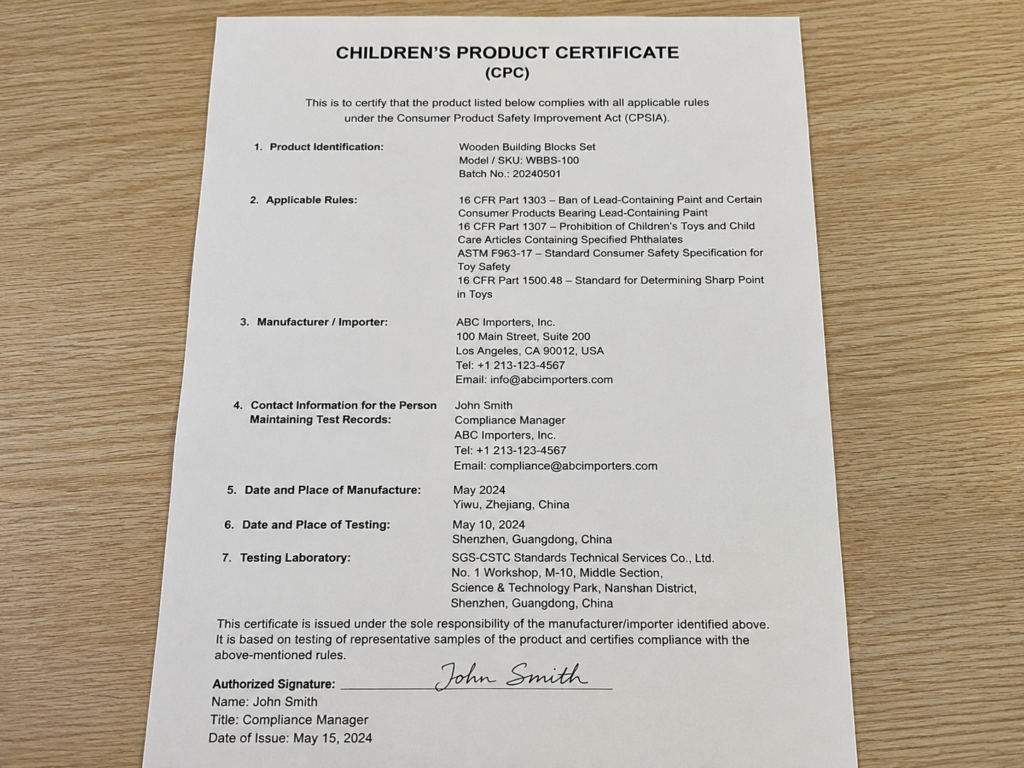
- The language must be English, can be in paper or electronic form, and does not need CPSC seal (CPC is an enterprise self-declaration document);
- Record retention requirements: According to CPSIA and related regulations, CPC, corresponding test reports and supporting production records must be retained for at least 5 years from the date of certificate issuance, and must be provided in a timely manner when required by regulatory authorities such as CPSC and customs. Special rules for different products may have additional requirements for record retention, which shall be subject to the corresponding regulations.
3.4 Entry-Level CPC Self-Check List
You can check the basic completeness of CPC through the following list to find common field missing and consistency problems, but it cannot replace professional regulatory review:
- □ All statutory required fields are included, with complete and no missing information;
- □ The issuer is a qualified U.S. domestic manufacturer or importer, with accurate address and contact information;
- □ The test record custodian has clear contact information and can be contacted for verification;
- □ Product manufacturing date and location, test date and location are clear and traceable;
- □ The test laboratory is a CPSC-accepted third-party laboratory, and the acceptance scope covers all test items of the listed regulations;
- □ Applicable regulations list specific standard/rule names item by item, matching the product category, applicable age, and material function;
- □ Product name, model, batch information are clear, and can correspond to the actually sold products;
- □ All information is consistent with the test report and the actual situation of the product, and the certificate issuance date (if any) is not earlier than the test completion date.
4. Full CPC Handling Process: Executable Steps from Judgment to Certification
The process of handling CPC is clear, divided into 5 steps in total. Following the rules at each step can avoid most problems.
Step 1: Confirm the CPSC Rules Applicable to the Product
First, it is necessary to clarify all CPSC safety rules corresponding to the product to avoid wrong or missing test items. Rule matching needs to be judged in combination with product category, applicable age, material, function, manufacturing time and other dimensions. At the same time, it is necessary to check the current effective regulations of the CPSC and the standard version cited, and cannot directly derive testing obligations only based on product name or material.
If it is difficult to judge by yourself, you can check the compliance guide for the corresponding category on the CPSC official website, or consult the compliance staff of the CPSC-accepted third-party laboratory.
Step 2: Select a Compliant Third-Party Test Laboratory
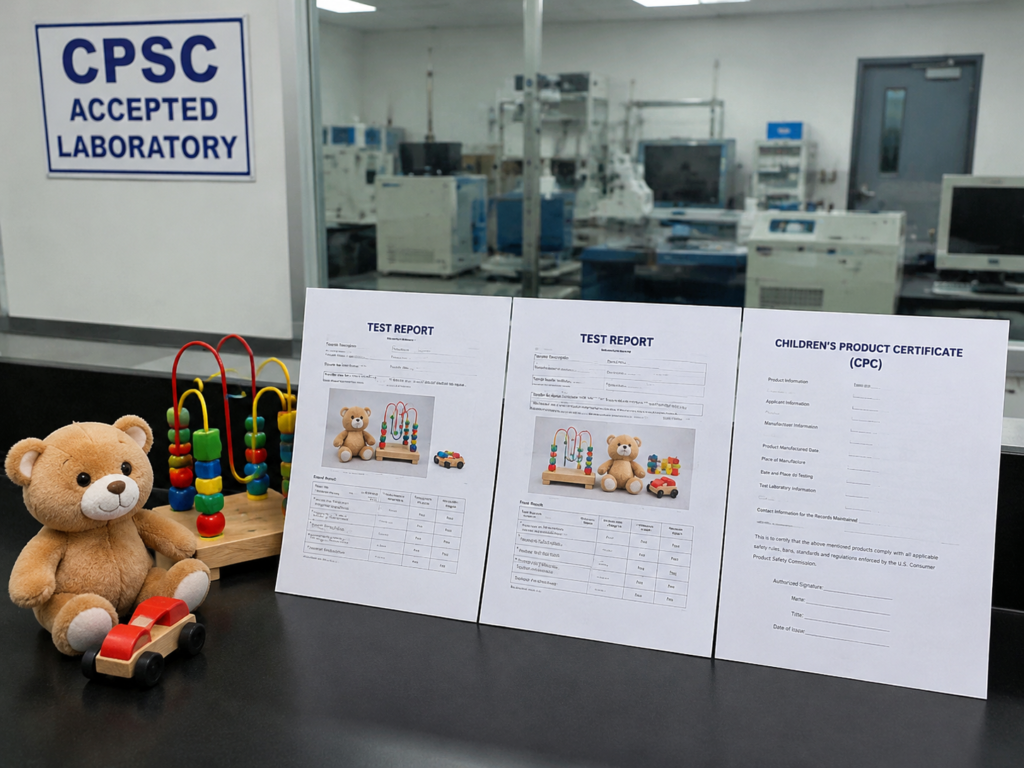
Testing must be entrusted to a CPSC-accepted third-party laboratory. Each accepted laboratory has a corresponding acceptance scope, which can be queried through the laboratory database on the CPSC official website. When choosing a laboratory, you need to pay attention: you need to confirm that the laboratory’s CPSC acceptance scope covers all test standards and test methods corresponding to your product, not just check whether the laboratory is on the acceptance list; some laboratories may only have acceptance qualifications for certain types of products and certain standards, and test results beyond the scope are not valid.
The core responsibility of the laboratory is to complete sample testing according to standards and issue test reports. It can provide reference suggestions on regulations and test items, but does not bear the final compliance responsibility of CPC.
Step 3: Send Samples for Testing and Obtain Reports
The core requirement for submitted test samples is that they can represent mass-produced products. It is necessary to ensure that the sample’s material formula, key components, production process, design structure, and production location are consistent with the mass-produced goods; if the product has multiple models, the test submission method needs to be selected according to the difference situation.
If there are unqualified items during the testing process, you must first clarify the reasons for the non-conformity, adjust the product design, materials or production process accordingly, save the rectification records, and then retest the unqualified items or retest all items. You cannot only rely on repeated sample submission to try to pass. Only when all test items corresponding to applicable regulations are qualified can the test report be used as the supporting basis for CPC.
Step 4: Draft and Issue CPC
The statutory issuing entity of CPC needs to be distinguished according to the source of the product: for products produced in the U.S., it is issued by the U.S. manufacturer; for products imported into the U.S., it is issued by the U.S. importer. Overseas sellers and service providers cannot be the statutory responsible party of CPC.
Enterprises can entrust laboratories and compliance agencies to assist in drafting CPC templates, but the final responsibility for the authenticity and compliance of the content is still borne by the U.S. manufacturer or importer that issues the certificate. All information of CPC must fully correspond to the test report and the actual production information of the product. It is not allowed to arbitrarily add untested regulatory items, or falsely report models, batches or manufacturing information.
Step 5: Use and Dynamic Management of CPC
After the CPC is issued, it is not once and for all. It is necessary to do a good job in daily use and dynamic update management to ensure continuous compliance with requirements:
- Daily use: Provide as required in scenarios such as customs inspection, platform qualification review, retailer request, CPSC market inspection, etc. Enterprises need to ensure that the effective version can be retrieved at any time.
- Multi-model sharing rules: The same CPC can list multiple product models, provided that the coverage of the test report can support the compliance of all models. If there are only differences between models such as color, non-critical appearance size, surface printing, etc. that do not affect safety and compliance, after the laboratory or compliance professional evaluation confirms that the test sample can represent the most stringent compliance risk of all models, the same CPC can be shared and all covered models are fully listed; if the differences involve material formula, key structure, applicable age, core function, production location and other factors that may change the compliance conclusion, they cannot be shared arbitrarily, and supplementary testing or separate CPC issuance is required for the differences.
- Update and retest trigger rules: CPC does not have a unified fixed validity period. It is necessary to judge whether it needs to be updated from two types of situations:
- Change trigger: When the product’s design, materials, key components, production process or production location change and may affect compliance; when the CPSC safety rules applicable to the product are revised; when the test results are questioned by regulatory authorities, platforms or customers and compliance cannot be proved by existing data; when platforms, retailers or special regulations have additional requirements, it is necessary to re-evaluate compliance, and supplement testing, retest or update CPC as appropriate.
- Periodic verification: If the product continues to be mass-produced without obvious changes, enterprises also need to formulate a reasonable testing plan (RTP, a periodic testing plan formulated to ensure continuous compliance of mass production) in accordance with CPSC requirements to regularly verify the consistency between mass-produced products and initial test samples. The test frequency can be determined according to factors such as product category, material stability, production process control level, and supplier change frequency. High-risk categories (such as baby products, mouth toys) need to appropriately increase the test frequency.
Note: There is no unified legal requirement that “CPC is valid for one year”. The annual retest requirement proposed by some institutions may be a commercial service clause, or correspond to the rules of specific platforms or retailers. It needs to be judged in combination with actual needs, and cannot be equated with the legal requirements of the CPSC.
5. Regulatory Rules and Consequences of Non-Compliance
CPC regulation covers four scenarios: import customs clearance, market circulation, e-commerce platforms, and retail channels. Once non-compliant, it may bring various risks.
5.1 4 Main Regulatory Scenarios
Different scenarios have different regulatory entities and verification focuses. The four common regulatory scenarios are as follows:
- U.S. customs clearance random inspection: Carried out by CBP in conjunction with the CPSC, mainly checking the completeness of CPC documents, the validity of laboratory qualifications, and the matching degree of applicable regulations. If the documents are missing or questionable, the importer may be required to supplement materials, or the goods may be directly detained for further verification.
- CPSC market circulation inspection: Carried out by CPSC law enforcement officers in circulation links such as physical stores and online markets. In addition to checking the authenticity of CPC documents, they will also check the consistency between the documents and the products on sale. If necessary, they will directly sample and send for testing to verify whether the products meet the declared safety standards.
- E-commerce platform qualification review: Carried out by platforms such as Amazon, Temu, and Shein according to their own rules. The requirements vary greatly between different sites and different categories. Usually, it is required to submit combined materials such as CPC, test reports, and tracking label photos as access conditions for category listing or store operation. The requirements will be dynamically adjusted with platform policies.
- U.S. retailer supplier audit: Carried out by local retailers such as Walmart and Target during supplier access or annual review. In addition to checking the compliance of CPC and test reports, they will also pay attention to the quality control system and traceability ability at the production end, as core evaluation items for supplier cooperation.
5.2 Common Non-Compliance Situations
In actual regulation, CPC non-compliance problems can be divided into four categories according to nature:
- Document problems: Missing statutory required information (such as no test record custodian information, missing manufacturing/test location), information inconsistent with the actual product (such as wrong model, responsible party is an overseas entity), incomplete or wrong list of applicable regulations, using GCC instead of CPC required for children’s products, directly applying false templates from the Internet.
- Testing problems: The test laboratory has not obtained the CPSC acceptance qualification for the corresponding items, the test items do not cover all applicable regulations, and the test process does not meet the standard requirements, resulting in invalid reports.
- Product consistency problems: There are compliance-affecting differences between test samples and mass-produced products in terms of materials, structure, process, etc., and the test report cannot support the declaration content of CPC.
- Channel adaptation problems: Although the CPC itself meets the statutory requirements, it fails to submit supplementary materials (such as tracking label photos, additional test item reports, production control records, etc.) as required by the platform or retailer, and does not meet the specific rules of the channel.
5.3 Actual Consequences of Non-Compliance
The consequences of CPC non-compliance vary according to the type of violation, the severity of the circumstances, and the safety risks of the involved products. According to the disposal entity, they can be divided into several categories:
- Disposal by regulatory authorities (customs/CPSC): If CPC is missing or non-compliant, it may lead to cargo detention, requirement to supplement materials, refusal of entry in the import link, and in serious cases, may be returned or destroyed; if there are also illegal situations such as products not meeting safety standards and false declarations, the CPSC may impose civil fines according to law, and in particularly serious cases involving subjective intent or major safety risks, criminal liability may be investigated; all disposals shall be subject to the formal decision of the regulatory authority.
- Disposal by platforms/commercial channels: E-commerce platforms or retailers may take measures such as product removal, restricted sales authority, deduction of security deposit against non-compliant merchants based on contract rules. The specific measures shall be subject to the current rules of the platform or retailer.
- Brand and market level impact: If the product has safety hazards, it may trigger product recall (including voluntary recall by enterprises or recall required by regulation), cause consumer complaints, and damage brand reputation and long-term market operation.
It should be noted that the legal consequences of non-compliant CPC documents and product safety defects are not exactly the same, and the specific disposal shall be subject to the formal decision of the regulatory authority.
6. Advanced Judgment and Pitfall Avoidance Guide
After mastering the basic rules, you also need to avoid common cognitive misunderstandings, master practical skills for certificate verification and boundary judgment, and further reduce compliance risks.
6.1 6 Common Cognitive Misunderstandings
- Misunderstanding: CPC is a certification officially issued by CPSC
Truth: CPC is a statutory self-declaration issued by enterprises based on third-party test results. The CPSC neither issues CPC certificates nor conducts pre-approval of CPCs (see Section 1.1 for details).
Pitfall avoidance: Be wary of false propaganda such as “officially certified CPC” and “CPSC issuance”. When choosing compliance services, prioritize verifying whether the service content meets legal requirements. - Misunderstanding: Having a CPC means the product is 100% compliant
Truth: CPC is a compliance declaration based on submitted test samples, which can only prove that the submitted samples meet the corresponding regulatory requirements. If there are differences between mass-produced products and test samples, or other compliance requirements such as labels and warning statements are not met, it may still be judged as non-compliant (see Sections 4.3 and 4.5 for details).
Pitfall avoidance: Strictly ensure that mass-produced products are consistent with test samples, carry out periodic verification according to a reasonable testing plan, and simultaneously implement other compliance requirements such as labels and warning statements. - Misunderstanding: Products of the same series can share CPC at will
Truth: Only when the coverage of the test report can support the compliance risks of all models can the same CPC be shared. For specific judgment rules, see Section 4.5 “Multi-model Sharing Rules”.
Pitfall avoidance: Before sharing CPC, conduct compliance evaluation and fully list all covered models. Models with core differences such as materials and structures need to be tested and certified separately. - Misunderstanding: Small batch products do not need CPC at all
Truth: Products that meet the CPSC small batch manufacturer rule may only be exempted from part of the third-party testing requirements, and CPC still needs to be issued in accordance with regulations, and small batch manufacturers have strict identification conditions (see Section 2.3 for details).
Pitfall avoidance: Verify eligibility against the official CPSC standards by yourself, and do not arbitrarily claim exemption. - Misunderstanding: Overseas sellers can directly act as the CPC responsible party
Truth: For children’s products imported into the U.S., the statutory issuing entity of CPC must be a U.S. domestic importer; for products produced in the U.S., it is issued by a U.S. domestic manufacturer (see Sections 3.1 and 4.4 for details).
Pitfall avoidance: Confirm the U.S. importer information in advance, clarify the final responsible entity when there are multiple levels of contract manufacturing, and do not fill in overseas entities. - Misunderstanding: Test reports can directly replace CPC
Truth: The test report is a technical document proving that the sample has passed the test, and CPC is a compliance certification document containing statutory traceability information. The two have different functions and cannot replace each other (see Section 1.3 for details).
Pitfall avoidance: Sort out complete CPC documents in accordance with legal requirements, and do not only submit test reports.
6.2 4 Methods to Quickly Verify CPC Validity
After getting a CPC, you can verify its basic validity from the following dimensions to initially troubleshoot common problems:
- Check the responsible and record entity: Confirm that the issuer is a U.S. domestic manufacturer or importer, the test record custodian has clear contact information, and overseas entities cannot be the statutory responsible party;
- Check product and traceability information: Check whether the product name, model, batch, manufacturing date/location, and test date/location on the certificate are clear and traceable, and whether the applicable regulations match the product category, age, and materials, without omissions or wrong listings;
- Verify laboratory qualifications: Check the acceptance status of the test laboratory through the CPSC official website, and confirm that its acceptance scope covers all test items corresponding to the listed regulations, not just verifying whether the laboratory is on the list;
- Check logical consistency: The certificate issuance date (if any) is not earlier than the test completion date of all applicable regulations, and all information is consistent with the test report and the actual situation of the product.
It should be noted that the above verification can only troubleshoot basic form and consistency problems. The substantive compliance of CPC still needs to be judged in combination with the actual situation of the product and the specific requirements of regulations. If necessary, you can entrust a professional compliance agency to review.
6.3 Judgment Skills for Products with Blurred Boundaries
Some products are between children’s and adult products with blurred boundaries. You can use the following methods to assist in judgment:
- Prioritize the core use scenario: If the product is suitable for both adults and children, focus on checking whether marketing promotion, sales channels, and packaging display are mainly targeted at children and parents. If the core audience is children aged 12 and under, it will usually be judged as a children’s product;
- Follow the CPSC judgment principle: If the marked age of the product conflicts with the actual sales scenario and consumer perception, the CPSC’s comprehensive judgment principle of “mainly designed or intended user group” shall prevail, and age marking does not have absolute exemption effect;
- Confirm the boundary through multiple channels: If you need further confirmation, you can first check the CPSC public rules and official compliance guides; for products with complex facts and blurred boundaries, you can submit product materials to the CPSC for consultation, or entrust a professional compliance agency to evaluate. However, the consultation opinions of CPSC staff and the evaluation conclusions of commercial institutions are not directly equivalent to official approval that is binding on all situations, and the final decision shall be subject to the formal law enforcement judgment of the regulatory authority.
Summary
CPC is a statutory self-declaration document for children’s products aged 12 and under subject to CPSC safety rules to enter the U.S. market. The core is that enterprises are responsible for compliance based on the test results of CPSC-accepted third-party laboratories. Entry-level practitioners can start with applicable boundary judgment, statutory field requirements, and basic handling procedures to avoid common cognitive misunderstandings; merchants who are deeply engaged in the U.S. children’s product market are recommended to continue to pay attention to CPSC regulatory updates, establish a full-cycle compliance control mechanism including sample control, periodic testing, and document retention, to reduce long-term operation risks.