
If you often shop cross-border for Chinese-made fast chargers and power banks, or plan to sell your own charging accessories to the Chinese mainland market, you have definitely seen the “CCC” (also called 3C) mark composed of three curved Cs on products. Many people think it is a quality award when they first see it, or a certification similar to overseas CE and UL — actually none of these are correct. It is a unique, legally mandatory safety access threshold exclusive to the Chinese market, directly related to the safety and compliance of charging products.
Core Definition and Positioning of CCC
Let’s explain CCC clearly in plain terms first: its official full name is China Compulsory Certification, which is a statutory mandatory safety access requirement set by the Chinese mainland for specific product categories. It is not a voluntary award, nor a high-end quality rating. Simply put, only products that meet the requirements can be sold in the Chinese market; those that do not cannot even enter customs.
From the perspective of regulatory logic, the entire CCC system is uniformly managed by the Certification and Accreditation Administration of the People’s Republic of China (referred to as CNCA for short), including dynamically adjusting the catalog of products requiring certification and formulating unified certification rules. The specific certification issuance and testing work are completed by third-party certification institutions and designated laboratories authorized by CNCA, rather than the government directly issuing certificates for each product.
The reason why charging products are a key category under CCC supervision is straightforward: most of these products are directly connected to 220V mains power. If they are of poor quality, they are prone to safety accidents such as electric shock, fire, and short circuit, which are directly related to users’ personal and property safety, so the entry threshold must be strictly controlled.
Here are three must-remember positioning boundaries for beginners, never mix them up:
First, CCC is the minimum safety threshold, not the highest quality standard — passing CCC only means the product meets basic safety requirements, and does not mean its quality and performance are top-tier.
Second, CCC only tests electrical safety and basic electromagnetic compatibility (simply put, it will not randomly interfere with other electrical appliances, nor is it easily interfered with by other electrical appliances), and does not cover performance indicators you care most about such as fast charging speed, product durability, and fast charging protocol compatibility.
Third, CCC is not an “absolute safety guarantee” — even a certified product may still have safety risks if its shell is cracked by falling, it is damaged by water or moisture, or its internal circuit is disassembled and modified without permission. It guarantees basic safety in the qualified factory state.
Practical Significance for Overseas Users
CCC may seem like a rule for the Chinese market, but for overseas users, whether you are a seller or an ordinary consumer, it has practical impacts.
If you are an overseas brand or seller who wants to sell charging products to the Chinese mainland: as long as the product is in the CCC catalog, without certification, it absolutely cannot enter customs, nor can it be listed on e-commerce platforms or offline stores. If you violate the rules, the consequences are tangible: at best, goods will be detained and rectification will be ordered; at worst, products will be destroyed and fines will be imposed.
If you are an ordinary overseas consumer who usually buys charging products sold to China: the CCC mark is a very useful basic safety judgment tool — products with formal CCC have at least passed officially recognized safety testing, which can help you quickly filter out those low-quality chargers and power banks with no safety guarantee at all.
Which Charging Products Require CCC?
Many people can’t figure out “Does my charging cable need CCC?” “Does a car charger need it?” In fact, there is only one core basis for judgment: the Catalog of Compulsory Product Certification dynamically updated by CNCA. Only products clearly included in the catalog require mandatory CCC processing.
For everyone’s quick reference, here is a comparison table of common charging products:
| Common charging products that require CCC | Common charging products that do not require CCC |
|---|---|
| Chargers/power adapters with 220V mains input (fast chargers, laptop power supplies, etc.) | Ordinary passive charging cables (only for power/data transmission, no built-in circuit) |
| Household power plugs, wall sockets with USB output, wire assemblies | Low-voltage charging accessories with input voltage lower than 36V (car chargers, car charging cables, etc.) |
| Charging accessories with active circuits (charging cables with boost/protection chips, etc.) | Products sold only in overseas regions and Hong Kong, Macao and Taiwan |
| Power banks, lithium-ion battery packs (included in the catalog from 2023) | —— |
When encountering products with ambiguous boundaries, don’t panic, just master three core judgment dimensions: whether it is directly connected to 220V mains power, whether it has a built-in active circuit, and whether the overall attribute is in the catalog. Special attention should be paid here: interface form and power rating do not independently determine certification requirements — you cannot say that Type-C interface products need it while USB-A ones do not, nor can you say 100W products need certification while 10W ones do not. It depends on the complete product attributes. For example, common wireless chargers need to be judged according to structure and function: the integrated model with pins that plug directly into the mains requires CCC, while the low-voltage model with only a USB port and powered by an external charger does not.
If you are really unsure, you must consult a certification institution officially authorized by CNCA. Do not make random judgments by yourself, so as to avoid compliance pitfalls later.
Core Process of CCC Certification for Charging Products (Simplified Version)
Many people are curious about how CCC certification is obtained. In fact, you don’t need to memorize too complicated steps, just understand the core logic, which can also help you judge the credibility of the certificate.
First, the basic requirements for application: the entity eligible to apply for CCC must be a manufacturing factory, brand owner or importer within the territory of the Chinese mainland. Overseas brands cannot apply directly, and must entrust a legal domestic agency. In addition, the samples sent for testing must be exactly the same as the subsequent mass-produced products. You cannot use “special version” samples for testing and cut corners during mass production.
Next is sample compliance testing (also called “type test” in the industry): it mainly tests two dimensions — electrical safety and electromagnetic compatibility. The entire cycle is usually 1 to 3 months. If the test fails, you need to rectify and retest.
Passing the sample test is not the end. The certification institution will also conduct on-site verification at the production factory to confirm that mass-produced products are consistent with the tested samples, so as to avoid the situation of “qualified samples, substandard mass production”. After getting the certificate, it is not once and for all: the certificate is valid for 5 years, and must accept supervised random inspections every year. If the random inspection fails, the certificate may be suspended or even revoked. If the product is later redesigned, the production factory is changed, or key safety components such as transformers and fuses are replaced, you must take the initiative to apply for certification changes, and cannot secretly replace them and continue to use the original certificate.

Finally, let’s talk about the rules for using the CCC mark: only products with valid certificates can be marked with the CCC mark on the body and outer packaging; the mark must be clear and complete, cannot be forged or deformed, and the mark of Product A cannot be moved to Product B for use. Special reminder: It is invalid to only print the CCC mark on the outer packaging. The body of a regular product (such as the parameter nameplate on the bottom or side of the charger) must bear the mark.
How to Verify the Authenticity of CCC for Charging Products?
There are many fake CCC marks on the market. Learning to verify authenticity is a very practical semi-proficient skill, which can be used whether you are purchasing or buying for yourself.
The first step is pre-exclusion: first figure out whether the product you have itself requires CCC certification, do not default to compliance just because you see the mark. Take the most common example: ordinary passive charging cables are not in the CCC catalog at all. If the ordinary charging cable you bought for a few yuan is printed with the CCC mark, it is probably fake, just used by merchants to deceive people.
After excluding the category issue, look at the mark on the product body: the formal CCC mark is usually printed on the parameter nameplate on the bottom or side of the charger, with a pattern composed of three curved Cs with standard proportions, and a unique certification number next to it. If the mark is printed blurry, has crooked proportions, or is only on the outer packaging and cannot be found on the product body, you should be vigilant.
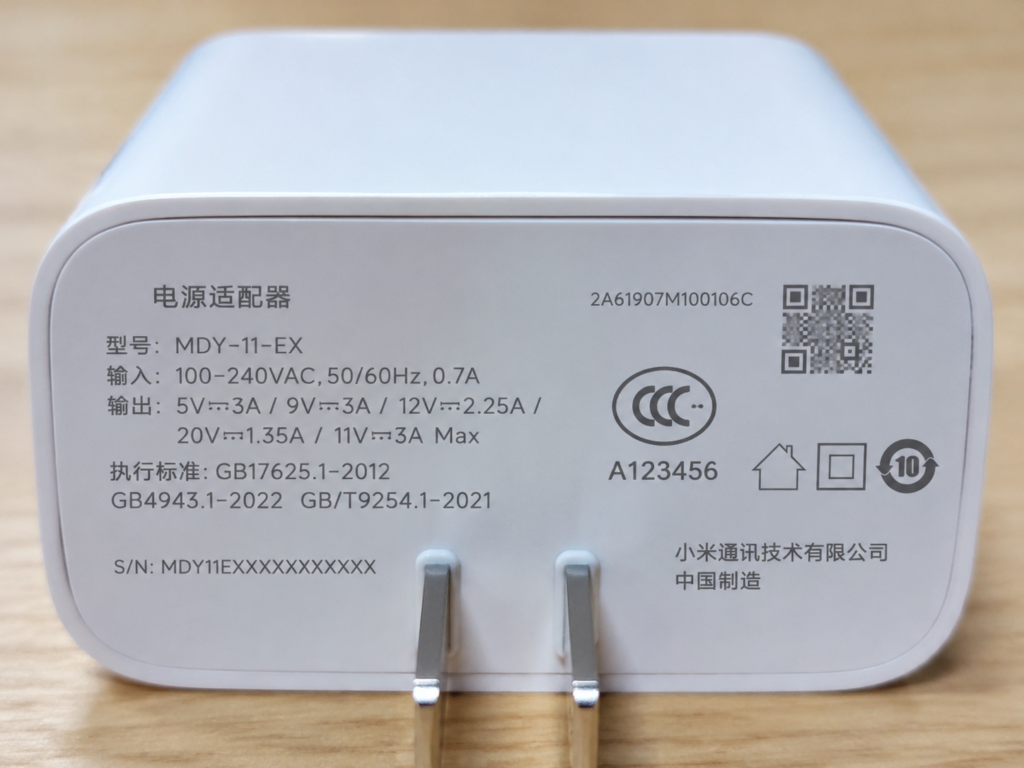
Just looking at the mark is not enough. The most reliable method is to verify the certificate information through official channels: you can directly go to the Official Certification Information Public Service Platform of CNCA and enter the certification number to query. When checking, pay attention to three key points: first, the certificate status must be “valid”; second, the product model, manufacturer, and applicant on the certificate must be consistent with the information of the actual product; third, certificates for different models of the same brand are not universal. Even similar models of the same series must be within the coverage listed in the certificate to be valid.
There are several common invalid/fake CCC scenarios, be cautious when encountering them:
- Misappropriated certificate: using the CCC certificate of Model A for Model B, with mismatched model numbers;
- Fake number: fabricating a certification number that cannot be found in the official system at all;
- Invalid certificate: the certificate has been revoked, suspended or cancelled, but is still used;
- Impersonated certificate: using ordinary test reports or overseas certification certificates to pass off as CCC certification.
Core Differences Between CCC and Common Overseas Certifications
Many overseas sellers or consumers will ask: I have CE, FCC, UL certification, can it replace CCC? The answer is clear: No. Market supervision in various countries and regions is independent. Currently, there is no mutual recognition agreement between CCC for charging products and mainstream overseas certifications. As long as products in the catalog are to be sold in the Chinese mainland market, they must apply for CCC separately.
For everyone’s convenience to distinguish, here is a comparison between CCC and three types of the most common overseas certifications:
| Certification Name | Applicable Region | Core Nature and Coverage |
|---|---|---|
| CCC | Chinese mainland | Statutory mandatory access, covering both electrical safety + electromagnetic compatibility |
| CE | European Union | Statutory mandatory access, with different testing rules and processes from CCC |
| FCC | United States | Statutory mandatory requirement, only focusing on electromagnetic compatibility, not covering electrical safety |
| UL | United States | Private voluntary safety certification, not a statutory mandatory requirement |
Simply put, each certification manages its own market, and the requirements are different. Do not confuse them.
Practical Pitfall Avoidance Action List for Overseas Users
Finally, we have sorted out directly usable pitfall avoidance steps for everyone, which can be followed by both sellers and ordinary consumers.
If you are an overseas seller or importer, follow these four steps before entering the market:
- First confirm whether the product is really intended to be sold to the Chinese mainland, or imported into the Chinese mainland. Those only sold overseas do not need to consider it;
- Judge whether the product is in the CCC catalog according to the boundary rules mentioned above;
- Require the supplier to provide a valid CCC certificate, and verify its authenticity and validity on the official CNCA platform by yourself;
- If the product is later redesigned, the factory is changed, or key safety components are replaced, be sure to update the certification in time.
In addition, there is a cost-saving tip: products of the same series and similar specifications can apply to be covered by the same certificate, instead of applying separately for each model, which can reduce a lot of costs.
If you are an ordinary consumer, you can check as follows when buying charging products:
- Prioritize buying from formal channels, and avoid unbranded products with ridiculously low prices;
- Turn to the product body (such as the bottom of the charger) to see if there is a clear CCC mark and a complete parameter nameplate;
- If you are unsure, you can ask the merchant for the certification number and check it on the official platform by yourself;
- Note: The CCC certifications of chargers, charging cables, and electronic devices are independent of each other and cannot replace each other — for example, if a mobile phone has CCC, it does not mean that the included charger also has it, you need to check them separately.
Finally, two general reminders: First, never believe false propaganda such as “guaranteed pass” or “buying certificates”. All certificates bought with money are fake, and it is also suspected of violating the law; second, when encountering products with ambiguous boundaries, do not force judgment by yourself, directly consult an officially authorized certification institution. Spending a little time is better than falling into pitfalls later.
Understanding CCC is actually not difficult. The core is to remember that it is the statutory mandatory safety threshold of the Chinese market, not a quality rating; when encountering charging products, first check whether the category requires certification, then check whether the mark is correct, and finally check it on the official platform. Whether you are doing business or using it yourself, you can avoid most safety and compliance pitfalls.