
Whether you are an ordinary consumer buying chargers or USB-C fast charging cables in the US, or a small seller selling charging products to the US market, you have most likely heard of “FTC penalties”: some people buy a 100W-labeled gallium nitride (GaN) charger, but the actual power is far lower than the advertised value; some cross-border sellers have been fined a large sum of money and even their stores are affected due to fake certification marks on packaging.
Many people have a vague impression of the FTC: what exactly does it regulate? Why are there so many related violation cases involving charging products? What kind of labeling is considered illegal? How serious are the penalties? In this article, we will clarify the FTC enforcement rules related to charging products, covering everything from how ordinary buyers can avoid pitfalls and defend their rights, to how entry-level sellers can conduct compliance self-checks.
Must-Know Basics: FTC and Fundamentals of False Labeling of Charging Products
The FTC, short for the Federal Trade Commission of the United States, is a federal agency responsible for combating deceptive and unfair business practices and protecting consumer rights, with its main legal basis being Section 5 of the Federal Trade Commission Act and other relevant regulations. Its enforcement is not a specialized jurisdiction over a certain type of product, but targets substantially false, misleading, or unfair issues in advertising, labeling, and sales practices targeted at US consumers — as long as chargers, power adapters, charging cables, and USB-C consumer electronics that enter the US market or are sold to US consumers have related promotions and business practices suspected of violating regulations, they may attract the attention of the FTC.
Many people think the FTC only regulates local US businesses, but in fact, its accountability scope covers the entire industrial chain: manufacturers, importers, sellers, and distributors may all bear liability based on their own faults; for overseas entities without a US physical presence, whether they can actually be held accountable depends on whether the products are sold to US consumers, whether they have a substantial impact on US commerce, the entity’s transactional connections with the US market, and the specific applicable legal procedures. A core boundary must be particularly clarified here: the core regulatory focus of the FTC is whether promotions and labels mislead consumers’ purchasing decisions, rather than directly formulating product quality or safety standards — but if product performance or safety issues are falsely advertised, or involve unfair business practices, they may still fall within the FTC’s enforcement scope. For example, if a charger works but has an exaggerated power rating, the FTC will intervene; if a charger catches fire and has safety hazards, the safety issue itself is under the jurisdiction of other agencies, but if the merchant has advertised “never heats up” or “100% safe”, the FTC will also enforce the law against the false advertising part.
Why Are False Labeling Violations More Common for Charging Products?
Charging products are a category with prominent false labeling issues among consumer electronics, and there are many related enforcement cases, mainly for three reasons:
First, parameters are difficult to verify, and the threshold for false labeling is low — ordinary consumers cannot tell whether a charger is 65W or 100W without professional equipment, nor can they directly judge whether it has certification, so the operational cost of fraud is very low;
Second, many cross-border sellers are not familiar with US advertising and labeling rules, and often have inconsistent parameters on e-commerce product pages, packaging, and the product body; even if they do not intentionally exaggerate specifications, they are prone to falling into pitfalls;
Third, there is large profit space from the abuse of buzzwords: labels such as “gallium nitride (GaN)”, “fast charging”, “UL certification”, and “MFi certification” can directly increase product prices, and many merchants are willing to take risks to commit fraud.
Boundaries of Responsibilities Between the FTC and Other Agencies
Many people confuse the FTC with other regulatory agencies. In fact, each department has a clear division of labor and cannot replace the others, and the same violation may trigger multiple penalties:
| Agency/Certification Type | Core Jurisdiction/Business Scope | Boundary of Responsibilities with the FTC |
|---|---|---|
| FCC (Federal Communications Commission) | Formulates requirements related to radio frequency interference and electromagnetic compatibility, as well as equipment authorization/supplier declaration rules, for electronic products with radio frequency transmission functions or belonging to the digital device category | The responsibilities of the two are not interchangeable: the FCC is responsible for radio frequency-related entry compliance of products; whether FCC rules apply depends on the specific functions and device category of the product, and not all chargers and USB-C accessories are subject to FCC equipment authorization requirements; the FTC is responsible for investigating and punishing deceptive practices such as falsely claiming FCC authorization in promotions and misleading consumers about compliance status |
| CPSC (Consumer Product Safety Commission) | Consumer product safety defects, mandatory reporting, and recall management (such as safety risks like charger fires and electric leakage) | If false advertising also involves safety risks, the two may conduct joint enforcement; safety compliance itself is under the jurisdiction of the CPSC, and promotional fraud is under the jurisdiction of the FTC |
| Third-party Certification/Authorization (UL/ETL/USB-IF/MFi, etc.) | The nature of different programs varies significantly: private institutions such as UL and ETL provide safety testing, listing, or certification services; USB-IF is responsible for USB specification compliance testing and related trademark authorization; MFi is Apple’s official accessory authorization program; all are third-party/industry testing, certification, or trademark authorizations, not government-mandatory certifications (may be required by regulators in some scenarios) | “Complying with a certain standard”, “passing testing by a certain institution”, “obtaining listing/certification”, and “obtaining trademark or brand authorization” cannot replace each other; the FTC is not responsible for certification itself, but will investigate and punish deceptive promotions such as unauthorized use or forgery of certification marks, or making consumers mistakenly believe that official authorization has been obtained; obtaining any private certification does not mean exemption from liability for false advertising |
| CBP (Customs and Border Protection) | Import clearance, tariff collection, origin marking verification, and contraband seizure | The CBP’s origin marking rules and the FTC’s “Made in USA” advertising rules have different applicable scenarios and judgment standards; origin tax evasion and illegal entry are under the jurisdiction of the CBP, while misleading consumers through origin promotion is under the jurisdiction of the FTC, and illegal products may be subject to coordinated seizure |
Core Logic: Common Approaches to FTC Violation Determination
Having understood the basic role of the FTC, next we need to figure out the core question: how to determine whether the labeling of a charging product is suspected of violating regulations?
Two Common Types of Violation Manifestations in Practice
Judging from actual enforcement cases, deceptive advertising mainly has two common manifestations, covering the vast majority of false labeling situations:
The first type is false representation, which is directly stating false facts. For example, printing a UL mark even though the product has not passed UL listing, or labeling a 65W charger as 100W — this is the most direct violation.
The second type is misleading representation: each sentence may be true when viewed alone, but when combined, it will cause ordinary consumers to have a wrong understanding. For example, a dual-port charger with a total power of 100W only has “100W Fast Charging” marked in large characters on the homepage, without mentioning that the maximum per port is only 65W and the total power is only achieved when charging with both ports at the same time — although this does not directly lie, consumers can easily mistakenly think that each port is 100W, and it may still be deemed a violation.
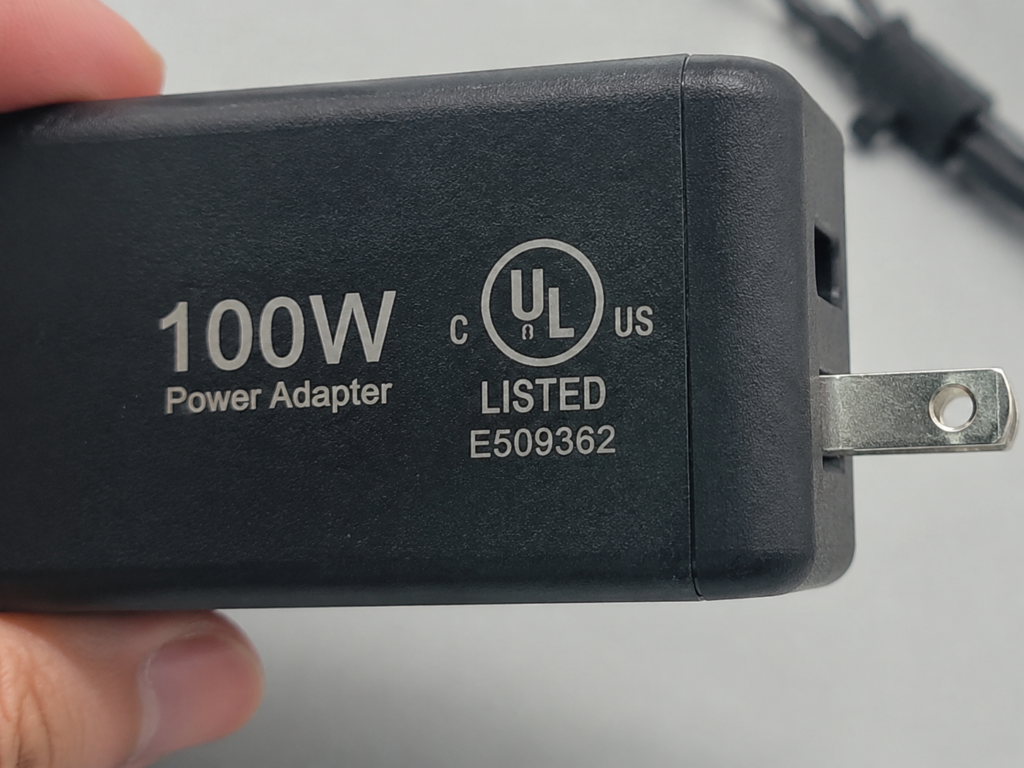
The core logic for determining whether a violation is suspected is: whether the promotional content will cause ordinary consumers to have a wrong understanding of important purchasing information, thereby affecting their purchasing decisions. It is not enough for the merchant to think “I didn’t lie”; it depends on whether a normal buyer, seeing this promotion, will pay because of the misunderstanding.
Four Types of Issues Usually Checked to Determine Suspected Violations
For case-specific judgments, there is no unified statutory test formula. In practice, the violation risk of promotions can usually be checked from four aspects:
The first is consumer perception: to see whether ordinary purchasers will have a reasonable wrong understanding of the promotional content. For example, the first reaction of ordinary people seeing “100W charger” is that a single port can stably output 100W; if the merchant only marks the total power without making it clear, it meets the cognitive condition for misleading.
The second is content authenticity: whether the express or implied content of the promotion is consistent with the actual performance and qualifications of the product. For example, if it is claimed to support PD3.1 fast charging but actual testing cannot trigger the corresponding power level, it is definitely untrue.
The third is decision impact: whether the misleading information will directly affect consumers’ purchasing choices. For example, power, certification, compatibility, and price are all core purchasing factors; if it is just a minor issue that does not affect decision-making, such as writing “black” as “dark gray”, it is generally not considered a violation.
The fourth is evidence support: whether the merchant already has reasonable and reliable objective evidence before publishing the promotional content. The form of evidence varies according to the risk and type of the claimed content, and does not necessarily have to be a third-party laboratory report, but it needs to be reproducible and match the sold model; for claims with higher risks such as safety and high power, more rigorous testing evidence is usually required, and if necessary, it must be issued by a qualified third-party institution.
Common Situations Where “Technically Correct Statements” May Still Constitute Violations
Many sellers feel wronged: the content I promote is technically true, why was I still fined? This is because the FTC looks at consumers’ overall perception, not just the literal “no lie” to be fine. There are three common situations:
The first is promoting extreme laboratory values as daily use effects. For example, the peak power (which may only last a few seconds) measured at a constant temperature of 25°C, no load, and for a specific short period of time is directly labeled as the output power for daily use, without explaining the test conditions and duration. Ordinary consumers will mistakenly think that it can be achieved during normal charging, which may be deemed misleading — it is not that peak power cannot be labeled, but that its limiting conditions must be clearly stated.
The second is misunderstanding caused by not clarifying limiting conditions. The most common is that multi-port chargers only mark the total power, without mentioning the per-port upper limit or the power distribution rules when charging with multiple ports at the same time; or saying “supports 100W fast charging” without mentioning that only specific ports, specific protocols, and specific devices can trigger it.
The third is treating partial capability as overall performance. For example, a USB-C cable with a rated current of 5A is directly labeled as a “100W fast charging cable”, but it does not explain that this power requires a charger and device that support the corresponding PD power level to achieve; some merchants promote high-power cables, but the E-Marker chip inside (a chip in USB-C cables used to identify power levels; whether this chip is required depends on the USB-C current level, PD power level, and specific specifications) is missing or has falsified parameters, failing to meet the advertised power trigger requirements, which also counts as this type of violation.
Validity Boundary of Disclaimers
Many sellers think that putting a line of small text at the bottom of the product page saying “Parameters are for reference only, subject to the actual product” can exempt them from liability. In fact, the FTC has clear requirements for the disclosure of disclaimers and limiting conditions:
First, hidden statements in small font at the bottom of the page cannot offset false or misleading promotions in prominent positions — if you write “100W Fast Charging” in large characters on the homepage and “actual maximum per port is 65W” in small characters at the bottom of the page, this disclosure is insufficient to eliminate misleading.
Second, if the product does not have the core function advertised at all, no amount of disclaimers will help — for example, if you label an ordinary silicon-based charger as using gallium nitride technology, and then add a line “technology iteration, random shipment”, it still constitutes deceptive advertising.
Finally, important limiting conditions must be placed near the corresponding promotional content and expressed in easy-to-understand language — for example, next to the large characters “100W Total Power”, mark “Maximum 65W per port, total power 100W when charging with both ports simultaneously” in similarly prominent characters, so as to effectively avoid misleading.
Common Pitfalls: Four Types of False Labeling for Charging Products
False labeling of charging products mainly falls into four categories, and different types of violations have different circumstances and consequences:
Performance Parameter Category
This is the most common type of violation:
- Exaggerated charger power: The most common is confusing total power with per-port power, and peak power with continuous output power, without clearly stating the applicable conditions.
- Exaggerated fast charging capability: Claiming to support fast charging protocols such as PD, QC, and SCP, but actual testing shows incompatibility; or labeling multiple power levels, but the actual maximum output does not reach the advertised value.
- Exaggerated charging speed: Promoting “fully charged in XX minutes” without explaining the test conditions (such as ambient temperature, initial battery level, device status, charging set used, etc.), resulting in a significant gap between the actual speed of ordinary users in daily use and the advertisement. It should be noted here that there is no unified statutory proportional threshold for charging speed differences, and the difference value can only be used as a clue for consumers’ initial screening or evidence collection; whether it is a violation requires comprehensive judgment based on whether the promotion is an objectively verifiable promise, whether the test conditions match daily scenarios, and whether the error is sufficient to affect purchasing decisions, and cannot be directly determined solely by a single speed test difference.
- Exaggerated USB-C cable specifications: Current carrying capacity, data transmission specifications, and conductor material are inconsistent with the advertisement; or the advertised power level requires an E-Marker chip according to specifications but the chip is missing, or the chip parameters are falsified.
Certification Qualification Category (Higher Enforcement and Reputation Risks)
This type of violation usually involves intentional fraud, and the enforcement and reputation risks are relatively higher:
- Forged certification/authorization marks: Unauthorized use of corresponding marks or implying that qualifications have been obtained without passing UL listing, ETL certification, USB-IF compliance testing, MFi authorization, etc.
- Misappropriated/expired certification: Using certification certificates of other models from the same factory or other factories to impersonate the qualification of this product, or continuing to promote and use the certification after it has expired or become invalid.
- Self-declaration treated as certification: Only confirming compliance with a certain standard through internal testing, then directly labeling it as “UL certified”, “USB-IF certified”, etc. — different certifications/authorizations have clear application, testing, and certification issuance processes, and internal self-testing is not equivalent to obtaining official authorization.
Fraud in Origin, Technology, and Brand Category
- Origin fraud: Products that are clearly produced overseas are promoted as “Made in USA”. It should be noted that the FTC adopts an “all or virtually all” judgment standard for “Made in USA” advertising, which requires comprehensive consideration of factors such as the final processing location, source of core components, and cost proportion; only packaging and labeling in the US do not meet the requirements; while the customs’ origin marking rules and the FTC’s advertising rules have different applicable scenarios and different judgment standards.
- Technology fraud: Chargers using traditional silicon-based power devices are promoted as using gallium nitride (GaN, a power semiconductor technology commonly used in small fast chargers, with costs usually higher than traditional silicon-based solutions), but in fact, the corresponding devices or technology are not used, so as to raise the selling price.
- Brand misleading: Counterfeiting the appearance and packaging of well-known brands such as Anker and Apple, or labeling “original genuine product” or “officially authorized” without official authorization.
Exaggerated Effect and Function Category
- Absolute statements: For example, unscientific claims such as “never heats up” and “100% safe” — as long as an electrical appliance works, it will generate heat, and safety is always relative and conditional.
- Exaggerated compatibility: Claiming “fully compatible with all devices”, but in fact not supporting the proprietary fast charging protocols of some brands, and can only charge at ordinary slow charging speed.
- Exaggerated durability: Labeling “X times of bending resistance” and “X years of service life”, but without the support of test data corresponding to daily use scenarios; the testing uses laboratory conditions far better than actual use, which has very low reference value.
Enforcement Procedures and Penalty Rules
Many people are curious: how does the FTC discover illegal products? What will happen after they are found?
Common Sources of Clues for Enforcement
FTC enforcement usually does not start out of thin air. There are several common sources of clues:
The first is consumer complaints: for example, someone buys a charger and finds that the power is wrong or the certification is fake, and submits a complaint to the FTC; these complaints will be aggregated into an enforcement clue database.
The second is market monitoring: the FTC conducts regular market inspections on key categories such as consumer electronics, and may also intensify compliance verification of popular charging products during promotional seasons such as Black Friday and Prime Day.
The third is reports from competitors and industry organizations: for example, industry associations such as USB-IF may report to the FTC when they find a large number of products that fraudulently use their trademarks or specifications.
The fourth is referrals from other agencies: for example, if the CBP finds origin fraud during import, the CPSC finds product safety issues that also involve false advertising, or the FCC finds fake compliance labels, they will all transfer relevant clues to the FTC for handling.
A common misunderstanding should be clarified here: it is wrong that low sales volume and small batches will not be inspected — as long as there is a complaint clue or the product is sampled in market monitoring, an investigation may be launched even if only dozens of units have been sold.
General Enforcement Procedure
The FTC’s enforcement procedures vary according to the type of case and applicable laws, and there is no unified fixed step. The usual investigation process includes:
- Clue assessment: After receiving a complaint or monitoring suspicious promotions, first collect public promotional materials (e-commerce pages, packaging pictures) and consumer feedback, and conduct a preliminary assessment of whether there is a suspicion of violation.
- Investigation and verification: If there is preliminary suspicion, the FTC may fix evidence by purchasing samples for testing on its own, verifying qualifications with certification bodies, or requiring platforms to provide sales data; after entering the formal investigation stage, it may issue a Civil Investigative Demand (CID for short) — this is the FTC’s mandatory information request tool, and the recipient must submit relevant materials within the specified time limit and scope, and shall not refuse without reason; at the same time, the party concerned may also actively submit evidence to explain its compliance status.
- Result handling: After the investigation is completed, if the FTC determines that a violation is established, it may negotiate a settlement (consent order) with the party concerned, or file administrative charges or apply for judicial relief from a federal court; if the party concerned is not satisfied with the result, it may apply for a hearing or file a lawsuit according to the corresponding procedure.
Possible Consequences After Violation
The possible consequences after a violation is established involve the authority of multiple agencies, not all of which are directly imposed by the FTC, and the ways different remedies are generated also vary:
- Consumer remedies: Monetary remedies such as refunding consumers’ purchase payments and compensating for losses usually need to be realized through court judgments or settlement consent orders, and cannot be directly unilaterally decided by the FTC.
- Civil fines: They are only applicable when meeting specific legal provisions (such as violating existing consent orders, violating explicit penalty provisions of specific regulations), and not all deceptive advertising cases will result in fines.
- Business and compliance restrictions: The FTC may, through consent orders, court injunctions, etc., require the party concerned to stop the involved false advertising, ban the sale of illegal products, regularly submit compliance reports, and publicize violation information, etc., depending on the specific case situation.
- Industrial chain liability: Industrial chain entities such as manufacturers, importers, sellers, and drop-shippers may bear liability respectively according to their degree of fault in the violation; cases of particularly serious fraud may be transferred to the Department of Justice for criminal liability.
- Disposal of involved inventory: Measures such as seizure, confiscation, and destruction of involved products shall be implemented by departments with corresponding authority (such as customs and other law enforcement agencies) in accordance with their respective functions and powers, and are not within the direct authority of the FTC.
Core Factors Affecting the Severity of Penalties
There is no unified general range for the specific amount of remedies or fines, which completely depends on the legal basis applicable to the case, the scope of the illegal act, the scale of consumers involved, illegal gains, degree of subjective fault, whether there is a prior violation record, the attitude towards cooperating with rectification, and the final settlement or judgment result; the amount cannot be predicted without specific cases. Generally speaking, the following factors will significantly affect the final penalty or remedy intensity:
The first is illegal gains and the scale of consumers involved: the more units sold, the more profits made, and the more affected consumers, the higher the amount of remedies or fines usually is.
The second is degree of subjective fault: those who sell products knowing that the specifications are exaggerated, or have prior violation records, will face heavier penalties.
The third is attitude towards cooperating with rectification: those who take the initiative to rectify, refund and compensate consumers, and cooperate with the investigation can be given lighter treatment.
The fourth is severity of violation circumstances: intentional violations that directly involve core purchasing decisions, such as exaggerated power ratings and forged certifications, usually bring higher enforcement and remedy risks.
Coordinated Enforcement Mechanism for Cross-Border Sellers
For overseas entities without a US physical presence, as long as the products are sold to US consumers and have a substantial impact on US commerce, they may fall within the FTC’s regulatory scope. However, whether they can actually be held accountable and what measures will be taken depend on the specific legal procedures and the authority of relevant parties. Common supporting measures include:
- Platform-related measures: The FTC may notify e-commerce platforms of violations, and the platforms will take measures such as removing products, freezing store funds, and banning accounts in accordance with their own user agreements, merchant rules, and relevant legal requirements — the direct basis for these measures is platform rules, not direct orders from the FTC.
- Import stage coordination: The FTC may inform the CBP (Customs and Border Protection) of information about illegal products, and the CBP will take measures such as seizing illegal products at the import stage in accordance with customs and import-related laws and regulations.
- Long-term entry restrictions: Supported by specific court orders, import bans, or other legal procedures, seriously illegal products or entities may face long-term restrictions on entering the US market, but this is not a common result for all cases.
Consumer Guide: Identification and Rights Protection Methods
For ordinary consumers, they can avoid most false labeling pitfalls without professional equipment, and there are ways to defend their rights if they really buy products suspected of having exaggerated specifications.
3-Step Quick Check for Suspicious False Labeling
Spending 1 minute doing these three checks before buying can help you greatly reduce the risk of buying products with exaggerated specifications:
- Check the price: If the price of a high-power fast charging product is far lower than the regular selling price of regular products of the same specification, you should be vigilant — for example, regular 100W gallium nitride chargers have basic thresholds for material and certification costs, and an excessively low price is very likely to have parameter shrinkage or fraud.
- Check the labeling: Specific labeling requirements vary by product type, applicable regulations, state laws, certification body rules, and sales platform requirements; not all products are mandatory to mark exactly the same information, but regular products usually clearly mark core performance parameters and responsible entity information; if there are only large power numbers and no other key information, it is most likely non-compliant.
- Check consistency and authenticity: The parameters on the packaging, the parameters on the e-commerce product page, and the parameters on the product body should be basically consistent; if there is a certification or authorization mark, you can check the official public directory of the corresponding institution, or directly contact the relevant institution to verify the model, manufacturing factory, authorization scope, and valid status — different certifications/authorizations have different query methods, and not all certification information supports public one-click query; for example, some MFi authorization information may need to be verified through Apple’s official channels.
Simple Self-Test Methods for Initial Screening
After buying home, you can conduct preliminary verification without going to a laboratory, but note: these methods can only be used as a reference for personal initial screening, and cannot be directly used as legal evidence to determine false advertising; if they are to be used as a basis for complaints or rights protection, comprehensive judgment needs to be made in combination with test condition records, multiple sets of repeated test results, official certification verification, etc. When testing, you need to pay attention to recording key conditions: including charger port, matching cable, test device, triggered fast charging protocol, initial battery level of the device, ambient temperature, load status, power duration, accuracy of the test instrument, etc.; test results with inconsistent conditions have no comparative significance.
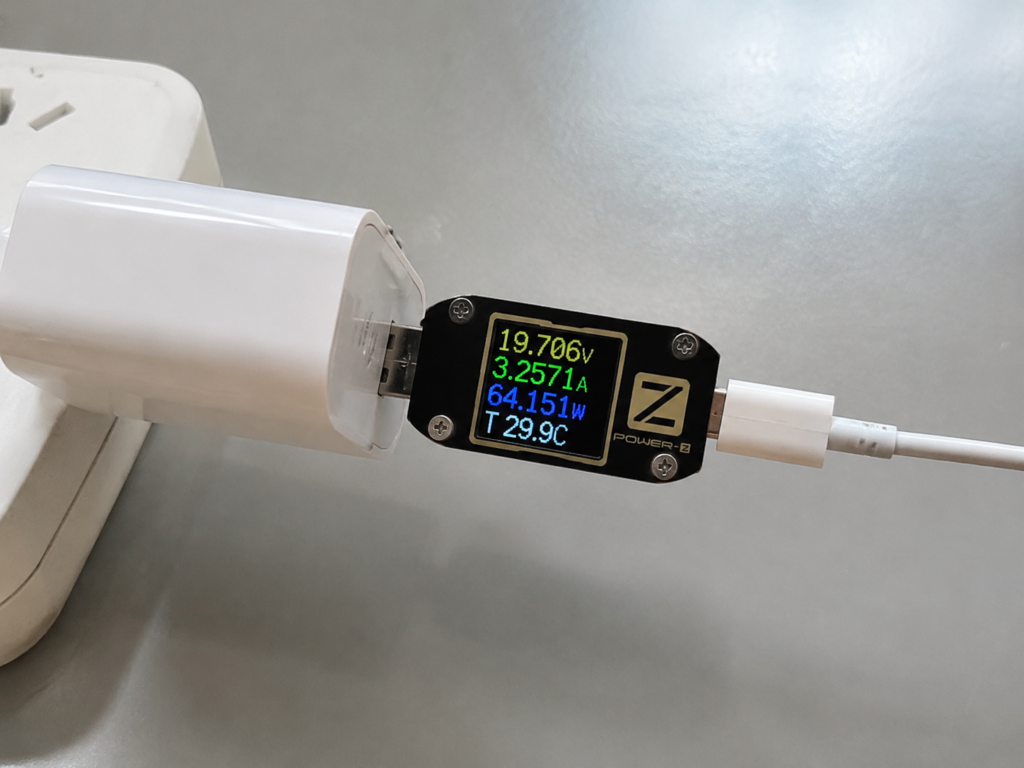
- Use an affordable power meter to measure actual output power: a household USB power meter costing more than ten dollars, plugged between the charger and the charging cable, can directly show the current output power. However, the actual power is affected by many factors such as the device’s battery level, temperature, and protocol handshake. When testing, try to control variables (for example, the device’s battery level is between 30%-80%, the screen is off, and the ambient temperature is around 25°C), and make a comprehensive judgment after multiple tests; the power meter also cannot verify the authenticity of certification, continuous output capability, or compatibility of all protocols.
- Compare charging speed: if the merchant has stated the test conditions for charging speed, you can test under the same conditions; if the daily use speed is very different from the advertisement, you should suspect whether the specifications are exaggerated. However, charging speed is affected by many factors such as battery capacity, initial battery level, device temperature, and system strategy, and you cannot determine falsehood based solely on one test.
- Observe the texture of the cable: because high-power charging cables need to carry larger current, the core is usually thicker, and they will be heavier and sturdier under the same length. However, the weight and thickness of the cable are also affected by factors such as sheath material, shielding layer, and length. You cannot determine exaggerated specifications solely by appearance, which can only be used as a prompt for further verification.
Rights Protection Channels for False Labeling
If you really buy a product suspected of false labeling, you can defend your rights according to the following steps:
- First apply for a refund or compensation in accordance with the return, dispute resolution, and consumer protection rules of the purchasing platform. Be sure to keep all vouchers such as order screenshots, product promotion page screenshots, packaging photos, test records, and communication records with the seller. In most cases, the platform will give priority to handling consumers’ reasonable demands.
- Submit a complaint on the FTC official website (ReportFraud.ftc.gov) and keep relevant vouchers. Complaints received by the FTC will be aggregated into the enforcement clue database to identify key violation categories and entities. However, the FTC will not reply individually to each case or promise to file a case or pay compensation; individual case refunds are mainly resolved through platforms or judicial procedures. Even if the seller is overseas, as long as the product is sold to US consumers, you can submit a complaint to the FTC, and the relevant information will be included in the enforcement clue database.
- If the amount involved is large and the number of affected consumers is large, there may be relevant class action procedures; whether you can participate and whether you can get compensation depends on whether the case is certified as a class action by the court and whether the consumer meets the eligibility conditions; not all cases have class actions.
Seller Compliance: Entry-Level Pitfall Avoidance Guide
If you are an entry-level seller operating in the US market, doing these points well can help you avoid most FTC violation risks.
4 Basic Self-Checks Before Launch
Before the product is listed, you must conduct these four checks, which are the most basic compliance requirements:
- Parameter authenticity: Do not directly use the verbal parameters given by the supplier. According to the content you promote, prepare reproducible test data — for example, if you promote continuous output power, you must have stable test results for the corresponding model and corresponding daily use scenarios, not just peak data.
- Certification validity: If you promote certification or authorization, you must confirm that the certificate is true and valid, and that the model, manufacturing factory, validity period, and coverage scope all match. You cannot use certificates of other models or other factories to make up the number; you must distinguish between internal self-testing and official certification, and cannot say that self-testing compliance with standards equals obtaining certification.
- Labeling consistency: All parameters, certifications, and origin information on the packaging, product body, e-commerce product page, and manual must be unified, and there must be no contradictory statements.
- Promotional compliance: Delete all unfounded absolute statements, exaggerated content, and false origin information, and place important limiting conditions in prominent positions.
High-Frequency Promotional Pitfalls
When promoting, these pitfalls are the easiest to fall into, and you must avoid them:
- Never use unfounded absolute statements, such as “fastest”, “never heats up”, “100% safe”, etc., which are all statements with very high violation risks.
- Do not fraudulently use or imply unobtained certification/authorization: for certifications that are still being applied for and have not been obtained, you cannot mark “certified”; you also cannot use vague expressions such as “compliant with XX standards” to make consumers mistakenly think that you have obtained certification from the corresponding institution.
- Do not obscure usage restrictions: for example, the power distribution rules of multi-port chargers, applicable devices and trigger conditions for fast charging must be placed in prominent positions of the corresponding promotional content, and cannot be hidden at the bottom of the page.
- If you hire KOLs for promotion, you must clearly disclose that it is a cooperative advertisement, and cannot let KOLs pretend to be ordinary users for recommendation; if KOLs exaggerate performance, the merchant shall also bear corresponding responsibilities.
Supply Chain and Daily Compliance Management
Compliance is not a one-time thing, it requires long-term management:
- Document retention: It is recommended to keep all compliance documents such as test reports (including original test data), certification certificates, authorization letters, origin certificates, historical versions of product packaging/product pages/manuals, and sample batch records for at least 3 years; if applicable regulations, certification body rules, platform rules, contract agreements, or dispute resolution requirements have longer retention periods, the longer period shall be followed. The saved documents must correspond to specific product models, batches, and promotional versions to ensure that matching evidence can be provided during investigations.
- Supply chain management: Do not blindly trust the verbal promises of suppliers. For all parameters and certifications, you must request written documents and verify their authenticity; when signing contracts with ODM/OEM factories, you must clarify compliance responsibilities, so that if violations occur due to factory problems, responsibility can be traced; you should also conduct regular batch spot checks, for example, sampling several units from each batch to test key parameters, to prevent parameter inconsistency with promotions caused by factory cutting corners.
- Re-review after changes: If you replace the core chip, cable, manufacturing factory, port configuration, or even update firmware that affects performance, all labels and promotions must be re-reviewed — because changes in key components or configurations may lead to parameter changes and certification invalidation, and the original promotional evidence will no longer apply.
Key Points for Responding to FTC Investigations
In case you really receive an FTC investigation notice (such as a CID), don’t panic, pay attention to these points:
- Cooperate immediately. Never lose contact, let alone destroy or tamper with evidence, otherwise the penalty will be aggravated, and it may even constitute obstruction of justice.
- Consult professionals familiar with US regulatory laws (such as US regulatory lawyers) as soon as possible to verify the time limit, scope, and response requirements of the notice, and do not submit materials or make statements at will.
- Actively organize and provide all materials that can prove your compliance, such as test reports, certification certificates, authorization letters, supply chain documents, etc.
- Choose the response method according to the actual situation of the case: if there is indeed a violation, settlement may be a lower-cost handling method, and you can strive for lighter treatment by taking the initiative to rectify and refund/compensate consumers; if you believe you are fully compliant, you can also defend through administrative procedures or litigation — there is no universal best solution, and it must be judged in combination with specific circumstances.
- After rectification, keep all modification records, such as screenshots of the revised product page, new packaging designs, and updated test reports, to prove that you have stopped the violation, and there is a basis for future inspections.
Clarification of Common Cognitive Misconceptions
Finally, let’s clarify a few most easily misunderstood cognitions to avoid pitfalls:
- Will having a certification mark mean no FTC penalty? → Certification only covers specific test scopes (such as safety and protocol compliance). If the promotional content exceeds the certification scope or has exaggerated specifications, it may still be investigated and punished. For details, see the relevant content of “Certification Qualification Category Violations” above.
- Is wrong parameter labeling just a minor quality issue that the FTC doesn’t care about? → As long as the parameters are important information that affects consumers’ purchasing decisions, false labeling may constitute deceptive advertising and fall within the FTC’s regulatory scope; it is not that the product being usable means there is no problem.
- Can a small-font disclaimer at the bottom of the page avoid liability? → Important limiting conditions need to be placed in the same prominent position as the corresponding promotional content, and hidden statements cannot offset misleading promotions. For specific rules, see “Validity Boundary of Disclaimers” above.
- Will small sellers and overseas sellers not be investigated by the FTC? → As long as the products are sold to US consumers and have a substantial impact on US commerce, regardless of the scale and whether the entity is domestic or overseas, they may be investigated due to complaints or market monitoring. For details, see “Coordinated Enforcement Mechanism for Cross-Border Sellers” above.
- Does the FTC regulate all charging product issues? → The FTC only regulates the authenticity of promotions and labels and whether there are deceptive/unfair business practices. Safety issues are under the jurisdiction of the CPSC, radio frequency/electromagnetic compatibility entry is under the FCC, and import tariffs and customs origin rules are under the CBP. Different issues need to be addressed to the corresponding agencies.
For ordinary consumers, spending a few more minutes checking parameter consistency and verifying certification qualifications before buying, conducting preliminary verification with scientific methods after buying, and defending rights through formal channels when encountering problems can avoid the vast majority of false labeling pitfalls; for entry-level sellers of charging products targeting the US market, making promotional content truthful, clarifying limiting conditions, and keeping solid compliance documents are the most reliable way to avoid enforcement risks and operate for the long term.