
If you are an overseas brand that manufactures chargers, power adapters, or charging accessories and wants to sell your products in the Chinese market, you will most likely encounter the “CCC certification” requirement. This article starts with basic concepts, covers the entire process of applicability judgment, pre-application preparation, core application procedures, and post-certification maintenance, to help you understand whether your product needs CCC certification, how to apply for it specifically, and what common risks to avoid.
First, Understand: What Exactly is CCC Certification
The full name of CCC certification is China Compulsory Certification, commonly known as “3C certification”. Simply put, products listed in the Catalogue of Compulsory Product Certification regularly updated by the Chinese government must pass this safety certification before they can be imported, produced, sold, or used for business purposes within China. It is a minimum safety access threshold, not an award for “high-quality products”. It focuses on three core aspects: electric shock protection, overheating and fire prevention, and electromagnetic compatibility — that is, the product will not randomly emit electromagnetic waves to interfere with other devices when operating, nor will it be easily interfered with.
Many overseas friends will compare it with the CE (EU) and FCC (US) certifications they are familiar with. It should be clarified first: there is no mutual recognition agreement between CCC and CE/FCC, and the test standards and requirements are also different. The overseas test reports you have can only be used as a reference for auxiliary assessment, and cannot be directly exchanged for a CCC certificate, nor can they replace the mandatory CCC testing. In addition, there is the often-mentioned CQC certification, which is a voluntary product safety endorsement and a bonus item for market differentiation. CCC, on the other hand, is a mandatory access threshold — you can only sell legally after passing it. The two are completely different in nature.
If products listed in the catalogue enter the Chinese market without obtaining CCC certification and without legal exemption, they may face various risks: If violations are found during the import process, customs may take disposal measures such as return of goods and the relevant parties shall bear corresponding responsibilities. The specific handling method depends on the product attributes, the circumstances of the violation, and the law enforcement basis of the regulatory authority; In online sales scenarios, some e-commerce platforms or specific product categories require submission of a valid CCC certificate before products can be listed. Platform rules may be adjusted along with categories, sales models, and policies, and the actual requirements shall be subject to the latest rules of the corresponding category at the time of listing; If market regulatory authorities find non-compliance through random inspections, they may take measures such as removal from shelves, recall, and administrative penalties; In the long run, it will also affect the brand’s channel cooperation and reputation in the Chinese market.
Step 1: First Determine Whether Your Product Needs CCC Certification
Not all charging products need CCC certification, nor do all products connected to 220V mains power need it. We can first conduct a preliminary assessment from the following 6 dimensions: product name and category, input power supply method, actual use, whether it contains active electronic modules, sales/import scenarios, and applicability of product structure and corresponding implementation rules. The core principle is: judgment cannot be made solely based on whether the product is connected to 220V mains power; it must be confirmed in combination with structure, classification, and the latest official documents.
For your quick reference, we have compiled classification references for common charging products:
| Product Type | Whether it is Usually in the Mandatory Scope (Preliminary Reference) | Core Judgment Points |
|---|---|---|
| Wall-plug charger (directly plugged into mains power) | Yes | The product category shall be confirmed according to the specific use, and the corresponding implementation rules shall be checked. |
| Standalone power adapter (matching complete machine) | Requires multi-dimensional judgment | Comprehensively judged based on the adapter’s use, output characteristics, category of the matching complete machine, and the current CCC catalogue; it cannot be directly determined solely by “matching complete machine”; the corresponding catalogue entries and implementation rules shall be checked to confirm certification units, test standards, and accessory requirements. |
| Charging power strip/desktop charging station with USB output | High-risk composite product, requires key verification | Classification shall be confirmed according to the overall product structure, use, and catalogue entries; if the product falls into relevant mandatory categories respectively, the certification requirements shall be determined according to the corresponding rules, and it shall not be directly judged as a dual mandatory scope solely because it has USB output. |
| Ordinary passive charging cable | No | Ordinary charging cables that only contain wires, have no active electronic modules, and do not belong to other product categories in the catalogue usually do not need CCC certification separately just because they support fast charging; products with identification chips, conversion circuits, or other active modules require separate assessment. |
| Charging cable with active modules | Requires separate assessment | If it belongs to active accessories in the catalogue, certification is required, and the product structure and corresponding rules shall be checked. |
| Power bank (portable charger) | Subject to the latest official announcement | It is a high-risk and high-concern product. It is necessary to check the latest catalogue adjustment announcements, implementation rules, and transition period requirements of the certification and supervision department to confirm the product’s applicable scope, rated parameters, and cell/battery pack requirements. |
| Charging accessories sold with the complete machine | Depends on the complete machine | If the complete machine is in the mandatory catalogue, the accessories must meet the certification requirements of the complete machine; if the accessories are sold separately, separate judgment is required. |
The above is only a preliminary classification reference for common charging products, and cannot replace the official judgment of each model. The final confirmation shall be made by comparing the specific model with the latest catalogue, implementation rules, and product structure, and a written pre-assessment from the certification body shall be obtained if necessary.
Of course, there are some special scenarios where certification can be exempted, but only for non-retail and non-commercial purposes: for example, samples for scientific research, testing, and exhibitions (with limited quantity and use, and absolutely cannot be sold); products that are exported after processing with supplied materials, or temporarily imported and then re-exported.
It should be noted that meeting the above scenarios does not mean that CCC can be automatically exempted. Relevant entities shall, before importing or carrying out corresponding activities, apply for relevant certificates of exemption from compulsory product certification in accordance with current regulations, or complete corresponding filing and customs clearance procedures, and keep supporting materials on the use, quantity, and destination of the products throughout the process to ensure that the products are always used within the limited scope and do not enter the sales link.
These exemption clauses cannot be applied to ordinary retail or imported products for sale.
If you are still unsure, you can use the 3-step quick confirmation method: first make a preliminary judgment against the above common product classifications; then check the latest compulsory certification catalogue and implementation rules, or find a qualified certification body or agent to conduct a pre-assessment; if it is an imported product, it is best to consult the customs in advance to confirm the customs clearance compliance requirements to avoid problems after arrival at the port.
5 Things to Do Before Applying
After confirming that the product needs CCC certification, completing 5 pre-application preparations can effectively reduce rework costs:
1. Choose the Right Applicant Entity (Especially Important for Overseas Users)
CCC certification involves multiple roles: the certificate holder is the party that bears legal responsibility and holds control over the certificate; the manufacturer is the entity that bears corresponding responsibility for product design, manufacturing, or certification consistency; the production factory is the factory that actually carries out product production; in addition, it may also involve roles such as importers, brand owners, and agencies. In actual operation, the brand owner, certificate holder, manufacturer, production factory, and importer may belong to different entities. The specific responsibilities and document requirements of each role shall be subject to the implementation rules of the corresponding product and the acceptance requirements of the certification body.
For overseas brands, they can participate in the certification application as the brand owner or relevant entity, and designate a domestic contact person to be responsible for docking in accordance with the rules; whether a domestic importer or other eligible entity can act as the certificate holder must meet the requirements of the corresponding product implementation rules and be confirmed by the certification body. Special attention should be paid here: agencies usually act as entrusted handling parties or process coordination contacts, and do not have official certification issuance authority; the specific qualification requirements for the applicant entity shall be confirmed in accordance with the implementation rules of the corresponding product, authorization documents, and the acceptance requirements of the certification body.
2. Prepare Exclusive Documents
The documents required for the application are mainly divided into three categories:
The first category is product technical documents, including product model, input and output parameters (if it is a fast charging product, all fast charging levels must be clearly stated), interface type, appearance drawing, circuit schematic diagram, etc.;
The second category is manufacturer’s documents, including factory address and basic information of the quality control system;
If it is an overseas brand, additional brand registration certificate and brand authorization letter must be prepared. If it is an OEM/ODM product, the corresponding cooperation agreement must also be provided.
3. Self-Check Before Sending Samples (Greatly Reduces Rework Rate)
Many people have their samples rejected due to minor problems after sending them, which wastes time. In fact, most problems can be avoided by self-checking a few core points in advance:
- The plug structure and specifications must comply with applicable product standards, implementation rules, and certification body requirements. Common mains direct-plug products usually use two-pin or three-pin flat plugs that meet national standards, which can be confirmed with the body in advance;
- The nameplate content, Chinese labeling requirements, and the method and position of applying the CCC mark must comply with applicable product standards, implementation rules, and certification body requirements. The specific template and labeling specifications can be confirmed with the body before sending samples;
- USB/USB-C interfaces must not have exposed pins, and must meet the basic requirements for electric shock protection;
- The samples sent must be final finalized mass production prototypes, with parameters completely consistent with the submitted documents, and unfinalized engineering prototypes cannot be used.
Here, remember a core principle that runs through the entire certification process: the information of the submitted technical documents, test samples, and product nameplate must be completely consistent, and subsequent mass-produced products must also be consistent with the certified status (i.e., production consistency requirements) — subsequent document review, sample testing, factory inspection, and post-certification supervision will all be checked against this standard.
4. Choose the Right Application Channel
There are two main channels for applying for CCC:
One is to apply directly to an officially approved CCC certification body, which is suitable for users with Chinese communication capabilities. Before applying, you should first check the official list of bodies to confirm that the other party has the certification qualification for the corresponding product category;
The other is to entrust a qualified agency familiar with charging products to apply, which is more suitable for overseas users and can solve the problems of language barriers, unfamiliarity with the process, and cross-time zone coordination.
Here is a big pit to avoid: agencies only help you sort out documents and coordinate the process, and have no authority to issue certificates. All agencies that claim “guaranteed pass” or “obtain certificates through internal channels” are scams, do not believe them.
5. Confirm Certification Unit Division in Advance (Key to Saving Money)
Many people don’t know that the same CCC certificate can cover multiple models of products, and this coverage scope is called a “certification unit”. The division rules are determined by the implementation rules of the corresponding product. Generally speaking, products with similar product structure, circuit principle, key components, rated parameters, and use categories can be classified into the same certification unit.
For example, if you have three wall-plug chargers of the same series, with the same circuit design, key components, and fast charging protocol, only with output powers of 20W, 25W, 30W, and only color differences in appearance, they may be included in the same certification unit to reduce the cost of repeated testing. However, differences in rated output parameters, fast charging protocols, key components, or circuit structure may affect unit division and representative model selection. Whether multiple models can share one certificate and how many models need to be tested must be confirmed by the certification body in accordance with the implementation rules, and it cannot be guaranteed in advance that one test will cover all models. Communicating with the body in advance to confirm unit division can avoid unnecessary expenses.
Core Application Process: From Application to Certificate Issuance
The general process of CCC certification is: pre-assessment → formal application → document review → sample testing → factory evaluation (on demand) → certification decision → certificate issuance, but this order is not fixed. For some certification modes, factory inspection can be done first, or if the production factory already has qualified similar quality records, it can also apply for exemption from on-site inspection, depending on the implementation rules of the corresponding product.
Pre-Assessment and Formal Application
Pre-assessment is an optional step. You can first submit the basic information of the product, and let the body help you confirm how to divide the certification unit, what standards apply, and the approximate cost and cycle, which can reduce the possibility of subsequent rework.
After confirming that there is no problem, you can submit a formal application, which is usually filled out through the online system of the certification body, including product model, certification unit, entity information, technical documents, etc. Common filling errors here include: only writing “fast charging” without indicating the specific power, and irregular model naming. Pay attention when filling out.
Document Review and Correction
After submitting the application, the body will first review your documents. If it passes, you will be notified of the follow-up arrangements, including sample submission requirements; if it fails, the body will tell you the content that needs to be corrected at one time, and you can resubmit after completing it.
Common reasons for document failure include: inconsistent information on the parameter label and the application form, lack of safety certification information in the list of key components, and incomplete authorization documents.
For low-power charging products, if the documents are complete, the document review takes about 5-10 working days. However, this time is for reference only, and is specifically affected by the body’s scheduling, not an official commitment.
Sample Testing (Core Link)
Samples can be sent after the document review is passed. The number of samples to be sent is subject to the notification of the body, and usually several units are sent for low-power products; for multi-model series products in the same certification unit, the certification body usually designates representative models for sample submission, and if necessary, will require additional differential models or supplementary samples.
Test items will be applied according to the product category, not all items are tested, mainly divided into two categories:
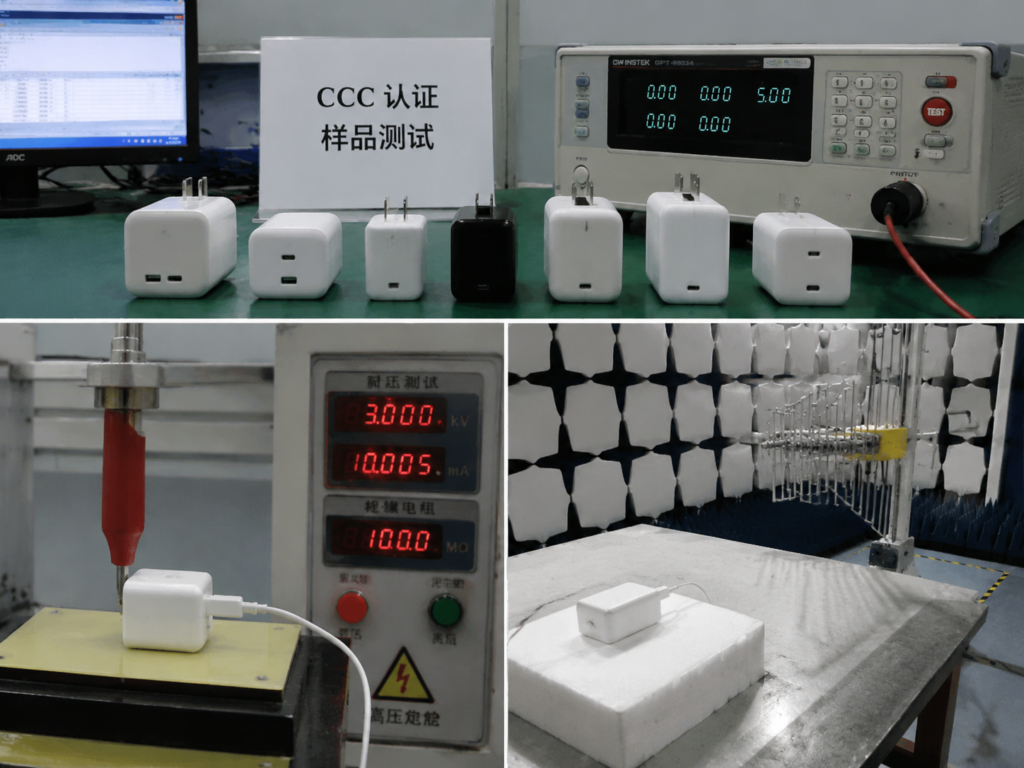
- Safety category: including parameter verification, temperature rise, withstand voltage, insulation, abnormal operation, mechanical strength, electric shock protection, etc.;
- Electromagnetic compatibility category: including radiation and conduction testing.
Common reasons for test failure of charging products include: plug size not meeting national standards, insufficient insulation strength, overheating protection failure, and excessive electromagnetic radiation. If the test fails, samples must be re-sent after rectification. You can do voluntary pre-testing in advance to reduce the rework rate of formal testing.
Excluding rectification and scheduling, the test cycle for low-power products is about 4-8 weeks, which is also for reference only. If rectification or retesting is required, the time will be significantly extended.
Factory Evaluation (Carried Out on Demand)
Whether factory evaluation is carried out, what method is adopted (on-site inspection/document verification, etc.), and whether it can be exempted depend on various factors such as product category, certification mode, existing similar CCC certificates of the production factory, and production consistency control records. The final decision shall be subject to the implementation rules of the corresponding product and the formal decision of the certification body.
The core of factory inspection is production consistency, that is, to ensure that mass-produced products are consistent with the status at the time of certification, and to avoid the situation where samples are qualified but mass-produced products have reduced standards. The main inspection contents include: change control of key components, incoming/process/finished product inspection procedures, equipment calibration status, non-conforming product control mechanisms, etc.
If it is an overseas factory, on-site inspection may also be required, and the cycle will be affected by factory scale, audit arrangements, travel and language conditions, and will be longer than that of domestic factories.
If the inspection result is passed, it will enter the certification decision stage; if it is a minor non-conformity, it only needs to be rectified within the time limit; if it is a serious non-conformity, re-inspection is required.

Certification Decision and Certificate Issuance
Only after the sample test is passed and the factory evaluation is passed (or meets the exemption conditions) can the certificate be obtained.
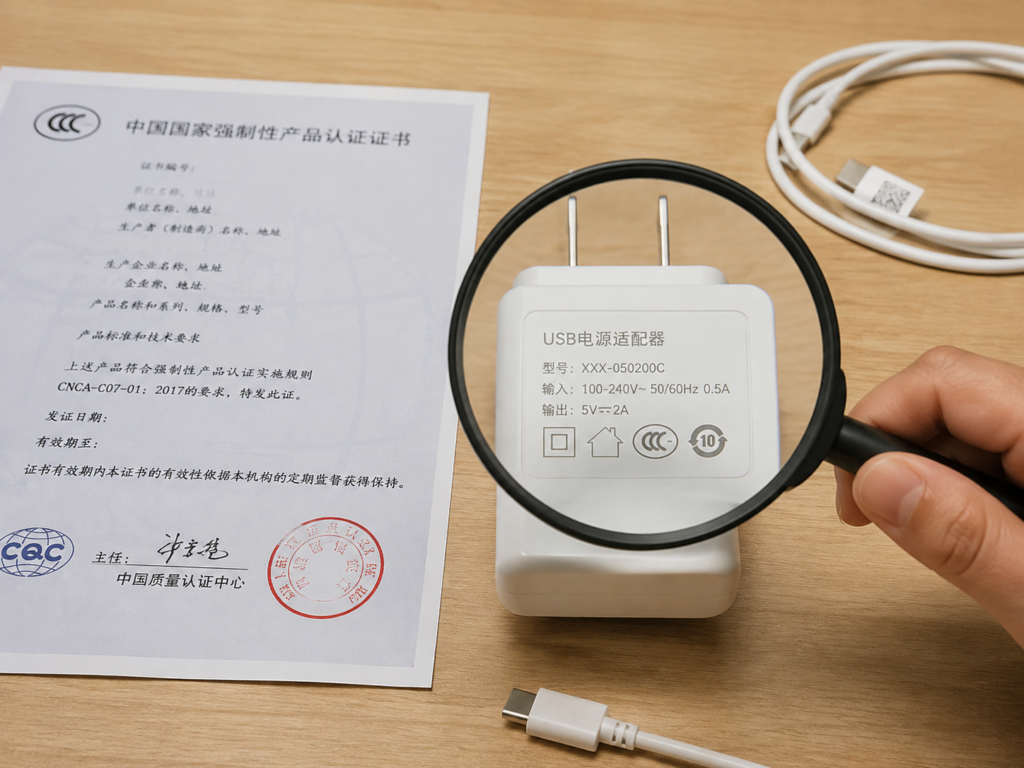
Current CCC certificates are available in both electronic and paper forms. After receiving the certificate, it is recommended to verify the status through official channels in time. For specific methods, please refer to the certificate authenticity verification section later. The core information on the certificate includes product model, specification parameters, production factory, validity period, certification unit coverage scope, etc., which must be consistent with the actual product.
Post-Certification Maintenance Notes
Certificate Status and Annual Supervision
The validity period of the CCC certificate shall be subject to the implementation rules of the corresponding product and the marking on the certificate, and there are differences among different categories.
The certification body will carry out annual supervision on certified products and production consistency in accordance with the implementation rules, in forms including certificate holder document verification, production factory on-site inspection, sample random testing, etc. Common random inspection items include output power, insulation performance, and consistency of key components with filed documents.
If you do not cooperate with the annual supervision, the certificate may be suspended or even revoked, and the corresponding products shall not continue to use the CCC mark.
These Situations Require a Change Application
If the product or entity information changes, you must apply to the certification body for a change in advance, and cannot continue to use the certificate after making changes without permission, otherwise the certificate may become invalid.
Common situations that require changes are divided into two categories:
- Product changes: for example, changing the supplier of plugs or interfaces, adjusting output parameters or fast charging protocols, changing key safety components, changing the shell or circuit structure;
- Entity changes: for example, the certificate holder or manufacturer changes its name, the production factory relocates, or the production factory is replaced.
For all changes that may affect production consistency, confirm with the body in advance whether retesting or re-certification is required, and do not make changes secretly by yourself.
Certificate Renewal and Status Management
Before the certificate expires, you must apply for renewal in accordance with the requirements of the implementation rules. How far in advance to apply shall be subject to the notification of the body.
Common reasons for certificate suspension or revocation include: unqualified annual supervision, inconsistency between products and filed documents, failure to apply for changes as required, failure to apply for renewal after the deadline, etc.
The product disposal requirements during the certificate suspension period, rectification and restoration conditions, and re-application rules after revocation shall all be subject to the decision of the certification body, corresponding implementation rules, and regulatory requirements; if revoked due to serious violations, there may be a period restricting re-application, which shall be subject to the specific disposal decision.
CCC Mark Usage Rules
The CCC mark can only be used when the certificate is valid and the product meets the certification requirements. The style, specification, and application method of the mark must comply with official regulations. Forgery, fraudulent use, or use beyond the scope is prohibited (for example, uncertified models and products beyond the coverage of the certificate shall not be marked). You shall not choose an application position that exceeds the rules on your own; the specific form, specification, application method and position of the mark must be strictly implemented in accordance with the labeling regulations of the corresponding product and the confirmation result of the certification body, and can only be used for product models covered by the valid certificate.
Exclusive for Overseas Users: Pitfall Avoidance and Practical Tools
5 High-Frequency Misconceptions to Avoid
- Having CE/FCC certification can directly exchange for a CCC certificate: As clarified earlier, there is no mutual recognition agreement between CCC and CE/FCC. Overseas test materials can only be used as a reference for auxiliary assessment, and cannot replace CCC testing and certification processes, nor can they directly exchange for a certificate.
- All 220V charging products need CCC certification: Judgment cannot be based solely on power supply voltage; it requires multi-dimensional assessment combining product category, structure, use, etc. (refer to the 6-dimensional judgment chain earlier). For example, some industrial-specific charging equipment may not be in the mandatory catalogue.
- All fast charging cables need CCC certification: Ordinary passive fast charging cables that only contain wires, have no active electronic modules, and do not belong to other categories in the catalogue usually do not need separate certification; charging cables with active modules such as identification chips and conversion circuits require separate assessment (for details, refer to the previous common product classification instructions).
- No more management is needed after getting the certificate: CCC certificates require continuous maintenance, including cooperating with annual supervision, timely reporting of changes, and applying for renewal before expiration, otherwise the certificate may be suspended or revoked.
- Hiring an agency can guarantee a pass: Agencies only provide document sorting and process coordination services, and have no certificate issuance authority. All claims of “guaranteed pass” or “obtaining certificates through internal channels” are scams.
Cycle and Cost Reference
Many people ask how long it takes and how much it costs to apply for CCC. In fact, there is no fixed answer, as it is affected by many factors: such as whether the documents are complete, whether the test requires rectification, whether the factory is domestic or overseas, how many certification units there are, and whether the body’s schedule is tight.
Here is a reference range (not an official commitment, the actual situation shall prevail): for a single-model low-power charging product from a domestic factory, it takes about 1.5-3 months to get the certificate; if it is an overseas factory, it takes about 3-6 months.
The cost is mainly divided into two categories. The specific items and amounts depend on factors such as product category, certification mode, factory location, and number of certification units, and the final official quotation shall prevail:
The first category is certification body-related fees: may include application fee, testing fee, factory evaluation fee, certificate-related fees, annual supervision fee, etc. Some of these items are only charged in specific certification modes or supervision links, and are not fixed mandatory payments;
The second category is external service and derivative fees: including agency service fee (if any), travel expenses for overseas factory auditors, additional fees incurred by rectification/retesting/re-audit, etc. Whether such fees occur depends on the actual handling situation.
When you get the quotation, be sure to check item by item clearly: clarify the specific items included in the quotation (such as whether it covers the test of the first application, factory evaluation, certificate fee, whether it includes agency services, overseas travel, etc.), and at the same time confirm which items are extra-charged (such as rectification, retesting, re-audit, annual supervision, etc.) to avoid subsequent fee disputes.
Legal Methods to Shorten the Cycle
If you want to get the certificate quickly, don’t believe the scam of “internal expedited processing”. These methods are legal and effective:
- Complete product self-check in advance, such as plug, label, and parameter consistency, to avoid rejection after sending samples;
- Do voluntary pre-testing in advance, and fix problems before the formal test to avoid delays caused by rectification;
- Prepare all application documents at one time to reduce the number of supplementary documents;
- Confirm the certification unit division in advance to avoid additional testing and expenses caused by incorrect unit division.
Certificate Authenticity Verification Method
Whether you apply by yourself or through an agency, you must verify the authenticity of the certificate after receiving it. You can verify it step by step in three steps:
Step 1: Log in to the “National Certification and Accreditation Information Public Service Platform”, enter the certificate number to check whether the basic information such as certificate status and certificate holder entity is true and valid;
Step 2: Check whether the issuing body is a CCC certification body approved by the National Certification and Accreditation Administration;
Step 3: Confirm that the certification business scope of the issuing body covers the product category you applied for, to avoid the situation where the body has CCC qualification but no corresponding category authorization.
After completing the verification of the validity of the body and the certificate, you also need to compare item by item whether the product model, specification parameters, manufacturer, production factory, and certification unit coverage scope on the certificate are consistent with the actual product.
Fake certificates usually have these flaws: the issuing body has not obtained CCC certification qualification for the corresponding product category, the certificate number cannot be found on the official platform, and the model specifications do not match the actual product.
Entry-Level Decision Checklist
If you are ready to start the application, you can self-check against this list first to ensure that no key matters are missed:
- □ Have initially confirmed whether the product is in the mandatory certification scope through the 6-dimensional judgment method, and kept the judgment basis of the catalogue, implementation rules, or body pre-assessment
- □ Have selected the certificate holder entity and clarified the ownership of certificate control
- □ Have prepared a full set of technical documents to ensure the consistency of documents, samples, and nameplates
- □ Have reserved buffer time for test rectification and factory inspection appointment
- □ Have arranged a dedicated person responsible for post-certification supervision and change reporting
Summary
Applying for CCC certification is the core compliance link for charging products to enter the Chinese market. When implementing, you can focus on three key decision points:
First, before starting the application, be sure to confirm the product’s catalogue classification and the qualification of the certificate holder entity to avoid waste of time and cost caused by incorrect classification or non-compliant entities;
Second, strictly implement the core principle of production consistency throughout the process, from self-check before sample submission to post-certification changes, all must be promoted in accordance with the rules, to reduce the risk of rework and certificate invalidation;
Third, clarify the responsible person for post-certification management in advance, and continuously follow up on annual supervision, change reporting, and certificate renewal to avoid abnormal certificate status caused by negligence.