
If you have ever run an electrical and electronic equipment business in the EU market, or purchased digital products from Europe via cross-border shopping, you have definitely seen the “crossed-out trash bin” symbol – an outline of a wheeled trash bin with a cross in the upper left corner. Many people think it is just an ordinary environmental reminder, affix it in the wrong position, omit it, or even confuse it with other labels, only to find out it is a mandatory compliance requirement for the EU market when they encounter customs detention of goods or e-commerce platform delistings.
1. First, Get It Straight: What Exactly Is This Crossed-Out Trash Bin?
The official name of this crossed-out wheeled trash bin symbol is the “crossed-out wheeled trash bin symbol”. It corresponds to the requirements of the EU’s (referred to as the WEEE Directive, current version 2012/19/EU), and is a mandatory label that must be affixed to electrical and electronic products entering the EU market, not a voluntary environmental certification.
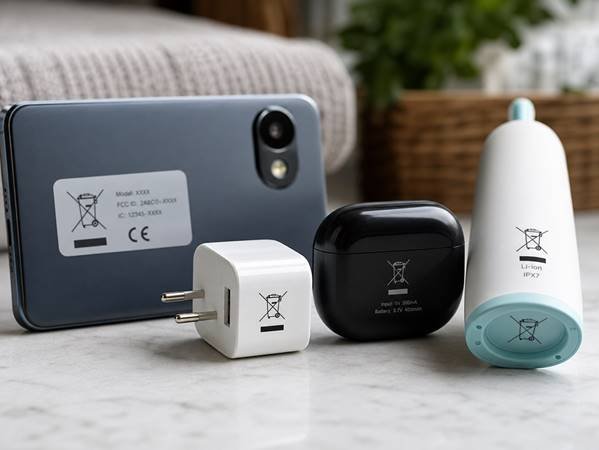
Many people mistakenly believe that affixing this label means the product is “more environmentally friendly”, but that is not the case – its core function is only to remind consumers that this electrical and electronic product cannot be discarded as ordinary household waste and must be separately sorted for recycling, which has no direct relationship with the product’s own environmental attributes or whether its materials are recyclable.
For regulators and merchants, this label is an intuitive marker for implementing the “producer responsibility for recycling”: whoever sells products to the EU market is responsible for the recycling and treatment of the products after they are discarded. The label, together with producer information, facilitates regulatory traceability of responsibility. On a broader scale, unified sorting reminders can reduce heavy metals and rare metals in e-waste from directly entering landfills, which not only reduces environmental pollution but also promotes resource recycling.
Sellers who are new to EU compliance often confuse the WEEE label with other common labels. We have compiled 5 types of the most easily confused labels, and the core differences can be understood at a glance:
| Common EU Labels | Core Differences from the WEEE Recycling Label |
| Ordinary recyclable three-arrow symbol ♻ | Only indicates that the product material is recyclable, is not a legal recycling label exclusive to electrical and electronic equipment, and cannot replace the WEEE label at all |
| CE mark | A product safety and market access declaration, only responsible for whether the product meets basic requirements such as safety and health, and is completely separate from recycling and sorting obligations |
| Green Dot / Triman label | Falls under the category of packaging recycling regulations, targets the recycling responsibility for product outer packaging, and cannot replace the WEEE recycling label of the product itself |
| Battery recycling label | The pattern is a crossed-out trash bin + chemical element symbols, only applicable to independently sold batteries; built-in batteries of complete machine products do not need to be affixed with this label separately |
| RoHS declaration | Restricts the use of hazardous substances such as lead and mercury in products, belongs to completely different regulations from the WEEE recycling label, and neither can replace the other |
2. Do You Need to Affix It? 2-Step Quick Judgment of Applicable Scope
Not all products need to be affixed with the WEEE label, nor do only large household appliances need it. We will first explain the core judgment criteria, then provide methods for judging borderline cases, and finally teach you the steps for quick self-inspection.
3 Core Premises for Judgment
A product needs to be affixed with the WEEE label if it meets all three conditions:
First, it belongs to electrical and electronic equipment (referred to as EEE) – its normal operation relies on electric current or electromagnetic fields; purely mechanical products definitely do not count.
Second, its rated voltage does not exceed 1000V AC or 1500V DC; high-voltage equipment exceeding this range is not under the jurisdiction of the WEEE Directive.
Third, it is commercially placed on the EU market – whether it is offline physical stores, online cross-border e-commerce, B2B sales, or commercial used/refurbished products, as long as it is a commercial sale, it counts; personal transfer of used products by individuals does not count.
A special reminder here: after 2018, the WEEE Directive implements the “open scope” rule, which means that except for categories explicitly excluded by regulations, almost all electrical and electronic equipment is covered, not only the listed large household appliances and mobile phones need to be labeled.
How to Judge Borderline Cases
When encountering uncertain accessories or components, there is only one core judgment criterion: does this product have independent electrical and electronic functions, and can it be placed on the market and used independently.
• Cases where labeling is required: independently sold Bluetooth headsets, USB chargers, electric toothbrush heads with circuits – these can all be used and sold independently, belong to independent EEE, and must be labeled.
• Cases where labeling is not required: purely passive cables (such as ordinary charging cables and data cables that only have wire connections, no chips, no active conversion or electronic display functions), purely mechanical keyboard keycaps, battery storage boxes without electronic functions – these have no independent electronic functions and do not fall within the scope of WEEE. Cables/adapters with chips, circuits, or that can independently realize electronic functions (such as charging cables with digital displays, video adapters) should be re-judged as EEE for whether labeling is required.
There are several other common borderline cases, and the conclusions are given directly:
• Electrical and electronic equipment with built-in batteries: only the WEEE label needs to be affixed to the product body; built-in batteries usually do not need to be affixed with separate WEEE/battery recycling labels as independent batteries, but necessary information should still be provided in accordance with battery regulations and member state requirements.
• Micro electronic components integrated into non-EEE products that cannot be separated individually: for example, micro chips embedded in paper anti-counterfeiting labels, small light-emitting modules that cannot be removed from ordinary handicrafts – since the entire product itself does not belong to electrical and electronic equipment, this small component does not need to be labeled separately.
Common Categories Requiring Labeling
Here are some of the most common categories for your reference:
• Large household appliances: refrigerators, washing machines, air conditioners, microwave ovens
• Small household appliances: hair dryers, electric toothbrushes, coffee machines, vacuum cleaners
• Digital 3C products: mobile phones, computers, headsets, chargers, routers
• Others: LED lamps, electric tools, electronic toys, smart wearable devices
Explicit Exclusions That Do Not Require Labeling
Categories explicitly excluded by regulations do not need to be affixed with the WEEE label, even if they meet the definition of electrical and electronic equipment:
1. Electronic equipment dedicated to military, aerospace, and national security use
2. Active implantable medical electronic devices, such as pacemakers
3. Large fixed industrial installations / special industrial tools that are permanently fixed in specific locations and only used for industrial production
4. Built-in electronic components dedicated to means of transport, such as automotive ECUs, which are under the jurisdiction of vehicle regulations
5. Traditional filament bulbs, which are lighting products explicitly excluded by the WEEE Directive
If you encounter ambiguous categories that you are really unsure about, it is safest to directly check the official classification list of the WEEE regulatory authority of the target member state.
Who Is Responsible for Affixing? Clarify the Responsible Subject
Many sellers think that affixing labels is the factory’s responsibility, but that is not the case – the core responsible party in the WEEE Directive is called the “producer”, which does not only refer to manufacturing factories, but includes: manufacturers within the EU, own-branders, importers, and cross-border e-commerce sellers who conduct remote sales directly to EU consumers.
That is to say, if you are a domestic cross-border seller selling products directly to EU consumers, you must bear the obligations of labeling and registration, and cannot push all responsibility to domestic suppliers. Producers outside the EU also need to appoint an authorized representative in the member state where you sell to complete local WEEE registration.
If you are only an original equipment manufacturer (OEM), you only need to produce labels according to the brand owner’s requirements and do not bear the final compliance responsibility; individuals transferring their own used items do not need mandatory labeling either.
2-Step Quick Judgment of Whether Labeling Is Required
For new products, just follow these two steps:
Step 1: Confirm that the product has independent electrical and electronic functions, and that you plan to conduct commercial sales in the EU market.
Step 2: Compare with the exclusions above to see if it belongs to a category that explicitly does not require labeling.
If you are still unsure after these two steps, directly check the official classification list of the target country, and do not judge based on feeling.
3. What Does a Compliant WEEE Label Look Like? Full Explanation of Style Requirements
Now that you know whether you need to affix it, the next step is how to do it compliantly. Many people think that just drawing a crossed-out trash bin will do, but there are actually many details. We will explain them one by one from pattern, date marking, size, color, to additional content.
Standard Pattern: Core Elements Cannot Be Changed
The WEEE label has only two core components: the outline of a wheeled trash bin, plus a cross in the upper left corner.
• It must not be stretched or deformed, must not lack core elements, and the cross must not block the main part of the trash bin, otherwise it will be deemed non-compliant.
• The number of wheels on the trash bin (2 or 3) is not a basis for compliance judgment, as long as it is the outline of a wheeled trash bin.
• The industry commonly uses the proportions of the EN 50419 standard to make labels, but this standard is not mandatory in the EU, as long as the pattern is clear and distinguishable – of course, making it according to the standard will basically not go wrong, and beginners can directly use this proportion.
There is another requirement that is easily missed: the product must bear a mark that can identify the producer, such as brand name, trademark, WEEE registration number, which together with the WEEE label facilitates regulatory traceability of recycling responsibility. Only affixing the trash bin pattern without a traceable responsible party is also considered non-compliant.
Black Bar / Date Marking: The Black Bar Is Not the Only Method, Products Placed After 2005 Require Equivalent Marking
Many people notice that some WEEE labels have a black horizontal bar at the bottom and don’t know what it is for. This black bar is used to distinguish products placed on the EU market after August 13, 2005 – because the WEEE Directive came into force on this date, and producers of products placed after that date must bear recycling responsibility.
Adding a black bar at the bottom is a common industry practice that can replace specific production date marking, but it is not the only method: you can also use other date markings that meet EU standards or member state requirements, such as directly printing the production date.
In short: date marking is an auxiliary mark, not a core component of the WEEE recycling symbol, but products placed after August 13, 2005 need to be distinguished by a black bar, production date, or equivalent date marking recognized by the member state; the black bar is just the most commonly used method.
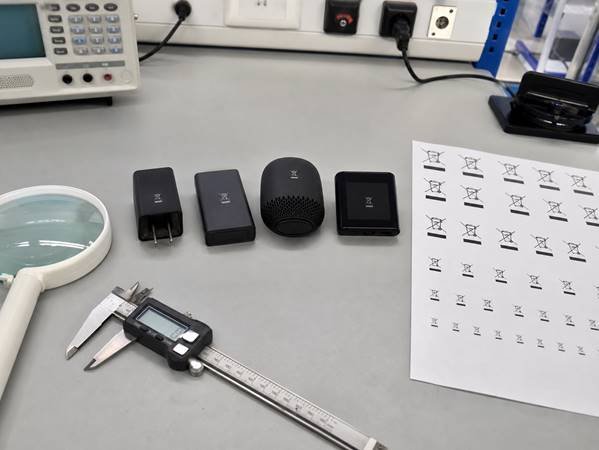
Size Requirements: No Unified Mandatory Value, Clarity Is the Core
At the EU level, there is no regulation on how many millimeters the WEEE label must be. There is only one core principle: it must be clearly recognizable to the naked eye at a normal use distance.
A commonly used reference in the industry is the minimum height of about 7mm in the EN 50419 standard. This is an industry practice, not a mandatory requirement, and most products will have no problem following this.
If the product itself is particularly small (such as a micro headset with a diameter of less than 2cm), or has a special structure that makes printing impossible, affixing it to the product body can be exempted, and it should be moved to the minimum sales packaging first; only when neither the product nor the packaging can be marked, can it be placed in the manual / warranty document – but the specific exemption conditions are still subject to the regulations of the target member state, and some countries may have more detailed size requirements.
Color and Durability: Must Withstand Use
There are no mandatory requirements for color; white background with black pattern, black background with white pattern are all acceptable, even colored, as long as the contrast is sufficient and it can be clearly recognized.
Durability is a point where it is easy to make mistakes: the label must remain clear during the normal service life of the product, and must not fall off or fade. It must never be printed on temporary protective films, peel-off stickers, or disposable seals – if consumers tear it off and it’s gone, it’s equivalent to not being affixed.
Permitted and Mandatory Additional Content
The basic version of the WEEE label only has a pattern and does not require additional text.
• Permitted additional content: brand logo, producer information, as long as it does not obscure the main body of the label.
• Mandatory additional content: products placed after August 13, 2005 must have date marking (such as a black bar); some member states require the addition of a local WEEE registration code.
Here we specifically mention the German EAR code: this is the number after German WEEE registration. Usually, it only needs to be displayed on commercial documents such as product detail pages, invoices, and quotations, and does not need to be forcibly printed on the product body. Don’t waste effort printing it on the product.
4. Where to Affix? Affixing Rules for Different Scenarios
Even if the label is made correctly, it will be non-compliant if it is affixed in the wrong position. The affixing of the WEEE label has clear priorities, and you cannot affix it wherever you want.
3-Level Priority of Affixing Positions
The priorities from high to low are:
1. First priority: prominent position on the product body – such as the bottom, back, nameplate, or near the battery compartment of the product, with the requirement that it does not affect product use nor damage the appearance. As long as there is space on the product body, it must be affixed here.
2. Second priority: minimum sales packaging – only when the product is too small or has a special structure that makes it impossible to affix on the body, can you settle for second best and affix it on the minimum sales packaging.
3. Third priority: manual / warranty document – only when neither the product body nor the minimum sales packaging can be marked, can it be placed in the manual.
Note: the latter two alternative positions are not default options. You must have reasonable reasons and keep relevant evidence (such as photos of product size measurement to prove that the body really cannot be printed), otherwise regulators will find you in violation if they check.
Labeling Requirements for Different Sales Scenarios
• Offline physical stores: the WEEE label on the product or packaging must be clearly visible, and it is best if consumers can find it without opening the packaging.
• Online e-commerce: the product detail page needs to meet the mandatory requirements of the target country for WEEE registration number, producer information, and recycling instructions – the registration number is used to prove that registration in the target country has been completed, producer information is used for responsibility traceability, and recycling instructions are used to inform consumers of disposal paths; whether to display the WEEE pattern should be confirmed according to platform and member state requirements.
• Commercial used/refurbished products: the original WEEE label must be retained; if it is severely worn and unreadable, it must be re-labeled; if refurbished products are re-placed on the market as brand new products, compliance must be re-done according to the requirements for new products.
• Personal idle transfer: no mandatory labeling is required, only commercial sales require it.
How to Affix for Sets / Combinations / Accessories
Set products are the most prone to mistakes, and there is only one core principle: the WEEE label on the packaging cannot replace the body label of each independently usable electrical and electronic device – unless the body really cannot be affixed due to size or structural reasons.
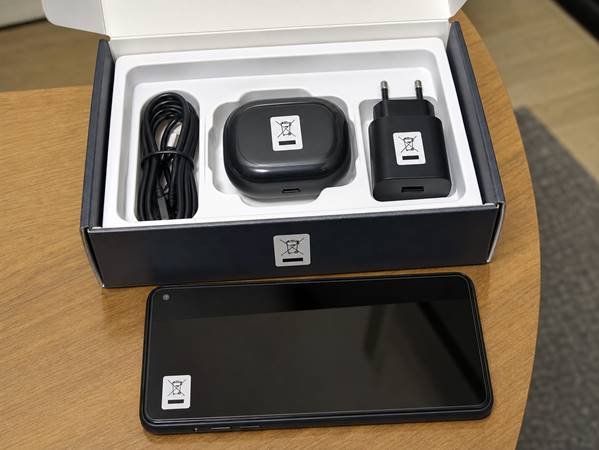
Here are some common examples:
• Sets with multiple independent EEEs: for example, a gift box of mobile phone + charger + Bluetooth headset, all three products can be used independently, so each must be affixed with a separate WEEE label, and the outer packaging must also be labeled.
• Main unit with non-independent accessories: for example, a Bluetooth headset and its charging case – the charging case is a non-independent accessory dedicated to the headset, the entire product counts as one EEE, and only one label needs to be affixed to the main unit (usually the charging case, because it has a larger area).
• Purely mechanical / passive accessories: such as passive charging cables and phone cases in the set, which do not fall within the scope of WEEE and do not need to be labeled.
• Non-detachable integrated products: such as electric toothbrushes with built-in batteries, the whole is a single unit, and only one label needs to be affixed.
Are There Differences Between B2B and B2C?
There are some, but not many:
• B2C household products must be clearly labeled to facilitate ordinary consumers in identifying recycling requirements.
• B2B professional equipment also needs to be affixed with the WEEE label – even if you and your customer have agreed on recycling responsibility in the contract, you cannot be exempted from the obligation to affix the label; you can only specify the specific recycling process in the contract.
5. Notes for Multi-Country Sales: Differential Requirements of Member States
Many sellers think that EU directives are the same across the EU, but that is not the case – the WEEE Directive is only the minimum unified requirement of the EU, and each member state can transpose it into stricter national regulations. Therefore, whichever member state market your product is placed in, you must comply with the specific requirements of that country.
Common difference dimensions include: minimum size requirements for labels, whether to add a local registration code, and whether to add additional explanatory text. We take several major markets as examples to give you an idea:
• Germany: You need to complete WEEE registration first to obtain the EAR code. This registration number must be displayed in scenarios such as commercial communications, quotations, invoices, and product detail pages, and does not need to be printed on the product.
• France: WEEE product labels still need to meet general requirements; packaging and related recycling information may involve Triman and local sorting information requirements. Triman does not replace the WEEE label on the product body, and the specific display position and text are subject to French rules.
• United Kingdom: The Great Britain region (England, Scotland, Wales) applies an independent UK WEEE system, and the label pattern is exactly the same as that of the EU; the Northern Ireland region follows EU single market rules, so it still follows EU WEEE requirements.
Also note that some countries’ official recycling schemes or e-commerce platforms may require larger label sizes or additional recycling explanatory text, so it is best to confirm in advance before listing.
If you want to check the specific requirements of a target country, there are two channels:
• Official channel: the official website of the target country’s Ministry of Environment or electronic waste regulatory authority. If you can’t understand it, you can use translation tools to check slowly. The advantage is authority, the disadvantage is that it takes time.
• Practical channel: entrust a local compliance service provider or recycling agency to confirm. It is suitable for small and medium-sized sellers, with higher efficiency and less likely to miss items.
One final reminder: each country’s local registration code is an additional compliance item, not equivalent to the WEEE recycling label itself – it’s not that once you register and get the code, you don’t need to affix the trash bin symbol; both are required.
6. Pitfall Avoidance Self-Inspection: Common Misconceptions and Compliance Check Methods
We have compiled 7 of the most common practical misconceptions, see if you have made any of them:
1. Confusing the WEEE label with CE, RoHS, and ordinary recyclable labels, thinking that if you have CE, you don’t need to worry about WEEE – in fact, each manages its own affairs and is completely unrelated.
2. The product body clearly has enough space, but the label is only affixed to the packaging – packaging labels cannot replace body labels, which is one of the most common misconceptions.
3. Thinking that WEEE requirements are the same across the EU, ignoring the special rules of member states, such as Germany requiring the EAR code and France requiring Triman on packaging.
4. Thinking that only large household appliances need to be labeled, while small household appliances, digital 3C products, and small electronic accessories do not – after 2018, the scope is open, and all except exclusions need to be labeled.
5. Thinking that products launched after 2005 must have a bottom black bar – the black bar is just a commonly used date marking, and other equivalent date markings are also acceptable, it is not mandatory.
6. Only affixing the trash bin pattern and forgetting to add the producer identification mark – if regulators cannot find the responsible party, it is still considered non-compliant.
7. Thinking that commercial used and refurbished products do not need to be labeled – personal idle transfer does not, but commercial used/refurbished sales must retain or re-label, and those sold as new products must re-do compliance.
3-Step Quick Self-Inspection of Compliance
If your product has already been labeled, or you are preparing to do so, self-inspect according to these three steps, and you can basically avoid 90% of the pitfalls:
Step 1: Check the applicable scope – confirm whether the product is electrical and electronic equipment, whether it will be sold commercially in the EU, and whether it belongs to explicit exclusions.
Step 2: Check style compliance – whether the pattern is deformed, whether there is date marking, whether the size is clear enough, whether the color contrast is sufficient, whether it is durable, and whether there is a producer identification mark.
Step 3: Check labeling compliance – whether the affixing position meets the priority, whether the requirements of the corresponding sales scenario are met, and whether the special rules of the target country are followed.
After self-inspection, remember to organize relevant materials into a “compliance evidence package” for retention, including: basis for product classification, label design drafts, product nameplate photos, packaging photos, manuals, WEEE registration certificates of the target country, and authorized representative agreements (if any). Most EU supervision is post-event random inspection, and only with evidence can you prove your compliance, otherwise it is difficult to explain clearly if checked.
What Are the Consequences of Non-Compliance?
If non-compliance is found, the consequences depend on the severity of the case and the member state:
• Mild: ordered to rectify within a time limit, and e-commerce platforms directly delist relevant products.
• Severe: customs detention of goods, refusal of entry, and administrative fines ranging from thousands to hundreds of thousands of euros, depending on the specific country and violation circumstances.
• Long-term: being placed on the regulatory blacklist, restricted from future market access, and even officially notified, affecting brand reputation.
After mastering this set of rules, you should be able to complete four types of core operations: accurately judge whether a product belongs to EEE and exclude legal exceptions; design compliant labels according to pattern specifications, date marking, size, durability, and producer identification requirements; handle special scenarios such as micro products, sets, and used/refurbished products according to the body-first principle; check registration numbers and product page information in combination with target country rules and organize a compliance evidence package. When encountering uncertain borderline cases or special requirements of member states, directly query official channels or consult professional compliance service providers to avoid pitfalls based on experience.