
For friends doing cross-border e-commerce in the EU, you have most likely heard the term WEEE, but many people fall into the same pit when first encountering it: they think WEEE is a unified EU “pass”, and getting one number allows you to sell across the entire EU. The result is either being delisted due to failed platform review, or being fined when caught by local regulators.
In reality, EU WEEE only has a top-level framework; the specific registration procedures, fees, and rules to comply with are all set by each member state themselves — the requirements for Germany and France are different, the processes for Italy and Spain vary greatly, and even the registration numbers cannot be used across borders. This article thoroughly explains the differences in WEEE registration across mainstream EU markets, from the most basic definitions to practical priority ranking. Even if you are a new entrant to the industry, after reading this, you will know which countries you should register in and how to avoid pitfalls.
Must-Know Basics: The Underlying Logic of WEEE Registration and Cross-Country Differences
What is WEEE Registration
You can understand WEEE as the EU’s “mandatory e-waste recycling responsibility system” — as long as you sell electrical and electronic products to an EU country, you must bear the cost of recycling and disposing of products that consumers discard in the future. WEEE registration is the legal procedure for you to report to the local authorities and assume this responsibility.
It falls under the category of Extended Producer Responsibility (EPR for short, with the core logic that “whoever first places products on the local market is responsible for recycling”). It is a completely independent compliance requirement from CE certification (product safety) and VAT (taxation), and they cannot replace each other.
The core process of WEEE compliance is simple in theory: first file with the authorities to get an exclusive registration number → sign an agreement with an officially recognized recycling agency → regularly report how many products you have sold → pay recycling fees based on sales volume → then you can sell locally legally.
Why WEEE Rules Vary by Country
Many people ask, since it is an EU rule, why isn’t it unified across countries? This comes down to the legal basis of WEEE.
At the EU level, there is only one top-level WEEE Directive (Directive 2012/19/EU), which only sets general recycling targets and a broad framework for producer responsibility, such as requiring member states to establish recycling systems and producers to bear recycling costs. After 2018, the EU also changed the scope of WEEE to an “open scope” — simply put, as long as an electronic device relies on electric current or electromagnetic fields to perform its main function, it is subject to regulation by default, unless it is an explicitly exempted category listed by the authorities.
However, specific implementation details such as how to register, how to classify products, how to collect recycling fees, and how often to declare are all determined by each member state themselves, that is, by transposing the EU directive into national law. This is the fundamental reason why WEEE rules differ from country to country.
Here you must remember a core principle: there is no EU-wide universal WEEE registration number. The number you obtain in one country is only valid within that country and cannot be used in other countries.
Who Must Pay Attention to Cross-Country Differences
If you fall into the following categories of sellers, you must understand the WEEE differences across countries:
• Cross-border e-commerce and independent station sellers who sell in multiple EU countries at the same time, such as those operating on Amazon Germany, France, and Italy stations simultaneously;
• Brand owners and foreign trade merchants with local warehouses and overseas warehouses (including Amazon FBA warehouses) in multiple countries;
• Non-EU sellers engaged in dropshipping, own-brand sales, and private label sales, because the brand owner is the primary responsible party for WEEE.
Four Core Beginner Misconceptions
People who are new to WEEE are most likely to fall into these four pitfalls, let’s clarify them in advance:
1. Having CE certification/VAT number means no need for WEEE registration: The three are completely independent compliance requirements. CE covers safety, VAT covers taxation, and WEEE covers recycling. They cannot replace each other.
2. Getting one EU WEEE number allows use across the entire EU: There is no EU-wide universal registration number. A number from one country is only valid in that country. Selling in France with a German number is a violation.
3. Low-volume/small products are definitely exempt from registration: The vast majority of EU countries do not have low-volume exemption rules. Even if you only sell a few headphones or data cables a year, you must register once the obligation is triggered.
4. Passing platform review equals full compliance: The platform’s requirement to upload a number is an access rule. Usually, it mainly verifies whether the number meets access requirements. Some sites will verify the authenticity of the number, but they will not fulfill the legal obligations such as declaration, fee payment, labeling, and voucher retention after official registration on behalf of merchants. The authorities will still impose penalties if violations are found.
Pre-Self-Assessment: Whether You Trigger WEEE Registration Obligations in a Country
Before comparing differences across countries, you must first figure out: do I need to register for WEEE when selling goods in this country? You can judge from three dimensions.
Whether the Product Falls Within the Scope of Regulation
The core judgment standard for WEEE is: whether the product relies on electric current or electromagnetic fields to perform its main function. After the EU changed to an open scope in 2018, such products are subject to regulation by default. For each specific country, there are only a small number of exemption lists, which need to be checked country by country.
Common cross-border best-selling products such as small home appliances, digital accessories, smart wearables, lamps, electronic toys, and IT equipment are basically within the scope. Especially products with plugs, USB ports, built-in batteries, or solar power supply must be checked emphatically — for example, solar garden lights, although they do not need to be plugged in, are driven by solar power generation and also belong to electrical and electronic equipment.
Whether You Are a Responsible Entity
“Producer” in WEEE does not only refer to factories, but refers to the entity that first places products on the local market. The following categories are all responsible entities:
• Brand owners, whether they are own-brand holders, private label holders, or dropshipping brand holders, are the primary responsible parties;
• Importers who import products from outside the EU to the local market;
• Non-EU distance selling sellers who sell directly to local end consumers, for example, if you sell directly to French consumers through an independent station from China, you are the responsible entity.
Core Scenarios That Trigger Registration
As long as you meet any of the following scenarios, you need to register for WEEE in this country:
• Having local warehouses or overseas warehouses (including FBA warehouses) in the country, with products shipped from local warehouses — the goods have already entered the local market, which definitely counts as “placing on the market”;
• Directly selling electrical and electronic equipment to end users in the country via distance sales, with specific requirements subject to the country’s rules;
• The corresponding platform site mandatorily requires uploading a WEEE number to sell, for example, Amazon Germany station does not allow sales without a number.
Prerequisites for Exemption
Only when the corresponding conditions are met at the same time is it possible to be exempt from registration:
• Pure B2B transactions with a clear contract stipulating that the buyer bears the recycling responsibility, and the formal contract must be retained as proof;
• The product is on the exemption list explicitly listed by the country’s authorities, such as some military equipment and special medical equipment.
Reminder again: low sales volume does not necessarily mean exemption. Don’t take it for granted that “selling only 10 units a year means no need to register”. The vast majority of countries do not have a low-volume exemption policy.
Pre-Comparison Notes: Scope, Caliber, and Variable Conditions
Next, we will compare WEEE rules across mainstream EU countries. Let’s clarify the premises first to avoid you applying conclusions incorrectly.
Country Scope Covered by the Comparison
We will focus on 6 core mainstream markets, that is, countries where more than 80% of cross-border sellers’ sales are concentrated: Germany, France, Italy, Spain, the Netherlands, Poland.
As for sub-mainstream and niche markets, such as Sweden, Belgium, Portugal, etc., you can refer to the rules of mainstream countries in the same region, for example, refer to Sweden for Nordic countries, and the Netherlands for Benelux. But ultimately, it must be subject to the latest local official requirements.
6 Core Dimensions for Unified Comparison
We will compare from 6 core dimensions for your convenience to view as needed: registration thresholds and entity requirements, product classification and coverage, fee structure and cost logic, declaration requirements and operational rules, labeling use and violation penalties, and special platform compliance requirements.
General Applicable Premises
All conclusions in this article are mainly aimed at non-EU local B2C consumer electronics sellers, such as those selling small home appliances, digital accessories, smart wearables, and lighting products. If you deal with special electronic equipment for industrial, medical, or military use, or are an EU local enterprise, or engage in pure B2B large-volume customized transactions, the rules will be different and require separate verification.
Key Conditions That May Change Conclusions
These conclusions are not set in stone. If you meet the following situations, the rules may be adjusted:
• Sales model: when the proportion of B2B is high, registration requirements and fees will be significantly different from pure B2C;
• Warehouse layout: countries with local warehouses usually require priority registration;
• Product attributes: rules for large home appliances, battery-powered products, and set products are more complex, and fees are higher;
• Enterprise qualification: registration requirements for EU local enterprises are usually looser than those for non-EU enterprises;
• Sales volume scale: low sales volume does not equal exemption from registration. Even if there is simplified declaration or minimum fee, it shall be subject to the statement of the local official or officially authorized recycling agency.
Core Difference 1: Registration Thresholds and Entity Requirements
Let’s first clarify four easily confused entities, otherwise you may get confused with the following content:
• Official registration authority: The government or statutory agency in each country responsible for WEEE registration and issuance of registration numbers, such as EAR in Germany and ADEME in France, equivalent to domestic regulatory authorities.
• Authorized Representative (AR): A local entity within the EU that helps non-EU sellers liaise with regulators and assumes compliance liaison responsibilities, equivalent to your local compliance contact. Because non-EU enterprises are not located locally, regulators cannot find anyone, so many countries require an authorized representative.
• Producer Responsibility Organization (PRO, also called eco-organization): An officially authorized collective recycling and disposal agency. The vast majority of sellers choose to join a PRO, so they don’t have to spend money on building recycling outlets or finding treatment plants themselves. They only need to pay fees based on sales volume, which is much more hassle-free.
• Importer: An EU-based entity that imports products from outside the EU to the local market. If you use your own importer for customs clearance, the importer may also bear joint WEEE responsibility.
Differences in Local Authorized Representative Requirements
Requirements for authorized representatives vary in strictness across countries:
• Germany, France: Non-EU sellers must appoint an officially recognized authorized representative within the EU, which requires corresponding qualifications, not just any company;
• Italy, Spain, the Netherlands: Non-EU sellers need to entrust a local compliance entity to liaise with regulators. This entity can be concurrently served by the cooperating PRO, no need to find a separate authorized representative;
• Poland: Requirements are even looser, and the cooperating PRO can directly serve as the local responsible party.
Specific requirements shall be subject to the latest official rules of each country.
Differences in Registration Entities and Qualification Requirements
First is the registration eligibility for individual sellers: Germany only accepts registration from enterprise entities, individual sellers are not allowed; individuals can register in France, Italy, Spain and other countries, but require the cooperation of local compliance entities, with specifics subject to local rules.
Second is the different registration caliber: Germany registers by “brand + category”. For example, if you have two brands, each selling 3 different types of electrical and electronic equipment, you need to register according to the corresponding combinations; France registers by “producer + EPR category”, that is, you as a seller only need to register the corresponding WEEE category, no need to split by brand.
Differences in Registration Validity Period and Renewal Rules
• Germany: Registration is valid for a long term. As long as you declare and pay fees on time every year, no special renewal is needed;
• France: The validity period can be 1-3 years. It must be renewed before expiration, otherwise it will become invalid;
• Italy, Spain, the Netherlands, Poland: Most have a 1-year validity period, and require annual renewal with fee payment.
Registration Number Format and Validity
The format of registration numbers varies by country: Germany’s starts with WEEE-Reg.-Nr. DE, issued by the EAR agency; France’s is called Unique Identification Number (UIN for short), which is synced to you after the cooperating PRO reports it to the regulatory authority; other countries also have their own exclusive formats. All registration numbers are only valid within their respective countries and have no cross-country universal validity.
Core Difference 2: Product Classification and Coverage
Many people ask: what category do the Bluetooth headphones I sell fall into in Germany? What about in France? Will they be different? Let’s first clarify the underlying logic of category division.
Underlying Logic of Category Division
The EU WEEE Directive uniformly stipulates 6 major categories in Annex III: temperature exchange equipment, equipment with screens, lamps, large electronic equipment, small electronic equipment, and small IT and telecommunications equipment. The legal classification of all countries will not conflict with this. The differences between countries only lie in the declaration caliber and the PRO’s fee classification — simply put, the major categories are unified, and countries will subdivide into smaller categories only for fee calculation purposes.
For example, the 15 categories often mentioned in France are actually the PRO’s fee classification, not legal classification. The final official caliber is still subject to the classification of the French Agency for Ecological Transition (ADEME). The rate subdivision dimensions in Italy, Spain and other countries are also different, and there is no legal rule of “following the old 10 categories”.
Classification Reference for Best-Selling Cross-Border Products
We will give a few classification examples of best-selling products for your reference, but ultimately it must be subject to the local official classification table:
• Electronic toys: classified as entertainment small electronics when declaring in Germany, and classified as toy electronics rate tier in France;
• Solar garden lights: classified as lighting equipment in most countries, and classified as outdoor electronics rate tier when declaring in Poland;
• Bluetooth headphones, smart watches: classified as small electronics in most countries, and classified as wearable electronics rate tier in France.
Differences in Exemption Scope for Registration
Although the EU has general exemption directions, the judgment criteria for exemption vary by country:
• Industrial-specific electronic equipment: exempt in most countries, but the judgment criteria for “industrial use” vary by country — some require that the equipment must be dedicated to factory production lines, and ordinary office printers and computers do not count;
• Temporary exhibition/test samples: rules vary by country. Some are exempt, some require advance reporting, which needs to be checked country by country;
• Very low volume exemption: only a very small number of countries have simplified rules. The vast majority of countries do not have exemption policies for small sellers, so don’t take chances.
Differences in Associated Compliance Obligations
Some countries will conduct joint reviews of WEEE and other EPR categories: France, Italy, and Spain often check battery EPR and packaging EPR together. When applying for WEEE, you may be required to provide compliance vouchers for batteries and packaging at the same time; in Germany and the Netherlands, each EPR category is independent of each other, managed separately.
But no matter which country you are in, as long as the product has batteries and packaging, you must meet the corresponding compliance requirements for batteries and packaging at the same time, which is universal.
Core Difference 3: Fee Structure and Cost Logic
Everyone is definitely most concerned about fees. The WEEE fee structure varies by country, with three main models:
1. Registration fee + annual fee model: For example, Germany, the Netherlands, Sweden. There is no additional environmental tax, and recycling fees are calculated based on actual sales volume, pay as you sell;
2. Registration fee + recycling fee + environmental tax model: For example, France, Italy, Spain. Some countries, categories or PRO contracts may set deposits or minimum fees. Whether they are refundable and the refund conditions are subject to the eco-organization contract and local rules;
3. Volume-based tiered fee model: For example, Poland, Italy. The higher the sales volume, the lower the per-unit recycling fee, which is equivalent to a bulk discount.
Cost Budget Reference
The following are only common quotation ranges in the cross-border service market around 2024, not official statutory fees; applicable premises are non-EU sellers, small consumer electronics with annual sales of less than 1,000 units, excluding additional fees such as agent expediting, translation, and additional authorized representative services:
• Germany: approximately 100-300 euros/year, including registration fee + basic recycling fee;
• France: approximately 200-400 euros/year, including registration fee + basic recycling fee + environmental tax;
• Italy, Spain, the Netherlands: approximately 120-250 euros/year, fluctuating by category;
• Poland, Sweden: approximately 80-200 euros/year, fees can be even lower if sales volume is particularly low.
Additional note: Fees for large home appliances and battery-powered products are usually 2-10 times that of small electronics, subject to the official PRO quotation.
Core Variables Affecting Fees
• Product category: large home appliances > small electronics > accessories. The heavier the product and the higher the recycling difficulty, the higher the fee;
• Annual sales volume: total fee increases with sales volume. Some countries have tiered discounts, the more you sell, the cheaper per unit;
• PRO selection: quotations from different officially authorized PROs will have reasonable differences. You can compare more, but be sure to choose an officially recognized one;
• Sales model: recycling fees for B2B transactions are usually lower than B2C, because the recycling responsibility for B2B can be transferred to the buyer.
Core Difference 4: Operational Declaration and Compliance Requirements
Registering to get a number is only the first step. The subsequent operational declaration is where problems are most likely to occur, and the differences across countries are also great.
Differences in Declaration Requirements
• Declaration cycle: Germany, the Netherlands, Sweden have annual declarations, once a year is enough; France, Italy, Spain have annual + quarterly/monthly declarations, the higher the sales volume, the more frequent the declaration; Poland has monthly/quarterly declarations.
• Declaration deadline: Here is a reference from recent years, specific to the official notification of the year: Germany declares the previous year before March each year, France in February, Italy in April.
• Declaration content: Germany, the Netherlands, Sweden only need to report the sales volume placed on the market; France, Italy, Spain need to report sales volume + recycling volume + waste disposal volume, with more detailed data requirements.
• Zero declaration requirement: In most countries, even if there is no sales volume in the year, a zero declaration must be made. Late declaration will incur late fees.
Differences in Labeling Use Requirements
All countries have a universal requirement: products must bear the “crossed-out trash bin” label, reminding consumers that they cannot be discarded with household waste and must be recycled separately.
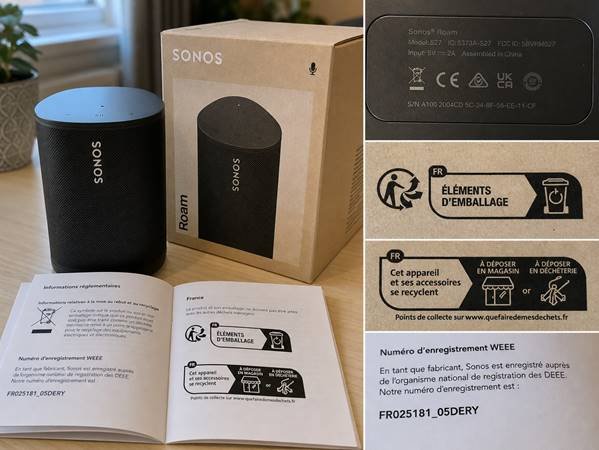
In addition, there are some differences across countries:
• Germany: Products only need the crossed-out trash bin label. The WEEE registration number must be disclosed in sales pages, invoices and other transaction documents, and is not required to be printed on the product;
• France: In addition to the crossed-out trash bin, the Triman label + Info-tri classification instructions must also be affixed. The UIN must be disclosed on the sales page, and no PRO label needs to be printed;
• Differences in other countries are mainly in label size and marking position, subject to local official requirements.
Violation Penalty Reference
The following are the maximum penalties in public regulations. Actual penalties will be adjusted according to the severity of the case, and ultimately subject to the latest enforcement caliber of each country:
• Germany: A maximum fine of 100,000 euros, and serious cases may result in a platform-wide sales ban;
• France: A maximum fine of 50,000 euros, accompanied by product delisting and environmental tax back payment;
• Other mainstream countries: Fines range from 10,000 to 300,000 euros, and serious cases may result in market access bans or impact on store permissions.
Full Lifecycle Compliance Obligation Nodes
No matter which country you are in, WEEE compliance is a full-process matter. Pay attention to these nodes:
• Before registration: confirm product classification, appoint AR/importer, sign PRO recycling agreement, submit registration application to get the number;
• During market placement: affix compliance labels on products, disclose registration number on sales pages, retain all transaction and recycling vouchers;
• Within the declaration cycle: submit sales/recycling volume data as required, pay recycling fees/environmental taxes on time, zero sales require zero declaration;
• After cancellation: registration records must be retained for 3-5 years (duration varies by country), and you must also bear the recycling responsibility for historically placed products. Cancellation does not mean everything is settled.
One-Country One-Registration Principle and Exceptions
The core principle is clear: WEEE registration numbers have no EU mutual recognition validity. Selling electrical and electronic equipment to end users in a country, in principle, requires registration according to that country’s rules.
Are there exceptions? Only a very small number of countries may have very low volume simplified declarations, minimum fees or special registration arrangements. But whether you still need to fulfill the registration obligation must be checked against official rules country by country, and you cannot self-exempt based solely on low sales volume.
Here we emphasize another special case: as long as you have a local warehouse (including FBA warehouse) in the target country, you usually need to register according to that country’s requirements, regardless of sales volume. Even if you only ship 1 unit from the local warehouse a year, you need to register.
Boundary Between Platform Compliance and Official Compliance
Many people think that passing platform review means everything is fine, but that’s not the case. Platforms like Amazon, eBay, and Cdiscount require uploading WEEE numbers, which are platform access rules, set by the platform to avoid its own risks.
Platform review is usually access-based. Some sites will verify the authenticity of the number, but they will not replace merchants to fulfill legal obligations such as declaration, fee payment, labeling and voucher retention after registration. If the authorities find violations, penalties will still be imposed.
The strictness of platform review also varies by country: German and French sites have the strictest review, verifying the authenticity of registration numbers; some southern European sites may only require uploading the number and will not actively verify it, but don’t take chances — you will still be held responsible when the authorities check.
Quick Reference for Practical Key Points of Key Countries
For your quick lookup, we have first compiled a quick reference table of key differences for 6 core countries, then explain details by country.
| Country | Authorized Representative Requirement | Registration Validity Period | Declaration Cycle | Annual Fee Reference (Small Electronics, <1,000 Units) | Platform Review Strictness |
| Germany | Must appoint officially recognized AR | Long-term valid | Annual declaration | 100-300 euros | Strict |
| France | Must appoint officially recognized AR | 1-3 years optional | Annual + quarterly | 200-400 euros | Strict |
| Italy | Can be concurrently served by PRO | 1 year | Annual + monthly/quarterly | 120-250 euros | Medium |
| Spain | Can be concurrently served by PRO | 1 year | Annual + quarterly | 120-250 euros | Medium |
| Netherlands | Can be concurrently served by PRO | 1 year | Annual declaration | 120-250 euros | Relatively loose |
| Poland | Can be directly concurrently served by PRO | 1 year | Monthly/quarterly | 80-200 euros | Medium |
Germany
The official registration authority is EAR (affiliated with the German Federal Environment Agency). Registration can be submitted through the EAR official website or by entrusting an agent. The registration caliber is “brand + category”.
Non-EU sellers must appoint an officially recognized authorized representative and sign a recycling agreement with an officially recognized PRO.
Declaration is annual, only need to report the sales volume placed on the market in the previous year.
For labeling, products only need the crossed-out trash bin label. The registration number must be disclosed on product detail pages and invoices.
Platform note: Amazon and eBay Germany stations mandatorily require uploading WEEE numbers, and the review is the strictest among all countries.
France
The official authority is ADEME (French Agency for Ecological Transition). You need to apply for a UIN through a cooperating PRO, which will sync it to ADEME.
Non-EU sellers need to appoint an officially recognized authorized representative and must cooperate with an officially recognized eco-organization.
Declaration is annual + quarterly. Need to report sales volume, recycling volume, and disposal volume, with relatively detailed data requirements.
For labeling, in addition to the crossed-out trash bin, the Triman label + Info-tri classification instructions must also be affixed. The UIN must be disclosed on product pages.
Platform note: Cdiscount and Amazon France stations mandatorily require uploading, and often conduct joint reviews with packaging and battery EPR.
Italy
The official authority is ISPRA (Italian Institute for Environmental Protection and Research). Submit a registration application through a local PRO to obtain the registration number.
Non-EU sellers need to entrust a local compliance entity, which can be concurrently served by the PRO.
Declaration is annual + monthly/quarterly. Data requirements are detailed, and the proportion of late fees for delayed declaration is relatively high.
For labeling, products bear the crossed-out trash bin label, and the registration number must be disclosed in sales documents.
Platform note: Amazon Italy station requires uploading the number. Late declaration fees are high, so don’t miss declarations.
Spain
The competent authority is the Spanish competent authority for ecological transition and its producer registration system. In practice, registration is usually completed through an authorized PRO to obtain the number.
Non-EU sellers need to appoint a local authorized representative, which can be concurrently served by the PRO.
Declaration is annual + quarterly. Need to distinguish between B2C/B2B sales volume.
For labeling, products bear the crossed-out trash bin label, and recycling reminders must also be marked on the packaging.
Platform note: Local warehouse orders need to be calculated separately. There is no default distance sales exemption. If you have a local warehouse, you must register.
Netherlands
The official authority is Rijkswaterstaat (Dutch Ministry of Infrastructure and Water Management). Register through an officially recognized PRO, with good English support and convenient communication.
Non-EU sellers can have the PRO concurrently serve as the local compliance entity, no need to find a separate authorized representative.
Declaration is annual. B2C/B2B sales volume need to be counted separately.
For labeling, products only need the crossed-out trash bin label. There is no mandatory requirement to print the registration number on products.
Platform note: Amazon Netherlands station has relatively loose requirements. For multiple categories, you need to confirm whether the PRO covers the corresponding categories.
Poland
The official authority is GIOŚ (Polish National Environmental Protection Inspectorate). Register through a local PRO. The system is mostly in Polish, so it is recommended to find a service provider or PRO that speaks Polish for liaison.
Non-EU sellers can have the PRO directly serve as the local responsible party, with loose requirements.
Declaration is monthly/quarterly. Classification rules are slightly different from Western Europe.
For labeling, products bear the crossed-out trash bin label, which must meet local size requirements.
Platform note: Local platforms such as Allegro require uploading the number. Low sales volume may also trigger obligations, so don’t be careless.
Special Reminders for Sub-Mainstream Markets
• Sweden: Low registration cost, simple rules, good English support, suitable for small-volume sellers in Northwestern Europe;
• Belgium: Involves regionalized regulation and corresponding recycling systems. Sellers should verify according to actual sales regions, PRO coverage, and local registration requirements;
• Other niche markets: Can refer to the rules of mainstream countries in the same region, but ultimately subject to the latest local official requirements.
Practical Decision-Making: Registration Priority and Pitfall Avoidance Methods
After talking about so many differences, you may ask: I operate in so many countries, which one should I register first? How to avoid pitfalls? We give you a set of implementable methods.
Step 1: Quickly Judge Countries Where Registration Is Mandatory
Screen with four criteria. Those that meet the criteria require priority assessment of registration obligations:
1. Countries with local warehouses/overseas warehouses (including FBA) require priority registration, this is a hard requirement;
2. Core sales countries (top 3 countries by sales proportion) need to be registered as soon as possible;
3. Countries where platform sites mandatorily require uploading WEEE numbers must be registered, otherwise you can’t sell;
4. For pure B2B with a clear contract stipulating that the buyer bears recycling/disposal responsibility, some countries may allow transfer of recycling responsibility or apply simplified arrangements, but you should not default to exemption from registration; you need to retain the formal contract and verify registration obligations country by country.
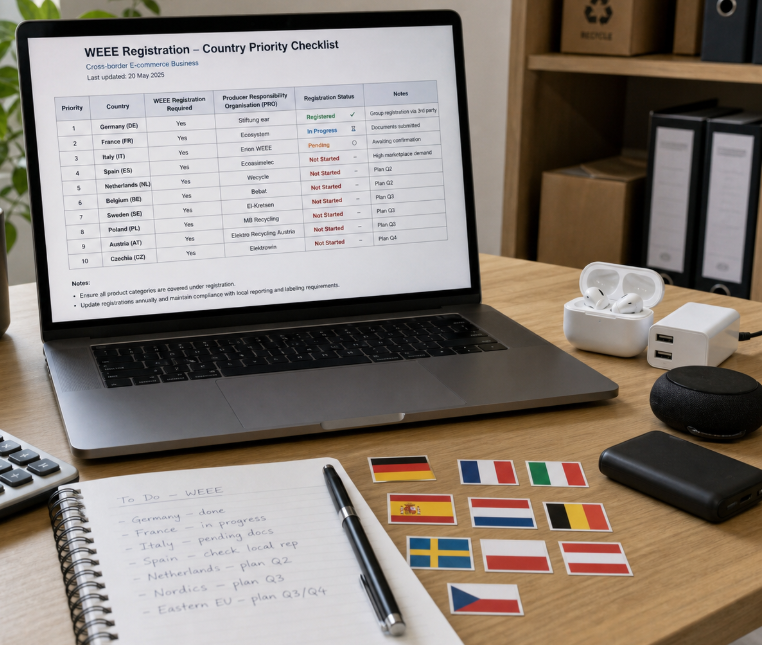
You can use the WEEE registration country priority checklist below to check the status of target countries one by one and quickly sort out priorities:
• □ Whether there is a local warehouse/overseas warehouse (including FBA)
• □ Whether it is a core market with top 3 sales proportion
• □ Whether the corresponding platform site mandatorily requires uploading WEEE number
• □ Whether the product comes with components that require additional compliance, such as batteries and independent packaging
• □ Whether it is a pure B2B transaction and holds a formal recycling responsibility transfer contract
• □ Whether a local authorized representative (AR) or cooperating PRO has been arranged
• □ Whether the latest declaration deadline of the country is approaching
Step 2: Registration Priority Ranking Scheme
Rank the countries that need registration into three tiers, no need to do all blindly:
• First priority: Core markets with local warehouses + mandatory platform requirements (such as Germany, France) must be settled first;
• Second priority: Sub-core markets with stable sales and high proportion (such as Italy, Spain) should be arranged as soon as possible after the core markets are settled;
• Third priority: Niche markets with low sales and no temporary warehouses should first check whether there are local simplified rules before deciding whether to register.
Here you must pay attention: you must never use WEEE qualifications from low-cost countries to cover other sales countries. For example, selling in Germany with a Polish number is a violation and will be heavily fined if caught.
4 Implementable Check Methods to Avoid Pitfalls
1. Check product classification: Don’t guess the category blindly. Go directly to the official regulatory agency website of the corresponding country (such as EAR in Germany, ADEME in France) to check the official classification table for verification, to avoid incorrect fees or violations caused by wrong classification;
2. Check agent qualification: If you find a service provider to handle it on your behalf, be sure to confirm that they have local officially recognized PRO cooperation qualification or authorized representative qualification. You can ask for an authorization letter to avoid fake numbers from unlicensed intermediaries;
3. Check declaration status: Check declaration records and payment vouchers once a quarter. Don’t just leave everything to the service provider and ignore it, to avoid late fees caused by missed or delayed declarations;
4. Check rule updates: Check the latest compliance requirements of each country at the beginning of each year. WEEE rules are not static, to avoid violations caused by rule adjustments.
Clarification of High-Frequency Practical Misconceptions
• Misconception: Platform withholding of EPR fees = completion of WEEE registration: The correct explanation is that withholding is only paying recycling fees on behalf. Registration to get the number still needs to be done by yourself, and you also need to upload the registration number to the platform, otherwise the platform will still judge it as non-compliant.
• Misconception: WEEE can be cancelled immediately after product sales stop: The correct explanation is that you need to bear the recycling responsibility for historically placed products. Usually, registration needs to be retained for 3-5 years (duration varies by country), and you cannot cancel immediately after stopping sales.
• Misconception: Electronic accessories (such as data cables) do not need registration: The correct explanation is that all accessories that rely on electric current to perform their main function need to be included in the verification. Data cables and chargers are all electrical and electronic accessories, and require registration in the vast majority of countries.
• Misconception: B2B sales do not need registration at all: The correct explanation is that B2B still requires registration in most countries, but the recycling responsibility can be transferred to the buyer through a contract, and the fee may be lower, but it is not that no registration is needed.
Quick Summary
After reading this article, you should be able to handle three core things:
First, accurately judge EU countries where registration is required. You can use the three criteria of “local warehouse + core sales + platform requirements” to rank priorities, and also understand the applicable boundary of the one-country one-registration principle, knowing that special situations such as low sales volume and B2B require country-by-country rule verification.
Second, distinguish the cost and difficulty of WEEE registration across countries. Understand the fee structure and process differences between core countries and small and medium-sized countries, and can choose a reasonable registration order according to your own sales situation, no need to do all blindly.
Third, avoid 90% of common compliance pitfalls. You can identify common misleading statements such as “one certificate for universal use” and “platform withholding equals registration”, and also use official channels to verify product classification, agent qualification, and declaration status.
WEEE compliance seems trivial, but as long as you sort out the differences across countries and implement them step by step according to priority, it is not complicated. The core is not to take chances. Arrange the required compliance in advance to avoid greater losses when you have to remedy after being delisted or fined.