
For practitioners just entering the Japanese electronic information product market, the threshold for understanding VCCI rules often comes from special mechanisms such as “self-discipline” and “self-declaration”: what is the difference between it and statutory certification? Is self-declaration just writing a statement by yourself? Does filing equal official endorsement? As a widely adopted electromagnetic compatibility self-discipline system in Japan’s electronic information industry, the core logic of VCCI is not complicated, but it is necessary to first clarify its nature, boundaries, and applicable prerequisites to avoid cognitive deviations. This article will start from basic concepts, covering applicability judgment, compliance requirements, filing options, mark use and risk avoidance, to help you build a systematic VCCI compliance judgment framework.
I. Basic Concepts: Core Definitions of VCCI, Self-Declaration, and Filing
Let’s start with the most basic VCCI: when electronic equipment is working, it will emit electromagnetic waves of a certain intensity. If the intensity is too high, it may interfere with the normal operation of other surrounding electrical appliances, such as a router interfering with TV signals, or a computer affecting the reception of radio equipment. This “ability of electrical appliances to not interfere with each other” is professionally called electromagnetic compatibility (EMC). The full name of VCCI is the Voluntary Control Council for Interference by Information Technology Equipment of Japan, a civil self-discipline organization established by Japan’s electronic information industry. The electromagnetic interference control rules it formulates are a widely adopted self-discipline compliance basis in the industry.
It needs to be clarified that: VCCI rules fall under the category of industry self-discipline, not statutory mandatory certification of the Japanese government, but they have been officially recognized by Japan and are a common access threshold widely adopted by channels such as offline retail and e-commerce platforms. Whether a product needs to comply with VCCI standards is usually proposed by purchasers, retail channels, and e-commerce platforms based on their own access rules, rather than directly mandatory by regulatory authorities. At the same time, the management boundary of VCCI should be clearly drawn: it only regulates the electromagnetic interference emitted by products, does not cover the electrical safety of products (such as electric shock and fire risks, corresponding to safety compliance requirements such as PSE), nor does it involve the compliance of frequency and transmission power of wireless products (corresponding to Japanese wireless regulations). The three types of requirements have different applicable scenarios, and some products may involve multiple types of compliance obligations at the same time.
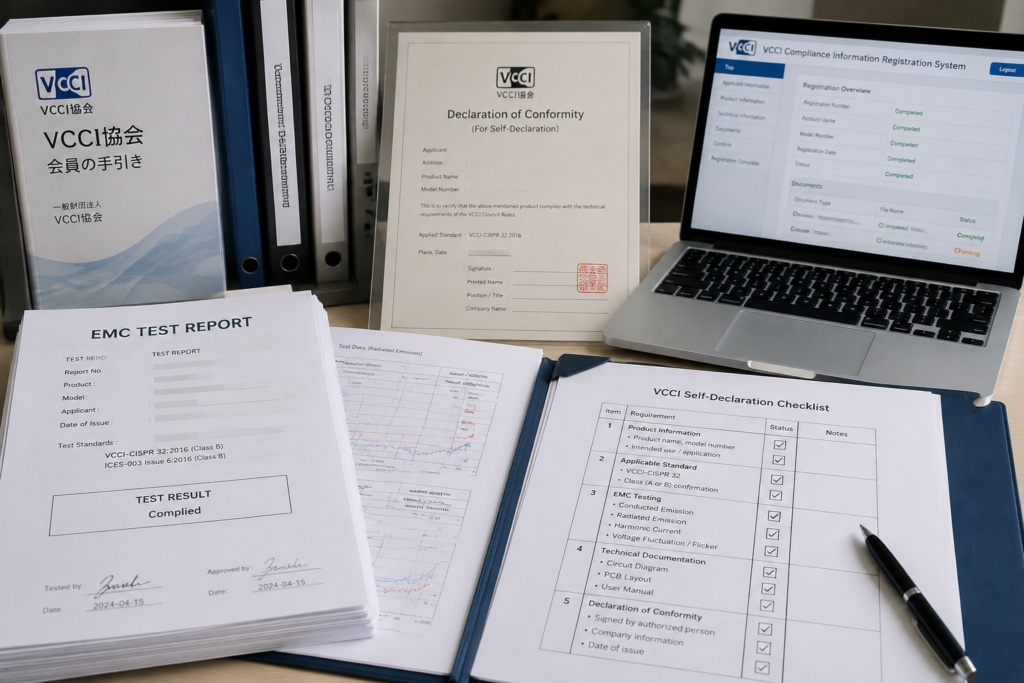
Next is self-declaration, which is the most basic compliance method under the VCCI system. Its core logic is “enterprises test on their own and take responsibility on their own”: enterprises do not need to submit products to VCCI for pre-audit. As long as they complete the test in accordance with the current effective VCCI standards, confirm that the product’s electromagnetic interference meets the corresponding level requirements, and issue a formal declaration of conformity on their own, the basic compliance is completed. VCCI’s supervision mechanism is mainly based on post-event spot checks: it will not verify the compliance of each product in advance, but will conduct self-discipline spot checks on products on the market. If products are found to be non-compliant or have false declarations, they will be handled in accordance with self-discipline rules, and all compliance responsibilities shall be borne by the entity issuing the declaration. It needs to be particularly clarified that self-declaration is not an “official certification” type of certification, but a compliance method where enterprises independently bear responsibility.
Then let’s talk about filing (officially called compliance information registration by VCCI), which is an optional upgrade procedure based on self-declaration. In essence, enterprises submit relevant materials of self-declaration to VCCI, and complete information archiving and disclosure in accordance with the rules. Filing has two core characteristics: first, it only conducts formal review — VCCI only checks whether the submitted materials are complete and the format meets the requirements, does not verify the authenticity of the test report, nor does it conduct actual testing on the product; second, you must first complete a qualified self-declaration before applying for filing, and you cannot skip basic compliance to handle it directly. It needs to be clarified here: filing is only information archiving under the self-discipline framework, does not mean that VCCI endorses the product’s compliance, and all compliance responsibilities are still borne by the enterprise issuing the declaration, which does not fall into the category of official certification.
The correct process sequence of VCCI compliance is: complete EMC testing → issue a self-declaration after passing the test → (optional) apply for VCCI filing → use the VCCI mark in accordance with the rules. There are two common confusion points that need to be clarified in advance:
First, passing the test does not mean completing compliance. If only the test is completed but no formal declaration of conformity is issued, it is not considered a completed self-declaration and cannot be used as a basis for compliance;
Second, filing is not equal to official certification. Filing is only information archiving after formal review, and does not change the subject of compliance responsibility.
II. First Step of Judgment: Whether Your Product Needs VCCI
To judge whether a product needs to comply with VCCI requirements, you can proceed step by step from three dimensions: scope of application, product classification, and responsible entity, while paying attention to special rules for boundary scenarios.
Core Judgment Criteria for Scope of Application
The core of VCCI coverage is electronic information equipment whose core functions are information processing, storage, transmission, display or printing. Common applicable categories include computers, monitors, routers, Bluetooth speakers, game consoles, printers, servers, mobile hard drives, etc.
The following categories usually have special electromagnetic compatibility rules and do not automatically apply to VCCI. They need to be confirmed case by case in combination with product functions, use environment, sales form and corresponding regulations:
1. Automotive electronic equipment: Japanese in-vehicle electronics have special electromagnetic compatibility technical requirements, which need to be evaluated in accordance with in-vehicle related regulations first;
2. Medical equipment: need to comply with the electromagnetic compatibility regulations related to Japanese medical equipment;
3. Professional industrial control equipment: control equipment dedicated to industrial scenarios may apply special standards in the field of industrial control;
4. Toy products: it is necessary to first judge whether the core function belongs to information equipment. Battery-powered toys with pure entertainment functions usually do not fall within the scope of VCCI coverage, but if they have core functions such as information processing and transmission, further evaluation is required.
Common situations that can be exempted from VCCI self-discipline requirements include (subject to the current VCCI rules): R&D prototypes, test samples, and exhibition samples for non-sales purposes; unmodified original compliant second-hand products, and the original compliance documents are still within the validity period; products that meet the VCCI very low power exemption threshold, the specific threshold needs to be confirmed against the latest technical standards issued by VCCI.
Product Classification: Distinction Between Class A and Class B
VCCI divides electronic information products into two grades, corresponding to different electromagnetic interference limits:
• Class B: equipment for residential environments, with stricter electromagnetic interference limits, applicable to consumer-grade electronic information products intended for use in family and residential scenarios;
• Class A: equipment for industrial/commercial environments, with relatively loose limits. According to VCCI rules, Class A products need to be marked with a warning statement as required, indicating that they may cause interference to radio reception in residential environments and are only suitable for use in commercial/industrial environments.
The core basis for classification judgment is the expected main use scenario and target users of the product. If the use scenario is unclear, it is recommended to prioritize evaluation according to Class B level from the perspective of risk control, because after passing the stricter standard, it can cover a wider range of use scenarios. The specific text, language, and marking requirements of the warning statement shall be subject to the current VCCI marking rules.
Identification of Compliance Responsible Entity
If the product is produced and sold by a Japanese local manufacturer, the manufacturer shall bear the main responsibility for self-declaration and filing; if the product is produced overseas and imported for sale in Japan, the domestic Japanese importer or designated compliance responsible entity shall bear the corresponding responsibility. VCCI filing applications usually need to be submitted by entities with VCCI membership. Overseas entities cannot directly apply for filing in their own name, and can entrust a domestic Japanese importer or professional compliance agency with membership to handle it.
Easily Overlooked Boundary Scenarios
The compliance judgment of the following scenarios is prone to deviation, and special attention is required:
1. Combined equipment/sets: For example, a complete set of “host + monitor + keyboard” cannot be judged as overall compliant only based on the compliance of individual components. It needs to be evaluated based on the EMC performance of the entire system, because interference may be superimposed when multiple devices work together;
2. Individually sold digital modules: Digital components such as Bluetooth modules, motherboards, and display modules that are sold separately to the market need to be separately evaluated for compliance, and cannot be skipped on the grounds of “accessories”;
3. Modified models: After product modification, the compliance conclusion of the old model cannot be used by default. If only the appearance color, packaging design and other content that do not affect electromagnetic emission are changed, no re-testing is required, but change records need to be kept; if the change involves power supply solutions, motherboard/shielding structure, interface configuration, software that affects electromagnetic performance, etc., it is necessary to re-evaluate the impact of the change on EMC, and re-test if necessary;
4. Products with wireless functions: Products with wireless transmission functions such as routers, Bluetooth headsets, and smart speakers need to meet both VCCI’s electromagnetic interference requirements and Japanese wireless regulations. The two have different jurisdictions and cannot replace each other.
III. Core Compliance Requirements for Self-Declaration
The compliance of basic self-declaration needs to be implemented from three dimensions: test effectiveness, document management, and change control. If any link fails to meet the requirements, it may lead to invalid compliance.
Judgment Criteria for Test Effectiveness
The premise of self-declaration is that the product’s electromagnetic interference intensity meets the limit of the corresponding VCCI level. The core assessment items are radiated emission (electromagnetic wave interference directly emitted by the product into space) and conducted emission (interference propagated through power lines and signal lines). To judge whether the test is effective, the following conditions must be met:
1. Test basis: Adopt the current effective test method standards of VCCI (corresponding to the relevant international CISPR series standards, the specific version is subject to the latest VCCI announcement);
2. Test facilities: The test must be completed in an environment that meets VCCI technical requirements. The enterprise’s own test site must meet VCCI’s relevant requirements for shielding rooms and test equipment; you can also entrust a third-party laboratory for testing. VCCI will publish its list of registered test laboratories. Before entrusting, you can check whether the laboratory’s qualifications cover the corresponding product categories and test items;
3. Test coverage: It is necessary to simulate the most unfavorable working mode of the product (such as maximum load, all functional ports working at the same time, using the standard longest cable, etc.). The hardware configuration, software version, shell material, interface configuration, supporting cables, etc. of the test sample must be completely consistent with the actually sold product, otherwise the test result cannot be used as a basis for compliance.
Required Compliance Documents and Storage Requirements
The core documents that need to be prepared for self-declaration include (specific requirements are subject to the current VCCI rules):
1. Declaration of Conformity (DoC): Issued by the responsible entity, clearly stating the product model, applicable VCCI level, applicable standard number and other information, and must have the signature and valid seal of the authorized representative of the responsible entity;
2. Complete EMC test report: It must include test environment description, sample configuration information, sample photos, test data, comparison results with limits, etc., which can fully prove that the product meets the corresponding VCCI level requirements.
Relevant original technical documents must be properly kept during the entire sales cycle of the product. The storage period after production suspension is usually at least 3 years. If the current VCCI rules or target channel requirements are stricter, the stricter requirements shall prevail. The core original materials that must be kept include the Declaration of Conformity, complete EMC test report, and prototype configuration records (including hardware version, software version, supporting cable specifications, shell material description, etc.), which must be provided in a timely manner as required during spot checks. The document language is usually acceptable in Japanese or English.
It should be emphasized that: whoever issues the Declaration of Conformity shall bear all compliance responsibilities. The third-party testing institution is only responsible for the test data it issues and does not bear the final compliance responsibility.
Change Control Rules
When a product undergoes key changes that may affect electromagnetic compatibility performance, it is necessary to re-evaluate the compliance, re-test if necessary, and update the self-declaration. Common key changes include: adjustment of power supply solutions, change of motherboard or shielding structure, increase or decrease of interface types/quantities, update of software versions that affect electromagnetic emission, replacement of core radio frequency or digital components, etc. Changes that only affect appearance color, packaging design, etc. and do not affect electromagnetic emission performance do not require re-testing, but change records need to be kept for inspection.
Products with different configurations on the same platform need to be evaluated for compliance separately, and cannot share the same Declaration of Conformity. For example, different hardware configuration versions of the same model product, if there are differences in internal circuits and shielding design, need to complete testing and declaration separately.
IV. VCCI Filing Rules and Selection Logic
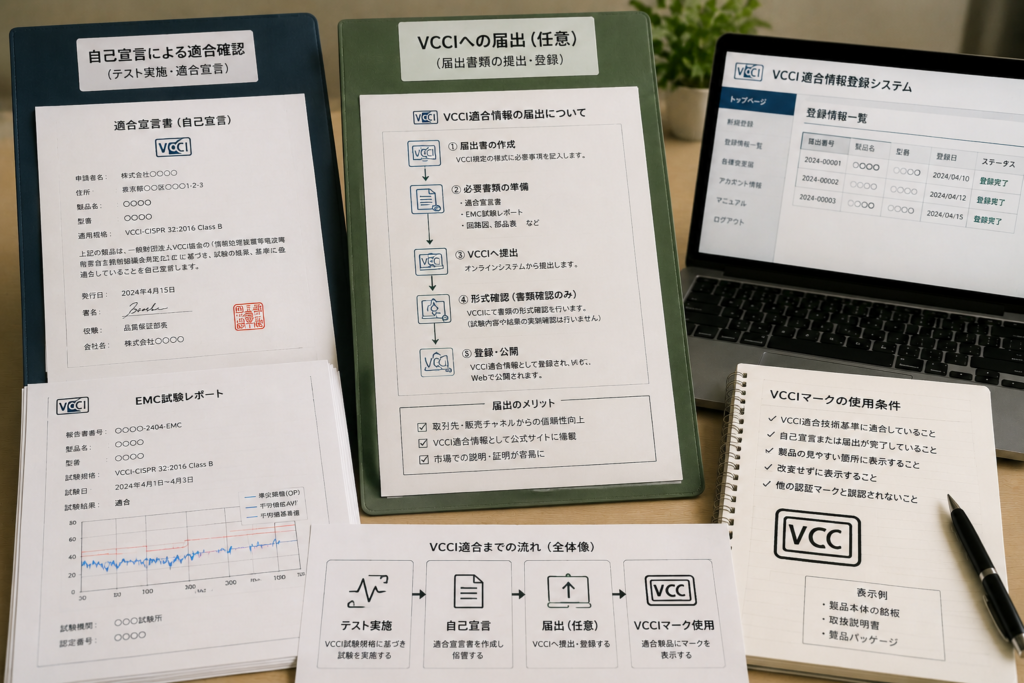
Many practitioners will struggle with whether they need to handle VCCI filing. The following is explained from three dimensions: prerequisites, core rules, and selection methods. The specific implementation requirements shall be subject to the latest filing system officially released by VCCI at the time of application.
Prerequisites and Basic Process of Filing
To apply for VCCI filing, three basic prerequisites must be met: first, the self-declaration that meets the requirements of VCCI rules has been completed, with complete test reports and Declaration of Conformity; second, the application must be submitted through a VCCI member unit, and overseas entities can entrust a domestic Japanese importer or compliance agency with membership to handle it; third, the product falls within the scope of VCCI coverage, and the grade classification is accurate.
The general process of filing is: prepare application materials → submit the application online by the member unit → pay the corresponding fee → VCCI conducts formal review → obtain the filing number after passing. The specific process, material list, and fee standard shall be subject to the current VCCI filing rules. It is emphasized again: filing review is only formal review, does not verify the authenticity of test data or the actual compliance of the product, and the compliance responsibility is still borne by the enterprise issuing the declaration.
Function, Validity Period and Maintenance Requirements of Filing
The core value of filing mainly has two points: first, product information can be queried through official channels in accordance with VCCI rules, which is convenient for partners to verify the compliance status; second, some large retailers and e-commerce platforms may take the completion of VCCI filing as one of the product access conditions, which shall be subject to the written rules of the target channel.
Under normal circumstances, VCCI filing has no fixed validity period. As long as the product has not undergone key modifications that affect EMC performance and the corresponding VCCI standards have not been updated, the filing will remain valid. When the product undergoes key changes that affect EMC, product grade adjustment, or manufacturer change, it is necessary to re-apply for filing in accordance with the rules. The maintenance of filing may be related to the membership status of the entity that submitted the application. If the membership of the entrusted member unit becomes invalid, it is necessary to replace the submitting entity in time to maintain the validity of the filing. The specific requirements shall be subject to VCCI membership rules and filing agreements. It is strictly forbidden to apply old filing numbers or use filing numbers across models.
Self-Declaration vs Filing: How to Choose
The core differences between the two can be referred to the following comparison, and the specific choice needs to be judged in combination with the actual situation of the product:
| Comparison Dimension | Basic Self-Declaration | VCCI Filing |
| Core Nature | Basic compliance method for VCCI self-discipline requirements | Optional information registration procedure based on self-declaration |
| Required Materials | Technical documents such as Declaration of Conformity and complete test report | Full set of self-declaration documents + product information and responsible entity information required for filing application |
| Publicity | Only kept by the responsible entity and not disclosed to the public | Filing information can be queried through official channels in accordance with VCCI rules |
| Channel Adaptation | Meets the general compliance requirements of most basic channels | Some high-end channels and large purchasers may explicitly require the completion of filing |
| Cost and Cycle | Mainly test cost, cycle depends on test arrangement | Additional filing-related fees need to be paid, and the cycle needs to be confirmed in combination with VCCI review progress |
Generally speaking, if the product has a fast iteration speed, limited budget, and the target channel does not explicitly require filing, it is enough to complete the basic self-declaration; if the product has a long life cycle, needs to enter channels with high compliance requirements, and needs a publicly available compliance certificate, you can consider applying for filing.
V. Correct Use Rules of VCCI Mark
After completing the corresponding compliance procedures, the mark can be used in accordance with VCCI rules. Improper use will also constitute a violation.
The use of the VCCI mark must comply with the current VCCI marking rules: the basic VCCI grade mark can only be used after completing the self-declaration of the corresponding grade; if using a mark related to filing, the VCCI filing procedure must be completed first. The mark must include the official VCCI mark pattern and the corresponding grade (A or B). Class A products need to be attached with the specified warning statement in accordance with the rules. The specific text and format requirements shall be subject to the latest VCCI marking specification.
The marking position is preferably on the product body. If the product size is too small to be marked, it can be marked on the minimum sales package or product manual in accordance with the rules. The specific allowed marking carrier shall be subject to the VCCI marking rules. It is strictly forbidden to use the VCCI mark without completing the compliance procedure. The proportion and color of the mark shall not be modified at will, and the wrong grade shall not be marked.
Consistency Requirements for Compliance Documents
When using the mark, it is necessary to ensure that the core information of the five types of documents Declaration of Conformity, test report, filing information (if any), product mark, and product manual are aligned item by item. The verification scope includes product model, version number, trademark, manufacturer information, and applicable grade, to avoid the situation of “same name but different configuration” or inconsistency between documents and physical products caused by different internal versions of the same platform.
The mark management after product change can directly refer to the change control rules mentioned above: if a key change that affects electromagnetic compatibility performance occurs, the corresponding mark can continue to be used only after the compliance procedure is re-completed; for changes that do not affect electromagnetic performance, the original mark can be retained, and the change record can be kept.
VI. Pitfall Avoidance Guide: Common Misconceptions and Risk Response
The self-discipline attribute of VCCI is easy to cause cognitive deviation. The following sorts out common misconceptions and risk response methods to help you avoid unnecessary losses.
Common Violations of Self-Declaration
1. Issuing a declaration without testing: Issuing a Declaration of Conformity without completing compliance testing is false compliance. Once discovered by VCCI self-discipline spot checks or channel verification, it may face consequences such as revocation of self-discipline qualification, product removal from shelves, and termination of cooperation. If it also violates statutory compliance requirements, it may also trigger an investigation by regulatory authorities;
2. Directly applying EMC reports from other regions: There are differences in electromagnetic compatibility limits and test methods in different regions. It is necessary to complete tests or difference tests in accordance with VCCI standards, and cannot directly apply test reports from other regions such as CE-EMC and FCC;
3. Sharing declarations for multi-configuration products: Products of the same model with different hardware configurations, if there are differences in electromagnetic compatibility performance, need to be evaluated and issued declarations separately. Otherwise, the actually sold product is inconsistent with the declaration, which is regarded as a violation.
Common Cognitive Misconceptions About Filing
1. Mistaking filing for official certification: Filing is only information archiving after formal review, does not mean that VCCI endorses the product’s compliance, and the compliance responsibility is still borne by the enterprise issuing the declaration;
2. Non-compliant selection of Japanese responsible entity: Filing requires the designation of a domestic Japanese responsible entity. If you choose an individual or institution that has no compliance experience and cannot be contacted normally, it may lead to the inability to provide materials in a timely manner during spot checks, affecting the validity of the filing;
3. Not updating the filing after model modification: After a product undergoes key changes, it is necessary to re-evaluate and update the filing in accordance with the rules, otherwise the filing qualification may be revoked.
Special Precautions for Overseas Entities
For overseas manufacturers and cross-border sellers, the following points also need to be noted:
1. VCCI filing applications need to be submitted through VCCI members. Overseas entities cannot directly apply by themselves, and need to entrust a qualified domestic Japanese institution to handle it;
2. The technical documents of self-declaration must be kept by the domestic Japanese responsible entity as required, for retrieval during self-discipline spot checks;
3. Even products delivered by small parcels directly may be checked for compliance by platforms, purchasers or consumers, and compliance documents need to be prepared as required; if the product involves Japanese statutory compliance requirements, customs or regulatory authorities may conduct inspections in accordance with the law.
3 Verification Methods for Compliance Authenticity
Whether verifying the compliance authenticity of suppliers or self-checking the compliance status, you can judge from three dimensions:
1. Check the mark: Check whether the pattern and grade of the VCCI mark are correct, whether Class A products are marked with a warning statement as required, and whether the mark has been tampered with;
2. Check filing information: If the product has a VCCI filing number, you can query the filing information through VCCI official channels to check whether the product model, manufacturer, and grade are consistent with the actual situation;
3. Verify technical documents: Require the responsible party to provide the Declaration of Conformity and test report, and check whether the product model, grade, applicable standard, and test configuration match the actual product.
Key Points for Response After Being Spot Checked/Complained
When receiving a VCCI spot check or compliance complaint, you can respond according to the following principles:
1. Provide complete self-declaration technical documents (test report, Declaration of Conformity) in a timely manner, and cooperate with the verification work;
2. For products that have completed filing, you can cooperate to retrieve VCCI official filing materials to explain the compliance status;
3. If it is confirmed that the product does not meet the requirements, timely measures such as stopping sales and rectification should be taken to reduce the impact. The specific responsibility bearing method shall be implemented in accordance with the applicable self-discipline rules, cooperation agreements and laws and regulations.
VII. Quick Distinction: The Relationship Between VCCI and Other Japanese Compliance Requirements
Many people confuse VCCI with other Japanese compliance requirements. The following sorts out the differences and overlapping scenarios of several common types of compliance.
VCCI vs PSE Certification
VCCI regulates the electromagnetic interference emission of electronic information products, which falls under the category of industry self-discipline; PSE is an electrical safety compliance system stipulated in Japan’s Electrical Appliance and Material Safety Law, targeting safety risks such as electric shock and fire of electrical appliances, which is a statutory regulatory requirement. The two have different scopes of application and regulatory natures. If the product falls within the scope of regulated electrical appliances, it needs to meet both PSE requirements and VCCI self-discipline requirements (if applicable).
It should be noted that the applicability of PSE needs to be judged in combination with the product type, power supply method, and whether it belongs to specified/non-specified electrical appliances as stipulated in the Electrical Appliance and Material Safety Law, and cannot be judged solely by “whether it is plugged in” as the only standard.
VCCI vs Japanese Wireless Compliance
VCCI manages the useless electromagnetic interference generated by products; Japan’s wireless compliance is under the jurisdiction of the Ministry of Internal Affairs and Communications (MIC), targeting the useful radio emission of wireless equipment (such as frequency band, transmission power, modulation method, etc.), which is a statutory regulatory requirement. TELEC is one of the wireless compliance certification institutions designated by the Japanese Ministry of Internal Affairs and Communications. Different wireless devices may apply different procedures such as technical standard conformity certification and construction design certification.
Electronic information products with wireless transmission functions usually need to meet both wireless regulatory requirements and VCCI electromagnetic interference requirements, and the two cannot replace each other. The specific wireless compliance procedure needs to be determined according to the wireless function, power, and use scenario of the product.
Quick Judgment Logic for Overlapping Compliance
To judge whether a product needs to overlap with other compliance requirements, you can refer to the following ideas:
1. First judge whether the product belongs to the category of electronic information equipment covered by VCCI;
2. If the product has a power supply or an external power adapter, it is necessary to judge whether PSE certification is required in accordance with the Electrical Appliance and Material Safety Law;
3. If the product has a wireless transmission function, it is necessary to judge whether wireless compliance procedures are required in accordance with Japanese wireless regulations;
4. For products in professional fields such as medical, automotive, and industrial control, priority is given to the special regulations of the corresponding field, and then judge whether they need to meet VCCI requirements.
VIII. Practical Summary: Core Competencies and Quick Judgment Checklist
After mastering the core logic of VCCI compliance, you can directly implement the following judgments and operations:
3 Core Competencies to Master
1. Compliance necessity judgment: able to independently judge whether the product falls within the scope of VCCI coverage and whether it is necessary to upgrade to filing;
2. Compliance authenticity verification: able to verify the authenticity of VCCI compliance in accordance with specifications and identify common violation pitfalls;
3. Compliance solution decision-making: able to select appropriate compliance methods in combination with product positioning and channel requirements, and judge whether other compliance requirements need to be overlapped.
5-Step Quick Judgment Checklist
When encountering specific products, you can quickly sort out compliance requirements according to the following steps:
1. Check whether the core function of the product is information processing, storage, transmission, display or printing, and preliminarily judge whether it falls within the scope of VCCI coverage;
2. Check the expected main use scenario of the product, determine the Class A/B grade, and prioritize evaluation according to Class B when the scenario is unclear;
3. Combined with the access requirements of the target channel, determine whether only basic self-declaration is required, or additional VCCI filing is required;
4. Check whether the core information of the Declaration of Conformity, test report, filing information (if any), product mark, and manual is consistent;
5. Combined with the product’s power supply method and wireless function, judge whether other requirements such as PSE and wireless compliance need to be overlapped.
It should be noted that VCCI rules will be dynamically updated with technological development and industry needs. The compliance requirements for specific products shall be subject to the effective VCCI official rules, target channel access requirements, and relevant Japanese laws and regulations at the time of sale. If you encounter a situation with blurred boundaries, it is recommended to consult a qualified Japanese compliance agency, or directly refer to the latest documents officially released by VCCI.