
If you have ever bought chargers, charging cables, or electronic devices with a USB-C port overseas, you must have seen terms like “USB-IF certified”, “PD fast charging”, and “USB-C compatible”. Sometimes you clearly buy a 65W charger, but it only delivers 20W when charging a laptop; sometimes you change a cable and the fast charging stops working — most of these issues are related to USB-IF standards and certifications. Many people think USB-IF is an official regulatory body and certification is mandatory, but that is not the case. In this article, we will explain the USB-IF regulatory certification system from start to finish, from basic knowledge to practical pitfall avoidance, to help you make fewer mistakes when choosing charging products in the future.
Basic Knowledge: First Understand the Most Fundamental Questions
What is USB-IF
USB-IF is not a government department, but a USB industry forum composed of major global technology manufacturers, which is an industry association organization. It has three core functions: formulating USB-related technical standards, managing product conformance certification, and authorizing the use of official USB trademarks.
Core Position of Certification
This is the most easily misunderstood point, let’s make it clear first: USB-IF certification is a voluntary industry conformance certification + trademark authorization, not a statutory mandatory requirement. Manufacturers can choose to do it or not, and not doing it does not mean the product is illegal.
Many regional regulations reference USB-IF technical standards, such as the EU’s mandatory USB-C regulation, but USB-IF itself is not a law enforcement agency. A product meeting local regulatory requirements does not mean it has passed USB-IF certification; conversely, passing USB-IF certification does not mean it meets local statutory access requirements. The two are completely independent.
Which Products Are Covered
The coverage of USB-IF certification is very clear:
- Direct coverage: Products with a USB-C interface or supporting PD fast charging, such as chargers, charging cables, terminals like mobile phones/laptops, power banks, etc.
- Not covered: Chargers with non-USB interfaces (such as old DC round-hole chargers), pure wireless charging devices (the device itself that only relies on wireless induction charging).
What It Does for Ordinary Users
For us, the three greatest values of USB-IF certification are:
- Reduce the compatibility risk of cross-brand charging. For example, using a Lenovo certified charger to charge an Apple certified laptop will most likely support normal fast charging;
- Reduce the overheating hazard caused by mismatched fast charging. The power negotiation and protection mechanisms of certified products comply with standards, so they are less likely to overheat due to improper power requests;
- When purchasing charging products overseas, it is a core compatibility reference — after all, there are many overseas brands and mixed standards, so a unified industry certification is more reliable.
What It Regulates, What It Doesn’t
Do not have overly high expectations for certification; its governance boundaries are clear:
- What it regulates: USB interface form, PD/PPS protocol negotiation rules, power matching logic, cross-brand interoperability, use of official logos;
- What it does not regulate: General product safety (such as electric shock prevention, drop resistance, which are under the jurisdiction of local safety regulations), manufacturers’ proprietary fast charging extended functions, product service life.
Simply put, it only manages “USB-related compatibility and specifications”, not “whether the product is easy to use, durable, or safe” — the latter depends on local mandatory compliance certification.
Four-Layer Core Architecture: From Underlying Rules to Market Implementation
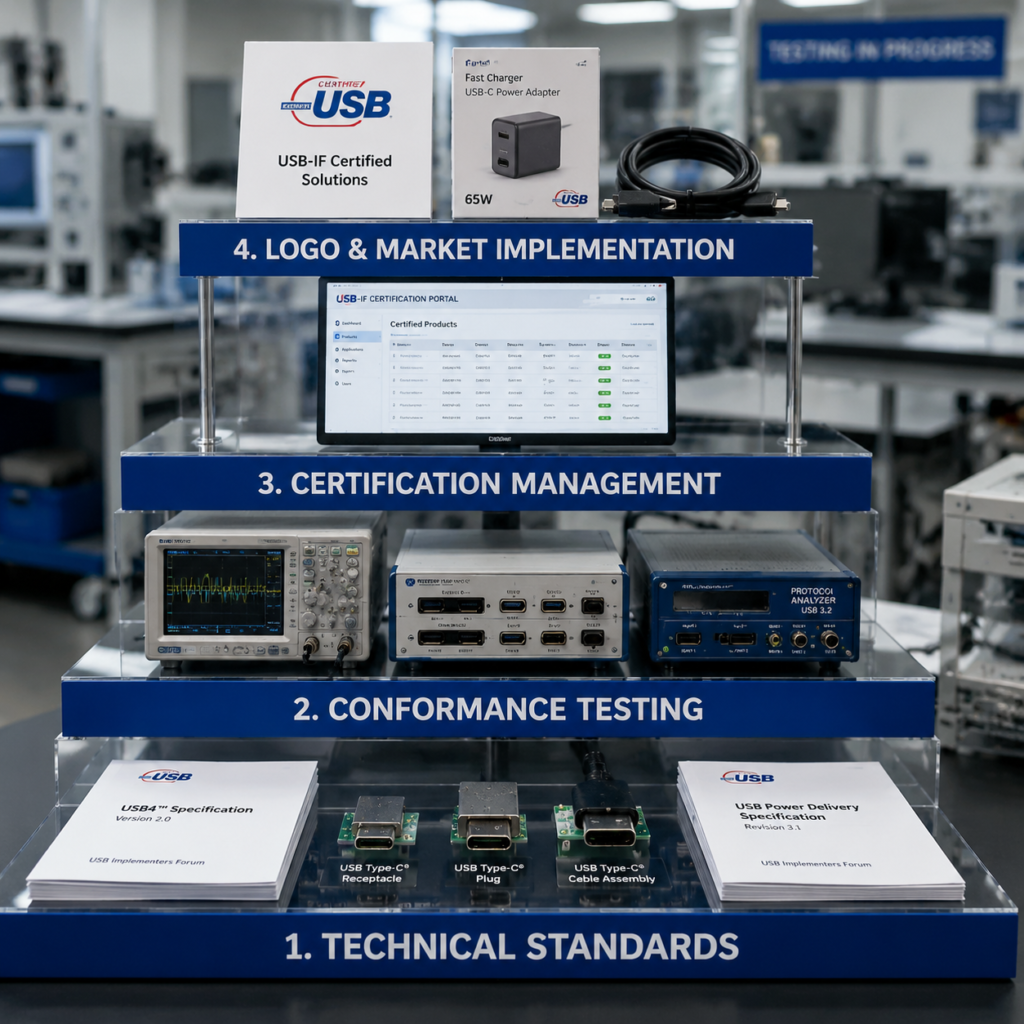
The entire USB-IF certification system can be divided into four layers from the bottom to the implementation, just like building a house, from the foundation to the exterior wall, each layer has its own responsibilities.
First Layer: Technical Standard Layer (Basis for Underlying Rules)
This is the foundation of the entire system, and all certifications and tests must be based on these standards.
Core Charging Standards
There are two core standards directly related to charging:
- Type-C Interface Specification: Defines the physical form, pin arrangement, and power supply/sink role identification rules of the USB-C interface. Simply put, it unifies “the physical appearance of the interface and the basic identification logic”.
- PD Fast Charging Specification: Full name USB Power Delivery, which defines how to negotiate charging power between chargers, cables, and devices — for example, how much voltage and current a phone needs, whether the charger can provide it, and whether the cable can withstand it, all rely on this set of rules to communicate, that is, it unifies “the negotiation rules for charging”.
Power Rules
First, supplement the most basic formula: Power = Voltage × Current, the unit is watt (W). For example, with 20V voltage and 5A current, the power is 100W. During actual charging, the final available power is determined by the charger (source end) and the device (sink end) through USB PD negotiation; the rated current, voltage drop, and electronic marker information of the cable will limit the maximum negotiable power. If any link does not support it, the maximum power cannot be achieved.
The current mainstream PD versions and maximum single-port power can be referenced in the table below:
| PD Version | Power Range Type | Maximum Single-Port Output | Common Application Scenarios |
|---|---|---|---|
| PD3.0 | SPR (Standard Power Range) | 100W (20V/5A) | Mobile phones, tablets, thin and light laptops |
| PD3.1 | Retains SPR and adds optional EPR | Up to 240W (48V/5A) when EPR is supported | Gaming laptops, high-performance devices |
There is also a commonly heard PPS (Programmable Power Supply), which is not a separate fast charging protocol, but a subdivided function in the PD specification. It allows the sink end to request voltage and current with fine granularity specified by the specification within the APDO range declared by the source end; its voltage resolution is 20mV and current resolution is 50mA. Most mobile phone fast charging uses this function, which can reduce heat generation and improve charging efficiency.
Data Standards Are Unrelated to Charging
Here we correct a common misconception: USB data transmission standards (such as USB 2.0, USB 3.2, USB4) only affect the speed of file transfer, and have no direct relationship with charging speed. Many people think that USB4 cables charge faster, but that’s not the case — as long as the cable’s current carrying capacity is sufficient, even a USB-C cable with USB 2.0 specification can run full 100W PD fast charging.
Confusing Concepts Clarified
Many people confuse USB-C, PD, PPS, and USB-IF certification, so let’s sort them out once and for all:
- USB-C interface, USB PD, PPS and USB-IF certification cannot be equated with each other: USB-C does not necessarily support PD; PPS is an optional APDO function in USB PD, and supporting PPS necessarily requires supporting PD as a prerequisite; supporting PD or PPS does not mean that USB-IF certification has been obtained.
- The following states describe information at different levels and cannot be directly ranked as “reliability” levels:
| Status | Description |
|---|---|
| Passed USB-IF certification | A specific product has completed the certification process according to the applicable compliance plan, and its TID and product information can be verified on the official Integrators List. |
| Compliant with specifications | The manufacturer claims to design and produce according to USB standards, but consumers still need to judge based on manufacturer information, test data, and actual compatibility. |
| Supports the protocol | The product can perform PD/PPS negotiation; this itself does not mean there must be compatibility issues, nor does it automatically mean it has been certified. |
| Can charge normally | The device can be charged, but the specific power, functions, and compatibility performance still depend on the actual specifications. |
The core conclusion is clear: having a C port does not mean supporting PD, and supporting PD does not mean passing official certification. Do not directly equate the words “USB-C” and “PD” on the product with certification.
Second Layer: Conformance Testing Layer (Ruler for Compliance Judgment)
With standards in place, how do we judge whether a product meets them? This relies on the conformance testing layer, which is equivalent to giving the product an “exam”.
Testing Validity
Only tests completed in accordance with USB-IF’s current compliance plan, specified processes, and by officially recognized testing resources are valid and can be used to apply for official certification. Test results conducted by manufacturers themselves or by non-accredited laboratories can only be used as internal reference and have no certification validity.
Core Testing Dimensions (Charging-Related)
There are four core testing directions directly related to charging:
- Power stability: Whether the nominal power can be output stably, whether it fluctuates up and down;
- Protocol handshake correctness: Whether there are logical errors when negotiating with different devices;
- Cross-device compatibility: Whether it can work normally with chargers, cables, and devices of different brands;
- USB PD conformance testing will verify applicable protocol states, messages, and error handling behaviors; overcurrent, overtemperature, insulation, and fail-safe protection shall also be evaluated in accordance with applicable product safety standards and local regulations, and cannot be solely guaranteed by USB-IF certification.
Testing Focus by Product Category
Different types of products have different testing focuses:
- Source end (charger): The focus is on testing whether the power levels (called PDO in the industry, and the adjustable levels supporting PPS are called APDO) are consistent with the nominal values, and whether the power redistribution logic when multiple ports are used at the same time is correct;
- Cable: The focus is on testing CC pin communication and VCONN power supply. CC is used for connection detection, role identification, and USB PD communication; VCONN is used to power electronically marked cables, active cables, or accessories. When needed, powered electronically marked cables can report their capabilities through SOP′ communication; in addition, attention will also be paid to whether the electronic marker capabilities meet standards and whether the current carrying is stable;
- Sink end (terminal device): The focus is on testing whether the power request logic is reasonable and whether the compatibility performance of multi-level chargers is normal.
There are more test items than these, including electrical, protocol, structural, reliability and other categories, which will be adjusted according to applicable specifications and the current compliance plan, and are not static.
Third Layer: Certification Management Layer (Application and Review Rules)
After the product passes the test, it still has to go through the certification management process, which is equivalent to “grading papers, issuing certificates, and managing files”.
Application Eligibility
Only USB-IF members can apply for formal certification; individuals or non-member manufacturers cannot apply.
Core Certification Categories
USB-IF certification and testing are determined by product type, implemented USB functions, and the current compliance plan. Common products include PD chargers, USB-C cables, PD terminal devices, and all-in-one devices, but they should not be understood as four fixed and only types of certification.
Numbering Rules
Certified products have two common numbers, which many people easily confuse:
- TID (Test ID): The unique number of the certification record for a single product, equivalent to the “certification ID number” of this product, which can be found in the official database;
- VID (Vendor ID): The identity code assigned by USB-IF to manufacturers. Any manufacturer that makes USB products can apply for it, and it is not exclusive to certification — do not assume that a product has passed certification just because it has a VID.
Change Control
If there are changes to the product’s hardware, firmware, power, or interface, and these changes will affect USB functions, the certification must be re-evaluated, and the original TID cannot continue to be used. For example, changing the original 65W charger to 100W, or replacing a different protocol chip, requires re-testing.
Fourth Layer: Logo and Market Supervision Layer (Implementation Link)
The top layer is the logo and market supervision layer, that is, the rules for the implementation of certification in the market, equivalent to “how to use the logo, what to do if counterfeiting is found”.
Logo Rules
USB-IF’s official trademarks and certification logos are protected by law and can only be used after authorization. Printing only words like “PD”, “fast charging”, “USB-C compatible” on the product does not mean it has passed official certification.
Usage Requirements
Even if you have obtained certification, you cannot promote beyond the scope — for example, if you are certified for a 65W single-port charger, you cannot claim to be a 100W multi-port certified product; uncertified products must never privately print official certification logos.
Official Query Channel
Ordinary users can query certification information for free through the public certification database on the USB-IF official website, no registration required, just enter the brand, model or TID to search.
Market Constraints
If a manufacturer counterfeits official logos or makes false propaganda, USB-IF can pursue its trademark infringement liability, which is also the core source of binding force for certification.
Certification Rules for Common Charging Products
After understanding the overall architecture, let’s look at the most commonly contacted types of charging products, what are the differences in their certification rules, and what to look for when buying.
Chargers/Power Adapters
USB-IF certification and testing are determined by product type, implemented USB functions, and the current compliance plan. For chargers that implement USB PD and USB Type-C functions, the applicable PD and Type-C conformance requirements and corresponding TID should be checked, and it cannot be generalized that all chargers must obtain two independent certifications.
The applicable test items for chargers depend on their implemented Type-C/PD functions, SPR or EPR capabilities, port configuration, and the current USB-IF compliance plan. For multi-port products, the actual power distribution of each port and when used simultaneously should be checked with the manufacturer; safety insulation and protection requirements must also be judged based on applicable safety standards.
The rules for multi-port chargers are more complex. For example, a charger is marked “100W for single port, 65W each for dual ports when used simultaneously”, but in actual use, you still need to check its port combination and power distribution instructions. The TID of a single port cannot directly infer the performance of multi-port combinations, the two need to be confirmed separately.
USB-C Charging Cables
The core certification of charging cables is USB-C cable certification, which is divided into different levels according to maximum carrying current and power.
The commonly heard E-Marker (Electronic Marker Chip) is a small chip hidden in the cable, used to store information such as the cable’s power and data capabilities. There are three key points about E-Marker:
- PD cables of 5A/100W and above must be equipped with E-Marker according to the standard, otherwise they cannot negotiate 5A current;
- Special cables such as full-featured cables and USB4 cables may also be equipped with E-Marker, because they need to support high-speed data or video transmission;
- The most easy pitfall: having an E-Marker chip does not mean passing USB-IF certification, the entire cable must pass official testing to count. Many merchants promote “with E-Marker” as “certified cable”, which is actually a concept swap.
The testing requirements for cables are also related to length and power: the longer the cable and the higher the rated power, the stricter the electrical performance requirements. For example, a 2-meter 100W cable is more difficult to pass the test than a 1-meter 100W cable, because the longer the cable, the greater the resistance, which is prone to large voltage drop and high heat generation.
Also pay attention to the boundaries of different cable types:
- C-to-C cables are typical cable types for PD high-power scenarios, and certification covers corresponding power requirements;
- USB-A-to-USB-C cables do not have the complete Type-C/PD capabilities of USB-C-to-USB-C power supply paths; their actual power supply and data capabilities depend on the A port and the applicable specification or proprietary protocol, and cannot be inferred from the power level of C-to-C PD cables.
Terminal Devices with USB-C Port
For terminals with a C port such as mobile phones, tablets, and laptops, the core certification is PD terminal compliance certification + USB-C interface certification.
Terminals and chargers that have both passed USB-IF certification will have a much higher success rate of cross-brand compatibility, after all, they are all made according to the same set of standards. But note: certification only covers the basic negotiation part of PD/PPS, and the manufacturer’s own proprietary fast charging functions (such as the proprietary fast charging of more than 100W of various brands) are not within the scope of certification. That is to say, even if both the mobile phone and the charger have passed certification, they may not trigger the highest level of the brand’s proprietary fast charging, and can only ensure that the basic PD/PPS fast charging is normal.
All-in-One Charging Products
The certification rules for all-in-one products are more complex, and you cannot just look at one certification:
- Power banks, docking stations and monitors: The applicable USB-IF test items and TID coverage should be determined according to their actual implemented input, output, data and video functions. The specific TID and product specifications should be checked, and it cannot be assumed that each port or function necessarily has independent certification.
- Docking stations/monitors with charging: If they also have data and video functions, you should check the product specifications and the scope covered by the specific TID, and cannot infer that all functions have been certified just because there is PD certification.
So the more functions a charging product has, the more carefully you need to check which functions the certification information actually covers. Don’t think that all functions have passed just because you see a certification logo.
Four Necessary Conditions for Full Fast Charging
Here is a very practical judgment formula for everyone: whether fast charging can be fully achieved, in addition to the common negotiable capabilities of the source end, cable, and sink end, will also be affected by the terminal battery status, temperature, and system charging strategy, etc.
- Source end (charger): Supports the corresponding PDO or PPS APDO power level, and the output capacity meets the demand;
- Cable: The rated current/power meets the standard, and has the corresponding level when E-Marker is required;
- Sink end (device): Supports PDO or PPS APDO that can be negotiated with the source end, and the maximum input power matches;
- Actual usage status: Temperature, battery level, battery health, system charging strategy, multi-port shunting, simultaneous running loads, and protocol negotiation status will all affect the actual power.
If you encounter the situation that fast charging cannot reach full speed in the future, you can check one by one according to these conditions.
Certification Process and Result Boundaries
Many people are curious, how to apply for USB-IF certification? Is it valid for life after getting certification? This brings us to the certification process and result boundaries.
Core Process Steps
The entire certification process is roughly divided into three steps:
- Pre-certification preparation: The manufacturer confirms the applicable standards for the product, selects USB-IF recognized testing resources, and prepares test samples;
- Testing and review: The laboratory tests according to specifications and issues a report. After USB-IF review is passed, a unique TID is assigned to the product;
- After certification: The manufacturer signs a trademark authorization agreement before using the official logo, and must not promote beyond the scope.
Result Applicable Boundaries
Regarding certification results, there are three important boundaries to be clear about:
- Model-specific: Only valid for the specific model and configuration submitted for testing. Products of the same brand with different models cannot share certification. For example, a brand’s 65W charger has certification does not mean its 100W charger also has it;
- No fixed validity period: As long as the product has not changed and the compliance plan has not been adjusted, the certification remains valid. New standards will not automatically revoke old certifications;
- Restrictions for non-member products: Products of non-member manufacturers can claim “USB compatible” or “supports PD”, but cannot use official logos, nor will there be TID records.
Relationship with Overseas Compliance/Standards
Overseas users buying charging products are most likely to confuse various certification marks: CE, FCC, UL, Thunderbolt, QC. What is the relationship between these and USB-IF certification? Can they replace each other? Let’s sort them out one by one.
Relationship with Regulatory Compliance/Safety/EMC
The core difference to remember: USB-IF is a voluntary industry + trademark certification, not statutorily mandatory; while the applicability of local safety and EMC requirements depends on the specific product category and sales market.
Common overseas compliance requirements:
- EU CE/UK UKCA: Conformity mark required when the product is subject to relevant EU or UK regulations; applicable safety, EMC and other regulations vary by product;
- Japan PSE: The applicable scope and compliance procedures should be confirmed according to product category, and different categories of products have different applicable procedures;
- US FCC: The applicable scope should be confirmed according to equipment category; applicable equipment may need to complete equipment authorization procedures such as certification or supplier’s declaration of conformity, not all electronic devices are subject to the same “EMC certification”;
- US UL/NRTL: Safety certification, although not mandatory by federal law, is required by many channels (such as Amazon) or customers.
The purchasing logic for overseas users is: first meet the applicable statutory compliance requirements of the sales place (this is the bottom line), USB-IF is a compatibility bonus item, the two cannot replace each other.
Relationship with Other Fast Charging Standards
- Relationship with Qualcomm QC: QC is Qualcomm’s proprietary protocol. USB-IF certification only covers the PD-related part of the product, and QC functions are not tested — passing certification does not mean that QC functions meet the requirements;
- Relationship with brand proprietary fast charging: Only PD/PPS basic negotiation is within the scope of certification, and manufacturers’ proprietary extended functions are not included;
- Compatibility conclusion: Certified products have better general PD compatibility, but may not support all proprietary fast charging levels. If you want to use a certain brand’s proprietary fast charging, you still need to check whether the product is marked to support the corresponding protocol.
Relationship with Thunderbolt Certification
Core difference: Thunderbolt is an independent certification system, USB-C is only the interface form, Thunderbolt certification ≠ USB-IF PD certification. For example, a Thunderbolt 4 cable may have passed Thunderbolt certification, but not necessarily passed USB-IF’s PD cable certification.
In high-power charging scenarios, it is still necessary to confirm the cable’s PD power level, electronic marker capability, and protocol negotiation capability. Thunderbolt certification can be used as an additional performance reference, but cannot replace USB-IF’s PD certification.
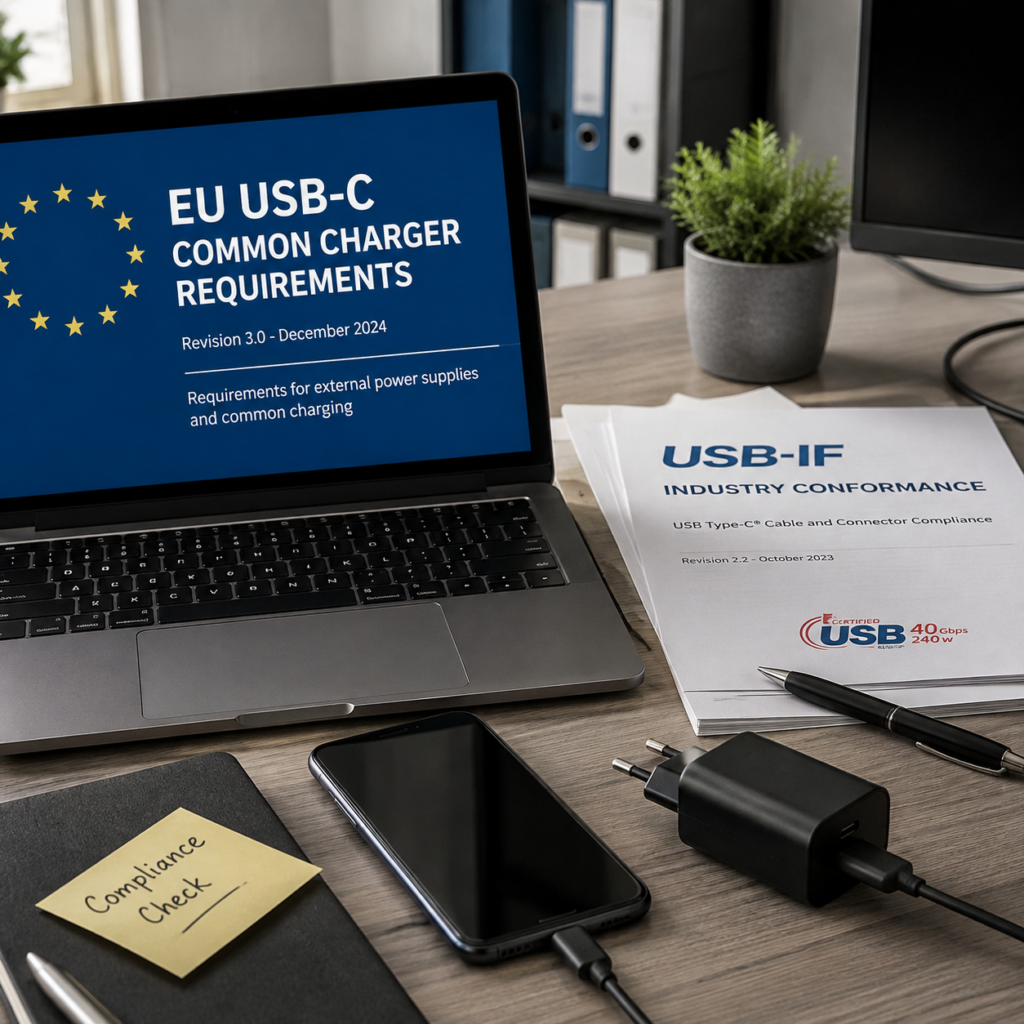
Relationship with EU USB-C Unified Charging Regulation
- Regulation nature: This is a statutory mandatory requirement of the EU, not a USB-IF regulation, but only references some USB-IF technical standards;
- Applicable scope and time: Most devices listed in the directive apply from December 28, 2024; laptop computers apply from April 28, 2026. For devices within the applicable scope that can be charged by wire and charge at higher than 5V, 3A or 15W, the directive requires the use of USB Power Delivery; harmonized standards are used to support conformity assessment and presumption of conformity;
- Core boundary: The law enforcement subject is the EU regulatory agency. Compliance with the regulation ≠ passing USB-IF certification — as long as the product meets the technical requirements of the regulation, it can be legally sold in the EU even without USB-IF certification.
Certification Identification and Misconception Avoidance
After talking about so many rules, the most practical thing is how to distinguish real and fake certification and avoid common pitfalls.
Quick Initial Screening Tips on Product End
When you get a product, first look at the logo on the appearance, you can do a preliminary screening:
- The trademark on the product appearance can only be used as a preliminary clue, and the authenticity cannot be judged by the clarity of the logo, power text or model position;
- Only printing “PD” or “fast charging” does not mean passing USB-IF certification;
- When the logo is deformed, blurred or obviously does not conform to the official graphic specifications, it is worth being vigilant, but you cannot draw a conclusion based solely on appearance.
Core tip: Appearance can only be used for initial screening, counterfeiters can imitate the logo, the authenticity should be verified based on the correspondence between the manufacturer, product name or model, TID and the listed certification scope in the USB-IF Integrators List and the physical product information.
Official Database Query Verification
The main channel for official verification is the public certified product search system on the USB-IF official website, which is completely free and does not require registration.
- Query method: Enter the full brand name, complete product model or TID to search;
- Key points for result verification: The product model, certification category, and power specifications are completely matched — for example, if you buy a 65W multi-port charger, but the search result is a 20W single-port of the same brand, that is a misattribution.
If you can’t find the record, it doesn’t necessarily mean it’s a fake product. There are several common reasons:
- Different registered name: Try searching with the manufacturer’s name, series name or TID;
- Certification under review: Contact the merchant to confirm the progress;
- No certification applied: Compatibility is not officially guaranteed, choose as needed;
- Incorrect input information: Check the model spelling and full brand name and try again.
Conclusion: Not finding a public record ≠ fake or non-compliant, it just means there is no official compatibility endorsement.
Common Cognitive Misconceptions
Here are six of the most common cognitive misconceptions, you can check them against:
- Misconception 1: Having a USB-C interface = passing USB-IF certification — wrong, the C port is just a physical form, manufacturers can make it casually, whether there is certification depends on official testing;
- Misconception 2: Cable with E-Marker chip = certified cable — wrong, E-Marker is just a chip, whether the performance of the entire cable meets the standard depends on complete testing;
- Misconception 3: USB-IF certification = absolute safety — wrong, it only tests USB-related compatibility and protocols, general safety should be checked against applicable product safety regulations of the sales place, conformity marks, and third-party safety certifications required by the market or customers; CE is the EU conformity mark, and cannot be generally referred to as safety certification;
- Misconception 4: Certified products will definitely support full-speed fast charging — wrong, fast charging also depends on the common negotiable capabilities of the source end, sink end and cable, as well as factors such as device temperature, battery status and system strategy;
- Misconception 5: Uncertified products must not be used — wrong, many products are made according to standards but have not applied for certification, they just have higher compatibility risks, not that they cannot be used;
- Misconception 6: Supporting PD protocol = passing USB-IF certification — wrong, supporting PD just means being able to negotiate power, whether it meets the standard and whether it has been tested are two different things.
Charging Abnormality Troubleshooting Sequence
If you encounter problems such as unable to charge, slow charging, or power jumping in the future, you can troubleshoot in this order for the highest efficiency:
- Step 1: Confirm whether the charger and terminal have compatible PDO or PPS APDO, and whether the cable has the required capabilities. It is not necessary for the PD/PPS versions to be exactly the same;
- Step 2: Charge with a single port to eliminate the impact of multi-port dynamic shunting;
- Step 3: Replace a known compliant spare cable to troubleshoot cable compatibility or damage issues;
- Step 4: Check official certification information to confirm whether there is parameter exaggeration or out-of-scope promotion.
Practical Checklist and Core Summary
Overseas Users’ Charging Product Purchase Checklist
- Charger check items:
- Meet the statutory compliance requirements of the sales place (CE/UKCA/PSE/FCC, etc.);
- If you value compatibility, choose products with USB-IF PD certification logo;
- Single-port/multi-port power matches the maximum input demand of the terminal, no need to blindly buy high power.
- Charging cable check items:
- Marked with clear rated current/power, do not buy those that only write “fast charging cable” but do not mark parameters;
- For high-power scenarios, it is recommended to choose products with USB-IF cable certification;
- Interface type and length meet the usage needs.
- Additional checks for high-power scenarios (laptop 65W+):
- The charger and terminal have negotiable PDO or PPS APDO, and the cable supports the required current and power;
- The cable has the corresponding level of electronic marker capability.
Core Competencies
After learning this article, you should have mastered these practical capabilities:
- Clear understanding of the four-layer architecture of USB-IF certification and its voluntary industry positioning;
- Able to distinguish the differences between USB-C interface, PD protocol, PPS function, and USB-IF certification;
- Able to distinguish the boundaries between USB-IF certification, local statutory compliance, and proprietary fast charging;
- Able to verify the authenticity of certification through initial appearance screening + official database;
- Able to judge whether fast charging can be fully achieved by combining the source end, cable, terminal and actual usage status, and troubleshoot common charging problems;
- Able to judge whether the product’s compliance and compatibility meet the needs according to the purchase checklist.
Overall, USB-IF certification is a practical tool to help us screen high-compatibility charging products, but it is not omnipotent nor mandatory. When buying charging products, first stick to the bottom line of local statutory compliance, then choose products with or without certification according to your own needs. There is no need to blindly pursue certification, nor should you completely ignore compatibility. Once you understand this system, you will not be easily fooled by merchants’ propaganda when buying charging products in the future.