
If you’ve ever bought a USB charger via overseas shopping, or traveled with a charger across different countries, you’ve most likely encountered these problems: Why are some chargers seized by customs? Why do chargers that look almost the same cost several times more? Who do you claim compensation from if your phone is damaged by charging? The answers are almost all related to “certification”. Many people think certification is just a marketing gimmick from manufacturers, but in fact it is directly related to your electricity safety, the smoothness of cross-border travel, and your confidence in seeking redress when problems arise.
1. First, Get the Basics Right: What is Certification? Which Products Apply?
Before discussing specific market requirements, let’s clarify the most basic concepts and rules first, to avoid getting more confused as we go on.
Scope of Application: Only These Products Fall Within the Discussion of This Article
The USB chargers mentioned in this article specifically refer to USB wall chargers directly connected to mains electricity, multi-port desktop chargers, and USB-C laptop power adapters. If you have a power bank (with built-in battery), wireless charger, separately sold charging cable, or car charger, their compliance rules are completely different from mains chargers and are not within the scope of this article.
Core Terms: Don’t Get Confused by Letter Abbreviations
Many people get a headache when they see abbreviations like CE, UL, DoC, but they are very easy to understand in plain language:
• Regulation: Mandatory rules formulated by the local government, equivalent to law; non-compliance is a violation.
• Standard: Technical basis used when testing products, such as what temperature to test for fire resistance, what maximum leakage current is allowed. Some standards are mandatory, some are voluntary references.
• Certification: A compliance certificate issued by a third-party authoritative body after testing the product, equivalent to “I have inspected it for you, and it meets the requirements”.
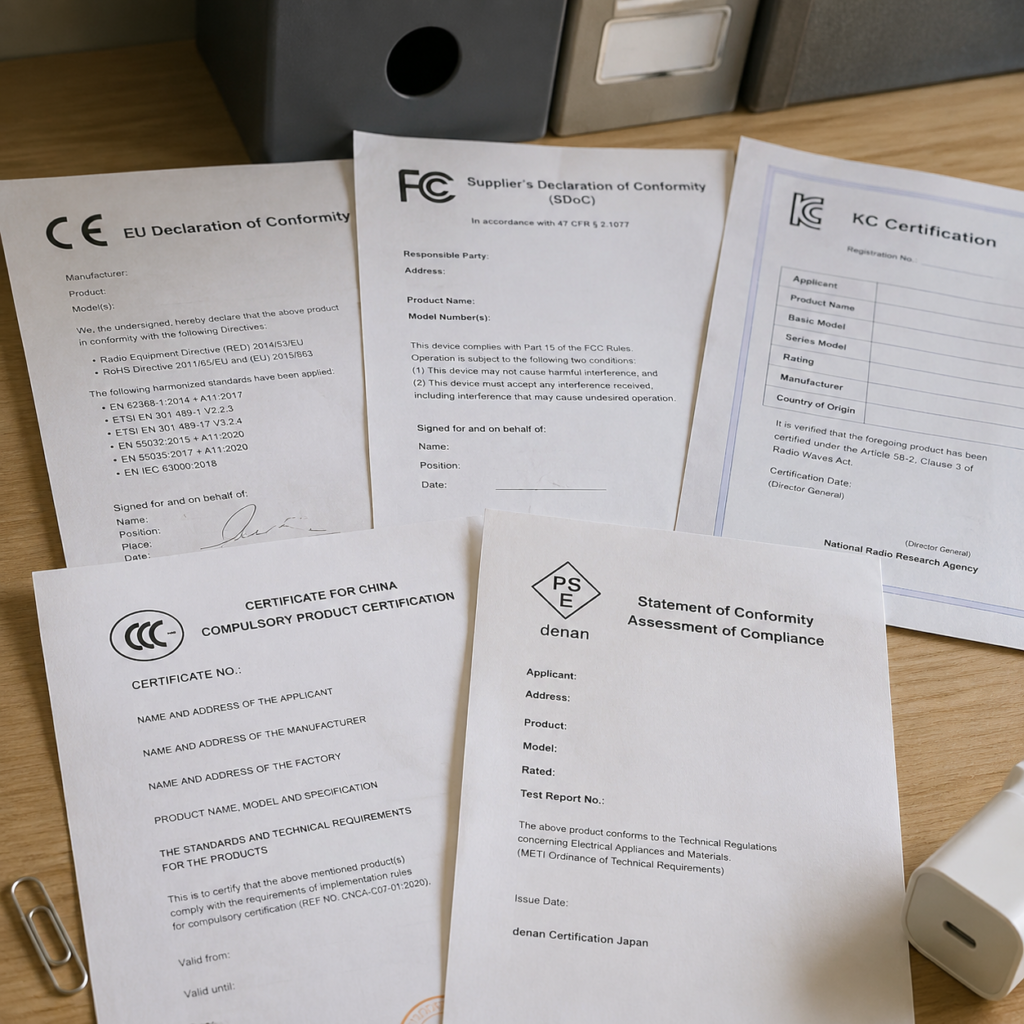
• Declaration of Conformity (DoC/SDoC): A written commitment issued by the manufacturer itself stating that its products comply with local regulations, no third-party body is required to issue a certificate, and the manufacturer is responsible for the authenticity.
• Registration: Submitting product information, test reports, etc. to the local official system for filing, equivalent to giving the product a “household registration”.
• Market Mark: A compliance mark printed on the product, such as CE, UL, CCC, which is a “compliance ID” for consumers and regulators.
Why Pay Attention to Certification? 3 Core Reasons
Many people think certification is the manufacturer’s business and has nothing to do with ordinary users, but that’s not the case:
1. Safety level: The core function of certification is to ensure safety, reducing the risks of electric leakage, fire, and damage to phones/computers from charging — after all, chargers are plugged into mains electricity every day, so problems are no trivial matter.
2. Compliance level: If you carry them cross-border, shop overseas, or engage in cross-border sales, without certification for the corresponding market, goods may be seized by customs, returned, and in serious cases, fines may be imposed.
3. Redress level: If a compliant product has problems, you can seek redress from the seller or even the manufacturer based on certification records and purchase vouchers, which has a much higher success rate than with unbranded products with no traceable manufacturer or valid certification.
4 Types of Compliance Requirements + 3 Attributes, Don’t Mix Them Up
Compliance is not just about “safety certification”. It is divided into 4 categories, each with a completely different function:
• Safety category: Protection against electric shock, fire resistance, heat resistance. It is the core access requirement, directly related to personal and property safety.
• Electromagnetic Compatibility (EMC) category: Limits mutual interference between chargers and other electronic devices — for example, a charger must not slow down WiFi or cause static on radios, and at the same time must not fail to charge normally due to interference from other devices. Many people mistake EMC for safety certification, but in fact it is completely different from electric shock protection and fire resistance.
• Energy efficiency/Environmental protection category: Limits the standby power consumption of chargers and the content of toxic and hazardous substances. It is mandatory in some markets and voluntary in others.
• Protocol/Performance category: Verifies interface specifications and fast charging compatibility, such as whether PD fast charging is supported and whether the USB-C interface is compliant. This category also does not fall under safety certification.
Divided by binding force, these requirements can be further classified into 3 attributes:
• Mandatory category: Required by local law; non-compliant products cannot be marketed or enter the country.
• Voluntary category: Not required by law, but passing it adds an extra layer of endorsement, such as many fast charging protocol certifications.
• Platform requirements: E-commerce platforms such as Amazon and AliExpress may impose stricter requirements than local laws, and products that do not meet them will not be allowed to be listed.
4-Step General Judgment Process, No Need to Memorize by Rote
When faced with a charger, you can use this process to determine which requirements it needs to meet:
1. First determine the country/region of use/sale, and whether it is for personal use or commercial use — the strictness of requirements differs between personal use and sale.
2. Clarify the specific form of the product: whether it is a wall charger or desktop charger, what the input voltage is, and what the rated power is. These parameters directly affect the applicable standards.
3. Check the four categories of requirements in order: safety, EMC, energy efficiency & environmental protection, and protocol & performance, to see which are mandatory and which are optional.
4. Confirm which supporting documents need to be prepared: whether they are third-party certificates, manufacturer self-declarations, or official system registration, and what marks need to be affixed to the product.
3 Most Common Pitfalls for Beginners
Clarifying these misconceptions in advance can help you avoid 80% of troubles:
1. Misconception 1: One certification is valid worldwide — The rules, standards, and certification systems of each country are completely different; no single certification can cover all countries.
2. Misconception 2: A certification logo printed on the product means it is truly certified — Fake marks are very common, and printing logos costs almost nothing. You must verify through official channels.
3. Misconception 3: All mains-powered chargers must have mandatory certification — Whether mandatory certification is required must be judged in combination with the target market, product category, and parameters. However, products without certification definitely carry higher risks.
Finally, a reminder: Regulations in all countries are updated dynamically, so specific requirements must be based on the latest rules officially released by the target market.
2. Mandatory Access Requirements for Key Global Markets, One by One
Now that we understand the basic logic, let’s look at the specific mandatory requirements for several key markets that people most commonly interact with.
North America (United States + Canada)
North America is a popular market for overseas shopping and cross-border sales for many people, but its safety certification rules are different from what many people think.
United States
Applies to USB wall chargers, desktop chargers, and power adapters connected to 120V mains electricity.
• Safety requirements: There is usually no unified mandatory third-party safety certification for such products at the U.S. federal level. However, some states, local competent authorities, e-commerce channels, and insurers may require products to obtain NRTL (Nationally Recognized Testing Laboratory) listing or recognition. This is not equivalent to a unified national statutory access requirement.
• EMC requirements: Ordinary chargers are subject to FCC Part 15 rules, and devices that meet applicable conditions usually use Supplier Declaration of Conformity (SDoC). The FCC mark is not uniformly mandatory for all SDoC devices. If the product includes wireless transmission functions, it should be confirmed according to the wireless device category whether FCC certification, FCC ID, or other corresponding requirements are needed; having only wireless charging function does not automatically mean an FCC ID is required.
• Energy efficiency requirements: USB power adapters that fall under the DOE definition of “external power supply” and are not excluded by regulations need to meet current DOE energy efficiency and testing requirements. The specific scope of application, exclusions, and test methods should be judged according to 10 CFR Part 430 of the U.S. Code of Federal Regulations and the latest DOE regulations, and cannot be determined solely by the name “USB charger”.
• Responsible entity: The U.S.-based manufacturer or importer bears the corresponding compliance responsibility.
• Marks and documents: Depending on specific requirements, this may involve NRTL listing marks such as UL and ETL, FCC SDoC documents, wireless device certification documents, and DOE energy efficiency test records. The FCC mark is not a unified mandatory mark for all SDoC devices.
• Query method: UL and ETL file numbers can be verified on the official websites of the corresponding institutions; FCC SDoC does not have a unified public product database, so you need to request documents from the supplier. If wireless devices involve FCC certification, corresponding records can be queried according to the device category.
• Common misconceptions: Many people think FCC is a safety certification — in fact, it mainly regulates electromagnetic compatibility and radio transmission; others think DOE energy efficiency requirements automatically apply to all USB chargers, but in fact you must first confirm whether the product is a regulated external power supply and whether it falls under any exclusion.
Canada
Applies to USB wall chargers, desktop chargers, and power adapters connected to 120V mains electricity.
• Safety requirements: Must comply with Canadian safety standards. Common certification marks are cUL, CSA, cETL. Note that these marks must carry Canada-specific identifiers; Canadian compliance cannot be judged solely by U.S. UL certification.
• EMC requirements: Ordinary chargers are subject to ICES rules; products with wireless functions need to confirm ISED-related requirements according to the device category.
• Energy efficiency requirements: Products that fall within Canada’s regulated external power supply scope need to meet the current energy efficiency requirements of Natural Resources Canada (NRCan) and fulfill corresponding reporting or record-keeping obligations. Its technical limits, scope of application, and labeling requirements should be independently verified in accordance with Canadian regulations, and cannot be directly replaced by U.S. DOE Level VI, nor can it be inferred that all USB chargers must have consumer energy efficiency labels.
• Responsible entity: The Canada-based manufacturer or importer bears the corresponding compliance responsibility.
• Marks and documents: The product may involve cUL/CSA/cETL marks, ICES-related information, and energy efficiency records or documents required by applicable regulations. Whether a specific energy efficiency label is required should be confirmed according to the product and regulations.
• Query method: Certifications such as CSA and cUL can be verified on the official websites of the corresponding institutions.
• Common misconceptions: Many people think U.S. UL certification can be used directly in Canada — in fact, you must confirm that the product has the applicable Canadian mark and complies with Canadian standard differences and regulatory requirements.
European Union + United Kingdom
Everyone has heard of the EU’s CE mark, but there are also the most misconceptions about CE.
European Union
Applies to USB wall chargers, desktop chargers, and power adapters connected to 230V mains electricity.
• Core requirements: According to the product’s parameters and category, the LVD Low Voltage Directive (safety), EMC Directive, RoHS Environmental Directive, and ErP Energy Efficiency Directive apply respectively. Not all requirements automatically apply to all products.
• The truth about the CE mark: Many people think CE is a certificate issued by an EU institution, but it is not — the CE mark is a mark affixed by the manufacturer itself after completing the conformity assessment, equivalent to the manufacturer’s self-commitment to comply with EU regulations. Ordinary USB chargers do not need a certificate issued by an EU institution.
• Common Charger Rule: The common charger revision of the EU Radio Equipment Directive applies to mobile phones, tablets, and other listed portable electronic devices from December 28, 2024. Covered devices need to have a USB-C charging port; when meeting the specified charging power conditions, they also need to support USB Power Delivery. Related requirements for laptop computers apply from April 28, 2026. This rule does not impose an unconditional “must support PD” certification requirement on all USB-C chargers.
• Responsible entity: Manufacturers, importers, or authorized representatives within the EU bear compliance responsibility.
• Marks and documents: The product must have the CE mark, and a Declaration of Conformity (DoC), test report, and technical documentation must be retained.
• Query method: The EU does not have a unified public certification database, so you need to request the DoC and test report from the supplier for verification.
• Common misconceptions: First, thinking CE is a certificate issued by a third-party institution; second, thinking all USB-C chargers must support PD. In fact, the common charger rule only applies to listed terminal devices, applicable power conditions, and corresponding effective dates.
United Kingdom
After Brexit, compliance rules in the UK are divided into two regions:
• GB region (England, Scotland, Wales): The CE mark can be recognized within the conditions and period specified by current UK regulations, and UKCA can also be used. The specific applicable regulations, responsible persons, technical documents, and marking period must be verified according to the latest UK government policy for this product category. UKCA is the UK conformity mark and should not be generally referred to as a “transitional mark”.
• Northern Ireland region: The CE mark or CE+UKNI mark applies, following relevant EU rules.
Key Asia-Pacific Markets (China/Japan/Korea/Australia & New Zealand)
China
Applies to USB wall chargers, desktop chargers, and power adapters connected to 220V mains electricity.
• Safety + EMC requirements: Products included in the national CCC certification catalog must pass mandatory CCC certification, which covers both safety and EMC requirements.
• Energy efficiency requirements: The mandatory energy efficiency label (divided into grades 1-5) for external power supply products is mandatory. Products within the applicable scope must be affixed with it, and low-power or special-purpose products can be exempted.
• Responsible entity: Manufacturers or importers within China bear compliance responsibility.
• Marks and documents: The product must have the CCC mark and energy efficiency label, as well as a CCC certificate and energy efficiency filing certificate.
• Query method: CCC certificates can be queried through the certification information platform of the State Administration for Market Regulation / Certification and Accreditation Administration of China; energy efficiency labels and filing information are usually queried through the China Energy Efficiency Label Information System. The two are not the same official system, and the scope of application and query numbers should also be verified separately.
• Common misconceptions: Many people think all USB chargers need CCC certification — in fact, only products included in the CCC catalog need it, and those not in the catalog do not have this mandatory requirement.
Japan
Applies to USB wall chargers, desktop chargers, and power adapters connected to 100V mains electricity.
• Classification rules: According to the Electrical Appliance and Material Safety Act, products are divided into two categories: “specified electrical appliances” and “non-specified electrical appliances”, corresponding to different requirements: specified category usually involves certification by a designated inspection body and affixing the diamond-shaped PSE mark; non-specified category usually requires the business operator to confirm compliance with technical standards and affix the circular PSE mark.
• Responsible entity: Manufacturers or importers in Japan need to fulfill obligations such as business notification, compliance with technical standards, retention of inspection records, and PSE marking in accordance with the Electrical Appliance and Material Safety Act. Specific responsibilities cannot be simply summarized as “importer filing”.
• Marks and documents: The product must have the applicable diamond or circular PSE mark, and corresponding test records, inspection documents, and business operator information must be retained according to the category.
• Query method: There is no government certificate database for individual PSE product marks that is generally accessible to the public. The information disclosed by Japan’s Ministry of Economy, Trade and Industry (METI) mainly includes business notifications and registered inspection bodies, which is not equivalent to a diamond PSE product certificate query database.
• Common misconceptions: First, thinking all USB adapters are specified category PSE; second, thinking PSE must be a product certificate issued by the Japanese government. The actual classification and obligations should be judged according to product definitions and applicable lists.
South Korea
Applies to USB wall chargers, desktop chargers, and power adapters connected to 220V mains electricity.
• KC system: South Korea’s KC electrical appliance safety system applies safety certification, safety confirmation, or supplier declaration of conformity according to category. Safety certification usually involves a designated certification body; safety confirmation usually requires testing by a designated testing body, followed by declaration by the responsible entity; supplier declaration of conformity is the self-declaration within the corresponding scope. EMC should also be separately confirmed according to South Korea’s relevant electromagnetic compatibility system.
• Responsible entity: Manufacturers or importers in South Korea bear corresponding compliance responsibility.
• Marks and documents: The product must have the KC mark and KC number, as well as corresponding test reports or compliance documents.
• Query method: Certification information can be queried on the official platform related to South Korean safety certification.
• Common misconceptions: Thinking KC is a single unified certification, but in fact it is a combination of multiple safety, EMC, and other applicable requirements.
Australia + New Zealand
Applies to USB wall chargers, desktop chargers, and power adapters connected to 240V mains electricity.
• RCM mark: RCM is a common compliance mark in the Australian and New Zealand markets, not a unified third-party certification. Australia and New Zealand each have their own safety, EMC, and supplier obligations; you cannot infer that unified third-party certification or unified registration has been completed solely based on the RCM mark.
• Registration requirements: Corresponding electrical equipment regulated by EESS in Australia requires the responsible supplier to fulfill supplier registration and compliance obligations corresponding to the equipment class. Whether registration is required depends on the equipment classification. Level 1 equipment usually does not have the same registration requirements as Level 2/3 equipment. New Zealand must separately meet its requirements for electrical safety, EMC, and supplier declarations, which cannot be replaced by EESS registration.
• Responsible entity: Local responsible suppliers as stipulated by applicable Australian or New Zealand regulations bear corresponding obligations.
• Marks and documents: The product may require the RCM mark, as well as supplier declarations, test reports, and records corresponding to Australian EESS or New Zealand regulations.
• Query method: For equipment subject to EESS registration in Australia, relevant information can be verified in the EESS database; New Zealand’s compliance documents and supplier declarations need to be checked according to New Zealand’s corresponding system.
• Common misconceptions: Many people think RCM is a certification certificate issued by a third-party institution, or that completing EESS registration automatically covers New Zealand. In fact, RCM is a compliance mark, and specific obligations for Australia and New Zealand need to be judged separately.
Other Popular Markets and the CB Mutual Recognition System
In addition to the key markets above, you can briefly understand the mandatory requirements of some other popular markets:
• India: BIS mandatory certification
• Brazil: INMETRO mandatory certification
• Saudi Arabia: SASO certification, which requires registration through the SABER platform, is a mandatory access requirement
• Singapore: Regulated electrical products must have mandatory Safety Mark registration
• Eurasian Economic Union (including Russia): Applies the conformity assessment system under EAEU technical regulations, with the EAC mark affixed
Here we should mention the CB Scheme: The IECEE CB Scheme issues CB test reports and certificates through accredited laboratories and national certification bodies, making it easier for member bodies to reduce duplicate testing when applying for national certification. It is not “one test to automatically obtain certification from all countries”: countries may require national difference testing, additional documents, local registration, factory inspection, or national certification. Whether it is accepted and what supplementary content is needed are determined by the competent authority or certification body of the target market. CB is also not a global universal market mark for consumers. If you buy products from niche countries via overseas shopping, prioritize products with CB documents, which usually makes it easier to reduce duplicate work when applying for local certification later, but you still need to check the destination rules.
Quick Reference Matrix for Global Market Certification
For your quick reference, we have compiled a comparison table of general requirements for key markets. Note that this is only a general situation, and specific details need to be verified according to product parameters, categories, and the latest regulations. This does not constitute legal advice.
| Market | Core Safety Requirements | EMC Requirements | Energy Efficiency/Environmental Requirements | Core Mark | Responsible Entity | Third-Party Required? |
| United States | No unified federal mandatory third-party safety certification; some states, localities, channels, or insurers may require NRTL listing | FCC Part 15; ordinary products eligible for SDoC provide SDoC, products with regulated wireless transmission functions confirm certification or FCC ID requirements by category | Current DOE requirements apply only to products that fall under the DOE external power supply definition and are not excluded | May involve UL/ETL listing marks; FCC mark is not uniformly mandatory for all SDoC devices | U.S.-based manufacturer/importer | Whether safety category is required depends on specific competent authorities, channels, and insurance requirements; ordinary EMC is often SDoC |
| Canada | Must comply with Canadian safety standards, common marks are cUL/CSA/cETL (with Canadian identifier) | ICES requirements, products with wireless functions confirm ISED requirements by category | Regulated external power supplies must meet current NRCan requirements, verify applicable scope, reporting and labeling obligations specifically | Applicable marks such as cUL/CSA/cETL and information required by regulations | Canada-based manufacturer/importer | Depends on the type of safety certification and specific requirements |
| European Union | LVD Low Voltage Directive applies according to parameters | EMC Directive | RoHS environmental protection, ErP energy efficiency (apply according to parameters) | CE mark | Manufacturer/importer/authorized representative within the EU | Ordinary chargers are usually self-declared, no third-party certificate required |
| UK GB | CE can be recognized within specified conditions and period according to current UK regulations, UKCA can also be used | According to current UK EMC requirements | According to current UK RoHS/energy efficiency requirements | CE or UKCA, specific according to current policy | Responsible person within the UK | Depends on specific regulations and assessment methods |
| Japan | Divided into specified/non-specified categories according to the Electrical Appliance and Material Safety Act, corresponding to diamond/circular PSE | Confirm according to applicable radio wave and EMC requirements | Some categories have energy efficiency requirements | Diamond/circular PSE mark | Manufacturer or importer in Japan | Depends on product category; specified category usually involves designated inspection bodies |
| South Korea | KC safety certification, safety confirmation, or supplier declaration of conformity (by category) | KC EMC system | Environmental protection related requirements | KC mark | Manufacturer/importer in South Korea | Assessment methods differ for safety certification, safety confirmation, and supplier declaration of conformity |
| China | Products included in the CCC catalog require mandatory CCC certification | CCC certification includes EMC requirements | Mandatory energy efficiency label (grades 1-5, low-power or special-purpose exempted according to regulations) | CCC mark, energy efficiency label | Domestic manufacturer/importer | Required for products included in the catalog |
| Australia & New Zealand | Australia fulfills corresponding safety obligations according to EESS equipment class; New Zealand separately meets its safety requirements | Comply with Australian and New Zealand EMC standards respectively | Confirm according to specific regulations of the two countries | RCM mark | Corresponding responsible suppliers in Australia and New Zealand | Whether registration and third-party testing are required depends on equipment classification and system requirements |
3. Don’t Mix Up: Voluntary Certification and Product Boundaries
In addition to mandatory access requirements, you may have seen many other logos on charger packaging, such as USB-IF, QC, MFi. These are all voluntary special certifications, not the same as safety certification, and certifications for different components cannot be misapplied.
USB-IF Protocol Certification
USB-IF certification is a voluntary certification launched by the USB Implementers Forum. Its core is to test whether the product’s interface and protocol comply with USB specifications, such as whether the USB-C interface size is standard, whether PD fast charging compatibility is good, and whether output power is stable. Certified products can use the USB-IF logo and have an exclusive TID number, which can be queried on the official USB-IF website.
Here we must pay attention to the boundary: USB-IF certification mainly targets protocol and interface compliance, which is not equivalent to mains safety, EMC, and energy efficiency compliance. Therefore, having USB-IF certification does not mean the charger has passed safety certification; it more indicates that the interface and fast charging compatibility meet the requirements of the corresponding program.
Common Misconceptions About Fast Charging Protocol Authorization
Many people mistake fast charging protocol authorization for safety certification, which is a typical misconception:
• Qualcomm QC Authorization: It is only a fast charging compatibility authorization issued by Qualcomm, indicating that the product supports QC fast charging, and cannot replace safety certification at all.
• Apple MFi Misconception: MFi certification is mainly for Lightning interface accessories, and USB-C chargers usually do not need MFi certification. If you see a merchant saying “USB-C charger has MFi certification”, it is either a conceptual trick or requires further verification.
• Proprietary Fast Charging Authorization: For example, proprietary fast charging authorizations from brands such as Xiaomi and Huawei are only the brand’s recognition of product compatibility, not equivalent to whole-machine safety certification.
Voluntary Energy Efficiency Certification
The U.S. Energy Star is a voluntary program, but it only applies within its currently listed product categories and certification specifications. Specific versions will specify standby power consumption, average efficiency, and test conditions. These should be compared item by item with applicable DOE requirements. You cannot generally assert that it applies to all USB chargers, nor that it is necessarily stricter than DOE Level VI.
Certification Boundaries of Chargers, Cables, and Terminals
Many people think that if a charger is certified, the matching cable is fine, or if a phone is certified, any charger will do. This is completely wrong:
• Charger certification: Covers mains input safety, output performance, and whole-machine EMC, and usually does not include separately sold charging cables.
• High-power USB-C cables: Need to verify the cable’s rated current, nominal power, and USB-C electronic marker. For USB-C cables exceeding 3A, it is necessary to confirm that they correctly report current capability according to USB Type-C and USB PD requirements, which usually involves an E-Marker chip. USB-IF certification and logo are voluntary compliance endorsements, and whether they are required depends on product declarations, brand, or channel requirements.
• Terminal devices (mobile phones/laptops): Have their own compliance requirements, which cannot replace each other with certifications of chargers and cables.
Simply put: Each certification is responsible for its own product, and you cannot misattribute them.
4. Beginner’s Practical Guide: 6-Step Verification Method, You Can Check Authenticity Yourself
After talking about so many requirements, you may ask: How do I know if the charger I have is really certified? Don’t worry, follow these 6 steps, combined with the evidence chain, even ordinary people can get a pretty accurate result.
Step 1: Confirm the Place of Use/Sale and Product Classification
First, clarify two core pieces of information: First, which country/region the product will be used or sold in, and find the corresponding local mandatory access requirements; second, confirm that the product belongs to the USB wall charger, desktop charger, or laptop power adapter we mentioned, excluding categories such as power banks and wireless chargers, to avoid applying the wrong rules.
• Retain evidence: Screenshots of target market rules, product category confirmation records.
Step 2: Check the Product Nameplate and Basic Marks
Turn to the plug side or side of the charger, find the printed or laser-engraved nameplate, and check if there is this necessary information: product model, input/output parameters, manufacturer or trademark, and mandatory marks of the target market.
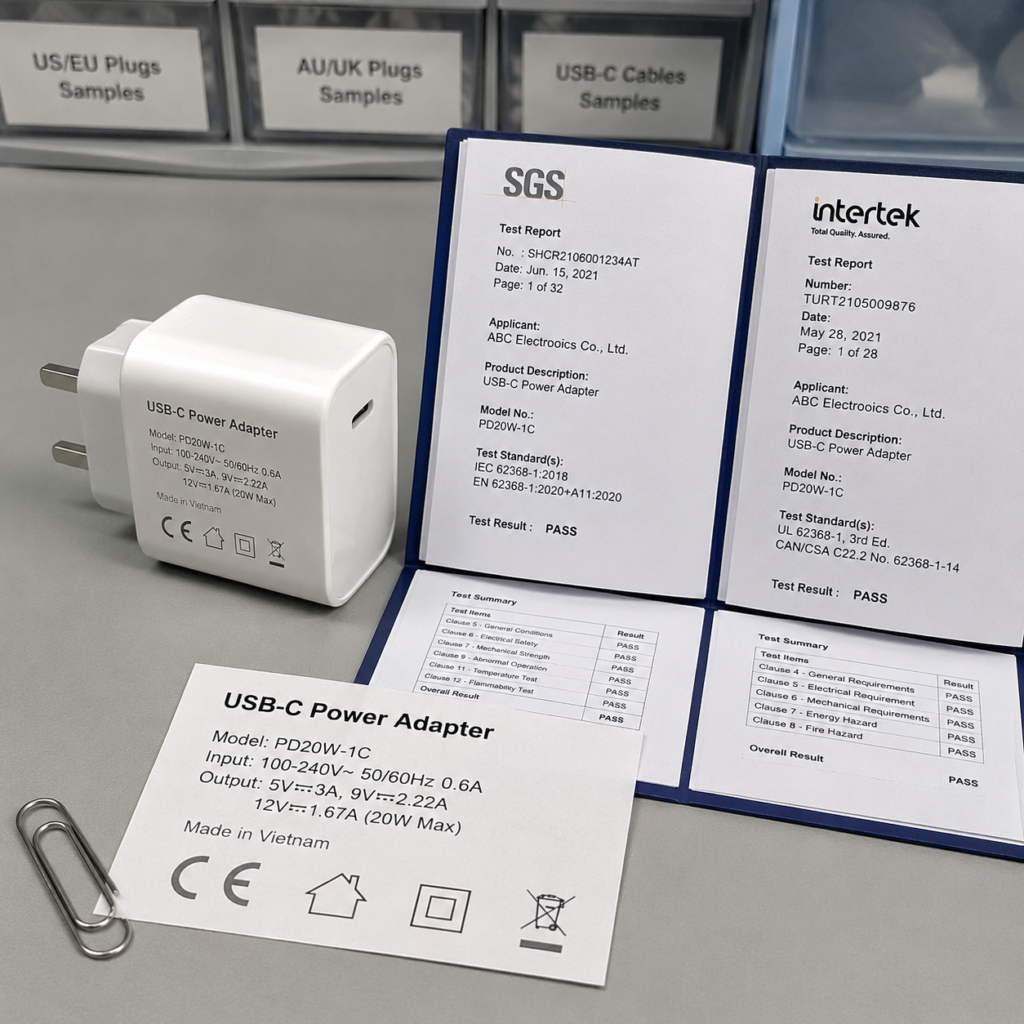
Special attention should be paid here: the maximum power of a single port is not equal to the total power of multiple ports. You must check if there are markings such as “combined output” or “dynamic distribution” on the nameplate. Many falsely labeled products use single-port power to impersonate total power.
Preliminary flaws of fake marks are also easy to spot: wrong logo proportion, no corresponding certification number, blurred marks that come off when scratched with a finger.
• Retain evidence: Clear photos of the product nameplate.
Step 3: Query the Database/Request Documents, Verify Certificate Status
Different certifications have different query methods:
• Publicly queryable category: UL/ETL file numbers, CCC numbers, KC numbers, USB-IF TID, and applicable Australian EESS registration information can be queried by entering the number on the corresponding official website.
• Category without unified public database: Self-declaration certifications or compliance documents such as CE, FCC SDoC, and circular PSE do not have a unified public product database, so you need to request formal DoC documents or test reports from the supplier.
For certifications with clear certificate validity periods or public status, you can verify whether they are valid, suspended, or revoked. For self-declaration documents such as DoC and SDoC, you should check the signing entity, applicable regulations, product model, signing date, technical documents, and whether the product continues to meet requirements. Do not require them to have a unified validity period or public status.
• Retain evidence: Official query screenshots, formal documents provided by the supplier.
Step 4: Verify Consistency
After finding the certificate, don’t think it’s over. You also need to verify the following:
1. Verify model coverage: Confirm that the sales model is clearly covered by the certificate, listing record, or test report. If it belongs to a series model, representative model, or variant, you should check the certification body’s model rules and difference descriptions, and cannot simply require the report model to be identical to the sales model word for word.
2. Verify factory: The manufacturer information should be consistent with the applicable scope in the certification filing or documents. If the factory is different, you need to confirm whether the changes required by the certification body have been completed.
3. Verify standards: The standard version used for testing should comply with the current regulations or applicable requirements of the target market. Using an older version of the standard does not necessarily automatically become invalid, but you need to confirm whether the target market still accepts it.
4. Verify key components and structure: When changes occur to transformers, fuses, protocol chips, PCBs, insulating materials, etc., you should confirm according to the change procedures of the corresponding certification body whether notification, supplementary assessment, or retesting is required. You cannot generally assume that any component change will invalidate the certification.
• Retain evidence: Comparison records of certificates, reports, model coverage descriptions, and product nameplates.
Step 5: Check Matching Components and Packaging
In addition to the charger itself, matching items also need to be checked:
• The shape of the plug must comply with the applicable plug and socket standards of the target country. Type A/B are common in the U.S., but they are not the only two types; EU countries also do not only have Type C/F, but may also involve national plug systems such as E, J, K, etc. Specific details should be checked according to the destination country.
• If it is a high-power set, you need to separately verify the rated current, power marking, USB-C electronic marker of the matching charging cable, and applicable requirements of the target market. Third-party cable certification is usually a voluntary, channel, or specific regulatory requirement, and 65W cannot be regarded as a unified threshold for cables to be separately certified.
• The certification marks on the packaging must be consistent with the product itself, and no exaggerated publicity is allowed. For example, if the UL mark is printed on the packaging but not on the product, further verification is definitely needed.
• Retain evidence: Photos of plugs, cables, and packaging.
Step 6: Channel Verification + Organize the Evidence Chain
The last step is to check the requirements of the sales channel: for example, Amazon US may require UL test reports for USB chargers, and the EU site may require CE DoC. If channel requirements are stricter than legal requirements, follow the channel requirements.
Also pay attention to wording checks: if a merchant only says “complies with XX standard” but does not say “passed XX certification/registration”, you must be more vigilant. “Complying with standards” and “passing certification” are completely different things.
All evidence should be organized and archived, which can be used whether for personal use redress or commercial inspection.
• Retain evidence: Screenshots of channel compliance commitments, archived records of all documents.
Can’t Find It in the Database? These May Be the Reasons
If you can’t find certification information, don’t rush to conclusions. These may be the reasons:
1. It belongs to self-declaration certification, which inherently has no unified public database, such as CE, FCC SDoC, and circular PSE.
2. The number is entered incorrectly, or the product model is not in the series covered by the certification — some certifications cover a series of products, and not all models are listed separately.
3. The certification has expired, been revoked, or the issuing body does not have the corresponding qualification.
4. The merchant uses a fake number or fake certification.
5. This type of document itself is not a third-party certificate in a public database, but a DoC, SDoC, or test record kept by the responsible entity.
5. Advanced: Scenario-Based Judgment and Pitfall Avoidance
Having mastered the basic verification methods, let’s look at judgment skills in several actual scenarios to help you avoid more hidden traps.
How to Judge Certification for Cross-Border Carrying/Overseas Shopping?
Many people care about whether chargers will be seized when taking them abroad or buying them via overseas shopping. Here is a judgment logic for you:
• Carrying a small amount for personal use: When carrying for personal use, most customs will not forcibly inspect certification item by item, but whether to inspect, detain, or return still depends on destination customs rules, product category, and law enforcement situation. If the product is obviously non-compliant or is sampled for inspection, problems may still occur.
• Overseas shopping/cross-border online shopping: For commercial import and sale in the destination market, it is usually necessary to meet local mandatory requirements for corresponding products. Whether personal use mail order requires certification, registration, and whether there are exemptions in terms of quantity or import method should be specifically judged according to destination customs and product regulations, and cannot be generalized.
• High-power reminder: The higher the rated power of a charger, the more likely it is to trigger stricter temperature rise, plug, cable, and energy efficiency standards. When buying a high-power charger, you must check the certification more carefully.
• Wide voltage misconception: Many people think that a charger marked with 100-240V wide voltage can be used worldwide, but in fact wide voltage only adapts to the voltage; plug shape and local certification requirements still need to be checked separately, and cannot be lumped together.
Different Usage Scenarios Have Different Certification Priorities
Not all scenarios require checking all certifications. You can prioritize according to the usage scenario:
• Mobile phone/tablet ordinary fast charging scenario: Prioritize mandatory safety certification, then check the corresponding fast charging protocol. After all, safety is the first priority, and fast charging compatibility is the second.
• Laptop high-power fast charging scenario: Prioritize confirming the mandatory safety, EMC, and energy efficiency requirements of the target market, as well as USB PD implementation and the rated capacity of the charging cable. USB-IF PD certification is an optional or channel requirement, and cannot be used as a globally unified mandatory verification item.
• Multi-port USB charger scenario: In addition to basic safety certification, you also need to additionally confirm that the total output power is within the certification coverage, to avoid the situation where single-port power meets the standard but total power is falsely labeled.
Note that the above are only usage references, not a globally unified certification boundary. Specifics should still be based on applicable regulatory standards.
Identify Certification “Padding” Traps at a Glance
Some unscrupulous merchants use various irrelevant certificates to pad the count, pretending that the product has complete certifications. There are three common traps:
1. Treating the manufacturer’s own factory self-inspection report as a third-party certification report — self-inspection reports have no credibility and do not count as certification.
2. Using certifications from other categories such as charging cables and ordinary power supplies to make up the number, where the category is completely inconsistent with USB chargers — certification must correspond to the category, otherwise it is misattribution.
3. Treating industry association membership, exhibition certificates, and award certificates as product certification — these have nothing to do with product compliance.
The judgment standard is very simple: compliance certification must target the “USB charger” category, have official registration or third-party test reports for the corresponding model, and everything else does not count.
Real Case Judgment
We use two common product cases to help you connect the previous knowledge.
Case 1: 65W Single-Port USB-C PD Charger Sold to US/EU/Japan/China
This product is the most common universal charger for laptops/mobile phones, and the requirements vary significantly across different markets:
| Market | Mandatory Requirements | Voluntary Items | Documents That Must Be Requested | High-Risk Misconception |
| United States | Applicable SDoC under FCC Part 15, applicable DOE external power supply energy efficiency requirements, and NRTL safety listing required by channels or localities | Energy Star (only within applicable product categories and specifications), USB-IF PD certification | UL/ETL listing certificate (if required by channel or locality), FCC SDoC document, applicable DOE energy efficiency test records | Thinking FCC is safety certification, thinking all USB chargers automatically apply to DOE Level VI |
| European Union | LVD safety, EMC, RoHS, ErP (apply according to product and regulations); Common Charger Rule targets listed terminal devices and corresponding power conditions | USB-IF PD certification | CE DoC, test report, technical document summary | Thinking CE is a certificate issued by a third party, thinking all USB-C chargers must support PD |
| Japan | PSE-related requirements (divided into specified/non-specified by category), Japanese domestic business operators fulfill corresponding obligations | USB-IF PD certification | PSE-related test records or certification documents, business operator notification and compliance information | Thinking all USB adapters are specified category PSE, thinking PSE must be a government-issued certificate |
| China | CCC certification (if in the catalog), mandatory energy efficiency label (when applicable) | USB-IF PD certification | CCC certificate, energy efficiency label filing certificate (when applicable) | Thinking all USB chargers need CCC certification |
Case 2: 100W Multi-Port GaN Charger + 5A USB-C Cable Set
The verification points for multi-port high-power sets are more than single-port ones. You need to check both the charger and the cable, as well as the total power:
| Market | Mandatory Requirements | Voluntary Items | Documents That Must Be Requested | High-Risk Misconception |
| United States | Same as single-port requirements, additionally need to confirm total output power is within applicable documents and certification coverage | Energy Star (when applicable), USB-IF PD certification, cable USB-IF certification | Charger UL/ETL listing certificate (if applicable), FCC SDoC, applicable DOE energy efficiency records, cable rated current certificate | Thinking single-port power meeting standards means total power is compliant, thinking cable certification can replace charger certification |
| European Union | Same as single-port requirements, additionally need to confirm total output power, cable rated capacity, and applicability of relevant regulations | USB-IF PD certification, cable USB-IF certification | Charger CE DoC, test report, applicable test documents or DoC for cable | Thinking GaN material is naturally safer, thinking multi-port chargers do not need additional total power verification |
| Japan | Same as single-port requirements, additionally confirm total power and cable compliance | USB-IF PD certification | Charger PSE-related documents, applicable compliance certificate for cable | Thinking multi-port chargers have exactly the same certification requirements as single-port ones |
| China | Same as single-port requirements, additionally confirm total power and energy efficiency grade | USB-IF PD certification | Charger CCC certificate (if applicable), energy efficiency filing, applicable compliance certificate for cable | Thinking GaN chargers have stricter certification requirements than ordinary chargers |
6. Boundary Clarification: Certification Is Not Omnipotent
Many people have extreme misunderstandings about certification: either they think certified products are absolutely safe, or they think certification is useless. Here we clarify the boundaries.
Certified ≠ 100% Safe, Why?
Certification is only the test result of new products under standard test conditions, which is a probabilistic safety guarantee, not an absolute “get-out-of-jail-free card”. Aging, dropping, overloading, and extreme environments (such as high temperature, unstable voltage) during use may cause the product to no longer meet standard requirements.
If your charger shows these conditions, you must stop using it immediately: abnormal heating, burning smell, abnormal noise, deformed casing, loose interface, intermittent charging.
What’s the Difference in Certification Between USB-C and USB-A Chargers?
Many people think that USB-C chargers have higher certification requirements than USB-A ones, but that’s not true — the difference in certification requirements is determined by rated power, port configuration, and applicable standards, and has nothing to do with the interface type itself. It’s just that USB-C chargers usually support higher power, so they may involve PD protocol compatibility testing, not that the interface itself leads to stricter requirements.
Two Easy-to-Get-Wrong Advanced Misconceptions
• Misconception: The higher the certified power, the faster the charging — No, charging speed is limited by multiple factors such as the protocol supported by the device, the rated current of the charging cable, and battery temperature. It’s not that a higher charger power necessarily means faster charging.
• Misconception: GaN chargers are naturally safer/more dangerous — No, GaN is just the material of power devices. Safety depends on the whole-machine design and whether it has passed corresponding certification, and has no direct relationship with whether GaN is used.
Certification Is Not Once and For All: Change Management
Many people think that once certification is obtained, it is valid for life, but that’s not true — certification only covers the product model, structure, key components, and test conditions at the time of application. If there are the following changes, re-evaluation may be required:
• Core parameter changes: For example, changes in output power, input voltage range, port number/type usually require retesting or change assessment.
• Key component changes: For example, replacement of transformers, fuses, PCBs, protocol chips, insulating materials requires notification, supplementary assessment, or retesting according to rules.
• Structural changes: For example, changes to the casing, plug, internal layout require assessment of whether they still meet the original standards.
• Entity changes: For example, changes in manufacturing factory, brand, manufacturer require certification change procedures.
• Matching cable changes: If the high-power cable in the set is replaced, its rated capacity and applicable requirements need to be verified separately.
Major changes that have not been evaluated or approved through prescribed procedures may cause the original certificate or listing to no longer cover the changed product, and may result in the product not meeting market requirements. In practice, change assessment, notification, supplementary testing, or re-certification should be handled according to the specific certification body, regulations, and standards. It cannot be generalized that all unreported changes will automatically invalidate the certification.
7. Practical Tools and Core Summary
One-Page Verification Checklist for Ordinary Consumers
For your practical operation, we have organized the 6-step verification method into a simple checklist. You can check off items one by one and retain the corresponding evidence.
| Step | Check Item | Result (Yes/No/Pending Confirmation) | Retained Evidence |
| 1 | Mandatory requirements of target market match product category | Screenshots of target market rules, product category confirmation records | |
| 2 | Product nameplate information is complete, marks are clear with no fake mark flaws | Clear photos of product nameplate | |
| 3 | Publicly queryable certifications are valid in official databases, self-declaration types can provide formal documents | Certification query screenshots, DoC/test reports provided by supplier | |
| 4 | Model coverage, factory, test standards, and key components of the certificate/report are consistent with the product or have clear change descriptions | Comparison records of certificates, reports, model coverage and changes | |
| 5 | Plug shape, matching cables, and packaging marks meet target market requirements | Photos of plugs, cables, packaging | |
| 6 | Channel has clear compliance commitment, all evidence has been archived | Screenshots of channel compliance commitment, full document archive records |
Compliance Document Checklist for Cross-Border Sellers/Purchasers
If you are engaged in cross-border sales or bulk purchasing, you need to prepare these compliance documents:
1. Mandatory certification/registration certificates or documents for the target market
2. Third-party test reports (if any)
3. Declaration of Conformity (DoC/SDoC)
4. Design drafts of product nameplate, packaging, and warning labels
5. Key component list and change management rules
FAQ
Will overseas-shopped chargers for personal use definitely be checked for certification?
Not necessarily. When carrying or mail-ordering for personal use, certification is not forcibly inspected item by item in most cases, but whether to inspect, detain, or return still depends on destination customs rules, product category, declaration situation, and law enforcement methods. If the product is obviously non-compliant or is sampled for inspection, problems may still occur. Commercial import and sale usually need to meet local applicable mandatory requirements.
Is a certification logo on a charger definitely real?
No. Fake marks are very common, such as wrong logo proportion, no corresponding number, blurred printing that is easy to peel off. You must query through official databases or request formal DoC and test reports for verification.
Can a charger with North American safety certification be used directly in Europe?
North American UL/ETL certification cannot replace CE and related regulatory compliance required for sale in the EU market, nor does it mean the product can be sold in the European market.
For personal use, you also need to confirm whether the charger’s input voltage, frequency, plug, and the adapter used are safe. Meeting these usage conditions does not mean the product has been approved for sale in the EU market.
Do all USB-C chargers need to support PD fast charging?
No. Only specific categories in some markets have relevant mandatory requirements. For example, the EU Common Charger Rule applies to listed portable electronic devices such as mobile phones and tablets from December 28, 2024; covered devices need to use a USB-C port, and when meeting the specified charging power conditions, they also need to support USB Power Delivery. Related requirements for laptop computers apply from April 28, 2026.
Industrial and special-purpose USB-C chargers may not be subject to these requirements. Ordinary USB-C chargers without PD may also meet basic safety requirements.
Are GaN chargers subject to stricter certification requirements than ordinary chargers?
There are no additional certification requirements specifically for GaN materials. The strictness of certification depends on the product’s power, port configuration, and applicable standards, and has nothing to do with whether GaN materials are used. GaN is just the material of power devices; safety depends on the whole-machine design and whether it has passed corresponding certification.
Core Summary
After reading this article, you should be able to independently judge these three things:
First, you can distinguish between mandatory access requirements and optional special certifications for USB chargers in the target region, and will not mistake voluntary certification for mandatory requirements, nor fast charging protocol certification for safety certification.
Second, you can use the 6-step + evidence chain method to judge the authenticity of certification, avoid padding traps, and no longer rely solely on the merchant’s word.
Third, you know the certification priorities for different usage scenarios, and can distinguish the certification boundaries of chargers, charging cables, and terminal devices, and will no longer misattribute them.
Finally, a reminder: Regulations in all countries are updated dynamically. If you are selling commercially, it is recommended to consult a local professional compliance agency to ensure compliance with the latest requirements.