
If you’ve ever bought digital accessories like USB-C fast charging cables or chargers, you’ve most likely seen the “USB-IF Certified” or “CE” mark on the packaging or the product itself. Many people get confused: are both of these certifications? Is having one enough? Why do some products have both printed, while others only have one?
In fact, the nature, purpose, and scope of application of these two marks are completely different—one governs “whether it works well and is compatible”, and the other governs “whether it is safe and can be sold in the EU”. Today, we will use common consumer-grade charging accessories such as USB charging cables, chargers, and docking stations as a baseline to thoroughly explain the differences between the two. Whether you are an ordinary consumer choosing products or a cross-border seller handling compliance, you can use this directly.
First, Understand the Basic Positioning: The Two Are Not the Same Thing at All
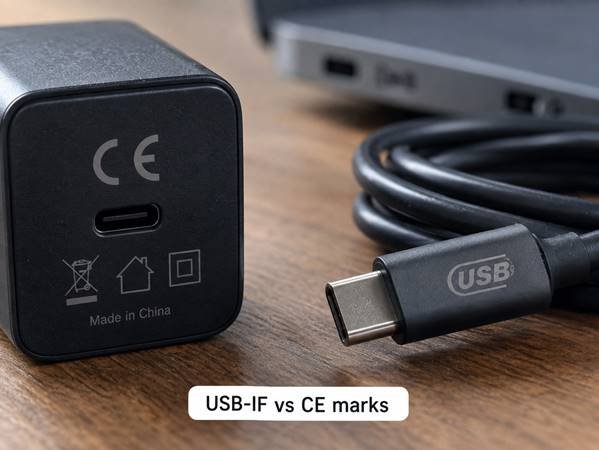
Before comparing the details, let’s first nail down the most core nature difference to avoid getting more confused as we read on:
USB-IF certification is a voluntary certification launched by the USB Implementers Forum (an industry alliance). Its core focus is the compatibility of USB functions. Only after passing the certification can you use the official USB logo, and each product will be issued a unique TID certification number, which is equivalent to a “USB industry compatibility certificate”. It is not required by law.
The CE mark, on the other hand, is a mandatory market access conformity mark legislated by the European Union. It is not a “quality medal” issued by a certain institution, and its core focus is the safety and environmental compliance of products. Any product within the scope of control sold in the EU/European Economic Area (EEA, including 27 EU countries + Norway, Iceland, Liechtenstein) must bear the CE mark to be legally marketed, which is equivalent to a “ticket to enter the EU”.
Simply put: USB-IF governs “whether USB functions work well and are compatible”, while CE governs “whether it is compliant and safe to sell in the EU”. The two have completely different roles and cannot replace each other.
Our Comparison Premise
All comparisons today are for ordinary consumer-grade USB charging accessories: including USB-C fast charging cables, ordinary charging cables, chargers/power adapters, and do not include USB products in special fields such as industry and medical treatment. Whether certification is required and which type to apply for are mainly affected by four factors: sales region, product power, whether it has an active (with chip) or passive (without chip) structure, and whether the official USB logo needs to be used.
Core Attribute Comparison: Differences in Mandatoriness, Scope, and Applicable Regions
Mandatoriness and Consequences of Violation
The most essential difference between the two is the question of “whether it is required”:
• USB-IF is completely voluntary. It is only required when you want to use the official USB/PD logo, enter e-commerce platforms that require USB-IF certification, or when the major clients you work with require it. If you violate the rules (for example, using the official logo without certification), the consequence is that the trademark authorization will be revoked and you will be removed from the certification list on the USB-IF official website, and there will be no legal fines.
• CE is a statutory mandatory requirement in the EU/EEA, which is a hard threshold that “you cannot sell without it”. If you violate the rules, in mild cases, goods will be detained by customs and removed from platforms for recall; in severe cases, you will be fined, with the specific amount determined according to the regulations of different countries.
Of course, there are also overlapping scenarios: some cross-border e-commerce platforms require both CE and USB-IF certification for USB accessories targeting the EU market before they can be listed, which is equivalent to the platform adding an additional compatibility threshold on top of EU access.
Coverage of Charging Products
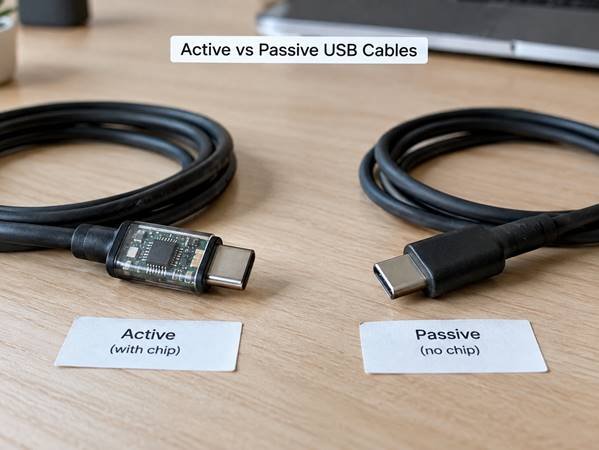
Even for USB accessories, not all products are within the scope of control of both:
• USB-IF has a wide coverage: as long as it is a charging accessory with a USB interface and uses the USB protocol, you can apply for it, whether it is a cable, charger, docking station, power bank, as long as it involves USB functions.
• The mandatory scope of CE only covers active products—that is, products with internal circuits and chips that actively process signals or power, such as USB-C fast charging cables with E-Marker chips (small components used to negotiate fast charging power), USB chargers, and powered docking stations. As for passive ordinary USB cables that only have pure copper wire cores and connectors without any electronic components, they do not fall into the category of electrical products under CE mandatory control, and do not need to bear the CE mark to enter the EU. They only need to meet relevant requirements in terms of material environmental protection (such as the RoHS Directive).
Many people can’t tell the difference between active and passive: simply put, if you get a cable that can support fast charging above 100W or can transmit high-speed data above USB 3.0, it is most likely an active product with an E-Marker chip; if it is just an ordinary 5V2A charging cable with no data function, it is basically passive.
Applicable Regions and Scenarios
• USB-IF is globally applicable with no regional restrictions. No matter which country you sell in, having this certification is equivalent to providing official endorsement for the USB compatibility of the product, which can enhance user trust and is a “bonus item”.
• CE is only valid in the EU/EEA region. The post-Brexit UK no longer recognizes the CE mark, and a separate UKCA mark is required to sell in the UK.
The most typical combination is brand chargers exported to the EU: CE is a necessary access threshold, without which you cannot enter the EU market; USB-IF is a bonus item to enhance product competitiveness, which can make users more confident in its PD fast charging compatibility.
| Comparison Dimension | USB-IF Certification | CE Certification |
| Core Nature | Voluntary compatibility certification from an industry alliance | Statutory mandatory access mark of the EU |
| Mandatoriness | Non-statutory; required when using official marks / required by platforms | Mandatory for EU/EEA markets |
| Core Control Focus | USB function compatibility, authenticity of stated specifications | Safety, environmental protection, electromagnetic compliance |
| Applicable Regions | Globally applicable | Only valid in the EU/EEA |
| Core Function | Authorizes official USB logo, provides compatibility endorsement | Legally enter the EU market |
Comparison of Testing Requirements: The Things Tested Are Completely Different
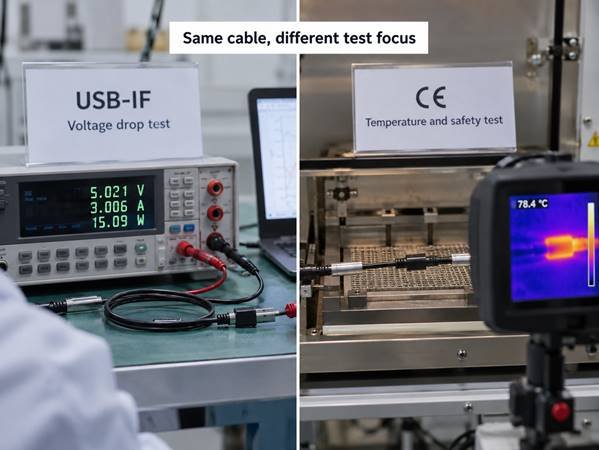
Many people think “since they are both certifications, the testing content is similar”. In fact, the testing objectives of the two are completely different. Even if there are test items that seem similar, the starting points are different, and they absolutely cannot replace each other.
Core Objective Differences
• All tests of USB-IF are carried out around “whether USB functions meet the specifications”, with the core being to verify compatibility and the authenticity of stated specifications—for example, if you say this is a 100W PD fast charging cable, it must actually support 100W, and must work normally with devices of different brands.
• All tests of CE are carried out around “personal safety and environmental compliance”, with the core being to verify that the product will not harm users or damage the environment—for example, it must not leak electricity or catch fire, must not contain toxic substances, and must not interfere with other electrical appliances.
For example: both will test the current resistance performance of the cable, but USB-IF tests “whether the voltage drop is too large when current passes through, resulting in the actual charging power not reaching the stated value”, while CE tests “whether it will overheat and catch fire when current passes through, and whether the insulating layer will break down”—it seems to test the same thing, but the purposes are completely different.
Core Test Items for Charging Products
Taking common charging accessories as an example, let’s see what each of the two tests:
Core Test Items of USB-IF
1. Fast charging protocol handshake test: Verify whether fast charging protocols such as PD can normally negotiate power, so that there will be no situation where the device burns out as soon as it is plugged in, or only slow charging is possible. This is the most core test for fast charging accessories.
2. Multi-device compatibility test: Pair the product with mobile phones, computers, and chargers of different brands to ensure that they can all charge and transmit data normally, and there will be no situation where “it can only fast charge a certain brand of mobile phone, and nothing else”.
3. Physical performance test: Including the plug-and-unplug reliability of the interface (for example, whether it will break after 10,000 plug and unplug cycles), the current resistance of the cable, and whether the voltage drop meets the standard, to ensure that there will be no problems with long-term use.
4. Additional tests for high specifications: If it is a high-power, high-speed product such as 240W PD3.1 or USB4, additional corresponding special items need to be tested, and there will be many more test items.
Core Test Items of CE
1. Electrical safety test: The core is electric shock prevention, flame retardancy, and insulation performance, to ensure that the product will not leak electricity or catch fire, and will not harm users even if it malfunctions.
2. Electromagnetic Compatibility (EMC) test: It is divided into two parts: first, the product itself will not emit excessive electromagnetic interference that affects the normal operation of nearby electrical appliances; second, the product will not fail due to external electromagnetic interference—for example, when there is a router nearby, the charger will not suddenly break down.
3. Hazardous Substances Test (RoHS): Test the content of toxic and harmful substances such as lead, mercury, and cadmium, which must meet the EU’s restriction requirements to avoid harm to the environment and human body.
4. Additional test items for chargers: If it is a power adapter such as a USB charger, it must additionally meet the EU’s energy efficiency requirements, must not consume too much power, and comply with the provisions of the Energy-related Products (ErP) Directive.
Common Factors Affecting Test Complexity
Although the test content is different, several factors will increase the test complexity of both types of certification at the same time:
• The higher the product power, the more test items there are for both certifications. For example, a 240W product definitely has more tests than a 20W one.
• For cables with data transmission function, USB-IF requires additional testing of data transmission compatibility, so there are more test items than cables that can only charge.
• The more complex the product functions, such as multi-port chargers and docking stations with video/network card functions, the more safety and EMC items CE needs to test.
Process, Cost and Responsibility: Who Is Responsible, How to Apply, How Much It Costs
Many people care about “how long it takes to get this certification, how much it costs, and who is responsible”. The differences between the two in this part are also very large.
Responsible Entity and Certification Issuance Logic
This is the most easily misunderstood point:
• USB-IF follows the “institution review and certification issuance” model: samples must be sent to a laboratory officially recognized by USB-IF for testing. After passing the test, they must be submitted to the USB-IF association for review. Only after passing the review will the certificate be issued and the product be listed in the official certification database. The validity is jointly endorsed by the association and authorized laboratories.
• CE follows the “manufacturer/importer responsibility” model: CE is not a “certificate” issued by a certain institution, but a set of compliance systems. The ultimate responsibility is borne by the product manufacturer or the EU importer. For low-risk USB products, enterprises can test by themselves and declare compliance by themselves, without needing to find a third-party institution; only high-risk products need to find a Notified Body (NB for short) recognized by the EU to participate in the assessment.
There is a very important reminder here: the full set of technical documents for CE compliance (including test reports, declarations of conformity, etc.) must be kept for 10 years. EU regulatory authorities can request to inspect them at any time, and if you cannot produce them, you will be deemed non-compliant.
Differences in Application Process
• The USB-IF process is relatively fixed: send samples to a designated laboratory recognized by USB-IF → the laboratory passes the test → submit all materials to the USB-IF association for review → after passing the review, the product will be included in the official certification list, and a unique TID certification number will be issued. The entire process must go through the official designated channel, and tests done by the enterprise itself are not counted.
• The CE process is more flexible: first identify the EU regulations applicable to the product → arrange product testing (can be tested by yourself or by a third-party laboratory) → organize a full set of technical documents → sign the EU Declaration of Conformity (DoC for short) → affix the CE mark on the product. Low-risk products do not need to be reviewed by official institutions, and enterprises are responsible for compliance themselves.
Cost and Cycle Range
The specific cost and cycle are affected by many factors. Here is a general reference range for you:
• USB-IF certification: The cost of a single product is about several thousand to tens of thousands of RMB (equivalent to hundreds to thousands of US dollars), and the cycle is usually 4-8 weeks. The specific time depends on the complexity of the product and the test pass rate. If the test fails and rectification is required, both time and cost will increase.
• CE certification: If it is a low-risk product and the enterprise makes a self-declaration, the cost is only several hundred to several thousand RMB, and the cycle can be completed in 2-4 weeks; if it is a high-risk product that requires the participation of a Notified Body (NB), the cost will rise to tens of thousands of RMB and above, and the cycle will be extended to 6-12 weeks.
The common influencing factors for both are: the higher the product power, the more complex the protocol, and the more test rectifications, the higher the cost and the longer the cycle.
Trigger Conditions for Certification Invalidation
Many people think that “once you do a certification, it is valid for life”, but that’s not the case. As long as one of the following situations occurs, the certification will become invalid and needs to be re-evaluated or re-applied:
1. Replacement of key components: such as the wire core of the cable, connector, E-Marker chip, or the power chip of the charger, etc.
2. Modification of core parameters: such as the length of the cable, the maximum power of the product, data transmission rate, number/configuration of ports, etc.
3. The applicable regulations or USB standards are updated: for example, the EU has issued new safety requirements, or USB-IF has updated the PD protocol standard, the original certification may become invalid.
4. Change of the product manufacturer: different factories have different production processes and supply chains, so the original certification cannot be directly used.
Judgment by Product Scenario: What Certification Does Your Product Actually Need?
After talking about so many rules, some people may still not know what certification to require for a product they buy/sell. We will directly give you the judgment criteria based on the four most common types of USB charging accessories:
1. USB-C Fast Charging Cable with E-Marker Chip
• Sold in the EU: must meet CE requirements (because it is an active product and within the scope of CE control). If combined with USB-IF certification, it can better ensure fast charging compatibility and enhance product competitiveness.
• Used outside the EU: prioritize products with USB-IF certification, which can avoid false stated power, for example, the packaging claims 100W but the actual power is only 60W.
• Pitfall reminder: be sure to check the power level corresponding to the certification. Don’t just look at the “240W” printed on the product. You must confirm that the power parameters in the certification document are consistent with the stated value.
2. Ordinary Passive USB Charging Cable (Pure Copper Without Chip)
• Sold in the EU: there is no mandatory requirement to affix the CE mark (it is not an active electrical product), so there is no need to blindly pursue CE certification, as long as the materials meet relevant environmental protection requirements.
• Daily use: if it is only used for slow charging of ordinary devices, USB-IF certification is not required; if it is used for fast charging or high-speed data transmission, prioritize products with USB-IF certification.
3. USB Charger/Power Adapter
• Sold in the EU: CE is an absolute hard threshold, covering multiple requirements such as safety, EMC, RoHS, and energy efficiency. Without CE, it is impossible to sell legally in the EU at all.
• Sold globally: USB-IF certification can greatly improve the credibility of PD fast charging compatibility, and is suitable for mid-to-high-end brand products.
• High-power chargers above 65W: prioritize products with dual certifications, which can ensure safety and compliance while avoiding fast charging incompatibility issues.
4. Docking Station/Hub with USB Power Supply
• Sold in the EU: CE needs to be evaluated based on the complete functions of the product, not just the USB interface part. If the docking station also has functions such as video output, network card, and card reader, these functions must also meet relevant CE requirements.
• USB compatibility: USB-IF certification only covers the USB part of the product, and does not mean that other functions such as video and network card are also compliant. Special attention should be paid to this point.
Mark Identification and Authenticity Query: Don’t Be Fooled by Fake Marks
Now many products print a random USB or CE logo on the packaging and claim to have passed certification, but many are fake. Here are some methods of identification and query to avoid pitfalls.
Official Requirements for Mark Styles
First of all, just printing the letters doesn’t count. Official marks have strict specifications:
• USB-IF certification mark: must contain the words “USB-IF Certified”, or use the official unified PD and USB-C logos. If there is only a separate USB trident logo without the word “Certified”, it is most likely that the product has not passed formal certification.
• CE mark: must be “CE” letters in standard proportions (the height and spacing of the two letters have clear regulations). If the product is evaluated with the participation of a Notified Body (NB), the CE mark will be accompanied by a 4-digit NB institution number next to it.
Simply put: if only casually designed letters “USB” or “CE” are printed, it can basically be judged as an invalid mark, and does not count as passing certification.
How to Check the Authenticity of USB-IF Certification
All certified products of USB-IF are in a public list on the official website, which is very convenient to check:
1. Log in to the product listing database on the USB-IF official website, you can directly search for the brand, product model, or enter the product’s TID certification number.
2. Check the product model, power, length, and interface type in the query results, which must be completely consistent with the physical product you have.
Pitfall reminder: for products of the same series, different lengths and different powers may be certified separately. You can’t just look at the series name and think that the entire series has passed certification. For example, for a brand’s “Pro series fast charging cable”, the 1-meter model has passed 240W certification, but the 2-meter model may only have passed 100W. Be sure to correspond to the specific model and parameters.
How to Verify the Authenticity of CE Compliance
Since many CE certifications are self-declared by enterprises and there is no unified official website query, it is necessary to verify through documents:
1. Ask the seller or manufacturer for the EU Declaration of Conformity (DoC) for the corresponding model, which is the core document of CE compliance.
2. Check the information on the DoC: product model, manufacturer’s name and address, applicable EU regulations, signatory information, etc., must be complete and consistent with the product.
3. If it is a high-risk product with the participation of a Notified Body (NB), you can check the validity of the certificate on the official website of the corresponding NB institution.
Note: Test reports issued by third-party laboratories are not equivalent to complete CE compliance. CE compliance requires a full set of technical documents plus a DoC declaration. A test report alone is not enough.
Common Fake Mark Identification Tips
Here are a few fake marks that can be identified at a glance:
• USB-IF category: only the USB trident logo, no “Certified” word, or the mark style is different from the official one, are basically fake.
• CE category: incorrect letter proportions (for example, C and E are the same size, incorrect spacing), no DoC document for the corresponding model, or the NB number cannot be found, are all invalid.
• General pitfall avoidance: don’t just look at the printing on the packaging, be sure to use the official listing (USB-IF) or formal DoC document (CE) as the standard.
Common Misconceptions and Pitfall Avoidance: Don’t Be Fooled by Marketing Rhetoric
There are many common misunderstandings about these two certifications on the market, many of which are marketing traps of merchants. Let’s clarify them one by one:
Misconception 1: USB Accessories with CE Support Fast Charging
Truth: CE only tests safety, environmental protection, electromagnetic compatibility and other content, and does not involve the compatibility of USB protocols at all. Whether it can fast charge depends on whether the product has USB-IF certification, or whether it has corresponding fast charging protocol marks such as PD and QC, which has nothing to do with CE.
Misconception 2: Products with USB-IF Certification Can Be Sold in the EU
Truth: USB-IF is a voluntary industry certification, not a statutory access requirement of the EU, and cannot replace CE certification at all. To enter the EU market, regardless of whether you have USB-IF or not, you must first meet the CE requirements.
Misconception 3: All USB Cables Need CE Certification
Truth: Only active USB cables with chips are within the mandatory control scope of CE. Passive pure copper ordinary charging cables are not electrical products and do not require mandatory CE certification. Don’t be fooled by merchants’ rhetoric of “full series CE certification”.
Misconception 4: CE Certifications Are All Issued by Official EU Laboratories
Truth: Most low-risk USB accessories are self-declared by enterprises to meet CE requirements, and do not need to be certified by EU official or third-party institutions. Only high-risk products require the participation of a Notified Body (NB) in the assessment, and NBs are all third-party institutions, not “official laboratories”.
Misconception 5: USB Cables Without USB-IF Certification Are Unqualified
Truth: USB-IF is not a statutory mandatory certification. Without certification, it just means there is no official compatibility endorsement, it does not mean the product is illegal, nor does it mean the quality is necessarily poor. Many reliable brand products, although they have not done USB-IF certification, have no problem with actual compatibility, they just didn’t spend the cost to get official endorsement.
Misconception 6: A 240W Certified Cable Can Charge All Devices at 240W
Truth: The actual charging power is determined by the charger, cable, and device together, taking the minimum of the maximum power supported by the three. Even if the cable is 240W, if the charger is only 65W and the phone only supports 30W, the final charging power will only be 30W. It’s not that the cable can charge at whatever power it supports.
Decision Logic for Different Identities: Choose According to Your Needs
Different people have completely different needs for certification. There is no need to blindly pursue “the more certifications the better”, just choose according to your own scenario:
For Ordinary Consumers Purchasing Products
• Users in non-EU regions: prioritize products with USB-IF certification, which can maximize the compatibility of fast charging and data transmission, and avoid device damage due to incompatibility.
• Users in EU regions / overseas shopping users: must first confirm that the product has CE compliance. On this basis, adding USB-IF certification will be more reliable.
• Scenarios with high power above 100W or requiring high-speed data transmission: prioritize products with dual certifications, which balance safety and compatibility.
For Cross-Border Sellers / Procurement Compliance
• Doing EU market: CE is the absolute bottom line for access. You must first complete CE compliance, otherwise you can’t even pass customs; USB-IF certification can be selected according to product positioning. If you are doing brand or mid-to-high-end products, getting it can enhance competitiveness.
• Doing non-EU markets: CE is not a mandatory requirement, and USB-IF can be applied for according to the requirements of the platform or major clients, no need to do it blindly.
• Product change reminder: as long as key components or parameters such as wire core, chip, power, interface are replaced, be sure to reconfirm the validity of the certification. You cannot directly use the original certification, otherwise there will be problems.
Key Points for Supplier Audit
If you are a purchaser and want to audit the certification qualifications of suppliers, remember three points:
1. Require suppliers to provide USB-IF TID screenshots and CE DoC documents for the specific model, not just a series certificate.
2. Carefully check the product model, version, and parameters on the documents, which must be completely consistent with the products you actually purchase.
3. Confirm that the certification is within the validity period, or that the corresponding regulations and standards have not been updated to invalidate the certification.
Core Summary
Regarding the difference between USB-IF and CE certification, just remember these four points:
First, completely different natures: USB-IF is a voluntary industry compatibility certification that governs how well USB functions work; CE is a mandatory EU safety and environmental protection access mark that governs whether a product can be sold in the EU. The two cannot replace each other.
Second, judge needs based on scenarios: Combine the region of use or sale, whether the product is active or passive, and the power level to determine which certifications are needed; there is no need to blindly pursue more certifications.
Third, know how to verify certification authenticity: Check USB-IF certification in the official listing database on the website; for CE, request the DoC document for verification. Don’t just rely on the printing on the packaging.
Fourth, avoid marketing traps: Don’t believe rhetoric like “having CE means it supports fast charging” or “the more certifications the better”. Just choose the most suitable option according to your needs.