
Many sellers of charging products who are new to the North American market have a string of questions when they first encounter UL and ETL certifications: What’s the difference between the two? Why is there such a large gap in quotes? Is the more expensive one stricter, and the faster one less rigorous? Today, starting from “whether you need to get certified”, we will thoroughly cover costs, cycles, pitfalls to avoid, and selection, so that even beginners can understand and make decisions on their own.
First, Understand: Does Your Product Really Need UL/ETL Certification?
Not all products are required to have UL/ETL certification. You can check one by one in order from mandatory to voluntary requirements to avoid wasting money:
First, look at regulatory and local supervision requirements: The United States does not have unified national mandatory safety certification rules. You need to check the acceptance requirements of the AHJ (the local regulatory authority responsible for electrical safety and fire acceptance inspection) in the target sales location; regulations may vary from state to state and city to city.
Second, look at platform, retailer, or procurement contract requirements: This is actually one of the common mandatory requirements. For example, North American sites of Amazon and Walmart, or supplier agreements and written customer requirements, may explicitly require NRTL Listing certification, test reports to applicable standards, or other compliance documents. NRTLs are organizations recognized by the U.S. OSHA that engage in product safety testing and certification within their recognized scopes of standards and facilities; which specific documents are accepted shall be subject to product category, platform policies, and contract requirements.
Third, look at B-end customer or bidding requirements: Many corporate procurement and government bidding projects explicitly specify the UL or ETL mark; in this case, just follow the requirements.
Fourth, look at commercial risks and brand needs: Even if there are no mandatory requirements, obtaining safety certification can reduce liability risks when product problems occur, and also improve user trust. It is a voluntary but valuable choice.
Before moving on, let’s clarify four most easily confused concepts, otherwise it’s easy to fall into pitfalls:
The first is test report: Many people think that getting a “report tested to UL standards” counts as UL certification, but that’s not the case — independent test reports usually only record the results of tested samples obtained according to the methods and conditions listed in the report. They are not equivalent to Listing certification in themselves, nor do they automatically grant the right to use the UL or ETL certification mark. Using the mark without authorization from the certification body may constitute unauthorized use or misleading compliance claims, and lead to delisting, claims, or regulatory risks.
The second is Listing (Listed): The “UL certification” and “ETL certification” we often talk about mostly refer to Listing certification, which is a certification type for final finished products. For example, a 20W USB-C wall charger you sell to consumers can only be printed with the corresponding mark and sold legally after completing Listing certification. Listing does not only require testing samples; it also includes factory inspection, mark authorization, and regular follow-up inspections after obtaining the certificate, which is a complete set of processes.
The third is mark authorization: Simply put, it is whether you can affix the mark. It must be officially approved by the certification body, and you cannot print it yourself just because the product has been tested. The certification body will give you clear mark usage specifications, such as size, position, and style; non-compliance with the requirements is also not allowed.
The fourth is follow-up inspection service: Obtaining the certificate is not a once-and-for-all matter. The certification body will conduct regular or irregular spot checks at the factory to confirm that mass-produced products are consistent with the certified samples and that quality control meets requirements. Only by passing inspections continuously can the certificate remain valid.
For friends who make charging products, for products such as wall chargers, car chargers, high-power USB-C power cables, and AC power cord sets, NRTL Listing may be an important requirement for workplace use, specific AHJ acceptance, retail channels, or procurement contracts. Whether it is mandatory and what kind of compliance documents are accepted shall be confirmed item by item according to product category, target sales location, platform policies, and written customer requirements. As for choosing UL or ETL, the first step is to see if anyone explicitly specifies which mark to use; if specified, there is no need to hesitate, just apply for the corresponding one.
Clarify Their Status: How Much Difference Is There in the Validity of UL and ETL?
Many people think ETL is less formal than UL. In fact, the core identity and compliance acceptability of both have clear official definitions:
The UL mark is used by the certification services of UL Solutions; the standard-setting function of the UL system is undertaken by the independent UL Standards & Engagement. The UL brand has a long history, so it has relatively high awareness in market perception. ETL is a brand under Intertek (Intertek Group), and Intertek Testing Services NA, Inc. is one of the major NRTL bodies in the United States, with equally extensive business coverage.
In the U.S. market, legal entities such as UL LLC and Intertek Testing Services NA, Inc. are all OSHA-recognized NRTLs. If the certification body has the corresponding OSHA recognition scope for the same standard, and the target AHJ, customer, or channel does not specify a particular mark, the compliance acceptability of the two is usually comparable; however, specific requirements still need to be verified.
It is important to note here that there is no such thing as “North America universal certification”. Electrical products in Canada usually need to comply with the approval requirements applicable to the target province or region. It is necessary to confirm that the certification body has SCC recognition within the relevant product and standard scopes, and that its Canadian mark and certification scope meet the regulatory requirements of the target province or region; a U.S.-only US mark usually cannot replace the approval required in Canada.
So before choosing, first check if your target sales channel or customer has specifically requested the UL mark — for example, some high-end offline chains and bidding projects will explicitly specify UL, in which case just choose UL directly without comparing back and forth.
You may ask, what standard applies to my product? Here is a preliminary screening reference for you. Note that this is only a reference, and the final conclusion must be subject to the written confirmation of the certification body. Do not forcefully apply it yourself:
• For ordinary fast chargers like 20W USB-C wall chargers, the common reference standard is UL 62368-1, which also depends on the output power and whether there are additional functions;
• For plug-in AC power cord sets (the cord that plugs into the wall on one end and the charger on the other, not a USB data cable), the common reference is UL 817. This standard only covers AC power cords and does not apply to USB cables;
• For USB-C power/charging cables, the common reference is UL 9990. For high-power cables, it is also necessary to verify whether the E-Marker chip, conductor specifications, etc. meet the requirements;
• For ordinary car chargers (the kind that plugs into the cigarette lighter), the common reference is UL 2089. This standard does not apply to special car chargers with inverter or energy storage functions.
In addition to Listing, there is another type of certification called Component Recognition (Recognized), which many people confuse with Listing, resulting in completely invalid quote comparisons. Listing is for finished products sold directly to users, and after completion, the product can be directly labeled and sold; while Component Recognition is for components inside the finished product, such as power ICs and transformers in chargers. It only proves that the part itself meets the requirements, and can only be used in conjunction with the Listing certification of the complete machine. It cannot be used alone to claim that “the entire product is certified”. Not only Component Recognition, but also different deliverables such as test reports and on-site evaluations have completely different quotes, usage scenarios, and labeling rights, and must never be compared together.
Let’s talk about the difference between U.S. and Canadian certification marks. The common ones are:
The first type has the US mark, which only corresponds to the requirements of the U.S. market;
The second type has the c mark (such as cUL, cETL), which usually corresponds to the requirements of the Canadian market, but it is still necessary to confirm that the certification body has SCC recognition within the relevant product and standard scopes, and meets the regulatory requirements of the target province or region;
The third type is dual-country marks (such as cULus, cETLus), which cover the certification scopes of both the United States and Canada. Factory inspections can be combined, and they are not two completely independent processes, so the cost will not be twice that of a single country.
Here’s a pitfall to avoid: Certification with only the US mark usually cannot replace the approval required for the Canadian market. Don’t try to save trouble by using it directly.
Must-Do Before Comparison: Unify the Caliber to Avoid Invalid Comparison
Many people ask several agencies for quotes and get more confused as they compare, mostly because the calibers of comparison are different — if you compare the quote for a 20W product with that for a 65W product, or compare a quote without factory inspection with an all-inclusive quote, you will certainly not get a correct conclusion. So before comparing, be sure to unify the caliber first.
Let’s use a most common benchmark sample to unify the reference: a 20W U.S.-standard USB-C wall charger, with frozen design, complete documentation, in mass production, applying for U.S. market Listing certification, standard service (no expedite), no rectification, and a single domestic factory of the same scale. Note that this benchmark is only for unifying the comparison logic, not that all products have this price and this cycle.
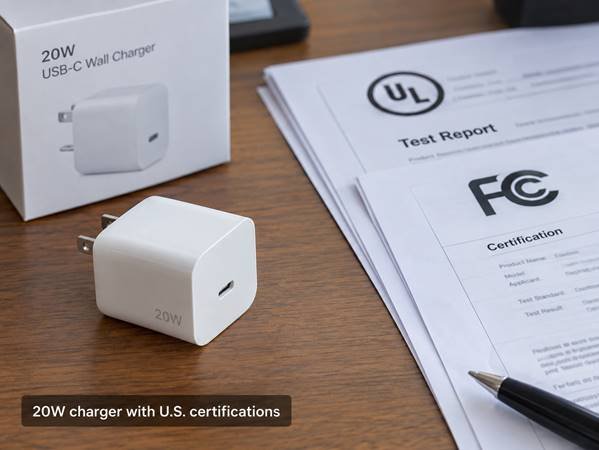
Specifically, four core dimensions need to be unified:
The first is product dimension: It must be the same power, same structure, same number of models, same sample status, and the certification status of key safety components must also be the same — for example, if one uses a certified capacitor and the other uses an uncertified one, the quotes will definitely be different;
The second is certification dimension: Same certification type (e.g., both are finished product Listing), same applicable standard and version, same covered countries and marks (e.g., both are U.S. single-country US mark);
The third is service dimension: Same expedite level, all including factory inspection, label authorization, travel and other services — some quotes look cheap because they do not include factory inspection travel expenses, which you will be asked to pay later;
The fourth is cost dimension: Compare the total cost of the whole cycle, not just the first test fee — many people ignore the annual fees and follow-up inspection fees later, and the actual total expenditure differs a lot.
If you encounter the following three situations, they are basically invalid comparisons and need not be referenced:
The first is comparing the quote of component certification with finished product Listing, which are not the same thing at all;
The second is comparing a low price without factory inspection and travel expenses with an all-inclusive price, which seems cheap but actually has high hidden costs;
The third is comparing the cycle of expedited service with rectification included with that of standard service without rectification, which is completely not on the same benchmark.
To get an accurate quote, you must first finalize these pieces of information, and don’t change them while the process is ongoing, otherwise the quote will keep changing:
• Sales country/region, and the certification mark you want (e.g., U.S. single US mark, or U.S.-Canada dual-country mark);
• Product name, intended use, list of main model and all derivative models;
• Input and output parameters, plug and cable configuration;
• Address of the production factory, and labeling location;
• List of key safety components and their certification status;
• Whether there are additional functions such as wireless, battery, or inverter;
• Whether there is a specified standard version, and whether to apply for U.S.-Canada dual certification.
Cost Breakdown: Don’t Be Tricked by “Low-Price Quotes”
Many people only look at the first number when seeing a quote, but the cost of certification is for the whole cycle and includes many easily overlooked parts. We divide it into three categories:
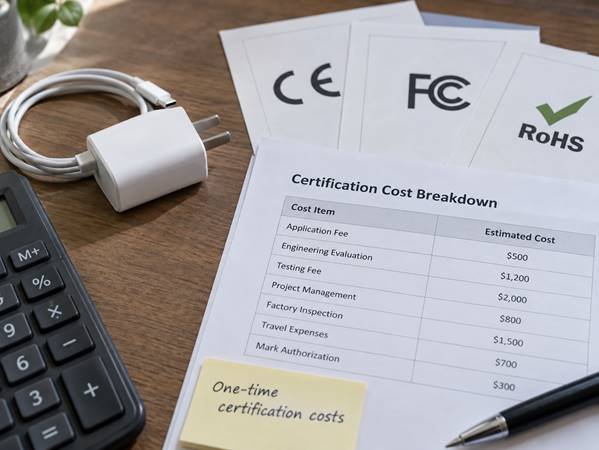
The first category is one-time costs: That is the money spent on the first certification, including application fee, engineering evaluation fee, testing fee, project management fee, first factory inspection fee and travel expenses, and first mark authorization fee.
The second category is annual maintenance costs: That is the money to be paid every year, such as follow-up inspection fees, certificate file maintenance fees, and annual mark authorization fees — if you plan to sell this product for a long time, this part of the cost must be included.
The third category is hidden potential costs: That is fees that may not be incurred but are easily generated, such as sample fees, international logistics fees for sending samples, rectification and retesting fees for failed tests, expansion fees for adding new models later, and change fees for replacing key components.
Many people ask, why are the quotes for 20W wall charger Listing certification different from different agencies? Is the more expensive one stricter? Actually, no. There is no public, unified fixed quote for certification fees, which fluctuate with standards, products, factories, and service levels. Under the premise of the same standard, same scope, and same type, the cost difference mainly comes from factors such as laboratory capacity, service solutions, and process efficiency. It cannot be directly assumed which agency has looser or stricter testing.
You can use these two formulas to roughly estimate the total cost. Note that not all items will be charged, and the final must be subject to the contract:
Total first-year cost = Application/engineering evaluation fee + Testing fee + First factory inspection and travel expenses + Label/file/project service fee + Sample logistics fee + Rectification reserve (optional)
Total three-year cost = Total first-year cost + Follow-up inspection and travel expenses for years 2-3 + Annual label/file fee + Model expansion and change reserve
If you are working on a long-term project, it is recommended to calculate the total three-year cost, which is more valuable for reference.
It should also be specifically clarified here that UL/ETL certification is only NRTL safety certification and does not include other compliance items. The following all require separate payment: FCC radio frequency equipment authorization/electromagnetic compatibility compliance (SDoC or Certification may apply, depending on the device category), energy efficiency certification, chemical compliance, USB-IF PD protocol certification, wireless function certification (such as Bluetooth, Wi-Fi), etc. Don’t confuse safety certification with protocol certification — for example, if you have a USB-C cable with UL 9990 certification, it only passes the safety certification, not the USB-IF PD protocol certification. These two are completely independent projects.
After receiving the quote, you can check item by item against the table below to avoid missing items:
| Check Category | Content to Confirm |
| Basic Information | Quote validity period, currency, whether tax is included, applicable standard and version, covered countries/marks, certification type |
| Product Related | Number of models included, test items, sample quantity requirements |
| Service Related | Whether scheduling is included, number of first factory inspections, party responsible for travel expenses, mark authorization fee, follow-up inspection frequency |
| Additional Fees | Retesting fee rules, model difference fee, key component change fee, scope of expedited service and markup ratio |
| Exclusions and Payment Nodes | Clarify service items not included, payment ratio at each stage |
Cycle Breakdown: From Which Day Does the “Working Days” Mentioned by Agencies Count?
Besides cost, the cycle is also the most concerned issue for everyone. Many people think that the “4 weeks” mentioned by the agency starts from the day the samples are sent, but that’s not the case. The certification cycle is divided into four stages, and the responsible party for each stage is different:
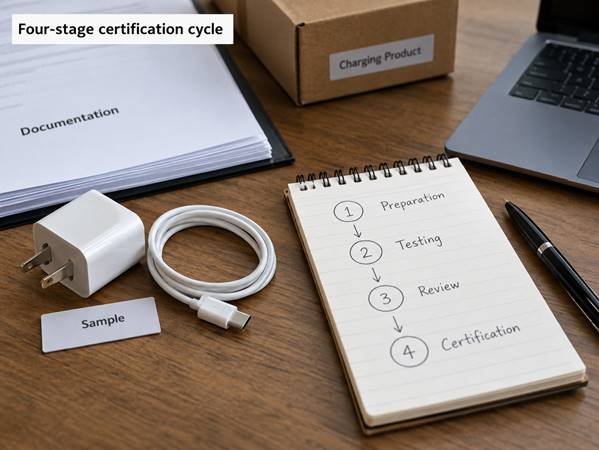
The first stage is customer preparation period: That is the time you spend preparing documents, samples, and rectification. This period is not included in the agency’s committed cycle — for example, if you spend half a month supplementing incomplete documents, that half month is your own time and cannot be counted as the agency being slow.
The second stage is agency scheduling and acceptance period: The time from when your samples and documents are all qualified and the agency officially accepts the case to when testing starts. Whether this period is included in the committed cycle depends on the contract agreement.
The third stage is testing/factory inspection/rectification period: The time to complete testing and the first factory inspection. Note that the time for rectification and retesting is not included in the agency’s committed cycle — if you spend a month rectifying after failing the test, that month is not counted.
The fourth stage is certificate issuance and mark release period: The time for the agency to issue the certificate and mark authorization after all documents, tests, and factory inspections are passed. This period is generally relatively short.
In summary: The committed working days mentioned by the agency usually start from the day of “official acceptance”. Whether it includes scheduling and factory inspection must be clearly stated in the contract, so as not to miss the launch time.
In terms of process, certification is mainly divided into four core stages:
The first is document review: The agency checks whether your product documents, circuit diagrams, and BOM are compliant and complete;
The second is product testing: Complete all safety test items according to applicable standards;
The third is the first factory inspection: Verify the factory’s production quality control capability. The order of this stage is not fixed; some agencies test first then inspect, some inspect first then test, which does not affect the final result;
The fourth is final review for certificate issuance: After all documents are reviewed and approved, issue the official certificate and mark authorization.
Like cost, there is no public, unified fixed cycle, which fluctuates with scheduling, products, and document quality. Under the premise of the same standard, same scope, and same type, the cycle difference mainly comes from factors such as laboratory scheduling, internal processes, project priority, and the cooperation efficiency of both parties. It cannot be said that agencies that issue certificates faster have looser audits.
Whether it is UL or ETL, the following situations will cause cycle delays, which must be avoided in advance:
• Incomplete or non-compliant documents that require repeated supplementation and revision;
• Failed tests that require rectification and retesting;
• Failed factory inspections that require rectification and re-inspection;
• Tight scheduling during peak seasons — Q3-Q4 each year, before the stock-up period for Black Friday and Christmas, is the peak season for certification. Laboratory capacity is tight, and scheduling will be longer than usual.
What Factors Will Push Up Costs and Lengthen the Cycle?
After understanding the basic cost and cycle, you must want to know what factors affect them. We divide them into four categories, and you can evaluate in advance against your own product.
The first category is product-related factors:
• Power/energy level: Higher rated power or higher energy level may increase the complexity of temperature rise, energy source, key component, and structural evaluation, but there is no general threshold that 65W or GaN will necessarily increase test items;
• Product complexity: Products with multiple interfaces, multiple plugs, and special functions (such as with a display screen, with wireless charging) have more test and audit items, which are naturally more expensive and slower;
• Model family size: Whether multiple models of the same platform can adopt difference evaluation, and what additional tests are required, shall be judged in writing by the certification body according to the actual differences of each model. Even if only the power or enclosure is changed, more supplementary evaluation may be required;
• Key safety component status: If key components (such as capacitors, transformers, ICs) have compliant certification and are traceable, the risk of review and rectification can be reduced. But note that the component certification of ordinary power ICs cannot replace the safety evaluation of the whole machine. Don’t think that just because the internal parts are certified, the entire product does not need certification.
The second category is certification scope-related factors:
• Covered countries: U.S.-Canada dual-country scope may increase certification cost and cycle, but it is not necessarily calculated as two independent processes or twice the cost. It shall be confirmed according to the applicable U.S./Canadian versions of the product, availability of joint standards, mark scope, factory services, and the written quote of the agency;
• Certification type: Component Recognition has lower cost and shorter cycle than finished product Listing, after all, the covered scope is different;
• Special test requirements: If you need to do additional tests such as waterproof, bending resistance, high and low temperature, these are charged separately and will also increase the cycle.
The third category is factory-related factors:
• Number and location of factories: Multiple production factories, or factories located overseas, will increase the cost of factory inspections and make scheduling longer;
• Certification experience with the same agency: If your factory has done certification for other products with this agency, some processes can be simplified during factory inspections, the cycle will be shorter, and some fees can also be reduced;
• Factory quality control level: New factories with imperfect quality control have a higher probability of failing tests and factory inspections, which will increase hidden costs and cycle.
The fourth category is service and external factors:
• Expedite level: Expedited service can shorten the time of scheduling and internal processes, but the cost will rise — note that expedited service does not reduce any mandatory test items, it only raises the priority of your project, and the premise is that your documents are complete and the samples pass at one time, otherwise expedited service is useless;
• Maturity of documents and samples: Samples with complete documents and frozen design will have smoother review and testing, shorter cycle, and lower probability of rectification; if you change while testing, both the cycle and cost will get out of control;
• Peak season scheduling: Q3-Q4 each year is the peak season for North American stock-up, with high demand for certification, longer scheduling, and costs may also rise slightly. If you are rushing for goods in the peak season, it is best to start certification 2-3 months in advance.
Pitfall Avoidance Guide + Selection Method
After talking so much, finally let’s talk about what everyone is most concerned about: how to avoid pitfalls, and how to choose between UL and ETL?
First, list the most common misconceptions, don’t be misled:
Misconceptions About Recognition
1. “ETL is a copycat of UL and has lower recognition” — Wrong. Legal entities such as UL LLC and Intertek Testing Services NA, Inc. are all OSHA-recognized NRTLs. If the certification body has the corresponding OSHA recognition scope for the same standard, and the target AHJ, customer, or channel does not specify a particular mark, the compliance acceptability of the two is usually comparable; it’s just that UL has a longer history, and some customers will specify the UL mark;
2. “Complying with UL standards means having UL certification” — Wrong. Complying with standards is the foundation. You also need to complete factory inspections and obtain official mark authorization to be truly UL certified. Saying you comply on your own is useless;
3. “U.S. NRTL certification is universally valid in Canada” — Wrong. The U.S. and Canada have two independent systems. Certification with only the US mark usually cannot replace the approval required for the Canadian market. It is necessary to confirm that the certification body has SCC recognition within the relevant product and standard scopes, and meets the regulatory requirements of the target province or region.
Misconceptions About Rules
1. “You can affix the certification mark once you get the test report” — Wrong. You must complete the full certification process (including factory inspection and mark authorization) before affixing the mark. Affixing the mark with only a test report may constitute unauthorized use or misleading compliance claims;
2. “Listing certification is permanently valid once passed” — Wrong. Listing certification requires continuous compliance with requirements and acceptance of follow-up inspections by the agency for the certificate to remain valid;
3. “Component certification can be directly used as finished product certification” — Wrong. Component Recognition only applies to components inside the complete machine, and must be used in conjunction with finished product Listing. It cannot be used alone as a certification credential for finished products.
Misconceptions About Cost and Cycle
1. “Agencies with lower quotes have looser testing / agencies that issue certificates faster have looser audits” — Wrong. Differences under the same caliber mainly come from factors such as service configuration, scheduling, and process efficiency, not strictness. NRTL agencies must carry out certification work within their OSHA-recognized standards and facility scopes;
2. “The quoted price is the total cost” — Wrong. Many quotes do not include factory inspection travel expenses, rectification and retesting, mark authorization, annual maintenance fees, etc. The total cost of the whole cycle must be calculated;
3. “Expedited service can skip test links” — Wrong. Expedited service only shortens internal scheduling and process time, and no mandatory test items are reduced. Don’t think that paying more can save steps.
So when to choose UL and when to choose ETL? Let’s talk by scenario:
Scenarios where UL is preferred:
• Customers, channels (such as high-end offline chains, bidding documents) explicitly require the UL mark;
• You already have many products with UL certification, and unifying the mark can reduce management costs;
• UL’s local service team response and support better match your needs.
Scenarios where ETL is preferred:
• The target platform or retailer accepts in writing any NRTL certification mark with the corresponding OSHA recognition scope;
• The project launch time is tight, and ETL’s scheduling and cycle better meet your needs;
• Under the same caliber, ETL’s official written quote has a cost advantage.
You can make a decision in these three steps, which is simple and reliable:
Step 1: Confirm the certification type required by the target market, sales channel, and regulatory requirements, and whether a specific mark is specified — if UL is specified, choose UL directly without comparison;
Step 2: Use the same complete set of product documents to apply for full-cycle written quotes from 2-3 agencies to ensure all calibers are unified;
Step 3: Compare the first-year/three-year total cost, cycle commitment, local service support, and change response speed, then make a decision combined with your own needs. Don’t just look at price or just look at speed.
Before starting the certification, you can prepare these things first, which can save a lot of detours:
• Technical documents: Product photos, parameter sheets, circuit diagrams, BOM (with the certification status of key safety components marked);
• Factory documents: Factory address, production process, labeling location, quality control system description;
• Internal preparation: Be sure to freeze the product design and key component BOM before testing, don’t change while testing. Also reserve a certain rectification budget and time buffer, don’t schedule it right up against the launch time.
We use two common charging product cases to give you a decision-making demonstration — note that this is only a demonstration, there are no fixed cost and cycle values, and the final shall be subject to the agency’s quote.
Case A: 20W USB-C wall charger, U.S. single-country certification, single factory, frozen design, complete documents
Core confirmation points: Applicable standards, number of samples required, all items included in the quote, current scheduling time.
Common risks: Key safety components without recognition files leading to rectification, incomplete documents delaying the review progress.
Mark selection logic: If the channel does not specify a mark, compare the full-cycle cost, cycle commitment, and local service response speed under the same caliber, and choose the agency that best matches your project rhythm.
Case B: 240W USB-C power cable, U.S.-Canada dual-country certification, supports PD EPR function
Core confirmation points: Applicable safety standards, whether separate USB-IF PD certification is required, cost of dual-country marks, sample requirements.
Common risks: E-Marker chip or conductor specifications not meeting safety requirements leading to retesting, tight scheduling for dual-country certification.
Mark selection logic: First confirm that the channel accepts any NRTL certification mark with the corresponding OSHA recognition scope, then compare the agency’s dual-country service capability, full-cycle quote, and change response speed before making a decision.
Finally, three special reminders for friends who make charging products:
First, for USB-C charging cables, distinguish between NRTL safety certification (such as UL 9990) and USB-IF PD protocol certification. The two are independent and should not be confused;
Second, the applicable standards for chargers and car charging products must be subject to the written confirmation of the certification body. Do not apply standards arbitrarily by yourself;
Third, for all-in-one charging products (such as chargers with cables, multi-port fast chargers), the applicable complete machine standards and possible applicable component or cable requirements shall be determined according to the intended use, power supply path, structure, and additional functions of the overall product. Wall chargers with cables cannot be independently classified solely by the single category of “wall charger” or “cable”, and shall be confirmed by the certification body.
Core Summary
Finally, let’s summarize the core content for your convenience:
First, comparable qualifications have prerequisites. Legal entities such as UL LLC and Intertek Testing Services NA, Inc. are all OSHA-recognized NRTLs in the United States; when the certification body has the corresponding recognition scope for the same standard, and the target AHJ, customer, or channel does not specify a particular mark, the compliance acceptability of the two is usually comparable. The actual choice also depends on customer-specified requirements, certification scope, and target market rules.
Second, there are no public fixed values. Neither cost nor cycle has a unified public standard, and they fluctuate with factors such as products, standards, factories, and services. The final must be subject to the official written quote and contract commitment of the agency.
Third, the sources of differences are clear. The cost and cycle differences under the same caliber mainly come from factors such as service configuration, laboratory scheduling, process efficiency, and engineering investment, which have no direct relationship with test strictness or audit rigor.
After reading this article, you should be able to judge by yourself whether charging products need NRTL Listing, understand certification quotes, avoid the pitfalls of invalid comparison, and choose a suitable certification solution according to your own needs.