
If you are shopping for USB chargers in North America, or running a cross-border business selling charging products to the US and Canadian markets, you cannot avoid the term “UL certification”. Some say it is the entry ticket to the North American market, some say it is just a mark you can buy with money, and others cannot distinguish between UL Listed and Recognized, treating component certification as complete product qualification.
This article starts with basic concepts that ordinary users can understand, covering common products such as USB-A/C wall chargers, PD fast chargers, multi-port chargers, and desktop power adapters. The content includes mark identification, authenticity verification, common pitfalls to avoid, as well as the application and maintenance logic that cross-border sellers need to understand. Ordinary consumers can focus on the sections on basic concepts, mark identification, authenticity verification, and pitfall avoidance, while sellers or purchasers can additionally read the subsequent content on certification application and responsibilities.
First, Understand: What Exactly Is UL Certification?
Many people’s first impression of UL is “American safety certification”, but its nature, role, and boundaries are actually not the same as most people think.
The Relationship Between Three Core Concepts
First, we need to clarify three most easily confused terms:
• UL Solutions: A well-known third-party safety testing and certification agency brand in North America. UL LLC, a subsidiary of UL Solutions, is one of the “Nationally Recognized Testing Laboratories (NRTLs)” recognized by the US Occupational Safety and Health Administration (OSHA). For specific product certifications, it is necessary to confirm which accredited legal entity issued the certification. UL is not the only agency with NRTL qualification.
• UL Listed: A “finished product safety listing” mark issued by UL. It is not an administrative license compulsorily issued by the US government, but a certification result provided by a third-party agency based on applicable safety standards.
• Certification logic: UL certification is not “valid for life after submitting one sample”. Instead, corresponding safety tests are first conducted on the submitted samples. After passing the tests, production factories are inspected according to follow-up service arrangements to confirm that mass-produced goods remain consistent with the submitted samples within the requirements of the certification file.
Why Do USB Chargers Need UL Certification?
Chargers are essentially “isolated equipment that converts high voltage to low voltage”: North American mains electricity is typically 120V class voltage, which needs to be converted to low voltages such as 5V, 9V, and 20V to power mobile phones and computers. If the internal isolation structure fails, high voltage will reach the output end, and people may get an electric shock when touching the charging port; especially for today’s high-power PD fast chargers, which generate a lot of heat, poor design can easily lead to overheating and fire.
From a market perspective, mainstream North American e-commerce platforms, offline retailers, corporate procurement specifications, and even local electrical safety regulatory authorities (Authority Having Jurisdiction, AHJ) and commercial insurance will require or prioritize accepting charging products with corresponding full-product safety certification. UL Listed is one common option, but UL is not the only agency uniformly mandated by the government in all scenarios.
USB chargers that are directly connected to mains electricity usually need to obtain corresponding full-product safety certification according to the applicable electrical regulations of the target market, AHJ requirements, sales channels, and procurement specifications. The certification body does not have to be UL; where relevant requirements accept it, full-product safety marks issued by other accredited NRTLs may also apply.
If you want to determine whether a product needs UL certification, you can sort it out according to this logic: target market is the US and Canada → product is directly connected to mains electricity → confirm specific requirements with sales channels, local regulators or AHJ → confirm accepted certification bodies and marks → finally determine the certification path.
Coverage Boundaries of UL Certification
Many people think UL covers everything, but in fact its scope is very clear:
• Covered content: Mainly focuses on electrical safety, including electric shock protection, fire protection, overload/short circuit protection, and structural safety.
• Not covered content: Charging speed, fast charging protocol compatibility, impact on battery life, and quality of ordinary charging cables. High-power cables with E-Marker chips may have component-level recognition, but this is not within the scope of full charger product certification.
• Validity premise: UL certification is only valid for specific models, specific configurations, and specific manufacturing factories within the certification file. It is not the case that “if a brand has UL, all its products are qualified”.
Which USB Chargers Require Full UL Listing for the Complete Product?
Not all USB-enabled charging products need to be evaluated under the same scope as ordinary wall chargers, and the applicable rules for different products vary greatly.
Products That Require Full UL Listing
Finished USB charging products that are directly connected to mains electricity usually need to obtain corresponding full-product safety certification according to target market regulations, AHJ requirements, sales channels, and procurement requirements. If UL certification is selected, common products include:
• Wall-plug and desktop USB chargers/power adapters
• Chargers with USB-A/C ports that support fast charging protocols such as PD/QC
• Travel chargers with interchangeable plugs, multi-port mixed-interface chargers, and laptop USB-C power adapters
“Requiring certification” here should not be simply understood as all products must legally obtain UL Listed when sold in the US or Canada. Actual requirements need to be confirmed in combination with the target region and specific sales scenarios; if NRTL certification is required, other qualified NRTL full-product safety marks may also be accepted.
Products Not Within the Scope of Standard Wall Charger UL Full Product Certification
The following categories of products are usually not evaluated under the same product scope as ordinary mains wall chargers, but this does not mean they do not require any safety assessment. Specific standards and certification requirements still need to be determined by the certification body based on product structure, intended use, input/output methods, and target market:
• Ordinary passive USB charging cables: They do not connect to mains electricity themselves, and are usually not certified as full wall charger products; high-power cables with E-Marker chips may have component-level recognition.
• In-car USB chargers: They use low-voltage power supply such as 12V from vehicles, and are usually not evaluated under the same scope as ordinary mains wall chargers, but may still be subject to automotive electronics or other related safety requirements.
• Low-voltage accessories powered only by USB: Such as USB small lights and small fans, which do not perform high-voltage to low-voltage conversion themselves. Whether they require safety assessment and what standards apply depends on the product structure and target market.
• Power banks with built-in batteries, built-in power boards for devices: They usually have applicable standards different from ordinary wall chargers, and specific requirements depend on the battery, power structure, device intended use, and target market.
Certification Notes for Special Chargers
For chargers with special functions or structures, there will be additional certification requirements:
• Multi-port (A+C) chargers: Testing should cover the port combinations, total power limits, and related abnormal operating conditions declared by the product. Whether it includes all ports simultaneously reaching their respective rated maximum loads shall be determined by applicable standards and certification schemes, as multi-port products usually have total output power limits or dynamic power distribution.
• Interchangeable-plug travel chargers: All plug configurations sold with the product or covered by the certification file must be included in the certification assessment. The specific test methods and representative samples shall be determined by the certification body, and may involve interchangeability, mechanical strength, plug-in, and electrical tests.
• Gallium nitride (GaN) fast chargers: There is no separate UL certification category. The applicable safety assessment principles are the same as those for ordinary chargers, only the internal components and design schemes are different.
• Chargers with built-in wireless charging/docking station functions: In addition to the safety requirements of the charger itself, they must additionally meet the safety requirements of related functions such as wireless charging and docking stations.
Certification Rules for Product Boundaries and Combined Sales
Many people are confused about “if a cable and charger are sold together, does it count as full product certification?” The core judgment criterion is whether the component is a fixed part of the complete product:
• Chargers with fixed output cables: The output cable is part of the complete product and must be included in the scope of full product certification.
• Detachable AC cables (mains power cords) and separately sold USB-C cables: Only need to confirm the applicable certification of the corresponding cables or components, which cannot replace the full product listing of the charger.
• Combined sales kits (charger + cable): It is necessary to confirm separately that the charger has full-product safety certification and the cable has corresponding certification. It cannot be generally said that “the kit has UL”.
• Model series rules: The same certification file may cover derivative models with consistent structure, key components, and ratings, such as models that differ only in color. Whether specific models are covered shall be subject to the assessment of the certification body, and manufacturers cannot decide on their own.
What Does UL Certification Test? Breakdown of Core Safety Requirements
UL certification may seem to have many test items, but the core revolves around four goals: “electric shock protection, fire prevention, structural durability, and output safety”.
Common Applicable Standards
At present, common applicable standards for external USB chargers include UL 62368-1, but there is no unified rule on which standard to use specifically. It shall be determined by the certification body based on product category, intended use, output parameters, and supporting equipment, and the current applicable version recognized by the certification body shall be used.
When standards are updated, it is also necessary to confirm the applicable transition period and certification body requirements. Whether old-version certifications are still valid cannot be generalized, and should be judged based on UL announcements, applicable regulations, AHJ requirements, and specific certification files.
Core Test Items
You don’t need to memorize complex test names, just understand their corresponding safety significance:
• Electric shock protection category: Includes withstand voltage test (applying high voltage to the insulation layer to verify whether it will be broken down), creepage distance/clearance test (the plastic surface path and air distance between high-voltage and low-voltage parts must be far enough to prevent current from leaking to the low-voltage side), as well as assessment of insulation systems and other protective measures. Specific structures may adopt basic insulation, supplementary insulation, reinforced insulation, or other standard-compliant safety protection schemes. Not all products must adopt the literal “double insulation”.
• Fire and overheating protection category: Includes temperature rise test (when operating at full load, the temperature of each part must not exceed safety limits), material flame retardancy test (plastic parts such as enclosures must self-extinguish after being ignited and must not spread), and overload/short circuit/abnormal operation test (under abnormal conditions such as output short circuit and overload, must not catch fire or explode).
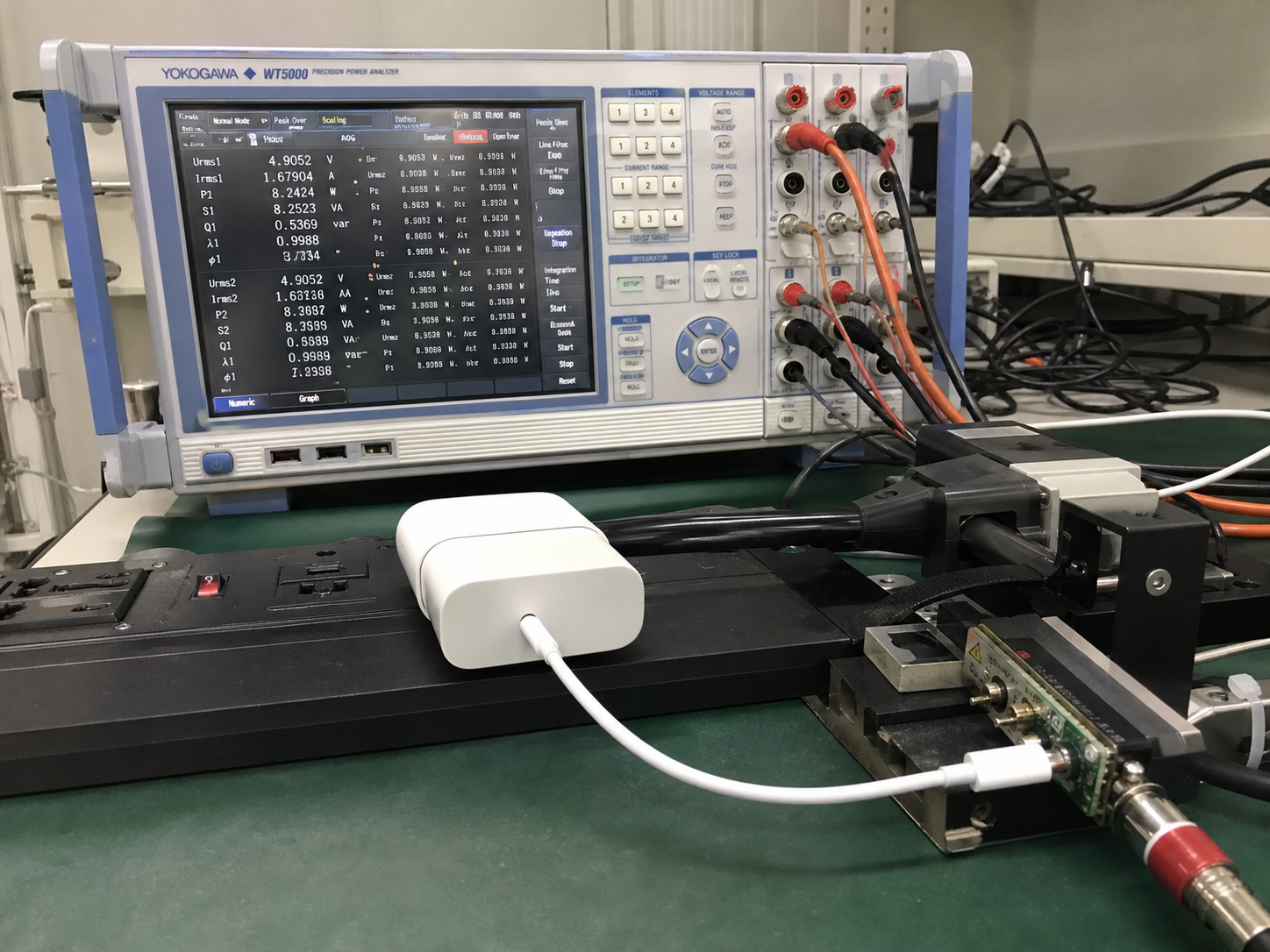
• Structural safety category: Includes pin pull/torque test (pins must not fall out when pulled or be easily twisted out of shape), enclosure mechanical strength test (internal high-voltage components must not be exposed after normal dropping or squeezing), and cable stress test (internal wires must not break after repeated pulling of the cable).
• Output safety category: Voltage, current, and energy limits during overload, short circuit, abnormal operation, and output abnormalities will be evaluated according to applicable standards. Protection methods may be current limiting, foldback, shutoff, power limiting, etc., and are not necessarily all automatic cut-off; this type of safety assessment is also not equivalent to USB protocol compatibility certification, and cannot be generalized as guaranteeing that all external devices will not be damaged when the PD protocol malfunctions.
User-Perceivable Safety Performance
These tests are mainly completed by laboratories under specified conditions. Users cannot confirm whether the product meets safety limits solely by feeling:
• Electric shock protection: Certification will evaluate safety indicators such as electric shock protection and electric leakage under specified conditions. Users should not judge whether the product is safe by touching the charging port or metal enclosure; if the product is dropped, deformed, water-damaged, or abnormal, it should be stopped immediately and replaced or sent for inspection.
• Temperature rise performance: Surface temperature meets limits under standard test environments, but actual use temperature is affected by power, ambient temperature, ventilation conditions, and number of loads. For example, charging while tucked under a blanket in summer may result in higher temperatures.
• Device protection: Under normal use, the product should control risks caused by abnormal output within the scope of applicable safety requirements, but UL safety certification is not equivalent to fast charging protocol compatibility certification, nor does it constitute a guarantee that all terminal devices will not be damaged.
How to Read UL Marks? Don’t Mistake Component Certification for Full Product Certification
Many people judge UL certification by “checking if there is a circular UL mark”, but there are many types of UL marks, and misprinted or improperly printed marks are very common, so you need to learn to distinguish them.
Differences Between the Two Core Certification Mark Types
The most easily confused are full product listing and component recognition, whose certification subjects and uses are completely different:
| Mark Type | Certification Subject | Significance for USB Chargers | Quick Identification Point |
| UL Listed (Full Product Listing) | Complete finished product | Represents that the entire charger has completed corresponding safety assessment within the scope of the certification file; in scenarios requiring full product listing, it should have the corresponding full product listing mark | The mark clearly displays the word “Listed” |
| UL Recognized (Component Recognition) | Individual internal components of the product (such as transformers, capacitors) | Only represents that a certain internal component has received recognition, and cannot alone prove that the entire charger has obtained full product Listed certification | The mark displays the word “Recognized”, and is usually used by component manufacturers |
Simply put, when buying a charger, what you need to confirm is full-product safety certification. Having only Recognized records cannot alone prove that the charger has obtained full product Listed certification; of course, this also does not mean that there are no qualified components inside the product.
Applicable Scope of Marks for Different Regions
UL marks will also indicate the applicable country, and not all UL marks are valid in both the US and Canada:
| Mark Type | Applicable Region | Notes |
| UL mark with “US” | Usually indicates US requirements | Whether it meets specific market requirements needs to be confirmed in combination with product standards and certification files |
| cUL mark with “CA” | Usually indicates Canadian requirements | Whether it meets specific market requirements needs to be confirmed in combination with product standards and certification files |
| cULus mark (with both US+CA) | United States + Canada | Indicates that certification covers the US and Canada, but the specific applicable scope still depends on the certification file |
Which of these marks is required depends on the target market and certification file. If only targeting the US or only Canada, a single-country mark may be sufficient. It cannot be simply assumed that cULus is mandatory or “more preferred” in all cases.
Note that you should not only look at the pattern, but also confirm it together with the country code, Product Category Code (CCN), and official file records on the mark to avoid merchants misleading consumers by randomly printing a pattern.
Other Easily Confused Certification/Compliance Marks
Many merchants promote other certifications as UL safety certification, so you need to pay attention to the distinction:
| Mark Name | Responsible Content | Can It Replace UL Safety Certification? |
| FCC (US)/ISED (Canada) | Mainly involves radio frequency, digital device and related radio technology requirements applicable in the US or Canada | Cannot replace electrical safety certification |
| CE | Compliance mark or declaration of conformity applicable to the European Union/European Economic Area | Cannot replace safety or electromagnetic compatibility requirements applicable in North America |
| ETL/CSA and other full-product safety marks | Electrical safety certification conducted by corresponding certification bodies according to applicable standards | If issued by an OSHA-recognized NRTL within the applicable scope, relevant full-product marks can meet corresponding NRTL requirements; specific marks and issuing bodies need to be verified |
| USB-IF | USB interface compliance, trademark authorization | Cannot replace electrical safety assessment |
How to Read a Compliant UL Mark
To judge whether a mark is compliant, the core is to look at the clear, durable mark on the product body that meets UL requirements. Specifically, labels, nameplates, molding, or other methods are allowed, subject to applicable standards and certification files. It is not only engraved or non-removable printing that is valid.
• Core verification items: Brand, complete model, rated input and output parameters, certification mark, applicable country code — none of these can be missing.
• Auxiliary verification items: Traceability information such as file numbers starting with E and control numbers can be used to check the official database, but are not the only basis for judgment.
• Statements on packaging and manuals can only serve as a preliminary reference and cannot be used as the sole basis, because the cost of counterfeiting packaging printing is relatively low.
How to Check the Authenticity of UL Certification? Step-by-Step Verification Guide
Looking only at the mark is not enough. Nowadays, many counterfeit products also print UL marks, which must be verified in combination with the official database to confirm.
Before Purchase: Key Points for E-Commerce Page Screening
Screening out obviously problematic products before placing an order can save a lot of trouble:
• The page should clearly indicate “UL Listed” or “cULus full product certification”. Be vigilant if only a blurry UL icon is placed without clarifying whether it is for the full product or a component.
• The complete model and specific input and output parameters should be indicated. Be cautious if only “65W fast charging” is marked without specific voltage and current parameters.
• Abnormally low prices can only serve as a risk indicator and cannot be used to judge the authenticity of UL certification. Verification must be conducted through product model, certification file, manufacturing factory, and mark status. Price cannot replace certification verification.
After Receipt: Physical Inspection Key Points
After receiving the goods, first perform three steps of preliminary inspection:
1. Mark inspection: The charger body has a compliant, clear, and durable UL mark, and the brand, model, and parameters are completely consistent with those written on the purchase page.
2. Appearance inspection: The enclosure is not cracked, the pins are not loose or bent, and the ports are not deformed.
3. Craftsmanship inspection: The mark is printed clearly, the enclosure seams are uniform, and there are no obvious burrs or misalignment. Damaged enclosure, loose pins, inconsistent mark and model, etc., are risk signals for stopping use or further verification; however, certification status cannot be judged solely by appearance and craftsmanship.
Official Database Query Operation
The most reliable verification method is to check UL’s official certification directory:
• Query entry: You can query through official certification directories such as UL Solutions’ Product iQ. Specific access permissions, visible fields, and subscription requirements are subject to the current rules on UL’s official website.
• Search method: Do not only search by brand name. It is best to use cross-search with file number, complete model, applicant, and product category for more accurate results.
• Verification key points: After finding the record, verify one by one the applicant/manufacturing factory, model suffix (for example, models with different ports in the same series have different suffixes, so you cannot only look at the preceding letters), input voltage frequency, output combination (single C or A+C), plug type, applicable country of the mark, and whether the certification status is valid.
Common Reasons for No Query Results and How to Handle Them
Sometimes you can’t find a record, which doesn’t necessarily mean it’s fake. First rule out these common reasons:
• Incorrect search fields entered, such as missing the model suffix or misspelling the brand name.
• Specific derivative models within the series are not individually published, only the main model is displayed.
• Certification records are restricted by public access permissions and are not displayed to everyone.
• Database records have not yet been updated.
• The certification has expired.
If you encounter a situation where no record is found, you can ask the merchant or certificate holder to provide official certification documents and verifiable file information. If necessary, directly contact UL or the relevant NRTL official for confirmation. No results in the database may be related to search methods, public access permissions, record updates, or certification status, but “just received the certificate and not yet entered” cannot be used alone as evidence of certification. Before verifiable official proof can be obtained, the product should not be promoted as having completed certification.
Four Judgment Conclusions for Query Results
After finding the record, make a corresponding judgment according to the following four situations:
1. Full match: The model, parameters, factory, and applicable region are all consistent with the product you purchased, and the certification is initially confirmed to be valid.
2. Series covered but suffix unclear: The main model of the same series can be found, but the specific suffix of the product you purchased is not published. The certificate holder needs to issue a written certificate to confirm that the suffix is within the coverage of the certification file.
3. Only component records: Only Recognized recognition of internal components is found, with no full product Listed record, which cannot prove the complete product is qualified.
4. No records/information conflict: No record can be found at all, or the found parameters, factory, or region do not match. It cannot be purchased or listed as a listed product.
6 Common Misconceptions About UL Certification
Many people’s misunderstanding of UL essentially stems from treating “safety certification” as a “universal guarantee”. These misconceptions must be avoided.
Misconception 1: Having a UL mark means absolute safety
UL is only responsible for the consistency of the submitted samples and mass-produced goods within the certification file. If the manufacturer cuts corners on materials or workmanship, or if you buy a counterfeit product, it is not safe even if it has a UL mark printed on it. When judging, comprehensive verification should be conducted based on information such as mark clarity, model and parameter consistency, and official records. If smoke, bulging, unusual odors, or abnormal heat to the touch occur during use, immediately power off and stop using it.
Misconception 2: UL certification is globally valid
UL is highly recognized mainly in the US and Canada. Different regions have their own access requirements, for example, CE in the European Union and CCC (China Compulsory Certification) in China. Some countries may recognize UL test reports, but they also need to be converted into local certifications for legal sale. UL certification cannot be directly used as a global pass.
Misconception 3: UL certification for accessories/other models of the same brand equals UL certification for the charger
UL certification is based on specific models and specific products, and the objects cannot be confused: a mobile phone of the same brand having UL does not mean the charger has it; a matching charging cable having UL also does not mean the charger has it. The core of avoiding pitfalls is: you must confirm that the charger you are currently purchasing itself has UL Listed full product certification.
Misconception 4: Higher power means higher safety risk
High-power chargers do have greater design difficulty, but as long as they have passed formal safety certification, they meet corresponding safety requirements. There is no need to blindly worry that “high power will easily explode”. The only thing to note is that small high-power chargers (such as GaN chargers) should not be covered by clothes or blankets, as this will affect heat dissipation and additionally increase risk.
Misconception 5: UL certification proves fast charging and good compatibility
UL only tests safety and does not involve performance or compatibility at all. Supporting PD fast charging and having UL certification are two different things. Many chargers claiming to be “100W fast charging” may not have undergone corresponding full-product safety certification at all. Do not equate “fast charging” with “safety”.
Misconception 6: UL-certified products are safe no matter how they are used
Certification only verifies that the product’s own design and manufacturing meet safety requirements. The actual use environment will also affect risks: for example, unqualified sockets/extension cords, mismatched travel adapters, abnormal power supply voltage, use in humid environments, poor heat dissipation, and damaged cables may all cause safety problems. Regardless of certification, as soon as unusual odors, abnormal noises, smoke, abnormal plug heating, or enclosure rupture are found, immediately power off and stop using.
A Must-Read for Cross-Border Sellers/Purchasers: UL Certification Application and Maintenance
If you are a cross-border seller or purchaser operating in the US and Canadian markets, in addition to knowing how to check certification, you also need to understand the basic application and maintenance rules to avoid compliance pitfalls.
Typical Certification Project Process (Simplified Version)
The safety certification process is not overly complicated, but the cycle is not short. It is mainly divided into four steps:
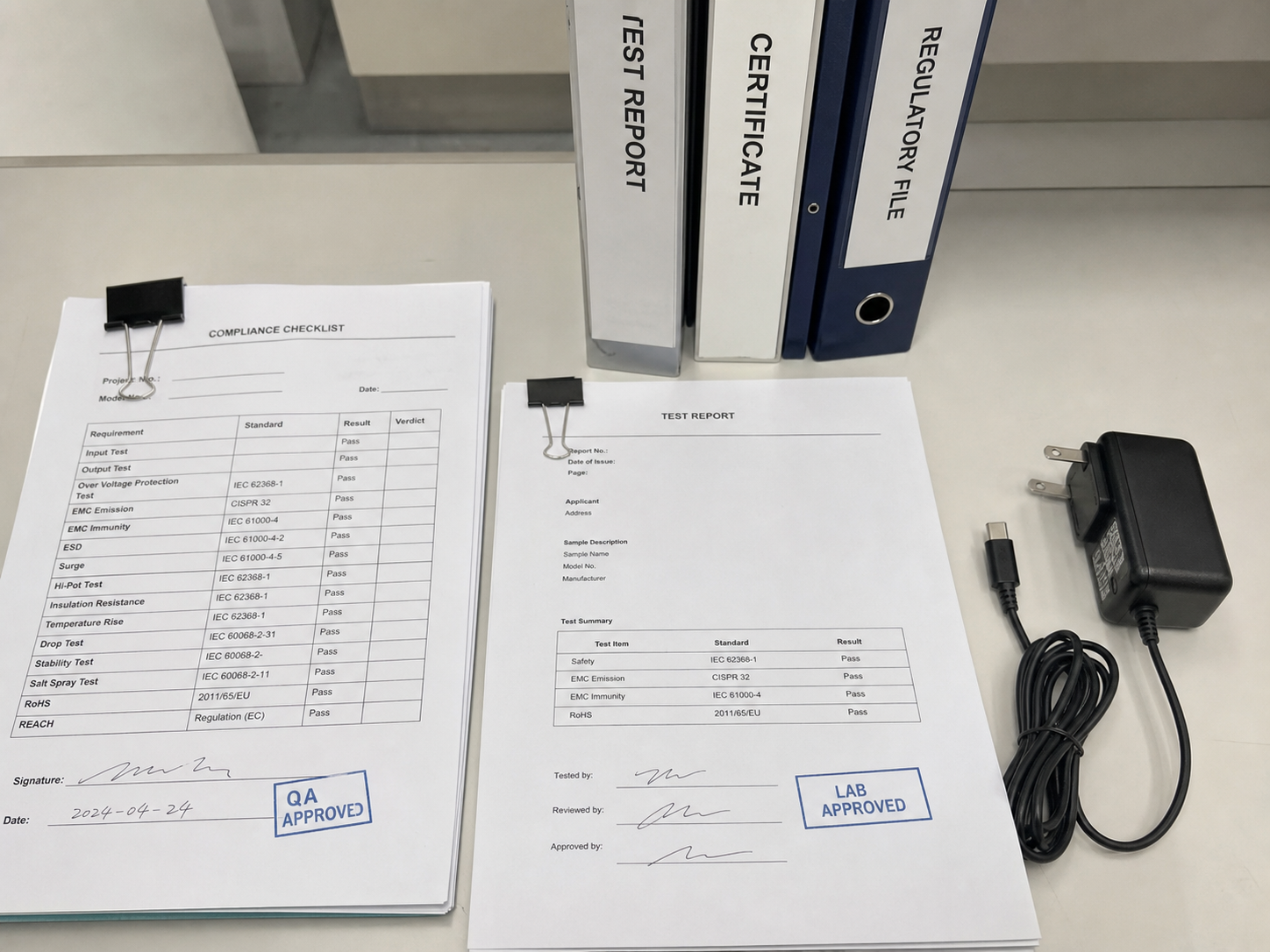
1. Preliminary assessment: Determine the product model and applicable standards, and sort out the list of key components (it is best for key components to also have corresponding recognition, which can reduce part of the assessment work).
2. Testing phase: Submit an application to UL Solutions or the selected NRTL, and complete the testing according to its accredited laboratories, witness testing, and certification procedures. If it fails, retesting is required after rectification, and the number of rectifications will directly affect the cycle and cost. Whether test results from other institutions are acceptable must be confirmed by the certification body and cannot be automatically converted into UL Listed certification.
3. Factory inspection phase: For first-time certification, factory inspection may be required to verify that the factory has the ability to continuously produce products consistent with the submitted samples; whether it is required and the specific arrangements are subject to the requirements of the certification body.
4. Certification issuance phase: After requirements such as testing and factory inspection are completed, the product enters the certification directory according to corresponding procedures, and the certification body authorizes the use of the corresponding safety mark within the specified scope.
Factors Affecting Cycle and Cost
There is no unified price and cycle for safety certification, which is mainly affected by these factors:
• Cycle: Usually ranges from several weeks to several months. The more complex the product, the more rectifications, and the fuller the laboratory schedule, the longer the cycle.
• Cost: Includes testing fees, first-time factory inspection fees, follow-up service fees, etc. If there are multiple models in the same series, part of the testing cost can be shared. The specific cost shall be subject to the official quotation of the laboratory. Do not readily believe claims of “one-price guaranteed pass”.
Post-Certification Maintenance and Change Rules
Obtaining the certificate is not the end. Poor subsequent maintenance may result in suspension or cancellation of certification:
• Regular follow-up: After certification, regular factory inspections must be accepted according to UL follow-up services or relevant NRTL regulations. The frequency is subject to specific service agreements and certification files, and cannot be uniformly understood as once a year.
• Change requirements: If you want to modify the circuit, replace the plug, modify the enclosure, or replace core components, you must submit it to the certification body for change assessment in advance. Unauthorized changes are not allowed without approval, otherwise the certification scope may no longer apply.
• Change handling: Not all changes require a full re-certification. Some minor changes can be handled through engineering changes, supplementary testing, or file updates. The specific approach should be communicated with the certification body.
Certification Holder and Authorization Responsibilities
There are several responsibility pitfalls that are easy to step into and need attention:
• The UL mark can only be used by relevant entities authorized by the certification file and UL agreement within the specified scope. The brand, applicant, manufacturer, and private label relationship must be consistent with the certification file and authorization arrangements.
• For private label sales (for example, sellers affix their own brand), the UL mark cannot be used solely based on oral authorization or certification of other models. It should be confirmed that the private label brand, specific model, manufacturing factory, and mark usage method are all covered by the certification file and relevant authorization arrangements.
• The division of responsibilities among the applicant, manufacturer, brand owner, and seller shall be subject to certification file records, certification agreements, and contractual agreements between the parties. Do not rely solely on oral agreements.
Summary: Quick Checklist and Key Takeaways
USB Charger UL Certification Quick Checklist
Whether ordinary consumers buy for their own use, or sellers purchase for product selection, they can use this checklist for quick verification:
• □ The charger body has a clear, durable UL full product listing (Listed) mark and applicable country code
• □ The product brand, complete model, and input/output parameters are consistent with the purchase page/certification file
• □ The model, factory, parameters, and region in the official database query results all match (or the certificate holder provides valid proof)
• □ It is full product UL Listed certification, not component Recognized certification
• □ The product has no problems such as damaged enclosure, loose pins, or abnormal heating
• □ Confirm the required mark according to the target market; when targeting both the US and Canada, you can verify whether the product has a cULus mark covering both the United States and Canada
What You Can Do Independently After Reading
After reading this article, you should have mastered these practical skills:
• Can distinguish between UL Listed and Recognized, and between UL and other common certifications
• Can query certification information through UL’s official certification directory and make preliminary judgments on the query results
• Can identify common purchase and use misconceptions about UL certification
• Can conduct preliminary verification of the UL full product certification of a USB charger; full North American compliance still needs to be confirmed in combination with target regional regulations, AHJ, sales channels, and other applicable requirements
• Cross-border sellers/purchasers can master the basic application and maintenance logic of UL certification
Overall, UL certification is not some mysterious “golden seal of approval”, nor is it an empty decoration printed randomly. It is one of the common electrical safety certification methods in the North American market, but it cannot replace all compliance judgments in the target region. Grasping the three core points of “full product certification, model matching, and official verifiability” can help you conduct preliminary certification verification; as for whether it meets the full North American sales and use requirements, it needs to be further confirmed by the certificate holder or compliance professionals in combination with local regulations, AHJ, sales channels, and other applicable requirements.