
If you run a 3C accessory business targeting the Japanese market, or often purchase Japanese-version charging devices via cross-border shopping, you must have seen the diamond-shaped or circular PSE mark printed on chargers. Many people think this is just an ordinary quality certification, and even cannot tell the difference between it and CE, UL – in fact, PSE is an important mandatory compliance requirement for electrical products in the Japanese market, and getting it wrong may lead to risks such as product detention, fines, or even recalls. In this article, we will thoroughly explain PSE certification for USB chargers from basic judgment to practical verification, which you can use directly whether you are a seller or an ordinary consumer.
Basics for Beginners: First, Understand What PSE Really Is
First of all, it should be clear that PSE is not a single certification certificate, but a complete set of electrical product safety supervision systems under Japan’s , equivalent to Japan’s “electrical safety access rules”. The competent authority of this system is the Ministry of Economy, Trade and Industry of Japan (abbreviated as METI), which is responsible for formulating which products need to comply and what technical requirements they must meet; there are two types of core roles at the implementation level: one is domestic notified business operators – you can understand them as “the first responsible persons filed with the Japanese official authorities”, usually local Japanese importers or brand owners, who are the first to be contacted if there is a safety problem with the product; the other is METI-recognized registered inspection bodies, which are responsible for conducting professional testing on high-risk products and issuing conformity inspection certificates.
When Compliance Is Mandatory and What Are the Risks of Non-Compliance
To judge whether PSE is required, you cannot only look at whether the product is nominally connected to 100V mains power, but must judge based on the specific categories and specifications in the , its cabinet orders, and technical standards.
Products manufactured, imported, or sold for the Japanese market must complete corresponding PSE compliance if they are included in the electrical appliance catalog specified in the . AC USB chargers are usually classified as “DC power supply devices”, but should still be confirmed in combination with specific input, output, structure, and catalog classification. The nominal input value can be 100V, or a rated range such as 100-240V, and does not necessarily have to be fixed as 100V.
If non-compliant, the lightest consequence is being prohibited from sale and required to rectify, and the heaviest may trigger disposal measures such as full-batch recalls and administrative fines.
Of course, there are situations that need to be distinguished: when individuals import small quantities for their own use, they usually do not bear the PSE declaration obligation of business importers, but may still be subject to customs, transportation, product safety and other regulatory restrictions, and these products must not be resold or used for commercial circulation. When enterprises import, sell, lease, or provide products in a commercial manner, they shall complete PSE compliance according to specific categories.
The Most Commonly Misunderstood Points
There are many misunderstandings about PSE, so we will first clarify the most common ones to avoid errors in subsequent judgments:
First, it is not a “certificate”, but a complete system including testing, filing, labeling, and post-supervision. Getting a certificate does not mean everything is done once and for all;
Second, it has nothing to do with fast charging or compatibility – PSE does not evaluate charging speed, brand experience, or PD/QC protocol compatibility. Don’t think that a charger with a PSE mark is a fast charging charger;
Third, it is not a quality grade selection, but only the legal minimum safety threshold. Passing PSE does not mean that the product quality is top-notch, it only means that it meets the safety bottom line required by Japan;
Fourth, it cannot be replaced by certifications from other countries or regions such as CE, UL, CCC. Even if the product has passed other global certifications, it still must comply with PSE requirements to enter the Japanese market.
Boundary Judgment: Does Your Charger Need PSE?
What many people find most troublesome is “whether my product falls within the scope of PSE regulation”. In fact, you can’t go wrong if you screen step by step in four steps: the first step is to look at the input – is it directly connected to AC mains power? If it is a DC input such as a car charging port or USB port, it is excluded from the PSE scope of AC chargers at the outset; the second step is to look at the scenario – is it sold, given away, or used commercially for the Japanese market? When individuals import small quantities for their own use, they usually do not bear the PSE declaration obligation of business importers, but must not resell or use them for commercial circulation; as long as enterprises import, sell, lease, or provide products in a commercial manner, they must continue to judge downward; the third step is to check the catalog – check the latest electrical appliance classification catalog released by METI to see if the product falls within the scope of regulation; the fourth step is to look at the sales form – is it sold separately? Even if it is a charger given away with a mobile phone, if the gift itself can be sold separately or provided as a commercial product, it also needs to be checked for PSE requirements according to the applicable category.
Core Products That Require Compliance
According to this logic, common USB charging products that need to be checked and complete corresponding PSE compliance include: wall-plugged USB-A or USB-C chargers, desktop multi-port chargers, external power adapters, and bundled AC chargers that can be sold separately.
Products Not Subject to This Rule
Conversely, the following types of products usually do not fall under the PSE category of AC USB chargers: car chargers (DC input, subject to other categories or other regulatory requirements), separate USB data cables/charging cables (not AC power supply devices), and small accessories powered only by USB low voltage (such as USB small fans, small desk lamps).
But power banks need special attention. Power banks containing lithium-ion batteries usually fall under the “lithium-ion storage battery” category regulated by PSE in Japan. The fact that it is charged via USB low-voltage input does not automatically exempt it from PSE requirements, and relevant regulations should be checked according to battery capacity, structure, and applicable scope.
Judgment Rules for Several Types of Easily Confused Products
There are several types of products with blurred boundaries that are easy to misjudge, so we explain them separately:
• Power strips with USB ports: Judged by the complete product, not only the USB module. It must meet the safety requirements of both the power strip and the USB charging module at the same time;
• Travel adapters: If they only convert the plug shape and have no voltage transformation or charging function, PSE is not required; if they have built-in voltage transformation and USB charging functions, they must be judged according to the specific product and applicable category;
• Wireless chargers (Qi): If the AC input part is a regulated electrical appliance, PSE should be checked. Whether the wireless charging function requires procedures related to the , or meets the requirements of high-frequency utilization equipment, radio stations, etc., must be confirmed with the Ministry of Internal Affairs and Communications of Japan or professional institutions based on frequency, power, and equipment structure, and cannot be uniformly required to have “PSE + Radio Law certification”. Wireless chargers that only connect to low-voltage DC input cannot simply exclude all radio-related requirements just because they use USB input;
• Built-in power supplies for complete machines: If it is a built-in power module that is not sold separately (such as the built-in power board of a laptop), it is sufficient to comply with the category of the complete machine; if this power module can be disassembled and sold separately, it must be checked separately for compliance with PSE requirements.
For easy memory, you can remember a mnemonic: For USB charging devices that can be plugged into Japanese wall sockets and sold separately, check PSE first.
Diamond vs. Circular PSE: Not True vs. False, But Different Risk Levels
Many people see that there are two types of PSE, diamond and circular, and think one is real and the other is fake, or one has a higher level and the other lower – in fact, both are legal compliance paths with exactly the same effect, but they apply to different product risk levels.
| Comparison Item | Diamond PSE (Specified Electrical Appliances and Materials) | Circular PSE (Non-Specified Electrical Appliances and Materials) |
| Mark Outline | Diamond outer frame + PSE letters | Circular outer frame + PSE letters |
| Applicable Categories | High-risk electrical appliances | Low-risk electrical appliances |
| Testing and Certification Requirements | Must undergo conformity inspection and be issued a certificate by a METI-recognized registered inspection body | No mandatory third-party certification required; the domestic notified business operator completes the required conformity inspection and keeps records |
| Primary Responsible Party | Registered inspection body + domestic notified business operator | Domestic notified business operator |
| Mandatory Label Content | Mark the diamond PSE, name of the notified business operator, name of the registered inspection body, and other information and rated parameters as required | Mark the circular PSE, name of the notified business operator, and rated parameters as required; usually no third-party certificate number requirement |
Specifically for USB chargers, most ordinary AC USB chargers fall under the “DC power supply devices” in the METI catalog, and follow the circular PSE compliance path. The core basis for classification is the product’s rated power, input and output structure, and purpose, and has no direct relationship with whether it uses fast charging technology or is made of GaN (gallium nitride) material. Of course, the final classification shall be subject to METI’s latest official catalog, as the catalog is updated from time to time.
What Does PSE Test: Core Is Safety, Unrelated to Fast Charging Experience
Many people are curious whether the more expensive the product, the more PSE test items there are. In fact, the requirements mainly focus on electrical safety and fire safety, and do not evaluate charging speed, brand experience, or PD/QC protocol compatibility; but to verify safety, rated input and output, electrical characteristics, and abnormal working conditions may be checked. There are several core directions:
First is electric shock prevention and insulation safety – this is the core requirement. The high-voltage area of the mains power and the low-voltage area of the USB must be reliably isolated. Places that can be touched by human hands must not have electric shock hazards, and must meet the requirements of applicable technical standards even in humid environments; short-circuit prevention of USB interfaces may also be involved in safety inspections, but this is only the safety bottom line and does not mean good charging performance.
Second is overheating and fire safety: During testing, rated input, full-load output, and even abnormal working conditions will be simulated to check whether the temperature of each component exceeds applicable requirements. There is no single temperature rise value uniformly applicable to all components; it must be judged according to different components and technical standards; the shell and insulating parts must also have corresponding heat resistance and flame retardant properties to prevent the spread of fire.
Third is structural and durability requirements: The size of the Japanese-spec plug pins of the charger must meet the standards, and it must be firm and not loose when plugged into the wall; the shell must have sufficient strength, and a slight fall must not expose live parts; the USB interface must not be loose after repeated plugging and unplugging, nor can it cause short-circuit risks.
Fourth is output and protection safety: The product must pass safety tests such as normal operation and abnormal operation required by applicable technical standards. Overvoltage, overcurrent, and short-circuit protection are common safety design measures, but whether they are set and what method is adopted shall be based on specific technical standards and product design; these protection circuit names cannot be directly regarded as unified legal configuration requirements for all USB chargers. If it is a fast charging model, the safety of each rated output state must also meet the standard, but PSE is still not responsible for evaluating protocol compatibility and charging speed.
These tests are professional items in the laboratory, and ordinary consumers cannot fully verify them just by looking at the appearance. That is why we rely on the PSE mark and compliance documents to judge product compliance.
Practical Verification: Three Steps to Judge Whether PSE Is Truly Compliant
Whether you are purchasing goods for resale or buying a charger for yourself, how do you judge whether its PSE is truly compliant? We will explain in the order of “before purchase – upon receipt – check documents”, which ordinary people can quickly master.
Check the Sales Page Before Purchase
First, it must be clearly marked that the product is applicable to the Japanese market and has PSE qualification; second, a clear PSE mark on the product body must be displayed – if only a blurry screenshot of the certificate is provided, and even the mark on the product body is not shown, you should be more vigilant; third, parameters such as model, power, and number of ports on the page must be consistent with the product, and cannot be mismatched; fourth, it is best to publicize the information of the Japanese domestic notified business operator, that is, the importer, so that the responsible person can be found if there is a problem.
Check the Product Body and Packaging Upon Receipt
First look at the charger body: it should have a PSE mark consistent with the product category, the name of the Japanese business operator, and legal or necessary parameters consistent with the actual situation such as rated input voltage range, input current, output voltage, and output current. The input can be 100V, or a rated range such as 100-240V, and “100V” cannot be used as the sole authenticity standard. Diamond PSE products shall also be marked with the name of the registered inspection body and other information as required; circular PSE usually has no third-party certificate number requirement, but this does not mean that it can omit conformity inspection, record keeping, and other labeling obligations.
Then look at the packaging and manual: check whether the manual and warning information meet applicable Japanese regulations, technical standards, and consumer safety requirements. Japanese instructions are an important compliance requirement in actual sales, but cannot be used as a unified condition for judging the validity of the PSE mark alone. It cannot be simply considered that without Japanese instructions, it must not comply with PSE.
Finally, do an appearance check: the plug pins are not loose or deformed, the shell has no cracks or peculiar smell, and there is no abnormal sound when shaken. If it is a multi-port charger, also check whether the nameplate, manual, and sales page truthfully explain the rated output of each port, total output limit, and power distribution when used at the same time, and do not only look at the maximum power of a single port.
How to Check Compliance Documents
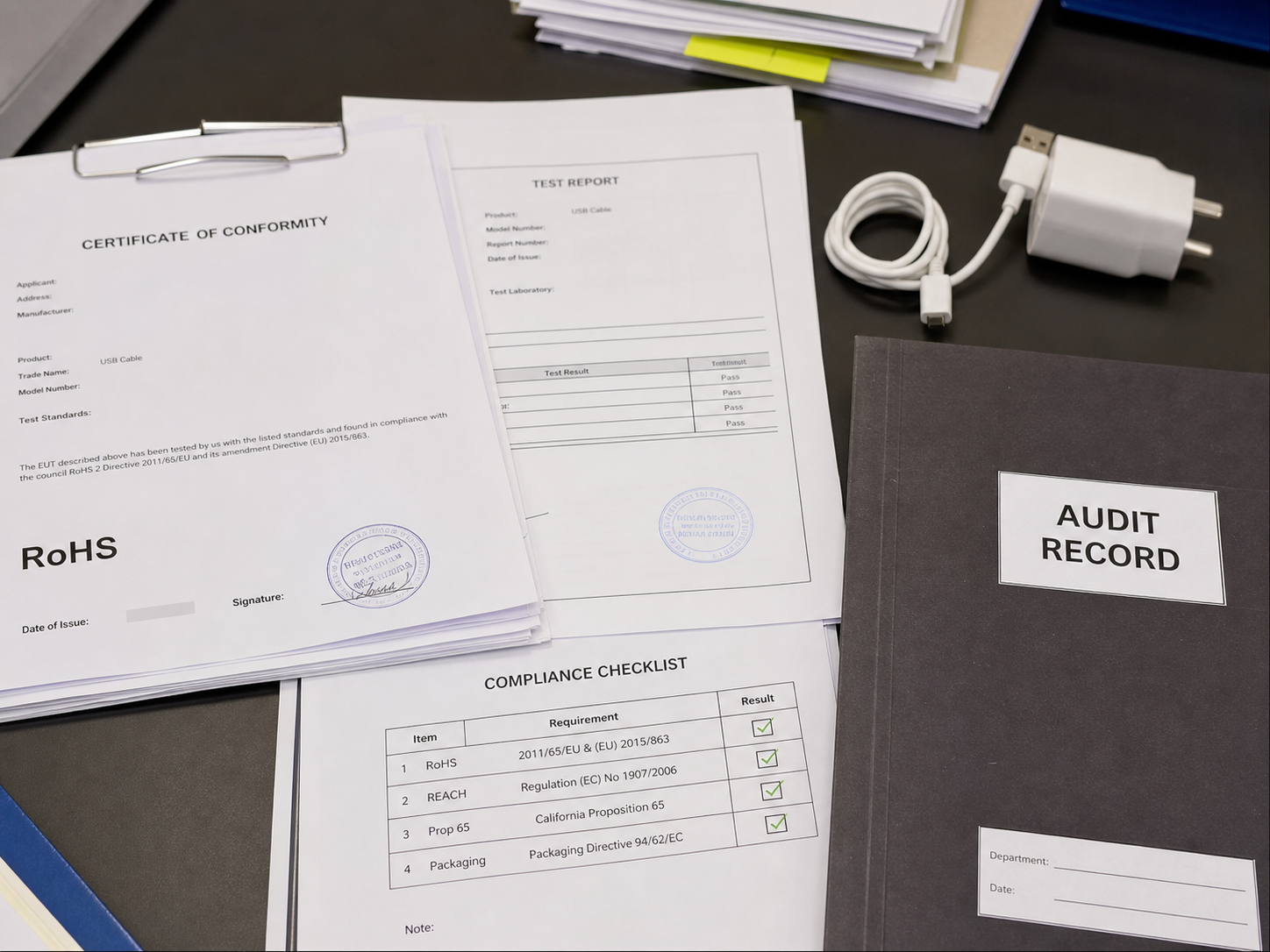
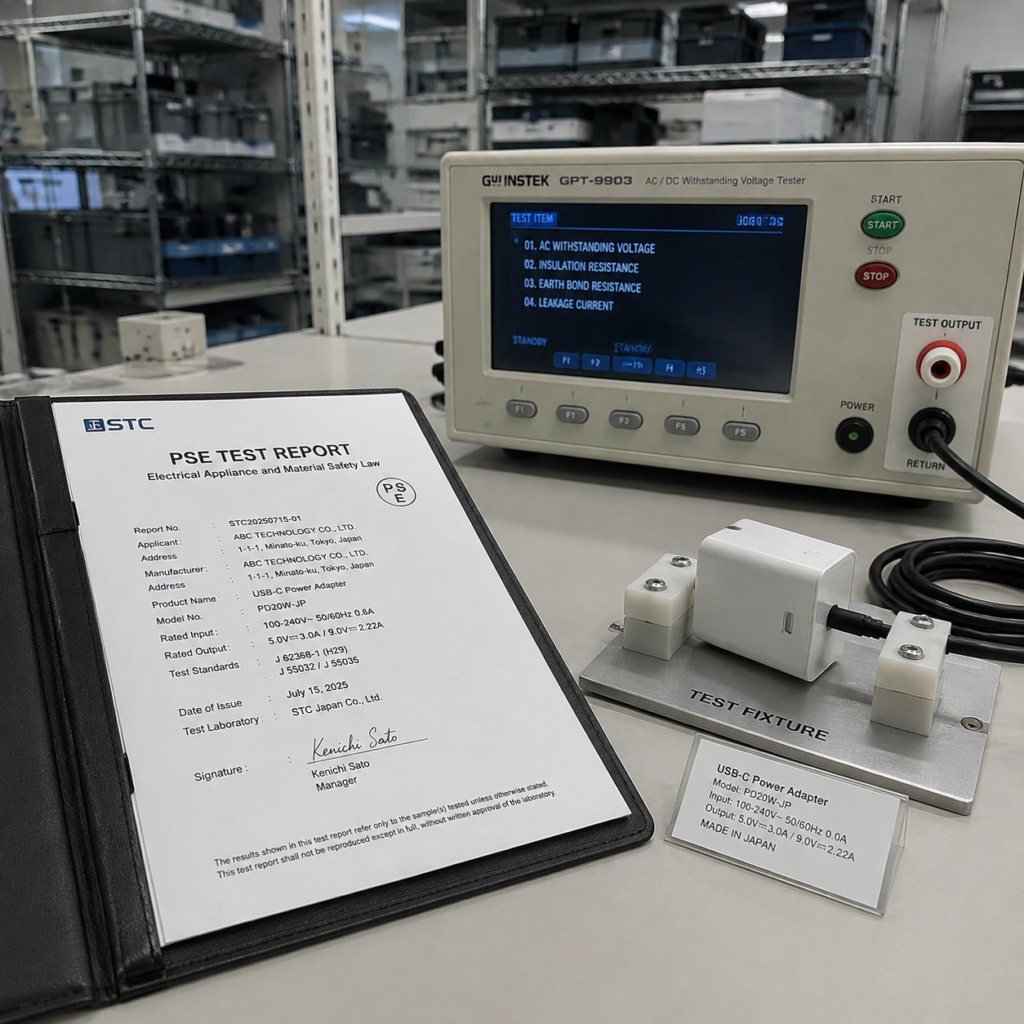
If more rigorous verification is required, you can ask the merchant for compliance documents: if it is diamond PSE, you can request the conformity inspection certificate issued by the registered inspection body, as well as documents that can correspond to the product model and responsible subject, and verify through relevant official channels; if it is circular PSE, since it is mainly the business operator that completes the conformity inspection and bears the record keeping obligation, there is no national unified public query system. You can ask the merchant to provide materials such as business notification certificates, test reports, or conformity inspection records.
No matter which type it is, pay attention when checking: the model, parameters, and responsible subject on the documents must be consistent with those on the product body. Whether series products can share documents depends on the model range, rated values, structure, and key components clearly covered by the documents, and cannot be judged only by similar brand or appearance.
Common Features of Fake Marks
Fake PSE marks generally have several obvious features, and you can avoid most pitfalls by comparing them: first, the mark shape is wrong, for example, there are only three letters PSE without the specified diamond or circular outer frame, or the outline is drawn incorrectly; second, key information is missing, for example, there is no name of the Japanese business operator, or the rated parameters required by applicable regulations are missing; for diamond PSE, the name of the registered inspection body and other information should also be checked; third, the workmanship is rough, the mark is printed with ink and scrapes off easily, or the font is blurred and does not meet the specifications; fourth, there is logical contradiction, for example, an unnecessary third-party certificate number is printed under the circular mark, or the diamond mark cannot provide corresponding information from a formal registered inspection body.
To sum up, quick verification only takes three steps: first, look at the mark – there must be a PSE mark of the corresponding shape, the name of the Japanese business operator, and rated input and output parameters consistent with the actual situation; second, check the parameters – the model, power, and number of interfaces must match, and for multi-port models, be sure to check each port and the total output limit; third, choose the right channel – give priority to regular and traceable platforms and merchants, and avoid ultra-low-priced products with no brand and no mark.
Key Verification Points for Special Chargers
Ordinary single-port chargers can be verified by the above methods, but there are several types of special chargers that are easy to fall into pitfalls, requiring extra attention:
• Multi-port USB chargers: Many merchants will only mark the maximum output power of a single port, for example, a single port has a maximum of 65W, but in fact the total power is only 65W when two ports are used together, not every port can reach 65W. During verification, compare the nameplate, manual, and sales page to see whether the rated output of each port, total output limit, and power distribution when used at the same time are truthfully and clearly stated. Incomplete information may cause misleading or affect safe use, but it cannot be concluded that PSE is non-compliant just because the total power is not marked;
• High-power USB-C PD chargers: This type of product has many port combinations and output conditions. During verification, check the actual rated input and output, restrictions of each port combination, and whether the test documents cover the sales model and all rated working conditions. Do not take 65W as a unified dividing line in PSE regulations, nor regard all PD protocol gears as items that must be printed on the nameplate in PSE format. The nominal total power does not mean that each C port can output full power independently. For example, a 65W charger with dual C ports may only reach 65W when a single port is used, and becomes 45W + 20W when both ports are used at the same time;
• GaN (gallium nitride) chargers: Many people think that GaN is a high-end technology and must be compliant, or that the PSE classification of GaN chargers is different – in fact, GaN is only a power device technology, and has no direct relationship with PSE classification and compliance. Small size does not mean lower safety requirements, and it is still necessary to check the PSE mark, rated power and other information according to the standards of ordinary chargers. In addition, compliance documents for GaN chargers of different models under the same brand cannot be automatically shared, and must be checked one by one according to the model range, rated values, structure, and key components clearly covered by the documents.
Common Product Judgment Cases
Let’s take several common products for actual judgment, and you can practice by comparison:
1. Single-port 20W USB-C wall charger: AC input, usually belongs to DC power supply devices, follows the circular PSE path. During verification, check the circular PSE mark, name of the Japanese business operator, rated input parameters consistent with the actual situation, and documents related to business notification and conformity inspection;
2. 65W dual C-port PD desktop charger: AC input, usually belongs to DC power supply devices, the final classification is subject to the METI catalog, and usually follows circular PSE. In addition to the basic marks, during verification, also check the labeling of total power, single-port power, and port combination restrictions, and whether the test documents cover multi-port load conditions;
3. Wireless charging base with AC plug pins: The AC input part is checked for PSE according to the specific category; whether the wireless function is subject to high-frequency utilization equipment, radio stations or other requirements under the must be specifically judged according to frequency, power, and equipment structure, and cannot be uniformly required to have two types of certification marks at the same time;
4. Japanese-spec power strip with USB ports: Complies with the power strip category, needs to meet the safety requirements of both the power strip and the USB charging module at the same time. During verification, check the PSE mark of the corresponding shape and the compliance test report of the whole machine;
5. Power bank with only USB-C input: It is not an AC input USB charger; but if it contains a lithium-ion battery, it usually falls under the lithium-ion storage battery category regulated by Japanese PSE. Relevant PSE requirements should be checked according to specific specifications, and it cannot be directly judged that PSE is not required just because it only has USB-C input.
Pitfall Avoidance Guide: Never Step Into These Misconceptions
Compliance Responsibilities of All Parties
Only by understanding the responsibilities in the compliance chain can you know who to turn to when something goes wrong: manufacturers must ensure that the design and production of products meet Japanese technical standards; exporters must provide product documents and test reports as required; Japanese domestic notified business operators (importers or brand owners) bear the primary compliance responsibility, and are responsible for submitting business notifications, completing conformity inspections, keeping compliance records, and ensuring that product labels are correct.
The specific legal obligations of sellers are not exactly the same as those of manufacturers and importers, but sellers shall purchase from traceable channels, shall not sell products that are not labeled as required or do not meet the requirements, and shall cooperate with recalls and regulatory disposal.
The Most Common Cognitive Misconceptions
There are several widely circulated false statements that must be avoided:
• “Global voltage 100-240V = PSE compliance”: Wrong. The voltage range meeting the requirement is only the foundation. It is truly compliant only after passing the corresponding safety test, completing the business notification in Japan, and meeting the labeling requirements;
• “Having a PSE mark means absolute safety”: Incorrect. PSE means that the business operator has completed the corresponding conformity inspection, filing, and labeling obligations for the applicable category, but the mark itself does not guarantee that every mass-produced product has no manufacturing defects. The inspection and certification systems of circular and diamond PSE are different, and cannot be uniformly referred to as “type test qualified”;
• “Same brand and same series can share PSE qualification”: This cannot be simply judged. PSE compliance documents only cover the models, model ranges, rated values, structures, and key components clearly confirmed therein. Whether series products can share documents shall be confirmed by the registered inspection body or the business operator responsible for conformity inspection according to the specific coverage scope; after changing the power, structure, or key safety components, re-evaluation is usually required;
• “USB output is low voltage, no safety risk”: Totally wrong. The risk of chargers mainly comes from the high-voltage end of the mains power. If the insulation is unqualified, high voltage will leak to the low-voltage USB end, which can still cause electric shock or even fire. That is why PSE attaches importance to insulation and abnormal operation safety;
• “Circular PSE is a fake certification, not as formal as diamond PSE”: Not at all. Both circular and diamond PSE are legal compliance paths with exactly the same effect, but they apply to different product risk levels. High-risk products follow diamond PSE, and low-risk products follow circular PSE. There is no distinction between high and low grades.
Use Safety and Abnormal Handling
Even a compliant charger can be risky if used incorrectly: in daily use, do not wrap the charger with cloth or plastic film, which will affect heat dissipation; do not use it beyond the rated power for a long time, for example, using a 20W charger to carry a 30W load for a long time will accelerate aging. If you find that the charger is severely hot, has a burnt smell, the shell is discolored, or charging is intermittent during use, immediately cut off the power and stop using it. If the plug pins are deformed, the shell is cracked, or the interface is loose, never plug it in again to avoid electric shock. If you buy a non-compliant product, first contact the seller for a return, keep evidence such as chat records and product photos. If you bought it on a platform, you can appeal to the platform.
At this point, the content related to PSE certification for USB chargers is almost covered. To sum up, you should now be able to judge whether a product needs PSE through a four-step logic, distinguish the difference and applicable scenarios between diamond and circular PSE, quickly verify compliance with the three-step method, and also judge the risk points of special chargers such as multi-port, high-power PD, and GaN, and avoid common cognitive misconceptions. Whether you are a seller doing business in the Japanese market or a consumer buying Japanese-version chargers, understanding PSE can not only avoid compliance risks, but also help you choose safer products.