
If you plan to sell USB chargers in Canada, or purchase compliant charging products in Canada, you cannot avoid the requirement of ISED compliance. Many people either mix it up with safety certification, or think all products must have an IC ID, and have run into many pitfalls. Today we will start from the most basic concepts, and step by step figure out what ISED certification for USB chargers is, how to judge whether it is needed, what the requirements are, how to check authenticity, and how to avoid common pitfalls.
Getting Started: Core Relationship Between ISED Compliance and USB Chargers
First, let’s clarify the most basic concept: ISED stands for Innovation, Science and Economic Development Canada. Many long-time sellers may have heard of the term “IC certification” — in fact, IC is the old name. Previously this department was called Industry Canada, and later changed its name, so the current ISED compliance and the former IC certification are essentially the same Canadian market access system, just with a changed name.
The core regulatory focus of ISED, to put it plainly, is two things: first, electromagnetic compatibility, to prevent electronic devices from emitting electromagnetic waves that interfere with other devices; second, radio spectrum management, to prevent devices with wireless functions from using frequency bands indiscriminately and affecting legal radio services (such as broadcasting, aviation communications). In addition, it also regulates radio frequency exposure (whether radiation from wireless devices affects the human body) and product compliance labeling requirements.
Many people may think, a charger is just a voltage-transforming device, why is it regulated by ISED? In fact, current USB chargers, especially fast chargers, have switching power supplies and fast charging chips inside, which generate high-frequency electromagnetic noise during operation. You may have encountered that when you plug in a cheap charger, the nearby radio makes a buzzing sound, or Wi-Fi suddenly lags — this is caused by electromagnetic disturbance. If it is a charger with Bluetooth, Wi-Fi or wireless charging function, it will actively transmit radio frequency signals, which involves the issue of spectrum use. If the product is non-compliant, the light consequence is being required to rectify and stop sales, and the serious consequence is recall and fines. Both sellers and consumers should pay attention.
ISED compliance actually has two completely different paths, which many people mix up. Let’s clarify them once today:
The first is the ICES line, which targets devices with digital circuits, with the core of regulating electromagnetic compatibility. For example, ordinary wired fast chargers usually need to first confirm whether they fall within the scope of application of ICES-003, then evaluate according to this line, and comply with ICES-003. This type of product usually does not have an IC ID. Many people think all compliant products have an IC number, which is wrong.
The second is the RSS line, which targets devices with radio transmission functions, with the core of regulating wireless spectrum and power. For example, smart chargers with Bluetooth need to follow this line, comply with the corresponding RSS standards, and after passing, will get a unique IC ID, which is commonly known as the “ISED certification number”.
It is particularly worth mentioning wireless charging products, which cannot directly apply the RSS process of ordinary wireless devices, and must be judged according to the special rules for wireless power transmission, which we will explain in detail later.
There is another very easily confused point: ISED is not a “full-category access certification” for Canada. It only regulates electromagnetic compatibility and wireless transmission. To legally sell chargers in Canada, you also need to meet several other requirements, don’t mix them up:
• Electrical safety: Shall be evaluated by a Canadian-recognized certification body in accordance with the applicable provincial electrical regulations in Canada and bear the corresponding safety certification mark, such as CSA, cUL or cETL marks; this is different from ISED’s electromagnetic compatibility and radio requirements.
• Energy efficiency: Regulated by Natural Resources Canada (NRCan), such as standby power consumption, conversion efficiency and other requirements, which are also not within the scope of ISED.
• Language and packaging: Such as consumer labeling requirements, French labeling requirements in Quebec, these correspond to their respective regulations and are not under the jurisdiction of ISED.
Quick Judgment: Whether Your USB Charger/Accessory Requires ISED Compliance
After understanding the basic concepts, what everyone is most concerned about must be: does the USB charger or accessory I have need to be ISED compliant? In fact, you can make a quick judgment in just a few steps.
This article mainly discusses independent products that are manufactured, imported, distributed or sold in Canada and fall within the regulatory scope of ISED. Personal carry or self-use situations may apply for specific exemptions, but you cannot generally conclude that no verification is needed just because it is “for self-use”. You should judge based on the device type, quantity, purpose and current regulations.
Products with different functions have completely different applicable standards. We have compiled a matching table of common USB charging-related products, you can compare and check:
| Product Type | Applicable Standard | Is IC ID Required | Remarks |
| Ordinary wired chargers (AC/DC, in-vehicle, multi-port GaN, with screen but no wireless) | Usually judged according to ICES-003 | Usually not required | Need to confirm whether it falls within the scope of application of ICES-003, or whether other standards or exclusion clauses apply |
| Smart chargers with Bluetooth/Wi-Fi | ICES-003 + RSS series | Required | Has active wireless transmission function |
| Qi/wireless power transmission devices | RSS-216, etc., additionally evaluate applicable electromagnetic compatibility requirements | Usually required, confirmed according to applicable standards | First judge according to operating frequency, power and device category |
| Ordinary passive USB charging cables | None | Not required | No digital circuit or wireless transmission function |
| Charging cables with E-marker/active chip/display | May require ICES-003 | Not required | Evaluate in combination with the specific situation of active functions |
| Laptop power adapters with USB output | Determined according to specific functions, product categories and applicable standards | Determined according to the situation | Cannot be judged only by the proportion of digital circuits or sales form |
If you don’t want to check the table, you can also use this 10-second self-check three-step method to quickly judge the path:
1. First confirm: Is the product an independent finished product to be manufactured, imported, distributed or sold in Canada, and falls within the regulatory scope of ISED? Personal self-use also cannot directly exclude applicable requirements just because of “self-use”.
2. Then look at functions: Does it have active wireless transmission functions such as Bluetooth and Wi-Fi? (Wireless charging is checked separately and is not counted as ordinary active wireless transmission)
3. Finally determine the path: Those with active wireless transmission follow the RSS + ICES path and require an IC ID; those without are usually judged according to applicable ICES or other requirements, and do not need to apply for an IC ID because there is no wireless function.
Here we need to correct several “taken-for-granted” exemption misconceptions. Many people think these situations don’t need to be done, but actually not necessarily:
First, a small number of products carried into the country for personal self-use are not automatically exempt. It depends on the quantity and purpose — if you bring 1 for your own use, it is usually different from commercial import, but if you bring more than a dozen, even if you say they are for friends, they may be judged to be for sale, and need to be judged in combination with specific regulations.
Second, custom chargers matched with industrial equipment are also not automatically exempt. It depends on the product category and sales scope. If they are for the consumer market, they still need to meet the requirements.
Third, chargers matched with main devices such as mobile phones and laptops are also not automatically exempt — if they are sold together with the main device, and the main device has been fully compliant as a whole, then it may be okay, but if they are sold separately, or the main device does not cover the compliance of the charger, then they still need to be done separately.
There are two particularly easily confused boundaries, specifically brought up to explain:
First, fast charging functions such as PD and QC, as well as USB data transmission, are all wired functions and do not belong to wireless transmission. So even a 100W multi-port PD fast charger, as long as it does not have wireless functions such as Bluetooth, Wi-Fi, wireless charging, usually does not need to follow RSS; but whether ICES-003 applies still depends on whether it falls within the scope of application of this standard, and whether there are other applicable standards or exclusion clauses. It cannot be directly judged only by the name “wired charger”.
Second, Qi wireless chargers cannot be considered to only need ICES-003 just because of low power, no Bluetooth/Wi-Fi or no additional communication functions. It should first be judged whether it falls within the scope of RSS-216 according to the operating frequency. Qi and other wireless charging transmitters operating within the frequency range covered by RSS-216 usually need to be certified according to RSS-216 and obtain an ISED certification number, while evaluating applicable electromagnetic compatibility requirements; whether there is an additional radio communication function cannot be used as the sole basis for exempting from RSS-216.
Core Requirements: ISED Compliance Standards and Content for Different Products
After determining which path the product should take, next we will talk about the specific compliance requirements under different paths. You don’t need to remember too much detail, just know roughly what is tested and why it is tested.
First, let’s introduce several most commonly encountered standards. You don’t need to memorize them, just know what each one regulates:
• ICES-003: Electromagnetic compatibility standard for digital equipment, applicable to digital equipment within its scope, regulating the electromagnetic disturbance we mentioned earlier.
• RSS-Gen: General requirements for radio equipment, which is the basic rule that all products with wireless functions must comply with, such as how to affix labels and what declarations to make.
• RSS-102: Radio transmitting equipment shall undergo radio frequency exposure assessment in accordance with RSS-102 and its applicable exemptions, assessment methods and use distances; devices used close to or in contact with the human body usually require key verification. Whether full testing is required depends on frequency, power, antenna and use conditions.
• RSS-216: Technical standard specifically for wireless power transmission equipment, that is, the exclusive wireless standard for products such as wireless chargers.
• As for dedicated wireless functions such as Bluetooth and Wi-Fi, they also have their corresponding RSS special standards, which will not be listed one by one here.
Wired Digital Devices Only: ICES-003 Requirements
Let’s start with the most common pure wired chargers, that is, products that may follow the ICES-003 path.
First, it is necessary to confirm whether the product is a digital device within the definition and scope of application of ICES-003, and exclude situations where other ICES standards or exemptions apply. Wired power products with digital circuits cannot be directly judged only by the name “charger”. The specific situation also depends on the latest effective version of the standard, product functions and product use.
Then is classification. ICES-003 divides equipment into two categories: household or consumer-grade is Class B, with stricter limits, because there are many electronic devices at home and they are close to people, so the tolerance for interference is low; industrial or commercial use is Class A, with relatively looser limits. The consumer-grade USB chargers we usually buy are usually required according to Class B, but the final confirmation should still be based on the actual use of the product and applicable standards.
There are two core test items: one is conducted disturbance, that is, interference transmitted through the power cord, for example, whether a charger on the same power strip will affect the nearby router or TV; the other is radiated disturbance, that is, interference emitted through the air, for example, whether it will cause problems with nearby radios or Bluetooth headsets.
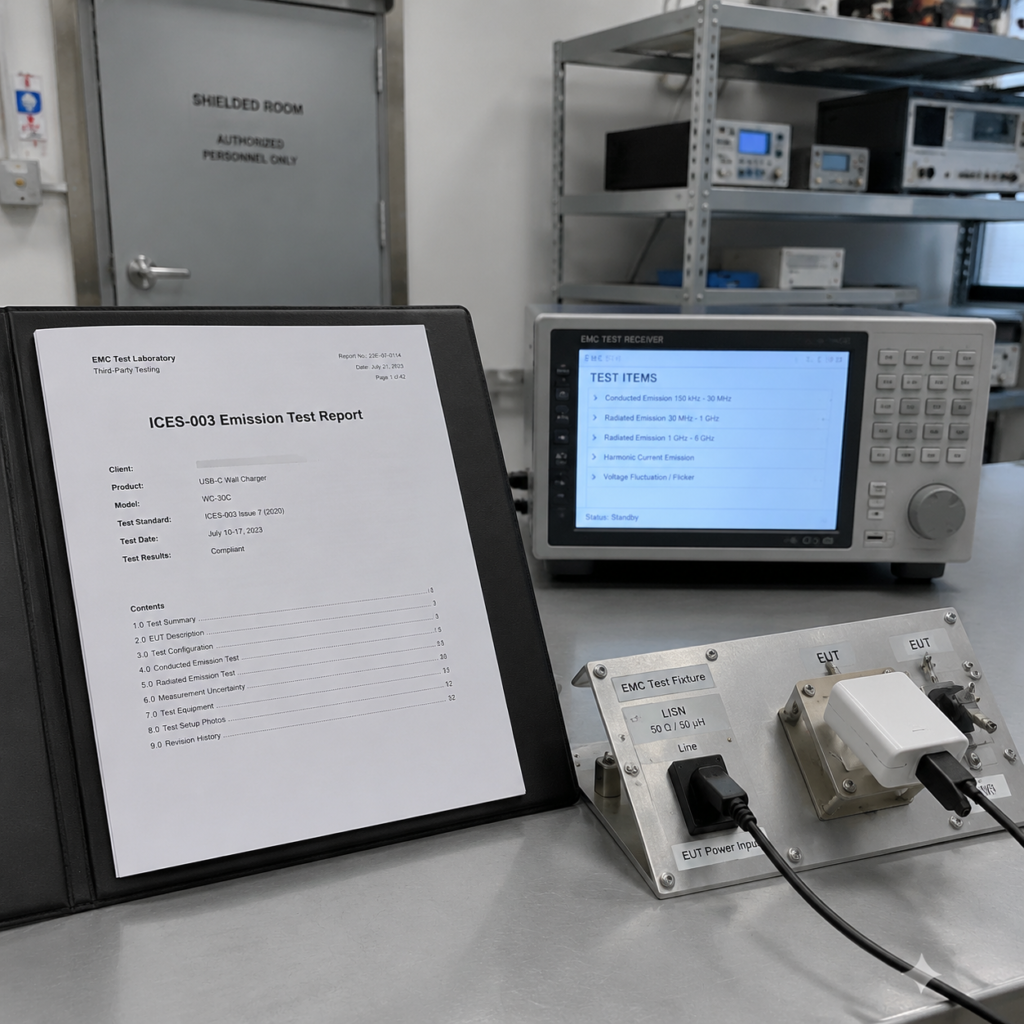
During testing, the laboratory will select representative and most unfavorable working conditions according to the product structure and test plan, such as high power output, simultaneous operation of multiple interfaces, different input conditions, etc. The specific situation shall be subject to the applicable standards and the laboratory’s test plan. Here we remind everyone that the Wi-Fi lag, radio noise you feel during daily use can only be used as a reference. Whether it is qualified or not shall be subject to the laboratory’s standard test, because the interference may come from other devices.
Devices with Radio Transmission Functions: RSS Certification Requirements (IC ID Required)
Next are chargers with active wireless transmission functions, such as smart chargers with Bluetooth and Wi-Fi. This type needs to follow the RSS certification path, and after passing, there will be an IC ID.
The core regulatory content of RSS is the frequency band, power and spectrum use of wireless signals. To put it plainly, it is to prevent devices from occupying frequency bands indiscriminately and transmitting high-power signals randomly, interfering with legal radio services. For example, they cannot occupy the dedicated frequency bands for broadcasting and aviation.
Core test items include transmission power (cannot exceed the specified upper limit), frequency range (can only work in allowed frequency bands), occupied bandwidth (cannot occupy too much spectrum resources), spurious emission (in addition to the main frequency band, no interference signals from other frequency bands can leak out). Radio transmitting equipment shall also undergo radio frequency exposure assessment in accordance with RSS-102 and its applicable exemptions, assessment methods and use distances; devices used close to or in contact with the human body usually require key verification. Whether full testing is required depends on frequency, power, antenna and use conditions.
Here is a cost-saving tip: if your product uses a wireless module that has passed ISED certification and meets the approved use conditions of the module, the evaluation of the whole machine can be simplified, and there is no need to retest the wireless part of the module, which can save a lot of time and cost.
After all tests and reviews are passed, ISED will assign a unique IC ID to the product. This is the “ISED certification number” in the narrow sense, which can be queried in the official system.
Special Judgment for Wireless Power Transmission (such as Qi) Products
Finally, the most asked about wireless charging products, such as Qi wireless chargers, have relatively special compliance requirements and cannot be directly calculated as ordinary wireless devices.
Wireless power transmission equipment shall first be judged whether it falls within the scope of RSS-216 according to the operating frequency. Qi and other wireless charging transmitters operating within the frequency range covered by RSS-216 usually need to be certified according to RSS-216 and obtain an ISED certification number, while evaluating applicable electromagnetic compatibility requirements; whether there is an additional radio communication function cannot be used as the sole basis for exempting from RSS-216. If the device also has communication functions such as Bluetooth and Wi-Fi, it is necessary to further judge the corresponding wireless standards and radio frequency exposure requirements.
During testing, wireless chargers must consider both electromagnetic compatibility and wireless transmission requirements, and cannot only test one of them. Special attention should be paid to this point. Many people miss one of them when doing it, resulting in non-compliance.
Full Process of Handling: Steps and Cost Reference from Preparation to Launch
After understanding the requirements, many seller friends will definitely ask: then if I want to handle ISED compliance, what exactly should I do? How much does it cost? How long will it take? We have sorted out the whole process from preparation to launch, all are links that everyone needs to participate in, and the internal operations of the laboratory don’t need everyone to worry about.
Before starting the handling, there are three key matters that must be confirmed first, otherwise it is easy to waste money:
First is product classification and applicable standards. Be sure to first determine which path the product takes according to the method we mentioned earlier, especially for wireless chargers, be sure to first clarify which standard applies, otherwise if you test the wrong standard, it will be useless even if you do it.
Second is sample status. The samples sent for testing must be the final mass production version. Core components such as fast charging chips, transformers, wireless modules must be the same as those in mass production — if you take an engineering sample for testing, and change the chip during mass production, then the test result will be completely invalid.
Third is institutional qualification. Not all laboratories can do ISED testing: laboratories doing ICES testing must be within the scope of ISED recognition or acceptance; if doing RSS certification, you also need to additionally confirm the qualification of the certification body or TCB (Telecommunications Certification Body), otherwise the report and certification made will not be recognized by Canada.
After confirming, you need to prepare basic materials, mainly these:
First is representative samples, which shall be determined according to circuit structure, key components, port configuration, software/firmware and the most unfavorable working mode. Whether other models can be covered by the same report or certification must be confirmed by the laboratory or certification body according to similarity and the most unfavorable configuration, and cannot be judged only by power or number of interfaces.
Then is the product specification, which should clearly state basic parameters such as input voltage, output power, interface type, supported fast charging protocols.
There are also basic technical materials, such as circuit block diagrams, appearance and internal photos, list of key components (such as chips, transformers, capacitors and other core parts).
If it is a product with wireless functions, you also need to additionally provide information such as the wireless module’s certification certificate and antenna parameters.
After the materials are prepared, you can enter the handling process. The steps for different paths are different:
If it is the pure wired ICES path, the process is very simple: choose a qualified laboratory, send the samples for testing. If unqualified, rectify according to the laboratory’s suggestions, retest after rectification. After passing, get the test report, keep it by yourself, and the product can be launched after affixing the correct label — this path usually does not require registration with ISED, nor does it have an IC ID, but you still need to confirm that the product meets all applicable Canadian marketing requirements.
If it is the RSS path with wireless functions, the process has one more step: first find a qualified laboratory to do the test. After the test is passed, a qualified certification body or TCB will conduct the review and complete the certification, obtain the ISED certification number, and the database record can be used for verification. Wireless devices must also meet applicable RSS, RSS-Gen, ICES, radio frequency exposure and labeling/declaration requirements. Obtaining the certification number itself does not mean that electrical safety, energy efficiency and other Canadian marketing requirements have been met.
The cycle and cost that everyone is most concerned about actually have no unified price. We can only give you an estimate of common projects, and the specific situation depends on the product:
• Pure wired ICES-003: The cycle is about 2-4 weeks, and the cost will increase with the increase of power and the number of interfaces, because there are more working conditions for testing.
• Products with wireless functions (RSS + ICES): The cycle is about 4-8 weeks, and the cost is definitely higher than that of pure wired ones, because the wireless part needs to be tested and the certification review process is also required.
There are many variables that affect the cycle and cost: for example, the scheduling of the laboratory, it may take a long time to wait in the peak season; if the standard is updated, additional test items may be required; if the first test is unqualified, rectification and retesting will also add money and time; the more frequency bands of wireless functions, the higher the cost, for example, those with both Bluetooth and Wi-Fi are more expensive than those with only Bluetooth. But there is a cost-saving method: multiple models of the same series, if the core configuration is the same, only the power and number of interfaces are different, can be done together, but whether the same report or certification can be shared must be confirmed by the laboratory and certification body according to similarity, key components and the most unfavorable configuration, and cannot be presumed by yourself.
Finally, let’s talk about the validity period of compliance and everyone’s ongoing responsibilities:
If it is a type certification category (such as RSS certification), as long as the core configuration of the product remains unchanged and the applicable standards are not updated, the certification record is long-term valid. But if there are situations such as standard updates, changes in applicant information, model adjustments, replacement of wireless modules or antennas, the validity of the certification may be affected, and re-evaluation is required.
In addition, the manufacturer is responsible for ensuring that the mass-produced products are consistent with the certified samples, and cannot secretly replace core components to reduce costs. Otherwise, if found, the certification will be invalidated and may face penalties.
Compliance Identification: Judging the Authenticity of ISED Compliance of USB Chargers
Whether it is a seller choosing a supplier, or a consumer buying a charger, they all want to know how to judge the authenticity of ISED compliance. First of all, we need to clarify the biggest misunderstanding, which we also mentioned earlier, and emphasize again: not all compliant products have an IC ID!
Pure wired chargers only need to meet the applicable ICES-003 requirements and do not have an IC ID. You cannot say that a product is non-compliant just because there is no IC number on it. Only products with active wireless transmission functions that need to follow the RSS certification path usually need to have an IC ID, which can be queried in the official system.
Then how to check if the label is correct? Different types of products have different labeling requirements:
• For pure wired Class B consumer-grade chargers, the correct label is「CAN ICES-3(B)/NMB-3(B)」, which is usually printed on the product label or shell.
• Products with wireless RSS certification shall be marked with an IC number, the format is generally「IC: Enterprise prefix-Product number」, which is uniformly assigned by ISED.
• If the product uses a certified wireless module, it is also necessary to mark relevant instructions according to the module’s requirements, such as “Contains ISED-approved module” and the like.
In addition, the language of the label should also be judged in combination with ISED rules, Canadian consumer packaging regulations, and local requirements of Quebec. For example, products sold in Quebec may need to have French labels, which should be noted.
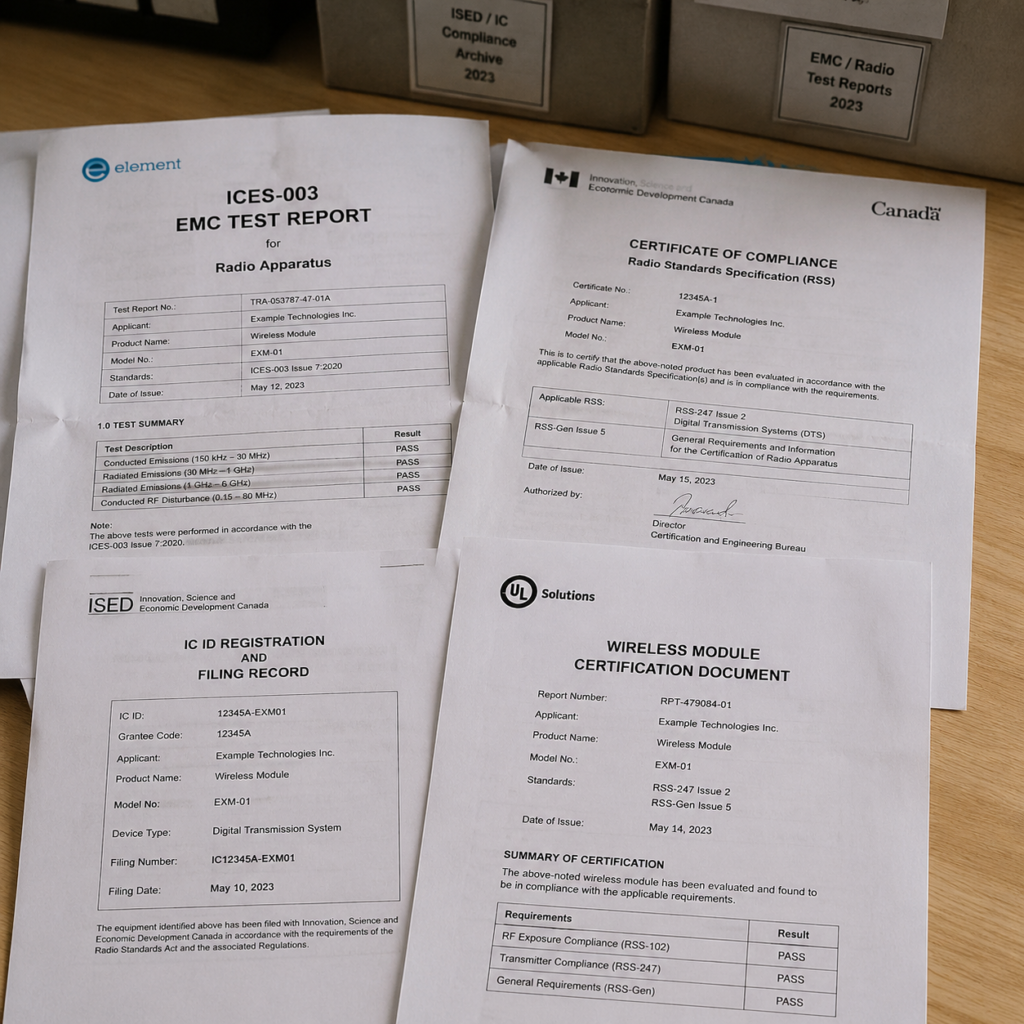
If it is a product with an IC ID, you can go to ISED’s official system to query the authenticity. The steps are very simple:
1. Be sure to enter ISED’s certification query system from the official website of the Government of Canada, do not click on third-party phishing websites from search results to avoid being cheated.
2. Enter the IC ID number you want to check, or the name of the enterprise applying for certification, and you can search.
3. After the search results come out, you need to check three core pieces of information: whether the product model is consistent with the one you have, whether the wireless parameters match, and who is the certification holder in the official record. If the certification holder is different from the product brand or manufacturer, you should also confirm its OEM, authorization or product ownership relationship, instead of requiring the name to be completely consistent.
Here we remind everyone: the query result can only prove that this certification record exists, and cannot alone prove that the mass-produced product you have is completely consistent with the certified sample — after all, some bad merchants use qualified samples for inspection, but cut corners during mass production. This situation cannot be detected just by checking the number, and you need to judge in combination with other information.
Let’s summarize several common fake certification identification skills. Be careful when encountering these situations:
First is wrong number format. You should check whether the certification number conforms to the number format announced by ISED, and confirm in the official database whether the number, certification holder, product model and wireless parameters are consistent; you cannot judge the authenticity only by the number of digits of the number or whether the word “IC” is used on the label.
Second is no record in the official system. If you enter the number in ISED’s official system and cannot find the corresponding product information at all, then it must be fake.
Third is passing off another product’s ID. That is, using the IC ID of other models or even other categories of products to impersonate, for example, using the IC ID of the same brand’s Bluetooth headset to stick on the charger. This can be found by checking the model and parameters.
Fourth is using the module’s IC ID to impersonate the whole machine’s certification. Some manufacturers use a certified wireless module, but do not meet the module’s use conditions, so they directly stick the module’s IC ID on the whole machine, pretending it is the whole machine’s certification. This is also non-compliant — the module’s certification is only for the module itself. Whether the whole machine can use it depends on whether it meets the module’s use conditions and completes other evaluations of the whole machine.
Pitfall Avoidance Guide: Common Misconceptions and Change Assessment Rules
Finally, let’s talk about several most common pitfalls that everyone is most likely to step into, as well as how to judge whether to re-do certification after product changes, and how to choose a reliable certification service provider.
Let’s first talk about 4 most common cognitive misconceptions, which 90% of people have stepped into:
First misconception: If you have FCC or CE certification, you don’t need to do ISED. This is wrong. FCC is the US certification, CE is the EU’s. Each region’s regulatory requirements, test details, and label rules are different and cannot replace each other. To enter the Canadian market, you must meet ISED requirements.
Second misconception: All chargers of the same brand have universal ISED certification. This is also wrong. Different power, different number of interfaces, whether with wireless function, the requirements are different. For example, a 20W wired fast charger and a 100W charger with wireless charging definitely cannot use the same certification, and must be evaluated separately.
Third misconception: ISED is Canada’s full-category access certification. No, as we mentioned earlier, ISED only regulates electromagnetic compatibility and wireless transmission. Safety, energy efficiency, language and packaging are all regulated by other departments. Passing ISED does not mean you can sell freely in Canada, you also need to meet other access requirements.
Fourth misconception: Getting compliance is once and for all. Of course not. If the core configuration of the product changes, or the applicable standards are updated, the compliance must be re-evaluated. Moreover, the manufacturer must always ensure that the mass-produced products are consistent with the certified samples, otherwise there will be big trouble if found.
Many seller friends will ask: I changed a certain part of the product, do I need to re-do the certification? We have sorted out a change assessment matrix, you can compare and judge:
| Change Type | Risk Level | Is Retest/Recertification Required | Description |
| Replacing fast charging chip/transformer/power solution, replacing wireless module/antenna, increasing power, adding wireless function | High risk | Retest/recertification required | Core configuration changes will directly affect electromagnetic compatibility or wireless performance |
| Changing shell/internal layout, adding interfaces of the same specification | Medium risk | Usually requires document evaluation, not necessarily retest | May have an impact on electromagnetic compatibility, need to evaluate to determine whether to retest |
| Label text adjustment (without changing certification number), outer packaging change, minor adjustment of cable length | Low risk | Usually no impact, but need to confirm | Does not involve core performance, as long as it meets the labeling rules |
Finally, let’s tell you several pitfall avoidance tips for choosing certification service providers to avoid wasting money:
First, be sure to check the qualification. Don’t just listen to the merchant say “can do ISED”, you need to confirm whether they have ISED recognition or acceptance qualification for the specific standard you want to do (such as ICES-003, RSS-216) — different standards have separate qualifications, don’t be fooled by the statement of “general qualification”.
Second, look at the test plan. Regular institutions will give you a clear test plan covering the most unfavorable working conditions, such as multi-port full load, maximum power, different input voltages. If some institutions offer particularly low prices, you should be careful. It may be that they have missed many core scenarios, so such reports are invalid, and if found, they are still non-compliant.
Third, don’t believe the statement of “guaranteed pass”. Regular certifications are tested according to standards. It is normal to be unqualified, and rectification is also a routine operation. If someone tells you “100% guaranteed pass”, either it is fraud, or they simply don’t test according to the standard. When the time comes, if you are found by Canadian customs or market supervision, the loss is not just a little certification fee.
So far, about the ISED certification of USB chargers, we have almost covered everything from basic concepts, judgment methods, core requirements, handling process, authenticity identification to pitfall avoidance skills. After reading this article, you should be able to quickly judge whether a USB charger or charging accessory needs ISED compliance and which path to take; you can distinguish the requirement differences between three types of products: pure wired, with wireless, and wireless charging, and will not mix them up with other Canadian access certifications; you can understand compliant ISED labels, know how to check the authenticity of IC ID in the official system, and judge whether it matches the product; you also understand the general process, cycle and influencing factors of cost of handling, and can avoid a lot of invalid costs; you can also avoid the most common cognitive misconceptions, and judge by yourself whether to re-evaluate compliance after product adjustment. Whether you are a seller doing the Canadian market, or an ordinary consumer living in Canada, understanding these will help you avoid a lot of compliance pitfalls.