
If you do cross-border e-commerce selling USB chargers to Eurasian Economic Union (EAEU) countries such as Russia and Kazakhstan, or often buy digital accessories from local platforms via overseas shopping, you must be no stranger to the “EAC mark”. But many people’s understanding of it either stays at “a randomly pasted label”, or they get confused by terms of various technical regulations and conformity assessment forms. In this article, we start from the most basic concepts, up to being able to judge compliance by yourself and avoid pitfalls in the application process. Both ordinary consumers and novice sellers can understand it.
Basic EAC Common Knowledge for Beginners
EAC Is Not a “Test Item”, But a Market Access Mark
The full name of EAC is the Eurasian Conformity Mark, which is the market access mark for conformity assessment of technical regulations of the Eurasian Economic Union (EAEU, including 5 member states: Russia, Belarus, Kazakhstan, Armenia, and Kyrgyzstan). It is not a single separate test.
Products subject to EAEU technical regulations can generally be circulated within EAEU member states after completing the corresponding conformity certificate or conformity declaration and correctly using the EAC mark; however, it is still necessary to separately check the language, plug, radio frequency and other national-level requirements of the target country. EAC replaces the old access arrangements within the scope of relevant technical regulations, and does not unconditionally replace all GOST or other requirements.
Many people think there is only one type of “certificate” for EAC. In fact, there are two types of conformity assessment: one is the conformity certificate, issued by an officially authorized certification body; the other is the conformity declaration, where the applicant declares compliance by itself, but it is not valid just by writing a declaration casually.
No matter which type of assessment it is, the core function is the same: effective EAC compliance documents are required for customs clearance, offline physical store sales, and listing on local mainstream e-commerce platforms such as Ozon/Wildberries.
Why Do USB Chargers Need EAC?
Chargers with AC mains input are directly connected to household power supplies. If they are of poor quality, they are prone to risks of electric shock, overheating, and fire. The EAC technical regulations set a minimum safety baseline. In addition, chargers are switching power supplies, which may generate electromagnetic interference during operation—for example, the radio next to it makes noise when charging a mobile phone, or the WiFi signal is affected. Therefore, they must also meet electromagnetic compatibility requirements: they must not interfere with other electrical appliances, nor can they be easily affected by external interference.
The consequences of non-compliance are clear: for sellers, without valid documents, goods will be detained by customs and returned, e-commerce platforms will directly remove the products, and they may even be fined by regulatory authorities. For ordinary consumers, buying non-compliant chargers may damage mobile phones and tablets, and in severe cases, cause safety accidents. When non-compliant products malfunction or cause safety accidents, consumers may face difficulties in rights protection. The specific after-sales liability still depends on the sales entity, contract, and consumer protection rules of the target country.
Of course, not all USB chargers are mandatory to have EAC—only products that are subject to EAEU technical regulations and placed on the market independently require mandatory compliance.
4 Common Cognitive Misconceptions for Novices
People who are new to EAC almost always fall into these pitfalls. Remembering them clearly in advance can save a lot of detours:
1. “EAC is a Russia-exclusive certification”: Wrong. EAC has unified validity within EAEU member states, but different countries may still have differences in plug standards, manual languages, radio frequency use, regulatory details, etc.
2. “CE/FCC can replace EAC”: Wrong. CE is for the EU, FCC is for the US. They are completely different from EAC’s regulatory system and assessment rules, and there is no mutual recognition relationship. Even with CE/FCC, EAC is still required to enter the EAEU market.
3. “EAC certification is permanently valid”: Wrong. EAC conformity assessment has a fixed validity period. For mass-produced products, the maximum period is no more than 5 years. Re-assessment is required when it expires or the product is redesigned.
4. “Low-power chargers do not need EAC”: Wrong. Whether EAC is required depends on the input type, product classification, and sales form, and has no direct relationship with power. For example, a 5W wall charger, as long as it is an independently retailed AC input product, still needs to comply with regulations.
How to Judge Whether Your USB Charger Needs EAC?
Core Logic: Three-Step Judgment Method
You don’t have to guess randomly to judge the compliance boundary. Follow these three steps to figure it out:
Step 1: Judge the product boundary: Confirm whether this USB charger is placed on the market independently. For example, if a charger included in a mobile phone box is imported and sold together with the mobile phone, and the EAC assessment of the mobile phone already covers the included charger, then it does not need to be done separately; but if the charger is packaged, sold, and declared separately, it is independently placed on the market and requires separate assessment.
Step 2: Judge applicable regulations: Check the input voltage, function, and sales form of the product to confirm which EAEU technical regulations it applies to. Different products have different applicable regulations and different tests to be done.
Step 3: Judge the assessment form: According to the assessment scheme in the corresponding regulations, determine whether a conformity certificate or a conformity declaration is required, and you cannot choose based on feeling.
Compliance Boundaries of Different Types of USB Chargers
We classify common USB chargers by type, and the corresponding rules are clearer:
• AC mains wall-plug type: These are single-port and multi-port fast charging heads usually plugged into home sockets, and laptop USB-C adapters also fall into this category. Most of them are sold independently and mostly require EAC assessment in accordance with regulations.
• DC car USB chargers: These are the ones plugged into car cigarette lighters. It depends on the input voltage—only those with DC input between 75V and 1500V may be subject to low-voltage safety regulations; the cigarette lighter of ordinary family cars is 12V or 24V, which is lower than 75V, so it is not subject to low-voltage safety regulations, but it still depends on whether it meets the requirements of other regulations.
• Wireless chargers with USB output: The applicable safety, EMC, hazardous substance and energy efficiency requirements shall be judged as a complete product; if they have Bluetooth, Wi-Fi or other radio transmission functions, it is also necessary to check the EAEU list of radio electronic equipment/high-frequency equipment, applicable conformity assessment and frequency use requirements.
• Built-in/industrial dedicated power modules: If they are installed in other equipment and not sold separately, they are covered by the EAC assessment of the whole machine and do not need to be done separately; but if they are independently packaged and sold separately, they require separate assessment.
• Charger + cable set: The charger is judged according to the above rules, and the charging cable needs to be separately confirmed whether it needs separate assessment according to the boundary rules of cables. You cannot think that everything is fine just because the charger has a certificate.
Supplement: How to Calculate the EAC Boundary of USB Charging Cables?
Many people ask whether charging cables need EAC. In fact, it depends on the situation:
• Independently sold ordinary low-voltage data cables (without chips): Usually they are not within the scope of low-voltage safety regulations, but it is necessary to verify whether they are included in the requirements of other relevant regulations.
• Independently sold USB-C cables with E-marker or protocol chips: It is necessary to confirm whether they involve requirements of regulations such as electromagnetic compatibility and hazardous substances.
• Special cables with power conversion/control circuits: For example, fast charging cables with voltage regulation function, these are judged as power products and need to comply with corresponding safety and EMC regulations.
• Cables sold in sets/with the machine: If they have been included in the assessment coverage of the charger or the whole machine, they do not need to be done separately; if not covered, separate verification is required.
Typical Scenarios and Influencing Factors
First, let’s give the conclusions of the two most common scenarios:
• Must apply: Independently retailed and separately declared wall chargers, multi-port PD fast charging heads, laptop USB-C adapters.
• May not need separate application: Included chargers imported in the same batch as the whole machine and already covered by the whole machine’s assessment documents, but be sure to verify the document list of the whole machine in advance, and cannot take it for granted that “the whole machine has a certificate so it’s fine”.
Not all chargers have the same compliance requirements. These factors will affect the applicable regulations and assessment forms: electrical parameters (input voltage range, total output power, single-port power, fast charging protocol type), structural differences (plug type, number of interfaces, whether pins are detachable, shell material), sales form (independent retail, set sales, sold with the whole machine), additional functions (whether there is wireless charging, Bluetooth/WiFi and other communication functions). The HS code can only be used as a reference for classification. The final compliance judgment shall be subject to the conclusion of the certification body, and cannot be based solely on the HS code.
What Does EAC Certification Test? Core Compliance Requirements
First Distinguish the Difference Between the Two Assessment Forms
Many people think that “declaration is less strict than certificate”. In fact, the core requirements of both are the same: whether it is a conformity certificate or a conformity declaration, it must meet the corresponding technical regulation requirements, and both must be registered in the EAEU official database.
Special attention: Conformity declaration does not mean exemption from testing or technical proof, but the required form of evidence depends on the applicable technical regulations and specific assessment schemes; some schemes require test protocols from accredited laboratories, and some schemes allow the use of technical evidence from the applicant or manufacturer.
The specific assessment form to choose shall be determined according to product classification, input voltage, purpose, power, and the assessment scheme in the appendix of the corresponding regulations. You cannot casually say “ordinary chargers just do declaration”.
In terms of validity period, the maximum validity period of conformity assessment for mass-produced products is no more than 5 years, and the specific period is determined by the corresponding regulations and assessment schemes. Whether production condition analysis, factory audit or annual supervision is required shall be strictly determined in accordance with applicable technical regulations and assessment schemes, and cannot be judged solely by power; mass production certificate schemes may involve production status analysis or supervision, and the specific shall be subject to the selected scheme and certification body documents.
What Do the 4 Core Technical Regulations Cover?
EAC compliance requirements are all centered on technical regulations. There are 4 common ones for USB chargers. You don’t need to remember the numbers, just know what they cover:
1. Low Voltage Safety Regulation (TR CU 004/2011)
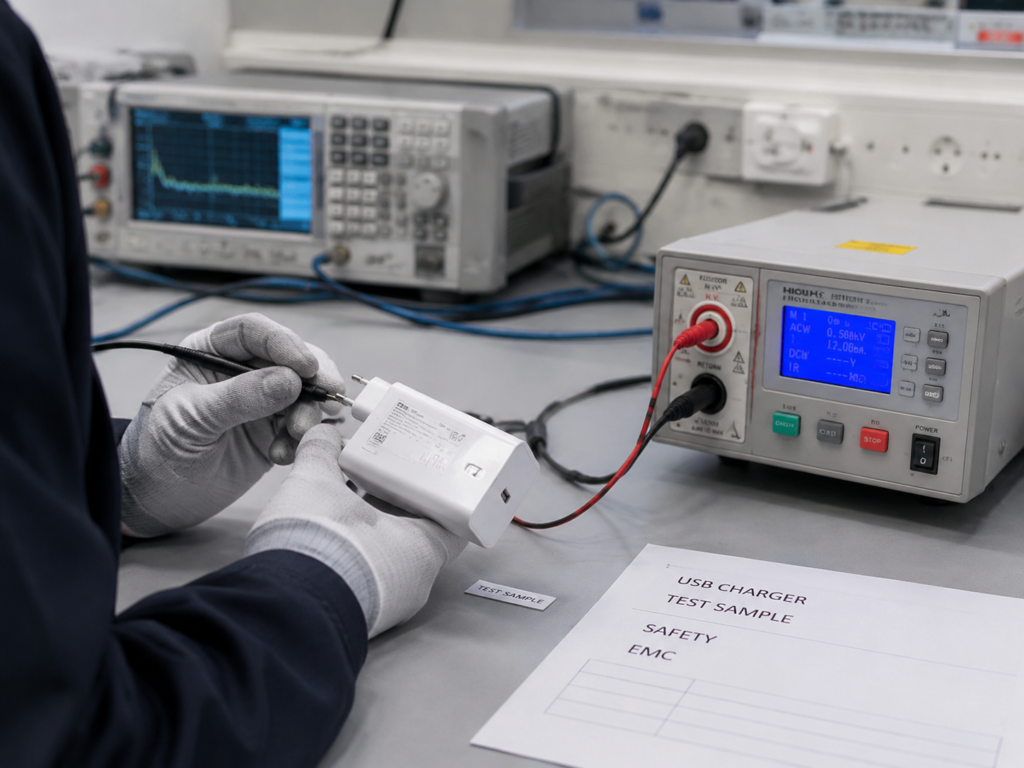
It covers basic safety, such as electric shock protection and fire prevention. The applicable conditions are low-voltage electrical equipment placed on the market independently with a rated voltage between AC 50-1000V and DC 75-1500V. Car chargers with DC input lower than 75V, built-in power modules not sold separately, and special equipment excluded from the appendix of the regulation are not applicable. Typical test evidence includes test reports of withstand voltage, insulation, and leakage current. Common misconception: Not all chargers are subject to this regulation. It must be judged according to input voltage and product form.
2. Electromagnetic Compatibility Regulation (TR CU 020/2011)
It covers electromagnetic interference: it must not interfere with other electrical appliances, and must also be able to withstand certain external interference. The scope of application and exclusions of TR CU 020/2011 shall be subject to the text and appendix of the regulation. Switching power supplies, wireless chargers, etc. usually need to focus on checking their electromagnetic interference and immunity requirements, but conclusions cannot be drawn solely based on the label of “electronic product” or “passive product”. Typical test evidence includes reports of conducted disturbance, radiated disturbance, electrostatic discharge immunity, etc.
3. Hazardous Substances Regulation (TR EAEU 037/2016)
Similar to the familiar RoHS, it restricts 6 types of hazardous substances in products. Only products included in the current regulatory list of the regulation need to comply. Products not included in the list and small parts exempted by the regulation are not applicable. The specific shall be subject to the latest list and transition period. Restricted substance test reports are the core evidence, and supply chain material declarations can only be used as supplements and cannot be equated with complete compliance evidence. Common misconception: Not all chargers need to comply. It shall be subject to the regulation list.
4. Energy Efficiency Regulation (TR EAEU 048/2019)
It covers the energy efficiency of power supplies, such as no-load power consumption and average conversion efficiency. Only external power supplies included in the current regulatory list of the regulation need to comply. Products not included in the list and special-purpose power supplies are not applicable. The specific shall be subject to the latest list and transition period. Typical evidence is the energy efficiency test report. Common misconception: Not all chargers need to do energy efficiency testing. It depends on whether they are on the list.
What Is the Relationship Between Regulations and Test Standards?
Many people confuse technical regulations with test standards. In fact, it is easy to distinguish: technical regulations set “goals”, such as requiring “no electric shock to users” and “no fire”, which are mandatory to meet; the supporting test standards set “methods”, generally using GOST R standards or equivalent IEC standards, telling you what method to use for testing and what value is considered to meet the requirements.
Note: The version of the standard, specific adoption situation, and test plan all need to be confirmed by the certification body. You cannot casually find an IEC standard to apply.
Overview of Core Test Items
For your convenience, we have sorted out common test items into a table:
| Test Category | Applicable Product Scope | Core Assessment Content |
| Input Safety | Products with AC input and meeting the applicable conditions of TR CU 004 | Insulation performance, withstand voltage, leakage current |
| Output and Abnormal Working Conditions | Determined according to product standards, structure and assessment scheme | May include output parameters, abnormal operation, short circuit and protection function verification |
| Temperature Rise and Structure | Determined according to applicable safety standards and product structure | May include temperature rise, insulating shell, plug mechanical strength and flame retardant related items |
| EMC | Products meeting the applicable conditions of TR CU 020 | Conducted/radiated disturbance, immunity |
| Energy Efficiency | External power supplies included in the TR EAEU 048 list | No-load power consumption, average efficiency |
| Restricted Substances | Products included in the TR EAEU 037 list | Content of 6 types of restricted substances |
Mandatory Requirements for Product Identification and Nameplate
Even if the test is passed, non-compliant identification is still non-compliant. These are must-notes:
• The EAC mark must have a fixed style and proportion, be clear and durable, and be visible throughout the service life of the product. It cannot be peeled off easily.
• The product body and accompanying documents shall be marked with product model, main electrical parameters, manufacturer or responsible entity and other required information in accordance with applicable technical regulations; specific fields and carriers such as input and output voltage, current, power and address shall be subject to applicable regulations, product standards and requirements of the target country.
• Product identification, packaging and user documents shall provide information in Russian and/or the national language required by the laws of the selling member state in accordance with applicable EAEU technical regulations and the language requirements of the selling member state. The specific parameters, warnings and carriers included shall be confirmed according to applicable regulations.
• The registration number is not mandatory to be marked on the product body. It must be reflected in the assessment documents, and can also be marked on the packaging or manual as required by regulations.
How to Check the Authenticity of EAC? Compliance Verification Methods
Step 1: Preliminary Appearance Screening (Only for Quick Investigation, Cannot Prove Compliance)
First look at the surface, which can quickly eliminate obvious counterfeit products:
• Identification check: The letter style of EAC should be standard, not blurred or deformed, and will not fall off easily.
• Parameter check: There is a complete model, input and output parameters, manufacturer information, and no obvious false labeling (such as marking 5V100A which is obviously inconsistent with common sense).
• Suspicious features: Only the EAC mark, no other information; the mark is pasted on a replaceable position (such as plastic film); the parameters are obviously unreasonable.
Note: A good appearance does not mean it must be compliant. It is only a means to quickly eliminate low-quality counterfeits.
Step 2: Free Query in Official Database
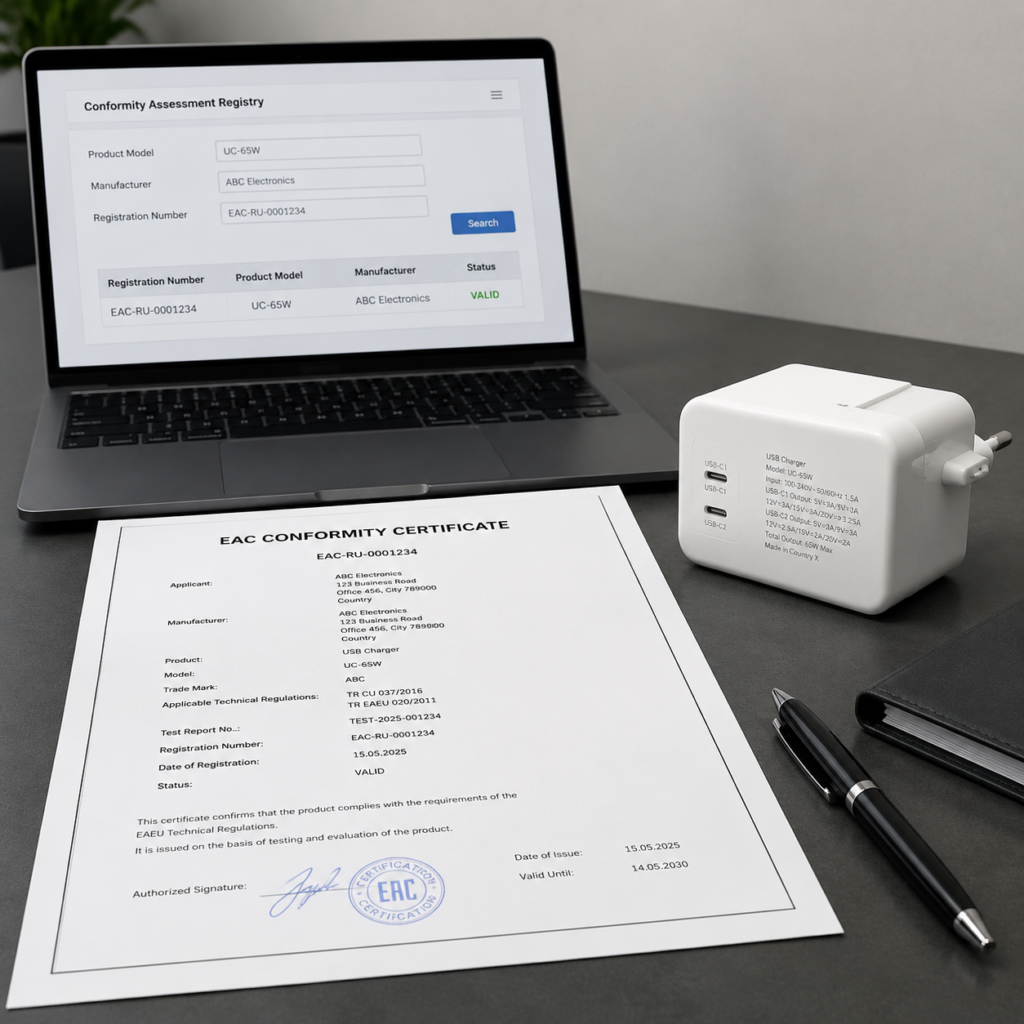
Ordinary people can check by themselves, no need to find an agency: the query channel is the EAEU Unified Conformity Assessment Registration Database, which has two entrances for certificates and declarations. Don’t enter the wrong one. When querying, you can enter the registration number, product model, and manufacturer name for search. The search fields may be adjusted with platform updates.
The result judgment is very simple: if it shows “valid”, it means the status of the document is normal; if it shows cancelled, expired, or no record can be found at all, it is invalid.
Limitations of Database Query, Don’t Think Everything Is Fine Just Because You Can Find It
Many people think that if it can be found in the database, it is real. In fact, it is not. There are these limitations:
• Status delay: Information about the suspension or revocation of a certificate may have an update delay, and the status in the database does not represent 100% real-time validity.
• Information deviation: For example, differences in the translation of manufacturer names and incomplete model lists may lead to failure to find or mismatches.
• Only verifying documents: A record in the database only proves that the document exists, and does not mean that the actually sold product is consistent with the product in the document—for example, in the case of certificate misappropriation, the document is real, but the product is wrong.
So the final compliance still needs to be comprehensively judged in combination with the original assessment documents and the actual product.
Step 3: Verify the Core Information of the Certificate/Declaration in Detail
If you want to confirm that the product is really compliant, check these points:
• Entity verification: The manufacturer and production address shall be consistent with the responsible entity marked on the product nameplate.
• Model verification: The actual product model must be in the model list specified in the document; if it is a product of the same series, it is necessary to confirm that the circuit structure is consistent.
• Parameter verification: The input and output range, total power, interface type, and fast charging protocol shall be consistent with the description in the document.
• Status verification: The document is within the validity period, and there is no record of suspension, revocation, or change.
• Coverage verification: The document shall cover the current sales form, additional functions, and production site. For example, if the document only mentions independent retail, it cannot be used as a compliance certificate for set sales.
4 Common Types of Invalid/Fake Assessments
These situations are invalid even if they can be found in the database:
• Certificate misappropriation: Using documents of products with similar appearance but different models and circuits to impersonate, and the actually sold product model is not in the document at all.
• Expired certificate: The document has expired but is still in use, and the database shows an invalid status.
• Fake number: Fabricating a non-existent registration number, which cannot be found in the database at all.
• Borrowed certificate: Borrowing documents from other manufacturers or other models, which do not cover one’s own products at all, and the risk is extremely high.
How Do Novices Apply for EAC Assessment? Beginner’s Guide
Who Can Apply? How Is Liability Divided?
First of all, note: overseas manufacturers cannot directly apply for EAC assessment. Usually, a subject registered within the EAEU is required as the applicant, that is, the importer or authorized representative.
The authorized representative does not need any special qualifications, as long as it is a legally registered subject within the EAEU with a clear authorization relationship, but it shall bear the corresponding compliance liability. The liability division is also clear: the applicant entity bears the main responsibility for compliance, including document preservation, cooperation with regulatory spot checks, product recall, etc.; the manufacturer is responsible for the design and manufacturing quality of the product.
Can Products of the Same Series Be Assessed Together?
Many sellers have several models of the same series and want to put them in one certification to save money. Whether they can be merged depends on whether the core design is consistent:
• Prerequisite for merging: The core safety design of the same series of products is completely consistent, and only non-critical parameters are different.
• Differences allowed for merging: For example, different numbers of interfaces under the same power level, different printing colors, and appearance detail differences that do not affect safety.
• Changes that cannot be merged: Different output power levels, different circuit topologies, different core safety components, different shell materials, different plug types, different production addresses, different fast charging protocol versions.
Note: Whether they can be merged must be evaluated and confirmed by the certification body. You cannot casually add models by yourself, otherwise it will be invalid.
What Materials Should Be Prepared Before Application?
Preparing these in advance can save a lot of time:
• Product category: Representative samples, product specifications (with clear input and output, interfaces, fast charging protocols, models), drafts of nameplates and packaging/manuals.
• Qualification category: Business license of the manufacturer, qualification documents of the applicant/authorized representative.
• Reference materials: Existing test reports such as CB and CE can be used as supplementary materials, which can reduce repeated testing and save time and costs.
• Others: If there are product change records, or supply chain declarations required by hazardous substance regulations, they should also be prepared together.
Reference for Application Process and Cycle
The application process is actually not complicated, mainly divided into three steps:
1. Choose a certification body with official EAEU qualifications, and confirm the applicable regulations, assessment form and specific scheme of the product according to the three-step judgment method mentioned earlier.
2. Submit the prepared materials and samples, and the certification body will conduct document review and product testing.
3. After the test and technical evidence meet the requirements, the conformity certificate shall be issued and registered by the corresponding certification body in accordance with regulations; the conformity declaration shall be registered by a qualified applicant entity in accordance with applicable procedures. Whether the certification body or service agency can assist in handling shall be subject to local rules and authorization arrangements, and the final information shall enter the corresponding unified registration system.
Cycle reference: For ordinary AC input single-port USB chargers, the conventional market experience is 2-4 weeks. This is only an empirical value, not the time promised by regulations. There are many factors affecting the cycle: laboratory scheduling, whether samples need rectification, the number of fast charging protocol gears, product power, and whether factory audit is required, all of which will affect the time.
How Is the Fee Calculated? What Are the Influencing Factors?
There is no unified fixed price for EAC. Quotations are based on product conditions. The cost usually includes testing, certification or registration services, document processing, sample transportation and translation, etc.; whether there is a government fee and its amount shall be confirmed according to the member state and specific registration procedures, and shall not be generally listed as a unified official registration fee.
Optional fees include document translation fees, factory audit fees, rectification guidance fees, change evaluation fees, and annual supervision fees (only required for some assessment schemes).
Generally speaking, the overall cost of a conformity declaration is lower than that of a conformity certificate; schemes that require factory audit and annual supervision will have higher costs. Factors affecting the cost include product power, number of interfaces, number of fast charging protocols, assessment form, whether factory audit is required, and whether testing requires rectification, all of which will affect the final quotation.
6 Core Points to Avoid Pitfalls in Application
Novices are most likely to fall into these pitfalls when applying for EAC. Avoiding them in advance can save a lot of money and time:
1. Don’t trust low-price agencies that promise “guaranteed pass”: Regular agencies test according to rules. If they are unqualified, they need rectification. There is no absolute “guaranteed pass”. Those who say guaranteed pass are most likely issuing fake certificates.
2. Don’t borrow other people’s documents: EAC assessment is bound to product model, production address, and technical structure. Borrowing other people’s documents does not cover your own products at all, and you will be heavily fined if found.
3. Confirm the model coverage in advance: Products of the same series must meet the merging conditions, and must be confirmed by the certification body before merging. You cannot casually add models by yourself.
4. Don’t judge factory audit requirements solely by power: Whether production condition analysis, factory audit or annual supervision is required shall be subject to applicable technical regulations and specific assessment schemes. Mass production certificate schemes may involve production status analysis or supervision.
5. Plan renewal in advance: For assessment documents of mass-produced products, you need to apply for renewal 1-2 months before expiration to avoid affecting sales due to supply interruption. The specific time is subject to the assessment scheme.
6. Confirm the applicability of regulations in advance: For products with additional functions and special input types, be sure to first judge the applicable regulations according to the boundary rules to avoid non-compliance caused by missing tests.
Is It Done After Getting the Certificate? Change and Continuous Compliance Rules
Core Differences Between EAC and Other Common Certifications
Let’s make a systematic comparison here to avoid confusion:
• Compared with CE (EU): The applicable regions, regulatory systems, plug/language requirements, and assessment rules are different, and there is no mutual recognition at all.
• Compared with FCC (US): FCC is a requirement under the system of the US Federal Communications Commission, mainly involving radio frequency transmission, equipment authorization and related electromagnetic compatibility rules; EAC assesses safety, EMC, and possibly applicable energy efficiency, hazardous substances and other requirements respectively according to applicable EAEU technical regulations. The two cannot replace each other.
• Compared with CB report: CB report is a mutual recognition test report of the International Electrotechnical Commission, which can be used as a reference for technical data of EAC assessment. After confirmation by the certification body, it can reduce repeated testing, but cannot directly replace EAC assessment.
What to Do If the Product Is Changed?
Many sellers think that they can change the product casually after getting the certificate. This is a big mistake. The general principle is: any information change that affects applicable regulations, product safety, EMC, energy efficiency, restricted substances, manufacturer or production site shall be submitted to the certification body or the responsible entity for declaration registration for evaluation before mass production.
According to the evaluation results, it may be necessary to update technical documents, supplement tests, modify or re-register certificates/declarations, and re-conduct conformity assessment if necessary; you cannot apply a unified three-level classification by yourself.
For example, adjustments to printing colors or packaging changes that do not affect safety usually still need to be kept on record; replacing key safety components, shell materials, pin types, output protocols, or adding new models of the same series may require supplementary testing or updating documents; when changes occur in power supply solutions, core circuits, manufacturers, product categories, input voltage ranges, etc., it is even more necessary to be evaluated by the relevant responsible entities in advance, and you cannot continue to use the original assessment documents by yourself.
Basic Requirements for Continuous Compliance
After getting the certificate, you also need to do these to maintain compliance:
• Mass production consistency: Mass-produced products must be consistent with the samples during certification. Key components cannot be replaced casually. If you want to replace them, follow the change evaluation rules.
• Document preservation: Assessment documents, test reports, and change records must be kept in accordance with regulatory requirements, and must be available during regulatory spot checks.
• Supervision spot checks: EAEU market regulatory authorities will randomly inspect products on the market. If they are unqualified, the assessment documents may be revoked and product recalls may be required.
• Annual supervision: Only some conformity certificates require annual factory supervision audits to maintain the validity of the documents. Whether it is required depends on the requirements of the assessment scheme.
Compliance Liability and Post-Market Disposal
If something goes wrong, how is the liability divided? How to dispose?
• Liability division: The manufacturer is responsible for the design and manufacturing quality of the product; the importer/authorized representative bears the main responsibility for market access.
• Common disposal paths: If the document is suspended, it can be resumed after rectification is qualified within the time limit; if the document is revoked, it needs to be re-assessed; if the product is unqualified, it may be required to be recalled, removed from the shelves, or even fined.
4 Most Easily Overlooked Compliance Risks
These are pitfalls that many people have stepped on. Be sure to pay attention:
1. Set sales risk: For a set of charger + cable, the cable shall be judged according to the boundary rules of charging cables whether it needs separate assessment. You cannot think that everything is fine just because the charger has a certificate.
2. Platform requirement risk: Some e-commerce platforms will additionally require scanned copies of documents and authorization documents. Just pasting the EAC mark on the product does not meet the platform requirements.
3. Country difference risk: Although EAC has unified validity within member states, different member states may have differences in plug standards, language requirements, radio frequency use and regulatory details. Be sure to confirm clearly before entering a specific country.
4. Whole machine matching risk: A whole machine with EAC certification does not mean that the included charger is necessarily within the coverage. Be sure to verify the product list in the whole machine documents. If it is not in it, it is still non-compliant.
Practical Checklists: Quickly Verify Compliance
Pre-Purchase Checklist for Ordinary Consumers
• The product has a clear EAC mark, complete model and electrical parameters;
• There are no obvious suspicious points such as blurred identification, false parameter labeling, and rough workmanship;
• You can ask the seller to provide the registration number, and the valid status can be found in the official database;
• The product model and core parameters are consistent with the records in the database.
Pre-Market Checklist for Novice Sellers
• The applicable regulations and assessment form have been determined according to the three-step method, and valid assessment documents have been obtained;
• Product identification, packaging, and manuals meet the identification requirements, and are in the official language of the target market;
• The actual mass-produced product is consistent with the certification sample and document description;
• The importer/authorized representative within the EAEU has been confirmed and can cooperate with regulatory inspections;
• The materials required by the e-commerce platform have been fully prepared.
Pre-Market Compliance Document Package Checklist for Sellers
• Applicable regulation judgment records, assessment form confirmation documents;
• Valid conformity certificate/declaration, official registration certificate;
• Test reports corresponding to the product, list of key components;
• Qualification documents of the authorized representative/importer within the EAEU;
• Drafts of nameplates, packaging, and manuals;
• Supply chain consistency commitment, change control process documents;
• Other authorization materials required by the platform.
Pre-Product Change Checklist
• The change content has been sorted out clearly (components, circuits, structure, production site, model, etc.);
• It has been submitted to the certification body for evaluation, and the change handling requirements have been clarified;
• Corresponding documents and records have been updated after the change is completed;
• Before the evaluation is completed, the changed products are not sold with the original assessment documents.
Learning Path from Beginner to Semi-Proficient
Beginner Stage (Able to Understand and Conduct Preliminary Checks)
• Step 1: Be able to judge whether a USB charger is within the scope of EAC jurisdiction according to the three-step method, and distinguish applicable scenarios and exceptions;
• Step 2: Be able to understand the basic concepts of the EAC mark, two assessment forms, and core regulations, and avoid common cognitive misconceptions;
• Step 3: Be able to preliminarily judge the validity of EAC documents through preliminary appearance screening + official database query.
Semi-Proficient Stage (Able to Judge and Avoid Pitfalls)
• Step 1: Be able to determine the applicable regulations and conformity assessment form according to product type and input method;
• Step 2: Be able to verify the core information of certificates/declarations, and identify common fake certifications and invalid scenarios;
• Step 3: Be able to master the application process, change management rules and continuous compliance requirements, and avoid market launch risks;
• Step 4: Be able to use checklists to quickly complete compliance verification before purchase, market launch, and change.
Generally speaking, EAC certification for USB chargers seems to have many terms and complicated rules, but the core logic is actually very clear: first judge the boundary, then choose the scheme, and finally maintain consistency continuously. Whether ordinary consumers who want to buy reliable chargers, or novice sellers doing business in the EAEU market, understanding these basic rules can reduce common compliance misjudgments and market launch risks, and you don’t have to be confused by various professional terms anymore.