
Friends who export consumer electronics and first enter the U.S. and Indian markets will most likely hear the terms FCC and BIS. Many people default to thinking both are “local safety certifications,” and even assume that having one of them allows access to both markets. In reality, the two systems are vastly different in terms of regulatory objectives, coverage, and application logic. What is more, India has another separate agency specifically governing wireless devices, which is independent of BIS.
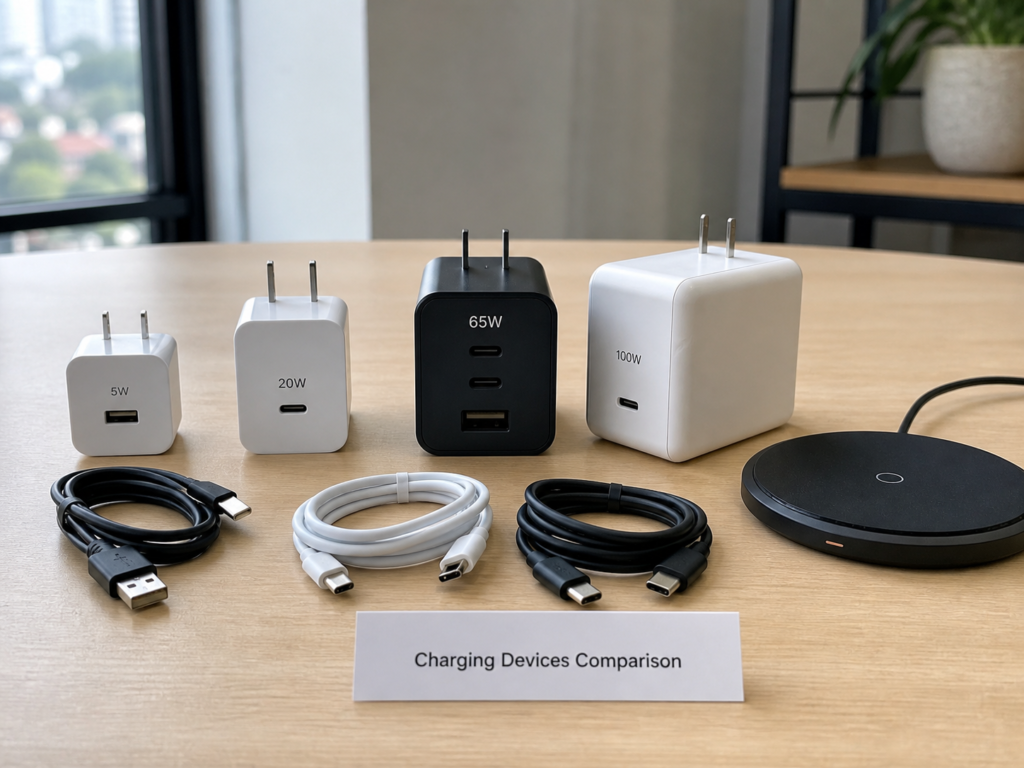
In this article, we will take the most familiar products such as consumer-grade 5-100W chargers, USB/USB-C cables, power adapters, and standard wireless chargers as examples to thoroughly explain the differences between FCC and BIS, covering everything from basic concepts to practical judgment logic. After reading this, you will be able to initially judge by yourself whether your product needs certification, what the general process is, and avoid most common pitfalls.
First, Understand the Three Independent Regulatory Bodies: Don’t Mix Them Up
The biggest misconception for many beginners is mixing up the functions of different agencies. Before the formal comparison, we need to clarify three independent regulatory bodies that are not subordinate to each other and each govern a separate area — their requirements are completely independent and cannot replace each other:
- U.S. FCC (Federal Communications Commission): Mainly governs RF emission, unintentional radiation, and related electromagnetic compatibility (EMC, simply put, controlling the electromagnetic energy generated by equipment to avoid interference with power grids, communications, or other electronic devices). FCC does not replace the electrical safety certification of chargers, so it does not comprehensively assess whether chargers pose electric shock or fire risks like electrical safety systems do; however, some wireless devices still need to meet FCC requirements for human exposure such as RF exposure. Electrical safety assessment in the U.S. usually also depends on related systems such as UL and ETL.
- India BIS (Bureau of Indian Standards): Governs whether the safety and performance of specific products comply with Indian local standards, such as whether the insulation of power adapters is sufficient and whether the performance of data cables meets the requirements, but does not govern requirements related to radio spectrum.
- India WPC (Wireless Planning & Coordination Wing): An Indian agency specifically governing radio spectrum and wireless device access, at the same level as BIS and independent of it. For products with wireless functions entering India, in addition to meeting BIS requirements (if they are on the mandatory list), they must also go through separate WPC approval.
Core Attributes of FCC and Two Compliance Pathways
FCC is not a “unified certification certificate,” but a U.S. market access requirement for RF emission, unintentional radiation, and electromagnetic compatibility. Some wireless devices also need to meet human exposure requirements such as RF exposure. It mainly has two types of compliance pathways:
One is SDoC (Supplier’s Declaration of Conformity): Enterprises complete testing and prepare technical documents as required, and a U.S. local responsible party (such as an importer or local agent) issues a declaration of conformity before the product can be launched. No separate official certificate issuance is required, and the enterprise bears the compliance responsibility.
The other is FCC ID: The FCC certification pathway is reviewed by a TCB (Telecommunication Certification Body) authorized by the FCC. After meeting the requirements, the FCC system issues a device authorization and generates an FCC ID. The FCC ID consists of the Grantee Code of the authorized entity and the product code. Generally speaking, products that “intentionally emit RF signals” (such as devices with Bluetooth or Wi-Fi) usually need to follow the FCC ID pathway, but the specific situation shall still be subject to FCC applicable rules and device categories.
Core Attributes of BIS and Two Compliance Pathways
BIS is an access requirement for products on the mandatory list. Not all products require it, nor is it a system certification like ISO (ISO governs enterprise management systems, while BIS governs specific products), and it does not inherently cover EMC or wireless requirements.
The two BIS pathways are not mutually exclusive:
One is CRS (Compulsory Registration Scheme): This is one of the common pathways. As long as the product is on the BIS mandatory list, it must be registered to obtain an R-Number (registration number starting with R), and factory audits are not required under normal circumstances.
The other is ISI product certification: It only applies to specific product categories (such as some home appliances and industrial products), requires factory audits and continuous market supervision, is not a general pathway for charging products, and should not be regarded as an alternative to CRS.
Three Key Consensus for Beginners
These three points will help you avoid most basic mistakes:
First, the compliance requirements of the two countries are not mutually recognized. FCC cannot replace BIS, and BIS cannot replace FCC. Even within India, BIS and WPC cannot replace each other.
Second, both FCC and BIS are minimum requirements for market access, not “quality grade certifications” — obtaining them only means meeting the corresponding access requirements, and does not represent how good the product performance is.
Third, certain devices or import purposes may be eligible for specific exemptions, but the device category, quantity, purpose, and import conditions of the corresponding regulations must be verified. Commercial sales do not automatically invalidate all exemptions; even if an exemption applies, it cannot be inferred that the product meets other safety, wireless, or labeling requirements.
Prerequisites for Comparison: Unified Benchmarks First
Many people get more confused the more they read comparison articles, mainly because the prerequisites for comparison are not clearly stated. All conclusions in this article are based on the following limitations. If your product or scenario is different, the conclusions may need to be adjusted:
- Time baseline: Rules are based on official public documents as of June 2024. When applying, the latest rules at that time shall prevail, as the lists and standards of both countries are updated regularly.
- Product scope: Mainly targeting consumer-grade 5-100W chargers, USB/USB-C cables, power adapters, and standard wireless chargers. Products with higher power, built-in batteries, or special functions have different rules.
- Applicable scenarios: Only for ordinary commercial import and retail. Special scenarios such as government procurement, customized products, and industrial-grade products require separate assessment.
- Transition period rules: In case of adjustments to standards or mandatory lists, implementation shall be in accordance with the officially announced transition period and inventory handling rules, and new or old rules cannot be directly applied.
We will compare five core dimensions: mandatory scope, test requirements, application process and timeline & cost, and labeling and post-market supervision. Each dimension will explain the conditions for conclusion changes.
Before the formal comparison, here is a set of general judgment logic — whether for the U.S. or India, to judge whether a product needs compliance, you can first sort out six core attributes: whether it contains digital/switching circuits, whether there is intentional RF emission, whether it has wireless power supply function, rated input/output parameters, whether it is an independent sales unit, and whether it is included in the mandatory list of the target market. Once these six points are clarified, the compliance pathway of most products can be judged with a high degree of accuracy.
Here we reiterate the core principle: When a product involves multiple regulatory areas, it must meet the requirements of each area separately, which cannot replace each other. For example, a wireless charger with Wi-Fi entering India needs to meet both BIS product safety requirements (if on the list) and WPC wireless device approval; neither is dispensable.
Item-by-Item Comparison of Core Dimensions
To help you quickly establish an overall concept, we first present a core comparison summary table, and then elaborate on the details of each dimension later:
| Comparison Dimension | U.S. FCC | India BIS |
|---|---|---|
| Regulatory Core | RF emission, unintentional radiation, and electromagnetic compatibility; does not replace electrical safety compliance; some wireless devices also involve RF exposure requirements | Product safety and performance; not responsible for radio spectrum management |
| Mandatory Logic | Determined by device category, RF characteristics, and applicable rules; verify whether exemptions apply | Determined by the official mandatory list; products on the list must be registered |
| Core Pathways | SDoC self-declaration / device certification authorization corresponding to FCC ID | CRS compulsory registration (mainstream) / ISI product-specific certification |
| Typical Timeline (single model, no rectification) | Confirmed on a case-by-case basis based on product, test items, and audit scheduling; no unified official timeline | Confirmed on a case-by-case basis based on applicable scheme, laboratory, and audit scheduling; no unified official timeline |
| Labeling Requirements | SDoC usually does not mandate the FCC Logo, but required compliance statements must be provided; FCC ID devices must be marked with the ID number | CRS mandates marking with BIS mark + R-Number |
| Factory Audit | No factory audit requirement in the usual sense | CRS generally has no factory audit; ISI requires factory audit and continuous supervision |
Mandatory Scope and Applicable Requirements
Comparison benchmark: Under commercial sales scenarios, whether products need to comply with regulations to be legally listed or cleared through customs.
FCC-Side Judgment Rules
Passive cables (such as ordinary USB cables without electronic components) usually do not trigger FCC device authorization solely due to interface type, but those with shielding layers or built-in electronic components (such as E-Marker chips) need to be evaluated for regulation in combination with specific functions.
Active cables or wired chargers shall be judged whether Part 15 authorization is required based on circuit functions, operating frequency, whether they are digital devices, and applicable exemption clauses. Digital circuits, switching power supplies, or clock circuits do not automatically mean that all devices must be processed under the same FCC authorization pathway; if authorization is indeed required, then determine whether to adopt the SDoC or Certification/FCC ID pathway according to applicable rules.
Wireless charging products require separate assessment of the inductive wireless power supply part and the digital control circuit part, which correspond to different FCC rules respectively.
Products with intentional emission functions such as Bluetooth and Wi-Fi usually need to apply for FCC ID, and specific requirements shall be subject to official FCC rules.
BIS-Side Judgment Rules
BIS adopts a “list-based system”: only products on the official CRS mandatory list must be registered. When judging, you cannot only look at the broad category; you must match item by item the product name and definition, corresponding IS standard number, rated parameters, and manufacturer/factory/brand information. A difference in any item may result in non-compliance with requirements.
Products not included in the mandatory list can be applied for voluntarily, but this does not mean that they do not need to meet other Indian regulatory requirements. For example, wireless products still need to comply with WPC regulations.
Here we emphasize again: The RF part and spectrum access of wireless products are under the jurisdiction of WPC, not BIS. Products with wireless functions need to separately verify WPC ETA (Equipment Type Approval), frequency band, power and other requirements.
ISI certification only applies to specific product categories, and charging products generally only need to follow CRS; if applying for ISI, overseas manufacturers must appoint an AIR (Authorized Indian Representative) and accept factory audits and continuous supervision.
Conditions for Conclusion Changes
- When the product power exceeds 100W, has a built-in battery, or has communication functions, the applicable rules and compliance pathways will be adjusted, and the conclusions for consumer-grade 5-100W products cannot be directly applied.
- For some devices or import purposes that originally qualified for exemptions, if the sales method, quantity, purpose, or device category changes, they may no longer meet the corresponding exemption conditions, and need to be re-verified, and cannot be simply treated as “automatically invalid for commercial sales”.
- Products sold in bundles/combinations need to be judged separately according to the complete device, accessories, and whether they are independent sales units. Compliance of individual accessories does not automatically cover the bundle. For example, if a charger has BIS, but the data cable in the bundle is an independent sales unit and is on the mandatory list, it still needs separate compliance.
Test Requirements and Assessment Focus
Comparison benchmark: Test items, assessment core, adopted standards, and laboratory qualification requirements.
FCC-Side Assessment Focus
The core direction of FCC is RF emission, unintentional radiation, and electromagnetic compatibility, which does not replace the electrical safety certification of chargers; some wireless devices also need to evaluate human exposure requirements such as RF exposure.
Unintentional radiation devices (such as ordinary wired chargers) usually test conducted disturbance (whether the electromagnetic wave leaked by the device through wires will interfere with the power grid) and radiated disturbance (whether the electromagnetic wave emitted by the device into the air will interfere with other devices).
Devices intended for residential environments or for residential users are usually evaluated according to Class B limits; devices only used in commercial, industrial, or professional environments and meeting corresponding conditions can be evaluated according to Class A, and cannot be judged solely by product name or industry attribute.
Intentional radiation devices (such as smart charging docks with Wi-Fi) require additional tests for frequency, power, bandwidth, spurious emission (extra signals outside the operating frequency), RF exposure (whether radiation meets the corresponding human exposure limits) and other items, in addition to the above unintentional radiation tests.
Testing applies to official FCC rules such as Part 15 and Part 18, and different products correspond to different Part chapters.
BIS-Side Assessment Focus
The core of BIS is to assess whether products meet the safety and performance requirements of the corresponding IS standards. There are no universal test items — it is completely subject to the current IS standards specified in the official BIS CRS list on the application date, and test items vary greatly for different products. For example, power adapters may be tested for insulation performance, dielectric strength, temperature rise, and overload protection, while data cables may be tested for insertion-extraction lifespan, impedance, and flame retardancy, all of which are directly related to the safety and performance of the product itself.
In terms of laboratory qualifications, CRS usually requires reports issued by BIS recognized/registered laboratories, and cannot be judged solely by ISO 17025 qualification, which is a common pitfall for many people.
Conditions for Conclusion Changes
- Test reports cannot be defaulted to cross-system mutual recognition. Even if FCC testing has been completed, local-specific test items usually still need to be supplemented when doing BIS, and vice versa.
- Changes in power, interface, and function may affect applicable standards, test configurations, and report coverage, but do not necessarily increase test items; model consolidation, report reuse, and component changes shall be subject to difference assessment by the laboratory or certification body in accordance with specific rules, and changes, supplementary tests, or re-application shall be handled if necessary.
Application Process, Timeline, and Cost
Comparison benchmark: The following timelines and costs shall not be regarded as unified timelines or fixed quotations announced by FCC or BIS. The actual situation is affected by many factors such as applicable standards, number of models, test items, rectification, laboratory scheduling, AIR or agency services, official fees, and whether WPC is required, and shall be confirmed on a case-by-case basis.
FCC-Side Application Rules
The process differences between the two pathways are obvious:
The SDoC process is relatively simple: testing by a qualified laboratory → preparing a full set of technical documents → the U.S. responsible party issues a declaration of conformity. No official certificate issuance is required, and there is no official unified number.
The FCC ID process has an additional step of official review: laboratory testing → submitting materials to an FCC-authorized TCB for review → after passing the review, the FCC system issues a device authorization and generates an FCC ID, which can be queried on the FCC official website. The FCC ID consists of the Grantee Code of the authorized entity and the product code.
FCC usually has no factory audit requirement, and the responsible party is the U.S. importer or local responsible party.
There is no unified official range of timeline and cost applicable to all products. SDoC usually does not require official review, but testing, technical document preparation, and responsible party confirmation still take time; FCC ID may also involve RF exposure, wireless module usage conditions, TCB supplementary documentation, and pre-market testing. The specific timeline and cost shall be quoted on a case-by-case basis according to product complexity, test items, number of rectifications, agency services, and audit scheduling.
In terms of validity period, FCC has no fixed validity period. As long as the RF characteristics of the product remain unchanged, relevant rules are not updated, and the responsible party remains valid, the compliance remains valid, but technical documents must be kept for inspection.
BIS-Side Application Rules
Charging products mainly use the CRS pathway; ISI only applies to specific products:
The CRS process is: confirm whether the product is on the mandatory list and the corresponding standard → testing by a BIS recognized laboratory → submitting a full set of materials → issuing an R-Number after passing official review.
BIS has a mandatory requirement: overseas manufacturers must appoint an Authorized Indian Representative (AIR) to be responsible for liaison and bear local compliance responsibilities.
There is also no unified official range of CRS application timeline and cost applicable to all chargers, cables, and wireless products. The actual situation will be affected by the applicable scheme, laboratory, number of models, brands and factories, number of rectifications, AIR and agency services, official fees, and audit scheduling, and shall be subject to the current BIS portal, corresponding Scheme Guidelines, and the specific quotation of the service provider.
CRS registration usually has an initial validity period of two years according to current BIS rules, and can be renewed when conditions are met; validity maintenance and requirements for special product categories shall be subject to the current BIS CRS guidelines and registration certificate. ISI licenses are managed according to the corresponding certification scheme.
Conditions for Conclusion Changes
- When testing fails and rectification is required, both the timeline and cost will increase, and the specific increase depends on the number of problems and the complexity of rectification.
- Whether multiple models of the same series can share reports or share part of the cost needs to be evaluated according to product differences, applicable standards, model coverage requirements, and certification body rules, and cannot be generalized.
- When core components (chips, transformers, PCB, wireless modules, etc.) are changed, the laboratory or certification body shall evaluate whether supplementary testing, change application, or re-application is required, and it cannot be directly assumed that re-application is definitely required.
- Other influencing variables include: product complexity, number of rectifications, agency services, official fee adjustments, factory audits (if required), exchange rates, test reuse, and whether WPC is required.
Labeling Identification and Post-Market Supervision
Comparison benchmark: Product labeling requirements, query methods, post-market supervision methods, and violation consequences.
FCC-Side Labeling and Supervision
Labeling requirements: SDoC devices usually do not mandate the FCC Logo, but the SDoC must be issued and kept by the responsible party, and the required compliance statement must be provided on the device, in the user manual, on the packaging, or in accompanying materials in accordance with FCC rules; the specific location and format shall be subject to applicable clauses. When voluntarily using the FCC Logo, it must also comply with FCC labeling rules. FCC ID products must be marked with the FCC ID number and related RF instructions on the product.
Query method: FCC ID can be verified through the official device authorization system; SDoC documents are kept by the responsible party for inspection and cannot be queried through the official system.
Supervision method: FCC enforces laws through market supervision, complaints and investigations, device testing, on-site inspections, and import环节 reviews. The specific supervision method depends on the device category and violation situation. Violations can result in fines, sales bans, recalls, and in serious cases, legal liability of the responsible party will be pursued.
BIS-Side Labeling and Supervision
Labeling requirements: CRS products need to be marked with the BIS standard mark + R-Number, no need to mark the ISI mark, and there are clear requirements for the location, size, and format of the mark.
Query method: Verify whether the model, brand, and factory match the actual product through the BIS official website certification system.
Supervision method: Mainly based on customs clearance verification and official market spot checks. Violations can result in goods detention, cancellation of registration, fines, and in serious cases, being blacklisted.
General Checklist for Label Verification
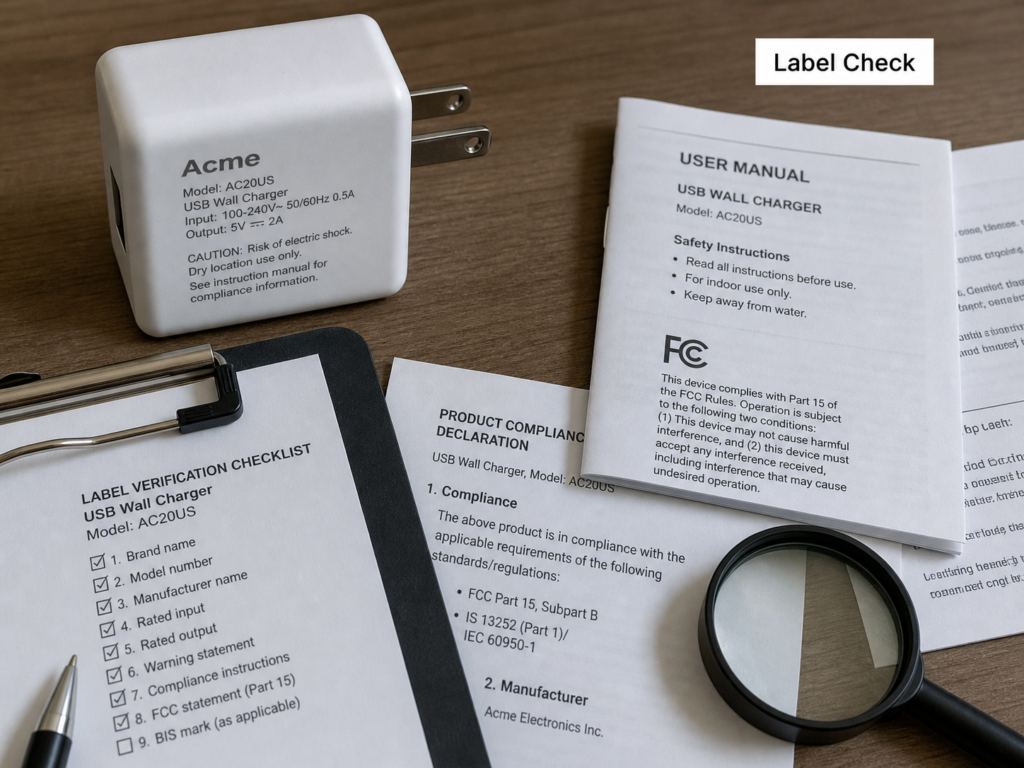
Whether it is FCC or BIS, you can use this checklist when verifying the labeling of charging products: model, brand, manufacturer/factory, registration number/FCC ID, rated parameters, warning statements, and compliance instructions in the user manual. These labels are usually printed on the charger housing, data cable plug, and outer packaging.
Conditions for Conclusion Changes
- If the location, format, or size of the label does not meet the requirements, it may be judged non-compliant even if there are compliance documents.
- It shall be verified whether the actually sold product is within the coverage of the certificate, registration, or authorization. If the model, hardware version, manufacturer, factory, brand, or key components do not match, the use of the document shall be suspended, and changes, supplementary tests, or re-application shall be handled in accordance with applicable rules.
Exclusive Judgment and Decision-Making Logic for Charging Products
The above is a general comparison. Next, we will provide a set of directly usable judgment methods and optimization ideas for charging products.
Quick Compliance Decision Tree for Single Products
Preliminary judgment can be made in three steps:
Step 1: Sort out the product characteristics and target market according to the six core attributes mentioned earlier.
Step 2, U.S. market: sort out RF characteristics → judge whether regulated by FCC → distinguish unintentional/intentional radiation → select the certification pathway corresponding to SDoC or FCC ID according to applicable rules.
Step 3, Indian market: query the latest BIS CRS mandatory list → match product information item by item → if on the list, CRS is mandatory; for products with wireless functions, simultaneously verify WPC requirements.
If you are unsure, it is recommended to verify according to circuit definitions or official standard definitions, or consult a professional compliance agency, and do not judge based on intuition.
Compliance Optimization Ideas for Single/Dual Markets
- Only for the U.S. market: first judge the FCC regulatory attribute and select the corresponding pathway; FCC does not replace electrical safety compliance. It is necessary to confirm whether NRTL (Nationally Recognized Testing Laboratory) certification or other applicable electrical safety assessments are required according to product category, sales channel, state and local requirements, and customer or platform conditions. UL and ETL are common certification marks, but they are not the same set of unified government certifications.
- Only for the Indian market: first check the BIS mandatory list to confirm the pathway; for products with wireless functions, be sure to simultaneously verify WPC requirements, do not wait until BIS is completed to handle it, to avoid delays.
- Dual market (U.S. + India) optimization: first confirm whether BIS and WPC are applicable, then arrange parallel work according to standards, laboratory scheduling, and test reuse; whether to start BIS or FCC first shall be decided on a case-by-case basis, and a fixed time-saving ratio cannot be promised.
Compliance Validity Verification and Change Maintenance
Many people stop paying attention once they get compliance documents, which is a big risk point.
Quick Validity Verification
After getting the documents, first check three points: first, whether the model, hardware version, manufacturer or factory information on the documents is consistent with the actual shipped products; second, whether the product labeling meets local requirements; third, whether the local responsible party or authorized representative remains valid.
More importantly, it is necessary to confirm that the actually sold product is indeed within the coverage of the certificate, registration, or authorization. If the model, hardware version, manufacturer, factory, brand, or key components do not match, the use of the document shall be suspended, and changes, supplementary tests, or re-application shall be handled in accordance with applicable rules.
Product Change Maintenance Rules
Handled in three categories according to the severity of the change:
- Minor changes (outer packaging adjustment, label style modification but unchanged content): confirm compliance with labeling rules is sufficient, no re-application required.
- General changes (cable length adjustment, housing material replacement): evaluate whether it affects test results, for example, metal housing may affect radiation testing, and update the test report if necessary; no change is required if there is no impact.
- Major changes (chip, transformer, PCB, rated power, wireless module, core circuit, factory, model change): compliance must be re-evaluated, and the laboratory or certification body shall judge whether re-testing, change processing, or re-application is required in accordance with specific rules.
Typical Case Judgment Chain
We will walk through the complete judgment logic with four common charging products, which you can reference against your own products:
Case 1: 20W USB-C Standard Wall Charger (no wireless/communication)
Product features: 5V/3A, 9V/2.22A output, with digital control circuit, no wireless module.
U.S.: Judgment shall be made based on circuit functions, whether it is an applicable digital device, whether there are exemptions, and specific FCC rules. If Part 15 authorization is required, ordinary products without wireless functions usually follow SDoC, not FCC ID.
India: If it matches the BIS CRS power adapter list, CRS is mandatory; no wireless function means no WPC required.
Labeling requirements: In the U.S., the responsible party issues and keeps the SDoC, and provides the required compliance statement in accordance with applicable FCC rules; the FCC mark can be voluntarily added; in India, if mandatory, mark with BIS mark + R-Number.
Misjudgment point: Not all chargers require FCC ID; not all 20W chargers are mandatory in India, they must fully match the list requirements.
Case 2: 100W USB-C to C E-Marker Fast Charging Cable (no communication)
Product features: with E-Marker protocol chip for power negotiation, no wireless/Bluetooth.
U.S.: It is necessary to evaluate whether FCC authorization is required based on circuit functions, operating methods, whether it is a regulated digital device, and applicable exemptions; if it is only for simple power negotiation without other digital functions, FCC compliance may not be required.
India: Check the corresponding cable standards and list of BIS CRS. E-Marker itself does not trigger mandatory requirements; the key is whether the cable category and parameters are on the list.
Labeling requirements: In the U.S., determine whether labeling and accompanying statements are required according to applicable rules; in India, if mandatory, mark as required.
Misjudgment point: Cables with E-Marker do not necessarily require FCC/BIS; not all USB-C cables require BIS.
Case 3: 15W Qi Wireless Charger (no Bluetooth/Wi-Fi)
Product features: only inductive wireless charging function, no communication module.
U.S.: Evaluate wireless power supply, digital control circuit, and applicable FCC rules separately. No intentional emission usually means no FCC ID is required, but it is still necessary to judge whether other FCC compliance and related tests are required according to applicable rules.
India: ① Check the corresponding standards and list of BIS CRS for wireless chargers; ② Verify WPC ETA (if applicable) and frequency band/power requirements, as the wireless RF part is under WPC jurisdiction.
Labeling requirements: In the U.S., provide statements and keep documents in accordance with applicable Part rules; in India, mark with BIS (if mandatory) + WPC related marks (if required).
Misjudgment point: Not all wireless chargers require FCC ID; Indian wireless requirements are not under BIS jurisdiction.
Case 4: Smart Wireless Charging Dock with Wi-Fi (15W wireless charging + wired output)
Product features: wireless charging + Wi-Fi remote control + wired output.
U.S.: With Wi-Fi, it is an intentional radiation device and usually requires FCC ID; if a certified wireless module is used, it is also necessary to confirm whether the module authorization covers the complete device usage scenario, and most still require complete device testing.
India: ① Check the corresponding standards and list of BIS CRS; ② Separately verify WPC ETA and wireless device requirements.
Labeling requirements: In the U.S., mark with FCC ID and related RF information; in India, mark with corresponding BIS marks + WPC marks (if required).
Misjudgment point: Having BIS does not mean that wireless products can be sold; FCC ID does not only test the wireless charging function.
Guide to Avoiding High-Risk Misconceptions
We have compiled three categories of the most common high-risk misconceptions that many practitioners have fallen for:
Misconceptions About Regulatory Scope
- Misconception: FCC is a safety certification. Correct explanation: FCC mainly governs RF emission, unintentional radiation, and EMC, and does not replace the electrical safety compliance of chargers; some wireless devices also need to meet human exposure requirements such as RF exposure.
- Misconception: All requirements for Indian wireless products are under BIS jurisdiction. Correct explanation: Indian wireless affairs are handled by WPC, which is independent of BIS, and both need to be met separately.
- Misconception: USB-C cables / cables with E-Marker definitely require FCC/BIS. Correct explanation: Whether compliance is required depends on the product’s circuit functions, applicable rules, and whether it is on the mandatory list, not all similar products require it.
- Misconception: All wireless chargers require FCC ID. Correct explanation: FCC ID is usually for intentional RF emission devices that require Certification; ordinary inductive wireless chargers without communication functions do not necessarily require it.
Misconceptions About Certificates and Testing
- Misconception: Having a BIS test report means having BIS certification. Correct explanation: The test report is only one of the application materials. Only after obtaining the official CRS registration number or ISI certificate can the corresponding BIS compliance pathway be considered completed.
- Misconception: BIS CRS registration is ISI certification. Correct explanation: CRS is registration for products on the mandatory list, generally without factory audits; ISI is certification for specific products, requiring factory audits and continuous supervision. The two are not the same thing.
- Misconception: ISO 17025 laboratory reports can all be used for FCC/BIS applications. Correct explanation: Both FCC ID and BIS CRS require the use of recognized laboratories or certification bodies that comply with corresponding rules, not just based on ISO 17025 qualification.
- Misconception: If accessories have certification, the bundle is compliant. Correct explanation: Judgment shall be made separately according to the complete device, accessories, and independent sales units. Compliance of individual accessories does not mean the entire bundle is compliant.
Misconceptions About Changes and Post-Market Compliance
- Misconception: Publicly announced timelines/costs are fixed quotations. Correct explanation: Timelines and costs can only be used as market estimates under specific products, laboratories, and service scopes, and are affected by many factors such as product complexity, number of rectifications, and agency services, and cannot be regarded as official commitments.
- Misconception: Compliance documents are permanently valid once obtained. Correct explanation: Core product changes and rule updates may affect the scope of application or validity of documents, requiring regular evaluation.
- Misconception: Mandatory lists and standards never change. Correct explanation: The rules of both countries are updated regularly, and the latest official documents at the time of application shall prevail.
- Misconception: FCC SDoC can be done by just finding any laboratory. Correct explanation: Although no official review is required, testing must comply with FCC rules, and technical documents and required compliance statements must be prepared and kept as required. If non-compliant, the U.S. responsible party shall bear corresponding responsibilities.
Core Summary
We will recap the core content for your quick memorization:
FCC is the U.S. compliance system for RF emission, unintentional radiation, and EMC, with the core of controlling electromagnetic interference, and does not replace electrical safety compliance; some wireless devices also involve RF exposure requirements. It mainly has two types of pathways: SDoC self-declaration and certification authorization corresponding to FCC ID.
BIS is India’s product standard conformity system, with the core of controlling product safety and performance, taking CRS compulsory registration as the main pathway. ISI certification only applies to specific products, and requirements related to radio spectrum are under the jurisdiction of WPC, which has nothing to do with BIS.
After learning this content, you should be able to independently judge four things: whether your own charging products need compliance when entering the U.S./India, and what the general pathway is; the general timeline, cost, and influencing factors of the two types of compliance; how to quickly verify the coverage of compliance documents and labels, and avoid core misconceptions; the basic compliance decision-making logic for single/dual market layout, and knowing when to consult a professional agency.
If you need to verify official information by yourself, you can query through the following public channels: U.S. FCC’s eCFR regulation database, device authorization (FCC ID) query system, recognized laboratory/TCB list; India BIS’s CRS mandatory product list, registration/license query system, current IS standard query entry, recognized laboratory list; India WPC’s official ETA notice and wireless device license query system.
When enterprises conduct compliance, it is recommended to keep the following materials for verification: test reports, declarations of conformity/certificates; label drafts, technical documents; version change records, supply chain (factory/core components) materials; local responsible party/authorized representative information.
Final reminder: This article is compiled based on official public information as of June 2024, and specific requirements shall be subject to the latest released lists, standards, and rules at the time of application.