
For cross-border sellers of charging cables and chargers entering the UK market for the first time, the most common pitfall is not poor sales, but detained goods, delisted listings, or even fines. Many people think that hiring a freight forwarder can handle customs clearance, but they do not realize that compliance covers the entire process from product design to after-sales recall.
This checklist is specifically for commonly sold products such as charging cables, USB-C cables, chargers, and power adapters. All rules are referenced from official announcements on GOV.UK. It helps you sort out the requirements step by step from basic judgment to advanced pit avoidance, so you no longer have to guess based on scattered policies.
First Understand 4 Basic Questions, Don’t Ask How to Do UKCA Right Away
Many people ask right away, “Does my product need UKCA?” but they haven’t even figured out the most basic prerequisites. First clarify the following four questions, then the subsequent requirements can be matched accordingly.
First Question: Are You Selling to GB or Northern Ireland?
The UK’s market rules are not unified; they need to be viewed in two parts:
• **GB region (England, Scotland, Wales)**: Applies to UK local compliance rules, which is the UKCA system everyone often hears about.
• **Northern Ireland (NI)**: Due to its special trade status, it follows some EU rules, which are different from GB requirements.
If the same product is sold to consumers in both GB and NI, it must meet the requirements of both sides respectively. The only criterion for judgment is the **final sales destination**, which has nothing to do with where you ship from.
Second Question: What Category Does Your Product Belong To?
Different types of charging products have very different compliance requirements. First classify your product against the following:
• **Passive charging cables**: Usually do not contain E-Marker or other active electronic circuits. The power and current that the cable can support are also related to the cable specification, port, and the charging protocol used, and cannot be simply understood as “only transmitting power, unable to negotiate power”.
• **Active/smart data cables**: Products with electronic circuits such as E-Marker chips, indicator lights, and conversion modules, such as some 100W fast charging cables or data cables with digital display functions. E-Marker is mainly used to report cable capabilities to the USB host, and cannot be equated alone to the cable completing all power negotiation.
• **Wall-plug chargers/power adapters**: Charging heads and power adapters that plug directly into household mains power, such as 65W GaN fast charging heads.
• **Smart/wireless charging products**: Products with wireless charging, Bluetooth, Wi-Fi or APP control, such as wireless chargers and multi-port charging stations with APP.
When judging the cable category, you should comprehensively check whether it contains an E-Marker or other electronic circuits, the supported USB PD or current capability, and actual test results. Do not define passive or active cables solely based on “whether power can be negotiated”.
It should be noted that electronic accessories dedicated to medical, industrial, and automotive use have special regulations and are not within the scope of discussion of this checklist.
Third Question: What Responsibility Do You Bear in the Entire Chain?
Many sellers are unclear about their role, thinking that hiring a freight forwarder or drop shipping provider means they don’t have to bear responsibility. In fact, the responsibilities of different roles vary greatly. First look at the four core roles:
• **Importer**: The entity that first places the product on the UK market. Customs clearance and compliance are the primary responsibilities, and you are the first point of contact if something goes wrong.
• **Manufacturer**: Whether it is a private label, OEM/ODM, or modified brand, they must bear all the responsibilities of the manufacturer and be fully responsible for product safety.
• **Distributor**: Those who only resell products without making any changes need to verify whether the product is compliant and retain traceability records.
• **UK responsible person, authorized representative or other local economic operator**: Whether such an entity needs to be designated shall be judged separately according to the specific applicable regulations. The concepts, scope of application, and responsibilities of responsible persons in systems such as GPSR and WEEE are not the same, and a single “UK RP” cannot replace the responsible entities under all regulations.
Responsibilities also vary across different business scenarios. You don’t need to memorize them by rote; check the table below to see which category you belong to:
| Business Scenario | Core Responsible Entity | Key Notes |
| UK local importer | Importer | Bears both importer and corresponding distributor responsibilities |
| Overseas self-shipping (direct mail to consumers) | Overseas seller and possibly involved local responsible entities | Whether a UK responsible person, authorized representative or other local economic operator needs to be designated shall be judged according to specific regulations and sales models; the platform may also bear corresponding responsibilities |
| Platform warehouse (e.g. Amazon FBA) | Importer | The warehouse party only cooperates with traceability; the importer bears primary responsibility |
| Third-party fulfillment services | Importer | The fulfillment party is only responsible for warehousing and distribution, and does not replace the importer’s compliance responsibilities |
| Drop shipping | Seller (distributor) | The seller must verify the compliance of upstream suppliers and cannot shift blame to the upstream |
| OEM/ODM private label production | Brand owner (manufacturer) | The brand owner is regarded as the manufacturer and bears all compliance responsibilities; the foundry is only responsible for production and does not bear market access responsibilities |
Special reminder: Whether you are a large seller or import small batches to sell to consumers, you must bear compliance responsibilities corresponding to your role. There is no such thing as “no need to worry if the volume is small”.
Fourth Question: What Are the Consequences of Non-Compliance?
UK regulation has two levels: the first is **UK Customs**, which may conduct inspections based on duties and risks during customs clearance; the second is **market regulatory authorities**, which conduct random inspections after products enter the market. Even if you have been selling for half a year, you may still be inspected.
The UK’s General Product Safety Regulations 2005 (GPSR 2005) is mainly a general product safety framework, usually applicable to products or safety matters that are not fully covered by more specific safety regulations. Products such as chargers and cables must still meet their applicable special requirements such as electrical safety, EMC, radio, RoHS, and WEEE respectively. Obligations such as incident reporting and recall shall also be judged according to specific regulations and regulatory requirements.
Consequences of non-compliance may include goods detention, fines, prohibition of entry into the UK market, platform delisting or recall, and particularly serious cases may involve criminal liability.
A common misconception must be corrected here: **customs release does not equal full compliance**. Customs clearance is only one part of the process. If non-compliance is found in random inspections after market entry, you may still be punished.
Core Access Tools: Quickly Locate What You Need to Do
After clarifying the basic prerequisites, you can use this set of tools to judge step by step what process your product needs to go through and what materials to prepare.
Conformity Assessment Decision Steps (Follow the Order, Don’t Skip)
Conformity assessment is the process of proving that your product meets applicable regulations. You must follow the order below; skipping steps can easily lead to detours:
1. **Confirm the final sales location**: First determine whether it is GB or NI, which is the starting point for all judgments.
2. **Match applicable regulations**: According to the product type, correspond to specific regulatory requirements.
3. **Judge the conformity assessment procedure**: Check the procedures, product categories and applicable standards specified in each applicable regulation to determine whether manufacturer’s internal production control can be used, or whether a qualified institution must participate.
4. **Determine labeling and assessment body requirements**: Based on the previous judgments, determine what labels to affix and what institutions to find for assessment.
Labeling Rules for Different Regions
Many people are confused about how to use the three marks UKCA, CE, and UKNI. Just refer to the table below directly:
| Sales Region | Labeling Requirements |
| GB region | 1. When using UKCA, the corresponding conformity assessment shall be completed in accordance with relevant UK regulations;<br>2. The CE mark is still recognized for some products at present, and the period is subject to GOV.UK;<br>3. UKNI cannot be used in GB |
| NI region | 1. CE only: applicable to products that can be self-declared, or products assessed by an EU Notified Body (EU NB);<br>2. CE + UKNI: applicable to products for which mandatory third-party assessment is completed by a UK body with corresponding scope;<br>3. UKNI cannot be used alone and is only applicable to the NI region |
When UKCA is required for GB and mandatory third-party assessment is required by regulations, a **UK approved body** with corresponding UK authorization scope shall be selected. NI applies EU rules, and an EU notified body can be selected; if mandatory third-party assessment is completed by an applicable UK body, CE + UKNI is used. EU notified body assessment usually supports the CE route for NI, but does not support the UKCA route for GB.
Do You Need Third-Party Assessment?
Not all products need to pay a third party for assessment. Whether third-party assessment is required must be determined by checking the conformity assessment procedures, product categories and adopted standards specified in each applicable regulation, and then judging whether internal production control can be used, or whether a UK approved body or EU notified body must participate.
You can judge according to the following train of thought:
• If applicable regulations allow manufacturers to adopt internal production control, and the enterprise can prove that the product meets the relevant basic requirements, self-declaration can be made in accordance with regulations.
• If the regulation clearly requires third-party participation, you must select a UK approved body or EU notified body with corresponding authorization scope.
• Incomplete adoption of applicable standards may increase conformity assessment requirements, but does not automatically trigger third-party assessment under all regulations.
• For products with wireless functions, you cannot judge whether third-party assessment is mandatory just based on the fact that they “have wireless function”. It should be judged in combination with the assessment modules specified in RER 2017, applicable designated standards and their adoption degree.
Reminder again: **having wireless function does not mean that third-party assessment is mandatory**. The key depends on whether specific regulations and products meet the corresponding conformity assessment conditions. Don’t be fooled by unscrupulous institutions into spending more money.
Quick Reference Table of Applicable Regulations
There are many regulations involved in charging products. You don’t need to check the original text one by one. Just find the corresponding ones for your product against the table below:
| Regulation Name | Applicable Product Scope | Core Requirements |
| EESR 2016 (Electrical Equipment (Safety) Regulations) | Chargers and power adapters with mains input | Electric shock protection, overheating protection, insulation strength, component reliability |
| EMC 2016 (Electromagnetic Compatibility Regulations) | Chargers with active circuits, some smart data cables, wireless chargers | Electromagnetic emission does not interfere with other equipment, and its own immunity meets standards |
| RER 2017 (Radio Equipment Regulations) | Products with Bluetooth, Wi-Fi or applicable radio functions; whether wireless charging function falls within the specific scope needs to be judged according to product technical characteristics | Frequency band compliance, transmission power up to standard, spectrum compatibility |
| Plugs and Sockets etc. (Safety) Regulations 1994 | Wall-plug charging products with UK plugs | Comply with applicable plug and socket safety requirements, and retain plug test reports and Declaration of Conformity (DoC) |
| UK RoHS 2012 (Revised) | Charging products that are electrical and electronic equipment (EEE) | Restrict 10 substances such as lead, mercury, cadmium, hexavalent chromium, PBB, PBDE, DEHP, BBP, DBP and DIBP; specific exemptions and applicable dates shall be checked against current regulations |
| UK REACH | May involve substances, mixtures and articles in products | For articles such as chargers and cables, focus on checking whether they contain SVHC on the candidate list and their concentration, and perform obligations such as information transmission in accordance with regulations |
| PSTI (Product Security and Telecommunications Infrastructure Act) | Consumer-facing internet-connected or network-connectable products that fall within the relevant scope | Prohibit universal default passwords, provide vulnerability disclosure channels, and clarify the period of security updates |
| GPSR 2005 (General Product Safety Regulations) | Mainly applicable to products or safety matters not fully covered by more specific safety regulations | General product safety requirements; obligations such as incident reporting and recall shall be judged according to specific regulations and regulatory requirements |
6 Core Concepts Beginners Must Understand
Many people are confused by various abbreviations, but they are actually very simple in plain language:
1. **DoC (Declaration of Conformity)**: It is a declaration signed by the manufacturer or other legally responsible entity, promising that the product complies with relevant regulations. It does not necessarily need a third-party seal, but the signatory is responsible for the content.
2. **Technical documentation**: The full set of materials supporting the DoC, which the enterprise retains by itself. It must be available when regulatory random inspections are conducted, and does not need to be actively submitted to anyone.
3. **Test report**: Product test results issued by a laboratory, which is an important part of the technical documentation, equivalent to one of the evidences that the product meets the requirements.
4. **UK approved body**: When mandatory third-party assessment is required by UK regulations, an institution with corresponding UK authorization scope shall be selected. Ordinary laboratories do not necessarily have this qualification.
5. **EU Notified Body (EU NB)**: An EU-authorized institution that may be valid in the assessment path where EU rules apply in Northern Ireland, but cannot be used to complete GB’s UKCA third-party assessment.
6. **UKAS accredited laboratory**: A laboratory accredited by the United Kingdom Accreditation Service, with relatively reliable testing capabilities. However, not all reports are required to be UKAS-accredited; it is just a reference for capability.
The Relationship Between Standards and Regulations: Don’t Treat Standards as Laws
Many people think that passing a certain standard means everything is fine, but that’s not the case:
• **Regulations are legal requirements** that must be complied with. Non-compliance is illegal and will result in penalties.
• **Standards are technical paths to prove compliance**, equivalent to the “reference answers” given by the official. If you follow this standard, it is usually easier to prove that the product meets regulatory requirements, but it is not the only path.
There are three types of commonly used standards: BS (British Standards), EN (European Standards), and IEC (International Standards). To judge whether a standard can be used, look at three points: whether the version is currently valid, whether it is suitable for your product, and if there are deviations from the standard, whether there are alternative verification methods.
Emphasize again: **meeting standards does not equal automatic compliance**. Ultimately, you must meet the core requirements of regulations, and you cannot cling to standards while forgetting the legal bottom line.
Breakdown of Core Access Requirements: Check Item by Item Without Missing Anything
Below, according to different requirement categories, each checkpoint, common risk and evidence to be retained are clearly explained. You can check item by item against your own product.
Electrical Safety and EMC Requirements
Electrical Safety (EESR)
• **Applicable products**: Wall-plug chargers and power adapters with mains input, that is, products that are directly plugged into household sockets.
• **Core checkpoints**: Electric shock protection, overheating protection, insulation strength, reliability of key components.
• **Typical risks**: Insulation layer is too thin, creepage distance is insufficient (that is, the distance between live parts and accessible parts is too short), fire at high temperatures.
• **Retained evidence**: Safety test report, risk assessment report, compliance certification of key components (such as certification of capacitors and optocouplers).
Electromagnetic Compatibility (EMC)
• **Applicable products**: Products with active circuits, such as chargers, wireless chargers, and some data cables with E-Marker, indicator lights or conversion circuits. Whether a product is a device within the meaning of the EMC Regulations and which requirements apply shall be judged according to the product’s circuit, function and placement form.
• **Core checkpoints**: Electromagnetic emission (whether the product interferes with other electrical appliances when working, such as routers and radios), immunity (whether the product will be interfered by other electromagnetic waves and fail to work normally).
• **Typical risks**: Fast charging heads cause Wi-Fi disconnection when working, and wireless chargers have unstable signals when charging.
• **Retained evidence**: EMC test report, circuit design description, and other compliance materials matching the actual functions of the product.
Cables containing E-Marker, indicator lights or conversion circuits shall be evaluated as to whether they are devices applicable to the EMC Regulations, and corresponding EMC compliance evidence shall be prepared according to the actual circuit and function. It cannot be concluded that all products must be assessed separately under the EMC Regulations just because they “have E-Marker”.
There is an exception: purely passive cables, if they do not fall within the scope of electrical and electronic equipment (EEE), usually do not need separate safety and EMC assessment.
UK Plug and Power Cord Requirements
This is the most common pitfall. Many sellers sell products with EU plugs plus a conversion head to the UK, and the goods are directly detained.
• **Regulatory basis**: Plugs and Sockets etc. (Safety) Regulations 1994, BS 1363 series standards.
• **Applicable products**: Wall-plug charging products for retail in the UK, whether with fixed plugs or replaceable plugs.
Different types of plugs have different requirements:
1. **Fixed UK three-pin plug**: Must meet applicable BS 1363 requirements. The plug usually needs to have a fuse that meets the requirements. A simple conversion head added to an EU plug cannot replace a compliant UK fixed household plug.
2. **Replaceable plug**: Shall be equipped with a UK standard plug that meets UK requirements. Travel adapters cannot be used to circumvent UK fixed household plug requirements.
3. **Travel adapter**: If sold with the product, it must also meet its applicable safety requirements and clearly state its travel use, and cannot be used as a substitute for fixed household plugs that do not meet UK requirements.
• **Typical risks**: Plug has no fuse, pin size does not meet standards, plug insulation is unqualified.
• **Retained evidence**: Plug test report, power cord material certificate.
Environmental Restriction Requirements (UK RoHS/REACH)
Many people are confused about the difference between RoHS and REACH. In fact, both are environmental requirements, but they regulate different things:
UK RoHS
• **Scope of application**: Charging products that are electrical and electronic equipment (EEE). For purely passive cables, first determine whether they are EEE and whether they are placed on the market independently, then determine the specific requirements.
• **Restricted substances**: Currently 10 substances are restricted: lead, mercury, cadmium, hexavalent chromium, polybrominated biphenyls (PBB), polybrominated diphenyl ethers (PBDE), di(2-ethylhexyl) phthalate (DEHP), butyl benzyl phthalate (BBP), dibutyl phthalate (DBP) and diisobutyl phthalate (DIBP). Specific exemptions and applicable dates shall be checked against current UK RoHS regulations.
• **Typical risks**: Excessive lead in cable PVC sheath, lead-containing solder, excessive harmful substances in components.
• **Retained evidence**: Supply chain material declarations, RoHS sampling test reports. No separate RoHS label is required.
UK REACH
• **Scope of application**: UK REACH may involve substances, mixtures and articles in products, and does not automatically impose the same set of registration or SVHC obligations on all products. For articles such as chargers and cables, focus on checking whether they contain SVHC on the candidate list and their concentration.
• **Registration obligation**: Ordinary article-type charging products (such as chargers, cables) generally do not need to be registered like chemicals or mixtures; the specific situation shall still be judged according to the nature, quantity and supply method of substances in the product.
• **Core obligations**: If SVHC accounts for more than 0.1% by mass in the product, it may be necessary to transmit relevant information to downstream customers; if consumers inquire, information shall also be provided within the specified period in accordance with applicable rules.
• **Note**: There is no need to actively inform all consumers. The relevant requirements of the SCIP database are subject to the latest announcements and applicable rules on GOV.UK.
• **Retained evidence**: Supply chain material declarations, SVHC test reports (if any).
Additional Requirements for Special Functions
If your product has the following special functions, it must additionally meet the corresponding requirements:
Wireless Functions (Bluetooth/Wi-Fi/Wireless Charging)
• **Applicable regulations**: May involve RER 2017. Whether it falls within the specific scope shall be judged according to the radio technical characteristics of the product.
• **Core checkpoints**: The frequency band used meets UK requirements, transmission power does not exceed the standard, and spectrum compatibility does not interfere with other equipment.
• **Assessment rules**: Whether self-declaration is possible or third-party participation is required shall be judged according to the conformity assessment modules specified in RER 2017, applicable designated standards and their adoption degree.
• **Retained evidence**: Radio test report, DoC.
Connected Smart Functions (APP/Cloud Control)
Having APP or cloud control does not mean that PSTI automatically applies. It shall first be determined whether the product is a consumer-facing internet-connected or network-connectable product as referred to in PSTI, and legal exclusions shall be checked. Some products that only connect via local Bluetooth or do not have relevant network connection capabilities cannot be deemed to fall within the scope of PSTI application just because there is an APP.
If the product does fall within the scope of PSTI application:
• **Core requirements**: Universal default passwords cannot be used (for example, the initial password of all products is 123456), there must be a vulnerability disclosure channel, and consumers must be clearly informed of the period of security updates.
• **Retained evidence**: Cybersecurity compliance declaration, vulnerability handling process documents, security update instructions.
Products with Built-in Batteries (e.g. Wireless Chargers with Batteries)
• **Applicable regulations**: UK battery producer responsibility and other applicable battery rules.
• **Core requirements**: Battery harmful substances meet standards, recycling labels are affixed as required, and corresponding producer responsibilities are fulfilled.
• **Retained evidence**: Battery test report, recycling qualification certificate. The specific post-market obligations will be discussed later.
Labeling, Packaging and Technical Documentation: The Links Most Prone to Problems in Random Inspections
Many products themselves have no problems, but if the labels are wrong or the documents are incomplete, they will still be punished. Special attention should be paid to this part.
Mandatory Labels on Product Body
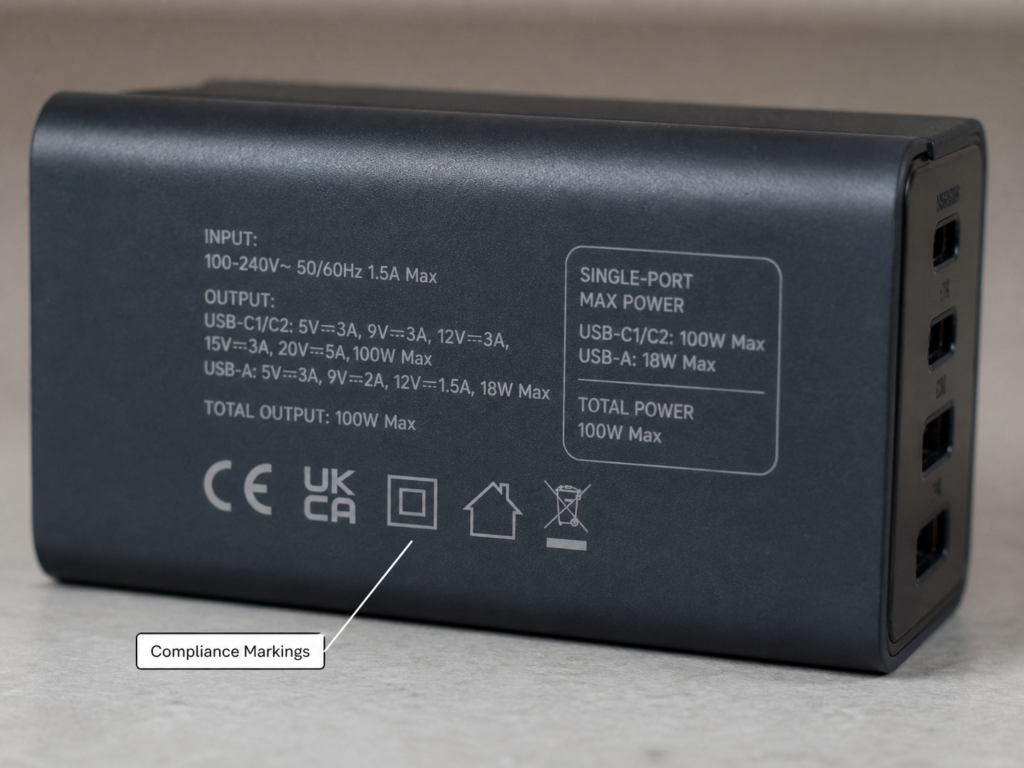
The labels on the product must be clear and durable, cannot be wiped off by hand, and the size must meet the requirements. You cannot just draw a counterfeit label by yourself.
1. **Conformity mark**: Mark UKCA, CE or CE+UKNI according to the sales location. The specific rules have been explained earlier.
2. **Product parameters**: Chargers and power adapters must clearly mark the input and output voltage, current, and power; multi-port products must separately mark the maximum power of a single port and the total power, not just the total power.
3. **Entity information**:
• **Mark according to specific regulations**: Manufacturer name or trademark, product model, and importer or other responsible entity information when applicable.
• **Traceability information**: Provide batch number, serial number or other information that can identify the product as required by regulations.
• Whether a UK address must be marked on the product body depends on the specific applicable regulations and sales methods, and cannot be generalized.
4. **Environmental labels**: Products subject to WEEE must be affixed with the “crossed-out wheeled bin” label; products containing batteries must be affixed with battery recycling labels according to battery type and applicable rules.
Country of origin is mainly used for customs declaration and other applicable trade rules, and should not be stated as a requirement that all such product bodies and packaging must generally be marked with the country of origin.
Mandatory Checks for Packaging and Accompanying Documents
• **Packaging**: Product model, brand (if any), batch number or serial number and other information shall be marked according to specific regulations and traceability requirements. Whether the country of origin needs to be marked on the packaging shall be judged according to customs and other applicable rules.
• **Manual**: Must have an English version, and the content must include safe use instructions, heat dissipation requirements, disassembly prohibition prompts, and access channels for compliance declarations.
• **Special instructions for charging products**: Fast charging cables must be marked with the actual maximum supported power and protocol; multi-port chargers must explain the power distribution rules when multiple ports are used at the same time, such as “single port maximum 65W, two ports used at the same time maximum 45W + 18W”, to avoid consumer misunderstanding.
Technical Documentation Retention Checklist (Necessary for Random Inspections)
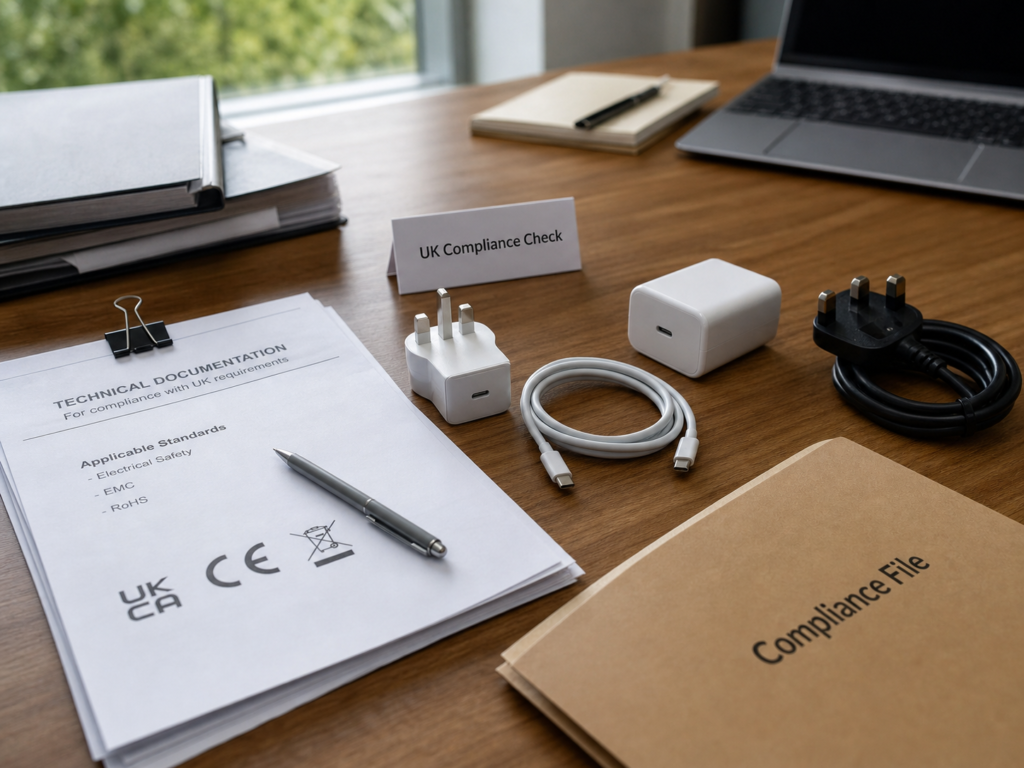
Technical documentation does not need to be actively submitted to customs or regulatory authorities, but once a random inspection is conducted, it must be provided within the specified time. Missing items may result in a judgment of non-compliance. You can prepare against the checklist below:
1. Product risk assessment report
2. Design materials: circuit diagrams, PCB diagrams, structural diagrams, key component specifications
3. Bill of Materials (BOM): full material details, key components shall be marked with compliance certificate numbers
4. Final market version label and manual samples
5. Valid test reports for all applicable regulations
6. Declaration of Conformity (DoC)
7. Change records: all records of product modifications, material replacements, design adjustments
8. Batch traceability documents: production batch records, shipment records, supply chain traceability materials
**Retention period**: Different regulations have different requirements. For product safety documents, it is recommended to keep them for 10 years under internal control, that is, they must be available within 10 years after sales stop, which is more secure.
Promotion Consistency Check
Many sellers tend to overlook this point, especially when product pages on platforms are written randomly, resulting in complaints of false promotion:
• The model, parameters, and functions on the product title, packaging, manual, and platform page must be completely consistent.
• For example, claims such as “100W fast charging” and “fireproof shell” must be supported by corresponding test reports, and cannot be falsely marked.
• You cannot promote “having UKCA/CE mark” as “UK official certification”. The conformity mark is the result of a conformity declaration made by the enterprise or the legally responsible entity, not an official certification.
Import Customs Clearance Check: Key to Avoiding Goods Detention
Customs clearance is the most troublesome part for many sellers. In fact, as long as you are well prepared, most goods detentions can be avoided.
Customs Clearance Entity and Qualifications
• **EORI number**: It is an identity number used by UK Customs for import and export enterprises. To conduct UK customs business with GB, a GB EORI is usually required; for related customs business between Northern Ireland and the EU or non-UK countries, an XI EORI may be required, which shall be specifically judged according to HMRC’s business scenario rules. The usage rules of GB EORI, XI EORI and EU EORI in different customs scenarios are different, and cannot be simply understood as all import scenarios to NI must hold a “NI EORI”. EORI should also not be confused with VAT numbers or platform accounts.
• **VAT number**: Not all imports require a VAT number in advance, depending on the importer’s identity and declaration mode. For example, for low-value goods (single consignment value ≤ £135) sold directly to consumers through e-commerce platforms, VAT is collected by the platform on behalf of the seller. The specific import VAT arrangement shall also be judged in combination with the transaction structure. Enterprises that have registered for UK VAT can apply for import VAT deferment, so they usually do not need to pay import VAT in full at the time of customs clearance, and will handle it according to the rules when filing later.
• **Declaration agent**: You can entrust a local customs broker or freight forwarder to help with declaration, but the importer still bears primary responsibility for the authenticity of the declaration content and cannot shift blame to the freight forwarder.
Commodity Classification and Country of Origin
• **Commodity Code/HS Code**: Classified according to the product’s function, structure, and connector type. Different codes correspond to different tariffs and regulatory requirements. Reference codes for charging products: chargers generally start with 850440, USB cables generally start with 854442. Note that this is only a reference. You cannot determine the code solely based on the product name. It is best to use the UK Customs classification tool to query, or find a professional classifier to confirm. Otherwise, a wrong code may result in overpayment of tariffs, or bring declaration and regulatory risks.
• **Country of origin judgment**: Products shipped from China do not equal to Chinese origin. Whether processing in Vietnam is sufficient to change the country of origin must be judged on a case-by-case basis according to the applicable UK non-preferential or preferential rules of origin. Simple assembly does not necessarily change the country of origin.
• **Preferential tariff**: Products that meet the rules of the China-UK Trade Agreement can apply for preferential tariffs, and need to provide a compliant certificate of origin or origin declaration.
Required Customs Clearance Documents
Basic documents must be prepared during customs clearance; compliance materials shall be available at any time:
1. **Basic commercial documents**: Commercial invoice (which must clearly state the product name, model, quantity, unit price, country of origin, and information of the buyer and seller), packing list, and customs declaration materials.
2. **Compliance materials**: DoC of the corresponding model, valid test report, and responsible person information when applicable, shall be retained by the enterprise and submitted when required by customs, market supervision or other competent authorities.
3. **Other documents**: Those applying for preferential tariffs shall provide compliant certificates of origin or declarations; those requiring license documents for special products shall also prepare them.
DoC, test reports and responsible person information are not generally required as mandatory customs documents for every import of all chargers or cables. Whether additional documents need to be provided with the goods for special products shall be judged according to specific license and regulatory requirements.
Tax and Declaration Notes
• **Tax composition**: Import tariff + import VAT. Tariff is determined by commodity code, country of origin, and trade agreement; the tax base of import VAT is calculated according to customs valuation rules, including goods value, freight, insurance premium, packaging fee, commission and other related fees, which shall be verified according to HMRC rules.
• **Tax bearing**: Incoterms can affect the freight, tariff and risk bearing agreed by the buyer and seller, but the UK customs and VAT responsibilities are still judged according to the legal importer, declaration arrangement and actual transaction mode, and cannot be determined solely by trade terms. The agreement of EXW or DDP also cannot alone determine who bears the UK legal importer, declarer or VAT responsibility.
• **Declaration notes**: Product description should be specific, for example, write “65W USB-C GaN power adapter”, not just “electronic accessories”. Vague descriptions are very likely to be randomly inspected by customs.
• **Safety and security declaration**: Goods entering GB need to submit a safety and security declaration as required. The responsible entity is determined according to the mode of transport and customs requirements. Confirm with the freight forwarder in advance.
Post-Market Continuous Compliance Obligations: Don’t Think It’s Over After Customs Clearance
Many people think that once the goods are cleared and sold, it’s all over. In fact, the UK has many post-market continuous obligations, and failure to perform them may still result in penalties.
WEEE Waste Electrical and Electronic Equipment Recycling Responsibility
• **Applicability judgment**: Products with electronic components such as chargers, active data cables, and wireless chargers usually need further judgment as to whether they fall within the scope of WEEE application; purely passive cables shall be judged on a case-by-case basis according to whether they are independently sold electrical connection products.
• **Core obligations**: First determine the producer identity, enterprise scale and placement volume according to the UK WEEE producer responsibility system, then determine whether to register directly, join a compliance scheme, appoint an authorized representative, or perform corresponding declaration and recycling fee obligations. Importers or brand owners who first place products on the UK market may be recognized as producers, but this cannot be generalized without considering the specific transaction model.
• **Labeling requirements**: Applicable products shall be affixed with the “crossed-out wheeled bin” label according to the rules.
Packaging Producer Responsibility (EPR)
• **Scope of application**: According to the enterprise scale, UK turnover, packaging tonnage, packaging supply or import role and applicable region, judge whether it is a small or large organization, and the corresponding data reporting, registration and packaging producer responsibility fee obligations. Not all entities that supply packaged products to the UK market automatically bear exactly the same obligations.
• **Packaging scope**: Not only retail color boxes, but also shipping outer boxes, cushioning materials (such as bubble wrap, pearl cotton), and plastic bags may be considered packaging and need to be counted according to applicable rules.
• **Core requirements**: Enterprises that meet the applicable thresholds shall register or join corresponding arrangements as required, declare packaging data, and bear corresponding recycling or producer responsibility fees.
Special Battery Responsibility
• **Scope of application**: Charging products with built-in or accompanying batteries may involve battery producer responsibility, such as wireless chargers with batteries; ordinary chargers and cables are generally not within the scope of battery product responsibility.
• **Core obligations**: First, according to the battery type, producer identity, enterprise scale and placement volume, judge whether it is necessary to register directly, join a compliance scheme, appoint an authorized representative, declare the placement volume or bear recycling costs; labeling requirements shall also be checked according to the specific product and battery type.
• **Note**: UK battery regulations are updated frequently, so the latest rules at the time of sale shall prevail.
Product Safety and Change Management
• **Incident handling**: If you receive complaints about product overheating, smoking, electric shock, etc., you must record and evaluate them in a timely manner. In serious cases, you must immediately stop sales and recall, and also report to the relevant departments in accordance with applicable regulations and regulatory requirements.
• **Recall requirements**: A recall plan shall be formulated according to applicable product safety regulations, and shall be implemented in cooperation when the regulatory authority requires a recall.
• **Change assessment**: When the product is modified, such as changing the chip, changing the shell material, changing the plug, adjusting the power, the compliance must be re-evaluated, and previous assessment documents and test reports cannot be used directly.
Quick Checklists by Product Category: Check Directly Against Your Product
For your convenience in quick checking, we have sorted out the core requirements of four types of common charging products. You can directly check against your own product:
| Product Category | Conformity Assessment Requirements | Environmental Compliance Requirements | Core Labeling and Packaging Requirements | Core Customs Clearance Requirements |
| Passive charging/data cable (e.g. ordinary A to C cable) | Judge according to whether it contains electronic circuits and applicable regulations; should not draw conclusions directly based solely on “passive” | UK REACH; if it is EEE, it must comply with UK RoHS | Mark manufacturer, model and traceability information according to specific regulations; promotion parameters are consistent with actual | Correct HS classification; complete basic commercial documents |
| Smart/active data cable (e.g. 100W fast charging cable) | Complete corresponding conformity assessment according to sales location and specific applicable regulations; if it is a device applicable to EMC Regulations, corresponding EMC evidence shall be prepared | UK RoHS, UK REACH | Mark conformity mark, actual power, manufacturer and applicable responsible entity information | Compliance materials are retained and available upon request; correct HS code |
| Wall-plug charger/power adapter (e.g. 65W GaN) | Complete corresponding conformity assessment according to sales location (including applicable requirements such as safety, EMC, etc.); UK plug meets applicable UK requirements | UK RoHS, UK REACH, WEEE (if applicable) | Mark input and output parameters, conformity mark, applicable WEEE mark, entity information; equipped with English safety manual | Complete basic commercial documents; correct HS code; other materials provided as required |
| Multi-port charging station/wireless charger/smart charging product | Covers the basic requirements of the corresponding category; wireless function is judged according to RER scope of application; connected function is judged according to PSTI scope of application | Environmental requirements of the corresponding category and battery responsibility (if any) | Multi-port products mark single port/total power; manual clarifies power distribution rules; affix applicable environmental labels | Complete basic commercial documents; correct HS code; special documents provided as required |
Real Scenario Case Analysis: Compliance Points of 4 Common Products
Below, we use 4 of the most commonly sold products to connect the previous requirements, to help you understand more intuitively.
Case 1: Ordinary USB-A to C Passive Charging Cable
• **GB/NI difference**: In both regions, it is necessary to first determine whether the product is EEE, then determine RoHS and WEEE obligations, and the requirements are basically the same.
• **Applicable regulations**: UK REACH; if it is EEE, UK RoHS is also added.
• **Labeling requirements**: Whether a conformity mark is required shall be judged according to specific applicable regulations; manufacturer, model and traceability information shall be marked as required. Country of origin is provided according to customs declaration and other applicable rules, and is not generally mandatory on all product bodies.
• **Required documents**: Supply chain material declarations, customs clearance commercial documents.
• **EPR obligations**: Packaging EPR shall be judged according to enterprise scale, turnover, packaging tonnage and packaging role; WEEE shall be judged according to whether it is EEE and producer responsibility conditions.
• **Common misconception**: Many people think that passive cables have no compliance requirements, but in fact RoHS and REACH may still apply, otherwise they may still be required to rectify if found out.
Case 2: 100W USB-C Fast Charging Cable with E-Marker
• **GB/NI difference**: GB uses UKCA or CE under applicable transitional arrangements; NI uses CE or CE+UKNI, which shall be specifically judged according to applicable regulations and latest policies.
• **Applicable regulations**: Whether EMC applies shall be judged according to E-Marker or other electronic circuits, product functions and placement form; also check UK RoHS and UK REACH.
• **Labeling requirements**: Mark conformity mark, actual supported power, manufacturer information and other applicable responsible entity information according to applicable regulations.
• **Required documents**: DoC, applicable EMC test report (if any), material declaration, and responsible entity information required by specific regulations.
• **EPR obligations**: Packaging EPR is judged according to applicable thresholds; if it is EEE, it is also necessary to judge registration, scheme, authorized representative and declaration obligations according to WEEE producer responsibility rules.
• **Common misconception**: Cables with E-Marker cannot be simply and uniformly deemed as requiring separate assessment under the EMC Regulations; the scope of application shall be evaluated according to the actual circuit and function, and corresponding evidence shall be prepared.
Case 3: 65W UK Plug GaN Charger
• **GB/NI difference**: GB uses UKCA or CE under applicable transitional arrangements; NI uses CE or CE+UKNI, which shall be specifically judged according to applicable regulations and latest policies.
• **Applicable regulations**: EESR (safety), EMC, Plugs and Sockets Regulations, UK RoHS, UK REACH, and applicable WEEE requirements.
• **Labeling requirements**: Affix conformity mark, input and output parameters, applicable WEEE mark and entity information; specific label content shall be checked according to applicable regulations.
• **Required documents**: DoC, safety, EMC and plug test materials; WEEE responsibility materials and other responsible entity materials shall be prepared according to specific systems and requirements.
• **EPR obligations**: Both packaging EPR and WEEE producer responsibility shall be judged according to corresponding thresholds, producer identity and placement volume.
• **Common misconception**: Selling with an EU plug plus a conversion head cannot replace the applicable requirements for UK fixed household plugs. Products for daily retail in the UK shall be equipped with compliant UK plugs, and travel adapters cannot be used to circumvent this requirement.
Case 4: Smart Charging Dock with Wireless Charging + Built-in Battery
• **GB/NI difference**: GB uses UKCA or CE under applicable transitional arrangements; NI implements according to corresponding labeling and EU conformity assessment rules.
• **Applicable regulations**: Safety, EMC, RER (if it falls within the scope of radio equipment), UK RoHS, UK REACH, WEEE, battery responsibility; if it is indeed a consumer connected product referred to in PSTI, it must also comply with PSTI.
• **Labeling requirements**: Mark conformity mark, product parameters, WEEE and battery recycling labels, entity and traceability information according to applicable regulations.
• **Required documents**: DoC, corresponding test reports, battery compliance documents, and applicable PSTI declarations and responsible entity information.
• **EPR obligations**: Packaging, WEEE and battery responsibilities shall all be judged according to enterprise scale, product category, placement volume and producer identity.
• **Common misconception**: Thinking that wireless chargers only need to do safety assessment. In fact, it is also necessary to judge whether it involves EMC, radio, battery and connected product safety requirements, and cannot miss applicable regulatory items.
Advanced Pit Avoidance: 4 Tips From Beginner to Not Being Scammed
The previous content can help you with basic compliance. The following tips can help you spend less money unnecessarily and avoid common pitfalls, which are semi-proficient level content.
Conformity Assessment Body Qualification Verification
If your product requires mandatory third-party assessment, you must verify the qualification of the institution. Don’t spend money and get an invalid report:
• **GB mandatory third-party assessment scenario**: You should find a UK approved body with corresponding UK authorization scope.
• **NI mandatory third-party assessment scenario**: You can choose an EU notified body with corresponding scope according to EU rules; if the assessment is completed by an applicable UK body, use CE+UKNI according to the rules.
• **Test laboratory selection**: For ordinary testing, you can find a laboratory with testing capabilities for corresponding standards. UKAS accreditation is only a reference for capability, not a mandatory requirement. There is no need to blindly pursue UKAS.
• **Common pitfalls**: Using reports from unqualified institutions, using test reports from ordinary laboratories to replace third-party assessment certificates – test reports only test samples, while third-party assessment is participation in the product conformity assessment procedure, the two are not the same thing.
• **Verification method**: Directly go to the UK institution database on GOV.UK, or the EU’s NANDO database to check the institution’s qualification and authorization scope. Don’t just listen to the institution’s own boasting.
Test Report and DoC Validity Check
Don’t put the report aside after getting it. First check these points to ensure its validity:
1. **Entity consistency**: The manufacturer name, product model, and specifications on the report and DoC must be consistent with the actual product on the market. A difference of one letter may cause validity problems.
2. **Standard validity**: The standards used for testing must be currently valid and applicable to your product. Expired standards cannot be used, nor can irrelevant standards be used.
3. **Content completeness**: A formal test report must have sample photos, key parameters, test items, non-conforming items (if any), and test conclusions. A one-page conclusion report is most likely problematic.
4. **Change impact**: After changes in product design, materials, and key components, it is necessary to re-evaluate whether the report can still be used, and cannot directly use the old report.
Common pitfalls: model coverage fraud (for example, a series of more than a dozen models, only one is tested, and the others may not meet the requirements), expired standards, inconsistency between test samples and mass-produced goods.
Compliance Cost Judgment and Optimization
There is no unified price for compliance fees, and there are many influencing factors: product type, test items, assessment method, and institution qualification all affect the price. Here are some practical tips for saving money:
• **Series assessment**: For multi-model products of the same series, if the core design is the same and only the appearance and power differences are small, you can apply for series assessment and share test reports, which can save a lot of money.
• **Choose the right service provider**: Prioritize institutions with experience in charging products and verifiable qualifications. Don’t be greedy for cheap and choose those with particularly low quotations. In the end, the report will be invalid, the money will be wasted and time will be delayed.
• **Do pre-testing in advance**: Before mass production or before shipment, send samples for pre-testing to find problems and rectify them in advance. Otherwise, if the entire batch of goods is detained or needs to be recalled, the loss will be much greater.
Handling of Non-Compliance Issues
If something really goes wrong, don’t panic. Handle it according to the following methods:
• **Detained at customs clearance**: First take the customs notice as the standard, and confirm the reason for detention. If it is a problem that can be rectified, such as missing documents or wrong labels, apply for release after supplementing the materials; if the product itself does not meet the requirements, it may be returned or destroyed.
• **Unqualified in market random inspection**: Rectify, recall or delist according to the requirements of the regulatory authority. Don’t delay handling, otherwise the fine will escalate.
• **Label/document issues**: Affix correct labels, supplement applicable responsible entity information, improve DoC and technical documentation, and submit for review after rectification.
Frequently Asked Questions
Do UK Chargers Must Have UKCA?
The GB region still recognizes the CE mark for some products at present. The specific transition period and scope of application are subject to the latest announcement on GOV.UK. Not all products must use UKCA immediately.
Do USB-C Cables Need UKCA?
For USB-C cables with active circuits such as E-Marker, whether conformity assessment is required shall be judged according to the actual circuit, function and applicable regulations; for passive USB-C cables, first determine whether they are EEE, then determine the corresponding requirements. It cannot be concluded that all products must be assessed separately under the EMC Regulations just because of E-Marker.
Is EORI Required for UK Imports?
To conduct UK customs business with GB, a GB EORI number is usually required; for related customs business between Northern Ireland and the EU or non-UK countries, an XI EORI may be required, which shall be specifically judged according to HMRC’s business scenario rules.
Who is Responsible for WEEE Registration?
Importers or brand owners who first place products on the UK market may be recognized as producers under the WEEE system. However, whether they need to register directly, join a compliance scheme, appoint an authorized representative and how to declare shall be judged in combination with the producer definition, sales model, enterprise scale and placement volume.
Must UK Plugs Be Three-Pin?
Wall-plug charging products for daily retail in the UK should usually be equipped with three-pin UK standard plugs that meet applicable UK requirements. If travel adapters are sold with the product, they must also meet their applicable safety requirements and clearly state their travel use, and cannot be used to circumvent UK fixed household plug requirements.
Abilities You Can Master After Learning
After reading this content, you should be able to do the following:
1. Able to distinguish the compliance paths for charging products in GB and NI regions, and avoid the most common beginner misconceptions.
2. Able to judge the regulatory requirements that need to be further checked according to product type (passive cable, active cable, charger, smart charger), no longer need to ask around.
3. Able to check the completeness of product labels, packaging, and customs clearance documents against the requirements, and avoid the risk of goods detention.
4. Able to verify the validity of assessment bodies and test reports, and identify common pitfalls such as fake reports and false markings.
5. Able to handle problems such as customs detention and unqualified random inspections, and fulfill post-market continuous compliance obligations.
Final Words
UK import compliance seems to have many items, but in fact, as long as you follow the steps: first determine the sales location and product type, then match the corresponding regulations, conduct assessment and prepare documents as required, you can avoid the vast majority of pitfalls. If you encounter something you are not sure about, be sure to check the latest announcement on GOV.UK, or consult an experienced professional institution. Don’t take chances – compliance may seem time-consuming and costly, but it actually helps you avoid greater losses.