
Sellers exporting products such as charging cables, USB-C chargers, power adapters, and interface connectors to the UK often encounter the UK REACH regulation. Some say it is the same as RoHS, some say small batches do not need to comply, and others say you must spend tens of thousands of yuan on registration. Who is right?
This guide starts with the most basic scope of application, and covers responsibility determination, mandatory obligations, practical operation steps, and pitfall avoidance tips, covering all UK REACH compliance points for charging products from entry-level to semi-proficient level. After reading it, you can judge for yourself what needs to be done and what does not, and avoid wasting money.
Entry-Level Understanding: Core Boundaries and Scope of Application
Core Logic and Competent Authority
UK REACH is a chemical control regulation independently implemented in Great Britain (GB, i.e. England, Scotland, and Wales) after the UK’s withdrawal from the EU, replacing the former application of EU REACH in the UK.
UK REACH mainly controls substances, mixtures, and articles. Charging products are usually classified as articles, and specific obligations need to be determined based on the substances they contain, whether there is intentional release, and the requirements of the SVHC and restriction lists. In other words, it does not only regulate chemical raw materials, but not all articles are automatically subject to the same set of obligations just because they contain a certain chemical substance.
The competent authority for this regulation is the UK Health and Safety Executive (HSE). Its core logic can be divided into four modules: registration (chemicals in large quantities require prior filing of safety data), evaluation (official verification of substance risks), authorisation (extremely high-risk substances require application before use), and restriction (explicitly prohibited or restricted hazardous substances).
Geographical Boundary: GB and Northern Ireland Must Be Assessed Separately
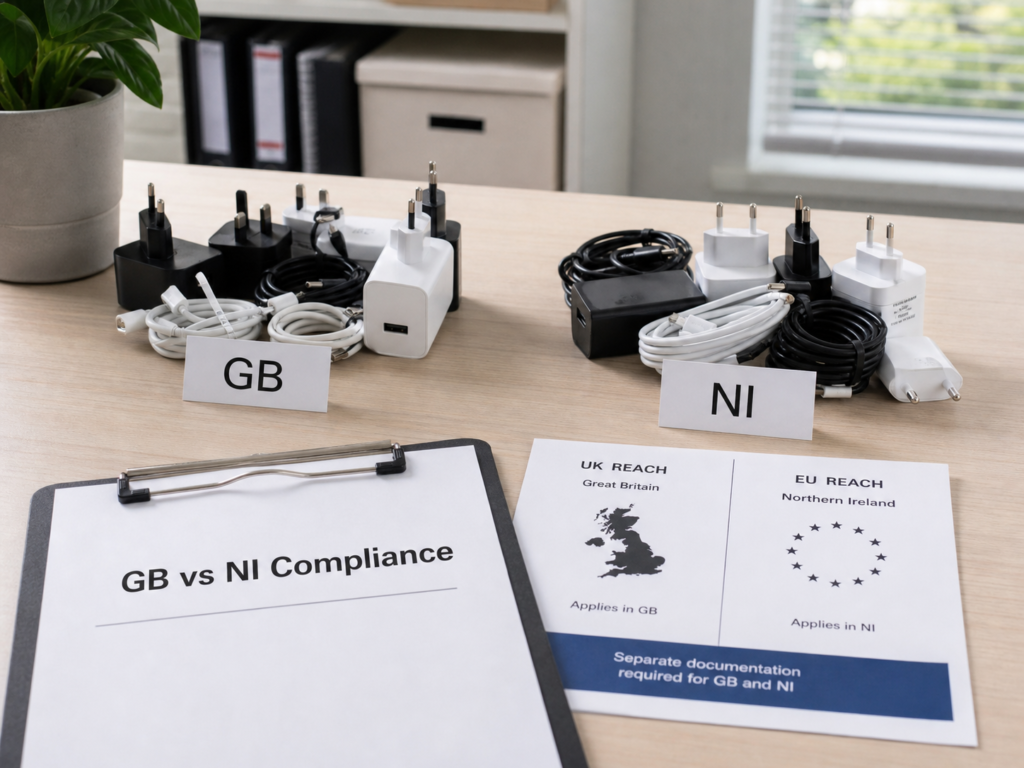
The “UK market” that many people refer to must be viewed in two parts under UK REACH, which is the most common basic pitfall:
• The only applicable area for UK REACH is GB (England, Scotland, Wales);
• Northern Ireland (NI) is subject to EU REACH, not UK REACH;
• If products are sold to both GB and NI, two sets of compliance documents need to be prepared;
• When promoting “UK compliance” externally, you must clearly state whether it covers GB, NI, or both to avoid ambiguity.
Controlled Objects and Attributes of Charging Products
UK REACH divides controlled objects into three categories: pure substances (such as lead pellets), mixtures (such as glues and inks), and articles (i.e. processed final products).
Products such as charging cables and chargers are typical **articles**, and they are not designed to “intentionally release chemical substances” during normal use. Intentional release here refers to the active release of chemicals by the product (such as electronic devices with aromatherapy functions), and trace seepage caused by normal wear and tear does not count. This attribute directly determines that most high-threshold obligations will not be triggered for charging products.
Scope of Control for Charging Products and Key Components
All charging cables, USB/USB-C cables, chargers, power adapters, and interface connectors entering the GB market are within the scope of UK REACH control. There is no need to doubt whether your products are regulated.
The focus of control is not the product as a whole, but the high-risk materials inside: PVC cable insulation, plastic housings, metal contacts/platings, solder, label inks, adhesives, and even packaging materials are included. Many sellers easily overlook the packaging item.
Common Consequences of Non-Compliance
The consequences of violating UK REACH depend on the illegal act and applicable enforcement regulations, and may include rectification notices, prohibition of supply or placing on the market, seizure or recall, fines, and criminal liability where applicable. Specific amounts and measures shall be subject to the decisions of law enforcement agencies or courts. You cannot simply apply a fixed fine range, nor can you treat “permanent ban on entry into the UK market” as a general penalty result.
There are three common reasons for non-compliance of charging products: hazardous substance content does not meet applicable restrictions, insufficient compliance certification materials are retained, and SVHC information is not transmitted to downstream parties or consumers as required.
Determination of Responsible Parties: Who Bears the Compliance Responsibility
Many sellers think that if they hire a freight forwarder to handle customs clearance, or let a UK distributor be responsible for sales, they do not need to bear REACH responsibilities. In fact, legal liability must be determined in combination with factors such as who is responsible for importation, contractual arrangements, and customs declaration arrangements, and cannot be judged solely by who takes delivery of the goods or who sells them on the platform.
Legal Definition of Importer
An importer under UK REACH is usually a natural or legal person established in GB who is responsible for importing substances, mixtures, or articles from outside the territory into GB.
Determination cannot be based solely on ownership of goods, in whose name customs clearance is conducted, or the sales platform. It is necessary to confirm who bears the legal responsibility for bringing products from outside the territory into GB in combination with contracts, customs declaration arrangements, and actual import responsibilities. Whether freight forwarders, customs brokers, and e-commerce platforms bear a specific responsibility cannot be generalized, but depends on the role they actually play in the business arrangement.
Responsibility Determination for Common Business Models
Different sales models have different responsible parties. You can directly compare with your own situation to determine:
• A UK company that directly purchases from overseas and handles customs clearance and sales by itself: this UK company is usually the importer and bears applicable UK REACH responsibilities;
• Overseas brands imported and sold through UK distributors: the distributor is usually the importer. After the overseas manufacturer appoints an Only Representative (OR) and the relevant import volume is formally covered by the OR, the OR can assume registration-related obligations, but the distributor still needs to fulfill applicable obligations such as restrictions and SVHC information transmission;
• Overseas sellers shipping via direct mail or UK overseas warehouses: it is necessary to confirm who the importer is in combination with contracts, customs declaration arrangements, and actual import responsibilities, and cannot be judged solely based on overseas warehouses or sales platforms;
• Cross-border e-commerce FBA model: it is necessary to confirm who is actually responsible for import declaration and related import responsibilities. Hiring a freight forwarder to handle customs clearance does not automatically change the attribution of legal liability.
Role and Boundaries of the Only Representative (OR)
There is a special situation where overseas entities can share part of the responsibility: appointing a legal person within the UK as the **Only Representative (OR)**, that is, finding a local UK compliance entity to assume UK REACH registration-related responsibilities on behalf of non-UK manufacturers.
This model is suitable for overseas factories or brands with stable shipment volumes for centralized compliance management, but three boundaries should be noted:
1. The OR mainly bears registration-related responsibilities, while obligations such as restriction list compliance and SVHC information transmission may still be borne by the importer;
2. You must obtain written confirmation from the OR to ensure that your purchase volume is covered by the OR’s registration scope, otherwise it is useless;
3. Small and medium-sized sellers with low annual import volumes have no need to hire an OR at all, as the cost may be much higher than the benefit.
Special Rules for the Northern Ireland Market
Charging products entering Northern Ireland are subject to EU REACH, and responsibility determination follows EU rules, which has nothing to do with UK REACH. If goods are shipped from GB to Northern Ireland, it is necessary to re-determine whether EU REACH import obligations are triggered, and UK REACH documents cannot be directly used as a substitute. Merchants supplying both GB and Northern Ireland must clearly identify the responsible parties for the two markets separately and not confuse them.
Hierarchy of Core Obligations: Which Are Mandatory, Which Are Triggered Only When Conditions Are Met
Not all sellers need to fulfill all UK REACH obligations. They are divided into two categories: “mandatory without tonnage threshold” and “required only when trigger conditions are met”. For small and medium-sized sellers of charging products, usually the first step is to fulfill obligations related to the restriction list and SVHC, while remaining tonnage-based obligations such as registration or notification need to be determined based on specific substances and business conditions.
[Mandatory · No Tonnage Threshold] Restriction List Compliance
The restriction list is a strictly controlled part of UK REACH, and is a list of chemicals explicitly prohibited or restricted in the UK. Whether a product complies with restriction provisions is generally not based on import volume as a general exemption basis, but depends on specific restriction provisions, substances, product scope, and applicable conditions.
Charging products may involve restrictions on some phthalates, cadmium, lead, flame retardants, or chlorinated paraffins, but this cannot be directly determined solely by component name or RoHS exemptions. Specific entries in UK REACH Annex XVII should be checked item by item, including:
• The specific scope of controlled substances;
• The applicable product or material scope;
• Concentration calculation basis;
• Effective dates and exception clauses;
• Whether there are applicable exceptions for specific products such as electrical and electronic equipment.
For example, some phthalate restrictions apply to specific plasticized materials and the product scope specified in the provisions. Not all PVC cables can simply apply the same 0.1% conclusion; cadmium restrictions also do not generally apply to all plastic and metal components. Brominated flame retardants, short-chain chlorinated paraffins, and lead in solder must also be determined based on specific substances and restriction provisions.
It should be particularly noted that an exemption under UK RoHS cannot automatically imply that there is also an exemption under UK REACH. Whether an exception applies shall be subject to the specific provisions of UK REACH Annex XVII.
[Mandatory · No Tonnage Threshold] SVHC Information Transmission
First, it is necessary to understand what SVHCs are. SVHCs are **Substances of Very High Concern** that meet one or more criteria under Article 57 of UK REACH, including:
• Carcinogenic, mutagenic, or reprotoxic substances (CMR);
• Persistent, bioaccumulative, and toxic substances (PBT);
• Very persistent and very bioaccumulative substances (vPvB);
• Other substances with equivalent level of concern.
The UK Candidate List is updated irregularly, and the number of entries on the list also changes with official decisions. When making a determination, you should directly check the current UK Candidate List, version, and specific substance entries published by HSE, and should not judge based on a fixed month or old number of entries.
Charging products may involve SVHCs such as phthalates, lead, cadmium, and brominated flame retardants. The SVHC list and the restriction list partially overlap, but the legal obligations of the two are not the same.
If an article contains a Candidate List substance and meets the applicable concentration conditions, it is usually necessary to fulfill the information transmission obligation:
• **B2B sales**: Provide downstream buyers with information sufficient for safe use, including at least the substance name;
• **B2C sales**: If a consumer makes a request, provide free information on safe use including at least the substance name, and reply within 45 days;
• Unless otherwise required by other regulations, UK REACH itself does not generally require proactive disclosure of SVHC names on product detail pages or packaging.
When determining concentration, the specific article containing the SVHC and its concentration shall be confirmed in accordance with the applicable interpretation of UK REACH for articles and complex articles. Improper dilution based solely on the total weight of the whole product is not allowed, but neither can all homogeneous materials or minimum functional units be directly equated with legal calculation units without analysis.
[Tonnage-Triggered] SVHC Notification Obligation
Producers or importers of articles usually need to consider submitting an SVHC notification to HSE under Article 7(2) only when all of the following conditions are met simultaneously:
1. The article contains a Candidate List substance and meets the applicable concentration conditions;
2. The total annual amount of the substance exceeds 1 tonne;
3. Exposure of humans or the environment to the substance cannot be excluded.
It is also necessary to check whether there are statutory exceptions such as registered uses, and pay attention to the 6-month deadline after the substance is included in the Candidate List.
For small and medium-sized sellers of charging products, the annual import volume of a single SVHC substance is generally less than 1 tonne, and this obligation is usually rarely triggered. However, it cannot be directly excluded just because “what is sold is a finished product” or “it is a small batch”, and should still be determined based on specific products and import volumes.
[Tonnage-Triggered] Substance Registration Obligation
Substance registration is a high-cost obligation under UK REACH, which means that a single chemical substance whose annual import volume meets the standard requires submission of corresponding technical and safety information to HSE.
Its trigger conditions vary by product type:
• Import of pure substances or mixtures: usually determined by the annual import volume of a single substance, and registration needs to be considered when it reaches 1 tonne per year;
• Import of articles: only when the substance is “intentionally released” and reaches the corresponding tonnage may the registration obligation of the article importer be triggered.
Charging products are articles, and ordinary charging cables and chargers have no intentionally released chemical substances, so registration is usually not automatically triggered just because the product contains a certain substance.
EU REACH registration cannot directly replace UK REACH registration. Eligible UK existing registration holders may apply grandfathering arrangements, and some existing importers or downstream users may submit DUIN (Downstream User Import Notification) in accordance with regulations and complete information submission within the corresponding deadline. Whether these transitional arrangements can be relied upon depends on the entity’s identity, import history, Only Representative arrangements, and submission deadlines, and should be verified based on specific circumstances, rather than generally assuming that EU registration can be used directly during the UK transition period.
[Very Rarely Triggered] Authorisation Substance Compliance
Authorisation substances are the highest-risk category of substances. After the specified “sunset date”, they must obtain official authorisation from HSE before use.
Charging products rarely involve such substances, and only some special flame retardants, plasticizers, or other specific substances may be encountered. If they are indeed used, the authorisation provisions, uses, and sunset date of the substance should be checked. If the authorisation requirements are not met, the product should not continue to be supplied or placed on the market for the relevant use.
Quick Screening of High-Risk Components for Charging Products
For compliance, you don’t need to disassemble all products and send them for testing at the beginning. You can first conduct a quick screening according to risk level to save time and cost.
Risk Ranking of High-Risk Components
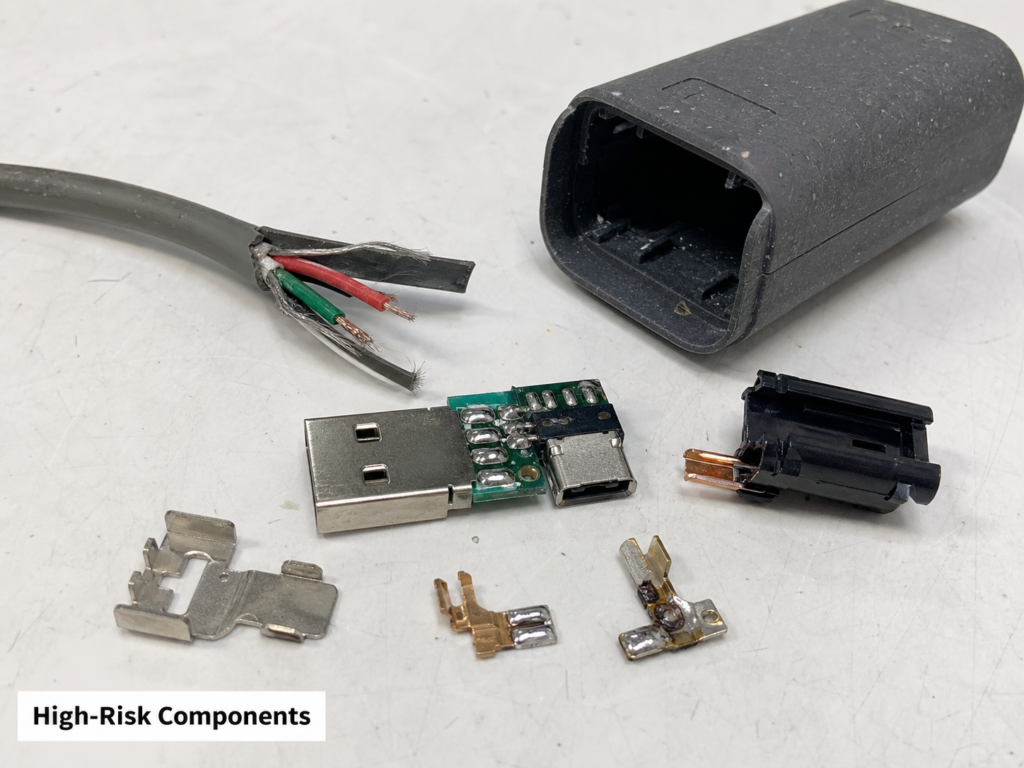
The hazardous substance risks of charging products are highly concentrated in several components, ranked from highest to lowest risk:
1. **Flexible PVC cables**: high risk of excessive phthalates and lead, which is a high-risk area;
2. **Recycled plastic housings**: high risk of excessive flame retardants and heavy metals;
3. **Solder/metal platings**: risks of substances such as lead and cadmium are common. Don’t think there is no problem with metals;
4. **Circuit boards/adhesives/label inks**: medium risk, secondary focus;
5. **Packaging materials**: the easiest to overlook, but may also involve applicable chemical requirements.
Quick Risk Prediction Tips
You can roughly judge the risk level without testing:
• For cheap unbranded charging products, supply chain material information is usually more incomplete, and risk management is more difficult;
• Black flexible PVC cables may use more pigments and plasticizer systems, so substances such as phthalates should be checked as a focus;
• For products with housings made of recycled plastic, heavy metals, flame retardants and other substances should be checked as a focus;
• Metal components also have SVHC risks, and heavy metals in platings and solder may require further verification.
Correct Calculation Method for SVHC Concentration
This is a point that many sellers and even suppliers get wrong: SVHC concentration cannot be simply diluted based on the total weight of the entire cable or entire charger. The article containing the SVHC and its supply status shall be identified in accordance with the specific applicable interpretation of UK REACH for articles and complex articles, and then the concentration and information transmission obligations shall be determined.
Therefore, the information provided by suppliers cannot only have general conclusions at the whole product level. A more practical approach is to require them to explain the material composition of cable sheaths, USB-C connector housings, plug housings, plastic housings, solder, and other key components, and explain the legal determination method for these components in complex products.
Entry-Level Practice: Four Steps to Complete Basic Compliance
For most charging product sellers with low annual import volumes, as long as you follow these four steps, you can complete basic compliance determination, and avoid wasting money on registration at the beginning.
Step 1: Self-Screening to Determine Obligation Level
First figure out what you need to do, and don’t go to a third party for testing right away:
1. **Disassemble product components**: list the materials of all charging products, such as PVC cables, ABS housings, nickel-plated copper contacts, solder, etc.;
2. **Estimate annual import volume**: count the annual imported products and related substance quantities, and distinguish by specific substance, product type, and business model as much as possible;
3. **Preliminary determination**: for general substance registration and Article 7(2) notification for articles, 1 tonne per year is an important threshold. Below this threshold, these tonnage obligations are usually not triggered, but you still must check restrictions, SVHC information transmission, authorisation, mixture classification and labelling, and other applicable requirements; if you are close to the 1 tonne threshold, monitor monthly cumulative volume to confirm whether it is triggered.
Step 2: Request Compliance Certification Materials from Suppliers
Supply chain materials sufficient to prove the compliance of specific products and materials should be obtained, such as:
1. **Substance composition and material information**: clarify the materials, formulations, and possible controlled substances used in key components;
2. **SVHC information**: state whether the product or related articles contain substances in the current UK Candidate List, and the applicable concentration determination;
3. **Targeted test reports**: based on material risks, conduct tests on substances such as phthalates, lead, cadmium, and flame retardants, or provide existing data;
4. **Supplier declaration**: suppliers can be required to provide written declarations corresponding to specific models, batches, and materials, but UK REACH does not prescribe a unified declaration format, nor does it generally require a seal.
Safety Data Sheets (SDS) cannot be simply judged as “containing excessive SVHC”. For hazardous substances or mixtures, SDS shall be provided in accordance with the SDS rules of GB CLP and UK REACH; an article containing SVHC does not automatically mean that an SDS must be provided.
When requesting documents, note that it is best to require the documents to correspond to specific models, batches, materials, and production dates. General declarations that only state “REACH compliant” without substance information and applicable scope usually have limited probative value.
Step 3: Import Customs Clearance and Document Retention
The customs clearance requirements of UK REACH are different from many regulations: usually, routine submission of UK REACH certificates is not required during customs clearance, but regulatory authorities may require enterprises to provide information afterwards.
If you receive a regulatory inquiry, you should reply within the deadline specified in the formal notice, and cannot apply a unified “10 to 28 days” deadline.
Information related to UK REACH obligations is usually retained for at least 10 years, calculated from the date of the last manufacture, import, supply, or use of the relevant substance. For actual retention, it is recommended to also do the following:
1. Documents can be stored within the UK or can be retrieved at any time;
2. Documents correspond to specific SKUs, material codes, production batches, and suppliers;
3. Retain material composition, test reports, supplier declarations, information transmission records, and import records;
4. Re-verify documents in a timely manner after product material changes, formula changes, or supplier changes.
Step 4: Complete Downstream Information Transmission as Needed
Handle according to different situations based on the SVHC determination results:
• **B2B sales**: if the article contains a Candidate List substance and meets applicable conditions, provide downstream customers with information sufficient for safe use, including at least the substance name;
• **B2C sales**: if a consumer makes a request, provide free information on safe use including at least the substance name, and reply within 45 days;
• UK REACH itself does not generally require proactive disclosure of SVHC on detail pages or packaging, but other regulations or specific product requirements may provide otherwise;
• If, after reasonable verification, the relevant article does not contain Candidate List substances that meet applicable conditions, there is usually no need to proactively transmit information under Article 33.
Advanced Pitfall Avoidance: Avoid Common Pitfalls and Wasted Money
Accurate Determination of Registration Obligations: Avoid Wasting Money Unnecessarily
Many third-party agencies promote “UK REACH registration services”, saying that it is mandatory as long as you sell to the UK. In fact, most charging product sellers do not need it at all. You can make a preliminary judgment based on the following criteria:
• **Situations where registration is usually not required**: the imported products are ordinary articles without intentionally released substances; the import volume of the relevant single substance does not reach the applicable tonnage threshold; or upstream suppliers or the OR have completed registration and cover your own import arrangements;
• **Situations requiring further determination**: import of pure substances or mixtures with annual import volume of a single substance reaching 1 tonne; articles with intentionally released substances reaching the corresponding threshold; or existing registration or OR coverage is insufficient;
• **Transitional arrangements**: EU REACH registration cannot be directly regarded as UK REACH registration. Arrangements such as grandfathering, DUIN, and phased submission should be verified based on entity identity and import history.
Registration costs range from thousands to hundreds of thousands of pounds depending on factors such as substance tonnage and data completeness, and small and medium-sized sellers are basically not involved. Do not readily believe the sales pitch that “registration is mandatory as long as you sell to the UK”. First judge the product type, substance type, import volume, and whether there is intentional release by yourself.
Validity Determination of Test Reports/Supplier Declarations
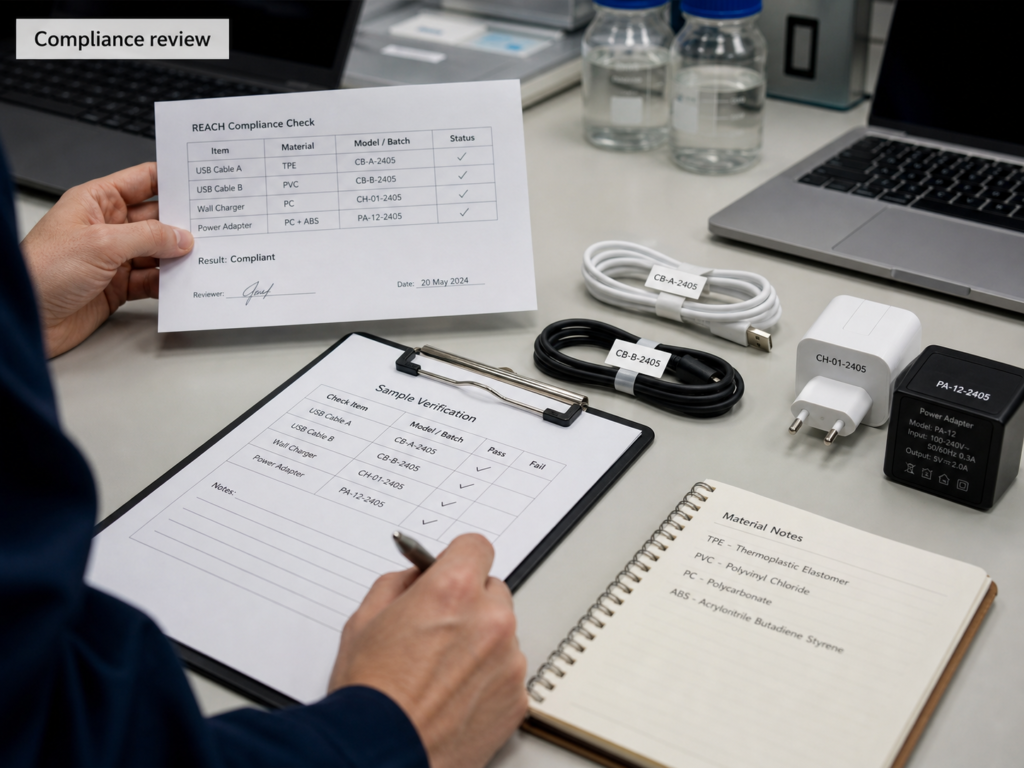
When you receive documents from suppliers, don’t just put them away. First determine whether they can support your compliance conclusion.
Key points to verify:
1. Whether the laboratory has the corresponding testing capabilities and methods;
2. Whether the samples can represent the actually sold products;
3. Which homogeneous materials or articles are tested;
4. Whether it covers specific models, batches, production dates, and key materials;
5. Whether the tested substances correspond to the current UK Candidate List and Annex XVII restriction provisions;
6. Whether old reports are still applicable after product material changes or formula changes.
UK REACH does not generally require the use of UKAS-accredited laboratories, nor is there a unified “UK REACH-specific report” format. UKAS, CNAS, or other qualifications themselves cannot automatically prove that the report covers the correct substances, materials, batches, and regulatory provisions. CMA also cannot simply be listed alongside CNAS as an internationally mutually recognized qualification.
EU REACH reports can be used as supporting materials, but cannot be regarded as meeting UK REACH requirements without verification. When using them, the substances, testing scope, and conclusions in the report should be compared item by item with the current UK Candidate List and Annex XVII.
Common reports with insufficient probative value include:
• Only testing the whole product, without explaining the scope of key materials or articles;
• Using outdated SVHC lists;
• Not clearly stating testing methods, samples, and applicable models;
• Only marking “REACH compliant” without specific substance data;
• Directly using EU REACH reports as UK REACH proof without verification.
Common Pitfalls and Avoidance Methods
These five pitfalls are the most common for charging product sellers, and must be avoided:
1. **Pit 1: Having UKCA/UK RoHS means you don’t need to worry about UK REACH**
Reason for error: The regulatory dimensions are different. RoHS only targets specific electrical and electronic products and controlled substances, while REACH stipulates different obligations for substances, mixtures, and articles.
Avoidance method: Use the same product material list to simultaneously check applicable UK RoHS and UK REACH requirements to save time.
2. **Pit 2: Directly using EU REACH reports/declarations as UK REACH proof**
Reason for error: EU REACH registration and UK REACH registration are two independent systems, and UK lists and restriction provisions may also gradually differ from those of the EU.
Avoidance method: When using EU materials, check the current UK Candidate List, Annex XVII, and specific product scope, and cannot only look at the document title.
3. **Pit 3: Freight forwarders/platforms say they handle customs clearance so REACH is sorted**
Reason for error: Customs clearance services are not equivalent to fulfilling all UK REACH obligations. Actual liability must be determined in combination with import arrangements and the legal roles of relevant entities.
Avoidance method: Confirm import responsibilities by yourself, retain a full set of compliance documents, and do not rely on verbal promises.
4. **Pit 4: Small batches/samples/self-shipping do not need compliance**
Reason for error: Small import volumes usually only affect some tonnage obligations, and cannot automatically exempt from restrictions, SVHC information transmission, or other applicable requirements.
Avoidance method: Even for small batches, complete the restriction list and SVHC verification; if samples are not for sale, other regulatory requirements should also be determined based on the specific supply method and product use.
5. **Pit 5: Products labeled “halogen-free/environmentally friendly” are equivalent to UK REACH compliant**
Reason for error: “Halogen-free” only means that a certain type of halogen or halide is not contained, and may still contain other SVHCs or restricted substances.
Avoidance method: Subject to material information, test reports, and declarations of conformity, and do not only trust promotional labels.
Rectification Steps for Compliance Issues
If you actually encounter a regulatory inquiry or find that products may be non-compliant, handle it according to these five steps:
1. Suspend the import and sale of high-risk batches to avoid expanding the scope of non-compliance;
2. Confirm the affected models, batches, import volumes, and sales destinations;
3. Request component-level material information, updated declarations, and targeted test reports from suppliers;
4. Re-screen against the latest UK Candidate List and Annex XVII restriction provisions to determine the risk level;
5. Consult professional compliance personnel when necessary, and take rectification, notification, or recall measures in accordance with regulatory requirements.
Suggestions for Compliance Clauses in Procurement Contracts
If you are a brand owner or a seller with long-term stable procurement, it is recommended to add these compliance clauses to the procurement contract to avoid risks from the source:
• Clearly state that suppliers must ensure products meet applicable UK REACH restriction and SVHC information requirements;
• Agree that suppliers have the obligation to notify in advance when changing material formulas, production locations, or key components;
• Clarify the division of responsibility for rectification and recall losses caused by false declarations or unauthorized material changes;
• Require suppliers to cooperate with regulatory inquiries and provide necessary material data;
• Agree on retention and update requirements for test reports, material declarations, and batch records.
Distinction Between Easily Confused Regulations
UK REACH is often confused with other UK market access regulations. Here we clarify the most easily confused ones.
UK REACH vs UK RoHS (Most Easily Confused for Charging Products)
These two are the most easily confused by charging product sellers, with three core differences:
• **Scope of control**: RoHS mainly targets electrical and electronic products, while UK REACH stipulates different obligations for substances, mixtures, and articles;
• **Controlled substances**: RoHS targets specified restricted substances, while UK REACH manages a wider range of chemical risks through mechanisms such as SVHC, restriction, authorisation, and registration;
• **Application logic**: Charging products are electrical and electronic products, and usually need to be checked for both UK RoHS and UK REACH. Exemptions under RoHS cannot automatically apply to UK REACH, and whether there are exceptions depends on the specific restriction provisions of UK REACH.
UK REACH vs UKCA Certification
• **Different nature**: UKCA is a mark of conformity or compliance mark applicable to specific product regulations, not a unified “product safety certification”; UK REACH is an independent chemical regulation;
• **Different scope of application**: UKCA or CE marks recognized by GB under applicable transitional rules must be determined separately according to the regulations applicable to the product, such as electrical safety, EMC, and RoHS;
• **Different labeling requirements**: UK REACH compliance does not require affixing the UKCA mark, and having the UKCA mark does not mean REACH compliance;
• **Relationship**: The two cannot replace each other. They should be determined separately according to specific product regulations and current GB marking rules, and it cannot be said that all charging products must use UKCA and complete the same set of market access procedures at the same time.
UK REACH vs EU REACH
• **Applicable regions**: UK REACH applies to GB, and EU REACH applies to EU member states and relevant supply scenarios in Northern Ireland where EU REACH applies;
• **List differences**: The SVHC and restriction lists of the two systems may have similarities, but the UK has the power to independently update and adjust, so it cannot be assumed that the two sides will always be completely consistent;
• **Registration validity**: EU REACH registration cannot directly replace UK REACH registration;
• **Transitional arrangements**: Eligible UK existing registration holders may apply grandfathering arrangements, and some existing importers or downstream users may submit DUIN in accordance with regulations and complete information submission within the corresponding deadline, depending on the entity’s identity and import history.
UK REACH vs GB CLP
• **Controlled content**: GB CLP regulates the classification, labelling, and packaging of hazardous substances and hazardous mixtures;
• **Applicable scenarios for charging products**: Chargers and charging cables themselves are usually articles, and CLP classification and labelling requirements are usually not applicable to the products themselves; however, hazardous substances or mixtures such as adhesives, cleaning agents, and inks imported with the products or supplied separately may need to be classified, labelled, and packaged in accordance with GB CLP.
Checklist and Core Summary
Entry-Level Checklist (Small and Medium Sellers / Annual Import <10 Tonnes / No Registration Triggered)
□ Confirmed that products are sold to GB (sales to NI require compliance with EU REACH)
□ Clarified your own UK REACH role in combination with contracts, customs declaration arrangements, and actual import responsibilities
□ Requested material information, SVHC information, and necessary restricted substance test data corresponding to specific products from suppliers
□ Determined SVHC concentration and information transmission obligations in accordance with the applicable interpretation of UK REACH for articles and complex articles
□ Confirmed that products meet the applicable restriction provisions of UK REACH Annex XVII
□ Retained compliance documents corresponding to SKUs, batches, and suppliers, usually for at least 10 years
Advanced Checklist (Large Importers / Brand Owners / Annual Import Close to 1 Tonne Threshold)
□ Estimated the annual import volume of a single high-risk substance and confirmed whether registration or Article 7(2) notification obligations are triggered
□ Verified that the coverage of upstream suppliers’ UK REACH registration, OR, or DUIN arrangements includes your own import arrangements
□ Checked the testing capability, testing scope, sample representativeness of test reports, and compliance with current UK Candidate List and Annex XVII provisions
□ Established a supply chain chemical information update mechanism to timely pay attention to changes in the UK Candidate List and restriction provisions
□ Clarified suppliers’ UK REACH compliance responsibilities, material change notification obligations, and regulatory cooperation obligations in procurement contracts
Special Inspection Items for the Northern Ireland Market
□ Charging products imported into Northern Ireland are subject to EU REACH, not replaced by UK REACH
□ Two sets of compliance documents have been prepared separately for products supplied to both GB and Northern Ireland
□ When promoting “UK compliance”, it is clearly stated whether it covers GB, NI, or both
Core Summary
After reading this guide, you will at least master three actionable determinations:
First, charging cables, chargers, and power adapters are usually classified as articles, but specific obligations still need to be determined in combination with substance composition, intentional release, SVHC, and the restriction list.
Second, REACH reports or declarations provided by suppliers cannot be judged by the title alone. You must confirm whether they correspond to specific models, batches, materials, and the current UK list. EU materials can be used as supporting materials, but cannot directly replace UK REACH determination without verification.
Third, import volume mainly affects registration and some notification obligations, and does not mean that small-batch products can ignore restrictions, SVHC information transmission, or other applicable regulations.
UK REACH may seem complicated, but for the vast majority of small and medium-sized sellers of charging products, the core is to first confirm the applicable region (GB or NI), then clarify import responsibilities, verify the restriction list and SVHC information, properly retain supply chain materials, and further determine registration or notification obligations when approaching the tonnage threshold.