
For people who export charging cables and chargers to the United States and South Korea, they almost always encounter the two certification terms FCC and KC right when they enter the industry. Many people are confused at first: Are both of these mandatory? Is FCC in charge of safety? Can you directly convert FCC to KC? Do all charging cables need certification?
Don’t worry. In this article, we will start from the most basic positioning, and use the most familiar consumer-grade charging products such as chargers, USB-C cables, and wireless chargers as examples throughout to thoroughly explain the differences, applicable scenarios, and pitfall avoidance methods of the two certifications. After reading this, you will not only be able to match the correct certification for your products yourself, but also avoid the vast majority of pitfalls that newbies often fall into.
First, Understand the Core Positioning of the Two Certifications
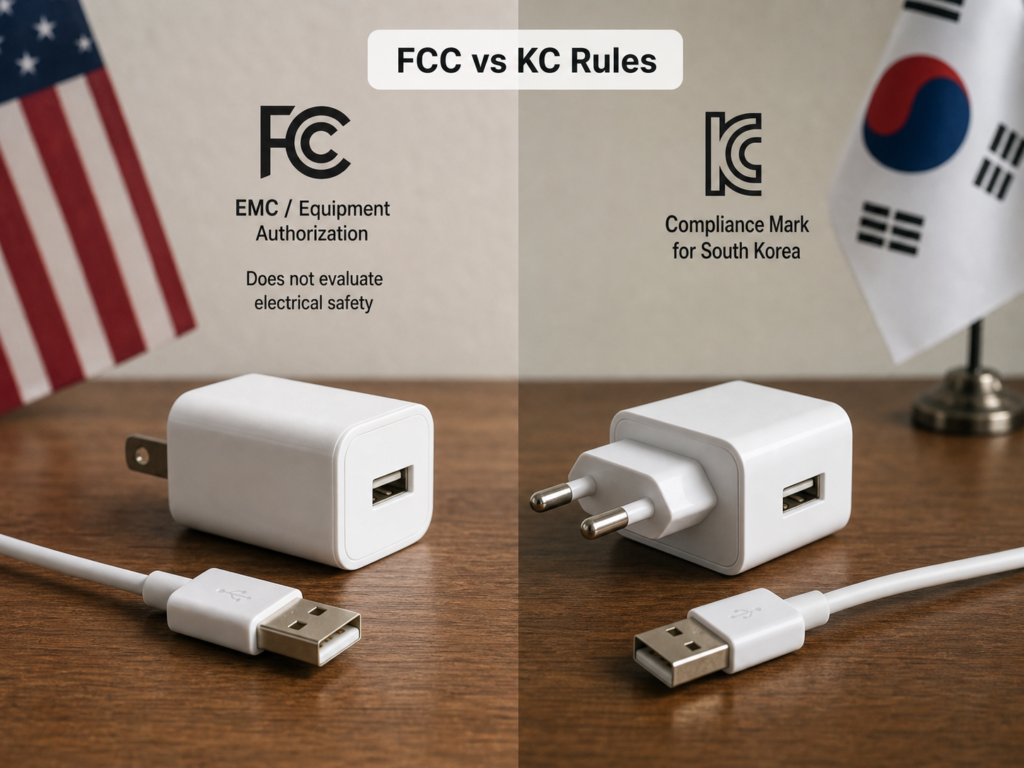
FCC Certification: Part of the US Electromagnetic Compatibility Compliance Requirements
The full name of FCC is the Federal Communications Commission, which is the official agency in charge of communications and electromagnetic environment in the United States. For charging products, the FCC mainly focuses on whether the electromagnetic emissions generated by equipment during operation will cause harmful interference to radio communications and other equipment.
You must remember this first: the FCC does not evaluate the electrical safety of products. For example, whether a charger will leak electricity or catch fire is not within the scope of the FCC’s safety evaluation. Safety compliance usually needs to be confirmed based on applicable standards such as UL and IEC, as well as local US regulations, requirements from retailers or AHJs (Authorities Having Jurisdiction). NRTL certifications such as UL and ETL may become actual access conditions in many sales, installation, or procurement scenarios, and cannot be generally referred to as voluntary certifications.
For charging products, charging equipment, digital devices, or wireless devices that contain electronic circuits usually need to confirm equipment authorization requirements in accordance with applicable FCC rules. Pure passive cables usually do not require separate authorization; for USB-C cables with E-Marker chips, a compliance laboratory must confirm whether Part 15 testing or other processing is required based on their circuit, sales form, and product classification, and a conclusion cannot be drawn solely based on “having a chip”.
KC Certification: The Compliance Mark System for the South Korean Market
KC is a compliance mark system used in the South Korean market, not a single certification that combines all safety, EMC, and wireless requirements. Specific requirements need to be judged separately:
- Electrical safety is usually handled in accordance with the South Korean Electrical Product Safety Management System supervised by KATS, which may involve safety certification, safety confirmation, or supplier conformity confirmation;
- Wireless and some EMC requirements are usually handled in accordance with the broadcasting and communication equipment conformity assessment system responsible for by the South Korean Radio Research Agency (RRA);
- Products with wireless functions may be subject to both the South Korean electrical safety system and the RRA system, or only one of them or other specific requirements may apply.
Therefore, the KC mark only represents that the product has completed the corresponding compliance procedures in accordance with the corresponding system, and cannot be simply understood as “all items of safety, EMC, and wireless are automatically passed”. For chargers, power adapters, USB cables, adapters, and wireless charging devices, you should separately check the applicable catalogs, standards, and conformity assessment types of Safety Korea and RRA, and cannot judge whether a certain KC certificate must be obtained solely based on the product name.
3 Core Misconceptions That Must Be Clarified for Beginners
Many people fall into these three pitfalls when they first come into contact with certifications. We will clarify them in advance to avoid detours:
First, FCC is not a US safety certification. To emphasize again: the FCC mainly deals with electromagnetic-related requirements, while product safety must be separately confirmed based on applicable standards and specific requirements of the US market.
Second, FCC and KC cannot replace each other or be directly converted. The regulations, product classifications, test scopes, and responsible entities of the two markets are different. Even if some EMI test data can be used for both parties’ assessment when conditions are met, it does not mean that FCC can be directly converted to KC, or KC can directly replace FCC.
Third, not all charging products require certification. Pure passive accessories without any electronic components, such as ordinary copper wire charging cables, often do not require separate authorization or certification, but you should still first check the product classification of the target market. Products with chips, control modules, wireless functions, or other active circuits must be specifically judged based on their actual structure and functions.
Why Must We Attach Importance to These Two Certifications?
If you sell products to the US and South Korea without completing the corresponding compliance procedures, in mild cases, the goods will be detained by customs and the links will be directly removed from e-commerce platforms; in severe cases, you may be fined, required to make rectifications, or even recall the products. For small and medium-sized sellers, the subsequent processing cost is often higher than the cost of confirming requirements before listing.
Whether you are engaged in cross-border e-commerce, wholesale, or offline retail, as long as your products are to enter the US and South Korean markets, you must first clarify the corresponding certifications and responsible entities.
Unify the Caliber Before Comparison to Avoid Misalignment
Certification requirements vary greatly across different categories. To make the comparison more referential, we will first clarify the scope and boundaries, and you can also check whether your products are within this scope first.
First is the fixed product scope for comparison: We only talk about consumer-grade charging products, that is, the most commonly sold wired chargers/power adapters, USB/USB-C charging cables, charging connectors, and ordinary wireless charging accessories. Industrial, medical, vehicle-specific charging equipment, and high-power energy storage or charging products above 200W are not within the scope of today’s comparison — the requirements for these special categories vary greatly and require separate assessment.
Second is the unified core dimensions for comparison: Next, we will expand on six dimensions: mandatory attribute and regulatory authority, assessment and testing requirements, certification path and process, cycle and cost, label and document requirements, validity period and market supervision. All content is combined with the actual requirements of charging products, and will not involve general industrial standards.
Last is the applicable boundary of conclusions: All requirements are based on the standards in effect as of 2024. If subsequent standards are updated, or your product has wireless functions, power exceeding 200W, or is a special custom model, you need to recheck the specific requirements and cannot directly apply them.
Item-by-Item Comparison of Core Dimensions (Exclusive to Charging Products)
This part is the key point. We will explain one dimension at a time. For each dimension, we will first talk about the requirements, then the differences and influencing variables, to make it easier for you to judge against your own products.
1. Mandatory Attribute and Regulatory Authority
FCC is regulated by the Federal Communications Commission. Charging equipment, digital devices, or wireless devices containing electronic circuits usually need to confirm equipment authorization requirements in accordance with FCC Part 15, Part 18, or other applicable rules; pure passive copper wires usually do not require separate authorization. Whether the FCC specifically requires SDoC, Certification, or other processing depends on the device category, operating mode, and applicable clauses.
KC-related requirements depend on the South Korean electrical safety system and the RRA broadcasting and communication equipment conformity assessment system respectively. Whether charging products are mandatory objects and which procedure is required depends on conditions such as product classification, rated input and output, and whether they contain wireless transmitters.
Overseas manufacturers usually need to designate an importer, agent, or responsible entity within South Korea to perform corresponding obligations for application, marking, record-keeping, and market supervision. Who specifically acts as the applicant or certificate-related entity must be confirmed in accordance with the system to which the product belongs, and cannot be simply summarized as Chinese companies absolutely cannot directly obtain certificates.
The judgment logic here applies to both certifications: whether the product contains active circuits, whether it is a digital device, whether it has wireless functions, and the sales form of the product will all affect the final requirements. You cannot judge only by the product name, nor only by “whether there is a chip”.
2. Assessment and Testing Requirements
This is an area where the two markets differ greatly, but the test items cannot be summarized with a fixed list.
Ordinary digital charging devices usually need to confirm applicable conducted emission and radiated emission requirements. Products with wireless transmission functions such as Bluetooth and Wi-Fi also need to evaluate items such as radio frequency emission, spurious emission, radio frequency exposure, and module and whole-machine integration in accordance with specific frequency bands and FCC rules. The wireless energy transmission of wireless chargers is also not automatically equivalent to radio transmission equipment; you should first determine whether Part 18, Part 15, or other rules and authorization methods apply.
For South Korea, safety test items must be determined in accordance with the corresponding product safety system and applicable standards of Safety Korea; EMC and wireless items may be separately assessed in accordance with the RRA system. Specific items depend on the device category, structure, rated parameters, operating mode, and laboratory test plan. There is no unified rule that all ordinary 20W chargers are tested for “more than 10 safety indicators” as a fixed set.
Of course, test requirements are not fixed, and several variables will directly affect the difficulty:
- The higher the product power, the more complex the operating mode, and the more wireless functions or multiple interfaces, the more test items and the higher the rectification difficulty usually are;
- For digital devices subject to Part 15 Subpart B, Class A or Class B must be judged based on the device’s use environment and applicable clauses, and cannot be uniformly classified as Class B just because the product is a consumer-grade charging product;
- The grid conditions of the two countries are different: the common input condition in the United States is 120V/60Hz, and the common input condition in South Korea is 220V/60Hz, so the input voltage conditions during testing may be different, and you cannot use the same test data to cope with both sides without judgment.
3. Certification Path and Process
Common FCC equipment authorization methods include SDoC and Certification, but they cannot be directly applied just based on the names “charger” or “wireless charger”.
SDoC (Supplier’s Declaration of Conformity), simply put, means the responsible party completes testing in accordance with applicable FCC rules and signs a declaration of conformity. Laboratory qualifications and test requirements must be confirmed based on the specific device category, and not all SDoC products must be tested by so-called “FCC-qualified laboratories”. Test reports, declarations of conformity, and related technical materials should be retained for inspection in accordance with the rules.
Certification is usually applicable to wireless transmission equipment or other specified equipment that require FCC certification. Such products are generally tested by an accredited testing laboratory, then submitted and authorized through a TCB (Telecommunication Certification Body) to obtain a unique FCC ID. Charging accessories with wireless transmitters such as Bluetooth and Wi-Fi usually need to confirm whether to take this path in accordance with transmitter rules; but the wireless charging function itself does not automatically require an FCC ID.
For ordinary digital chargers and cables with electronic circuits, you should first confirm whether to use SDoC or other authorization methods in accordance with applicable FCC clauses, and cannot simply assert that all products use SDoC.
KC-related processes are not limited to two fixed paths: “safety certification” and “self-declaration of conformity”. The South Korean electrical product safety system distinguishes at least types such as safety certification, safety confirmation, and supplier conformity confirmation. Power adapters should first confirm which system they belong to according to the Safety Korea catalog, and then determine whether factory inspection, supervision inspection, or other ongoing obligations are required.
If the product has wireless functions, or belongs to broadcasting and communication equipment under the jurisdiction of the RRA, you must also separately confirm the RRA’s EMC and wireless conformity assessment types. The specific procedures may vary by device category and cannot be uniformly referred to as “wireless equipment filing”.
The core difference between the two is: the FCC usually does not take initial factory audit as a unified precondition for all equipment authorizations; different South Korean safety systems and the RRA system also have their own application, factory, marking, and supervision requirements, and the process of a certain safety certification cannot be extended to all KC-related products.
The complexity of the process mainly depends on several variables: whether the product has a wireless transmitter, what category of device it belongs to, whether TCB or RRA assessment is required, whether factory inspection is required, and whether design changes occur subsequently.
4. Certification Cycle and Cost
We will not give a fixed “industry average cycle” and unified price here. The FCC, South Korea’s Safety Korea, and RRA do not stipulate a unified commercial cycle or RMB quotation for all charging products.
The actual cycle and cost need to be quoted and confirmed separately by the laboratory or service agency based on the following factors:
- Which regulation and device category the product belongs to;
- What tests need to be conducted;
- Whether the FCC uses SDoC or Certification;
- Whether TCB, RRA assessment, or factory inspection under the South Korean safety system is required;
- Whether the participation of a South Korean importer, agent, or other responsible entity is required;
- The number of product rectifications and the preparation of materials;
- Official fees, laboratory testing fees, certificate or registration fees, and third-party service fees.
Therefore, you cannot simply assume that FCC SDoC must take 1–2 weeks and Certification must take 4–6 weeks, nor can you uniformly classify KC safety certification and self-declaration of conformity into a fixed cycle. The more complex the product, the more test items, and the need for factory inspection or rectification, the higher the cycle and cost usually are.
When inquiring about prices, it is best to ask the other party to list testing fees, official or registration fees, factory inspection fees, agency service fees, and rectification fees separately, to avoid only comparing a low total price.
5. Label and Document Requirements
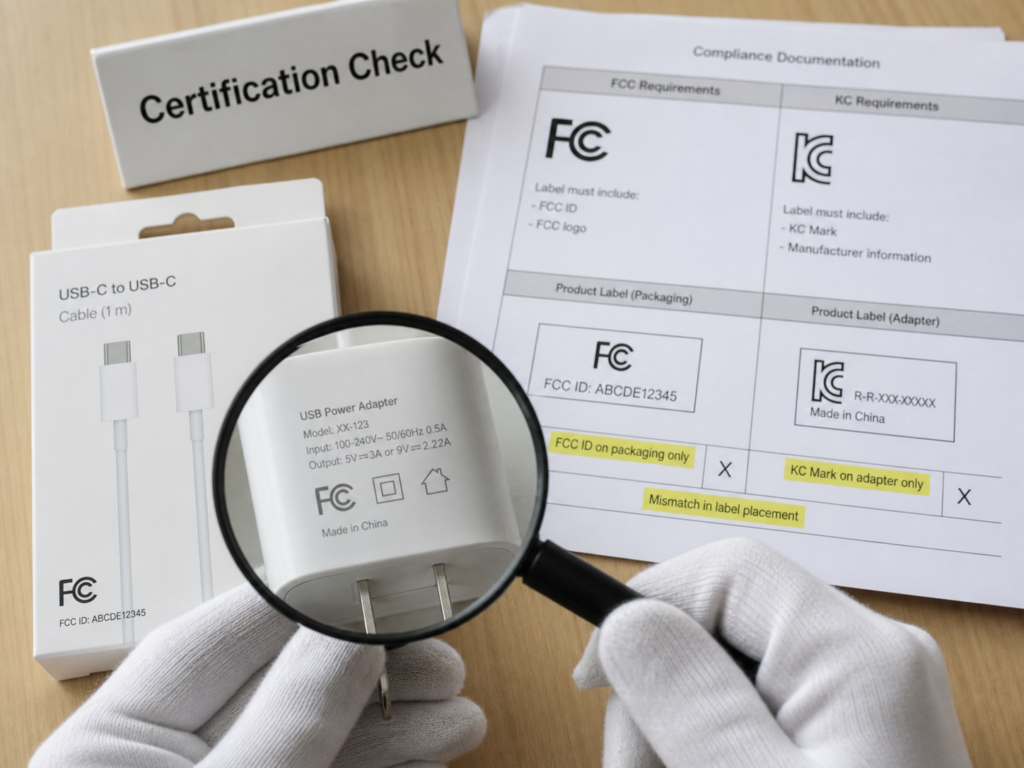
First, let’s talk about FCC rules:
- For products using SDoC, the responsible party shall prepare and sign a declaration of conformity, and retain the test report and related materials for inspection. The specific document content, responsible party information, and language requirements shall be confirmed in accordance with applicable FCC rules.
- Devices using Certification usually must be marked with the FCC ID on the device body in accordance with 47 CFR §2.925. If marking on the body is not possible due to size or structure, it shall be implemented in accordance with FCC’s alternative conditions for electronic labeling, user manuals, or packaging marking, and the specific device rules shall be checked. “Printing on the minimum sales package” cannot be regarded as applicable to all products.
- The FCC ID, model, manufacturer information, and other markings shall be consistent with the actually sold products and authorization records.
Now let’s talk about KC-related rules:
- The KC mark, certification number, declaration number, and other device identification information depend on the South Korean safety system or RRA conformity assessment system applicable to the product. Not all mandatory products can be summarized as “KC mark plus certificate number”.
- The specific format, size, position of the marking, as well as whether it can be placed on the packaging or manual when it cannot be marked on the product body, must be checked against the corresponding regulations and product category requirements.
- In terms of documents, whether Korean manuals, warning statements, and information of the South Korean importer or responsible entity are required must also be confirmed based on the applicable system and sales scenario. When selling to South Korean consumers, special attention should be paid to whether the Korean information is complete and accurate.
Common violations include the following: forged or misappropriated FCC ID, incorrect use of KC mark or number, non-compliant marking position with corresponding rules, failure to provide Korean manuals as required, or inconsistency between product label information and test reports or authorization records.
Specific label requirements also vary with the situation: for example, very small products can use alternative marking methods when conditions are met; if sold only online, the platform may have additional document and label requirements, which should be checked in advance.
6. Validity Period and Market Supervision
First, let’s look at validity:
- FCC SDoC does not have a unified fixed term. When there are no changes in product design, key components, and applicable standards that affect compliance, the responsible party still needs to continuously maintain conformity and re-assess after changes in rules or products.
- The authorization records of FCC Certification usually do not automatically expire simply according to a fixed number of years, but if standards, device configuration, or product design change, it is necessary to confirm whether re-testing, authorization change, or re-application is required.
- Products belonging to a specific South Korean safety certification system shall implement the certificate term, regular inspection, and factory supervision in accordance with the provisions of that system. The 5-year term and annual supervision of a certain type of safety certification cannot be extended to all KC-related products.
- Safety confirmation, supplier conformity confirmation, and RRA conformity assessment each have their own ongoing obligations, record-keeping requirements, and re-assessment rules after changes, which shall be confirmed in accordance with the corresponding system.
Now let’s look at market supervision:
Both the United States and South Korea may conduct import, market, and platform compliance inspections. The specific enforcement methods and frequency depend on the regulatory authority, product category, and sales channel. Customs, regulatory authorities, e-commerce platforms, or offline sales channels may all require the provision of test reports, declarations of conformity, authorization records, certificates, or product label materials.
The validity of certification mainly depends on two variables: whether the product has design changes, and whether the standards or regulations of the corresponding region have been updated. As long as the shell, key components, wireless module, power parameters, or circuit structure change, you should reconfirm whether the original documents can still cover the actually sold products.
Beginner’s Practical Guide: Directly Match Certification Requirements by Product Type
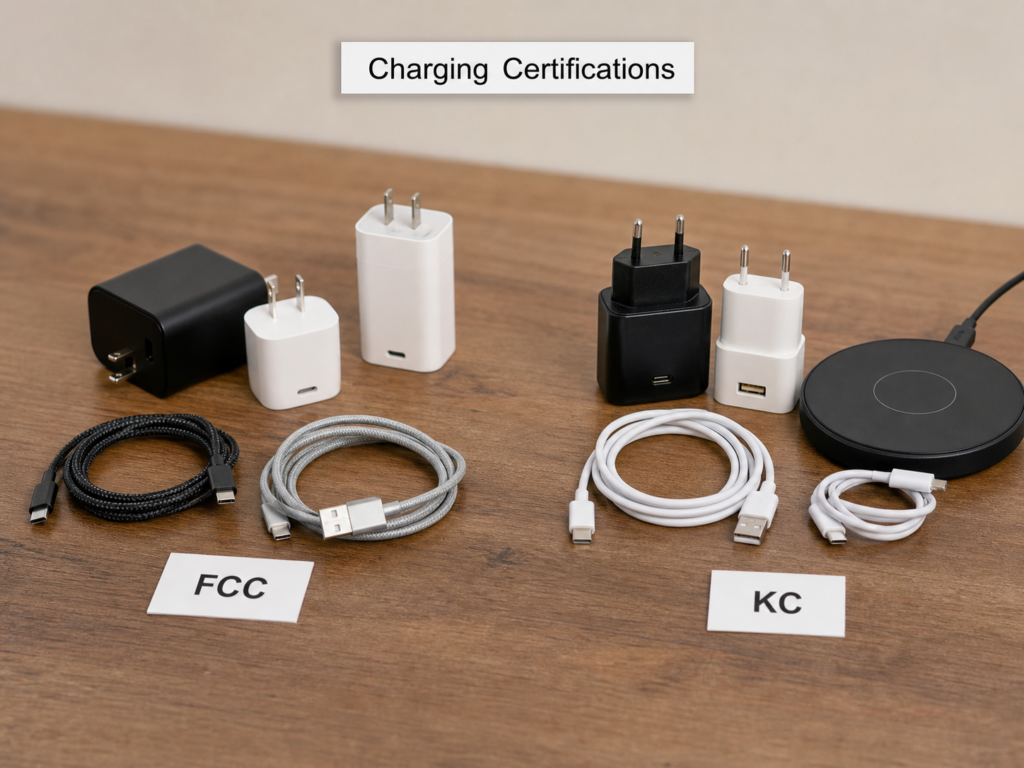
After talking about the overall differences, you may still not know what to do for your products. We will directly correspond the requirements and key judgment points for the 5 most common types of charging products, and you can just follow them.
Pure Passive USB/USB-C Charging Cable (No Chip, No Electronic Components)
This is the most ordinary copper wire, without any chips, LEDs, or control modules inside, only for charging, without power identification or data transmission functions.
- FCC requirements: Usually no separate equipment authorization is required.
- KC requirements: Need to check the official South Korean product catalog for confirmation, and cannot be judged solely by the name “ordinary wire”; qualified passive cables may not be subject to the relevant mandatory system.
- Key judgment point: Just look at whether there is an active circuit — as long as there are chips, LEDs, control modules, etc., it cannot be directly treated as a pure passive cable.
USB-C Charging Cable with E-Marker Chip
This is a USB-C cable that can identify power and support fast charging, with an E-Marker chip inside.
- FCC requirements: You cannot directly conclude that SDoC is mandatory just based on the E-Marker chip. A compliance laboratory shall confirm whether Part 15 testing or other processing is required based on the cable circuit, whether it contains other digital functions, sales form, and product classification.
- KC requirements: It depends on the official South Korean catalog, chip function, and product risk classification. If the chip only performs power identification, the applicable requirements may be different from products with signal conversion or control functions.
- Key judgment point: Don’t just look at whether there is an E-Marker; look at the function of the chip — whether it only does power identification, or has active functions such as signal conversion and control. The final classification shall be judged by the applicable system.
Ordinary Wired Charger/Power Adapter (≤200W)
These are the commonly used wall-plug chargers and power adapters, consumer-grade products with power within 200W.
- FCC requirements: Usually, it is necessary to assess conducted and radiated emissions in accordance with applicable FCC clauses, and confirm whether SDoC or other authorization methods should be used.
- KC requirements: You should first confirm whether it belongs to safety certification, safety confirmation, or supplier conformity confirmation according to the Safety Korea catalog, and then determine the testing, factory inspection, and supervision requirements. If the product has wireless functions or belongs to RRA equipment, you also need to separately confirm the RRA’s EMC/wireless conformity assessment.
- Key judgment point: Focus on whether it is directly connected to the mains, rated input and output, internal circuit, and product classification, rather than applying a fixed process just based on the word “charger”.
Wireless Charger/Magnetic Charging Base
These are wireless chargers that do not need to be plugged in, magnetic charging bases, and the like.
- FCC requirements: You should first determine the applicable FCC Part 18, Part 15, or other rules and authorization methods. The wireless charging function itself does not automatically mean that Certification or FCC ID must be obtained; if it additionally contains wireless transmitters such as Bluetooth and Wi-Fi, then confirm requirements such as FCC ID, radio frequency emission, and radio frequency exposure in accordance with the corresponding transmitter rules.
- KC requirements: Separately confirm whether the product is subject to South Korean electrical safety management, and whether it belongs to RRA broadcasting and communication equipment. Wireless transmitters are handled according to the applicable conformity assessment type of the RRA, and safety and EMC requirements are determined according to their respective applicable systems. A fixed combination of “safety certification + EMC + RF” cannot be preset.
- Key judgment point: It depends on the operating frequency, emission nature, power of wireless charging, and whether there are additional communication functions such as Bluetooth and Wi-Fi — those with additional communication functions usually require more classification and assessment.
Smart Charging Accessories with Bluetooth/Wi-Fi
For example, smart chargers with Bluetooth, charging power strips with Wi-Fi, and the like.
- FCC requirements: Wireless modules usually need to confirm whether to go through Certification and obtain an FCC ID in accordance with the corresponding transmitter rules, and assess radio frequency, spurious emission, radio frequency exposure, and the impact of whole-machine integration; the digital circuits in the product may also involve other FCC requirements.
- KC requirements: First confirm whether the product is subject to South Korean electrical safety management, and then confirm whether the wireless module belongs to RRA broadcasting and communication equipment. The wireless part is handled according to the applicable conformity assessment type of the RRA, and safety and EMC are judged according to the corresponding system and standards.
- Key judgment point: It depends on the type of wireless module, operating frequency band, whether it has been certified, whether it is integrated by the whole machine, and whether it has active control functions — the more wireless modules and the more complex the functions, the higher the requirements.
Intermediate Advanced Guide: Pitfall Avoidance and Cost Reduction Tips
If you have already done certification once or twice, and want to avoid fewer pitfalls and save some money, you can read this part. All are experiences summarized from actual operations.
Two Advanced Cognitive Misconceptions
Many sellers who have been in the business for a long time also fall into these two pitfalls:
First, having a certification mark equals compliance. That’s wrong. The certification mark, FCC ID, KC number, or other identification information must correspond to the correct product model, configuration, and applicable system, and remain valid under relevant requirements. Forging or misappropriating others’ FCC ID or KC certificate number is a serious violation, and the penalty is heavy if caught.
Second, the same report can cover all products in the same series. That’s wrong. Only when the structure, key components, operating mode, and other conditions affecting compliance are close enough can assessment be conducted by series or model family. If elements such as the shell, power, wireless module, or core circuit change, whether the original report can continue to cover must be reconfirmed, and it cannot be automatically regarded as valid.
High-Frequency Compliance Risks for Cross-Border Charging Products
We will talk about FCC-specific, KC-specific, and common risks. You can check against your own situation:
- FCC-specific risks: The most common is the use of forged or misappropriated FCC ID; another risk is that SDoC products do not have a declaration of conformity signed by the responsible party, or the test materials cannot prove that the product complies with applicable FCC rules. SDoC products usually do not have an FCC ID, and the FCC ID query method cannot replace all compliance checks.
- KC-specific risks: Common problems include failing to implement importers, agents, or other responsible entities in accordance with the applicable South Korean system, incorrectly selecting the type of safety certification, safety confirmation, or supplier conformity confirmation, and failing to complete wireless or EMC conformity assessment in accordance with the RRA system. Missing or inconsistent Korean manuals, warning statements, and label information may also cause problems in customs clearance, sales, or platform review.
- Common risks: After products are launched, many sellers change the shell, replace core components such as power chips and wireless modules, but do not re-assess the certification. As a result, when inspected, the certification does not match the actual product, which is directly regarded as a violation; another issue is that the information on the label is inconsistent with the certificate and declaration records, such as incorrect model or parameters, which will also cause problems.
Feasible Methods for Reasonable Cost Reduction (Without Sacrificing Compliance)
These methods are commonly used in the industry, fully compliant, and can save a lot of money and time:
First, simultaneous application for both markets. If you need to do both FCC and KC at the same time, you can choose a laboratory familiar with the rules of both regions. Some EMI test data may be used for both parties’ assessment when they meet the requirements of test methods, input conditions, frequency bands, limits, and report formats, but you cannot default that all data can be directly shared; it still needs to be confirmed by the laboratory.
Second, series product application. If your products are chargers with the same structure but different powers, or cored cables with the same chip but different lengths, you can ask whether assessment can be conducted by series to reduce the cost of repeated testing. Of course, the premise is that the core structure and components cannot be changed. Whether it can be done by series specifically needs to be confirmed with the laboratory in advance.
Third, R&D pre-testing. In the product R&D stage, first find a laboratory to do a preliminary test to see if there are any non-compliant parts, and rectify them in advance. Then you can pass the formal test at one time, avoiding additional costs and time due to rectification.
Methods for Verifying Certification Authenticity and Report Validity
Whether the certification is done by yourself or provided by the supplier, you must check it to avoid pitfalls:
- FCC Certification authenticity query: You can enter the FCC ID in the FCC equipment authorization database to check the registered product model, applicant information, and authorization status. It should be noted that SDoC products usually do not have an FCC ID, and you should instead check the responsible party’s declaration of conformity, applicable rules, and test records.
- KC authenticity query: You cannot just log in to KATS or Safety Korea to query a certificate number to cover all KC-related products. Products belonging to the South Korean safety system shall be checked for corresponding records at Safety Korea; products belonging to the RRA broadcasting and communication equipment system shall be checked for certification or declaration records, product model, manufacturer, and responsible entity in the RRA official system.
- The validity of the test report is checked in three steps:
- Check basic information: The product name, model, version, and photos on the report must be completely consistent with the products you actually sell. Even a difference in model requires further confirmation.
- Check laboratory qualifications: The laboratory issuing the report must have the capabilities or accreditation conditions matching the specific testing and authorization path, and you cannot just look at whether there is a “certification mark” on the report.
- Check the nature of the conclusion: You must see clearly whether the report is a test report with “test passed” or a certification document that has completed official registration, authorization, or certification — don’t treat an ordinary test report as a certification certificate. A test report only indicates that the sample has been tested, and does not necessarily mean that the official authorization has been completed.
Pre-Launch Quick Checklist for Both Markets
You can check off items one by one, and ship only after all are checked, which can avoid the vast majority of compliance problems:
□ Product classification has been confirmed, and it falls within the mandatory/exempt scope of the target market
□ The corresponding certification path has been correctly selected (SDoC/Certification/South Korean safety certification, safety confirmation, supplier conformity confirmation, or RRA conformity assessment)
□ The responsible party, applicant, and necessary US agent or contact entity have been implemented in accordance with the specific FCC authorization path; the South Korean importer, agent, or other legal responsible entity has been implemented in accordance with the applicable South Korean system
□ Product labels (marks, numbers, parameters) meet the requirements of the corresponding system and are consistent with authorization, certificate, or declaration information
□ Compliance documents (test reports, declarations of conformity, manuals) are complete, and the language meets the requirements of the target market
□ Certification or conformity records are still applicable, and product design, wireless modules, and key components do not exceed the coverage of the report or authorization
Summary
After reading this article, you can at least understand three things:
First, you can quickly distinguish the core differences between FCC and KC: one is regulated in the United States and the other in South Korea. The FCC mainly deals with electromagnetic and equipment authorization issues, and does not evaluate electrical safety; KC is a compliance mark system for the South Korean market, and safety, EMC, and wireless requirements are respectively determined by the applicable South Korean safety system and RRA system, and cannot be simply regarded as a comprehensive certification of “safety + EMC + wireless”.
Second, you can match the correct certification category for your own charging products: according to the sales region, product type (passive/active/with radio frequency), circuit structure, and specific product catalog, respectively confirm the FCC authorization method and the applicable procedures under the South Korean safety system and RRA system, so you don’t have to waste money on unnecessary certifications.
Third, you can avoid common certification pitfalls and also check authenticity: you will no longer think that FCC is a safety certification, will not easily believe the claim that FCC and KC can be directly converted, and will not blindly do certification for all charging cables; at the same time, you can check authorization, certification, or declaration records in the official systems of FCC, Safety Korea, or RRA according to the system to which the product belongs.