
Merchants operating in the North American market almost always encounter UL certification requirements — it is required for Amazon listing, for entry into offline supermarkets and hypermarkets, and for procurement by local buyers. The question everyone is most concerned about is often not “what is UL”, but “how long does it take to get this certification? Will it delay new product launches or stock preparation?”
Many people either hear agents say “you can get it in two weeks” or hear peers say “I waited half a year and still haven’t received it”, so they are completely confused. In fact, there is no unified answer to the UL certification cycle, but there are clear rules and a predictable range. In this article, we will thoroughly explain the time-related issues of UL certification, starting from basic cognition, to full process breakdown, then to speed-up methods, pitfall avoidance, and delay troubleshooting. After reading it, you can estimate the approximate cycle by yourself, and you will not be fooled by unreliable institutions.
1. First Understand the Basics: Core Boundaries of the UL Certification Cycle
1. What Exactly Is UL, and Why Apply for It?
UL is an authoritative safety testing institution with a century-long history in the United States, and it is an officially recognized national safety laboratory (abbreviated as NRTL in the industry) in the US. Simply put, if a product has passed UL certification, it means it meets the general safety standards of the North American market. Whether it is e-commerce platforms, offline chain supermarkets, or local wholesalers, most will take UL certification as an access threshold.
Here we need to first clarify the most easily misunderstood point: UL certification is not a mandatory certification required by the US federal government; for the vast majority of product categories, it is a requirement of the market, platforms, or buyers. UL certification is usually evaluated and tested by UL or its recognized/authorized laboratories in accordance with corresponding safety standards. However, the final official certificate, product listing information, and authorization to use the UL mark are all subject to confirmation by UL’s official system and verifiability in the Product iQ database, and cannot take effect through enterprise self-declaration.
2. How to Calculate the Start and End Time of UL’s Official Cycle
Many people miscalculate the cycle because they get the start and end points wrong. The boundaries of UL’s official cycle calculation are very clear:
- Start point: Complete application materials are submitted, and samples are delivered to UL or its authorized laboratory
- End point: UL issues the official electronic certificate, and product information can be queried in UL’s official Product iQ database
Special attention should be paid: the time for enterprises to prepare materials independently, make samples, and make internal decisions on selecting institutions is not included in UL’s official cycle. Many merchants, when applying for the first time, count the half month they spent preparing into the cycle, and end up thinking “why is UL so slow”, when in fact they have miscalculated the start point.
3. Cycle Differences Among the Three Types of UL Certification
UL certification is not just one type; different types have different evaluation scopes, and their cycles vary greatly:
The first type is UL Listed, which is for complete finished products, such as hair dryers, mobile phone chargers, and household lamps. It requires evaluating all safety items of the entire product, with the widest scope, so the cycle is also the longest.
The second type is UL Recognized, which is for components or raw materials, such as capacitors, wires, and circuit boards. It only evaluates the safety performance of the part itself, with a narrow scope, so the cycle is much shorter.
The third type is UL Classified, which only targets a specific risk or performance of the product, such as fire resistance rating and impact resistance. The evaluation scope can be large or small, and the cycle also varies with the evaluation content, with no fixed reference value.
4. Common Cycle Misconceptions for Beginners
People who are new to UL certification easily fall into several common pitfalls regarding the cycle. Avoiding them in advance can save a lot of detours:
The first is thinking that the duration of all UL certifications is fixed. In fact, the certification cycle of simple plugs and large medical equipment can differ by several times. Product type, risk level, and preparation status all affect the time, and there is no unified “standard cycle” at all.
The second is regarding test reports as proof of completed certification. Some institutions will take a third-party test report and say “UL has passed”, but in fact, the certification only truly takes effect when UL officially issues an official certificate and the corresponding product’s listing information can be found in UL’s Product iQ database; a separate test report is not valid.
The third is taking the time promised by agents as the final official time of UL. Formal agents can only estimate the cycle based on experience. The final testing, scheduling, and certificate issuance are all decided by UL. Any claim that “certificate will be issued within X days for sure” should be questioned.
The fourth is thinking that the certificate is permanently valid once obtained. UL certification is not a one-and-done deal. There will be irregular factory follow-up inspections every year thereafter to ensure that mass-produced products are consistent with the submitted test samples. If the inspection fails, the certificate may be suspended or even revoked.
5. Certifications Easily Confused with UL, Time Must Be Calculated Separately
In addition to these cognitive misconceptions, there are several certifications that are easily confused with UL, and their time must be calculated separately, not mixed together:
For example, FCC, CE, etc. FCC mainly involves US compliance requirements related to radio frequency, electromagnetic compatibility, etc. Whether it applies depends on the functional type of the product, and not all products need to apply for it; CE is the compliance mark of the EU market, covering safety, health, environmental protection and other requirements. Neither of the two belongs to the category of UL safety certification. If your product requires these compliance qualifications at the same time, you need to plan and prepare for them separately or in parallel. The time will not overlap with UL certification, and they cannot replace each other.
There are also certifications such as ETL and CSA. Like UL, they are all NRTL certifications officially recognized by the US, and their cycle logic is similar. However, if your buyer or platform explicitly specifies the UL mark, these certifications cannot replace it, so don’t waste money and time.
2. Full Process Breakdown: How Much Time Each Stage Takes
After clarifying the basic concepts, let’s break down the entire UL certification process from preparation to certificate acquisition, to see how much time each step takes and what nodes need attention.
1. Preparatory Stage (Not Included in Official Cycle)
Before formally submitting the application, all preparatory work is completed by the enterprise itself and is not included in UL’s official cycle, but this step is precisely the key that affects the total time consumption:
First is material preparation. It is necessary to provide product manuals, circuit diagrams, bill of materials (commonly known as BOM list), certification information of key components, etc. This generally takes 1-2 weeks, depending on the speed of cooperation and familiarity with the requirements.
Then is sample preparation. The samples must be prototypes that meet mass production standards, not hand-assembled samples, otherwise the test results will be invalid. Sample preparation generally takes 1-4 weeks; the more complex the product and the more structures it has, the longer the time.
The core check point of this step is: the parameters on the materials, design drawings, and actual samples must be completely consistent. Otherwise, repeated supplementary submissions later will delay a lot of time. If budget and time allow, finding an experienced institution to do pre-evaluation and pre-testing in advance can greatly reduce the probability of subsequent rectification.
2. Application and Acceptance Stage (Starting Point of Official Process)
After the materials and samples are ready, you can formally submit the application. This step is the starting point of UL’s official cycle:
Submitting the application, signing the contract, and making payment can generally be completed in 1-3 working days; after that, UL will assign a dedicated project engineer and confirm the corresponding test standards for the product at the same time. This process takes 2-5 working days.
If the materials are missing items or do not meet the requirements, UL will notify you to supplement them. Each supplement will add 3-7 working days of waiting time, so preparing all materials in advance can save a lot of trouble.
The check point of this step is: only after receiving the official docking email from the UL project engineer and both parties confirming the test standards, can you truly enter the subsequent process.
3. Sample Testing Stage (Takes Up the Longest Part of the Official Cycle)
After the samples are sent to the laboratory, they enter the testing stage, which is the most time-consuming part of the entire official process:
First is sample registration and test scheduling, which generally takes 3-7 working days. If it catches up with the peak season or popular categories, the scheduling may take longer.
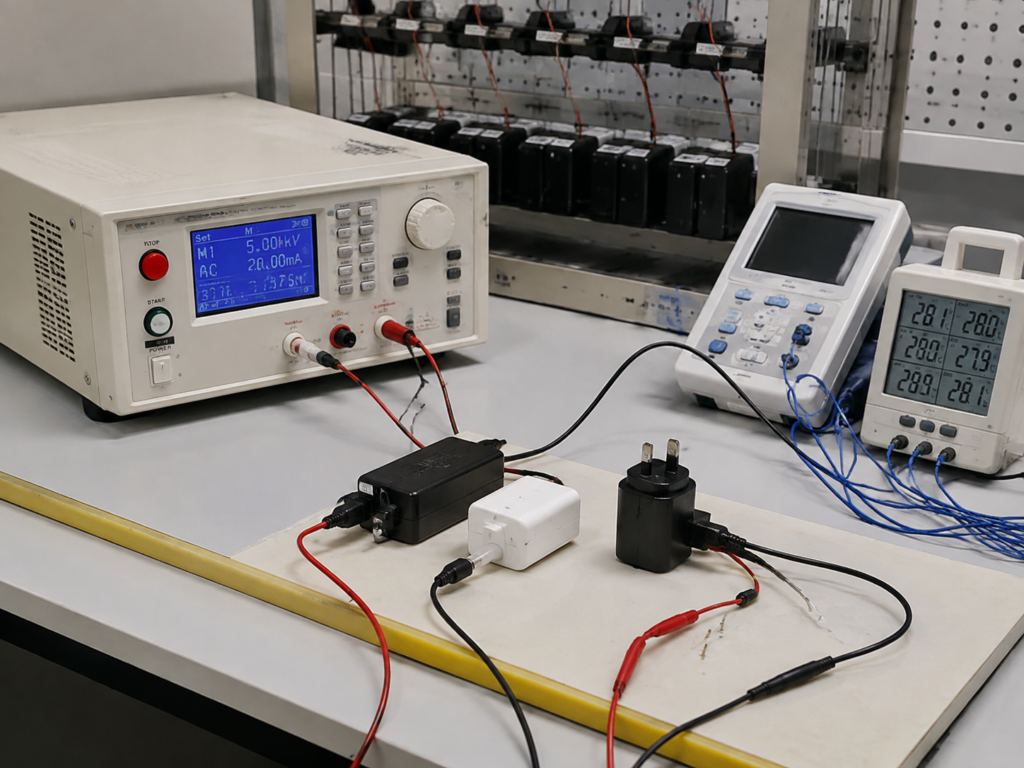
The formal testing time ranges from 2 weeks to 8 weeks, mainly depending on the product category and the complexity of the corresponding standards. Simple components have fewer test items, so it is faster; high-risk products have more test items, so it is slower.
If the test fails, retesting is required after rectification. Each rectification plus retesting will add 1-4 weeks of time. However, if only one item fails, retesting only the corresponding item will be much faster than full testing.
You don’t have to wait idly during the testing stage. You can check the progress through the docking project engineer at any time, or ask clearly if there are any unqualified items, and prepare for rectification in advance.
4. Initial Factory Inspection Stage (Can Be Parallel to Testing)
Many people don’t know that there is a mandatory initial factory inspection before getting the certificate. UL’s logic is simple: qualified submitted test samples do not mean that every mass-produced product is qualified. Factory inspection is to confirm that the production process, materials, and quality control can ensure that mass-produced products are consistent with the submitted test samples.
Factory inspection does not need to wait for all testing to be completed before scheduling; it can be carried out simultaneously with testing, which can save a lot of time. Scheduling plus on-site inspection generally takes 1-2 weeks, depending on the location of the factory and the auditor’s schedule — if the factory is outside the US mainland, the auditor needs to arrange travel and visas, so the scheduling will take a little longer.
If non-conformities are found during the inspection, rectification is required. The rectification time ranges from 1 week to 3 weeks, depending on the severity of the problem.
The check point of this step is: receiving the notice of passing the factory inspection, or clearly knowing the content and requirements of the rectification needed.
5. Certificate Issuance and Listing Stage
After both sample testing and factory inspection are passed, you enter the final certificate issuance stage:
UL will first conduct a final material consistency review to confirm that all materials, test results, and factory inspection results are consistent. This process takes 3-10 working days.
After the review is passed, UL will issue an electronic certificate and synchronize the product information to the Product iQ database at the same time. This process takes 1-3 working days.
After receiving the certificate, be sure to check it on Product iQ. Only when the listing information of the corresponding model can be found can the certification be considered truly completed.
6. Formal Progress Inquiry Channels
During the entire application process, if you want to check the progress, there are three formal channels:
The most authoritative is UL’s official Product iQ database, which is mainly used to verify formal public content such as listing/recognition/classification information after certification is completed, corresponding models, company names, and file numbers;
For ongoing projects, if you want to know the real-time progress of scheduling, testing, rectification, certificate issuance, etc., you can directly contact the project engineer assigned by UL to inquire;
If you applied through a formally authorized agent, you can also ask the agent to assist in querying and communicating with UL. But if you submitted the application directly to UL, you can just directly contact the project engineer.
3. Estimate the Cycle Yourself: What Are the Core Influencing Factors?
After understanding the time of the full process, you may still ask: how long will my product take? In fact, as long as you clarify several core variables, you can estimate the approximate range by yourself.
1. Product Side: The Most Critical Determining Factor
The condition of the product itself is the core factor affecting the cycle, mainly depending on the following points:
First is product complexity. The cycle of simple components is 30%-50% shorter than that of large equipment. For example, the cycle of an ordinary plug and an industrial control cabinet differs by several times.
Second is risk level. Products with batteries, high voltage, heating components, or moving parts, such as power banks, electric heaters, and juicers, are high-risk products with more test items, so the cycle is naturally longer.
Third is application scenarios. Products for special scenarios such as medical, industrial, children’s, and outdoor use have stricter corresponding safety standards and higher testing requirements, so the cycle will also be longer. For example, the cycle of ordinary mobile phone chargers and medical-grade chargers can differ by several months.
Fourth is the certification status of key components. If the key components of the product (such as transformers, capacitors, wires) already have UL Recognized certificates, UL does not need to additionally evaluate the safety of these parts, which can save 1-2 weeks of time.
Fifth is the number of series models. If there are multiple products of the same series with the same core structure and safety design, only small differences such as power and color, applying jointly eliminates the need for separate testing of each model, which can save a lot of repeated testing time.
2. Application Side: Factors You Can Control
This part is completely controllable. If done well, it can save a lot of time:
First is the completeness of materials. Missing one item requires waiting an extra 3-7 days; if you miss two or three times, more than half a month will be gone.
Second is the sample pass rate. The cycle is the shortest when all tests are passed on the first submission. If rectification is repeated three or four times, the cycle may directly double.
There is also the rectification response speed. After UL raises a question, replying and resolving it within 24 hours is definitely faster than delaying for three or four days before handling it.
Finally is the cooperation degree of the factory. If the factory prepares all relevant records of the quality system in advance and passes the factory inspection once without rectification, it can also save a lot of time.
3. UL Official Side: Uncontrollable but Predictable
Some factors are on UL’s side and cannot be controlled, but they can be predicted in advance and planned for:
For example, laboratory scheduling. During the peak stock-up season at the end of the year, before Black Friday and Christmas, as well as for periodically popular categories such as wireless audio, energy storage power supplies, and fast-charging power supplies, there are many applicants, so the scheduling will be longer.
There are also factory inspection resources. For factories outside the US mainland, auditors need to arrange travel and visas, so the scheduling will be longer than for US mainland factories.
In addition, if there is a version update of safety standards, during the transition between old and new standards, UL’s internal evaluation process will also slow down a bit.
4. Service Provider Selection: An Optimizable Intermediate Factor
Choosing the right service provider can also help you shorten a lot of time:
For example, choose a local laboratory with UL witness testing authorization — simply put, UL engineers supervise on-site and complete the testing in the local laboratory, eliminating the need to send samples to the US mainland, which saves both cross-border logistics time and the need to wait for scheduling at US laboratories.
In addition, it is also important to choose an institution with experience in similar projects. They are familiar with the standards and common problems of corresponding products, and can help you avoid many pitfalls that easily cause delays in advance, saving you detours.
4. Reference Cycles for Different Categories (with Prerequisites)
Many people still want a specific reference number. Here we have compiled the ideal cycles for common categories, but you must read the prerequisites first:
All the following cycles are ideal scenarios under the conditions of complete documentation, samples passing testing on the first try, no rectification needed, and normal UL scheduling. The actual cycle should be comprehensively judged based on the product situation, preparation degree, and current scheduling. It is recommended to reserve a 10%-30% margin on the basis of the reference value to prevent unexpected situations such as supplementary materials and rectification.
| Product Type | Common Certification Type | Ideal Reference Cycle | Remarks |
|---|---|---|---|
| Simple components (plugs, switches, wires, capacitors) | Mainly UL Recognized | 4-8 weeks | The simpler the structure, the shorter the cycle |
| Consumer electronics accessories (chargers, power banks, computer peripherals) | UL Listed | 6-12 weeks | Longer for those with batteries or wireless functions |
| Small home appliances (hair dryers, coffee makers, small kitchen appliances) | UL Listed | 8-14 weeks | Longer for those with heating functions or high power |
| Lighting products (LED bulbs, household lamps, driving power supplies) | UL Listed | 8-16 weeks | Longer for those with additional energy efficiency or photobiological safety requirements |
| Industrial control/power equipment (relays, circuit breakers, control cabinets) | UL Listed/Classified | 12-24 weeks or longer | Complex structure, multiple testing standards |
| Medical-related electrical products | UL Listed (medical grade) | 4-6 months or longer | Stricter medical safety standards |
In addition to product categories, different project types also have different cycles:
If it is the first application for a brand-new product, you can directly refer to the product categories above.
If you already have UL certification for the same series and add a model with very small differences, such as only changing the shell color or adjusting small non-safety parameters, only document review or a small amount of supplementary testing is required, which can be completed in 2-6 weeks — this cycle applies to scenarios where there is an existing valid UL certification file, the new model has minimal differences from the original certified model, and no supplementary testing is required.
If you are replacing key components or materials, if the new parts already have UL Recognized certification, only 1-3 weeks of material review is needed; if the new parts do not have UL Recognized certification, supplementary testing is required, which takes about 4-8 weeks.
If it is only a non-critical change, such as changing labels, changing packaging, or adjusting the appearance that does not affect safety, only document review is needed, which can be done in 2-4 weeks.
If time is tight, you can also apply for UL’s official expedited service. Eligible products can shorten the cycle by 30%-50%. However, note that expedited service requires additional payment, and not all categories and all laboratories support it. Whether it can be expedited and how much time can be saved will ultimately be subject to UL’s official evaluation. In addition, expedited service only means priority scheduling, not skipping the process. None of the required links such as testing, rectification, and factory inspection will be omitted.
5. Legal Speed-Up: How to Shorten the Cycle Without Violating Rules
Since the UL certification cycle is affected by so many factors, is there a way to legally shorten the time? Of course there is, and the most effective methods are all before the application, with the lowest cost and the best effect.
1. Pre-application Preparation Is the Most Cost-Effective Speed-Up Method
Many people are in a hurry to get the certificate and rush to send samples for testing as soon as they get them, but instead waste more time due to repeated rectifications caused by incomplete materials or unqualified samples. Doing these things well before applying can save a lot of time:
First, find a formal and experienced institution to conduct product pre-evaluation in advance, confirm the corresponding test standards and material requirements for the product, and avoid detours.
Second, organize the full set of materials according to UL’s requirements to ensure that parameters, drawings, and samples are completely consistent, and avoid supplementary materials from the root.
Third, do pre-testing in advance, especially for the most easily unqualified items such as temperature rise, insulation distance, and flame retardancy. Test them yourself first, make corrections in place, then send for formal testing.
Fourth, prioritize selecting models with UL Recognized certification for key components, eliminating the need for additional component evaluation, saving time and hassle.
2. Speed-Up Tips During the Application Process
After formal application, there are also several tips to help you save time:
First, choose a local laboratory with UL witness testing authorization. You don’t need to send samples to the US, saving both logistics time and scheduling time.
Second, arrange a dedicated person familiar with the product to handle UL’s questions, ensuring a response within 24 hours, and don’t delay replying.
Third, after testing starts, schedule the initial factory inspection simultaneously. You don’t need to wait for all testing to be completed before scheduling. This way, when the testing is passed, the factory inspection is almost finished, saving 1-2 weeks of waiting time.
Fourth, eligible products can proactively apply for UL’s official expedited service.
3. How Effective Is the Speed-Up?
Many people will ask, is it worth doing pre-evaluation and pre-testing? From the experience of similar projects of formal service institutions in the industry:
Doing pre-evaluation and pre-testing in advance can usually significantly reduce the probability of first test failure, avoiding weeks of rectification time at every turn;
Preparing all materials at once can reduce 2-3 rounds of supplementary materials, saving more than half a month;
Scheduling testing and factory inspection simultaneously can save at least 1-2 weeks of waiting time.
Overall, spending a little time preparing in advance actually saves more time and money than rushing to send samples for testing.
6. Pitfall Avoidance Reminder: “Fast Certification” Scams Cannot Be Trusted
When it comes to speed-up, we have to mention many “fast certification” scams on the market. Many merchants, eager to list their products, fall into these pitfalls. In the end, they spend money but get a fake certificate, which is not worth the loss. These types of “speed-up” must never be trusted:
The first type is those that claim “get certificate in 1 week, guaranteed pass”. They are all fake or misleading. UL’s official process is there; no matter how fast it is, it is impossible to complete all testing and review in 1 week. They either give you a fake certificate or pass off other certifications as UL.
The second type is those that say there are “internal channels for expedited service, can skip factory inspection”. UL’s process is very standardized, and no one can skip necessary links through connections. Anyone who says this is scamming money.
The third type is those that ask you to forge samples or materials for application. Even if you muddle through at the time, it will be found out during UL’s follow-up inspection later, the certification will be directly revoked, and there may be fines, which is not worth the loss.
The fourth type is those that ask you to print UL labels and stick them on yourself. UL labels must have a formal authorization number. Self-printing is a violation. If found out, the certificate will be directly invalidated, and you may also face legal liability.
Verification Methods for Formal UL Certificates
Whether you applied for it yourself or through an agent, you must verify the authenticity of the certificate after receiving it. The method is very simple:
Log in to UL’s official Product iQ database, enter the product model, company name, or file number to query. Only if the corresponding information can be found is it real.
When checking, also pay attention: confirm that the models and product categories covered by the certificate are consistent with the products you actually sell. For example, if you sell a 12W charger but the certificate only has 20W, then this certificate is useless for your product.
In addition, the specific form and labeling requirements of the UL Mark will vary depending on the certification type and product category. They must comply with the corresponding authorization documents and UL’s official mark usage rules. It is not recommended to judge authenticity solely based on a certain number on the label or a single anti-counterfeiting feature. The core verification standard is still subject to the public information in the Product iQ database.
7. Project Stuck? Teach You to Quickly Troubleshoot Delay Causes
If the UL certification you applied for has not made progress for a long time, you don’t have to wait anxiously. You can troubleshoot the cause by yourself according to the following ideas, and only by finding the problem can you move forward.
1. No Engineer Assigned for a Long Time After Application
If it has been several days since you submitted the application and you haven’t waited for UL to assign a project engineer, first check from these directions:
First, check if the materials are incomplete and UL is waiting for you to supplement them. Often, the supplementary notice may be missed as spam, so take the initiative to check your email.
Then confirm if there is no clear corresponding standard for the product, and UL needs to internally evaluate which standard to use. This situation will be slower.
Also verify whether the contract has been signed and the payment has been received. Many people forget to pay and wait for several days in vain.
2. Excessively Long Time in the Testing Stage
If the testing stage takes longer than estimated, don’t rush to urge first. First figure out what the problem is:
Is it because it’s peak season, the laboratory schedule is full, and it’s not your sample’s turn yet? Or is the testing already in progress, but the product itself has many test items, so it takes a long time?
If testing has been going on for a while, confirm whether the sample has unqualified items and is undergoing rectification and retesting. Often, the rectification time is longer than the formal testing.
Also check whether the sample is inconsistent with the materials, and UL has been checking parameters with you, delaying the progress.
3. No Certificate Issued for a Long Time After Factory Inspection
If the factory inspection has been completed but you still haven’t received the certificate, it may be due to these reasons:
First, confirm whether all non-conformities of the factory have been rectified in place as required, and whether complete rectification certification materials have been submitted.
If the rectification has been completed, it may be that UL is conducting the final material consistency review, finding inconsistencies, and verifying them.
4. Common Causes of Overall Schedule Delays
If the entire project is slower than estimated, it may also be due to the general environment:
For example, if it catches up with US statutory holidays (such as Christmas, New Year, Independence Day), UL staff are on holiday, so the progress will naturally slow down.
Or if it catches up with the year-end peak stock-up season, everyone is rushing to do certification, UL’s cases are backlogged, and the scheduling will be longer.
Also, if the product is a current popular category with a particularly large number of applicants, the scheduling will also take a long time.
In addition, if samples are sent to the US for testing, delays in cross-border logistics and customs clearance will cause the samples to arrive late, which will also push the overall schedule back.
Three Core Questions for Quick Troubleshooting
If you are too lazy to check step by step, ask yourself three questions first, and you can basically find the direction:
First, at which step is the current project stuck? Is it materials, testing, rectification, factory inspection, or final report review?
Second, has the last question raised by UL been resolved and formally replied to?
Third, what needs to be done now? Supplement materials, supplement samples, modify the design, or reschedule the factory inspection?
After figuring out these three questions, you will know how to proceed, and you don’t have to wait blindly.
8. Notes After Obtaining the Certificate: Maintenance and Change Cycles
Many people think that everything is fine once they get the UL certificate. In fact, subsequent maintenance and changes also take time. Understanding them in advance can avoid last-minute rushes.
1. Annual Follow-Up Inspection Cycle
UL certification is not a one-and-done deal. After obtaining the certificate, UL will arrange 1-4 irregular factory follow-up inspections every year. The specific number depends on the risk level of the product; the higher the risk of the product, the more frequent the inspections.
If the inspection is passed, the certificate remains valid; if problems are found during the inspection, rectification is required. The rectification cycle is generally 1-4 weeks. If the rectification fails, the certificate may be suspended or even revoked.
2. Product Change Cycle
If the product has changes, do you need to redo the certification? How long does it take? It mainly depends on the nature of the change:
If it is a non-critical change, such as changing labels, changing colors, or adjusting the appearance that does not affect safety, you only need to submit materials to UL for review, which can be completed in 2-4 weeks.
If it is a critical change, such as changing the product structure, replacing key components, or upgrading the corresponding standard, supplementary testing is required. The cycle is generally 4-12 weeks, depending on the size of the change.
3. Cycle for Adding New Models/Expanding Series
If you want to add new product models of the same series, there are also two situations:
If the new model has very small differences from the original certified model, with the same core safety design, only document review plus a small amount of supplementary testing is needed, which can be done in 4-8 weeks — this cycle applies to scenarios where you expand models of the same series after certification, involving a small amount of supplementary testing or synchronous update of factory documents, which is slightly longer than the cycle of adding models in a small scope with only document review.
If the difference is very large, for example, you originally made wired chargers and now want to add wireless charging function, that is equivalent to a brand-new project, and the cycle is similar to the first application.
4. Recovery Cycle After Certificate Suspension/Revocation
If the certificate is suspended due to failed inspection or other reasons, if you want to restore it, you need to rectify first, then submit it to UL for re-review. The cycle depends on the severity of the problem, generally at least 4 weeks or more.
If it is a serious violation, such as forging materials, secretly replacing materials, or privately printing UL labels, the certificate may be directly revoked and cannot be restored at all.
Final Summary
Overall, although there is no fixed value for the UL certification cycle, all links have clear rules and predictable ranges. After reading this article, you should be able to independently judge the following things:
First, you understand the start and end boundaries of UL’s official cycle, will not count the time you spend preparing materials and samples into it, and will not be fooled by others’ “fast” claims.
Second, you can estimate a reasonable cycle range based on your own product category and preparation status, make plans in advance, and will not delay listing or stock preparation.
Third, you can distinguish which speed-up methods are legal and effective, which are “fast certification” scams, and you also know how to verify the authenticity of UL certificates.
Fourth, if the project is stuck, you can troubleshoot the core cause of the delay by yourself, know how to proceed, and don’t have to wait anxiously.
Fifth, you understand the time cost required for maintenance and changes after obtaining the certificate, make long-term plans in advance, and avoid temporary problems.
There is no need to blindly believe the gimmick of “ultra-fast certification”, nor do you need to think that the UL certification process is unfathomable — as long as you prepare well in advance and proceed according to the rules, you can get the certificate within a reasonable time and avoid many unnecessary losses.