
Friends who engage in foreign trade of electrical products or cross-border e-commerce targeting the Japanese market have most likely heard of the two terms “METI filing” and “PSE certification”. Many people easily get confused when they first come into contact with them: Do you need to obtain PSE first before handling METI? Does completing METI mean the product is qualified? Can overseas factories apply directly on their own?
In fact, METI notification (called “todoke” in Japan, commonly known as METI filing in China) is a basic administrative procedure under Japan’s Electrical Safety Act. It is not difficult, but a large number of people fall into pitfalls — either the classification is wrong and the application is sent back for correction, or the entity qualification is incorrect and the application is directly rejected. Some people even think that after completing this procedure, there is no need to do PSE, and end up with products detained or removed from shelves.
This article starts from the most basic definition, covers pre-processing judgment, material preparation, specific procedures, as well as subsequent maintenance and common pitfalls, to explain the entire METI notification process clearly. Even beginners can follow along and avoid detours.
1. First Understand the Basics: What Exactly is METI Notification
1.1 Plain Language Definition and Core Regulations
Simply put, METI notification means submitting a set of documents to the Ministry of Economy, Trade and Industry of Japan (abbreviated as METI) for official filing. It is called “todoke” in Japanese regulations, and what is often referred to as “METI filing” in China also refers to it.
It should be particularly emphasized that this is an administrative reporting procedure, not an approval, nor a product safety certification — the official will issue an acceptance record or acceptance copy for applications that meet formal requirements, but this record only proves that the documents have been accepted and filed. It does not mean that product safety has passed official approval, let alone represent an official guarantee of product safety.
Its core regulatory basis is Japan’s (abbreviated as “Electrical Safety Act”), which governs the reporting of manufacturing and import entities of civilian electrical products. Its core function is to clarify that “whoever puts the product on the Japanese market is responsible for compliance”, to facilitate subsequent official supervision.
1.2 Relationship with PSE Compliance: Both Are Mandatory, Not the Same Thing
Many people think the process is “complete PSE → handle METI → sell after approval”, which is completely wrong.
First of all, both PSE and METI notification are pre-market statutory obligations under the Electrical Safety Act. There is no legally prescribed order, but in the industry, the technical compliance of the product (that is, PSE-related work) is usually completed first before handling the notification, which can reduce the probability of being asked for correction due to incorrect compliance materials.
The division of labor between the two is completely different:
• PSE governs the technical compliance of the product itself: the product must meet Japan’s safety technical standards. Among them, high-risk “specified electrical appliances and materials” require third-party institutions to conduct “conformity inspection” (commonly known as diamond PSE certification), while low-risk “non-specified electrical appliances and materials” only require the factory to pass self-inspection and affix the circular PSE mark.
• METI notification governs the reporting of the responsible entity: submit information such as “who is selling, what product is being sold, and the product has completed compliance” to the Bureau of Economy, Trade and Industry for filing. The official does not review the safety of the product itself.
In one sentence: the two cannot replace each other, and electrical products cannot be legally sold in the Japanese market if either is missing.
1.3 2 Boundaries That Beginners Most Easily Confuse
The first boundary: it is not PSE certification. Many people regard METI filing as part of PSE, or think that after getting METI, there is no need to do PSE, which is the most common misunderstanding. PSE governs product safety, and METI governs entity reporting — they are completely two different things.
The second boundary: not all electrical-related procedures are called METI filing. The METI notification we often refer to specifically refers to the manufacturing/import notification of civilian electrical appliances under the Electrical Safety Act, which has nothing to do with procedures related to electric power business (such as power generation, power sales) and electrical construction. Don’t get confused.
2. Judge Before Handling: Whether It Is Needed and Who Should Handle It
After understanding the basic definition, don’t rush to prepare materials first. First make two core judgments: Does your product need to be handled? Who should handle it? If these two steps are wrong, all subsequent work will be in vain.
2.1 Does Your Product Need METI Notification?
The core judgment standard is whether the product belongs to civilian electrical appliances regulated by the . You can first conduct a preliminary screening through several high-probability clues: for example, whether it uses mains electricity, whether it has a plug, whether it has power adaptation functions, whether it is a separately sold portable lithium battery, etc. But the final classification must be confirmed against the official METI list of electrical appliances under the Electrical Safety Act and specific category definitions.
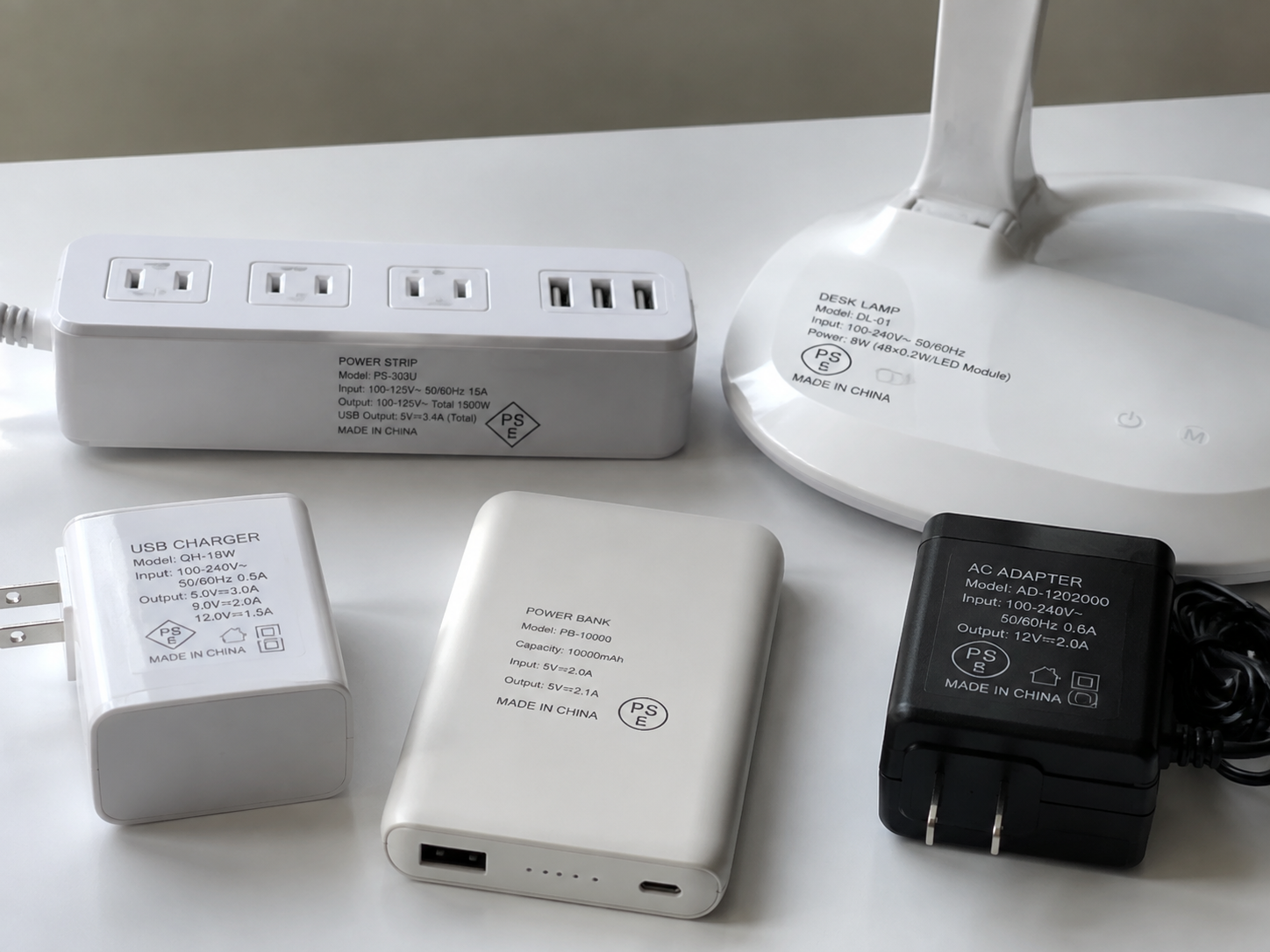
Here are some common examples for comparison:
• Required to handle: mobile phone chargers, power strips, separately sold power banks/lithium batteries, desk lamps, AC adapters (power adapters)
• Not required to handle: purely mechanical products (such as manual screwdrivers), industrial-specific electrical equipment (such as large motors for factories), batteries built into the whole machine and not sold separately (such as built-in mobile phone batteries)
There are also clear judgment rules for special scenarios:
• Products sold in sets: judged by the highest-risk electrical appliance in the set. For example, if you sell a desk lamp with a charger, it is classified according to the charger.
• Multi-functional products: classified according to the function corresponding to the main safety risk. For example, a desk lamp with Bluetooth function has its main safety risk still in the electrical part of lighting, so it is classified as a desk lamp.
If you are not sure, don’t guess by yourself. Directly check the official METI list of electrical appliances under the Electrical Safety Act, or call the competent Bureau of Economy, Trade and Industry for consultation — wrong classification is the number one cause of correction requests.
2.2 Who is the Statutory Notification Entity?
The first big pitfall that many overseas sellers encounter is thinking that their factories can apply directly. In fact, the Electrical Safety Act has clear regulations: the notification entity must in principle be a business operator engaged in the manufacture or import of electrical appliances within Japan, and overseas manufacturers cannot directly serve as the entity for import notification.
The responsibility division for different scenarios is very clear:
• General trade import: the Japanese importer bears the notification obligation and is also responsible for the compliance of the PSE mark.
• Cross-border e-commerce sellers: must entrust a qualified importer or responsible entity within Japan as the notification party to handle it.
• Platform sellers: either have their own legal entity within Japan, or entrust a compliance agent. The platform is only responsible for verifying documents and does not bear compliance responsibilities.
• OEM/ODM foundries: if they only produce products and do not directly put them on the Japanese market, they do not need to handle notification.
A special reminder here: legal liability is always borne by the notification entity. Finding an agent to handle it is just running errands, and the final compliance responsibility still cannot be escaped. Don’t think that signing an agency contract means everything is fine.
2.3 4 Types of Notification
Not all notifications are the first-time handling type. According to different scenarios, there are 4 types in total:
• Business commencement notification: usually handled at the business node when the entity starts manufacturing or importing a certain type of electrical appliance, which is what people often call the first filing. When the same entity subsequently adds new product models of the same type, adjusts models, or changes product information, it is necessary to judge whether to handle a change notification, supplementary materials, or re-handle the business commencement notification based on the name of the electrical appliance, type classification, and the degree of change of the notification materials.
• Change notification: handled when the entity information or product information of the notification is adjusted, such as company name change, minor product model adjustment.
• Succession notification: if the notified business is merged, split, or transferred to another company, it shall be handled by the party that succeeds the business.
• Abolition notification: when the product is discontinued, or this line of business is no longer operated, it is necessary to handle abolition to inform the official that sales will cease.
2.4 What Are the Risks If Not Handled?
Don’t think this is a procedure that no one checks. The cost of violation is actually not low:
• Customs clearance risk: when Japanese customs or market supervision conducts random inspections, they may directly detain the goods, require you to supplement compliance certificates, and if you cannot supplement them, the goods will be returned or destroyed.
• Sales risk: mainstream e-commerce platforms such as Amazon and Rakuten will require the provision of METI notification acceptance records when entering the platform or during daily random inspections. If you do not have them, products will be directly removed from shelves.
• Penalty risk: according to the provisions of the Electrical Safety Act, violating the notification obligation can result in fines of up to one million yen level, subject to the latest regulatory penalty provisions.
3. Pre-Processing Preparation: 4 Core Checks to Avoid Wasted Effort
After confirming that it needs to be handled and who will handle it, the next step is pre-processing preparation. Many people are in a hurry to fill out the form, but end up being sent back several times due to errors or omissions in materials. In fact, as long as you do 4 checks in advance, you can save a lot of time.
3.1 Entity and Agent Qualification Check
First, confirm the qualification of the applicant entity clearly, don’t find out that it does not meet the requirements when submitting.
• Materials that the applicant must prepare: legal person registration certificate within Japan. If entrusting an agent to handle it, a formal power of attorney is also required.
• How to judge whether an agent is reliable: first, it must have a Japanese legal person registration certificate; second, it has relevant experience in Electrical Safety Act notification; third, it can cooperate with docking during subsequent official random inspections.
• Must-check hard rule: the entity name must be exactly the same as the full name registered with the Japanese official. Abbreviations and English names cannot be used, and even a single character difference may result in the application being sent back.
3.2 Product Compliance Material Preparation
Depending on whether the product is a specified or non-specified electrical appliance, the materials to be prepared are different:
• Specified electrical appliances and materials (high risk, diamond PSE): conformity inspection certificate issued by a third-party institution (i.e., PSE certification certificate), information of the manufacturing factory/overseas manufacturer, Japanese instruction manual, product nameplate photo with PSE mark, complete model list.
• Non-specified electrical appliances and materials (low risk, circular PSE): self-inspection report (which must include records of structural inspection and performance inspection, and be signed by the compliance responsible person), Japanese instruction manual, product nameplate photo with PSE mark, model list.
• Must-check hard rule: all compliance documents must be within the validity period, and the parameters on the documents must be exactly the same as the final version of the product actually sold in the Japanese market. Don’t use the parameters of the domestic version or European and American versions directly to make up the numbers.
3.3 Full Material Consistency Check
Don’t rush to submit after the materials are prepared. First do a consistency check, which is a step that many people easily overlook.
There are 5 core dimensions for checking: entity name, electrical appliance name/type classification, rated parameters, key components, manufacturing factory information.
The most common mistake is: the declared model is different from the actually sold model, or the parameters of the overseas version are directly used in the Japanese version declaration. For example, the nameplate of a charger sold in China is printed with 220V, while the Japanese version is 100-240V. If you use the nameplate photo of the domestic version to declare, it will definitely be asked for correction.
The checking technique is very simple: take the final product actually sold in the Japanese market as the center, compare all items against all materials, and correct those that do not match. Don’t take chances.
3.4 Can Series Models Be Declared Together?
If there are multiple models of the same type of product, they can be declared together if they meet the conditions, which can save a lot of trouble, but they cannot be merged randomly.
All of the following conditions must be met at the same time to declare together:
1. The name of the electrical appliance is exactly the same
2. The type classification (i.e., the product subcategory in the Electrical Safety Act) is the same
3. The difference in rated parameters is within the safety allowable range
4. The circuit design and safety structure are completely consistent
5. The models and suppliers of key safety components are the same
6. Applicable to the same Electrical Safety Act standard
As long as one condition is not met, for example, the supplier of key safety parts is changed, the safety structure is adjusted, or the rated parameters exceed the safety range, they cannot be merged and must be declared separately.
The core logic of judgment: as long as the difference involves safety items specified in the Electrical Safety Act, declare separately. If you are not sure, send an inquiry to the competent Bureau of Economy, Trade and Industry in advance. Don’t force the merger by yourself, it will be more troublesome if you are sent back later.
4. Full Process of METI Notification Handling (Follow the Steps to Reduce Corrections)
After the preparation work is done, you can officially go through the handling process. We break it down step by step, explaining what to do and what to pay attention to in each step, to minimize the probability of correction requests.
Step 1: Product Classification and Compliance Pre-judgment (The Link with the Highest Correction Rate)
The first step is also the most error-prone step: against the official METI list of electrical appliances under the Electrical Safety Act, confirm three core matters: whether the product is within the regulatory scope, whether it belongs to the specified or non-specified classification, and what the corresponding classification code is.
The classification rules for multi-functional products and set products can refer to the judgment methods mentioned above, which will not be repeated here. Since many products with ambiguous boundaries (such as power strips with USB charging, humidifiers with lighting functions) are extremely easy to be misclassified based on experience, if you are not sure, you must consult the competent Bureau of Economy, Trade and Industry in advance. Don’t wait until after submission to be sent back before adjusting, which will delay time instead.
Step 2: Confirm the Notification Entity and Responsibility Division
The second step is to determine the notification entity and clarify the responsibility division. If you have your own Japanese legal entity, use your own; if you are an overseas seller, find a qualified Japanese importer or agent and sign a formal entrustment agreement.
There is only one check point: the notification entity must be a manufacturing/import business operator within Japan. Overseas factories absolutely cannot apply directly, and the application will not be accepted even if submitted.
Step 3: Sort Out Materials and Fill in the Official Notification Form
After all materials are prepared, you can fill in the official unified format notification form.
The required fields of the notification form include: name, address, and legal representative name of the notifying business operator, date of business commencement, whether it is manufacturing or import, name and type classification of the electrical appliance, information of the manufacturing factory or overseas manufacturer. For specified electrical appliances, the number of the conformity inspection certificate must be filled in, and for non-specified ones, the number of the self-inspection record must be filled in.
The preferred filling channel is Japan’s e-Gov electronic government system. Fill in and submit online, which has higher processing efficiency; if the materials are relatively complex and many paper certificates need to be attached, you can also download the paper template, fill it out, and then mail it or submit it in person.
After filling in, be sure to check again: all fields must be completely consistent with the compliance materials prepared earlier, no omissions, no typos.
Step 4: Submit to the Competent Bureau of Economy, Trade and Industry
After filling in, you can submit it to the corresponding competent Bureau of Economy, Trade and Industry. There are three submission channels, you can choose according to your own situation:
1. e-Gov electronic submission: suitable for standardized applications, all materials are electronic, with the highest processing efficiency. It is recommended to use this if possible.
2. In-person/mail submission: suitable for situations where the materials are particularly complex and many paper certificates need to be attached, the processing speed will be slower.
3. Agent submission: suitable for overseas sellers, submitted by a Japanese agent on their behalf, which is more convenient for communication.
Regarding fees: the official handling of METI notification has no administrative fee, but third-party fees such as PSE certification fees, translation fees, and agency service fees must be borne by yourself.
A special reminder here: notification is not approval, there is no fixed statutory processing period. The actual duration depends on the work arrangement of the competent Bureau of Economy, Trade and Industry, submission method, material complexity, and whether correction is required; if there is a clear product launch plan, it is recommended to start the handling in advance and reserve sufficient time. Don’t wait until the launch node to start.
Step 5: Acceptance Confirmation and Correction Response
After submission, just pay attention to the official feedback. Keep the formal acceptance record properly after receiving it.
There are three common results:
1. Formal review passed: the official will give you an acceptance copy or acceptance record stamped with the seal of the Bureau of Economy, Trade and Industry. Here is another reminder: this record is only an administrative filing voucher, does not represent official recognition of product safety, and cannot be used as a product qualification certificate.
2. Correction notice: if there is a problem with the materials, the official will issue a correction notice, telling you what is wrong and what materials need to be supplemented. You can modify it as required and resubmit.
3. Not accepted: if the entity qualification obviously does not meet the requirements, or the product is not within the regulatory scope of the Electrical Safety Act at all, the official will directly refuse to accept it, and you have to adjust and re-declare.
If you receive a correction notice, don’t panic. Check in this order, and most problems can be found: first check whether the product classification is wrong, then check whether the entity qualification is problematic, and finally check whether the material information is inconsistent.
Finally, let’s talk about validity: METI notification itself has no separate validity period. As long as the product always meets the technical standards of the Electrical Safety Act and the compliance certificate (such as PSE certificate) is within the validity period, the notification will remain valid.
5. Analysis of Easily Confused Boundaries: Differences in Different Scenarios
Many people easily confuse different types of notifications, requirements for different scenarios, and even mix them up with other electrical procedures. In this part, we sort out the easily confused boundaries.
5.1 Differences in Notification Between Specified and Non-Specified Electrical Appliances
Many people can’t tell the difference between specified and non-specified notifications. We have compiled a comparison table for clear understanding:
| Comparison Dimension | Specified Electrical Appliances and Materials (Diamond PSE) | Non-Specified Electrical Appliances and Materials (Circular PSE) |
| Core Compliance Requirements | Third-party institutions conduct conformity inspection (diamond PSE certification) | Factory self-inspection passes, affix circular PSE mark |
| Core Notification Materials | Conformity inspection certificate, factory information, model list, etc. | Self-inspection report, model list, etc. |
| Processing Efficiency | More materials, slightly longer verification process | Simple materials, faster processing |
| Subsequent Random Inspection Probability | Higher (high-risk categories) | Relatively lower |
It should be noted that if METI updates the list of electrical appliances under the Electrical Safety Act and adjusts the product classification, it is necessary to supplement materials according to the new requirements, or even re-handle the notification.
5.2 Differences in Practical Requirements for Different Sales Channels
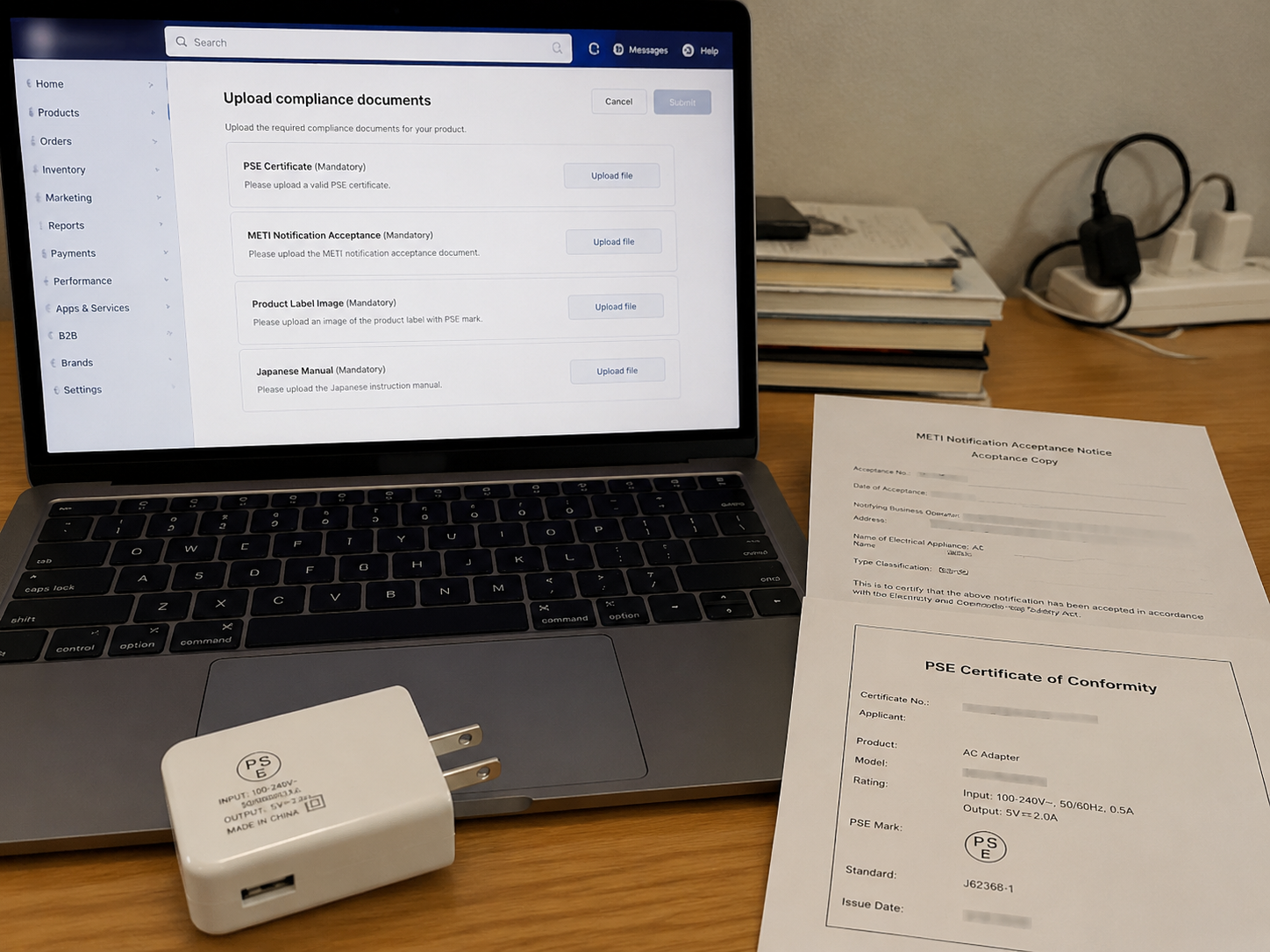
For the same product, through different sales channels, the actual verification requirements encountered are also different. We have also compiled a comparison:
| Sales Channel | Main Verification Entity | Common Requirements | Risk Warning |
| General trade import | Japanese customs, market supervision departments | Notification records and PSE certificates may be randomly inspected during customs clearance | Medium, it is a regular compliance document for customs clearance |
| E-commerce platform entry/operation | Amazon, Rakuten and other platforms | PSE certificate + notification acceptance record need to be uploaded for entry or daily random inspection, products will be removed if not passed | Higher, platform verification requirements are clear |
| Small-batch cross-border direct mail | Customs, market supervision (random inspection) | It is a statutory pre-market obligation, no exemption rules | Obligations are not exempted due to small batch, and may be traced when the regulatory caliber is adjusted |
A special reminder here for sellers of small-batch direct mail: you can’t take chances because of small batches and direct mail channels. Notification is a statutory pre-market obligation. Once platform rules are adjusted, customs random inspections are tightened, or regulatory caliber changes, you may still be required to supplement certificates or even be traced for past violations.
5.3 Don’t Confuse: Electrical Safety Act METI Notification vs Other Electrical-Related Procedures
Many people think that “electrical procedures” and “METI procedures” are the same thing, but they are completely different:
• Electrical Safety Act METI notification: governs the reporting of manufacturing/import entities of civilian electrical appliances, it is a compliance procedure for product market entry, which is the content of this article.
• Procedures related to the Electricity Business Act: governs the licensing and reporting of power business entities such as power generation, power sales, and power transmission and distribution, which has nothing to do with the market entry of civilian electrical products.
• Regulations related to electrical construction: such as the and the , which govern the qualifications and operation specifications of electrical installation and construction, and do not belong to the category of product notification.
If your company is involved in multiple types of business at the same time, you need to handle the corresponding procedures separately, and the processes and materials are not interchangeable.
6. Compliance Maintenance and Exception Handling After Notification
Many people think that after completing the notification, everything is fine, but that’s not the case. After the notification, there are daily compliance maintenance requirements, and you also need to know how to deal with random inspections and information changes.
6.1 Daily Compliance Requirements
After completing the notification, it doesn’t mean you can modify the product at will. Pay attention to the following points in daily operation:
• The product must continuously meet the technical standards of the Electrical Safety Act. You cannot randomly change the safety structure or replace key safety components. If you do, you must re-evaluate, or even re-handle the notification.
• Compliance records must be kept as required: conformity inspection certificates, notification acceptance copies, product design records, inspection records, etc., must be kept during the product sales period and within the period required by regulations. The retention period varies for different products, subject to the latest regulatory requirements.
• The PSE mark and entity information on the product nameplate, outer packaging, and instruction manual must be completely consistent with the content of the notification, and cannot be modified at will.
6.2 Response Methods for METI Random Inspections
METI regularly conducts random inspections of electrical products on the market. It’s not that everything is fine after the notification is completed.
• Inspection frequency: specified electrical appliances and products with high complaint volume will have a higher inspection rate, and are sampled proportionally every year.
• Inspection content: mainly check whether the product is consistent with the notification information, whether the product meets the technical standards, and whether the compliance records are complete.
• Response points: organize and store all compliance materials at ordinary times, and actively cooperate with official inspections when sampled. If it is judged to be unqualified, rectification must be carried out within the specified period. If the rectification is not in place, the regulatory authority may require further rectification, stop sales, or improve labeling. In serious cases, administrative penalties under the Electrical Safety Act may also be imposed; specific measures shall be subject to the formal requirements of the regulatory authority and the latest regulatory provisions.
6.3 When to Handle Change/Succession/Abolition Notification?
Many people don’t know when to handle change and when to handle abolition. In fact, the judgment standard is very simple: as long as the change will affect the authenticity of the notification materials, product classification, or responsible entity, the corresponding procedures must be handled.
Specifically:
• Scenarios that require change notification: the notification entity changes its name, moves its address, or changes its legal representative; the name or model of the electrical appliance is slightly adjusted; the address of the manufacturing factory changes; the PSE certificate is renewed; non-core parameters are adjusted but do not affect safety.
• Scenarios that require succession notification: the notified business is merged, split, or transferred to another company, and it shall be handled by the party that succeeds the business.
• Scenarios that require abolition notification: the product stops being sold or imported, and the corresponding business is terminated.
If you are not sure, call the competent Bureau of Economy, Trade and Industry for consultation. Don’t fail to handle what should be handled, and end up being identified as a violation.
7. High-Frequency Pitfall Avoidance Guide for Beginners
7.1 Misconceptions About Compliance Logic
• Misconception: Use overseas certifications such as CE, UL, CB to replace PSE, or think that after completing METI notification, there is no need to do PSE.
Correct approach: PSE is the product technical compliance certificate required by Japan’s Electrical Safety Act, and overseas certifications cannot be directly replaced; METI notification is an administrative reporting procedure, both are pre-market statutory obligations, and neither is dispensable.
• Misconception: Circular PSE (non-specified electrical appliances) does not need to handle METI notification.
Correct approach: Whether it is specified or non-specified electrical appliances, as long as they are manufactured or imported and sold in the Japanese market, they need to handle notification in accordance with regulations.
• Misconception: Notification is an official safety certification, and getting the acceptance record means the product is qualified.
Correct approach: Notification is only an administrative filing procedure, and the acceptance record only proves that the official has received and stored the declaration materials, and does not represent official recognition of product safety.
7.2 Misconceptions About Entity and Qualification
• Misconception: Entrust an agent without Japanese legal person qualification, or declare directly in the name of an overseas factory.
Correct approach: The notification entity must be a manufacturing/import business operator within Japan. Overseas factories cannot directly declare, and the agent must also have Japanese legal person qualification and relevant experience.
• Misconception: Share the notification acceptance copy of other companies, or use the agent’s general filing for your own products.
Correct approach: Notification corresponds to a specific entity, product model, and manufacturer. Different entities and different products cannot be shared. Using others’ notification records is invalid compliance.
• Misconception: After entrusting an agent, you don’t have to bear compliance responsibility yourself.
Correct approach: Legal liability is borne by the notification entity. Entrusting an agent is only to handle the procedures, and the final compliance responsibility is still borne by the entity that puts the product on the market.
7.3 Misconceptions About Operation and Maintenance
• Misconception: Classify products randomly based on experience, without checking the official list.
Correct approach: Classification error is the number one cause of correction requests. It must be judged against the official METI list of electrical appliances under the Electrical Safety Act. If you are not sure, consult the competent department in advance.
• Misconception: The declared information is inconsistent with the actually sold product, or the product structure is randomly changed later.
Correct approach: All declared information must be consistent with the final version sold in the Japanese market. If there is a change in the product, the change notification must be handled in a timely manner.
• Misconception: Sell first and then make up the notification, thinking that small batches will not be inspected.
Correct approach: Notification is a pre-market statutory obligation. Even small-batch direct mail may be traced, and violations may face detention, removal from shelves, or even fines.
Learning Summary
After reading this, you should have a complete understanding of the entire METI notification process, and at least be able to independently handle three things:
First, quickly judge whether your product is within the regulatory scope of the Electrical Safety Act, whether it corresponds to the specified or non-specified classification, and who is the statutory notification entity;
Second, prepare materials and handle METI notification according to the standard process, and be able to identify common correction reasons and respond to them;
Third, be able to distinguish between Electrical Safety Act notification and other electrical-related procedures, avoid high-frequency pitfalls for beginners, and also handle basic compliance issues such as changes and random inspections after notification.
If you encounter uncertain situations, prioritize checking the official materials released by METI, or directly consult the competent Bureau of Economy, Trade and Industry. Don’t act based on experience, which will only delay time.