
Sellers of electrical and electronic products exporting to the UK almost always encounter the terms UKCA and EMC. Many people either think “UKCA is just CE with a new shell, so we can apply it directly”, or cannot figure out whether their products need compliance and how to proceed. In mild cases, e-commerce listings are taken down; in severe cases, goods are detained and fines are imposed.
This article will explain step by step from basic concepts, applicability judgment, technical requirements, standard retrieval to practical implementation. As long as entry-level users understand the core logic and find the correct judgment method, they can avoid most common compliance pitfalls.
1. First, Get the Basics Straight: What Exactly is UKCA EMC
Let’s start with the most core concepts, explaining them in plain language as much as possible to avoid piling up jargon right at the beginning.
First is electromagnetic compatibility, commonly known as EMC (Electromagnetic Compatibility). Put simply, it is the characteristic of electronic equipment that “they rarely interfere with others, and are not afraid of being interfered with by others”.
Then there is UKCA, the full name of which is UK Conformity Assessed. It is the statutory compliance mark for the Great Britain region of the UK (England, Scotland, Wales, abbreviated as GB). A key point to emphasize here: UKCA is not the only compliance path for the Great Britain market. The CE mark may still be accepted under certain conditions, subject to the latest official policy. Do not believe absolute statements such as “CE is completely invalid” or “CE is permanently usable”.
UKCA EMC is a mandatory requirement for electrical and electronic products stipulated in the UK’s , and is one of the core categories in the UKCA compliance system. Its control objects are not all products with circuits, but “electrical and electronic apparatus that may generate electromagnetic disturbance, or whose own performance is susceptible to electromagnetic disturbance” as defined by the regulations. The core boundary is that it only governs the interference and anti-interference performance of products in a real electromagnetic environment, and does not involve whether the basic functions of the product itself are usable — for example, a power bank that cannot charge is a quality issue and does not fall within the scope of EMC, but if it interferes with nearby radios so they cannot work normally during charging, that is an EMC problem.
What is the Relationship Between the Various Roles in the Compliance Chain
Many people are confused about the relationship between regulations, standards, test reports, declarations, and marks. In fact, they form a top-down logical chain:
At the very top is the UK’s , which is the top-level legal basis. It only stipulates broad basic requirements, such as “products must not generate excessive electromagnetic interference, and must be able to withstand common daily electromagnetic interference”. However, the law does not specify in detail what the exact value of “excessive” is or how to conduct testing.
Next are designated standards, which are technical standards issued by the UK government, most of which start with BS EN, and their technical content is close to the EU’s EN standards. Under the premises that the standard version is valid, test items are applicable and complete, product configuration is consistent with the report, and technical documents are complete, using designated standards can directly obtain a presumption of conformity, which is the most worry-free compliance path; regulators may still conduct spot checks on the consistency between technical documents and actual products, and if inconsistencies or missing documents are found, it will still be deemed a violation.
Further down are technical documents, which are all the supporting materials retained by the manufacturer. They are the core basis for the entire compliance, and all declarations and marks must be supported by them.
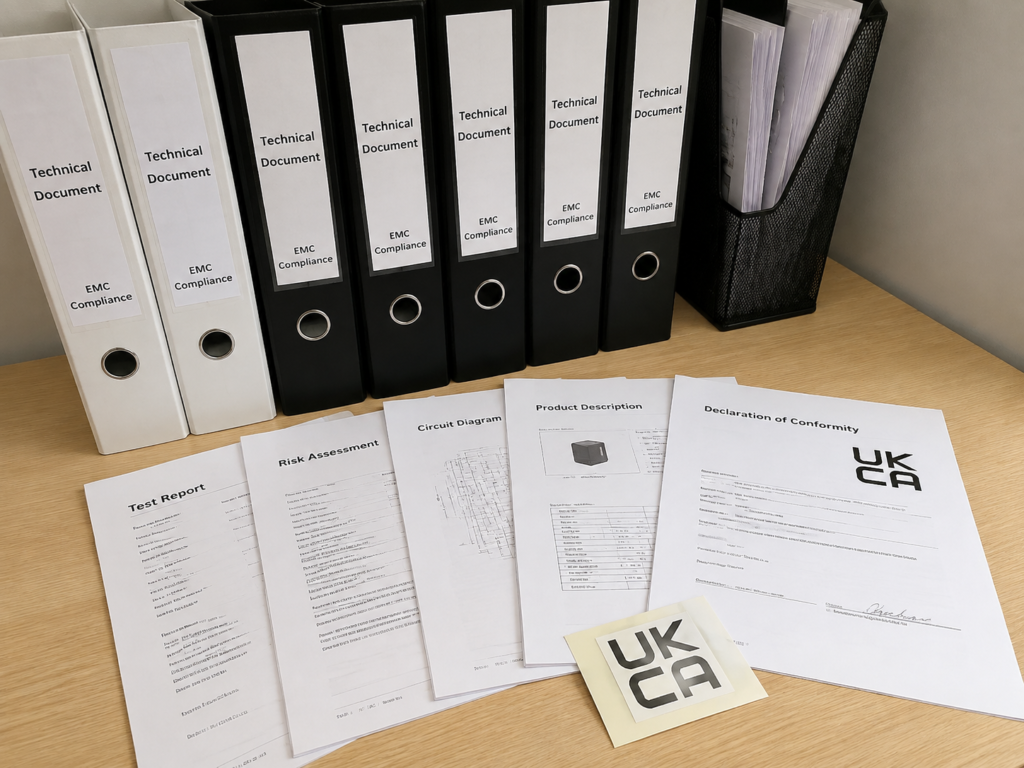
Then there is the Declaration of Conformity (DoC), which is a self-certification document signed by the manufacturer itself. It is equivalent to you guaranteeing that “my product meets regulatory requirements”, and no third-party seal is required.
Finally, there is the UKCA or CE mark, which is just an external label affixed to the product. It can only be affixed with the support of complete technical documents and a DoC. Affixing it randomly without documents is a violation, and having the mark does not equal compliance.
As for the often-heard notified body, it only needs to be involved when the product is also subject to regulations requiring mandatory third-party assessment, such as explosion-proof, medical devices, and some radio equipment. Ordinary EMC products do not need to involve it. UKAS (United Kingdom Accreditation Service) is the UK’s official body that accredits the qualifications of laboratories and notified bodies. It does not conduct tests or issue certificates itself, and ordinary EMC testing does not mandate the use of UKAS-accredited laboratories.
What are the Actual Consequences of Non-Compliance
Many people think compliance is “making trouble for nothing”, but the losses when problems actually occur are far higher than the upfront investment. Common consequences include: goods being detained by customs after arriving at the port, the UK Office for Product Safety and Standards (OPSS) requiring removal from shelves and recall, and in serious cases, fines or even confiscation of products; e-commerce platforms will directly take down listings if they find non-compliance, and if consumers suffer losses due to electromagnetic interference, it may also lead to claims. The investment in compliance in advance is usually far lower than the comprehensive costs caused by cargo detention, recall, retesting and rectification, platform delisting, and sales interruption.
Boundaries with Other UKCA Compliance Requirements
EMC is only one category of UKCA compliance. Do not think that completing EMC means full compliance. If your product involves categories such as low-voltage safety, wireless functions, mechanical safety, medical, explosion-proof, and automotive, you need to simultaneously check the requirements of the corresponding UKCA special regulations. EMC requirements may be included in the scope of special regulations, and you cannot conclude that the entire product meets the requirements just by completing ordinary EMC compliance.
2. Quick Judgment: Which Compliance Path Your Product Should Take
When you get a product, don’t rush to find a laboratory for testing. The first step is to judge whether it is subject to UKCA EMC and which path to take, otherwise you are likely to waste money.
First, Clarify the Mark Requirements for Different Markets
After Brexit, compliance rules vary across different regions, so don’t mix them up:
• Great Britain (GB, England, Scotland, Wales): UKCA is the statutory compliance mark, but the recognition policy for the CE mark will be dynamically adjusted. You need to go to the UK government official website (gov.uk) to check the latest official announcement. It is not absolutely that only UKCA can be used, nor is CE permanently valid.
• Northern Ireland (NI): Due to special Brexit arrangements, EU CE EMC requirements apply by default, and there is no separate “UKNI EMC” statement; the UKNI mark is only required to be used together when the product involves mandatory third-party assessment.
• EU/EEA: Only CE EMC is recognized. The UKCA mark is not recognized in the EU, so don’t think you can sell to the EU just by affixing the UKCA mark.
How to Determine the Applicable Scope of Products
The core logic of judgment is not “whether it is powered”, but first to determine whether the product belongs to the apparatus (electrical and electronic equipment that may generate electromagnetic disturbance or is susceptible to electromagnetic disturbance) referred to in the regulations, then to see if it is covered by special industry regulations. If not, it follows the ordinary EMC main line:
• Products applicable to the ordinary EMC main line are finished electrical and electronic equipment not covered by special industry regulations, whether plug-in or battery-powered, such as ordinary USB chargers, wired earphones, household small desk lamps, etc. They need to meet all the requirements of EMC regulations.
• Products diverted to special regulations need to have their applicable rules judged one by one by category, and conclusions cannot be applied uniformly:
1. Products with wireless transmission functions such as Bluetooth, WiFi, and cellular: usually subject to the UK . The basic requirements of this regulation already include EMC, and at the same time, they must meet requirements such as spectrum, radio performance, and safety; the non-wireless function part still requires regulatory applicability analysis.
2. Medical devices, explosion-proof equipment, etc.: need to check the applicable scope of the corresponding UK special regulations. If the special regulations already cover EMC requirements, the ordinary EMC regulations do not apply separately, subject to the provisions of the special regulations.
3. Automotive, aerospace, marine, and military products: in addition to possibly applicable special regulations, they may also be subject to vehicle type approval, industry rules, and procurement contract requirements. The EMC compliance path needs to be judged in combination with specific scenarios, and ordinary consumer EMC rules cannot be directly applied.
For components or parts, the judgment boundary should be more rigorous: only purely passive components that do not generate or are not affected by electromagnetic disturbance (such as ordinary resistors, capacitors, structural screws, housings without electronic functions, etc.) are usually not required to comply as separate EMC control objects; but modules with active circuits, interfaces, control functions, or that can be placed on the market independently still need to undergo applicability analysis first, and cannot be excluded just because they are “parts”. All parts installed in the complete machine must ensure that they do not affect the EMC performance of the complete machine — for example, selling ordinary resistors does not require a separate UKCA mark, but the complete machine manufacturer cannot cause the complete machine to fail EMC standards due to the use of low-quality resistors.
Exemption Scope and Special Scenarios
Products that are fully exempt from EMC requirements are clear: purely mechanical products without any electrical components, such as pure metal phone holders and plastic storage boxes, definitely do not need EMC; and the previously mentioned purely passive parts without electronic functions also do not need separate compliance.
There is another special scenario called fixed installation apparatus, which many people are confused about. It refers to electrical systems that are permanently fixed in a specific location and installed by professionally qualified personnel, such as an entire production line in a factory or a building’s power distribution system. As an overall system, this type of apparatus does not require each individual device to bear the UKCA mark, nor does it require a separate Declaration of Conformity for each unit. However, good engineering practice must be followed throughout the entire process of design, installation, and maintenance, and a complete set of EMC technical documents must be retained. The responsibility is not entirely borne by the installer; manufacturers, system integrators, and installers shall share responsibility according to their respective roles — for example, if the equipment itself has design problems, the manufacturer is responsible; if wiring is not carried out in accordance with specifications during installation, the installer is responsible.
The boundary should be clarified here: the special requirements for fixed installations only apply to complete systems that are custom-combined, installed, and operated for a long time at a specific location; if finished equipment that is placed on the market separately as an independent product is used in the system, that equipment still needs to complete compliance in accordance with its applicable regulations.
3. Core Technical Requirements: Test Items and Qualification Standards
After clarifying the applicable scope, let’s look at what EMC specifically tests and how to determine qualification. You don’t need to memorize standard numbers by rote. First understand the logic, and then look up the corresponding standards when needed.
EMC testing is divided into two categories: one is electromagnetic emission, which means “you don’t interfere with others”; the other is electromagnetic immunity, which means “you don’t break down when others interfere with you”.
Electromagnetic Emission Requirements: Must Not Interfere with Others
Electromagnetic emission means that the electromagnetic signals leaked by the product to the outside must not exceed the specified upper limit, otherwise it will interfere with surrounding electronic equipment, communication facilities, medical instruments, etc. Common active equipment usually needs to evaluate the following emission paths, but whether to test and which ports to test are determined by product family standards, equipment categories, port configurations, power supply methods, and applicable exemption clauses:
• Conducted emission: refers to interference propagated through wired paths such as power lines and signal lines. It is necessary to prioritize matching the corresponding product family standards. BS EN 55032 is only a typical applicable example for multimedia equipment.
• Radiated emission: refers to interference propagated through air into space. It also needs to prioritize matching product family standards, and there is no universal emission standard applicable to all electrical and electronic equipment.
• Harmonic current: refers to the pollution of the power grid waveform caused by product power consumption, corresponding to BS EN 61000-3-2. It only applies to AC-powered equipment with a rated input current ≤ 16A, and some categories of equipment are exempt.
• Voltage flicker: refers to power grid voltage fluctuations caused by changes in product load, corresponding to BS EN 61000-3-3. It only applies to AC-powered equipment with a rated input current ≤ 16A, and some categories are exempt.
There is no unified universal limit for EMC. The specific values need to be determined according to product categories and usage scenarios corresponding to UK designated standards (prioritizing product family standards), and the standard values of a certain category of products cannot be directly applied.
Electromagnetic Immunity Requirements: Not Afraid of Interference
Electromagnetic immunity means that when products encounter common daily electromagnetic interference, they must not have safety problems, nor must they have key function failures beyond the allowable range. Specific test items need to be selected according to product family standards and port applicability. Not all products need to be fully tested. Common items include:
• ESD (Electrostatic Discharge): simulates the impact when a human body with static electricity touches the product, usually applicable to product ports that may be touched by humans.
• EFT (Electrical Fast Transient): simulates fast pulse interference generated when switches and relays are turned on and off, usually corresponding to ports such as power lines, signal lines, and control lines.
• Surge: simulates instantaneous high-voltage impact caused by lightning induction and large equipment start-up and shutdown, usually corresponding to external access ports such as power and signal.
• Radio frequency field immunity: simulates interference from surrounding wireless signals (such as mobile phones, base stations), and the applicable scope is determined by product standards.
• Voltage dip/interruption: simulates interference from sudden power grid voltage drops and short-term power outages, mainly for products with AC power input.
Specific test items and limits are specified by the corresponding product family standards or general immunity standards (such as BS EN 55035).
How to Judge Qualification: Performance Criteria A/B/C
The qualification judgment of EMC immunity testing is first based on the performance level specified in the applicable product standards. Manufacturers need to clearly define the “basic performance” and allowable functional deviation range of the product in combination with the product’s intended functions and safety risks, and cannot set criteria arbitrarily on their own. The logic of the three common types of performance criteria is as follows:
• Criterion A (highest level): During and after the test, the product must maintain the basic performance specified in the standard, and functional deviations beyond the specified range are not allowed.
• Criterion B (medium level): Performance degradation or misoperation within the specified range is allowed during the test. After the test, the specified basic performance can be automatically restored without manual intervention, and there must be no safety hazards.
• Criterion C (lowest level): Temporary loss of function is allowed during the test. As long as the hardware is not damaged, the specified basic performance can be restored through manual operation or system restart after the test, and no safety risks may arise.
It should be noted that there is no absolute rule that “a certain criterion only applies to a certain industry”. Which criterion to use specifically is determined jointly by the requirements of product family standards, the importance of product functions, and the safety risk level. Manufacturers need to clarify the judgment basis in the technical documents.
4 Key Conditions Affecting Qualification Judgment
The results of EMC testing are not fixed. Many conditions will affect whether the final result is qualified. These factors must be considered during testing, otherwise the test will be in vain:
1. Usage environment: The interference intensity in household, commercial, light industrial, and heavy industrial environments is different. The more complex the environment, the higher the immunity requirements usually are. For example, equipment used in industrial scenarios generally has higher immunity requirements than household consumer products.
2. Power supply method and power configuration: The interference characteristics of AC, DC, and battery power supply are different; power adapters, cables, and accessories sold with the product or declared by the manufacturer as part of the product should usually be included in the representative test configuration evaluation, because the interference of the power supply itself may affect the EMC performance of the entire system. The final test boundary is determined by applicable standards, product placement methods, and the typical configuration declared by the manufacturer. The test report must clearly list the specifications and models of the power supply used.
3. Cables and peripherals: The antenna effect of long cables may amplify interference, and external peripherals such as printers and sensors will also change the EMC performance of the product. During testing, the standard longest cables and typical peripherals should be used, and configuration details should be clarified in the report.
4. Operating mode: The interference intensity of the product is different in different modes such as standby, full load, start-up, and communication peak. You cannot only test the standby state with the least interference, but need to cover the “most unfavorable working condition” with the greatest interference.
4. Essential for Semi-Proficiency: How to Find the Applicable UKCA EMC Standards
Many people just find a random standard to use when doing compliance, and end up with invalid compliance because the standard is wrong. This is a very common pitfall. Finding the right standard is a key step from beginner to semi-proficient.
Basic Rules of UK Designated Standards
First of all, it must be clear that UKCA only recognizes “designated standards” issued by the UK government. Not all standards starting with BS EN can be used, nor will the UK immediately synchronize when the EU updates EN standards.
There are several core rules for designated standards:
• Using the valid version of designated standards can directly obtain a presumption of conformity, which is the most worry-free compliance path; if designated standards are not used, the manufacturer needs to prove on its own that the product meets the basic requirements of EMC regulations, and the document complexity and compliance risk are much higher than using designated standards.
• The UKCA designated standard list is independent and will not automatically update with EU harmonized standards. If a standard is removed from the list, you cannot directly determine that previous declarations are immediately invalid, nor can you continue to use the old version unconditionally: you need to check the designation date, withdrawal date, replacement standard, and official transition period of the standard, and then combine the time when the product is placed on the market to judge whether this version can continue to be used for presumption of conformity; after the old version is officially withdrawn and the transition period ends, you cannot continue to rely on the presumption of conformity effect of the standard just because the test report has been completed.
• The only authoritative query channel is the designated standard list on the UK government official website (gov.uk), which can be searched by product category. You cannot assume validity just by looking at the standard number (even if it starts with BS EN).
Priority of Standard Selection and Retrieval Steps
There is a clear priority for selecting standards. Don’t use general standards right away:
Prioritize product family-specific standards. For example, home appliances have EMC standards for home appliances, lighting has those for lighting, and power supplies have those for power supplies. Product family standards are specially formulated for a certain category of products and are the most accurate; if there is no corresponding product family standard, then select general standards, which are divided by usage environment: residential/commercial/light industrial use, or industrial use.
Specific retrieval can be done in four steps, which entry-level users can follow:
1. First confirm whether the product is within the applicable scope of EMC regulations, and exclude products covered by special regulations. For example, those with WiFi follow RED, and there is no need to find ordinary EMC standards.
2. Find the corresponding product family standard by product category. For example, for a household USB power adapter, first confirm that it is not covered by special regulations, then find the corresponding EMC standard according to the category of consumer power products.
3. If there is no product family standard, match the corresponding general EMC standard according to the product’s usage environment.
4. Finally, be sure to go to the designated standard list on the UK government official website to check the standard’s version number, effective date, replacement relationship, and transition period to confirm that this version is valid.
What to Do When There Are No Designated Standards
If your product is relatively special and you cannot find the corresponding designated standard, it is not impossible to comply. The law allows manufacturers to prove that the product meets the basic requirements of EMC regulations through other technical methods, but you need to provide more sufficient evidence, such as engineering demonstration, risk assessment, test data, comparison data of similar products, etc. The complexity of technical documents and compliance risks are much higher than using designated standards.
For entry-level users, try to choose product solutions with corresponding designated standards. Don’t take this path easily, as it is too easy to fall into pitfalls.
5. Practical Implementation: How to Achieve UKCA EMC Compliance
Compliance for ordinary EMC products is actually not difficult. There is no need to find a third party to issue certificates, and manufacturers can complete it on their own.
Compliance Mode: Mainly Self-Declaration, Third Party Only Required in Special Cases
Many people think that UKCA must find a third-party institution to issue certificates, but that is not the case at all. Under ordinary EMC regulations, all products adopt the internal production control mode, where the manufacturer self-declares compliance. No UKCA notified body certificate is required, nor is third-party audit required.
Only when the product is also subject to other UKCA regulations that require mandatory third-party assessment, it is necessary to find the corresponding UKCA notified body to intervene, such as explosion-proof products, medical devices, and some RED products. Not all products with wireless functions require a notified body; it depends on the specific product category and regulatory requirements.
Compliance Responsibilities of Different Market Entities
EMC compliance is not only the responsibility of manufacturers. The responsibilities of different roles must be clearly distinguished. All obligations are subject to the corresponding regulations and the UK’s current product safety marking policy:
• Manufacturer: bears the main responsibility for compliance, is responsible for testing, organizing technical documents, signing the Declaration of Conformity, and ensuring that products meet requirements. It is the first responsible party.
• UK-based importer: needs to verify that the product has compliance documents and correct marks, and usually needs to mark the name and address of the UK-based importer on the product; if the size or nature of the product does not allow it, it can be reflected on the packaging or accompanying documents in a manner permitted by regulations, and at the same time, documents must be retained to cooperate with regulatory spot checks.
• Distributor: needs to ensure that the marks of the products sold are compliant, and report problems to the regulatory authorities in a timely manner when found.
• Authorized representative: only when the manufacturer is not located in the UK can an authorized representative in the UK be designated through a written agreement to perform part of the compliance duties on its behalf. The specific scope of duties must be written into the written authorization document, and the core responsibility of the manufacturer for product conformity cannot be transferred; not all EMC products mandate an authorized representative, which needs to be judged in combination with specific regulations and sales models.
• Online sales scenario: platforms need to cooperate with regulators to remove non-compliant products, and sellers need to ensure that the information on product pages is consistent with the actual compliance status of the products and meets the compliance requirements of the corresponding market.
Practical Steps for Self-Declaration
For self-declaration of ordinary EMC products, just follow four steps:
1. Confirm applicable standards: first find the UK designated standard corresponding to the product, and clarify the items, limits, and performance criteria that need to be tested.
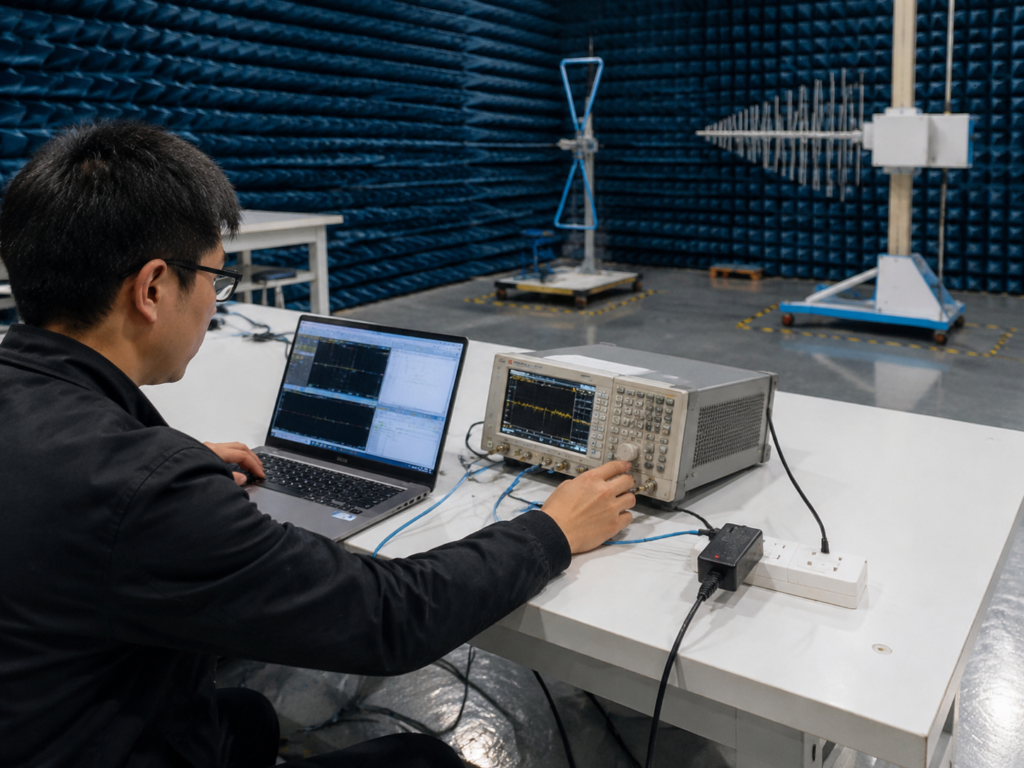
2. Complete testing: you can test by yourself or entrust a capable laboratory. The law does not mandate that ordinary EMC products must be tested by UKAS-accredited or UK-based laboratories, but the manufacturer must be able to prove that the test methods, equipment, environment, personnel competence, raw data, and report conclusions are sufficient to support the Declaration of Conformity — “whether the laboratory has official accreditation” and “whether the test evidence is sufficient” are two different issues, and choosing a capable laboratory can reduce compliance risks.
3. Organize documents and sign the declaration: organize a full set of technical documents and sign the UKCA Declaration of Conformity (DoC).
4. Affix the mark and retain documents: affix the compliance mark as required, and retain the technical documents and DoC for at least 10 years from the date the product is last placed on the market.
Pre-Test Preparation and Rectification Closed Loop
Testing is not just taking a random prototype to test. Pay attention to these points, otherwise the test will be in vain:
• Prototype selection: choose the model with the highest configuration and the most complete functions, bring all standard peripherals, and cannot use a simplified prototype for testing.
• Working condition setting: test the “most unfavorable working conditions” with the greatest interference, such as full load, start-up, and communication peak, and cannot only test the standby state.
• Clear boundary: use the standard longest cables and typical peripherals, and all test conditions must be written into the report, so that they can be clearly explained when regulators check later.
• Rectification and retest: if the test fails, whether it is modifying hardware or software, the corresponding items must be retested after rectification. You cannot just modify the data in the report, which is fraud.
• Change control: if there are subsequent changes to the product, such as changing the power supply solution, motherboard, high-speed devices, modifying software timing, adding wireless functions or long cables, these changes that affect EMC must be re-evaluated; if it is just a change that does not involve circuits, such as changing the shell color or packaging, there is no need to re-evaluate.
Required Documents and Declaration of Conformity Requirements
Technical documents are the core of compliance, and must include at least the following content: product description, intended use and usage environment, circuit/structural schematic diagrams, port and cable configuration instructions, operating mode instructions, software and hardware version information, model differences and basis for selecting representative prototypes, test reports (including raw data and rectification records), risk assessment, conformity assessment method adopted, product manual (which must state the usage environment and restrictions). Special attention should be paid: the final prototype after rectification and the test conclusion must be completely consistent with the model, hardware, software, and accessory configuration actually placed on the market.
The Declaration of Conformity (DoC) also has mandatory required fields, and it is invalid if missing: manufacturer’s name and address, product model/batch, responsibility statement, clearly cited UK regulations (must write , not just UKCA), applicable designated standards and version numbers, identity and authority of the signatory, place and date of signing.
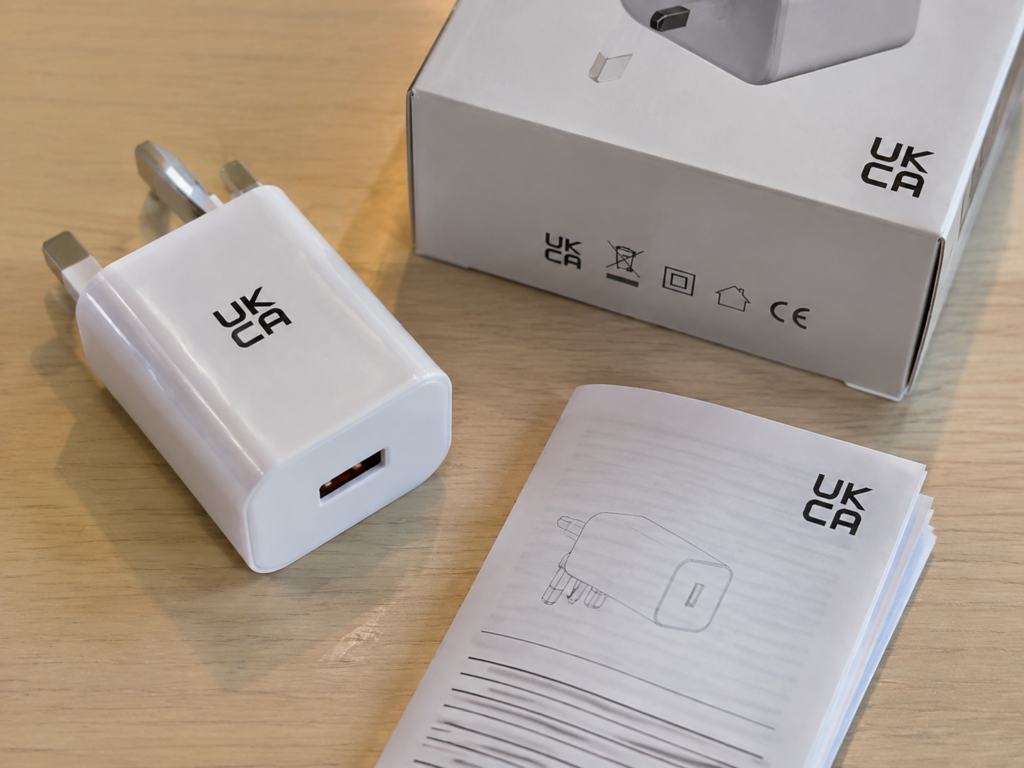
There are also rules for the affixing of the UKCA mark: it must be clearly visible, indelible, and its size and proportion must meet official requirements; it is usually affixed to the product itself, and for too small products, it can be affixed to the packaging or accompanying documents as required by regulations. The specific affixing position, size requirements of the mark, as well as the applicable scope and period for alternative positions for small-sized products, shall be subject to the latest marking rules and product category requirements published on gov.uk at the time of release, and the applicable scope of alternative positions shall not be expanded without authorization. It should be noted that the mark can only be affixed with the support of complete technical documents and a DoC, and random marking is a violation.
If your products are sold to both the UK and the EU, you can also make a joint DoC, that is, one declaration covering both CE and UKCA requirements, but the regulatory and standard bases of the EU and the UK must be listed separately, and cannot be mixed together. Of course, you can also make two separate ones, depending on the product, market, and internal management needs.
6. Key Comparison: Differences Between UKCA and CE EMC and Document Reuse
Many people have already done CE EMC before, and now they want to do UKCA. What they care most about is whether they can reuse the previous materials to save money. First clarify the core differences between the two, then judge whether they can be reused.
Core Differences Between UKCA and CE EMC
The two look similar, but they are essentially two independent compliance systems, with four core differences:
1. Different legal frameworks: CE EMC is based on the EU’s EMC Directive, and UKCA EMC is based on the UK’s . After Brexit, the UK no longer synchronizes the revisions of EU directives, and the differences may become larger and larger in the future.
2. Different applicable standards: CE uses harmonized standards published in the Official Journal of the EU, and UKCA uses designated standards of the UK government. The version numbers and inclusion times of the two may be different. Standards updated by the EU may not be synchronously included by the UK.
3. Different certification qualifications: For products that require the intervention of a notified body, CE uses certificates from EU notified bodies (NB), and UKCA uses certificates from UK-recognized UKCA notified bodies. EU NB certificates are not recognized by UKCA.
4. Different applicable regions: CE applies to the EU/EEA and Northern Ireland of the UK; UKCA only applies to Great Britain (GB) of the UK.
Judgment Method for Whether CE EMC Materials Can Be Reused
There is no universal fixed transition period for whether CE materials can be reused. Everything is subject to the latest official announcement of the UK government, the designated standard list, and product categories. It can be reused only when three necessary conditions are met at the same time:
1. The standard version you used when doing CE is exactly in the valid version of the UK designated standard list.
2. The data in the test report fully meets the requirements of UKCA designated standards.
3. Comply with the UK official CE material reuse policy at that time.
In the following cases, it cannot be directly reused: the product requires review by a UKCA notified body, but the CE certificate is issued by an EU NB; the standard version used for CE is not included in the UK designated list; it does not comply with the UK official reuse policy.
Precautions for Selling to Both the UK and the EU
The same product can bear both CE and UKCA marks, as long as it meets the two sets of compliance requirements respectively. The DoC can be joint or separate, but it must be ensured that the respective regulatory and standard bases are complete and accurate, and cannot be confused.
7. Pitfall Avoidance Self-Check and Case Practice
Finally, we have sorted out common misunderstandings, self-check tables, and cases to help you consolidate what you have learned and avoid most pitfalls.
4 Most Common Cognitive Misunderstandings
1. Misunderstanding 1: UKCA EMC and CE EMC are exactly the same, just directly use CE materials. The two belong to independent compliance systems, and there may be differences in standard versions, regulatory bases, and qualification requirements, which need to be checked one by one according to reuse conditions.
2. Misunderstanding 2: All EMC products need to find a third-party institution to issue certificates. Ordinary EMC products can adopt the internal production control mode to self-declare compliance. Only when the product is also subject to special regulations requiring mandatory third-party assessment, a UKCA notified body is required to intervene.
3. Misunderstanding 3: Affixing the UKCA mark equals compliance. The mark is just an external label, which is only valid with the support of complete technical documents and a Declaration of Conformity. Random affixing without documents is a violation.
4. Misunderstanding 4: EMC testing must be done by a UK-based or UKAS-accredited laboratory. Ordinary EMC testing does not mandate the laboratory’s location or accreditation qualification, but the manufacturer needs to ensure that the test evidence is sufficient and the conclusion is reliable enough to support the Declaration of Conformity.
Six-Step Compliance Self-Check Table
You can check step by step against the table below to quickly identify common compliance problems:
| Self-Check Step | Core Check Items | Common Failure Points |
| 1. Regional check | Confirm whether the sales destination is Great Britain (GB) of the UK, and check the latest CE recognition policy | Mistakenly treating the Northern Ireland market according to GB rules, resulting in non-compliance due to failure to pay attention to the timeliness of CE recognition |
| 2. Product applicability check | Confirm whether the product is an EMC control object, and whether it needs to be diverted to special regulations | Treating purely passive parts as EMC-controlled products, or products with wireless transmission functions not following the RED regulatory path |
| 3. Standard validity check | Find the UK designated standard for the corresponding product, and check the version, effective date, and transition period | Using an old version of the standard that has been removed, only looking at the BS EN number without checking the official list |
| 4. Test completeness check | The test covers all required items, adopts the most unfavorable working conditions, and has clear boundary conditions | Missing a certain type of emission/immunity test items, only testing the standby state, not using the standard longest cable |
| 5. Document completeness check | Have complete test reports, technical documents, UKCA DoC, fields meet requirements, and be kept for 10 years | Directly applying the CE DoC template without modifying the regulatory basis, blurred model boundaries, insufficient document retention period |
| 6. Marking and responsibility check | The UKCA mark meets the affixing requirements, the importer/authorized representative information is complete, and the responsible subject is clear | Randomly affixing the UKCA mark without document support, not marking the information of the UK-based responsible subject |
For entry-level users, the first step is always to confirm whether the product is within the applicable scope of UKCA EMC, and then proceed with the follow-up process after confirming the product category, to avoid unnecessary cost investment.
Typical Case Judgment Practice
We use 5 common products for practice. You can judge by yourself first, then look at the conclusions:
1. Ordinary consumer AC-input USB power adapter: First, find the UK-designated product family standard according to the power equipment category, and confirm that it is applicable to the ordinary EMC main line; if it is AC input and the rated input current is ≤ 16A, the applicability of harmonic and flicker items needs to be further judged; other items such as conducted emission, radiated emission, and immunity also need to be determined according to product standard requirements, port configuration, and usage scenarios. This type of product can be self-declared and affixed with the UKCA mark. If it also involves other regulatory requirements such as low-voltage safety, it is necessary to match the corresponding standards separately to complete compliance.
2. Smart light with Wi-Fi: subject to UK RED regulations. EMC requirements are included in the basic requirements of RED, and at the same time, it must meet spectrum and safety requirements, and does not need to follow the ordinary EMC main line separately.
3. Industrial frequency converter: applicable to the ordinary EMC main line (industrial category), corresponding to the general industrial EMC standard. The immunity requirement is higher than that of consumer products, and the performance criteria are implemented according to product standards.
4. Factory fixed production line (complete electrical system): belongs to fixed installation apparatus. As a whole, there is no need to affix UKCA on each unit or have a separate DoC for each unit. A complete set of EMC technical documents must be retained, and integrators, installers, and manufacturers shall bear compliance responsibilities according to their respective roles.
5. Purely mechanical phone holder: fully exempt from EMC requirements, no need for UKCA EMC compliance.
Summary
By now, you should be able to independently complete most of the basic judgment and practical work of UKCA EMC: you can quickly judge whether a product needs to follow the UKCA EMC main line and which regulatory path is applicable; you can distinguish the applicable regions and rule differences of UKCA, CE, and UKNI, and know the policy timeliness of the CE mark in the GB market; you can retrieve UK designated standards step by step and judge whether existing CE EMC materials can be reused; you can also identify common compliance misunderstandings through the six-step self-check and avoid the risk of invalid certification.
Although there are many details in UKCA electromagnetic compatibility compliance, the core logic is clear. As long as you confirm the scope step by step, match the standards, and do a good job of document support, you can efficiently complete compliance and reduce unnecessary cost investment.