
Sellers of electrical products targeting the Australian market often get confused when first encountering abbreviations like RCM, EESS, and ERAC: some think RCM is a “certificate” you have to pay to obtain, some mistake EESS as an exclusive requirement for energy storage products, and others spend tens of thousands of dollars on testing only to have their products removed from platforms for failing to complete EESS registration, wasting all their upfront investment.
In fact, the core of understanding Australian electrical compliance logic is to first clarify the relationship between RCM and EESS — the former is the compliance mark you ultimately affix to products, while the latter is the mandatory filing requirement for the electrical safety link. This article covers all the core issues you will encounter, from basic judgment to registration operations and post-registration maintenance.
1. Basic Literacy: Core Relationship Between RCM and EESS
What is RCM (Regulatory Compliance Mark)
You can think of RCM as the “compliance ID” for electrical products in the Australian and New Zealand markets — it is not a quality award issued by the government, nor a certificate issued by a specific institution. Instead, it is a mark that can only be affixed after the supplier responsible for the product self-declares that the product complies with all applicable Australian and New Zealand regulations.
RCM covers three types of compliance requirements: first is electrical safety, meaning the product will not cause electric shock, fire, or personal injury; second is electromagnetic compatibility (EMC for short, which simply means the product will not interfere with the normal operation of other electrical appliances, nor will it be easily interfered with by other electrical appliances); third is radio communications — if the product has wireless functions such as Bluetooth, WiFi, or cellular network, it must also meet radio-related requirements. The electromagnetic compatibility and radio parts are regulated by the Australian Communications and Media Authority (ACMA for short).
What is EESS (Electrical Equipment Safety System)
EESS is Australia’s unified national safety registration and supervision system for low-voltage electrical products, managed by the Electrical Regulatory Authorities Council (ERAC for short).
In the past, electrical safety supervision requirements and implementation methods across Australian states and territories were relatively fragmented, and the same product sold across states might face different filing requirements. The core function of EESS is to coordinate the safety supervision and registration mechanisms for low-voltage electrical equipment in participating states/territories, build a unified information query platform, reduce the risk of unsafe electrical products entering the market, and reduce safety accidents such as electric shock and fire. It covers the safety supervision framework for low-voltage electrical equipment; as for whether a product requires mandatory registration, it needs to be comprehensively judged in combination with the scope of application, risk level, and official exemption conditions.
Here we must first clarify the most easily confused point: EESS is not an Electrical Energy Storage System (ESS for short). Many people see two Es and one S in the abbreviation and think it is specifically for energy storage, but in fact, energy storage is just one of the many high-risk categories regulated by EESS.
Position of EESS in the RCM System
Once you understand these two concepts, you can clarify their relationship: EESS is only responsible for the official registration and filing of the “electrical safety” part among the three types of RCM requirements.
If your product is purely radio-based (such as a wireless module without a mains interface) and does not fall within the scope of EESS low-voltage electrical equipment, you only need to meet the corresponding EMC and radio requirements of ACMA, as well as the obligations of labeling, supplier declaration, and record-keeping specified by ACMA, before you can use the RCM mark, without involving EESS registration. But if your product is a low-voltage electrical device with a mains interface, EESS registration is a prerequisite that must be met first to legally use the RCM mark — affixing the RCM mark without completing EESS is a violation.
Actual Consequences of Incomplete EESS Registration
Many people think “I can just sell quietly and not get caught”, but in fact, EESS supervision is already very well implemented. According to the electrical safety laws of Australian participating states and territories, products within the mandatory registration scope sold in these regions must first complete EESS registration.
Common consequences of violations include: product seizure, fines, and even sales bans within participating states; now mainstream e-commerce platforms such as Amazon and eBay often require RCM/EESS registration information during the listing review of electrical or high-risk categories. Failure to provide it may result in listing rejection, product removal, or supplementary review. In addition, all EESS registration information is public, and anyone can query and verify it for free in the official database. Whether it is platforms, buyers, or peers, they can find out if your product is compliant with a simple search — fraud cannot be hidden at all.
3 Basic Cognitive Misconceptions for Beginners
Beginners who are just getting started are most likely to fall into these three cognitive pitfalls. Here we correct them directly to avoid going further astray later:
First, RCM certification = EESS registration? Incorrect. RCM is the mark to be affixed ultimately, covering three types of requirements: electrical safety, EMC, and radio. EESS is only the registration requirement for the electrical safety link; completing only EESS is far from enough to affix the RCM mark.
Second, EESS is laboratory testing? Incorrect. EESS is a government filing system. You must first prepare test reports or certificates that meet the requirements, then submit the filing in the system. EESS itself does not conduct testing.
Third, All RCM products need EESS? Incorrect. Only products with electrical functions that fall within the EESS supervision scope need it. Pure radio modules and small pure-battery products with voltages outside the range are not necessarily exempt — you must first confirm that the whole device has no mains input, external adapter, or charging device; if sold as a set with an adapter, the adapter itself needs to be separately assessed for EESS compliance requirements.
2. 3-Step Judgment: Does Your Product Need EESS Registration?
After understanding the basic concepts, what you care about most must be: does the product I sell need EESS registration? In fact, you don’t have to find an agent for paid consultation right away. Follow these 3 steps, and you can make a pretty accurate judgment on your own.
Step 1: Confirm Whether the Product Is Within the Applicable Scope
First, there are two hard boundaries:
The first is the voltage boundary: only low-voltage electrical equipment with a rated voltage between 50V-1000V AC and 120V-1500V DC falls within the supervision scope of EESS. Looking only from the 5V low-voltage load end, it usually does not fall within the scope of EESS low-voltage electrical equipment, but if the whole device includes mains input, built-in power supply, external adapter, or charging device, relevant components and the power supply method of the whole device need to be assessed separately; industrial high-voltage equipment with voltage higher than the above range is not within the supervision scope.
The second is the scenario boundary: as long as it is commercially sold within Australia, whether it is cross-border e-commerce direct mail, overseas warehouse delivery, local wholesale, or offline retail, it counts.
There are also exemption cases: for example, products only for export and not sold in Australia, personal non-commercial use, scientific research prototypes, and equipment dedicated to industrial use and not entering the circulation market do not need registration, but the specific situation shall be subject to the official exemption list, and do not make arbitrary judgments on your own.
There is also a special situation that is easily missed: if your product comes with an external adapter, the adapter itself must separately meet EESS requirements — adapters belong to the high-risk category, and testing only the whole device is not enough.
Step 2: Match the Product Risk Level (Determines Whether Mandatory Registration Is Required)
Even if within the applicable scope, not all products require mandatory registration. ERAC divides low-voltage electrical products into 3 levels according to the risk of electric shock and fire, and only medium and high-risk products require mandatory registration. For easy comparison, they are organized into the following table:
| Risk Level | Registration Requirement | Core Required Documents | Common Product Examples |
|---|---|---|---|
| Level 3 (High Risk) | Mandatory registration | Certificate of Conformity (CoC) issued by an ERAC-recognized body | Plugs and sockets, power adapters, electric water heaters, energy storage systems, medical electrical equipment |
| Level 2 (Medium Risk) | Mandatory registration | Test report compliant with AS/NZS Australian and New Zealand standards + Declaration of Conformity (DoC) | Table lamps, hair dryers, electric toys, power banks, household lighting fixtures, IT equipment |
| Level 1 (Low Risk) | No registration required | Keep compliance test documents on file for inspection | Ordinary wires, passive speakers, simple electrical accessories |
Here we must emphasize: Never judge the risk level solely by product name, appearance, or customs code. For example, some products that look like ordinary small home appliances may actually be classified as Level 3 high risk. The safest method is to use the product classification tool on ERAC’s official website, or check one by one against the official declared equipment list — the consequences of misjudging the level are very serious.
Step 3: Confirm the Supervision Requirements of the Sales Region
EESS is a unified registration system for Australian participating states/territories, which is currently joined voluntarily by each state and territory. But you don’t have to worry too much — now the vast majority of states and territories by population have joined, including New South Wales, Victoria, Queensland, South Australia, Western Australia, Tasmania, etc.
The biggest benefit of EESS is “one registration, valid across all participating states” — you don’t need to apply separately for each state, and cross-participating-state sales are completely fine. A small number of non-participating regions that have not yet joined still have their own local electrical safety requirements, which need to be checked against local regulations before sales; in practice, you can prepare documents at the same level as EESS requirements, but this cannot replace confirmation of local requirements to avoid compliance loopholes.
Boundary Scenarios Prone to Misjudgment
There are several boundary scenarios that almost all beginners misjudge, so we will cover them separately here:
- Products with wireless functions: For example, WiFi smart sockets and Bluetooth table lamps. Many people think that once they get the wireless ACMA certification, they don’t need EESS — that’s wrong. As long as the product is connected to mains power and falls within the low-voltage electrical scope, EESS assessment for electrical safety is indispensable; wireless compliance cannot replace electrical safety.
- USB low-voltage powered products: Many people think USB is 5V low voltage and must be exempt, but that’s not necessarily the case. It depends on the power supply method and rated voltage of the whole device. For example, a USB power strip with a mains plug itself is a Level 3 high-risk product and must be registered.
- Battery-powered products: For example, wireless vacuum cleaners and Bluetooth speakers. It’s not that pure battery-powered products definitely don’t need EESS — as long as the product has mains charging or external power supply functions, it may fall within the supervision scope and needs to be judged in combination with voltage.
- Industrial/medical equipment: Don’t think that “it’s for industrial/medical use” so it’s automatically exempt. You must check the official definition; many industrial low-voltage electrical devices still need to be registered as required.
3. Registration Subject Requirements: Who Can Apply for EESS Registration
After confirming that the product needs registration, the next question is: who can apply? Can overseas sellers register on their own? The answer is clear: overseas entities cannot apply directly, and must register through a local Australian “Responsible Supplier”.
What is a Responsible Supplier
To put it simply, a Responsible Supplier is “the entity that bears legal responsibility for product compliance locally in Australia”, and is the statutory applicant for EESS registration.
Its qualification requirements are very clear: it must hold a valid Australian Business Number (ABN for short, equivalent to the ID number of an Australian enterprise), and have a fixed local contact address and phone number.
The legal obligations of a Responsible Supplier are also heavy: it must bear full compliance responsibility for the product, receive inquiries from regulatory authorities, cooperate with spot checks, and be responsible for recalls if the product has safety hazards. Simply put, if there is a problem with the product, the first party the regulator looks for is the Responsible Supplier.
Registration Path for Overseas Sellers/Manufacturers
Overseas sellers and manufacturers, whether from China or other countries, cannot apply for EESS registration directly as overseas entities, and must entrust a local Australian Responsible Supplier to do it for you.
There are three common types of entrusted parties: professional compliance service providers, local Australian importers, and local brand partners you work with.
Here’s a pitfall to avoid: Freight forwarders, e-commerce platforms, and customs clearance agents do not automatically assume the role of Responsible Supplier. Don’t think that if you hire a freight forwarder for customs clearance or get your product listed on a platform, someone will bear compliance responsibility for you — if something really goes wrong, the responsibility is still yours.
Core Precautions for Choosing a Responsible Supplier
When choosing a Responsible Supplier, don’t just look at the price. There are three core points you must pay attention to:
First, verify whether the other party’s ABN is real and valid, whether they have an actual local office address, and whether they can be contacted stably for a long time. If you find a shell company and the regulator cannot find the contact person, it may lead to failure to respond to regulatory inquiries, failure to normally maintain the registration status, and requests from platforms or regulators for supplementary compliance certificates, which will affect the normal sales of products in severe cases.
Second, a formal authorization agreement must be signed, clearly stating the division of compliance responsibilities between the two parties, the ownership of materials, and the procedures for changing and terminating cooperation. Otherwise, it will be very troublesome if the agent later coerces you with your registration information, or refuses to transfer the account when you change agents.
Third, don’t let the agent have exclusive control over your EESS registration account. Make sure that as the brand owner, you can get all registration materials at any time, and even manage the account jointly — otherwise, when the cooperation ends one day, you won’t even be able to find your own registration number.
4. Prerequisites for Registration: 4 Mandatory Conditions
After finding a Responsible Supplier, don’t rush to submit the application. First check whether these 4 prerequisites are met, otherwise the submission will just be rejected, wasting time and money.
Have Valid Compliance Documents Corresponding to the Risk Level
Products of different risk levels require different compliance documents, which is the core:
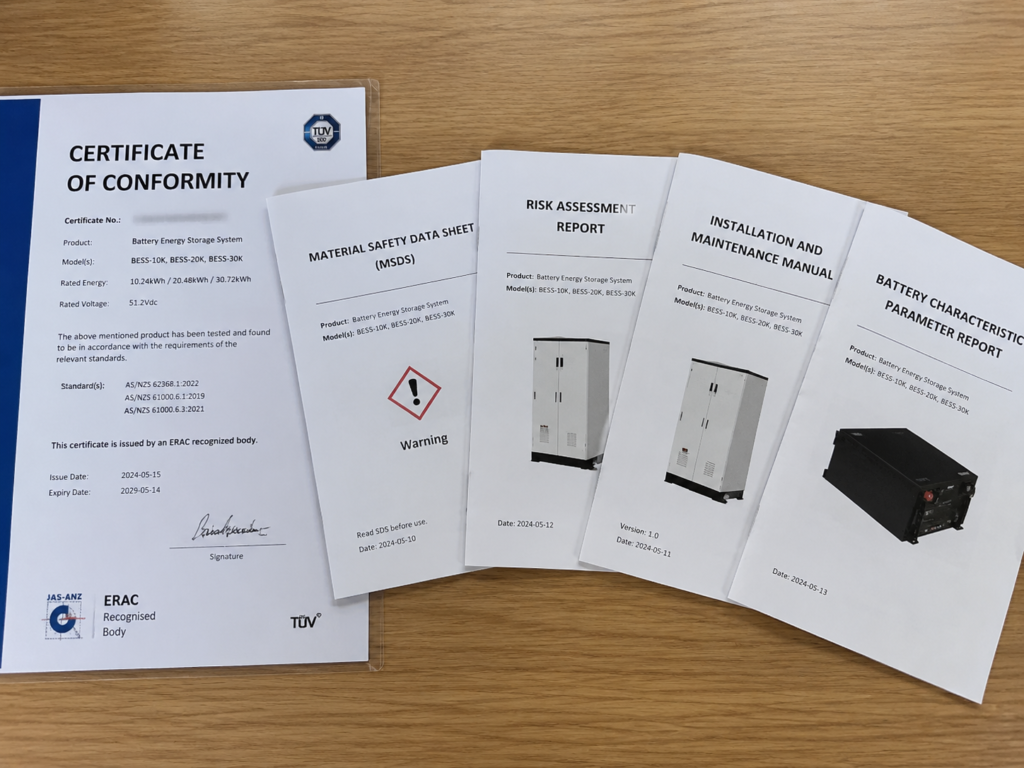
- Level 3 high-risk products: Must have a Certificate of Conformity (CoC) issued by an ERAC-recognized body, and the certificate must cover all sold models and all key safety components. For special high-risk categories such as energy storage, additional materials such as Material Safety Data Sheet (MSDS), risk assessment report, installation and maintenance manual, and battery characteristic parameter report are required.
- Level 2 medium-risk products: Need a test report compliant with Australian and New Zealand AS/NZS safety standards, plus a Declaration of Conformity (DoC) issued by the Responsible Supplier.
- Level 1 low-risk products: Although no registration is required, compliance test documents must be kept on file for regulatory spot checks.
There are also several general requirements for all documents: they must be in full English, within the validity period, and the product information (model, brand, rated parameters) on the documents must be completely consistent with the actual product — not even a single letter difference is allowed.
Usability Judgment of Existing Overseas Reports
Many sellers have already done overseas tests such as CE, UL, and CB before, and will ask if they can be used directly for EESS registration? The answer is: Cannot be used directly.
There are differences between AS/NZS standards in Australia and New Zealand and those in the European Union and the United States, so CE LVD reports, UL reports, and CB reports cannot be used directly to apply for EESS. But if your test standard is equivalent to AS/NZS and the test items are relatively fully covered, you can make up the difference test, and then apply with the supplementary test report.
Whether it can be used ultimately cannot be decided by yourself; it must be formally assessed by an ERAC-recognized body or your Responsible Supplier.
Product Labeling Meets Basic Specifications
The labeling on the product itself must also meet the requirements, otherwise even if the documents are fine, the application may be rejected:
- The product body must have clear parameters such as model number, manufacturer or Responsible Supplier name, rated voltage, and power, which cannot be erased or blurred.
- The RCM mark must use the official unified graphic style, the size and proportion cannot be changed arbitrarily, and it must be durable — it cannot fall off during use, let alone be replaced by just printing the three letters “RCM”.
- It is necessary to ensure that the RCM mark and related information can be traced back to the Responsible Supplier in accordance with applicable rules. A common practice is to mark the Responsible Supplier identification code, corresponding registration information, and other content that can be queried through the EESS public database. Do not only print the RCM graphic that cannot be linked to a specific responsible entity; the specific labeling method must comply with the relevant specifications of ACMA and EESS, and there may be detailed differences for different product categories.
- False or misleading compliance marks must never be labeled, such as using the CE mark as RCM, or printing a fake registration number.
Have a Valid EESS System Registration Account
The EESS registration account must be registered with the ABN information of the local Responsible Supplier, and must be bound with a valid local contact address, contact person, and work email. One account can manage multiple brands and multiple product series, so there is no need to register a separate account for each brand.
5. Full Operation Process: EESS Registration Steps and Key Checkpoints
After all prerequisites are met, you can proceed with the registration process. The entire process is completed online, with a total of 4 steps. Each step has checkpoints to pay attention to, and paying attention to them in advance can save you a lot of detours.
Step 1: Preparatory Document Preparation
First prepare all the materials completely, don’t find out you’re missing something halfway through filling out the form:
- First use ERAC’s official tool to confirm the product’s risk level, and organize the corresponding compliance documents;
- Confirm the Responsible Supplier and complete the account registration for the EESS system;
- Prepare a full set of product materials: model list, specification description, real photos of labeling, and all compliance documents.
✅ Key checkpoint: All compliance documents must have a validity period of at least 6 months remaining to avoid expiration halfway through the review; product information (model, brand, parameters) on all documents must be completely consistent, with no spelling errors or inconsistencies.
Step 2: Submit Registration Application Online
After the materials are prepared, you can log in to the official EESS online registration system to submit the application:
- Select the corresponding application form according to the product category, and accurately fill in information such as product model, rated parameters, brand, and applicable standards;
- Upload all prepared compliance documents;
- Pay the registration fee as prompted by the system. The fee is generally between tens to hundreds of Australian dollars per model, and high-risk categories will be more expensive. The specific amount shall be subject to the real-time display of the system.
✅ Key checkpoint: Responsible Supplier information and product model must be completely consistent with those on the compliance documents; if multiple models of the same series are registered together, they must comply with the official grouping rules — only products with the same manufacturer, same risk level, same applicable standards, and consistent key safety structures can be combined into the same registration, and unrelated models cannot be randomly grouped together.
Step 3: Official Review and Response to Supplementary Material Requests
After submission, it enters the official review stage, and the review cycle varies for products of different levels:
- Level 3 high-risk products: The official mainly checks whether the CoC you submitted is issued by an ERAC-recognized body, whether the validity period is correct, and whether the covered models are correct. The review cycle is usually 1-3 weeks;
- Level 2 medium-risk products: Mainly formal review, that is, checking whether the materials are complete and the information is correct. Only a small number of products will be selected for supplementary material requests. The review cycle is usually 1-2 weeks.
Common reasons for supplementary material requests include: inconsistent model numbers, missing pages in the report, expired certificate, and incorrect information filling.
✅ Key checkpoint: After receiving the supplementary material notice, carefully check the official requirements, make sure the supplementary content fully corresponds to the requirements, do not miss any items, and must submit within the specified time limit. If it times out, the application will be directly rejected.
Step 4: Successful Registration and Verification
After the review is passed, the system will generate a unique EESS registration number.
How to confirm that the registration is really successful? Don’t just look at the screenshot given by the agent — go query it yourself in the EESS public database. Only when your product registration information can be found is it truly valid.
The registration number has many uses: it needs to be filled in when listing on e-commerce platforms, downstream distributors will ask you to provide it for verification, and it can also be marked on the product packaging or the included manual for buyers to query conveniently.
6. Post-Registration Maintenance: Validity Period, Changes, and Compliance Obligations
Many people think that registration is a once-and-for-all thing, but that’s not the case. EESS registration has subsequent maintenance requirements. If not done well, the registration may become invalid or even be revoked.
Registration Validity Period Rules
EESS registration does not have a unified fixed validity period. Its validity depends on the continuous compliance and validity of supporting documents and the maintenance of system status. The specific period shall be subject to the requirements of the EESS system, certificates, and applicable regulations.
Usually, the CoC for Level 3 products is valid for 5 years. Before expiration or before the supporting documents become invalid, the CoC review/compliance document update must be completed, and the EESS registration records must be maintained simultaneously; if key compliance documents are not updated as required after expiration and the system status becomes invalid, the registration cannot continue to be used to support product sales or RCM labeling.
Information Change Scenarios That Must Be Reported
If product or entity information changes, you cannot modify it privately. You must submit a change application in the EESS system and upload the corresponding supporting materials:
Scenarios that require changes include: product model adjustment, replacement of key safety components, change of Responsible Supplier, update of product labeling, and update of compliance documents.
If you privately change the safety-related information of the product without reporting it, the registration will be directly revoked if found, and you may also face fines.
Special attention should be paid here: if it is a change of Responsible Supplier, both the old and new suppliers need to confirm jointly and go through the transfer procedures in the system. It is strictly forbidden to privately borrow someone else’s account to register your own product — this is a serious violation.
Daily Compliance Obligations
Even if the registration is successful, you must perform the following compliance obligations on a daily basis:
- All compliance documents, including test reports, certificates, and registration vouchers, must be kept for at least 5 years, which is a mandatory requirement under Australian law;
- If the regulatory department conducts a spot check, a complete compliance folder must be provided within the specified time, and no delay or refusal is allowed;
- If the product has safety hazards, a recall must be initiated proactively, and the registration status in EESS must be updated in a timely manner;
- Continuously track whether the applicable Australian and New Zealand standards are updated. If the standards change, timely assess whether your product is still compliant, and if not, rectify it as soon as possible.
Correct Usage Specifications for the RCM Mark
Many people rush to affix the RCM mark after completing EESS registration, only to be fined for improper use. Here we clarify the core rules:
- Mark form: Must use the official unified RCM graphic, cannot be deformed or discolored, and cannot be replaced by only the three letters “RCM”;
- Labeling position: Priority is given to labeling on the product body. If the product is too small (such as small earphones, small chargers), it can be labeled on the minimum sales packaging or the manual;
- Prerequisite for use: All applicable RCM requirements of EESS electrical safety, EMC, and radio (if the product has wireless functions) must be met at the same time before the mark can be affixed — affixing RCM only after completing EESS is false compliance and will be punished;
- Online sales: The product detail page must display the RCM mark, or provide a way to query EESS registration information.
7. Pitfall Avoidance Guide: 9 Registration Misconceptions Beginners Most Easily Fall Into
I have sorted out 9 pitfalls that beginners most easily fall into when doing EESS registration, divided into cognitive and operational categories. Each has a specific judgment method, and avoiding them in advance can save a lot of unnecessary money.
Cognitive Misconceptions
- Can you register directly with a test report? Incorrect. Level 3 high-risk products must have a CoC issued by an ERAC-recognized body, and test reports from ordinary third-party laboratories are invalid. Judgment method: Check whether the issuing body is on the recognition list on ERAC’s official website; reports from bodies not on the list have no registration validity.
- One registration number can cover all products? Incorrect. EESS is registered by model or series. Only products of the same series with the same manufacturer, same risk level, same applicable standards, and consistent key structures can be combined under the same registration number. Judgment method: Check the key structure, rated value, and coverage of compliance documents of the product; if inconsistent, they cannot be combined.
- Completed EESS registration = RCM certification fully done? Incorrect. EESS only covers the electrical safety link in the RCM system. Products must also meet all applicable requirements such as EMC and radio (if applicable) to legally use the RCM mark. Judgment method: Check whether the product has a wireless module and whether it falls within the EMC control scope; if any item is missing, labeling is not allowed.
- Can overseas sellers register EESS on their own? Incorrect. Overseas entities cannot directly apply for EESS registration, and must entrust a local Responsible Supplier holding a valid Australian ABN to handle it. Judgment method: Check whether the applicant entity holds a valid Australian ABN and local business qualifications.
- EESS is an exclusive requirement for energy storage systems? Incorrect. EESS is a safety supervision system covering all categories of low-voltage electrical equipment. Energy storage is just one of the high-risk categories it regulates. Don’t be misled by the similarity of abbreviations.
Operational Misconceptions
- Low-risk products also need registration to be sold? Incorrect. Level 1 low-risk products do not need registration, as long as compliance documents are kept on file for inspection, no additional registration fee is required.
- Product level can be judged by name/experience? Incorrect. It must be checked against ERAC’s official list or classification tool, otherwise it is easy to mistake Level 3 high-risk products for Level 2, and the penalty will be very heavy if found out.
- Platform listing/customs clearance = compliance? Incorrect. Platform review and customs clearance are only basic process checks, which do not mean that the product fully meets regulatory requirements. If subsequent regulatory spot checks find non-compliance, penalties will still be imposed in accordance with regulations.
- Energy storage products can be registered by only testing the battery cells? Incorrect. Energy storage products require complete system testing, including special requirements such as grid connection, thermal runaway, and protection functions. Testing only battery cells does not meet the registration requirements at all and cannot pass the review.
8. Quick Self-Check and Competency Summary
By now, you have a comprehensive understanding of EESS registration. Finally, here are two practical tools: one is a quick self-check list to help you judge whether you can submit registration now; the other is a core competency summary to help you clarify the compliance skills you have mastered.
EESS Registration Qualification Quick Self-Check List
You can tick the items below. If all are met, you can submit the application. If any are not met, complete them first before submitting to avoid rejection or supplementary material requests:
Product Qualification Self-Check
□ The product falls within the applicable scope of EESS low-voltage electrical equipment (voltage and scenario meet the requirements)
□ The product belongs to Level 2/3 mandatory registration level (confirmed with ERAC official tools)
□ Have valid compliance documents corresponding to the level (CoC for Level 3, test report + DoC for Level 2)
□ Product labeling (model, parameters, RCM mark) complies with official specifications
Entity Qualification Self-Check
□ A legal local Australian Responsible Supplier has been confirmed (holding a valid ABN)
□ The Responsible Supplier has registered an EESS system account
□ Have a valid local contact address and contact person
Document Consistency Self-Check
□ Product model, brand, and parameters are completely consistent across all documents
□ All compliance documents are within the validity period
□ Combined registration of series products complies with official grouping rules
If all are ticked, you can confidently submit the registration application according to the process; if there are unmet items, complete the corresponding qualifications first before applying, which can save a lot of time and costs.
Core Competency Summary
After learning this content, you can master these core compliance competencies:
- Can clearly distinguish the positioning and relationship between RCM and EESS, and avoid entry-level cognitive misconceptions;
- Can confirm whether the product needs EESS registration and the corresponding risk level through the 3-step judgment method, and independently complete preliminary compliance judgment;
- Can clarify the registration subject requirements, prerequisites, and the full application process, and know how to respond to supplementary material requests and verify registration validity;
- Can implement post-registration maintenance obligations and RCM mark usage specifications, and quickly assess their own registration conditions through the self-check list.
As long as you clarify the rule boundaries of EESS, you can independently complete most electrical safety compliance judgments, effectively reducing violation risks and unnecessary cost inputs.