
Many cross-border sellers entering the Australian and New Zealand markets for the first time are often confused when they first encounter RCM: what kind of certification is RCM exactly? What tests are required? Can small low-voltage products be exempted? Starting from basic definitions, this article covers core content of the entire process including test requirement judgment, interpretation of core test items, laboratory selection, and report validity verification, to help beginners establish a clear understanding of RCM compliance.
1. RCM Introduction: First Master These Most Easily Misunderstood Basic Facts
Practitioners who are new to RCM often simply understand it as the “market access certificate for Australia and New Zealand”, but this statement is not comprehensive. Let’s first clarify the core concepts:
The full name of RCM is Regulatory Compliance Mark, which is a compliance mark. In plain terms, it is the legal “entry pass” for products to enter the Australian and New Zealand markets. However, two core boundaries must be noted: first, “RCM testing” is not a single test, but a general term for multiple types of compliance tests such as electrical safety, electromagnetic compatibility, and radio frequency. Different products require different test combinations. Second, the RCM mark is affixed by the responsible supplier on its own; no official agency will directly issue an “RCM certificate”. The so-called “RCM certificates” on the market are actually common names for test reports or declarations of conformity, which must be kept in mind first.
Next, let’s talk about the regulatory differences between Australia and New Zealand. Many people think that Australia and New Zealand are the same market and one set of compliance documents is universally applicable, but this is not the case. In Australia, electrical safety is regulated by the EESS (Electrical Equipment Safety System), and electromagnetic compatibility (EMC) and wireless/telecommunications compliance are regulated by ACMA (Australian Communications and Media Authority). Although New Zealand recognizes most Australian and New Zealand standards, there are differences in registration processes, labeling requirements, and provisions on responsible entities. For products sold in both regions, compliance cannot be determined solely by Australian test reports, and New Zealand’s requirements need to be confirmed separately.
RCM is not an optional “bonus item”, but a legally mandatory requirement. Non-compliant products sold may face fines, forced removal from shelves, or even recalls. In actual scenarios, customs clearance, e-commerce platform entry, offline retailer procurement, and even insurance claims after product problems all require compliance evidence. Its core role is also clear: to reduce public safety risks such as electric shock, fire, and electromagnetic interference, which essentially protects consumers.
Finally, clarify the 3 most common beginner misconceptions to avoid taking detours at the beginning:
- It is not true that small/cheap/USB-powered products do not need testing. Even low-voltage products powered by 5V, as long as they have digital circuits or wireless functions, may still be subject to EMC or wireless regulations, except that high-voltage safety testing is not required.
- It is not true that having overseas certifications (such as CE, FCC, CB) can directly replace RCM. Standards and local requirements vary by region. Usually, supplementary Australia-New Zealand difference tests are needed, and they cannot be used directly.
- It is not true that only reports from Australian local laboratories are valid. As long as they have the required qualifications, laboratories both domestic and overseas are recognized. There is no need to specifically choose Australian local institutions, provided that the laboratory has ISO/IEC 17025 accreditation recognized by NATA or ILAC, and the accreditation scope covers the specific standards applicable to the product.
2. Quick Initial Judgment: Does Your Product Need RCM Testing?
To determine whether a product needs RCM testing, you can first conduct a quick initial screening through simple logic: as long as the product uses electricity (plug-in, rechargeable, built-in battery all count) or can actively transmit wireless signals, it is likely to need RCM-related testing.
Of course, there are clear exclusion scenarios: purely mechanical products without any electrical components (such as manual screwdrivers, plastic water cups), products with special regulatory regulations such as medical/automotive products, and items for personal use not for sale do not need RCM testing.
There are several types of boundary products that require special attention to the judgment rules: first, low-voltage battery-powered products themselves may be exempt from high-voltage safety testing, but the matching chargers and adapters need to be evaluated for compliance separately. Second, USB-powered low-voltage products with digital circuits or wireless functions still need to meet EMC or radio frequency regulatory requirements. Third, products with only wireless receiving functions (such as ordinary FM radios, pure GPS receivers/navigation devices) do not need additional radio frequency testing, but still need to evaluate EMC as required. Fourth, if receiving equipment is equipped with any active transmission module (such as cellular backhaul, Bluetooth pairing), it needs to be managed as a wireless transmission product.
After confirming that testing is needed, we can divide the tests into several categories according to power supply and function:
- Basic assessment logic: products subject to electrical safety control need to complete corresponding safety tests; most plug-in electronic products, those with digital circuits or that generate electromagnetic interference need to complete EMC assessment.
- Additional testing: products with active wireless transmission functions such as WiFi, Bluetooth, remote control, cellular network, and RFID need to additionally complete radio frequency assessment.
- Special supplements: products with laser, battery, or industrial control functions also need to comply with corresponding special regulatory requirements, and cannot only cover basic test items.
The strictness of testing and registration is directly related to the electrical product risk level of Australia’s EESS. The requirements for different risk levels are clearly different. Here is a clearer table:
| EESS Risk Level | Risk Degree | Core Requirements | Registration Requirements |
|---|---|---|---|
| Level 3 | High risk | A compliance certificate must be issued by an accredited third-party institution | Mandatory registration in the EESS database |
| Level 2 | Medium risk | Complete testing in accordance with AS/NZS standards, self-declare compliance | Mandatory registration in the EESS database |
| Level 1 | Low risk | Self-save compliance evidence such as test reports | Some states require registration, no mandatory equipment registration |
It should be noted that the above registration requirements only apply to EESS database registration at the equipment level. Although Level 1 products usually have no mandatory equipment registration requirements, responsible supplier registration, compliance record keeping, labeling specifications, and specific registration obligations of some states/regions still need to be confirmed one by one in accordance with applicable regulations. The risk level is clearly defined by the EESS statutory list, and cannot be judged independently by product appearance, selling price, or function name.
Finally, let’s talk about the division of compliance responsibilities: the responsible supplier must be a locally registered entity in Australia or New Zealand, and bears full legal responsibility for product compliance. Overseas manufacturers or cross-border sellers must entrust a local importer or authorized representative as the responsible entity, and cannot directly affix the RCM mark on the product themselves. Even distributors or platform sellers need to verify upstream compliance documents, and cannot exempt themselves from responsibility on the grounds of “I don’t know”.
3. First Core: Core Requirements for Electrical Safety Testing
Electrical safety is the first core of RCM testing. After all, it involves personal safety, and the requirements are the strictest. If it fails, it is a one-vote veto with no room for negotiation.
The goal of electrical safety testing is simple: to verify that the product will not cause electric shock or fire during normal use or in the event of foreseeable minor faults. Its applicable voltage range is usually electrical products with 50V AC to 1000V AC, or 120V DC to 1500V DC. Products below this voltage threshold are usually not required to carry out high-voltage electrical safety testing, and other compliance requirements need to be determined separately according to product functions.
The core items of electrical safety testing can be divided into four categories, which can be understood with daily logic:
The first category is electric shock protection: whether during normal use or when minor faults occur, people cannot touch the internal live parts. For example, the gap of the charging port must not be too large, so that fingers cannot reach the copper contacts when inserted; the enclosure must not be easily disassembled, or all live parts are covered with insulating layers after disassembly.
The second category is temperature and fire protection: when the product is working normally, the temperature of each component must not exceed the bearing limit of the material. For example, the enclosure must not be deformed by heat, and the power cord must not melt due to excessive temperature. Even if a fault such as a short circuit occurs inside, flammable components must not be ignited, and the fire must not spread.
The third category is mechanical structure strength: for example, after the enclosure is subjected to a certain degree of impact, or the power cord is pulled hard, no live wires will be exposed, and internal wiring will not come loose, so there is no risk of electric shock.
The fourth category is insulation and grounding: when high voltage is applied to the product for testing, the insulating layer will not be broken down; if it is a product with a metal enclosure, in case of internal leakage, the current can be safely conducted away through the grounding wire, and will not electrocute people who touch the enclosure.
In actual testing, common reasons for non-conformity and rectification directions are also clear:
- Structural problems: such as too large enclosure openings, insufficient insulation of the charging port. The rectification direction is generally adding insulating layers, reducing gaps, and adjusting structural design.
- Material problems: such as insufficient temperature resistance of the power cord, low flame retardant grade of the enclosure. The rectification direction is to replace qualified temperature-resistant and flame-retardant materials.
- Component problems: such as plugs not conforming to Australian standards, adapters without compliance certification, key components inconsistent with those declared. The rectification direction is to replace compliant components and ensure that key parts are consistent with the declaration.
Finally, let’s talk about exemption rules and standard selection logic: low-power products powered by safety extra-low voltage can be exempted from some high-voltage related test items, but not all. For example, basic requirements such as mechanical strength and electric shock protection still need to be met. Standard selection should be based on the actual use of the product: for lamps, use the safety standard for lamps; for home appliances, use the one for home appliances. If it is a multi-functional product, select the standard according to the function with higher risk. Overseas standard materials such as IEC/EN/CB can be used as reference for product standard selection and difference assessment, and there is no need to start compliance assessment from scratch.
4. Second Core: Core Requirements for EMC Electromagnetic Compatibility Testing
The core logic of electromagnetic compatibility (EMC) can be summarized into two points: first, the product will not randomly emit electromagnetic waves to interfere with the normal operation of other electronic equipment; second, the product will not malfunction due to interference from external electromagnetic waves. It should be noted that EMC control has nothing to do with whether the product has wireless functions. The vast majority of plug-in products with digital circuits need to complete testing, such as ordinary USB chargers and plug-in LED desk lamps are within the scope of control.
EMC testing is mainly divided into two categories: emission testing (to see how much interference the product propagates outward) and immunity testing (to see how well the product resists external interference). The specific core test items are as follows:
- Conducted emission: the intensity of interference that the product propagates to the power grid through the power cord, which must be lower than the limit of Australian and New Zealand standards. Otherwise, plugging in a charger may affect other devices on the same power strip.
- Radiated emission: the intensity of electromagnetic wave interference that the product propagates outward through the air, which must not exceed the limit. Otherwise, it may interfere with nearby devices such as radios and routers.
- Immunity testing: whether the product can work normally when encountering common external interference, or can recover by itself after minor faults. For example, electrostatic discharge in winter, surges during thunderstorms, and interference from nearby high-power equipment must not directly cause product damage.
There are also two supplementary items: harmonic current and voltage fluctuation, which are only mandatory for some high-power products or lighting products, and not all products need to be tested.
EMC problems of several types of products are more prominent and require special attention: consumer electronics (computers, chargers, routers, smart home devices), lighting products (LED lamps, driver power supplies, dimmers), home appliances and tools (home appliances with switching power supplies or motors, electric tools), commercial equipment (POS machines, industrial control equipment, networked terminals). If your product belongs to these categories, it is best to do EMC pre-testing in advance to avoid failing the formal test.
There are several key variables in EMC testing that are easily overlooked and directly affect test results:
The first is working mode: the interference intensity emitted by the product may be different in different modes such as standby, high load, charging, and communication. Therefore, testing must cover all working modes, otherwise the result will be inaccurate.
The second is configuration changes: if you add a docking station to the product, replace different cables, or replace the plastic enclosure with a metal one, it may change the EMC performance, and need to be re-evaluated. The original test results cannot be used directly.
The third is result margin: if the measured value during testing is just close to the limit, then due to minor differences in components during mass production, it is likely to exceed the limit and become unqualified. Therefore, it is best to leave enough margin during design.
5. Additional Testing: Radio Frequency Requirements for Products with Wireless Transmission Functions
Products with active wireless transmission functions need to add radio frequency testing on the basis of safety and EMC testing, which is a requirement that many sellers easily miss.
The judgment logic is consistent with the boundary rules in Chapter 2: products with active transmission functions such as WiFi, Bluetooth, remote control, cellular network, and RFID need additional testing; products that only receive wireless signals (such as ordinary FM radios, pure GPS receivers/navigation devices) do not need additional radio frequency testing, but still need to evaluate EMC according to rules. If the device is equipped with cellular, Bluetooth, LoRa, WiFi, or any transmission module with backhaul or remote control functions, even if GPS itself is only used for receiving, it still needs to complete radio frequency assessment as a product with wireless transmission functions. Simply put, as long as the product can connect to WiFi/Bluetooth, or can remotely control other items, it is basically within the scope of radio frequency testing.
There are also three core requirements for radio frequency testing, with clear logic:
- Frequency band compliance: the working frequency of the product must be within the open frequency bands allowed by Australia and New Zealand, and must not occupy prohibited frequency bands. Otherwise, it will interfere with legal wireless services, such as broadcasting and aviation communications.
- Power compliance: the maximum transmission power must not exceed the limit of Australian and New Zealand standards. The greater the power, the stronger the interference, so there is a clear upper limit requirement.
- Spectrum compliance: the occupied bandwidth and spurious emission of the product must meet the requirements, and must not randomly transmit signals in other frequency bands in addition to normal signals.
Many people will ask: the wireless module I use has been certified, so does the whole machine not need to be tested for radio frequency? The answer is no. Certified modules can indeed reduce part of the repeated test scope, but cannot completely replace the whole machine test. For example, if the module is installed in a metal enclosure, the signal will be shielded or reflected, and the transmission characteristics will change; or if a higher gain antenna is replaced, the antenna position is changed, or the transmission power is increased, these will affect the radio frequency performance and need to be re-evaluated. Moreover, the whole machine also needs to test electrical safety, EMC, labels, instructions, and other content not covered by module certification.
Finally, let’s talk about several special requirements and common pitfalls of radio frequency testing:
The first is radio frequency exposure (SAR) assessment: high-power wireless products used close to the human body, such as mobile phones and walkie-talkies, may need to do SAR testing, that is, to assess the impact of wireless radiation on the human body. Whether it needs to be done shall be subject to the corresponding standard requirements.
The second is high-frequency pitfall: many 433MHz frequency band remote control products allowed in China or Europe and America are prohibited in Australia and New Zealand, because these frequency bands are occupied by other local services. Be sure to confirm whether the frequency band is legal before proceeding.
Third, special attention should be paid: even if the wireless function of the product can be manually turned off, as long as it has this function, the radio frequency compliance assessment must be completed when it goes on the market. You cannot evade testing on the grounds that “users can turn it off”.
6. Practical Preparation: Core Work Before Testing
The adequacy of preparation before testing directly affects the rework probability and compliance cycle, and the following content needs to be implemented in advance:
First, clarify the core information of the product before testing. The more complete the information given to the laboratory, the more accurate the quotation and schedule, and no test items will be missed:
- Basic information: product model, brand, power supply method, rated voltage/current/power, expected use scenario (household or industrial use).
- Functional information: whether there is wireless transmission function, whether there are heating components, whether there are exposed metal structures.
- Sales information: whether the target market is only Australia, only New Zealand, or both; sales channel is e-commerce or offline retailers; planned launch time, to facilitate the laboratory to arrange the schedule.
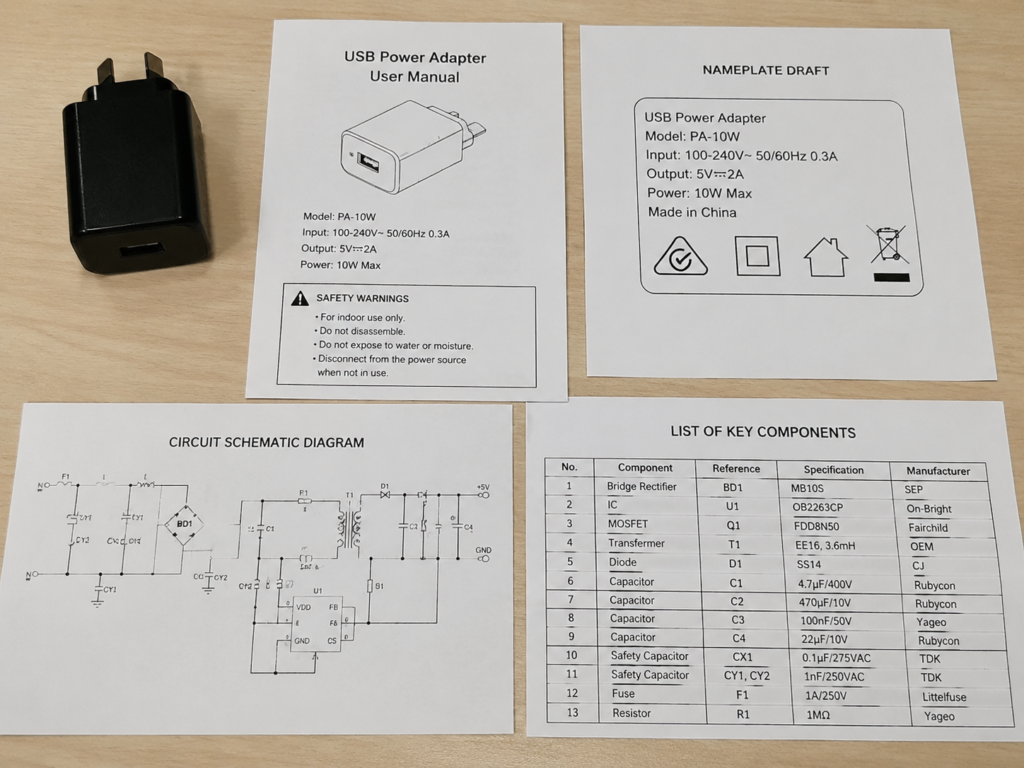
Next are the technical documents to be submitted, which are roughly divided into two categories:
- Basic documents: English manual (must include safety warnings, rated parameters), nameplate draft, multi-angle photos of the product.
- Technical documents: circuit schematic diagram, list of key components. If there is a wireless module, the module’s specification sheet and certification certificate must also be provided.
There is a very common pit here: the parameters of the submitted documents must be completely consistent with the actual samples sent for testing. For example, the manual says the input is 100-240V, but the sample can only use 5V, then the test will definitely have to be reworked, wasting time and money.
Then the basic requirements for test samples, which is very important. If the samples do not meet the requirements, the test is useless:
- Quantity requirement: 1-3 units of final mass-produced samples are enough for conventional products. Products with multiple configurations (such as two versions with and without Bluetooth) need to add samples appropriately, subject to the laboratory’s requirements.
- Status requirement: must have the final enclosure, final power supply configuration, all accessories sold with the product, and can cover all working modes. Test results of hand-made prototypes, modified board machines, and samples with parameters inconsistent with the mass-produced version are not recognized.
- Power supply requirement: plug-in products must comply with Australian standard power supply parameters (230V/50Hz), otherwise they cannot even work normally, let alone carry out testing.
Finally, let’s talk about how to choose a qualified laboratory. You don’t need to look at the size of the reputation, just grasp two core standards:
First, look at qualifications: must have ISO/IEC 17025 accreditation recognized by NATA (Australian local accreditation body) or ILAC (International Laboratory Accreditation Cooperation). Simply put, it has formal testing qualifications, and the reports issued can be recognized by Australian and New Zealand regulatory authorities.
Second, look at capability: don’t just look at having 17025 qualification, but also check whether the laboratory’s qualification scope covers the specific test standards of your product. For example, this laboratory can only test home appliance safety. If you take a product with Bluetooth there, it has no radio frequency testing qualification, and the report issued is useless.
Also, avoid a pitfall: do not blindly trust promises of “guaranteed pass”. Test results are determined by the compliance of the product itself; laboratories only conduct objective testing. Compliant products will pass, non-compliant ones will not. The so-called “guaranteed pass” is either done by cutting corners and omitting tests, or requires you to pay extra for rectification later, which is actually unreliable.
7. Advanced Must-Know: Full Compliance Process and Report Validity Judgment
Testing is only one part of RCM compliance. The complete compliance process is as follows:
Step 1: Confirm product classification, risk level, implement local responsible suppliers in Australia and New Zealand, and clarify the target market.
Step 2: Select applicable Australian and New Zealand standards according to product type, and complete all necessary tests such as electrical safety, EMC, and radio frequency.
Step 3: Rectify non-conforming items, and re-test to confirm all items are qualified.
Step 4: Establish a complete technical file, keep it for at least 5 years in accordance with regulatory requirements (the specific duration is subject to applicable regulations), and issue a declaration of conformity stating that the product meets all applicable standards.
Step 5: Complete the registration required by regulations (such as EESS registration), and then correctly affix the RCM mark on the product as required.
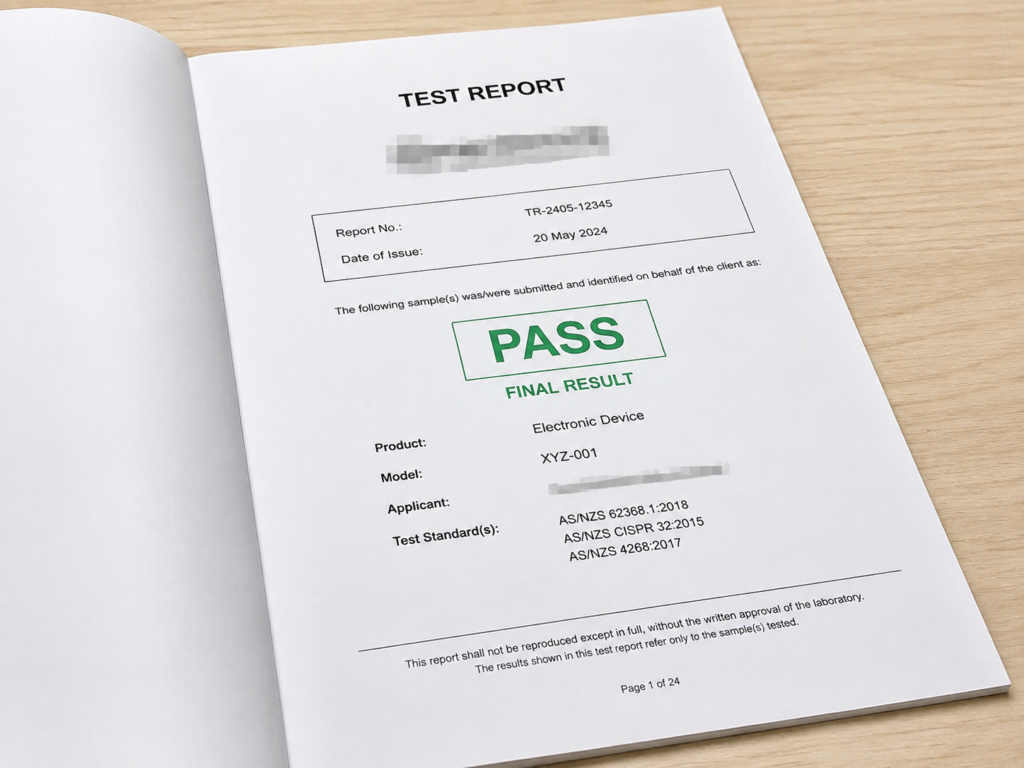
After getting the test report, you don’t need to stare at the full page of professional data. Grasp a few core points to quickly understand the conclusion:
First, look at the cover page: whether there is a final pass/fail conclusion, which standard the test is based on, whether the report number and date are valid.
Then look at the detail pages: what is the limit for each test item, what is the measured value, and whether the result is PASS or FAIL. There is no need to understand the technical meaning of each professional test item one by one; just focus on whether there are any unqualified items.
Also pay attention to rectification priority: unqualified items related to electric shock protection and fire protection in the safety category are high-risk problems, which must be rectified first, and should not enter mass production with problems; unqualified EMC items also cannot be used for compliant listing, but usually can be rectified and re-tested through filtering, shielding, grounding, adjusting wiring, etc.
Many people don’t know if the report is valid after getting it. Here is a verification checklist, just check against it:
- Qualification verification: the qualification of the laboratory issuing the report is within the validity period, and the qualification scope covers the specific standards used in the test. It is not that having a 17025 qualification is everything.
- Consistency verification: the product model, software and hardware version, and key component models in the report must be completely consistent with the actual mass-produced version. Even if a key capacitor is replaced, it may cause the report to be invalid.
- Standard verification: the standard used in the test is the current valid version recognized by Australian and New Zealand regulations, and outdated old standards cannot be used.
- Scope verification: the report covers all applicable test items. It cannot be that only safety is tested but EMC is not, or only the version without wireless is tested, but the version you sell is with wireless.
Finally, let’s talk about the rules for report reuse and retesting. Many people have old reports or overseas reports and don’t know if they can be used:
- Reusable scenarios: the same model product only has different colors or packaging, or the core circuit and key components of the same series of products have not changed. In this case, the original test report can be reused, no need to retest all items.
- Conditional reuse scenarios: if you have overseas certification reports such as CE, FCC, CB, you don’t need to retest all items. But only when the corresponding standard version, test items, sample configuration, laboratory qualification, and test scope of the report are accepted by Australian and New Zealand regulations, can the corresponding test data be reused. Usually, supplementary local Australia-New Zealand difference assessment or testing is still required.
- Non-reusable scenarios: the report only covers similar products not the same model, key configuration is inconsistent with the mass-produced version, test standards have been updated. In these cases, the report cannot be used.
- Mandatory retest scenarios: replacement of key components, modification of circuit structure, addition of new functions, update of regulations or standards. In these cases, retesting must be carried out, and old reports cannot continue to be used.
There is an exception: if it is only a software update, and the update does not change the product’s safety performance, EMC performance, or wireless transmission performance, such as only changing the operation interface, then no retesting is required. But if the software update changes the wireless transmission power, or changes the parameters of the protection circuit, it needs to be re-evaluated.
8. Pitfall Avoidance Guide: Sorting Out High-Frequency Compliance Risks
First, common pitfalls in the test execution stage:
The first pit is that the test sample is not the final mass-produced version. Many people, in order to save time, take engineering prototypes for testing. As a result, the mass-produced version is modified after the test, resulting in the test results not being recognized, and they have to retest, which is slower instead.
The second pit is that document parameters are inconsistent with the actual sample. For example, the rated parameters in the manual are written incorrectly, or the list of key components is different from the actual ones used, which will lead to test rework, wasting time and money.
The third pit is that the applicable standards for the product are not confirmed in advance. For example, the product has wireless function, but only safety and EMC tests are arranged, missing radio frequency testing, which finally makes it impossible to go on the market compliantly, and supplementary testing is needed.
Then are the compliance risks after mass production and listing. Many people think that after testing, it’s once and for all, but it’s not:
The first risk is unauthorized replacement of key components, enclosures, and accessories. For example, in order to reduce costs, replace the original flame-retardant enclosure with ordinary plastic, or replace the compliant adapter with a cheap one. This will change the product’s safety, EMC, or radio frequency performance, the original compliance report will be directly invalidated, and you will be fined if found.
The second risk is failure to keep technical files as required. Many people lose the report after testing, or do not organize a complete technical file. When the regulatory authority conducts random inspections, they cannot produce it, which is directly regarded as non-compliant, even if the product itself is qualified, it is useless.
The third risk is failure to re-evaluate after product modification. For example, adding a Bluetooth function to the original ordinary desk lamp, or modifying the circuit, but still using the original test report. This is non-compliant, and if found, you will face fines, removal from shelves, or even recall.
Finally, common omissions in the compliance chain. Many people pass all tests, but fail on these small things:
The first omission is no registered local responsible supplier in Australia or New Zealand. The RCM mark must be affixed by a locally registered responsible supplier in Australia or New Zealand. If overseas sellers do not find a local importer or authorized representative, they cannot legally affix the RCM mark, even if all tests are passed.
The second omission is failure to complete statutory registration or registration requirements. High-risk electrical products belonging to EESS Level 3 must complete product registration in the EESS database before going on the market; EMC, wireless, and telecommunications products controlled by ACMA need to complete responsible supplier registration, keep compliance records, and meet labeling and declaration requirements as required. Whether product-level registration is required shall be subject to applicable regulations and specific product categories; it is by no means enough to just test and affix the mark.
The third omission is that the RCM mark does not meet the requirements. There are clear requirements for the position, size, and durability of the RCM mark. For example, if it is too small to see, comes off when scratched, or is pasted in a place that is not easy to see, it is regarded as invalid marking, even if the test is qualified.
Summary: Quick Self-Check List
Finally, we summarize the core requirements of RCM testing in one sentence: match the corresponding Australian and New Zealand standards according to the product type, complete electrical safety + EMC testing (add radio frequency testing for products with wireless transmission functions), cooperate with completing necessary registration and technical file management, then you can use the RCM mark compliantly.
If you want to quickly self-check your product’s test requirements, you can follow these four steps:
Step 1: Determine whether the product is an electrical/wireless product, and confirm whether RCM testing is needed.
Step 2: Clarify the product’s risk level and your sales role, and confirm test qualification requirements and compliance responsibilities.
Step 3: Determine the test scope of electrical safety and EMC according to the product’s power supply method and core functions.
Step 4: Check whether the product has wireless transmission function, and confirm whether additional radio frequency testing is needed.
After learning these, you should be able to independently judge these things: whether your product needs RCM testing, roughly what types of tests are required; what materials to prepare before testing, how to choose a qualified testing laboratory; whether the test report you get is valid, whether old overseas reports can be reused; which situations require retesting, how to avoid common compliance pitfalls. The compliance judgment of boundary products shall be subject to the official regulatory list or the verification results of qualified laboratories.