
Ordinary consumers who buy charging cables and chargers in Great Britain (GB), or sellers engaged in cross-border sales of charging products, often come across statements related to the UK REACH SVHC List: some call it a “prohibited list of harmful substances”, some believe that having the UKCA mark means no attention needs to be paid, and others directly use EU REACH documents to deal with the UK market — all these cognitions have deviations.
Combined with common charging products such as chargers, power adapters, charging cables, and USB plugs, this article systematically sorts out the basic concepts, compliance judgment logic, practical methods and common misconceptions of the UK REACH SVHC List, for readers of different roles to refer to.
Basic Knowledge
What is the SVHC List, and Who is Responsible for Its Management?
The UK REACH SVHC List is the Candidate List of Substances of Very High Concern under the UK REACH regulatory framework implemented independently after Brexit, and can be understood as the UK’s high-risk chemical observation list.
The management responsibilities for the list are divided into two levels: the Secretary of State for the UK has the final say on whether a substance is officially included, and the Health and Safety Executive (HSE) is responsible for specific implementation, technical support, and official information release.
Its core control logic is: first require information disclosure, then gradually escalate control according to risks; it is not the case that all substances on the list are prohibited from use.
Applicable Regions and Dual-Market Boundaries
The scope of application is the most confusing issue at the entry stage, and three types of boundaries need to be clarified:
• The core applicable area is only Great Britain (GB, i.e. England, Scotland, Wales). For charging products sold to GB, the SVHC compliance judgment must be based on the UK REACH Candidate List as the legal basis;
• Due to the special Brexit arrangements, Northern Ireland applies the EU REACH SVHC List, not the UK version;
• Products sold to both GB and Northern Ireland need to be evaluated against the two lists respectively, and a single list cannot cover both markets.
The difference between the lists stems from the fact that the UK initially inherited the EU REACH List after Brexit and then conducted independent evaluations and updates. At present, the substances in the two lists are not completely consistent. A list or statement only marked with EU REACH cannot alone prove compliance in the GB market; if supplier materials simultaneously cover the version of the UK REACH Candidate List, corresponding substances, and applicable dates, they can be used as the basis for GB compliance assessment.
Reasons for Attention to Charging Products
Charging products have a high correlation with the SVHC List, mainly for three reasons:
First, strong component correlation: Common components such as the PVC outer sheath of charging cables, plastic shells of chargers, metal plating of plugs, and solder of circuit boards are often added with SVHC chemicals during the production process;
Second, high exposure risk: Charging products are items that are frequently held, plugged and unplugged in daily life. If components contain high-risk substances, they may slowly migrate and come into contact with the human body;
Third, clear compliance consequences: Failure to perform SVHC-related obligations may result in consumer complaints, regulatory enforcement investigations, product recalls, and even restrictions on sales in the GB market.
Core Entry-Level Misconceptions
People who are new to this often have three types of cognitive biases, which need to be clarified in advance:
1. “The SVHC List is a prohibition list”: Wrong. It is an observation list of substances of very high concern, with the core requirement of information disclosure; it is not that all listed substances are prohibited from use;
2. “Products containing SVHC are unqualified”: Wrong. 0.1% (w/w) is the trigger threshold for obligations such as Article 33 information transfer, not a product qualification judgment line. When the concentration of a candidate list substance in an Article is lower than 0.1%, the SVHC-related information disclosure obligation is not triggered, but it is still necessary to separately check the prohibition and restriction requirements of the UK REACH Restriction List (Annex 17), UK RoHS and other applicable regulations, and cannot be directly equated with “fully legal”;
3. “Having a UKCA/CE mark is equivalent to SVHC compliance”: Wrong. UKCA and CE are conformity marks under applicable product regulations, which may cover requirements in areas such as safety, electromagnetic compatibility, and environmental protection, but they cannot alone prove that the information transfer, consumer response, or notification obligations of UK REACH SVHC have been fulfilled. The two belong to independent compliance systems.
List Operation Rules and Control Boundaries
Substance Inclusion Criteria
Substances that can be included in the SVHC List are all highly hazardous substances confirmed through scientific evaluation, mainly divided into three categories:
• CMR category: Refers to carcinogenic, mutagenic, or reproductive toxic substances classified as category 1A or 1B in accordance with the CLP classification rules adopted by the UK. Carcinogenicity means may induce cancer, mutagenicity means may damage genetic material, and reproductive toxicity means may have adverse effects on reproductive function and fetal development; the specific substances included in SVHC shall be subject to the specific entries in the official UK REACH Candidate List.
• PBT/vPvB category: PBT refers to persistent, bioaccumulative and toxic substances, and vPvB refers to very persistent and very bioaccumulative substances, that is, substances that are difficult to degrade in the natural environment, easy to accumulate in organisms and difficult to excrete, and are toxic at the same time.
• Equivalent hazard category: Substances whose hazard level is confirmed to be equivalent to the first two categories through official scientific evaluation, such as some endocrine-disrupting substances that meet the conditions after evaluation.
List Update and Entry into Force Rules
The UK REACH SVHC List has no fixed update cycle. The entire process from substance evaluation proposals, public consultation to final inclusion is subject to the official announcement of HSE.
When judging compliance, key dates need to be checked in the following order, and a single announcement date cannot replace item-by-item verification:
1. First confirm the currently referenced official Candidate List version, record its release date, and keep the archived link or file of the announcement as the basis for the timeliness of the list;
2. Then check the official inclusion date of the specific substance, that is, the legal effective date when the substance is included in the UK REACH SVHC Candidate List;
3. Finally, correspond to the obligation trigger rules respectively: the Article 33 information transfer and consumer response obligations are triggered from the effective date of the substance inclusion announcement; the 6-month declaration period for the Article 7(2) notification obligation is calculated from the date of inclusion of the substance. If the official announcement stipulates special transitional arrangements, the scope of application and date of the announcement shall prevail.
Due to the dynamic update of the list, compliance judgment needs to record the release date of the queried list version, the EC/CAS number of the corresponding substance (the unique identity code of chemicals, which can avoid confusion due to the same name), and the officially clarified applicable date of obligations. Historical query conclusions cannot be directly applied to the new version of the list.
Applicable Boundaries of Substances, Mixtures and Articles
UK REACH has different control obligations for chemicals in different forms, and relevant parties involved in charging products can correspond according to the following categories:
1. Pure substances: Such as pure chemical raw materials for production, mainly subject to UK REACH obligations such as registration, Safety Data Sheet (SDS), and restrictions, and the responsibility is mainly borne by raw material manufacturers;
2. Mixtures: Raw materials made by mixing multiple substances, such as production glue, coatings, and solder paste, are also mainly subject to obligations such as registration, SDS, and restrictions, and the responsibility is mainly borne by raw material suppliers;
3. Articles: Defined by law as “products whose function is determined by their fixed shape, surface or design”, that is, finished products or components that have been made into a specific form and realize their functions through appearance/structure, such as separately sold USB-C plugs and charging cables. The Article 33 information transfer and Article 7(2) notification obligations focused on in this topic all take SVHC in articles as the judgment object.
It should be noted that raw material suppliers bear the corresponding compliance obligations for the substances/mixtures they supply, and cannot replace the SVHC compliance responsibilities of downstream finished product manufacturers for articles.
Article Boundaries of Complex Articles
Actual products are mostly composed of multiple components, such as power adapters with fixed cables. Such products are usually called “complex articles” — they are not a fourth type of legal object independent of articles, but a product combination composed of one or more independent articles. When judging obligations, it is necessary to first identify each independent article, and then calculate the concentration respectively.
To judge whether a component is an independent article, the core basis is the legal definition: whether the component has a function independent of the whole product, determined by its shape, surface or design. The following two points are only auxiliary clues for factual judgment and cannot replace the legal definition:
• Whether the component has a use function independent of the whole;
• Whether the component can be separately disassembled and replaced, and its own function will not be damaged after disassembly. It should be specially noted that replaceable components do not automatically constitute independent articles, and non-replaceable components are not automatically excluded from independent articles. In the end, it is still necessary to return to the core standard of “whether the shape, surface or design determines the independent function”.
In addition, it is necessary to distinguish between homogeneous materials and articles: homogeneous materials are the smallest uniform units split during laboratory testing (such as the PVC outer sheath of charging cables, the wear-resistant coating on the shell), but whether a homogeneous material is an independent article must be judged according to the legal definition, and the test split unit cannot be directly equated with an article. For example, for the wear-resistant coating on the charger shell, if it is confirmed through evaluation that its shape, surface or design does not have a function independent of the shell, and it belongs to the same article as the shell, the weight of the coating must be included in the total weight of the entire shell when calculating the concentration, and cannot be calculated based on the weight of the coating alone; the same applies to integrally formed embedded components, which cannot be identified as independent articles just because they can be split during testing.
Division of Supply Chain Responsibilities
Different parties bear different obligations in SVHC compliance, and each is responsible according to legal division:
• UK-based manufacturers: Responsible for sorting out the SVHC information of products, transferring relevant information downstream, and performing notification obligations when legal conditions are met;
• GB importers: One of the primary responsible persons for UK REACH compliance, they need to verify the compliance materials of upstream suppliers, perform consumer response obligations, and perform notification obligations when conditions are met;
• Distributors/retailers: Responsible for transferring the obtained SVHC information downstream and cooperating with consumer inquiries;
• Cross-border e-commerce sellers: The responsibility needs to be comprehensively judged in combination with import arrangements, customs declaration entities, cargo ownership transfer nodes, sales terms, etc. For example, under DDP terms, the seller usually arranges import, but whether it constitutes an importer in the sense of UK REACH depends on the actual declaration entity and the division of supply chain responsibilities, and cannot be directly judged solely by trade terms;
Each responsible entity needs to keep the information required for the performance of its applicable obligations and available for regulatory verification: manufacturers and GB importers usually need to keep full-chain materials such as article identification, quantity calculation, and notification basis; distributors and retailers only need to keep upstream and downstream documents related to their own information transfer and consumer response obligations, and do not need to obtain complete full-chain materials.
Differences Between the Three Types of REACH Control Lists
Many people think that the SVHC List is the whole of REACH. In fact, UK REACH has three types of control lists with different mechanisms. The most commonly contacted one for charging products is the SVHC Candidate List. The core differences between the three are as follows:
| List Type | Core Control Mechanism | Involvement in Charging Products | Core Judgment Points |
| SVHC Candidate List | Information disclosure and notification under specific conditions | Most frequently involved | When the concentration in a single Article exceeds 0.1%, the Article 33 information transfer and consumer response obligations are triggered; when legal conditions are met, the Article 7(2) notification obligation is triggered |
| Authorization List (Annex 14) | Use authorization management | Less involved | High-risk substances selected from the Candidate List, not all are fully prohibited upon inclusion; it is necessary to judge whether they can be used legally in combination with the sunset date, applicable uses, authorization status and exemption situations of specific substances |
| Restriction List (Annex 17) | Restriction/prohibition of specific uses | Partially involved | The rules are independent of the SVHC Candidate List. It is necessary to check applicable substances, product scope, concentration limits and use requirements according to specific clauses. Not all listed substances are fully prohibited |
The three types of lists have different mechanisms and apply separately. Not all substances are upgraded sequentially from the Candidate List, Authorization List to Restriction List, and the Restriction List does not require substances to enter the Candidate List first. The conclusion of “usable/unusable” cannot be directly drawn solely from the name of the list.
Control Scope and Risk Priority of Charging Products
Scope of Charging Products Under Control
All chargers, power adapters, charging cables, USB/USB-C plugs, charging port accessories, etc. sold in the GB region usually enter the market in the form of finished articles, but the product may contain multiple constituent articles, mixtures or substances. It is necessary to first identify the boundaries of each component according to the legal definition, and then judge the triggering situation of corresponding obligations, rather than directly equating the entire finished product with a single article.
Only when the relevant articles in the product contain substances in the Candidate List and meet legal conditions such as concentration, will specific obligations such as information transfer and notification be triggered. It is not that selling such products will necessarily violate regulations or must perform specific obligations. Different obligations have different judgment bases: for example, the core judgment standard for Article 33 information transfer and consumer response obligations is whether the SVHC concentration in the relevant articles exceeds the 0.1% (w/w) threshold.
Evaluation Differences of Different Product Forms
For charging products of different forms, there are differences in evaluation methods:
• Separately sold charging cables and USB plugs: evaluated as independent articles, and it is also necessary to identify whether there are smaller independent articles inside;
• Power adapters with fixed cables: belong to complex articles, and each component article such as the adapter body and cable needs to be evaluated at the same time;
• Multi-country version products: versions in different regions may have different materials and plug configurations. For example, the plating materials of UK standard plugs and US standard plugs may be different, and they must be evaluated separately;
• OEM/ODM products: the factory’s general model statement cannot be directly applied, and must correspond to specific production batches and materials, otherwise the statement is invalid.
High Inspection Priority Components
Compliance inspection can prioritize high-risk components to improve inspection efficiency:
1. Plastic/rubber category (highest priority): For example, the PVC outer sheath of charging cables and the plastic shell of chargers. Such components are often added with chemical substances such as plasticizers during production, which is the top priority of SVHC risk screening. It should be noted that “plastic plasticizers” are only a general category, and whether they specifically belong to SVHC needs to be checked against the current UK REACH Candidate List with the accurate EC/CAS number of the substance.
2. Metal category: For example, the plating of plugs, USB metal contacts, and circuit board solder. Common risk screening clues include some lead-containing compounds, specific hexavalent chromium compounds, etc. It should be clarified that elements such as “lead” and “hexavalent chromium” or broad chemical categories cannot be directly equated with SVHC substances, and the restriction requirements of UK RoHS on relevant substances need to be separately checked against their applicable scope and limits, and the two sets of rules are independent.
3. Coating/adhesive category: For example, waterproof and oil-proof coatings, assembly glue. Common risk screening clues include specific per- and polyfluoroalkyl substances. It should be noted that perfluoro compounds cannot be regarded as SVHC as a whole, and specific substance entries and applicable scopes in the list need to be checked specifically.
The above three categories are all risk clues for initial screening. For actual compliance judgment, it is necessary to first obtain the name and EC/CAS number of specific substances from the supplier’s BOM (Bill of Materials), material declaration or Safety Data Sheet (SDS), and then compare and confirm item by item with the current version of the UK REACH Candidate List.
Low-Priority Components in Initial Screening and Exceptions
Some components have lower risk during initial screening, such as pure copper wires, ceramic components, uncoated pure metal components, etc.
However, the following situations cannot be directly assumed to be compliant: resin-containing fiberglass boards (such as circuit board substrates), components with surface treatment or adhesives, components made of recycled materials, and materials of unknown purity — even if these seem to belong to low-risk categories, they must be confirmed in combination with supply chain materials and cannot be directly skipped.
Core Rules: 0.1% Threshold and Compliance Obligations
The core rule of the SVHC List is the 0.1% threshold rule, which is a core rule that is very easy to confuse at the entry stage.
0.1% (w/w) Threshold Judgment Logic
First of all, it is clear that the legal calculation unit of this threshold is the relevant Article, not the average weight of the entire product!
Take an example of a charging product: if the PVC outer sheath of a charging cable is an independent article, the outer sheath weighs 2 grams, and it contains 0.003 grams of a certain SVHC substance, then the concentration is 0.003 ÷ 2 = 0.15%, which has exceeded the threshold — even if the entire charging cable weighs 20 grams and the average is only 0.015%, it is still considered to exceed the standard.
It should also be reminded that 0.1% is an obligation trigger threshold, not a safety threshold. It means that if the concentration exceeds this level, the corresponding disclosure obligation must be performed. It does not mean that exceeding it will definitely endanger health, nor does it mean that being below it is absolutely safe — other regulations (such as the Restriction List) may have stricter prohibition and restriction requirements.
Core Compliance Obligations After Exceeding the Threshold
If the SVHC concentration in an article exceeds 0.1%, three different types of compliance obligations will be triggered, corresponding to different scenarios:
1. Supply Chain Information Transfer Obligation
• Trigger condition: SVHC concentration in the relevant article exceeds 0.1%;
• Obligation object: transfer information to downstream article recipients (such as wholesalers, retailer customers);
• Content requirements: at least the name of the substance must be provided, and the component where it is located and safety precautions for use can be provided according to the actually available information; there is no mandatory unified format;
• Evidence requirements: keep transfer records, such as emails, formal documents, etc., for verification.
2. Consumer Response Obligation (Article 33)
• Trigger condition: consumers actively raise relevant inquiries;
• Time limit requirement: must respond free of charge within 45 days;
• Content requirements: it is sufficient to provide the already available information that is sufficient to ensure safe use; there is no mandatory requirement to provide a complete test report.
• Note: This obligation has nothing to do with sales volume. Regardless of the sales scale, as long as the product is supplied in the GB market, it must be performed.
3. Article 7(2) Notification Obligation
• Trigger condition: the subject is a UK-based manufacturer or GB importer; the total weight of a single SVHC contained in all articles produced annually by the manufacturer or imported annually by the importer exceeds 1 ton (calculated separately for each responsible entity and each substance per year); and exposure to the substance under normal use and reasonably foreseeable use conditions cannot be excluded, and the use of the substance has not completed UK REACH registration (legal exceptions are subject to official rules);
• Notification object: UK competent authority or the declaration system designated by HSE;
• Time limit requirement: usually 6 months after the substance is officially included in the list. The specific time limit and declaration requirements are subject to the official announcement;
• Evidence requirements: keep the notification receipt and the calculation basis of the annual total amount.
For most small businesses, it is difficult for the total weight of a single substance in annually produced/imported articles to reach 1 ton, so the probability of this obligation being triggered is not high, but it is necessary to know this rule.
Obligation Boundaries for Special Scenarios
The responsibility judgment for some ambiguous scenarios needs to clarify boundaries:
• Cross-border direct shipping scenario: The responsible entity needs to be judged in combination with the definition of importer in UK REACH, cargo import arrangements, and sales terms. For example, if it is agreed that the consumer will clear customs by themselves, the division of responsibilities is completely different from that where the seller covers customs clearance;
• Inventory/products already placed on the market: The obligation boundaries need to be judged according to the following steps: first, confirm the time when the product was first manufactured, imported or placed on the GB market; second, check the official inclusion date of the corresponding SVHC substance and the obligation entry into force rules; third, judge whether the responsible entity is still supplying the product to the GB market, or whether it is still likely to receive compliance inquiries from GB consumers; fourth, check whether the list update is accompanied by official transitional arrangements. Regardless of whether the product is sold out, the responsible entity must keep records of product placement and supply, and perform applicable obligations in accordance with official rules.
Compliance Inspection Methods
Judgment on the Validity of Supplier Compliance Materials
UK REACH does not stipulate a unified format for SVHC compliance materials. To judge whether materials can be used for GB market compliance assessment, the core depends on whether the content is traceable and covers legal judgment elements, rather than whether a specific template is used or specific words are marked.
It should be noted that the layered scope of application of materials: SDS (Safety Data Sheet) is mainly used for chemical information of pure substances or mixtures, and cannot alone prove the SVHC status in solid articles such as charging cable sheaths, charger shells, and metal plating.
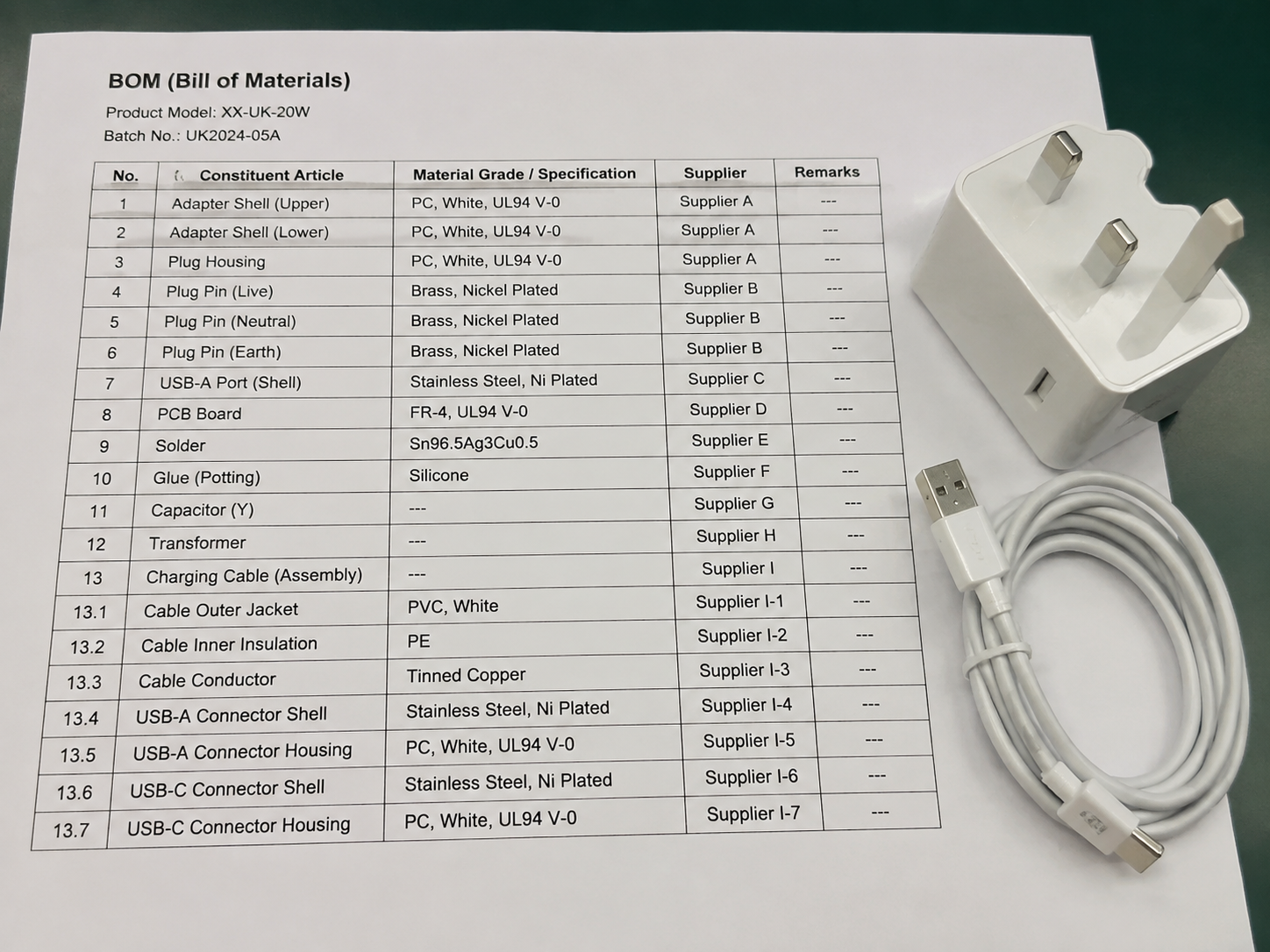
Materials that can be used for GB compliance judgment usually need to contain the following levels of information:
1. Product level: BOM (Bill of Materials) lists each constituent article, corresponding material grade and supplier, covers specific product models and batches, and includes all components such as charging cables and plugs;
2. Material level: material declaration or supplier SVHC declaration corresponds to specific material grades and formula versions, and clarifies the EC/CAS number of each substance and the basis for concentration judgment (such as supply chain traceability, material declaration or test data);
3. Version level: clarify that the applicable market is Great Britain (GB) and the regulatory basis is the UK REACH Candidate List, and indicate the release date of the referenced Candidate List version and the inclusion time of the corresponding substance.
Even if the document is not directly marked with “UK REACH”, as long as the content fully covers the above elements, it can also be used as the basis for evaluation. If the materials only cover the EU REACH List, do not clearly correspond to the UK version, or only use general expressions such as “no harmful substances” and do not provide specific substances and article boundary information, then GB compliance judgment cannot be completed based on this, and suppliers should be required to supplement corresponding materials. When materials, suppliers are changed or formulas are adjusted, the validity of the material-level declaration needs to be reconfirmed.
Relationship Between Material Inspection and Testing
Many people think that testing must be done for compliance, but this is not the case:
• Supplier declarations plus BOMs and material declarations are the basis for preliminary compliance judgment and supply chain traceability, and are also the most commonly used compliance method;
• Third-party test reports are only used for risk verification, and are only responsible for the submitted samples, tested components, testing methods used, and corresponding list versions. One report cannot be used to prove that all series and all batches of products are compliant.
A valid test report must at least include information such as sample information, split articles/materials, test methods, detection limits, and corresponding list versions. Without these, the reference value is very low.
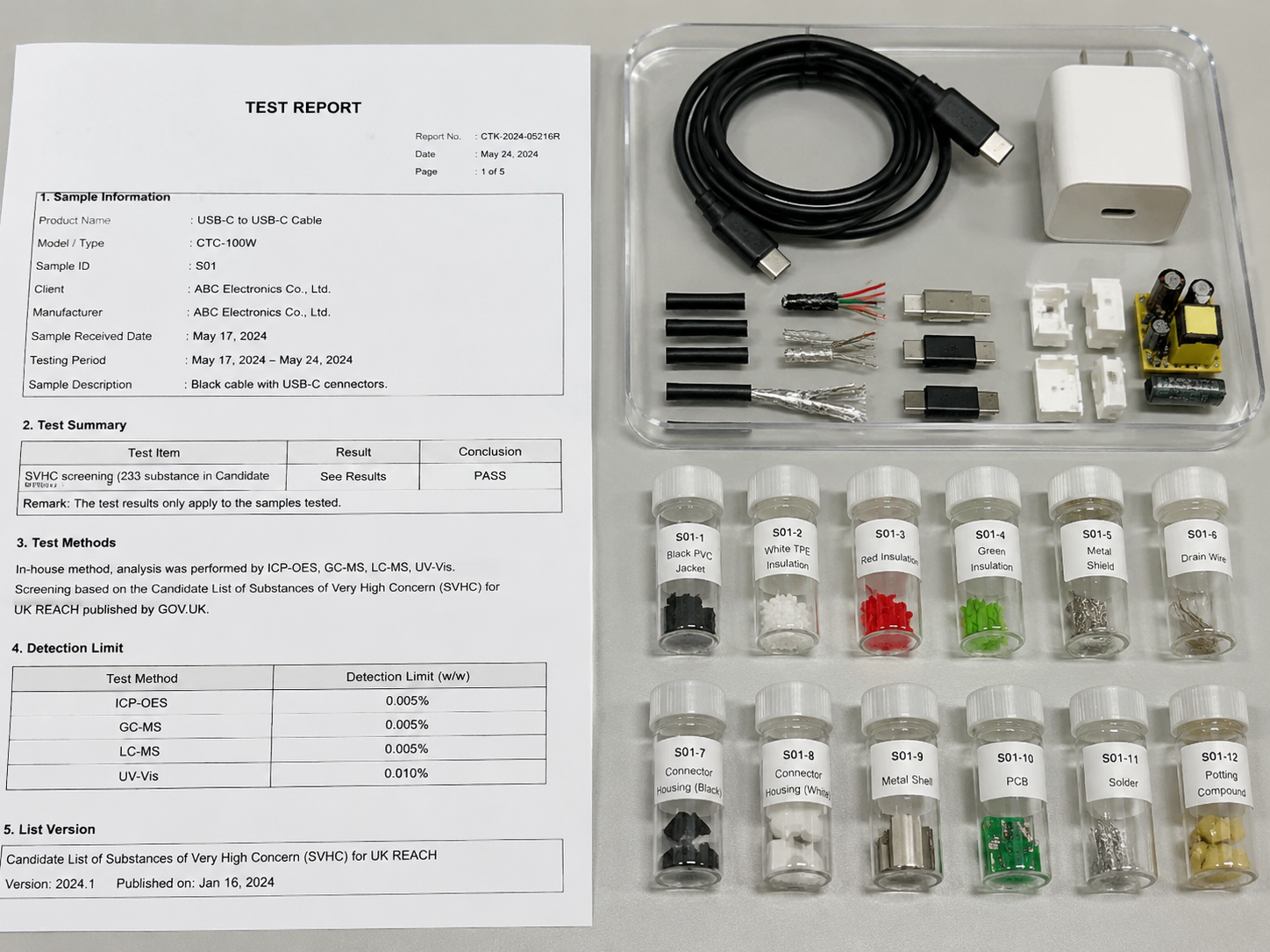
High-Risk Component Inspection Logic
Compliance inspection can be carried out in the following three steps:
1. Mark all high-priority components and inspect them first;
2. Low-priority components are confirmed in combination with supply chain materials, and cannot be directly assumed to be compliant;
3. Correspond to the SVHC substances in the list version one by one, and confirm whether the concentration in each article exceeds 0.1%.
Scenarios Requiring Additional Testing
Testing costs are high, and there is no need to blindly send samples for testing. Testing only needs to be considered in the following scenarios:
• Suppliers cannot provide valid compliance materials, or the content of the materials is ambiguous;
• Products use high-risk materials, such as soft PVC, recycled plastics, metal plating of unknown origin;
• Suppliers are changed, material formulas are adjusted, or product models are changed;
• Platforms, customs or regulatory authorities require formal test reports to be provided.
Evidence Chain Retention Requirements
For compliance, a complete evidence chain needs to be retained for regulatory verification:
• Core retained documents include: supplier compliance materials, BOMs, material declarations, test reports, supply chain communication records, obligation performance vouchers (such as information transfer records, consumer response records, notification receipts). Records are recommended to include the following fields: product model/batch, list of constituent articles, corresponding material grades and suppliers, version of the UK REACH SVHC List used, EC/CAS numbers of involved substances and concentration judgment basis, product supply date, obligation performance vouchers.
• Role-specific requirements: manufacturers and importers need to retain full-chain compliance evidence corresponding to their own obligations; distributors should keep all materials that can prove their performance of information transfer and other applicable obligations, including SVHC information received from upstream, records of downstream transfer, etc.;
• Retention period: UK REACH-related compliance records usually need to be kept for at least 10 years. The specific starting point needs to be combined with applicable UK REACH clauses, responsible roles and obligation types, and shall be subject to HSE official guidelines. Retention requirements shall not be simplified without authorization;
• Version review requirements: when official list updates, material/supplier changes, product modifications, or new regulatory requirements occur, the compliance of the product needs to be re-evaluated, and it cannot be done once and for all.
Pitfall Avoidance Guide: Easily Confused Scenarios and Common Misconceptions
Practical Distinction Between UK and EU REACH SVHC
In practice, there is no need to dwell on the title or marking of supplier documents. The core is to check whether the content matches the legal requirements of the target market: if used for GB market compliance assessment, it is necessary to confirm that the materials correspond to the version of the UK REACH Candidate List, the EC/CAS number of the substance, the inclusion date, and cover the specific model of the target product and each constituent article; materials that only include the evaluation conclusion of the EU REACH List cannot alone support the GB market compliance judgment, and evaluation materials of the UK dimension need to be supplemented. For specific boundaries, refer to the previous description of applicable regions.
Boundaries Between SVHC, UK RoHS and UKCA
SVHC, UK RoHS and UKCA belong to completely independent compliance systems, and there is no mutual coverage relationship:
• Difference from UK RoHS: UK RoHS targets specific electrical and electronic equipment, only controls several specified restricted substances, and is a mandatory access requirement; while SVHC is a candidate list under UK REACH, which controls a wider range of substances, focuses on information disclosure obligations, and is not a mandatory access threshold.
• Difference from UKCA/CE marks: UKCA and CE are conformity marks under applicable product regulations, which may cover requirements in different fields such as safety, electromagnetic compatibility, and environmental protection, but they cannot alone prove that the information transfer, consumer response or notification obligations of UK REACH SVHC have been fulfilled. The two belong to independent compliance systems.
Common Advanced Misconceptions
• It is not necessary to memorize all SVHC substances to make a judgment: wrong. Just directly query the official list or request a supplier compliance statement;
• Products from big brands and with high prices must be compliant: wrong. Formal brands and high-priced products can only be used as a low-risk reference for initial screening, and cannot replace supply chain materials or testing.
Common Mistakes in Information Transfer
Many people tend to go to extremes in the information transfer link, and three common mistakes need to be corrected:
• “SVHC information must be marked on the product detail page or packaging”: wrong. It can be transmitted through various methods such as technical documents, product instructions, and electronic pages. There is no mandatory requirement that it must be printed on the packaging or detail page;
• “A complete test report must be provided when consumers inquire”: wrong. It is only necessary to provide the already available information that is sufficient to ensure safe use;
• “The requirements for information transfer to commercial customers and consumer responses are exactly the same”: wrong. It is necessary to actively transfer excessive SVHC information to commercial customers, while for consumers, a response is only required when they take the initiative to inquire, and the content requirements are also different.
Practical Implementation: Action Steps for Different Parties
Ordinary Consumers (Purchasing Charging Products in the GB Market)
If you purchase charging products in the GB market and want to confirm relevant SVHC information, you can do it in two steps:
1. Directly make a clear request to the seller: “Among all relevant Articles of this product, are there any UK REACH SVHC substances with a concentration exceeding 0.1%? If yes, please provide the name of the substance and safety precautions for use.”
2. If you do not receive a reply within 45 days, or the reply is ambiguous, you can further contact the brand official to verify relevant information.
Basic Compliance Steps for Small Businesses/Cross-Border Sellers
If you are a small business or cross-border seller of charging products, the following four steps can cover entry-level compliance requirements:
1. Request the UK REACH SVHC compliance package from upstream suppliers, and confirm that the materials cover all sold product models, as well as high-risk components such as charging cables and plugs. It is not allowed to only provide host materials;
2. Retain full-chain compliance evidence to meet regulatory traceability requirements;
3. If the SVHC concentration in any article exceeds 0.1%, establish an information transfer mechanism, such as downstream customer instruction documents and consumer inquiry response templates;
4. Establish a list version monitoring mechanism, and re-evaluate product compliance when the list is updated, materials/suppliers are changed, or products are modified.
Official List Query Channels
The most authoritative query channel is the UK REACH special page on the official websites of the UK government and HSE. The legal effect is subject to the latest officially released documents. Do not trust lists compiled by third parties.
Operation steps: enter the UK REACH special page, download the Excel version of the current Candidate List, and you can search and query by substance name, EC number, and CAS number.
When checking, pay attention to confirming the substance name, EC/CAS number, inclusion date and revision records to avoid missing the latest updated substances.
Work That Does Not Need to Be Carried Out at the Entry Stage
When you are new to this, the following things are completely unnecessary:
• No need to memorize hundreds of SVHC substances, just request a supplier statement or check the official list;
• No need to blindly send samples for testing by yourself. First refer to the supplier’s materials, and test when there is a dispute or regulatory requirements;
• No need to stick “SVHC certification marks” on products, because there is no official unified certification mark at all. Such marks on the market are all made by merchants themselves and have no legal effect.
Core Summary
UK REACH SVHC compliance judgment can be carried out according to the following 5-step process:
1. Confirm the target market: use UK REACH for sales to GB, and use EU REACH for sales to the EU/Northern Ireland;
2. Identify Article boundaries: identify the boundaries of the product and its internal constituent articles according to the legal definition;
3. Lock the list version: find the UK REACH SVHC list version with the corresponding date and clear official announcement;
4. Check threshold conditions: check whether the SVHC concentration in each article exceeds 0.1%, and judge the type of obligation triggered;
5. Perform corresponding obligations: supplement compliance materials, carry out risk testing, or perform corresponding information transfer, response, and notification obligations based on the results.
After mastering the above content, you can identify the high inspection priority components and exceptions of low-priority components of charging products, distinguish the differences in control logic of the three types of REACH lists, judge the validity of supplier SVHC compliance materials, understand the applicable boundaries of test reports, take correct compliance actions corresponding to your own role, and also find official list query channels and clarify the trigger scenarios for testing, which can cover the daily SVHC compliance judgment needs of charging products.