
Many merchants exporting consumer electronic products to the United States may be familiar with regulations such as FCC, UL, and California Proposition 65, but when they are suddenly informed by customs that their products are “TSCA non-compliant”, they are often confused: what regulation is this? Does it even apply to the chargers and charging cables I sell? Some people even have their goods detained, face fines, and their subsequent customs clearance is affected due to lack of understanding of the rules.
In fact, TSCA is the basic control rule for environmental and health risks of chemical substances in the U.S. import process. Many charging products may be subject to TSCA import compliance obligations because they contain chemical materials such as plastic shells, cable jackets, plating, and adhesives. Whether compliance is required and what work needs to be done must be judged in combination with product form, substance composition, usage scenarios, and specific regulatory provisions, and cannot be directly presumed based solely on material type. This article takes charging products such as chargers, power adapters, charging cables, USB interface parts, and plugs as the core entry point, systematically sorts out TSCA import compliance logic and practical methods from introductory concepts to practical steps, and then to advanced pit avoidance, to help practitioners quickly establish a compliance judgment framework that meets their own needs.
Introductory Basics: Basic Relationship Between TSCA and Charging Products
First, let’s understand what TSCA is. You can think of it as the U.S. market access threshold for “environmental and health risks of chemical substances”, with the full name of the Toxic Substances Control Act, enforced by the U.S. Environmental Protection Agency (EPA). It does not regulate whether a product works well or leaks electricity, but rather chemical substances, mixtures, and articles containing restricted chemical substances that enter the U.S. market. Its core goal is to prevent and control health and environmental risks posed by chemical substances – in plain terms, it is to prevent harmful chemical substances contained in products from leaking out, harming people or polluting the environment.
Many people will ask: I sell finished chargers, not chemical raw materials, why do I need to comply with TSCA? In fact, if you look closely, you will find that charging products are all made of chemical materials: the plastic shell of the charger, the outer jacket of the charging cable, the plating of the USB interface, the adhesive used for assembly, the surface coating… all of these may trigger TSCA control requirements. If non-compliant, you may face customs inspection, detention, refusal of entry, return or destruction, and may also trigger EPA civil fines; according to law enforcement practice, violation records may also increase the inspection probability of subsequent imports, increasing customs clearance costs.
First, clarify the product boundary of the discussion: the charging products focused on in this article include chargers, power adapters, charging cables, USB/USB-C interface parts, plugs, and charging port components; they do not include toys, children’s products, large household appliances, nor are they targeted at independent bulk chemical raw materials – these categories have special control logic and are not within the scope of this article’s discussion.
People who are new to TSCA are most likely to make 4 basic mistakes. Let’s clarify them in advance to avoid going astray at the beginning:
First, thinking that TSCA is a third-party certification, and having a certificate or mark is enough. In fact, TSCA is a U.S. federal regulation, there is no unified certification mark, and obtaining a third-party report does not equal compliance – it requires that the product actually meets the rules and can provide traceable materials to prove it, which is completely different from certifications such as UL and ETL.
Second, believing that finished electronic products are not subject to TSCA control at all. As long as the chemical substances contained in the product trigger the applicable rules of TSCA, even finished products need to comply, and most finished charging products may involve TSCA obligations.
Third, having FCC, UL or RoHS compliance means complying with TSCA. These regulations regulate completely different dimensions, they cannot replace each other, nor do they have an inclusion relationship. For the specific division of responsibilities, please refer to the later section “Division of Responsibilities Between TSCA and Other U.S. Import Regulations”.
Fourth, small parcels, samples or small-batch imports definitely do not need to be declared. TSCA import obligations are not exempted based on cargo value or batch size. Only items that meet statutory exclusion or exemption clauses can be exempted from declaration or apply special treatment, and need to be confirmed by checking regulatory provisions item by item; as long as the goods are for commercial sale, even single-piece small parcels need to meet the requirements.
Core Concept Clarification: TSCA Applicability Boundary for Charging Products
After understanding the basic concepts, the next most critical thing is to figure out what rules the product is subject to. There is a core concept called “Article”, and almost all consumer-grade finished charging products fall into this category, which is also the most commonly used regulatory logic for us.
What is an “Article”? Simply put: it has formed a fixed shape or design, does not actively release chemical substances during normal use, and its function is mainly realized by shape or structure, rather than by the chemical components inside. For example, complete chargers, finished charging cables, USB plugs, and power adapters are all typical articles – a charging cable is used to transmit electricity, relying on the copper wire inside and the insulation structure outside, not by releasing chemical substances from the outer jacket to work, so it belongs to an article.
If it belongs to an “Article”, there are two important exemptions that can greatly reduce the compliance workload at the entry stage: First, there is no need to submit a Premanufacture Notice (PMN) for new chemical substances (simply put, if it is a brand-new chemical substance, it must be reported to the EPA in advance before production and import, but finished articles do not need to go through this process); second, there is no need to check whether all chemical components in the product are in the TSCA Inventory of Existing Chemical Substances one by one.
But special attention should be paid: the exemptions here are only for the new substance premanufacture notice and full-component inventory verification obligations, which does not mean that articles are not subject to all TSCA rules, let alone that all articles do not need to submit TSCA import declarations. Ordinary articles not covered by specific TSCA rules will not automatically trigger full chemical substance import obligations just because they contain plastic, copper, adhesives or plating, but they still need to judge the type of Section 13 import certification according to applicable rules, and cannot directly exempt all compliance judgments on the grounds of “being an article”.
There are three types of situations that cannot be covered by the two exemptions for articles, and corresponding obligations need to be evaluated separately:
First type: EPA explicitly restricts the production, processing or distribution of certain chemical substances in specific articles under special rules such as TSCA Section 6. For example, some PBT substances mentioned later have restriction requirements for specific articles, which cannot be evaded on the grounds of “being an article”.
Second type: The product is designed to actively release chemical substances. For example, charging products with antibacterial release coatings or fragrance slow-release structures – at this time, the function of the product is not only dependent on shape, but also on releasing chemical substances, so the simplified rules for articles cannot be directly applied, and obligations need to be evaluated separately; if antibacterial efficacy claims are involved, it may also trigger other federal regulations such as FIFRA, which need to be verified separately.
Third type: What is imported is chemical substances, mixtures or raw materials for subsequent processing. For example, plastic pellets, liquid adhesives, unformed coatings, etc., these do not belong to articles, and obligations such as inventory verification and pre-notification need to be checked according to the rules for chemical substances.
A special reminder here: do not only rely on the customs HS code to judge the regulatory category, it must be based on the actual form, material and use of the product – the same USB interface component, a finished plug is an article, and the plastic pellets used to produce the plug are raw materials, with completely different regulatory requirements.
Core Compliance Obligations in the Import Process
After clarifying the regulatory category of the product, let’s talk about what exactly needs to be done and who is responsible when importing. It should be specially noted that: the PMN/inventory exemption for Articles and the Section 13 import certification obligation are two sets of independent rules and cannot be confused. Before import, three levels of judgment need to be completed in a fixed order to avoid over-declaration or under-declaration:
- Determine the basic attributes of the goods: First confirm whether it is a chemical substance/mixture or a formed Article;
- Judge whether it is subject to TSCA jurisdiction and applicable rules: If it is a chemical substance/mixture, it is subject to TSCA jurisdiction by default (unless it meets statutory exemptions); if it is an Article, it is necessary to further verify whether it is covered by specific TSCA rules (such as Section 6 restrictions, Section 8 reports, etc.);
- Determine the declaration type and requirements: According to the TSCA jurisdiction status of the goods, compare 40 CFR 707.20 and CBP declaration rules, select the corresponding type of Section 13 import certification, or apply statutory exemption.
For quick correspondence, you can refer to the following comparison table of cargo attributes and certification obligations:
| Cargo Type | TSCA Jurisdiction Status | Section 13 Certification Requirements | Core Basis |
|---|---|---|---|
| Ordinary Articles not covered by special rules | Fall within the category of articles defined by TSCA, no special rule constraints | Need to select the corresponding certification type according to the actual situation, and cannot presume that no declaration is required on your own | 40 CFR 707.20, CBP TSCA Import Guidelines |
| Articles subject to special rules such as Section 6/Section 8 | Subject to TSCA special rules | Submit positive certification (must meet all applicable requirements) | 40 CFR 707.20, corresponding special rules |
| Chemical substances/mixtures (including processing raw materials) | Subject to TSCA jurisdiction (except statutory exemptions) | Submit positive certification (must meet all applicable requirements) | 40 CFR 707.20, TSCA Section 5 |
| Goods fully meeting statutory exclusion clauses | Not subject to TSCA jurisdiction | Submit negative certification | 40 CFR 707.20, statutory exclusion clauses |
Declaration Responsibility and Certification Types
The import compliance statement under TSCA Section 13 is submitted through the U.S. Customs and Border Protection’s (CBP) ACE electronic filing system by the Importer of Record (IOR, the importer who bears primary responsibility for the compliance of imported goods) registered in the United States or its authorized customs broker. The IOR bears primary responsibility for the authenticity and accuracy of the declaration content in the import process, and the customs broker only submits the declaration according to the entrustment and does not bear the final compliance responsibility. Although overseas manufacturers and exporters do not directly submit import certifications, they need to ensure that the provided product composition, use, material and other information are true and traceable. If they intentionally provide false information, participate in illegal processing or distribution of restricted chemical substances, they may still trigger independent legal liabilities under TSCA.
The applicable scenarios of the two common certification types need to be strictly distinguished:
- Positive certification: Declares that the product meets all applicable TSCA requirements, and is only applicable to goods subject to TSCA jurisdiction and for which compliance verification has been completed;
- Negative certification: Only applicable to situations where the goods are completely not subject to TSCA jurisdiction and meet statutory exclusion clauses. Natural material attributes are only factual reference and cannot be used alone as a basis for applying for negative certification; statutory exclusion conditions need to be checked one by one. Such completely non-jurisdictional situations almost do not exist in charging products.
Items that meet statutory exemption conditions (such as personal use items, test and R&D samples, etc.) apply to corresponding exemption rules, which are not regular applicable scenarios for negative certification and cannot be applied arbitrarily. The application of all declaration types must be based on the current import certification regulations issued by CBP and EPA. Do not arbitrarily select the certification type to simplify the process, otherwise it may constitute a false declaration.
Record Retention Requirements
According to the provisions of 40 CFR 707.20, all supporting materials for TSCA Section 13 import certification must be retained for at least 5 years from the date of import of each batch of goods; if special rules for specific restricted substances apply (such as reporting obligations for some PBT and PFAS) and the rules require a longer retention period, the provisions of those rules shall prevail.
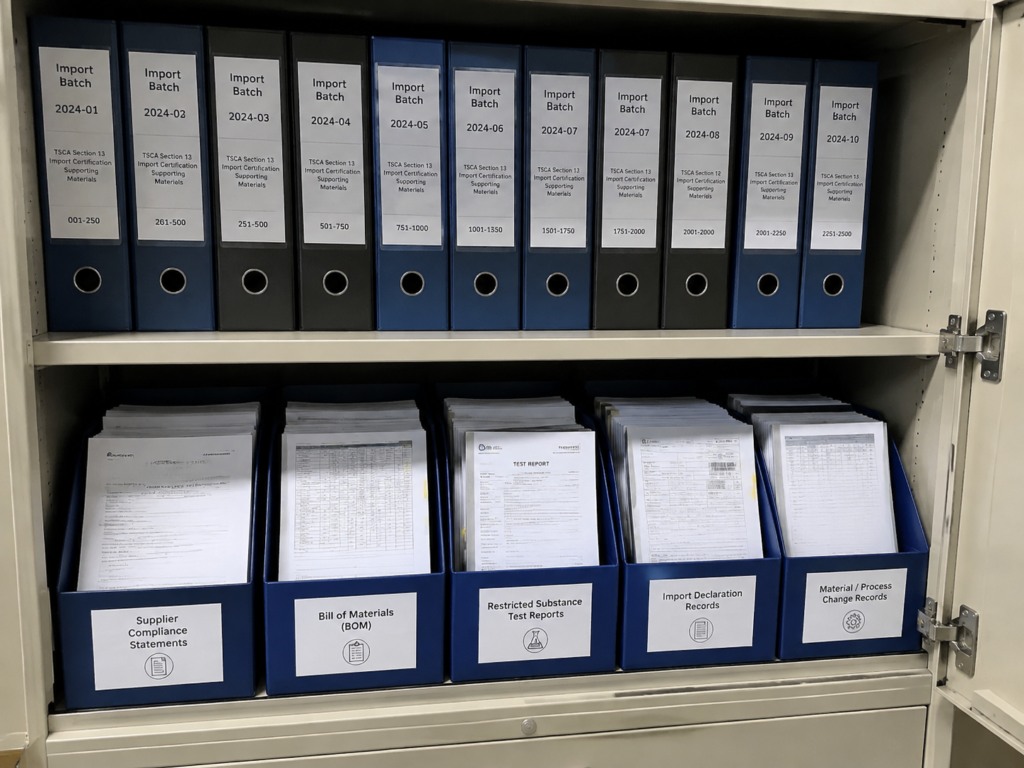
TSCA does not uniformly stipulate a fixed statement format or mandatory testing requirements. What importers need to retain is a complete evidence chain that can support their own compliance judgment. It is recommended to include the following materials to ensure that they can correspond to specific import batches, product models and production versions:
- Compliance statement signed by the supplier’s authorized representative (must clearly specify the corresponding product model, batch, and covered material scope; a general “full product compliance” statement cannot meet traceability requirements)
- Bill of materials (BOM) of main components, including the composition, CAS number, and use description of key chemical materials
- Relevant test reports for restricted substances (if any, must correspond to the tested samples and test items)
- Import declaration records, customs declarations and other vouchers
- Notification records of material or process changes
Common Causes of Violations
The most common violation triggers are: failing to submit a declaration as required, the declaration content being inconsistent with the actual goods (false declaration), the product containing prohibited or restricted substances and not meeting exemption conditions, and incomplete retention of compliance materials, making it impossible to trace the batch or material source.
TSCA High-Risk Substances and Corresponding Components for Charging Products
Many people get a headache when they hear that they need to check chemical substances: I’m not a chemistry expert, how do I know what’s in the product? In fact, don’t be afraid. There are many types of chemical substances controlled by TSCA. At the entry stage, you don’t need to check them one by one. You can start with substances that EPA has clearly issued restriction rules for and are relatively common in charging products for screening. But note: screening high-risk substances is only the first step of compliance, not equal to completing all compliance obligations. TSCA does not have a unified “list of prohibited substances”, and each control rule needs to be checked item by item for specific substances, uses and product forms.
Section 6(h) PBT High-Risk Substances
PBT is the abbreviation of “Persistent, Bioaccumulative, and Toxic chemical substances”. Simply put, these substances are extremely persistent, difficult to degrade when entering the environment, accumulate in animals and plants, and are highly toxic. EPA has formulated independent final control rules for various PBT chemical substances under TSCA Section 6(h), and the applicable scope, control requirements, and exemption conditions of each substance are different.
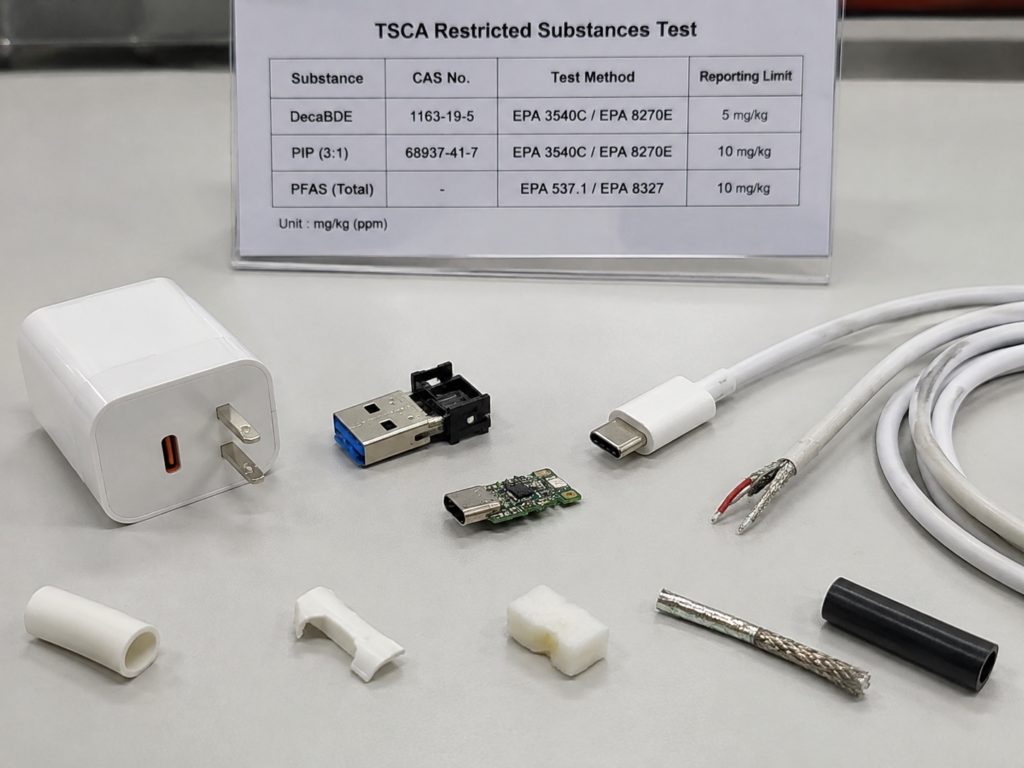
For consumer-grade charging products, at the entry stage, you can prioritize screening two types of relatively high-incidence substances – Decabromodiphenyl ether (DecaBDE) and phenol, isopropylated phosphate (3:1) (PIP (3:1)); note that these are only entry priority screening items, not the complete control list of Section 6(h). Other PBT substances (such as 2,4,6-tri-tert-butylphenol (2,4,6-TTBP), etc.) need to be checked for applicable conditions item by item against the latest PBT rule summary table released by EPA, combined with product material characteristics.
| Substance Name | Possible Formula Scenarios (Charging Category) | Core Restricted Behaviors | Applicability to Articles | Concentration/Unintentional Impurity Requirements | Common Exemptions and Transition Periods | Official Rule Source |
|---|---|---|---|---|---|---|
| Decabromodiphenyl ether (DecaBDE, CAS No. 1163-19-5) | May exist in plastic and rubber parts that require flame retardancy, such as charger shells, charging cable jackets, USB interface plastic bases, heat shrink tubes, etc., subject to the actual formula | Restrictions are imposed on its production, processing, distribution and commercial use | Need to be judged in combination with specific uses, concentrations and rule provisions; does not automatically cover all articles containing this substance | No general safety concentration threshold; unintentional residues must comply with the impurity clauses and applicable scenarios of the corresponding rules, and cannot be set or applied to general standards on your own | Specific industrial uses, repair spare parts, etc. may be eligible for exemption, subject to the rules | EPA TSCA Section 6(h) DecaBDE Final Rule |
| Phenol, isopropylated phosphate (3:1) (PIP (3:1), CAS No. 68937-41-7) | May exist in specific plastic, rubber, coating, adhesive or lubricant formulations; cannot be presumed to be contained solely by component name (such as cable jacket, circuit board assembly), need to be verified through supplier formula statements, bill of materials (BOM) and CAS number information | Restrictions are imposed on its production, processing, distribution and commercial use | Need to be judged in combination with specific uses, concentrations and rule provisions; does not automatically cover all articles containing this substance | No general safety concentration threshold; need to be judged against the applicable conditions of specific rules | Specific circuit board assemblies, repair spare parts, some industrial uses, etc. may be eligible for exemption, subject to the rules | EPA TSCA Section 6(h) PIP (3:1) Final Rule |
PFAS Related Requirements
PFAS is the general term for Per- and Polyfluoroalkyl Substances, known as “forever chemicals” due to their extremely stable chemical properties, with thousands of types. There is no unified “PFAS prohibition list” under TSCA. Different types of PFAS may trigger different TSCA obligations. Importers need to first confirm the specific chemical identity (name, CAS number) of PFAS in the product or whether it belongs to the PFAS category defined by EPA rules, and then verify the corresponding obligations respectively:
- Section 5 New Chemical Substances/Significant New Use Rule: If PFAS is a new chemical substance not included in the TSCA Inventory, or involves a significant new use, a PMN or SNUR declaration must be submitted in advance;
- Section 6 Restriction Rules: Some specific PFAS have been included in Section 6 restriction rules, and applicable products, uses and exemption conditions need to be checked;
- Section 8(a)(7) Reporting Rule: This rule sets reporting obligations for entities that produce or import chemical substances, mixtures or articles containing PFAS, and is not affected by the PMN/inventory exemption for ordinary Articles. As long as the trigger conditions specified in the rule are met (such as import volume threshold, use scope, time range, etc.), even finished charging Articles need to fulfill reporting obligations. The specific trigger conditions, exclusions and declaration requirements shall be subject to the latest rule text released by EPA.
In charging products, PFAS may be used in braided charging cables with waterproof, oil-proof, low-friction coatings, waterproof charger shells, special non-stick coating parts, etc. But this is only a risk reminder, which does not mean that these parts necessarily contain PFAS, nor does it mean that containing PFAS is necessarily a violation. When verifying, you cannot directly judge compliance or non-compliance solely based on “containing PFAS”, you need to confirm item by item corresponding to specific substances and rules. At the same time, note that PFAS control requirements in some U.S. states (such as relevant regulations in California) are state-level rules, not equivalent to TSCA federal requirements, and need to be verified separately.
Low-Risk and Control Boundary Description
In addition to the above two types, there are some substances whose control boundaries need to be clarified to avoid wasted effort or missed checks:
- PCB (Polychlorinated biphenyls), asbestos, mercury: TSCA has special control rules for these types of substances, which are usually rarely used in modern consumer-grade charging products and are not mandatory items for entry-level checks. However, if the product uses recycled plastic, old electronic components, special switches or components containing related materials, it is necessary to transfer to the corresponding special rules for verification, and cannot directly default to being free of them.
- Lead, cadmium, most phthalates: The consumer product safety-related requirements for these substances are often regulated by CPSC’s CPSIA regulations, California Proposition 65, etc., but being regulated by other regulations does not mean that TSCA application is automatically excluded. If EPA subsequently issues TSCA Section 6 restriction rules for these substances, or there are other applicable TSCA provisions, they still need to be implemented in accordance with TSCA requirements, and need to be judged separately based on specific substances, uses and product forms.
Entry-Level Practice: 5 Steps to Complete TSCA Import Compliance Verification for Charging Products
After talking about so many concepts, some people may still not know where to start. Here is a 5-step entry-level practical process. Following this, you can complete the basic compliance screening of ordinary finished charging products, which is suitable for most merchants who sell finished charging products.
Step 1: Confirm Product Form and Regulatory Logic
Before import, first judge the TSCA attribute of the product through the following core dimensions, correspond to the correct regulatory rules, and determine the verification scope:
| Judgment Dimension | Compliance Characteristics | Corresponding Regulatory Logic |
|---|---|---|
| Form and Structure | Has a fixed final shape/design | May belong to Article |
| Function Realization | Function is mainly realized by shape/structure, rather than by releasing chemical substances | May belong to Article |
| Release Characteristics | Does not actively release chemical substances during normal use (e.g., no design of antibacterial release, fragrance slow-release, etc.) | May belong to Article |
| Import Status | Is a directly usable finished product/component, not a raw material for subsequent processing | May be regulated according to Article rules |
Ordinary finished chargers, charging cables, USB interface parts, etc., usually meet the characteristics of Articles, and the focus is to verify whether there are specific TSCA rules applicable to Articles; processing raw materials such as resin pellets, liquid adhesives, and unformed coatings are verified according to the rules for chemical substances/mixtures. Note that you cannot judge solely by HS code, it must be based on the actual form of the product.
Step 2: Request Traceable Compliance Supporting Materials from Suppliers
Do not guess the product composition on your own, directly request written materials from the supplier that can correspond to specific models and batches, as part of the compliance evidence chain. TSCA does not uniformly stipulate a fixed format or mandatory stamping requirements for statements. Such materials are supporting evidence for importers to establish reasonable compliance judgments, not statutory mandatory certification documents. The core materials include three categories:
① Basic compliance statement: TSCA compliance statement signed by the supplier’s authorized representative, which must clearly specify the covered product model, production batch/version, main material scope, and have a clear signing subject and date;
② Material information: Bill of materials (BOM) of main components, focusing on the type of flame retardant used in plastic parts, whether the cable has a special coating, the main components of the plating, and CAS numbers must be provided for key chemical substances;
③ Targeted confirmation items: Directly confirm three high-risk directions – are there special coatings containing PFAS such as waterproof/oil-proof ones? Do plastic parts use decabromodiphenyl ether flame retardants? Do they contain PIP (3:1) with CAS number 68937-41-7? Require suppliers to provide the chemical name and CAS number of the corresponding substances, do not judge solely based on abbreviations or verbal promises.
Step 3: Entry-Level Screening of High-Risk Substances
After obtaining the supplier’s materials, you can check the control requirements of the corresponding substances for free through EPA official channels. At the entry stage, you can prioritize screening substances that have clearly issued Section 6 restriction rules and are relatively high-incidence in charging products (such as DecaBDE, PIP (3:1), specific restricted PFAS), but this is only a simplified step, not equal to completing all compliance obligations.
Verification notes: ① The TSCA Inventory of Existing Chemical Substances (TSCA Inventory) is only used to confirm whether a substance is included in the inventory. Listing itself does not mean that the substance is approved for circulation in all uses and all products, and it needs to be comprehensively judged in combination with Section 6 restrictions, Section 5 Significant New Use Rule, specific uses and exemption clauses; ② If you have questions about the compliance of a substance, you can require the supplier to provide a third-party test report or material compliance certificate for the corresponding substance. When verifying, pay attention to whether the tested sample model, test items, and test methods match the actual imported product.
Step 4: Confirm Import Declaration Preparation
First, confirm that a qualified Importer of Record (IOR) has been implemented, or an authorized agent has been entrusted to be responsible for the declaration. Second, confirm that the IOR or customs broker is familiar with the TSCA declaration process in the ACE system, can first confirm the TSCA jurisdiction attribute of the goods according to the three-level judgment logic mentioned above, and then submit the corresponding type of compliance statement to ensure that the declaration information is consistent with the actual situation of the product – for example, if the product contains a restricted PFAS coating, it cannot be declared as not subject to TSCA jurisdiction, otherwise it is a false declaration, and the responsibility is borne by the IOR.
Step 5: Organize and Retain Compliance Materials
Sort out materials such as supplier compliance statements, BOMs, test reports, declaration records, and material change records by import batch and product model to ensure quick traceability. Retention requirements: Section 13 certification supporting materials shall not be shorter than the statutory minimum period (5 years from the date of import), and if specific substance rules apply, they shall be implemented according to the corresponding requirements; it is recommended to back up both electronic and paper files to avoid data loss.
Intermediate Advanced: Pit Avoidance and Special Scenario Judgment
If you have already mastered the entry-level compliance process and want to go further, avoid some invisible pitfalls, or have special import modes, then you should read this part carefully.
4 Deep Pitfalls and the Truth
The first pitfall: taking EU RoHS or REACH compliance as TSCA compliance. This is the most common mistake – EU rules and U.S. TSCA are different in terms of both the controlled substance list and regulatory logic. For example, RoHS focuses on controlling the use of 6 harmful substances such as lead and cadmium in electrical and electronic equipment, while TSCA focuses on the environmental and health risk access of chemical substances. There is no inclusion relationship between the two scopes. Whether substances such as lead and cadmium trigger TSCA obligations needs to be verified according to EPA’s current rules for specific substances, uses and articles. So don’t directly use EU reports as TSCA compliance certificates, the two cannot replace each other.
The second pitfall: mistakenly thinking that “Article exemption” means you don’t have to care about any TSCA requirements. Articles are only exempt from PMN and full-component inventory verification obligations. If EPA explicitly restricts the use of certain substances in specific articles, or sets special reporting obligations, you still have to meet the requirements, and you can’t use “this is a finished article” as an excuse.
The third pitfall: only relying on the supplier’s verbal promises of “environmental protection” and “halogen-free” to feel at ease. Remember, the core responsibility for TSCA import declaration is borne by the IOR, and verbal promises have no legal effect. Once something goes wrong, the IOR has to take the blame. So there must be written, traceable supporting materials, and a material change notification mechanism must be established to avoid violations caused by suppliers changing materials without permission.
The fourth pitfall: thinking that having a third-party test report equals full compliance. The test report is only valid for the sample submitted for testing, and only tests the items submitted for testing, which cannot prove that all batches and all substances are compliant. For example, if decabromodiphenyl ether is tested and there is no problem, it does not mean that PFAS is also okay; if batch A is tested and there is no problem, it does not mean that batch B is also okay. Therefore, test reports should be combined with the supplier’s material statements and change records to form a complete evidence chain, and cannot rely solely on reports.
Differences in Requirements for Different Import Modes
TSCA compliance obligations mainly depend on the nature of the goods, use and applicable provisions, not simply divided by import channels. However, common scenarios of different import modes correspond to different judgment logics:
- General trade full-batch import: Usually belongs to commercial use finished product import. It is necessary to first judge the TSCA jurisdiction attribute, submit the applicable TSCA import certification as required, and retain a full set of compliance materials.
- Overseas warehouse stocking: Essentially still commercial import, the requirements are exactly the same as general trade. Compliance verification must be completed before entering the warehouse. Don’t wait until you sell to find problems, by then you can’t even return them.
- Cross-border e-commerce small parcel direct mail: Only non-commercial, personal use, reasonable quantity items that meet statutory conditions can be judged whether they are exempt from declaration according to the corresponding exemption clauses. The determination of reasonable quantity is implemented by customs in combination with the actual use, and there is no fixed number standard; a small number of samples used for testing, R&D, and certification need to be checked against the specific exclusion clauses of EPA and CBP, and cannot be self-exempted solely in the name of “samples”; all goods for resale or commercial use, even single-piece small parcels, need to meet TSCA requirements.
- Bulk raw material/component import: Do not directly judge as chemical raw materials just because they are “bulk”. First confirm the attributes according to the four judgment dimensions of Articles: if they are formed, have fixed functions, and are directly used for assembly, they may still be regulated according to Article rules; if they are raw materials/mixtures for subsequent processing such as resin pellets, coatings, and adhesives, then additional verification is required according to the rules for chemical substances/mixtures.
Real Scenarios of Legal Exemption
There are legal exemption scenarios, but they must strictly comply with the specific regulatory provisions issued by EPA, and cannot be presumed to be exempt on your own. Common possible applicable exemption scenarios include:
- Personal use non-commercial items that meet statutory conditions (not for resale, reasonable quantity, specific application subject to current CBP and EPA rules);
- Products completely made of natural materials (this situation almost does not exist in charging products);
- Uses that meet EPA’s specific exemption clauses (such as specific industrial repair spare parts, specific industrial components, need to check the applicable conditions of the rules item by item);
- Small quantities of samples for testing, research, and R&D that meet EPA and CBP regulations, need to meet the requirements of quantity, use, labeling, etc. of the corresponding clauses.
All exemptions need to be checked against the original regulatory text item by item, and can only be used after confirming that the product fully meets the applicable conditions. You cannot apply for exemption based on vague reasons such as “samples” or “natural materials”.
Division of Responsibilities Between TSCA and Other U.S. Import Regulations
Many people confuse TSCA with other U.S. import regulations. Here is a table to clarify the division of responsibilities of each regulation, so that you won’t be confused in the future:
| Regulation/Certification | Core Control Scope | Relationship with TSCA |
|---|---|---|
| FCC | Electromagnetic compatibility, radio frequency compliance, to ensure that products do not interfere with other electronic equipment | Parallel control, mutually non-replaceable |
| CPSC/CPSIA | Physical safety of consumer products, restriction of harmful substances in children’s products, etc., focusing on use safety and consumer product risks | Different control dimensions. TSCA focuses on environmental and health risks of chemical substances and market access, which need to be met separately; the specific TSCA applicability of substances such as lead and cadmium must still be checked against EPA’s current substance rules, uses and article forms. Being regulated by other regulations does not mean automatically meeting TSCA requirements |
| DOE/CEC | Energy efficiency requirements for products such as chargers | No direct connection, independent of each other |
| California Proposition 65 | Hazardous substance warning obligation for products sold in California | Parallel requirements. TSCA is federal-level chemical substance access, and California Proposition 65 is state-level warning requirement |
| Third-party safety certifications such as UL/ETL | Product safety performance certification, which may be required by some sales channels or local rules | Not a mandatory compliance item of TSCA, no direct connection between the two |
Key Points for Continuous Compliance Judgment
Regulations are not static, and you cannot do it once and for all:
First, EPA will continue to add or revise the list, threshold, and exemption clauses of restricted substances. The recent hot spots are PFAS and PBT categories, so we should focus on the rule updates of these two categories.
Second, if the product materials, suppliers or production processes change, be sure to re-verify the TSCA compliance status – for example, the previous supplier used halogen-free flame retardants, and the new supplier may use decabromodiphenyl ether. If you don’t re-check, it is easy to fall into a pit.
Third, regardless of the import scale, the statutory responsibility of the IOR is the same. You can find a third-party compliance service agency to help with verification, but the responsibility is still the IOR’s and will not be transferred to the third party.
Summary
Overall, TSCA import compliance for charging products can be promoted around four core logics: First, determine the attribute first, clarify whether the product belongs to Article, chemical substance or other categories, distinguish the boundary between PMN/inventory exemption and actual compliance obligations, and cannot equate Article exemption with no need to fulfill all TSCA obligations; second, judge the obligation again, according to the specific TSCA rules applicable to the product, determine the Section 13 certification type and other declaration and reporting requirements against 40 CFR 707.20 and CBP rules, and do not arbitrarily choose negative certification; third, verify substances accurately, check high-risk substances against EPA’s specific rules, do not apply general thresholds or empirical judgments, and pay special attention to the fact that special rules such as PFAS may not be affected by Article exemption; fourth, maintain dynamically, follow up on EPA rule updates, re-evaluate the compliance status when product materials and processes change, retain complete and traceable supporting materials, and ensure full-process compliance.