
If you are a seller of products such as chargers and charging cables who is just planning to enter the UK market, or who is already selling but has received a notice from the platform requiring submission of WEEE compliance certification, you will most likely have a host of questions: What exactly is WEEE? What is the difference between it and the UKCA and RoHS I have already completed? Does the small charging head I sell also need to comply with regulations? How much will it cost? What are the consequences of non-compliance?
This article starts from the actual needs of charging product sellers, and thoroughly explains UK WEEE producer responsibilities. From the basic concepts that beginners must understand, to quickly determining whether a product is regulated, confirming one’s own responsibilities, to specific compliance processes and pitfall avoidance tips, you will be able to operate after reading this, without having to search for scattered information everywhere.
1. Beginner’s Must-Know: Basic Understanding of UK WEEE
UK WEEE is the UK’s regulation specifically governing the recycling of waste electrical and electronic equipment, falling under the scope of EPR (Extended Producer Responsibility). Simply put, the core logic of EPR is: whoever first places a product on the UK market is responsible for the recycling and treatment of the product after it is scrapped, and bears the corresponding costs; they cannot shift the disposal cost of e-waste to the government and consumers.
Before delving deeper, there are two prerequisites that must be firmly established, otherwise it is easy to go astray:
First, the UK’s WEEE rules are not unified across the entire UK – the rules and regulatory bodies for Great Britain (GB, including England, Scotland, Wales) and Northern Ireland are completely independent. Northern Ireland’s rules are still partially linked to the EU WEEE system due to the Brexit agreement, so GB rules must never be directly applied to Northern Ireland.
Second, WEEE rules are updated from time to time. All thresholds, processes, and time nodes shall be subject to the current official guidelines issued by the corresponding region. Do not rigidly apply guides from several years ago.
Why should charging product sellers pay special attention?
First, the compliance risk is high: non-compliance may lead to regulatory penalties, platform delisting, or even recovery of recycling fees; second, charging products are small electronic devices, which are a high-frequency category for UK compliance inspections, with a much higher probability of being inspected than large home appliances; finally, compliant products can use the UK’s official recycling channels, which not only meets environmental protection requirements but also enhances consumer trust.
4 Most Easily Confused Compliance Requirements, Clarified at Once
Many new sellers think that with a UKCA or RoHS report, they don’t need to worry about WEEE. This is completely wrong – these four sets of rules are independent of each other, each governing its own area, and none can replace the other:
• UK WEEE: Governs the recycling responsibility and costs after product scrapping. Requires registration, fee payment, and recycling marking. The core is “how to handle the product after it is scrapped”.
• UK RoHS: Governs the restriction of hazardous substances in the product itself (e.g., lead and mercury must not exceed standards). Requires testing and issuance of a declaration of conformity. The core is “whether the product itself is toxic”.
• UKCA: The UK market access conformity mark, proving that the product meets basic requirements such as safety. It governs neither recycling nor hazardous substances. The core is “whether the product can be sold in the market”.
• Battery EPR: Governs battery recycling. If your charging product has a built-in battery (e.g., wireless charger with battery, power bank), you must meet both WEEE and battery EPR requirements, not just one.
Regional Regulatory Architecture: Find the Right Agency to Avoid Detours
Great Britain (GB: England/Scotland/Wales)
The three regions each have an independent environment agency, which respectively governs local WEEE affairs. The registration path is divided according to annual placement volume: small producers with a total annual placement weight of less than 5 tons can register directly with the local environment agency; large producers with an annual placement volume of ≥5 tons must join an officially approved PCS (Producer Compliance Scheme) – simply put, this is an officially recognized third-party organization that helps you handle recycling docking, data declaration, cost accounting and other matters, but the final responsibility still rests with the producer. Regardless of the path, you need to submit annual placement data and pay corresponding fees in accordance with regional or PCS rules.
Northern Ireland
The competent authority is the Department of Agriculture, Environment and Rural Affairs (DAERA for short), which has independent WEEE rules, with some rules linked to the EU WEEE system. If your products are sold to Northern Ireland, you must never directly apply GB rules; you must follow the current guidelines issued by DAERA and separately confirm registration requirements and processes.
2. Quick Self-Check: Is Your Charging Product Within the Regulatory Scope?
Many sellers ask right away “does the charging head I sell need to comply with regulations?” In fact, by going through the five-step judgment method below, you can basically reach a conclusion, and if you are unsure, you can consult an agency.
Five-Step Judgment Method for Regulatory Scope
1. Check product attributes: Whether it is electrical and electronic equipment (EEE for short) with a rated voltage ≤ 1000V AC / 1500V DC. Ordinary wires that are purely passive and have no electronic components are not EEE and are not within the regulatory scope.
2. Check placement form: Whether it is placed on the UK market as an independent product. Complimentary accessories need to be judged in combination with independent usability and whether they are priced separately.
3. Check exemption categories: Whether it is not within the statutory exemption scope (e.g., military/aerospace equipment, large fixed industrial equipment, etc.).
4. Check classification rules: Whether it meets the current declaration category scope of the corresponding region or the selected PCS.
5. Check boundary requirements: Whether it meets the boundary requirements for size and function. If unsure, consult the PCS or regulatory authority.
Classification Reference for Common Charging Products
For your convenience in comparison, we have compiled the classification of common charging products into a table:
| Classification Type | Specific Product Examples | Description |
| Clearly Regulated | USB charging heads, laptop power adapters, wireless chargers, multi-port charging stations | Belong to independent electrical and electronic equipment, with active charging function |
| Subject to Scenario Judgment | Travel adapter plugs with USB ports, scattered charging accessories | Classified according to the main function of the product; charging accessories are judged based on whether they are independently placed on the market |
| Clearly Exempt | Purely mechanical power plugs without electronic functions, special internal spare parts for maintenance | Not belonging to electrical and electronic equipment, or not distributed to end users |
Special Judgment for Charging Cables: Not All Cables Are Exempt from Compliance
This is the most frequently asked question. The core judgment criterion is whether there are active electronic components inside the cable:
• Purely passive cables (without any active components, such as ordinary USB-A to Micro USB cables, which only have wires and shielding layers inside): Independently sold ones are usually not within the regulatory scope.
• Cables with chips/conversion functions (e.g., Type-C cables with E-Marker chips that support PD fast charging, charging cables with video conversion functions): Independently sold ones are within the regulatory scope, because they have electronic components inside and belong to EEE.
• Cables with display screens/control circuits (e.g., digital display charging cables that can show charging power): Clearly within the regulatory scope.
The final judgment still needs to be confirmed in combination with official definitions and PCS classification rules. Do not assume by default.
How Are Random Complimentary Accessories Calculated?
Many sellers think “you don’t need to worry about free gifts”, but in fact it depends on the specific situation:
• If they are standard accessories, cannot be used independently, and are not priced separately (e.g., an ordinary charging head included with a mobile phone purchase): They can be declared uniformly by the producer of the main product.
• If they are accessories that can be used independently, are priced separately, and are optional add-ons (e.g., a fast charging head that can be purchased for an extra 20 yuan when buying a mobile phone): They shall be declared separately as independent EEE.
Responsibility attribution is judged based on the first placement entity. Neither under-declaration nor repeated declaration is allowed.
Weight Declaration Caliber Directly Affects Your Costs
Weight is the core basis for calculating recycling fees. Be sure not to miscalculate:
• Statistics are based on product net weight, excluding external materials such as packaging and manuals.
• Multiple products sold in sets (e.g., “charger + charging cable” set) need to have the weight of each individual product counted separately, and cannot be declared based on the total weight of the set.
• For charging products containing batteries, WEEE and battery EPR responsibilities run in parallel. Weight splitting must be confirmed in accordance with official or PCS requirements, and do not split on your own.
B2C/B2B Attribute Judgment: Don’t Assume You Can Save Money
B2C and B2B recycling fees differ greatly. Many sellers take it for granted to classify products as B2B to save money, but end up being fined more. To judge the attribute, you cannot only look at the sales target; you must comprehensively consider five dimensions: product design positioning, publicity caliber, sales target, usage scenario, and contract agreement:
• Ordinary mobile phone chargers are designed for individual consumers. Even if 100 units are sold to an enterprise at one time, they still belong to B2C.
• Industrial-grade DIN rail power adapters are designed for industrial scenarios. Even if only 1 unit is sold, it belongs to B2B.
• For bulk procurement by enterprises, it needs to be judged in combination with contract agreements and actual usage. If you are unsure, be sure to consult the PCS or regulatory authority, and you must not assume the classification by default.
3. Responsibility Judgment: Who Needs to Bear UK WEEE Obligations?
The core judgment principle of UK WEEE is just one sentence: The entity that first places the product on the corresponding UK market is the producer and needs to bear full responsibility.
We have sorted out the common roles in the supply chain one by one, and you can compare them with your own identity:
1. UK local own-brand manufacturer: Belongs to the producer. They manufacture themselves and place their own brand on the market for the first time, so they bear the responsibility themselves.
2. OEM sales brand owner: Belongs to the producer. Even if they find a contract manufacturer to produce, as long as they affix their own brand and place it on the UK market for the first time, the brand owner is responsible, not the contract manufacturer.
3. UK importer: Belongs to the producer. The entity that first brings overseas products into the UK for placement is the importer.
4. Overseas distance selling seller: Belongs to the producer. For example, if a Chinese seller mails directly to UK end users, the first placement entity is the seller.
5. Authorized representative: Entrusted by the producer to perform local obligations, but does not replace the producer’s final responsibility.
6. Distributor/retailer: Does not belong to the producer. Only bears the front-end recycling cooperation obligation, and does not need to register, pay fees, or declare.
7. Contract manufacturer/logistics/warehousing provider: Does not belong to the producer. Does not participate in placement decisions, and does not need to bear responsibility.
8. Online marketplace platform: Bears qualification review and joint liability. It is not a producer in the traditional sense, and the main responsibility still rests with the seller.
3-Step Self-Check for Producer Identity
1. Confirm whether you are the entity that first places the product on the corresponding UK market.
2. Confirm that the product is within the WEEE regulatory scope (refer to the content of Chapter 2).
3. Confirm the compliance path corresponding to the annual placement volume: GB uses 5 tons as the boundary between small/large producers, and the Northern Ireland threshold needs to be verified separately.
Easily Confused Responsibility Boundaries: Don’t Get Them Wrong
• Contract manufacturer vs brand owner: Whoever places the product first is responsible. Internal contracts cannot oppose regulation – when regulators find non-compliance, they will only look for the first placement entity. As for internal recovery, it is a civil dispute, and regulators do not care.
• Distributor vs producer: Distributors only bear the recycling cooperation obligation, and do not replace the responsibilities of registration, fee payment, and declaration.
• General distributor vs distributor: If the general distributor has completed compliance, the distributor does not need to bear producer responsibility repeatedly.
• Individual second-hand seller vs commercial seller: Individual resale of unused items is not considered commercial placement and does not require responsibility; commercial sellers specializing in second-hand charging products are producers and need to comply with regulations.
Requirements for Non-UK Producers and Authorized Representatives
This is the part that Chinese sellers are most concerned about. The responsibility judgment for different sales chains is completely different:
Responsibility Judgment for Different Sales Chains
1. Direct mail from China: The overseas seller is the producer. In GB, a local authorized representative must be designated, and Northern Ireland rules need to be verified separately.
2. Shipping from UK local warehouses (FBA/overseas warehouses): The first placement entity is judged based on the import + sales chain, and cannot be determined solely by the location of the warehouse – for example, if a Chinese seller clears customs by themselves, stocks FBA and sells directly, the seller is the producer; if they sell to a UK importer, who stocks and sells, the importer is the producer.
3. Supplying to UK importers: The importer is the first placement entity. The supplier needs to keep certificates such as contracts and orders to avoid being recognized as the producer.
Core Requirements for Authorized Representatives
• There must be a written appointment letter, clearly specifying the authorized region and scope of obligations, and verbal agreements are not allowed.
• The requirements for authorized representatives for B2B sales shall be confirmed in accordance with the rules of the corresponding region.
• If the platform handles compliance on behalf of the seller, the producer responsibility still rests with the seller, and the platform only provides agency services.
4. Must-Do for Beginners: Core Compliance Obligations of Producers
After confirming that you are a producer, you need to perform these core obligations, all of which are indispensable.
Registration Obligation
• Path division: In GB, those with annual placement <5 tons register with the environment agency, and those with ≥5 tons join an approved PCS; the Northern Ireland path needs to be verified separately.
• Registration materials: List of product models, net weight per unit, estimated annual placement volume, brand information, and overseas producers need to provide local authorized representative information.
• Time requirements: For first placement, registration must be completed within the specified period; the annual deadline is subject to the current official rules.
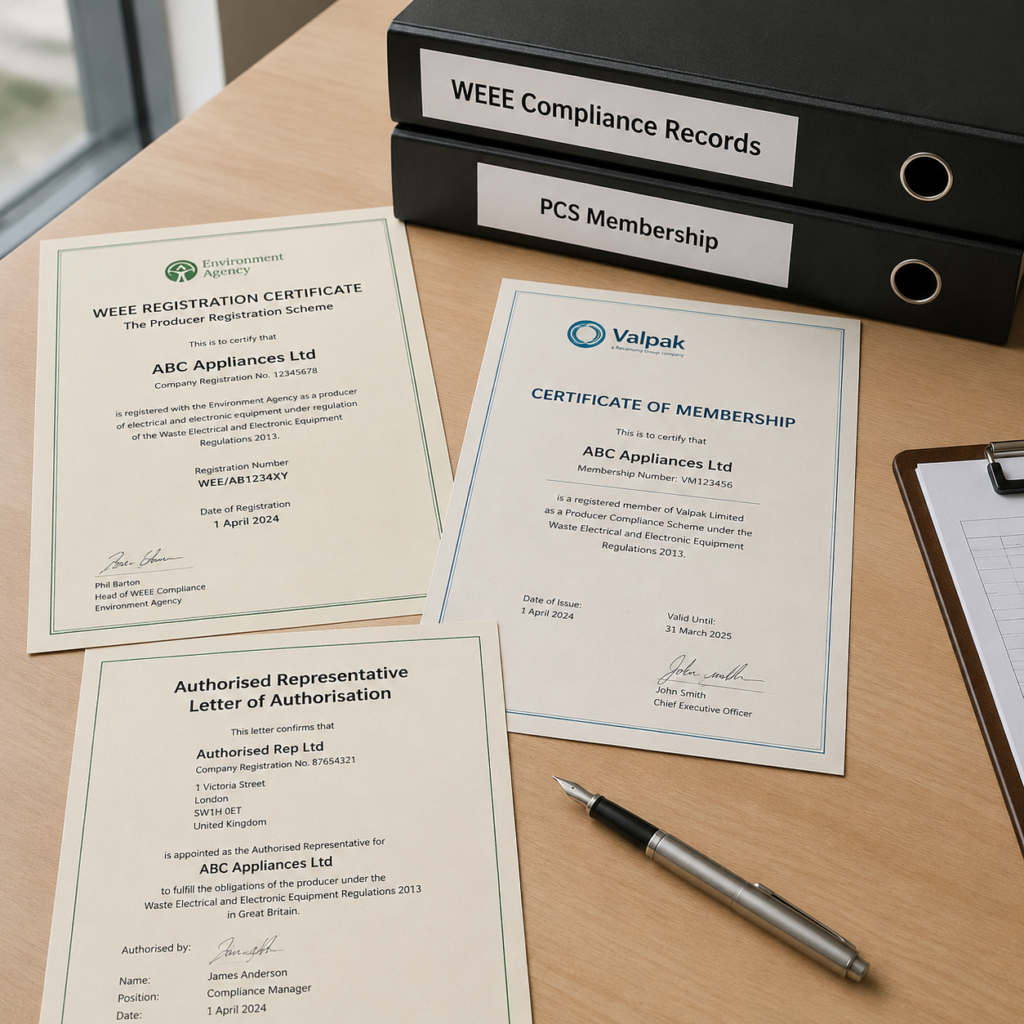
• Compliance certificate: After obtaining the registration certificate or PCS membership certificate, you need to keep the numbered document for platform review or regulatory inspection.
Fee Payment Obligation
WEEE fees are not fixed, nor are they calculated based on product power. They mainly consist of several parts:
• Registration fee: Annual registration fee paid by small producers to the regulatory authority.
• PCS service fee: Service fee for large producers to join the compliance scheme, according to contract agreements, different PCS have different pricing.
• Recycling and treatment fee: Calculated based on the total annual net weight of placement, category, and B2C/B2B attribute, collected by the PCS or regulatory authority, and is the main component of the fee.
• Other fees (if any): Such as recycling certificate fees, data verification fees, etc., which are not applicable in all cases.
The actual cost depends on the region, classification, placement volume, and PCS plan. Do not easily believe statements like “a charging head only costs a few cents”, you need to calculate it yourself.
Obligation of Marking and Consumer Information Notification
This is the most error-prone link, with many detailed requirements:
Mandatory Product Markings (3 Required)
1. Crossed-out wheeled bin symbol: Marked on the product body, indicating that it cannot be disposed of as domestic waste.
2. Producer identification mark: Marked with information that can identify the producer (brand/trademark/registered name, etc.), which must be consistent with the registration information.
3. Date mark: Products placed after August 13, 2005 must be marked. A solid horizontal bar indicates placement after that date, and cannot be replaced by the manufacturing date.
Marking Replacement Rules for Small-Sized Products
Only when the product size/function really cannot be marked, and it meets the regulatory conditions, can the marking be moved to the minimum sales packaging + manual. The marking obligation cannot be automatically exempted due to small size, let alone not marked at all.
Consumer Recycling Information Notification
Consumers must be informed of official recycling channels and disposal requirements through manuals/packaging; whether e-commerce product detail pages are required to display this information shall be implemented in accordance with current platform/regulatory requirements.
Declaration and Record-Keeping Obligation
• Declaration content: Total quantity, total net weight, category, and B2C/B2B distribution of products placed in the previous year.
• Declaration time: Submitted according to the current deadline of the regional regulatory authority/PCS. Late submission may result in fines.
• Record keeping: Materials such as placement data, sales vouchers, and compliance certificates must be kept for the specified period in accordance with regulatory requirements to cooperate with regulatory inspections.

• It is recommended to count placement data on a quarterly basis (not mandatory), which can greatly reduce the workload and error probability of annual declaration.
Recycling Cooperation Obligations of Distributors/Retailers (Need to Know)
Although this is not the responsibility of producers, it is often encountered in business, so a simple understanding is enough:
• When selling small EEE, it is necessary to recycle old equipment of the same type for free (except for specific exemptions), that is, “one-for-one recycling”.
• E-commerce sellers need to provide equivalent recycling solutions such as door-to-door pickup/mail-back.
• It is necessary to clearly inform consumers of recycling channels and fee rules, and keep recycling records.
• These obligations run parallel to the producer’s registration/fee payment/declaration responsibilities, and do not replace each other.
5. Practical Implementation: Full Compliance Process for Charging Product Sellers
After finishing the rules, next we will give you a set of practical steps that you can follow directly, covering from initial compliance to annual review.
Full Initial Compliance Process (8 Steps)
1. Sort out product list: Organize information such as function, net weight, and whether batteries are included for all SKUs, the more detailed the better.
2. Confirm regulatory scope: Refer to the content of Chapter 2 to confirm whether each product is regulated, its classification, and B2C/B2B attribute.
3. Determine responsibility identity: Refer to the content of Chapter 3 to confirm whether you are a producer and whether you need an authorized representative.
4. Choose compliance path: According to the sales region + annual placement volume, choose to register directly with the environment agency or join a suitable PCS.
5. Submit registration application: Prepare the materials and submit them. After completing registration, obtain the compliance certificate and keep the number.
6. Implement markings and information: Adjust products, packaging, and manuals to ensure that markings and recycling information meet requirements.
7. Daily data retention: Sales vouchers and placement records are archived regularly to facilitate subsequent declarations.
8. Annual declaration and fee payment: Complete the annual declaration and fee payment on time as required.
Comparison of Compliance Key Points for Different Sales Models
For your convenience in matching your own situation, we have compiled the core differences of common sales models into a table:
| Sales Model | Responsible Entity | GB Authorized Representative Requirement | Core Compliance Path | Key Evidence to Retain |
| Shipping from UK local warehouses (FBA/overseas warehouses) | First placement entity judged by import + sales chain | Required if the responsible entity is an overseas seller | Choose environment agency registration/PCS according to placement volume | Import vouchers, sales records, chain responsibility certificates |
| Direct mail self-shipment from China | Overseas selling seller | Must be designated | Choose environment agency registration/PCS according to placement volume | Order records, logistics vouchers, authorized representative agreement |
| Offline wholesale to UK importers | UK importer | Not required for the supplier | Compliance completed by the importer | Supply contract, order |
| Platform store sales | Seller (or producer judged by the chain) | Required if the seller is an overseas entity | Upload compliance certificate according to platform requirements | Compliance certificate, product list, sales data |
Key Points for Annual Compliance Review
WEEE compliance is not a one-time thing. A review must be done every year:
• Placement volume review: Check whether the small/large producer threshold is crossed. If the path needs to be switched, apply within the deadline.
• New category review: Confirm whether the classification of new charging products is correct and whether there is any under-declaration.
• Marking review: Check whether the markings and recycling information on products, packaging, and manuals are compliant.
• Data review: Check the consistency between sales data and declaration data, and confirm whether vouchers are complete.
6. Advanced Pitfall Avoidance: Judgment Skills for Semi-Proficient Level
If you have completed basic compliance, the following content can help you avoid 90% of hidden pitfalls.
Responsibility Judgment for Multi-Entity Cooperation
Now the supply chain is becoming more and more complex, and multi-entity cooperation scenarios are very common. Remember the core principle and you won’t be confused:
• Brand + contract manufacturer + importer model: The first placement entity is responsible, and internal contracts cannot oppose regulation.
• Platform and seller model: The platform bears the qualification review obligation. Non-compliant sellers may be delisted. Joint liability is implemented in accordance with current rules, but the main responsibility still rests with the seller.
• Battery-containing charging products: WEEE and battery EPR run in parallel, and need to be complied with separately. Weight splitting is implemented in accordance with official caliber.
• Charging accessory placement scenarios: Judgment of sales with the whole machine/independent/replacement, refer to the classification rules in Chapter 2.
Special Rules for B2B WEEE
Many people think that B2B products don’t need to worry about WEEE, which is completely wrong:
• Statutory final responsibility remains unchanged: For B2B products placed after August 13, 2005, the producer still needs to bear the statutory final responsibility for recycling. It’s not that you don’t need to worry about it just because you sell it to an enterprise.
• Commercial costs can be agreed: Recycling fees and processes can be allocated with customers through contracts. After the producer bears the responsibility, they can recover compensation based on the contract, but regulators will only look for the producer.
• Replacement of old and new equipment: If the sale of new B2B equipment involves the replacement of similar old equipment, bear the recycling responsibility in accordance with regional rules.
• Historical waste equipment: For products placed before August 13, 2005, the responsibility division is implemented in accordance with current regional rules.
Sellers doing B2B must keep sales contracts and product usage certificates to prove the B2B attribute and responsibility agreement, otherwise they may be charged fees according to B2C standards.
Types of Violation Risks: Don’t Panic but Don’t Take Chances
• Mild risk: Regulatory investigation, rectification within a time limit (e.g., adjusting markings, making up registration, making up declaration). Timely rectification generally will not result in additional penalties.
• Moderate risk: Recovery of recycling fees, administrative fines, generally targeting cases of overdue rectification, under-declaration or false declaration.
• Severe risk: Serious cases may involve criminal penalties, platform sales restrictions/delisting. Such cases are rare but not non-existent.
It should be noted that customs detention of goods and market access prohibition are not common direct consequences. They may only occur in specific collaborative rectification scenarios. Don’t be scared by exaggerated publicity, but don’t take chances either.
Correct Judgment of Exemption Situations
Exemption is not up to you. You must meet one of the conditions of “not EEE, not first placed in the UK, not for commercial use, belonging to statutory exemption categories”, and need to provide supporting materials. Typical exemptions include: purely mechanical plugs without electronic functions, individual unused second-hand chargers, military/aerospace special charging equipment. If you are unsure, be sure to consult the PCS or regulatory authority, and do not judge on your own.
7 Most Frequent Pitfalls for Charging Product Sellers
1. Pitfall 1: If the supplier has a WEEE number, own-brand OEM products don’t need compliance – Wrong. The own brand is a new placement entity and must comply separately. The supplier’s WEEE number only corresponds to their own brand.
2. Pitfall 2: Chargers + charging cables sold in sets are not weighed separately – Wrong. Recycling fees for different categories may be different. If not split, you will either spend more money or be inspected for under-declaration.
3. Pitfall 3: Thinking the platform handles all compliance on your behalf – Wrong. The platform only reviews or handles it as an agent, and the final responsibility still rests with the seller.
4. Pitfall 4: Thinking small-sized/light-weight products are automatically exempt – Wrong. Only markings can be replaced, and the obligations of registration, fee payment, and declaration are all required.
5. Pitfall 5: Complimentary chargers do not confirm whether the main product producer has declared – Wrong. This easily leads to under-declaration or repeated declaration. Standard accessories included with the main product must be declared uniformly by the main product producer.
6. Pitfall 6: The importer and the overseas brand owner do not have a clear division of responsibilities – Wrong. Both parties think the other will do it, and in the end neither is compliant, and both are fined.
7. Pitfall 7: Thinking all charging cables do not need compliance – Wrong. Charging cables with active components are within the regulatory scope when sold independently, and cannot be under-declared.
7. Quick Self-Check and Summary
Quick Self-Check List for Charging Product UK WEEE Compliance
□ Have confirmed the regulatory scope and classification of all charging products according to the five-step judgment method
□ Have confirmed your own producer identity and responsibility boundaries
□ Have selected the correct compliance path (direct registration/PCS) according to regional rules + placement volume
□ Independently sold active charging cables/adapters have been included in the declaration scope
□ Product markings (crossed-out bin/producer identification information/date mark) meet requirements
□ Have retained all compliance certification materials as required
□ Have completed the annual declaration and fee payment on time
□ Have separately confirmed applicable rules for sales to Northern Ireland
5 Core Competencies You Can Master
After learning this content, you should be able to:
1. Quickly judge whether charging products are subject to UK WEEE regulation, including the judgment of different types of charging cables and different sales scenarios.
2. Accurately identify the responsibility boundaries of each entity in the supply chain, and confirm whether you are a producer and whether you need an authorized representative.
3. Master the core obligations of producers and the basic compliance process, and know the boundaries of distributors’ cooperation obligations.
4. Distinguish the compliance differences between GB and Northern Ireland, small/large producers, and B2C/B2B, and avoid high-frequency misunderstandings.
5. Distinguish the requirements of UK WEEE from RoHS/UKCA/Battery EPR, and no longer confuse compliance obligations.
Finally, we remind everyone: All WEEE rules are subject to the latest official version. Before the annual compliance review, be sure to re-verify through channels such as the official GOV.UK guidelines, current rules of the three environment agencies / Northern Ireland DAERA, classification and fee plans of the selected PCS, and current requirements of e-commerce platforms, to avoid non-compliance due to rule updates.