
Many cross-border sellers and small businesses that sell products such as chargers, charging cables, and USB plugs to the UK often hear the term “UK REACH”, but they always regard it as an obscure chemical regulation, and do not know who conducts inspections, what is inspected, or what consequences will follow if violations are found. In fact, the enforcement logic of UK REACH is not complicated. As long as you clarify the boundaries, obligations, and processes in combination with the characteristics of charging products, you can have a clear idea, avoiding both blind anxiety and pitfalls.
1. Basic Boundaries: Scope of Application of UK REACH Enforcement
What is UK REACH Enforcement
Simply put, UK REACH enforcement is the regulatory action taken by UK authorities to verify whether market entities comply with UK REACH rules. Its core goal is to prevent charging products containing excessive harmful chemicals from entering the UK market, harming consumers or polluting the environment. Its official term is “UK REACH Enforcement”. Random inspections by competent authorities and port transfer verifications that people usually see are all part of enforcement.
“Dual-track System” for Territorial Application
The scope of application of UK REACH is divided into two independent systems according to different administrative regions of the UK, and cannot be generalized:
• GB region (England, Scotland, Wales): The UK’s domestic UK REACH regulation applies, and enforcement is carried out by competent authorities legally designated within GB. Compliance requirements, allocation of responsible entities, and versions of substance lists are all implemented in accordance with UK REACH rules;
• Northern Ireland (NI): According to the special arrangements after Brexit, EU REACH regulation applies to chemical access to the NI market. Specific enforcement is carried out by competent authorities with statutory authority within NI, and is subject to the EU’s relevant chemical regulatory system.
If your charging products are only sold to the GB region, you only need to meet UK REACH requirements and configure corresponding responsible entities; if they are also sold to the NI region, you need to additionally meet the corresponding requirements of EU REACH. The same set of technical documents can only be reused when the substance list version, product scope, sample information, and responsible entity requirements are all consistent. However, the statutory responsibilities, declaration paths, and list application requirements of GB and NI still need to be checked separately, and one set of compliance conclusions cannot be directly shared. Products sold across regions must separately meet the compliance requirements of the corresponding regions, and the configuration of responsible parties must be determined in combination with actual import routes and sales scenarios.
Attributes of Charging Products and Obligation Judgment Logic
Finished products with fixed shapes and specific functions, such as chargers, charging cables, and plugs, are classified as “articles” under UK REACH, and their obligations are different from those of chemical raw materials and mixtures.
To judge the compliance obligations of an article, the core is to first split it into homogeneous materials — that is, the smallest unit of the same material that cannot be further disassembled. For example, the PVC sheath of a charging cable is one homogeneous material, and the copper wire inside is another. The judgment of substance content is based on homogeneous materials, and cannot be calculated as an average based on the weight of the whole machine.
It should be noted that there is no general UK REACH exemption for charging products. Only special scenarios such as industrial use, R&D use, and national defense use need to be individually determined in combination with specific statutory provisions. Do not assume that industrial chargers automatically qualify for exemption.
Responsibility Boundaries of Different Roles
UK REACH responsibilities are divided according to supply chain roles, and there is no unified “primary responsible party” formula. The specific determination needs to be combined with product attributes, obligation types, and transaction facts. The confirmation of the responsible entity cannot be based solely on the identity of the seller, but needs to be comprehensively judged based on facts such as customs declarations, import records, transaction contracts, cargo flow, and who places the product on the GB market. You can refer to the table below to see the core statutory obligations of different roles:
| Responsible Entity | Core Compliance Obligations |
| UK domestic manufacturer | For products it manufactures and places on the GB market, assumes corresponding obligations under UK REACH (such as substance compliance, information transmission, record keeping, etc.) |
| GB importer | Assumes corresponding statutory compliance responsibilities for products imported into the GB region, including import compliance verification, cooperation with supervision, record keeping, etc. Specific responsibilities are determined according to import arrangements and customs declaration entities |
| GB Only Representative (OR) of overseas manufacturers | Designated by the overseas manufacturer to undertake specific obligations of the manufacturer under UK REACH (such as registration-related matters, transmission of compliance records, cooperation with supervision, etc.), does not replace the importer’s own import responsibilities, market supply obligations, and statutory responsibilities |
| Distributors/e-commerce platforms/overseas warehouses | Fulfill obligations such as supplier identity verification, compliance information transmission, record keeping, and cooperation with regulatory investigations. “Unawareness” alone cannot completely exempt from liability |
| Downstream users | Fulfill corresponding obligations according to their own usage scenarios (such as substance use compliance of industrial users, etc.) |
If an overseas seller sells directly to GB consumers through the self-delivery model, it cannot be determined that the consumer is the importer solely based on the consumer being the consignee. The responsible entity must be comprehensively confirmed in combination with facts such as customs declaration arrangements, import records, transaction contracts, and who is responsible for placing the product on the GB market; if the seller arranges bulk import to the GB market before sales, the compliance responsibility of the corresponding GB importer must be clarified. Overseas manufacturers can designate a GB Only Representative to undertake some manufacturer-side obligations, but this cannot exempt the importer’s statutory responsibilities.
2. Enforcement Subjects and Trigger Scenarios
Division of Labor of Enforcement Agencies
UK REACH enforcement in the GB region is not fully undertaken by a single department, but has a clear division of statutory authority:
• Competent enforcement agency: The Health and Safety Executive (HSE) is the main regulatory and enforcement authority for UK REACH in the GB region, responsible for overall regulatory coordination, special enforcement actions, and handling of complex cases. Relevant policy formulation is promoted by the government competent department in accordance with statutory responsibilities;
• Frontline market enforcement: Local Trading Standards have specific enforcement authority determined according to the GB region where they are located and the statutory authority for case types, responsible for daily enforcement of products in market circulation within their jurisdiction, clue verification, and cooperation with HSE;
• Border cooperation: Border customs and border forces undertake border risk management and control responsibilities for incoming goods in accordance with statutory authority. If goods suspected of violating UK REACH are found, they will be transferred to the corresponding competent authority. Specific investigations, supply restrictions, and penalty decisions under UK REACH are made by enforcement agencies with statutory authorization.
It should be noted that product safety (such as charger explosions) and waste environment (such as recycling of old charging cables) are not within the direct enforcement scope of UK REACH, and correspond to competent authorities of other regulations respectively.
Common Enforcement Trigger Reasons
UK REACH enforcement adopts a risk-oriented principle, not a full census. High-risk products have a higher probability of being inspected. Common trigger reasons include the following:
1. Port risk deployment: During entry inspection, customs may focus on charging products with low prices, unknown sources, or high historical non-compliance rates based on risk assessment, and transfer suspected violations to the competent authority;
2. Market targeted inspection: Regulatory authorities will carry out compliance inspections on specific categories based on risk assessment results. For example, popular fast charging heads, high-power chargers, etc. are often included in special actions;
3. Complaints and reports: Violation clues submitted by consumers (such as reporting product odor or causing skin allergies), peers, or platforms may trigger enforcement after preliminary verification;
4. List update investigation: Whenever UK REACH adds restricted substances or SVHC candidate substances, regulatory authorities will focus on verifying the compliance of corresponding categories.
Three Typical Enforcement Scenarios
Combined with the characteristics of charging products, there are three most common enforcement scenarios: first, suspected violation transfer verification during border customs clearance; second, targeted sampling testing of products sold in offline stores or on e-commerce platforms; third, special verification for complaints and reports. The inspection intensity and requirements of different scenarios will vary, but the core judgment logic is consistent.
3. Core Inspection Content: 4 Types of Obligations Involving Charging Products
There are many obligations under UK REACH, but for charging “articles”, only 4 types are core inspected during enforcement. The first two are encountered by the vast majority of sellers, and the latter two are only triggered in special circumstances.
The SVHC candidate list, authorization list (Annex XIV), and restriction list (Annex XVII) under UK REACH are three independent legal mechanisms. Not all substances circulate in a fixed order. The core requirements of the three are as follows:
| List Type | Regulatory Basis | Core Requirements | Commonness in Charging Products |
| SVHC Candidate List | Article 57-59 | When the homogeneous content exceeds 0.1% (by weight), information transmission obligations must be fulfilled; notification obligations may be triggered when conditions such as tonnage and exposure are met, and sales are not directly prohibited | Relatively high |
| Authorization List (Annex XIV) | Article 58-66 | For substances included in the list, after the sunset date, specific uses require official authorization before being placed on the market | Extremely low |
| Restriction List (Annex XVII) | Article 67-69 | Clearly prohibit or restrict specific uses of specific substances. Products that do not meet the requirements shall not be sold | Need to be judged in combination with specific entries |
1. Restriction Obligations (Annex XVII): Red Lines for Sales Prohibition Need to Be Checked Item by Item
The restriction list is the strictest requirement in UK REACH, but not all harmful substances are restricted — you must first check whether the substance is included in the specific entries of Annex XVII, and then match one by one the applicable product scope, homogeneous material requirements, concentration/release limits, exemption conditions, and effective time specified in the entries.
It should be particularly noted that: as electrical and electronic articles, the chemical substance restrictions of charging products need to check the corresponding entries of both UK REACH Annex XVII and UK RoHS, two independent regulations. They cannot replace each other, nor can one be defaulted to take precedence over the other. The following are common substances that need to be checked in charging products and key inspection points:
• Lead: May involve PCB solder, pin metal plating, plastic stabilizers, non-electronic metal parts, etc. Among them, the lead restriction of components such as solder in electrical and electronic products needs to be checked against the corresponding clauses of UK RoHS; the lead restriction in scenarios such as metal plating and plastic stabilizers needs to be simultaneously checked against the specific entries of UK REACH Annex XVII. Both must be judged according to the exemption conditions and concentration limits of the corresponding regulations, and it cannot be generally considered that all electronic uses are exempt.
• Cadmium: May involve metal parts, plastic stabilizers, etc. The cadmium restriction for electrical and electronic uses needs to be checked against UK RoHS, and for other scenarios, the specific material limits and applicable scope of UK REACH Annex XVII need to be checked. The limit requirements for different materials vary.
• Phthalates: Commonly found in materials such as PVC cable sheaths and soft plastic shells. To determine whether they are restricted, follow the complete steps: ① Confirm whether the specific phthalate substance is included in the corresponding entry of the current UK REACH Annex XVII; ② Confirm whether the product or component belongs to the product category covered by the entry; ③ Test the content of phthalates in the PVC sheath according to the homogeneous material standard to see if it meets the corresponding limit; ④ Check whether there are applicable exemption conditions. You cannot directly determine whether it is restricted solely based on the product name “PVC charging cable”, nor can you default that all soft plastic materials trigger phthalate restriction obligations.

• Polybrominated diphenyl ethers (PBDEs): Mostly used as flame retardants. The PBDE restriction in electrical and electronic products needs to be checked against UK RoHS, and at the same time, the corresponding entries and exemption conditions of UK REACH Annex XVII need to be simultaneously checked.
• Nickel: Mainly involves metal parts that may come into contact with skin, such as charging port plating. The corresponding restriction entry targets the nickel release limit (migration amount) of articles that are in direct and long-term contact with skin, not the total nickel content in the metal. It is necessary to judge whether it belongs to the category of “direct and long-term skin contact” in combination with the actual use scenario of the product.
The core evidence for such obligations is the test report of the corresponding entry and the supplier’s declaration of conformity.
2. Substances of Very High Concern (SVHC) Obligations: Corresponding Obligations Must Be Fulfilled If Exceeding the Limit
Substances in the SVHC candidate list are substances that have potential risks to health or the environment. Many people confuse it with the restriction list. Here, the core difference is clarified first: Excessive SVHC content will not directly lead to product sales prohibition; failure to fulfill corresponding obligations constitutes a violation.
SVHC-related obligations are divided into two levels, with different trigger conditions. The entire text uniformly uses content exceeding 0.1% (by weight) in homogeneous materials as the basic threshold:
1. Information transmission obligation (corresponding to Article 33): As long as the SVHC content in a homogeneous material exceeds 0.1%, it is necessary to transmit substance information up and down the supply chain, and after a consumer makes a relevant request, safe use information must be provided within 45 days — the trigger of this obligation has nothing to do with the annual sales volume of the product or the import tonnage.
2. Notification obligation (corresponding to Article 7(2)): If three conditions are met at the same time — the homogeneous content of SVHC in the article exceeds 0.1%, the annual total amount of the substance in all articles placed on the GB market is ≥ 1 ton, and the exposure of the substance cannot be excluded — the manufacturer or importer of the article needs to submit a notification to the HSE. Ordinary consumer-grade charging products usually do not trigger this tonnage-level obligation due to the low substance content per unit, but it needs to be evaluated in combination with the actual situation.
In addition, if the material or formula changes, the SVHC content and corresponding obligations need to be re-evaluated.
3. Registration Obligation: Only Triggered in Special Circumstances
The registration obligation under UK REACH targets chemical substances themselves, not the whole charging product. Ordinary charging products (as articles) that do not intentionally release chemical substances usually do not trigger registration obligations. The “intentional release” here refers to chemical substances that the product is designed to actively release to achieve specific functions (such as the fragrance components released by a charger with aromatherapy function). Ordinary chargers and charging cables do not have such designs, so they are basically not involved.
Only two types of situations require evaluation of registration obligations, and it is not that reaching the tonnage necessarily requires registration. It needs to be judged in combination with multi-dimensional statutory conditions:
First, when importing or producing chemical substances or mixtures separately: it needs to be comprehensively evaluated based on the annual import/production volume of each single substance in the mixture, the import/production role, the use of the substance, whether registration has been completed for the same use, etc.;
Second, when an article contains intentionally released chemical substances: it is necessary to simultaneously meet statutory conditions such as corresponding tonnage, the substance not being registered for the same use, and exposure not being excluded, before further evaluating the registration obligation.
Historical arrangements such as transitional registration and grandfather rights after Brexit are implemented in accordance with the time limit officially announced, and ordinary consumer-grade charging products basically do not encounter them.
4. Authorization Obligation: Rarely Triggered for Ordinary Products
The authorization obligation is for some high-risk SVHCs. After these substances are included in the authorization list (Annex XIV) from the candidate list, after the specified sunset date, specific uses require prior official approval before use.
Only specific industrial uses of some flame retardants and plasticizers in charging products may involve authorization, and ordinary consumer-grade products basically do not encounter it. Here is a common misunderstanding to clarify: Inclusion of SVHC in the candidate list does not mean that authorization is required; only specific uses that enter the authorization list require approval.
4. Enforcement Inspection Methods and Evidence Requirements
Three Common Enforcement Inspection Methods
UK REACH enforcement inspections adopt different methods according to risk levels, and not all involve sampling testing:
1. Document verification: A common method for preliminary inspection, which only requires submitting compliance materials as required, without sending samples;
2. Sampling testing: If the documents are suspicious or belong to high-risk categories, the enforcement department will draw samples from the batch and entrust a qualified laboratory for testing;
3. On-site verification: For enterprises with higher violation risks, law enforcement officers will go to the warehouses or offices of importers or manufacturers to verify inventory and compliance ledgers on site.
Common Evidence to Prepare
There is no general “required list” of materials required to be submitted for enforcement, and the specific ones shall be subject to the official notice of the enforcement authority. However, common evidence can be divided into two categories:
• Substance compliance category: Restricted substance test reports, SVHC supply chain declarations, material composition lists, etc.;
• Entity and record category: Import records, supplier information, registration/authorization certificates (if involved), past rectification records (if any), etc.
It should be noted that the test report can only prove the corresponding substance content of the submitted sample, which is not equal to full compliance. It also needs to cooperate with the performance of other statutory obligations such as information transmission and record keeping.
Common Sampling Parts for Charging Products
If sampling testing is required, law enforcement officers will generally take samples from high-risk homogeneous materials. The most commonly sampled parts of the charging product body are:
• Plastic and rubber categories: PVC sheath of charging cables, plastic shell of chargers, plug overmolding, adhesives;
• Metal categories: charging port plating, PCB solder, pin metal parts;
• Other functional components such as flame-retardant materials.
If the regulator includes packaging or packaging materials in the inspection scope, it may also involve materials such as packaging inks. The final sampling parts shall be subject to the enforcement notice, risk assessment, and specific regulatory entries.
It should be noted that the total element screening of metal parts cannot replace the release test required by specific restriction entries (such as nickel release), and the specific test items shall be subject to the corresponding regulatory entries. When doing internal quality control on a daily basis, you can also focus on these body parts to check risks in advance.
5. Full Enforcement Process: From Receiving Notice to Result Disposal
Enforcement Initiation: Verify Identity First After Receiving Notice
Enforcement notices are usually first sent to entities identified by the enforcement authority as relevant responsible parties, which may include GB importers, domestic manufacturers, GB Only Representatives (OR), distributors, e-commerce platforms, or other supply chain participants; sellers on e-commerce platforms may receive notices forwarded by the platform, and the forwarding by the platform does not change the determination of actual responsibility. A formal notice will clearly indicate the model of the product under inspection, the materials to be submitted, the feedback deadline, and bear the official letterhead of the corresponding enforcement agency.
The first step after receiving the notice is to verify the official identity of the sender to avoid fraud — for example, do not click on unfamiliar links in the email, and verify directly through the public contact information on the official website of HSE or local Trading Standards.
Standard Steps for Cooperating with Verification
After confirming that the notice is authentic, follow the steps below to cooperate:
1. First confirm the product scope and specific requirements under inspection, and do not blindly submit materials for all products;
2. Sort out or supplement compliance evidence, and submit it before the deadline. If you cannot make it, apply for an extension in advance, and do not be overdue;
3. If sampling is required, cooperate with the sampling requirements of law enforcement officers (by mail or on-site sampling), and keep good records of sample circulation to avoid being unable to explain the source of samples later;
4. Do not refuse to submit materials without reason. If business secrets are involved, you can explain to the enforcement agency and apply for confidential treatment, but you cannot refuse to provide materials required by law on this ground.
Enforcement Results and Disposal Measures
The results after enforcement verification and corresponding disposal measures need to be determined in combination with specific illegal acts, applicable regulations, and enforcement authority, and shall be subject to the official formal notice. Common types include:
• Compliance passed: The submitted documents are valid, the testing meets the standards, the verification is completed, and there is no penalty;
• Supplementation and rectification: If the documents are missing or the performance of obligations is defective but the substance itself meets the requirements, the enforcement agency may require supplementation within a time limit. Whether to be exempted from punishment shall be determined according to the specific illegal circumstances and the discretion of the enforcement agency;
• Violation disposal: If it is confirmed that the UK REACH obligation is violated, the enforcement agency may take measures such as restricting supply, requiring recall, seizing illegal products, and imposing fines in accordance with statutory powers;
• Criminal procedure: For cases that meet the statutory conditions for criminal accountability, criminal procedures may be initiated. Whether it is triggered depends on the violation clauses, evidence, responsible entities, enforcement authority, and applicable legal procedures in the UK.
Reference for Violation Risk Assessment
Assessing violation risks requires comprehensive judgment based on multi-dimensional factors, and there is no fixed severity ranking. The core reference dimensions include:
1. The type of obligation involved and the degree of harm of the substance;
2. Substance content/exposure level;
3. The quantity, value, and supply scope of the products involved;
4. Duration of the violation;
5. The degree of cooperation of the responsible entity and whether it takes the initiative to rectify;
6. Whether there are previous violation records.
For charging products, situations where restricted substances exceed the standard and are supplied in batches, and refusal to cooperate with rectification are usually high-risk combinations.
6. Responsibility Boundaries and High-frequency Pitfall Avoidance Guide
Penalty Responsibility Boundaries of Different Entities
Different supply chain roles have different ways of assuming responsibility, which need to be judged in combination with their own statutory obligations and case facts:
• GB importers, domestic manufacturers, GB Only Representatives: assume corresponding responsibilities according to their respective statutory obligations, and are common direct recipients of enforcement notices;
• Overseas sellers: the way of assuming responsibility needs to be judged in combination with the import model and the determination of the responsible entity. If a domestic importer is responsible for bulk import to the GB market, overseas sellers mainly face accountability at the supply chain cooperation level; if overseas sellers assume import responsibilities on their own (such as the seller being responsible for customs clearance under the self-delivery model), products may be intercepted at the border, restricted from supply, and may also face platform rule disposal; whether they can enter the country and whether they are directly punished depends on the case facts and enforcement decisions;
• Distributors, e-commerce platforms, overseas warehouses: need to fulfill statutory obligations such as supplier identity verification, compliance information transmission, record keeping, and cooperation with regulatory investigations. Unawareness usually cannot automatically exempt from liability. Whether it affects the determination of violations or penalty discretion shall be judged by the enforcement agency according to the specific obligation clauses and case facts; merchants should properly keep materials such as supplier qualifications, compliance declarations, and batch records as support for compliance verification.
4 High-frequency Minefields for Charging Products
Combined with enforcement practice and the characteristics of charging products, the 4 types of cognitive minefields that merchants are most likely to step on include:
1. Defaulting that all PVC charging cable sheaths are restricted by phthalates: It is necessary to check the applicable scope, substance types, limits, and exemptions of Annex XVII entries according to the complete steps, and cannot directly determine whether they are restricted solely based on the product name;
2. Directly replacing UK REACH compliance with UK RoHS or EU REACH reports: The three regulatory systems are independent of each other. Reports can be used as technical support, but cannot directly prove compliance with all UK REACH requirements;
3. Believing that the SVHC information transmission obligation is linked to annual sales volume: The information transmission obligation under Article 33 only depends on whether the homogeneous material content exceeds 0.1%, and has nothing to do with import tonnage or annual sales volume;
4. Confusing total element content with release requirements: The restriction of substances such as nickel is based on release amount (migration amount), and the total content result of XRF screening cannot be used to directly judge compliance.
Clarification of Adjacent Regulations and Evidence Boundaries
Boundaries with Other Regulations
• vs UK RoHS: UK RoHS only restricts 6 types of core harmful substances and subsequently added substances in electrical and electronic products. UK REACH covers a wider range of substances. The applicable requirements of the two are independent of each other and cannot replace each other;
• vs WEEE/Battery Regulations: They are independent regulations for waste recycling and battery management, and their enforcement systems and compliance requirements are completely separate from UK REACH;
• vs EU REACH: After Brexit, UK REACH has become an independent regulatory system. The update of substance lists, enforcement subjects, and responsibility requirements are all different from EU REACH. Products sold to the GB region need to separately meet UK REACH requirements;
• vs UKCA/CE Certification: UKCA and CE are product safety certifications, which do not cover chemical compliance requirements and cannot replace UK REACH compliance obligations.
Evidence Validity Boundaries
1. Supplier declaration ≠ permanently valid: If the UK REACH substance list is updated, or the product formula/material/production process is changed, compliance needs to be re-evaluated, and old declarations cannot be used for a long time;
2. Reports of other regulations ≠ UK REACH compliance: Reports such as EU REACH and UK RoHS can be used as technical support materials, but cannot directly prove compliance with all UK REACH requirements, and UK-specific rules need to be checked separately.
7. Practical Guide: From Daily Compliance to Enforcement Response
Basic Actions for Daily Compliance
For charging product merchants who have just entered the UK market, doing the following three basic tasks well can effectively reduce compliance risks:
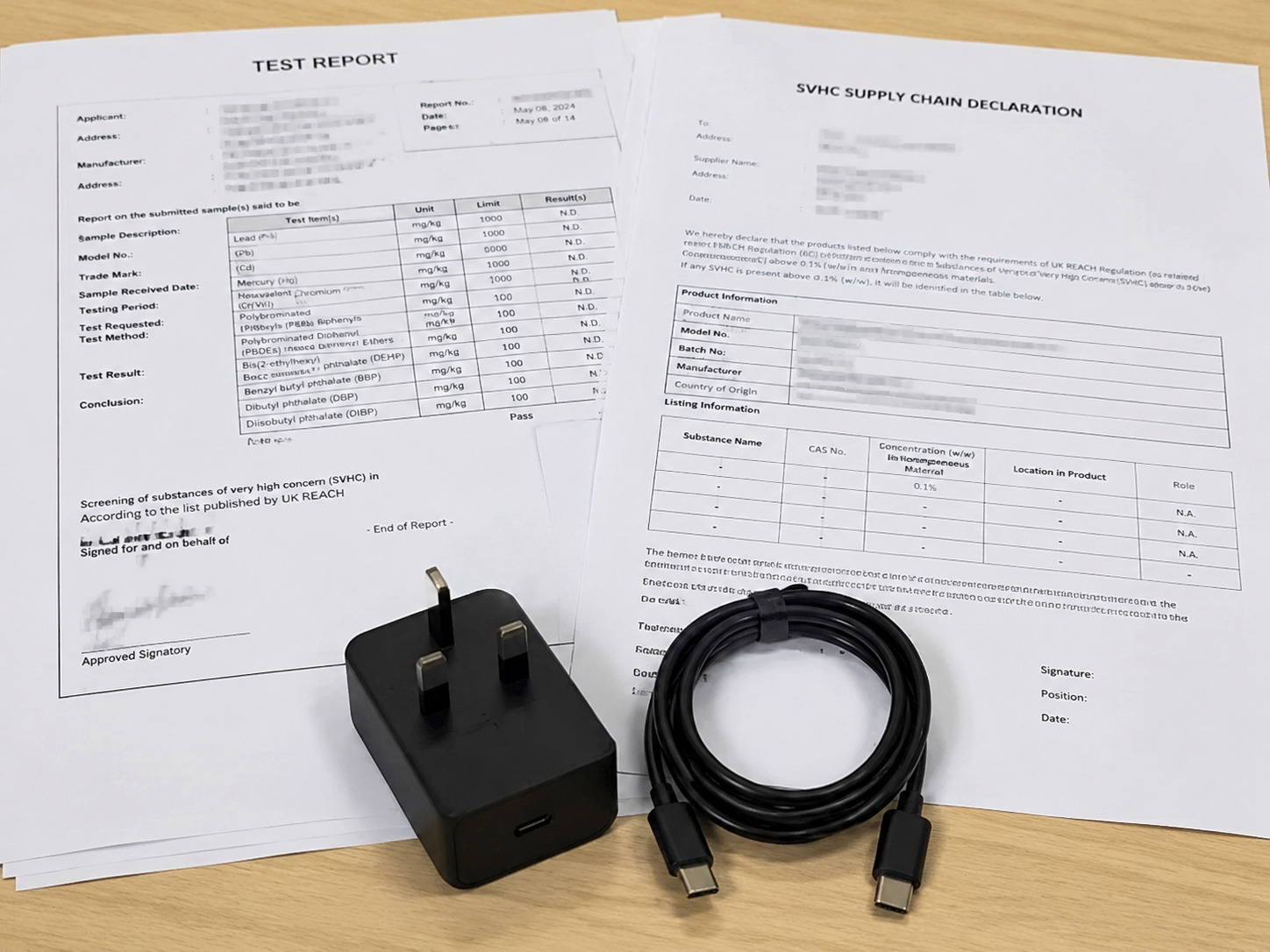
1. Supplier verification: Request the restricted substance test report and SVHC supply chain declaration of the corresponding product from the supplier, check that the homogeneous materials, product models, and production batches corresponding to the report are consistent with the actual supply, and avoid using general template declarations;
2. Clarification of responsible entities: Confirm the corresponding compliance responsible entity according to your own import model, customs declaration arrangement, and sales region — if you import in bulk to the GB region, you need to clarify the compliance responsibility of the corresponding GB importer; overseas manufacturers can designate a GB Only Representative to undertake some manufacturer-side obligations, but this does not exempt the importer’s statutory responsibilities;
3. Record keeping management: The compliance records explicitly required to be kept under UK REACH usually need to be kept for at least 10 years from the date of the last manufacture, import, or supply of the relevant product. The specific starting point and scope of keeping need to be checked according to the corresponding obligation clauses, and not all enterprise commercial materials need to be kept for 10 years. The core compliance materials to be kept include product models, batches, supplier information, restricted substance test reports, SVHC supply chain declarations, consumer information reply records, rectification records, etc. It is recommended to file them by category for inspection.
Response Ideas After Receiving Enforcement Notice
After receiving a UK REACH enforcement notice, you can first judge the risk level according to your own compliance situation, and then take corresponding measures:
• Low risk (substance compliance, complete documents): Sort out and submit a complete compliance evidence package according to the requirements of the notice to ensure that the materials correspond to the products under inspection;
• Medium risk (missing documents but substances are likely to be compliant): Contact the supplier as soon as possible to supplement the materials. If it cannot be completed before the deadline, apply to the enforcement agency for an extension in advance to avoid overdue;
• High risk (suspected violation of restriction requirements or lack of core obligations): First suspend the supply of the corresponding products, sort out the causes of the problems and formulate a rectification plan, and consult a professional compliance agency if necessary.
Compliance Cost Optimization for Different Entities
Sellers of different sizes can choose different compliance solutions to control costs on the premise of compliance:
• One-time small-batch importers: Directly choose public mold products with existing UK REACH compliance certificates, keep the supplier’s declaration of conformity and corresponding test reports, and ensure that the materials are consistent with the actual supply;
• Platform/small and medium-sized sellers: Prioritize choosing stable and compliant suppliers, and conduct regular sampling tests on high-risk materials such as PVC sheaths and charging port plating, without full testing for each batch;
• Brands/high-frequency importers: Establish material files for the full series of products, regularly review the update of UK REACH substance lists, and evaluate the relevant obligations of high-risk substances in advance to avoid temporary problems.
Practical Testing Strategies and Boundaries
Reasonable arrangement of testing can ensure compliance while controlling costs. It is necessary to pay attention to the applicable boundaries of different testing methods and select the corresponding type according to needs:
1. Preliminary screening of total element content: X-ray fluorescence spectrometer (XRF) can only be used for rapid screening of total element content such as lead, cadmium, and nickel. It cannot detect organic substances such as phthalates, nor can it replace migration tests such as nickel release. It is only used for internal risk investigation and cannot be used as formal enforcement evidence;
2. Quantitative precision testing of homogeneous materials: For high-risk homogeneous materials, it is necessary to entrust a laboratory with corresponding qualifications to carry out quantitative testing of target substances. The testing items must strictly correspond to the requirements of specific UK REACH restriction entries;
3. Specific release test: For entries involving nickel and other substances that require evaluation of release amount, corresponding migration tests must be carried out separately, and the total element content result cannot be used for judgment.
The validity of the test report does not depend on the issuance time, but must meet the following requirements at the same time: clearly marked corresponding UK REACH specific entries, name of the submitted homogeneous material, product model/batch, production date/formula version, testing method, and the sample is consistent with the material, formula, production process, and supplier of the actually sold product. If the above elements have not changed, the report of the same series of products can be used as compliance support; if there is a change, re-evaluation or testing is required.
Objection and Relief Paths
Testing Objection and Rectification Re-inspection
If you have objections to the results of sampling testing or the authenticity of the sample chain, you can apply for review or re-test in accordance with the procedures of the enforcement agency within the time limit specified in the enforcement notice. Pay attention to keeping supporting materials such as retained samples and sample circulation records.
If it is determined that the violation requires rectification, the rectification must be completed within the time limit required by the enforcement notice (such as supplementing compliance documents, recalling products, replacing compliant materials, etc.). After the rectification is completed, you can apply to the enforcement agency for re-inspection. Whether to resume supply and lift restrictions shall be subject to the final decision of the enforcement agency.
Relief Paths for Penalty Decisions
If you have objections to the formal penalty decision made by the enforcement agency, you must strictly follow the appeal, administrative reconsideration, or judicial relief procedures and time limits specified in the decision letter, and consult a professional legal person if necessary.
8. Typical Cases and Judgment Logic
The following are reference scenarios designed in combination with UK REACH rules to help understand the actual judgment logic:
Case 1: Suspected Violation of Phthalates in PVC Sheath of USB-C Cable
Background: A batch of USB-C cables was randomly inspected by customs when entering the country, and after being transferred to the enforcement agency, it was required to verify the compliance of phthalates in the PVC cable sheath.
Judgment logic: First, check according to the complete judgment steps of phthalate restriction: ① Confirm whether the specific phthalate substance involved is included in the corresponding entry of the current Annex XVII; ② Confirm whether the USB-C cable and PVC sheath belong to the product category covered by the entry; ③ If it belongs to the restricted scope, then test the phthalate content in the PVC sheath according to the homogeneous material standard; ④ Finally, check whether it meets the exemption conditions.
Response points: Submit the compliance test report and supply chain declaration of the corresponding batch; if the violation is confirmed, cooperate with the disposal requirements of the enforcement agency.
Common misunderstandings: Mistakenly thinking that the concentration can be calculated by the average weight of the whole machine, ignoring the judgment standard of homogeneous materials; or defaulting that all PVC products are restricted by phthalates, without first checking the applicable scope of the entry and the types of substances.
Case 2: Failure to Inform When SVHC Content in Charger Shell Exceeds the Standard
Background: A consumer reported to the regulatory authority that a charger had an odor. After random inspection by the enforcement agency, it was found that the homogeneous content of a certain SVHC in the shell exceeded 0.1%, and the seller did not provide relevant information when the consumer inquired.
Judgment logic: First confirm whether the SVHC content exceeds the 0.1% threshold, and then check whether the seller has fulfilled the supply chain information transmission under Article 33 and the obligation to reply within 45 days after the consumer’s request. According to the SVHC obligation rules mentioned above, the information transmission obligation has nothing to do with the annual sales volume of the product; at the same time, it can be evaluated whether the tonnage-level notification obligation under Article 7(2) is triggered in combination with the actual situation.
Response points: Supplement the supply chain SVHC declaration, provide consumers with safe use information as required, and improve the internal information transmission process; if the notification obligation is triggered, submit materials to the HSE in accordance with regulations.
Common misunderstandings: Mistakenly thinking that excessive SVHC content will directly lead to product sales prohibition, in fact, failure to fulfill corresponding obligations constitutes a violation; or thinking that all SVHC obligations are linked to annual sales volume.
Case 3: Submitting EU REACH Report and Being Required to Supplement Materials
Background: After receiving an enforcement notice, a seller submitted an EU REACH test report, but was required to supplement more compliance materials.
Judgment logic: Combined with the system differences between UK REACH and EU REACH mentioned above, the EU REACH report can only be used as technical support, and further verification is needed: whether the substances covered by the report are consistent with the current UK REACH list, whether there is a compliance declaration from the responsible entity in the GB region, and whether the test sample matches the actually sold product.
Response points: Supplement the UK REACH declaration of conformity, complete supply chain information, and GB responsible entity information; if there are additional substances required by UK REACH, supplement the corresponding test materials.
Common misunderstandings: Mistakenly thinking that the EU REACH report is completely equivalent to UK REACH compliance, ignoring the differences between the two regulatory systems, substance lists, and responsible entities.
The core logic of UK REACH enforcement is “risk-oriented, divided by responsibility, and judged by entries”. For finished charging products, the vast majority of compliance needs are concentrated on the verification of restriction obligations and SVHC information transmission, and registration and authorization obligations are rarely triggered. Merchants only need to combine their own supply chain roles, sales regions, and product characteristics, check the corresponding regulatory entries one by one, and do a good job in basic supplier verification and record keeping, which can effectively avoid enforcement risks.