
If you are in the business of charging products for the South Korean market, or plan to bring chargers and fast charging cables to South Korea for long-term use, you have most likely heard of the term “KC Certification”. Many people think it is just an ordinary quality mark, while others believe only lithium batteries need it, but neither view is accurate. In this article, we will systematically sort out the relevant rules of KC certification from the perspective of charging products — from basic definitions to scope of application judgment, mark authenticity verification, and common misconceptions — to help you establish a clear compliance judgment logic.
1. Basic Definition of KC Certification
Put simply, KC is the “safety compliance ID card” for charging products entering the South Korean market — it is not a single certificate, but an official conformity mark system shared by multiple South Korean product safety, electromagnetic compatibility, and radio compliance systems. Only products that meet the requirements of corresponding regulations can be marked with the KC mark and circulated in the South Korean market.
Its core function is to prevent safety risks of charging products such as electric shock, fire, and overheating. It has nothing to do with how easy the product is to use or how fast the fast charging speed is, nor does it represent a quality grade; it only proves that the product meets the corresponding safety and compliance requirements of South Korea.
Many people think KC only covers products with lithium batteries, which is the first common misconception for beginners: in fact, charging accessories without batteries such as chargers, fast charging cables with active circuits, and some conversion plugs may also need to obtain KC compliance as long as they fall within the mandatory scope of corresponding regulations, and it is not only products with batteries that are involved.
From the official attribute perspective, the full name of the KC mark is Korea Certification. Since 2009, it has gradually integrated the styles of multiple types of safety marks such as the original EK electrical safety certification, with the aim of unifying the appearance of compliance marks in South Korea. However, the compliance management of electromagnetic compatibility and radio equipment is still implemented by the corresponding competent authorities in accordance with special regulations, and not all old compliance systems have been merged into the same certification system.
Different types of compliance requirements are supervised by different departments:
- Electrical safety requirements (such as insulation and fire protection requirements for chargers): supervised by KATS (Korea Agency for Technology and Standards);
- Electromagnetic compatibility and radio equipment requirements: supervised by RRA (National Radio Research Agency).
Both types of requirements may use the KC mark, but they belong to different systems and cannot replace each other. For charging products, KC compliance is the core access threshold for entering formal sales channels in South Korea. The specific type of requirements to be met shall be determined according to the product’s category, parameters, and functions. Non-compliant products may be detained, required to rectify, or even penalized during customs clearance or market spot checks.
2. Scope of Application and Judgment Method for Charging Products
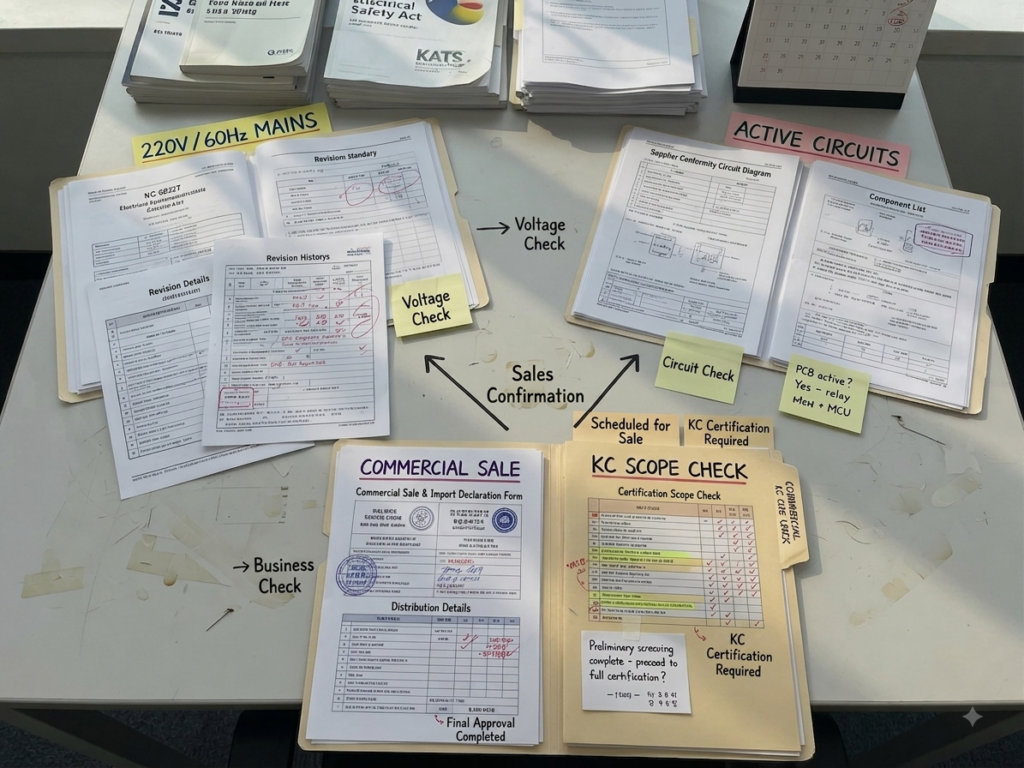
Since KC is closely related to charging products, which products exactly need KC certification? In fact, there is no need to memorize it by rote. Those who are new to this can first conduct a quick preliminary screening through three dimensions to narrow the scope of judgment, but the preliminary screening is for reference only, and the final result must be subject to the requirements of the official catalog:
- Whether it is directly connected to South Korean mains electricity (220V 60Hz): Products directly connected to the mains usually have higher safety risks and are very likely to involve mandatory compliance;
- Whether it has power conversion, active circuits, or charging control functions: Products with active circuits have much higher risks than purely passive accessories and are more likely to be included in the mandatory scope;
- Whether it is for commercial sale or bulk import: As long as the product is for commercial circulation in the South Korean market, compliance must be confirmed in advance, and judgment cannot be made based on experience or feeling.
Judgment Reference for Common Charging Products
The following are the compliance judgment logics for several types of common charging products, all of which are key verification objects. The final requirements shall be subject to the official product catalogs of KATS and RRA:
- Mains-connected chargers/power adapters: Including fast charging heads, multi-port charging stations, wall socket charging heads with USB ports, etc. These products are directly connected to 220V mains and have power conversion functions, and most fall within the scope of mandatory electrical safety compliance. The specific situation needs to be confirmed according to rated power and product category.
- Car chargers: Judgment needs to be made in combination with the input voltage range, power, and whether they contain a step-down conversion circuit. Most car chargers with active circuits may involve safety or EMC compliance requirements and cannot be directly exempted.
- USB/USB-C fast charging cables with E-marker chips: E-marker is a small chip in fast charging cables used to negotiate power, which can support high-current fast charging. Fast charging cables with such chips or other active circuits, rather than purely passive wires, may be included in the mandatory assessment scope, and compliance requirements need to be confirmed separately when sold separately.
- Charging devices with wireless charging, Bluetooth/Wi-Fi functions: Charging devices with wireless charging or wireless communication functions need to confirm the requirements for electrical safety, EMC, and radio conformity assessment supervised by RRA respectively, according to the wireless power transmission method, operating frequency band, transmission power, and whether they include a communication module. Among them, products equipped with communication modules such as Bluetooth and Wi-Fi usually need to additionally confirm radio compliance requirements, and RRA-related requirements cannot be directly excluded just because it is “ordinary wireless charging”.
Exemption Reference for Low-Risk Accessories
The following types of charging accessories usually have lower risks and are generally not included in the scope of mandatory safety certification, but the final result shall still be subject to the latest official catalog released by KATS:
- Purely passive charging adapters: Accessories with no internal chips, no power conversion circuits, and only converting the physical shape of the interface;
- Pure data cables that only transmit data and have no power supply function;
- Low-risk accessories with rated parameters below the mandatory threshold; the specific threshold shall be subject to the official catalog.
Boundary Cases Prone to Misjudgment
There are several special situations that are prone to misjudgment, which require special attention:
- USB-C fast charging cables with E-marker chips cannot be directly classified as ordinary passive cables, and need to be evaluated separately in combination with conditions such as circuit function, whether they are sold separately, and rated parameters;
- Multi-port chargers need to be evaluated as a whole based on the maximum power of the whole machine and the overall functions of all ports (such as whether they support fast charging, whether they have wireless modules), and the risk level cannot be determined only by looking at the power of a single port;
- The KC compliance of a charger does not mean that the matching charging cable sold separately in separate packaging is automatically covered by compliance — separately sold accessories need to confirm applicable requirements separately.
Regulatory Differences in Different Usage Scenarios
If charging products are for personal use and brought into the country with luggage, they are usually not managed according to the rules of commercial bulk import. However, they still need to comply with the relevant regulations of South Korean customs, transportation, and safety, do not have the compliance qualification for commercial sale, and cannot be directly equated with no need for compliance.
Query Sequence for Accurate Judgment
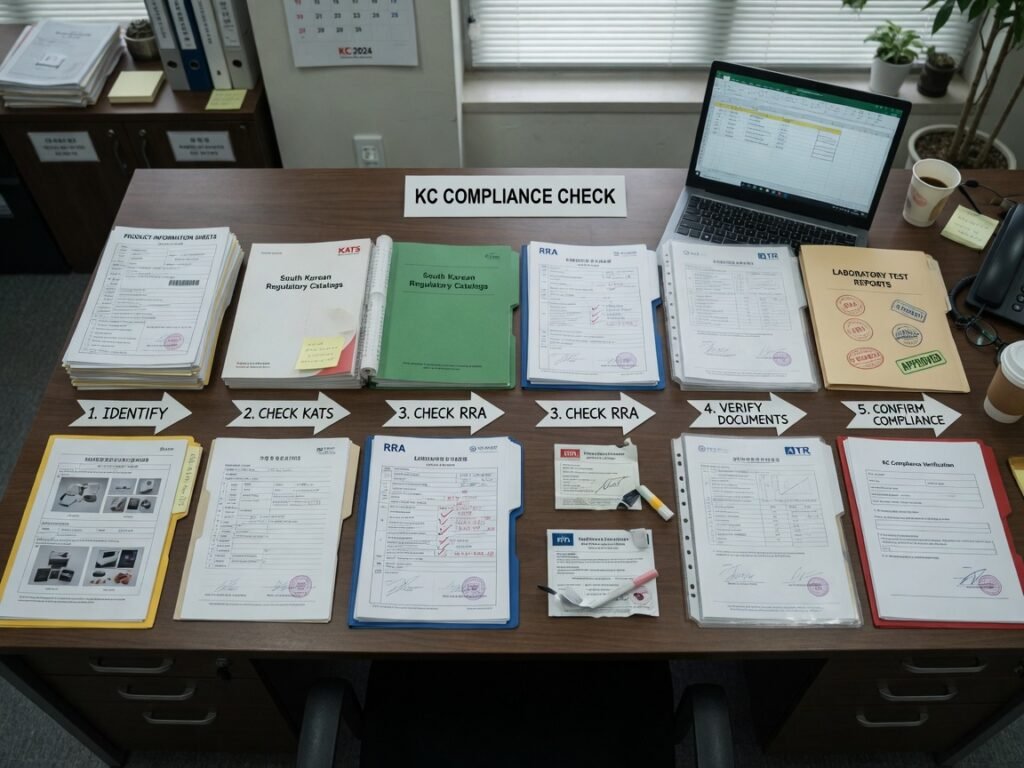
To finally confirm the KC compliance requirements of a charging product, you can check step by step according to the following procedures to avoid missing checks or misjudgment:
- First sort out the core product information: input method, rated power, whether it has active circuits, whether it has wireless functions, and sales scenario (commercial circulation/personal use);
- Confirm the applicable electrical safety compliance system through the KATS official product catalog;
- Combined with product functions, confirm whether it is necessary to meet EMC and radio conformity assessment requirements through relevant RRA channels;
- If compliance documents have been obtained, check whether the information such as product model, manufacturer, hardware version, and validity period completely matches through the corresponding official database.
3. Three Levels of KC Compliance and Corresponding Rules for Charging Products
Many people do not know that the electrical safety compliance system corresponding to KC is divided into three categories according to product risk level and management strictness, and different categories correspond to different application procedures, audit requirements, and responsible entities. The specific classification of charging products needs to be confirmed by KATS or its authorized institutions in combination with product type, parameters, and functions, and cannot be directly determined only by power or product name.
| System Name | Core Requirements | Official Issuance/Registration Status | Main Responsible Entity | Reference Applicable Charging Products (for reference only, subject to official classification) |
|---|---|---|---|---|
| Mandatory Safety Certification | Testing by South Korean designated laboratories + factory audit + official certification issuance | Official issuance of certification certificate with a unique certification number | Manufacturer + local South Korean certificate holder | High-risk electrical products such as high-power power adapters and high-voltage fast charging chargers |
| Safety Confirmation | Testing by South Korean accredited laboratories + official registration, no factory audit required | Official registration and assignment of a unique registration number | Manufacturer + local South Korean declaring entity | Ordinary mobile phone chargers, low-power car chargers, and some USB-C cables with active circuits or independent control functions (the specific level is subject to the official South Korean product classification) |
| Supplier’s Declaration of Conformity (SDoC) | The enterprise conducts testing by itself or entrusts testing and keeps the report, no official audit required | No official certification issuance or registration required, no unified official number | Manufacturer/importer (bears responsibility on its own) | Low-risk products such as low-power passive charging adapters and pure data accessories |
The E-marker chip itself does not automatically trigger a certain certification level. It needs to be comprehensively judged in combination with the product’s power supply capacity, control function, rated parameters, and official South Korean classification, and cannot be directly classified just because it “has a chip”.
Independent Compliance Requirements That Cannot Be Ignored
In addition to the above electrical safety systems, charging products may also involve two other types of independent compliance requirements, which may also use the KC mark, but the three cannot replace each other:
- Electromagnetic Compatibility (EMC) requirements: Most chargers with switching power supplies and charging devices with active circuits need to additionally meet EMC requirements to avoid interfering with other electronic devices during operation. This part of the requirements is independent of safety requirements and needs to be confirmed separately;
- Radio equipment compliance requirements: Products with wireless transmission functions (including wireless power transmission and wireless communication) need to confirm whether they need to meet the radio conformity assessment requirements supervised by RRA according to the product’s frequency band, power, and functions.
Different levels of safety compliance systems also have different effects. Products falling within the scope of mandatory safety certification cannot be replaced by safety confirmation or SDoC. The numbering formats of the three types of systems are different, and those familiar with the rules can initially distinguish the type through the number, but the final result shall still be subject to the query results of the official database.
4. Core Assessment Content of KC Compliance for Charging Products
KC’s assessment of charging products focuses on safety risks. The specific test items, limits, and sample requirements are all subject to the applicable South Korean standards for the corresponding product, and the assessment items for different categories of products will vary. The following are common assessment directions for charging products:
Core Electrical Safety Requirements
This is the core assessment item for all live products, mainly targeting common risks in charging scenarios:
- Electric shock prevention: Insulation performance meets standard requirements, no exposed live parts at the charging port, and leakage current is within the limit range to avoid the risk of electric shock when users come into contact;
- Fire protection and overheating protection: The product’s overheating, short circuit, overvoltage, and overcurrent protection functions need to be effective in normal use and fast charging scenarios to prevent fire caused by abnormal power;
- Abnormal working condition test: Tests for input abnormality, overload, short circuit, temperature rise, and fault conditions are carried out in accordance with applicable standards, and safety accidents such as fire and electric shock shall not occur during the test.
Structural and Mechanical Reliability
This type of test is determined according to product type and applicable standards, and not all products need to be assessed:
- Products with USB/USB-C interfaces may be assessed for indicators such as interface plug-in life and contact resistance to avoid problems such as poor contact and overheating after long-term use;
- Charging cable products may be assessed for bending strength, plug drop resistance, etc., to verify durability in daily use;
- The charger shell must meet the flame retardant and insulation requirements of corresponding standards to reduce external risks caused by internal faults.
Fast Charging and Output Stability
For charging products with fast charging function, this type of assessment is the focus:
- The output voltage must meet standard requirements, and overload, abnormal heating, etc. shall not occur when multiple ports output simultaneously;
- When the fast charging protocol negotiation is abnormal, it must be able to safely downshift or stop output to avoid damage to electrical equipment due to incorrect output voltage;
- For fast charging cables with E-marker chips, the temperature rise during high-current transmission must meet the limit requirements to avoid risks caused by overheating.
Labeling and Manual Requirements
Different categories of compliance systems have different requirements for labeling and manuals. Common requirements include:
- The product body or nameplate may need to be marked with the KC mark, corresponding compliance number, model, rated parameters (voltage/power/current), and manufacturer or South Korean importer information;
- Safety products usually require rated parameters and safety prompts marked in Korean, and the manual must include safety usage instructions in Korean;
- The specific requirements for the location, content, font size, etc. of the label must comply with the provisions of the corresponding system and standards, and cannot be generalized.
The impact of non-conformity in different items is also different: failure to meet electrical safety standards will directly lead to the failure of compliance applications, and the product itself has safety hazards; non-standard labeling or manuals, even if the product itself passes the test, may be required to rectify or be detained during customs clearance or market spot checks; if the reliability of interfaces and cables does not meet the standards, it usually requires re-testing after rectification, which will lengthen the application cycle.
5. KC Mark Identification and Authenticity Verification
The style and supporting information of the KC mark will vary depending on the compliance system and product type. The authenticity cannot be directly judged only by appearance. It is recommended to confirm through the two-step method of “preliminary screening + official database verification”.
Preliminary Screening (for quick exclusion only)
If the product has the following characteristics, it is a high-risk non-compliant situation and requires further verification:
- The KC mark itself is severely deformed, printed blurry, and does not conform to the fixed proportion specified by the official;
- For products with sufficient labeling area such as chargers and power adapters, there is no nameplate or KC-related information on the body, and the mark is only printed on the outer packaging;
- The marked parameters and models are obviously inconsistent with the actual functions of the product (for example, it is nominally 100W fast charging but actually only 10W).
Note: For products with limited labeling area such as charging cables and small passive accessories, compliance information can be marked on the plug, packaging, or manual in accordance with the requirements of corresponding standards. It cannot be directly judged as non-compliant just because “there is no mark on the body”. The final conclusion must be subject to the labeling rules of the corresponding system and official verification.
Official Verification Method (Accurate Judgment)
To confirm whether the KC compliance of a product is valid, the safest way is to query through official channels. It is necessary to check information such as product model, rated parameters, manufacturer, certificate holder/declaring entity, certificate validity period, and product version, and only when all information matches is it valid compliance:
- Electrical safety compliance (safety certification, safety confirmation): You can query by entering the compliance number or product model through the official system of KATS or Safety Korea;
- Electromagnetic compatibility and radio equipment compliance: You can query the corresponding filing information through the official website of RRA.
Common Situations of “Having a Certificate but Not Compliant”
Many people think that there is no problem as long as there is a compliance number. In fact, the following situations are still violations even if there are compliance documents:
- The model and hardware version on the compliance document are inconsistent with the actually sold product;
- After product modification (such as changing the interface type, adjusting the rated power, replacing the internal circuit or wireless module), the compliance document has not been re-applied for or updated;
- The compliance document has expired, or has been suspended or revoked;
- The content of the product’s label and manual does not meet the requirements of the corresponding system, such as missing necessary Korean prompts, non-compliant mark position, etc.
In addition, it should be noted that the certificate holder/declaring entity, manufacturer, local South Korean responsible entity, and sales entity of the compliance document may be different entities. Their respective responsibilities and qualifications need to be checked in accordance with the requirements of the corresponding system. It cannot be simply considered that “inconsistency between the sales entity and the certificate holder is a violation”. The key is to see whether the product is within the coverage of the compliance document and whether the local South Korean responsible entity meets the regulatory requirements.
In daily work, also pay attention to distinguishing the KC mark from the old KCC mark, KS industrial mark, and Qi wireless charging mark — these marks have different uses, competent authorities, and scopes of application, and cannot replace KC compliance.
6. Differences and Mutual Recognition Between KC and Other Common Certifications
Many friends who do cross-border business will ask: if you have certifications from other countries, can you use them directly as KC? The core conclusion is: Marks and certificates from other countries or regions such as CE, UL, and FCC cannot automatically replace KC compliance; some CB/IEC test materials may be used to reduce repeated testing after evaluation by the institution, and whether they are accepted depends on applicable standards, national differences, and certification systems.
Differences from the CE Mark
CE is a conformity mark under EU regulations. Manufacturers need to complete conformity assessment for the specific EU regulations applicable to the product; different regulations may involve requirements such as safety, EMC, radio, or hazardous substance restriction, and the specific scope varies by product. KC is a South Korean compliance mark. The applicable region, test standards, voltage and frequency (South Korea 220V 60Hz, EU 230V 50Hz), and plug requirements are all different, so it cannot be automatically replaced.
Differences from UL and FCC
UL is a safety certification provided by a private US safety certification agency. Although it is not mandatory by the US government, it has a high recognition in the US market; FCC is the compliance requirement of the US Federal Communications Commission, mainly targeting radio frequency equipment and electromagnetic emission related matters, and does not cover all EMC requirements. Both are relevant certifications for the US market, and neither can directly replace KC’s safety, EMC, or radio requirements.
Differences from RoHS and Qi Certifications
RoHS is a hazardous substance restriction requirement, which controls the content of harmful chemical substances in products, and does not fall into the category of safety certification; Qi is a compatibility certification of the Wireless Power Consortium, which proves that wireless charging devices meet the compatibility of Qi standards, and has nothing to do with South Korean market access. Neither can replace KC compliance.
Explanation on Mutual Recognition of CB/IEC Reports
CB (IEC Conformity Assessment System) test reports can be used as reference materials for applying for KC compliance. If they are evaluated by the certification body to meet the requirements of the Korean standard version and national differences, some repeated tests can be reduced, but they cannot be directly equated with KC certificates. Whether they are accepted is ultimately subject to the judgment of the corresponding system and the accepting institution.
7. Common Misconceptions and Basic Decision-Making Logic
After understanding the basic rules, we have sorted out the most common misconceptions in actual operation and the basic decision-making logic for applying for KC compliance to help you avoid detours.
Common Misconceptions
- Product classification misconceptions
- Not all charging cables do not need KC: Fast charging cables with active circuits and E-marker chips, especially those sold separately, may fall within the scope of mandatory compliance and need to be confirmed according to official classification;
- Low power does not necessarily mean exemption: Compliance requirements need to be comprehensively judged in combination with input method, product function, and official catalog, and cannot be judged only by power level;
- Multi-port chargers need to be evaluated as a whole based on the maximum power of the whole machine and the functions of all ports, and cannot be judged as low risk only by looking at the power of a single port.
- Certificate usage misconceptions
- Different models of the same brand cannot share the same compliance document; the model and hardware version must completely correspond;
- After product modification (changing interfaces, adjusting power, replacing internal circuits or wireless modules), it is necessary to re-evaluate whether the compliance document needs to be updated, and the old certificate cannot continue to be used;
- After the compliance document expires or is revoked, the KC mark cannot continue to be marked on the product;
- Importers need to confirm that the local South Korean responsible entity meets the requirements of the corresponding system, and cannot directly use an unauthorized manufacturer’s certificate.
- Application decision-making misconceptions
- Do not judge the compliance level only by product name or experience; you need to first check the official catalog or consult an authorized institution;
- Do not ignore additional requirements such as EMC and radio; you need to fully confirm the compliance scope in combination with product functions.
Basic Application and Change Rules
If you plan to apply for KC compliance for charging products, there are several basic rules to note:
- Confirm product classification first: Before applying, first confirm which type of compliance system the product belongs to through the official catalog or consulting an authorized institution, to avoid wasting time and cost due to wrong level;
- About the applicant entity: Different systems have different requirements for the applicant entity. Foreign manufacturers can usually handle it by designating a local South Korean importer or authorized representative as the certificate holder or declaring entity. The specific requirements need to be confirmed according to the corresponding system;
- Sample consistency: The samples submitted for testing must be completely consistent with the final mass-produced version, including hardware, firmware, structure, labeling, etc. Any change requires re-evaluation of whether supplementary testing or re-application is needed;
- Cycle and cost: For safety certification, a preliminary plan can usually be made for 4 to 8 weeks; for safety confirmation, a preliminary plan can usually be made for 2 to 4 weeks. Neither includes the time for laboratory scheduling, factory audit, rectification, and re-testing. The actual cycle is subject to the institution’s evaluation. The cost varies with factors such as product power, number of ports, whether factory audit is required, and whether wireless functions are involved, and there is no unified quotation.
If you enter the South Korean market without compliance, you may face consequences such as customs detention of goods, removal from e-commerce platforms, fines, and product recalls. In severe cases, it may also affect subsequent market access.
Summary
To judge the KC compliance requirements of a charging product, you can proceed step by step according to this logic: first sort out the product’s input method, rated parameters, core functions, and sales scenario; then confirm the applicable electrical safety system through the KATS official catalog, and confirm EMC and radio requirements through relevant RRA channels; if it is for commercial sale, check in advance whether the product model, hardware version, and local South Korean responsible entity meet the requirements; after obtaining the compliance document, verify the consistency of information through the corresponding official database, and you can avoid the vast majority of compliance risks.