
If you live in the UK, have bought phone chargers or laptop adapters, or sell charging products to the UK via cross-border e-commerce, you have more or less heard of the term “energy efficiency standards”. But what exactly do they regulate? Which products need to comply? What impact do they have on ordinary users and small sellers respectively? Many people either have only a smattering of knowledge, or have quite a few misunderstandings. In this article, we will start from the most basic concepts, all the way to being able to judge compliance by yourself and avoid common pitfalls. After reading it, it will be sufficient whether you are shopping for yourself or doing entry-level compliance work.
I. First, Clarify: What Is an External Power Supply, and Who Must Abide by the Rules?
What Is an External Power Supply
The “chargers” and “power adapters” we usually talk about mostly belong to external power supplies (abbreviated as EPS, External Power Supply) — they generally refer to power supply devices that convert AC mains power into low-voltage DC or other electrical energy usable by electrical equipment, and are independent outside the equipment, different from power supply boards installed inside the equipment.
Common forms include phone chargers, PD fast chargers, square adapters for laptops, and all-in-one chargers with mains input plugs and integrated AC-DC conversion circuits inside; if it is just a pure conduction accessory with a fixed cable and no voltage conversion function, it does not fall into the category of external power supplies.
Regulatory Position and Function
The UK’s external power supply energy efficiency requirements are part of the UK Mandatory Ecodesign Regulations (UK Ecodesign). After Brexit, they replaced the original EU ERP energy efficiency requirements and are one of the mandatory access rules for the UK market.
For ordinary users, the direct benefit of energy efficiency requirements is reducing ineffective power consumption and saving electricity bills. At the same time, because less electrical energy is wasted, the heat generated by chargers during operation will also be lower; for cross-border sellers, this is a hard threshold for entering the UK market, and non-compliant products cannot be legally listed for sale.
Scope of Application and Exclusion Boundaries
Not all charging-related accessories are regulated by this standard. We can first use four core conditions for preliminary screening: directly connected to mains power, being an independent external device, used for charging/powering consumer electronics, and rated power ≤ 250W. But this is only the basis for preliminary screening. Whether it is ultimately included in the jurisdiction needs to be checked against the clear definition of the UK Ecodesign Regulations, the actual use of the product, and official exclusion clauses.
Common products confirmed to be under jurisdiction include: single-port/multi-port USB chargers, PD fast chargers, and power adapters for laptops or small consumer electronic devices.
The following types of products are usually not subject to the external power supply energy efficiency rules described in this article (this only means they are excluded from this EPS energy efficiency requirement; they may still need to comply with other UK product safety, electromagnetic compatibility, WEEE, or special regulations for corresponding categories):
• Passive charging cables: They only undertake power transmission and do not involve AC-DC voltage conversion, so they are not included in EPS energy efficiency assessment (but cable resistance and contact resistance will still cause transmission losses in actual use)
• Power banks: They are power storage devices, not power supply devices that are directly plugged into mains power for voltage conversion, and are governed by other category rules
• Car chargers: They use the car’s 12V low-voltage power supply instead of mains input
• Power strips/plug adapters: They only conduct current, do not change voltage, and have no power conversion function
• Special power supplies for industrial, medical and other fields: If they are supporting power supplies for special equipment as defined by regulations, they may be excluded from consumer-grade EPS energy efficiency rules, which needs to be confirmed according to regulatory exclusion clauses and actual usage scenarios
• Built-in power supply boards: They are installed inside electrical equipment and do not belong to external independent devices
II. Two Key Indicators for Core Assessment
The core of energy efficiency standards is actually just two indicators: one manages the electrical energy utilization rate during charging, and the other manages the invisible standby power consumption when not charging. Let’s first quickly build an understanding through a table, and then elaborate on each:
| Core Indicator | Plain Language Definition | Assessment Purpose | Common Reference Range | Daily Perception Correlation |
| Average Efficiency in Active Mode | The proportion of electricity actually used for charging the device to the total power consumption during charging | Measures the level of electrical energy waste during the charging process | Common consumer-grade products are roughly in the range of 75%-89%; the higher the power, the higher the corresponding limit usually is (this is only an approximate reference and not a basis for compliance judgment) | For products with the same power and same design, the higher the efficiency, the relatively less heat generated during charging |
| No-Load Power Consumption | The invisible power consumption when plugged in but not connected to a device/not charging | Measures the electrical energy waste in standby state | The limit for most consumer-grade products is between 0.1W and 0.21W; the specific value is graded according to product type and power (this is only an approximate reference and not a basis for compliance judgment) | The more chargers are plugged in all year round, the greater the cumulative difference in electricity bills |
Average Efficiency in Active Mode: Utilization Rate During Charging
Simply put, if you take 100 units of electricity from the grid, how many units are actually used to charge the device, and the rest is wasted as heat — this ratio is the active mode efficiency. The higher the value, the more power is saved.
To prevent merchants from “cheating” by only achieving high efficiency at a certain power point, regulations require testing the efficiency at multiple load points and then taking the average as the assessment basis. For conventional non-low-voltage external power supplies, four load points of 25%, 50%, 75%, and 100% are usually tested; for special types of external power supplies such as low-voltage output and multi-voltage output, different test point selection rules and efficiency calculation formulas may apply. The specific requirements shall be subject to the annexes of the regulations and the test plans of formal laboratories. After all, chargers do not always work at full power: for example, after charging a phone to 80%, the current will decrease, that is, the load decreases. If only full load is tested, the waste at low load will be left unregulated.
To give everyone a general idea, the minimum efficiency requirements for common consumer-grade low-voltage low-power chargers of around 5W and non-low-voltage high-power chargers of around 100W roughly fall in the range of 75%-89%. The higher the power, the higher the corresponding limit usually is. But this is only a very rough reference and cannot be directly used to judge whether a product is compliant. The specific limit needs to be calculated according to the product’s rated output power and product type (low-voltage/non-low-voltage) against the regulatory formula or official limit table, and the final result shall be subject to the formal test report.
Most chargers have relatively high efficiency in the medium load range (about 50%-75% of rated power), and the efficiency may be slightly lower at low load or full load. But this is only a common engineering trend, and for each specific product, it is still subject to the actual measurement results at each load point.
No-Load Power Consumption: Invisible Power Consumption When Plugged In But Not Charging
Many people think that if a charger is not connected to a device and not charging, it will not consume power. In fact, this is not the case — as long as it is plugged into a socket, the internal standby circuit will still consume a little power. This is no-load power consumption, and the lower the value, the more power is saved.
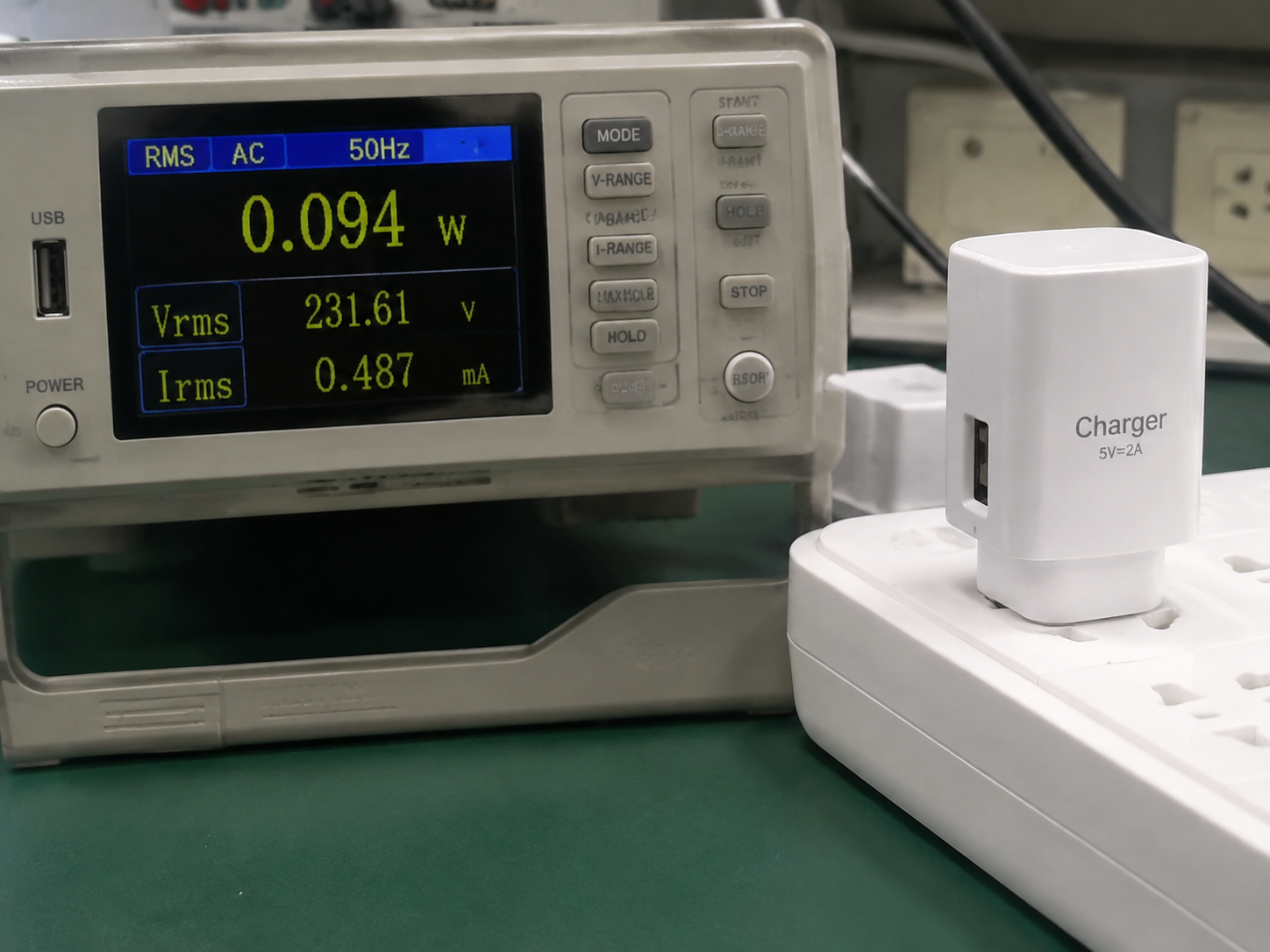
In the regulations, no-load power consumption limits are set in grades according to product type and rated output power: for common consumer-grade single-voltage low-voltage chargers, the limit is mostly around 0.1W; for multi-voltage and higher-power products, the limit will be appropriately increased according to the grade. The no-load limit of most common consumer-grade EPS does not exceed 0.21W. The specific limit needs to be checked against the regulatory requirements according to product type and rated power, and cannot be judged solely by the number of ports.
Don’t underestimate this difference of a few tenths of a watt: the no-load power consumption of some low-priced white-label products may reach 0.5W or even higher (this is only an example of common inferior products and does not mean that all white-label products exceed the standard). Calculated based on the average UK electricity price and 8760 hours of plug-in per year, a product with 0.5W no-load consumes about 3.5 kWh more per year than a compliant product with 0.1W, which is equivalent to about 1 pound in electricity bills; if there are 7-8 such non-compliant chargers plugged in by the bedside or on the desk all year round at home, the cumulative extra cost for the whole year is about a few pounds. If there are more chargers, higher no-load power consumption, or rising electricity prices, the cumulative cost may approach more than ten pounds. Many people have not noticed this invisible expense at all.
Assessment Rules for Special Types of Chargers
The above are general requirements. There are several types of special chargers whose assessment rules are different from conventional products. The specific test methods shall be subject to the annexes of applicable regulations and the plans of formal laboratories:
• Low-voltage chargers: For example, traditional 5V USB-A single-voltage chargers, because of their low output voltage, have different loss characteristics from high-voltage output products, so special efficiency calculation formulas apply, and the limits are also different from high-voltage output products.
• Multi-voltage fast chargers: For example, USB-C PD chargers that support multiple voltage levels of 5V, 9V, 12V, and 20V cannot only test the efficiency of a certain level. All nominal voltage levels must be tested separately as required, and all must meet the corresponding limits.
• Multi-port chargers: Compliance cannot be judged solely based on the test results of single-port output. It needs to cover various output states and load combinations required by regulations. The test report must cover all output modes declared on the nameplate, including typical combinations of single-port and multi-port simultaneous output. It is not allowed to only submit test data of the highest single-port efficiency or a single combination. The specific test matrix shall be implemented in accordance with regulatory requirements and formal laboratory plans, and cannot be completed by only testing single ports.
III. How to Check the Energy Efficiency Information of Products?
Many people want to buy high-energy-efficiency products but don’t know where to check the parameters. Here are several formal query methods, as well as a small tip for quickly screening out inferior products.
First, we need to clarify a common misunderstanding: the core obligation of the external power supply energy efficiency requirements described in this article is to meet the minimum energy efficiency limits of the UK Ecodesign Regulations. The A-G energy efficiency rating label only applies to specific categories that are also subject to the UK Energy Labelling Regulations, and not all external power supplies are required to be posted with it. In addition, the UK has an independent energy efficiency label system, which is not interchangeable with the EU energy efficiency label. Even for products that are eligible for energy labels, EU labels cannot be directly used interchangeably.
Formal energy efficiency information can be verified level by level through the following channels, and the parameters of all public channels must be consistent:
1. Product body, packaging and accompanying documents: Core energy efficiency information such as average efficiency and no-load power consumption is preferentially marked on the product body or packaging; if the surface space of a small-sized charger is limited, regulations allow detailed data to be placed in the manual, officially published technical documents, or the free public website of the manufacturer/UK importer, and not all of them need to be printed on the charger shell.
2. Compliance technical documents: You can request documents such as the UK Declaration of Conformity and energy efficiency test report summary of the product from the seller or manufacturer. Formal products will have corresponding compliance supporting materials, and the document parameters must be consistent with the product nameplate and external publicity.
3. E-commerce sales page: For product detail pages sold to the UK market, sellers need to publicize core energy efficiency information (including average efficiency, no-load power consumption, etc.) in accordance with UK regulations and corresponding platform rules. If relevant information cannot be found on the product page, you can directly ask the seller for compliance documents for verification.
If you don’t want to check complicated documents, looking at the charger’s nameplate (the parameter label engraved or pasted on the surface) can first screen out a large number of high-risk products. The nameplate of a formal product will definitely have the following information: input voltage range, output voltage/current/power, brand and model, manufacturer or importer information. If a charger doesn’t even have model and manufacturer information, it is basically a white-label product from a small workshop, with an extremely low probability of meeting energy efficiency standards. It’s best not to buy it.
IV. Practical Guides for Different Groups
Ordinary Users: Product Selection + Power Saving Tips
For ordinary consumers, there is no need to memorize complicated standard provisions. Just remember these points:
1. Prioritize products from formal brands that actively publicize specific efficiency values and no-load power consumption. Don’t just believe vague publicity such as “high energy efficiency” and “super power saving”.
2. For products with the same power, prioritize those marked as meeting UK energy efficiency requirements and with complete manufacturer information. Don’t buy unbranded white-label products with no model number and no production entity.
3. Daily power saving: Unplug chargers that are not used for a long time, or plug them into a power strip with a switch and turn it off, to avoid the accumulation of no-load power consumption.
Entry-Level Cross-Border Sellers: Basic Compliance Requirements
If you are a cross-border seller who has just entered the UK market, first implement these basic requirements properly to avoid big pitfalls:
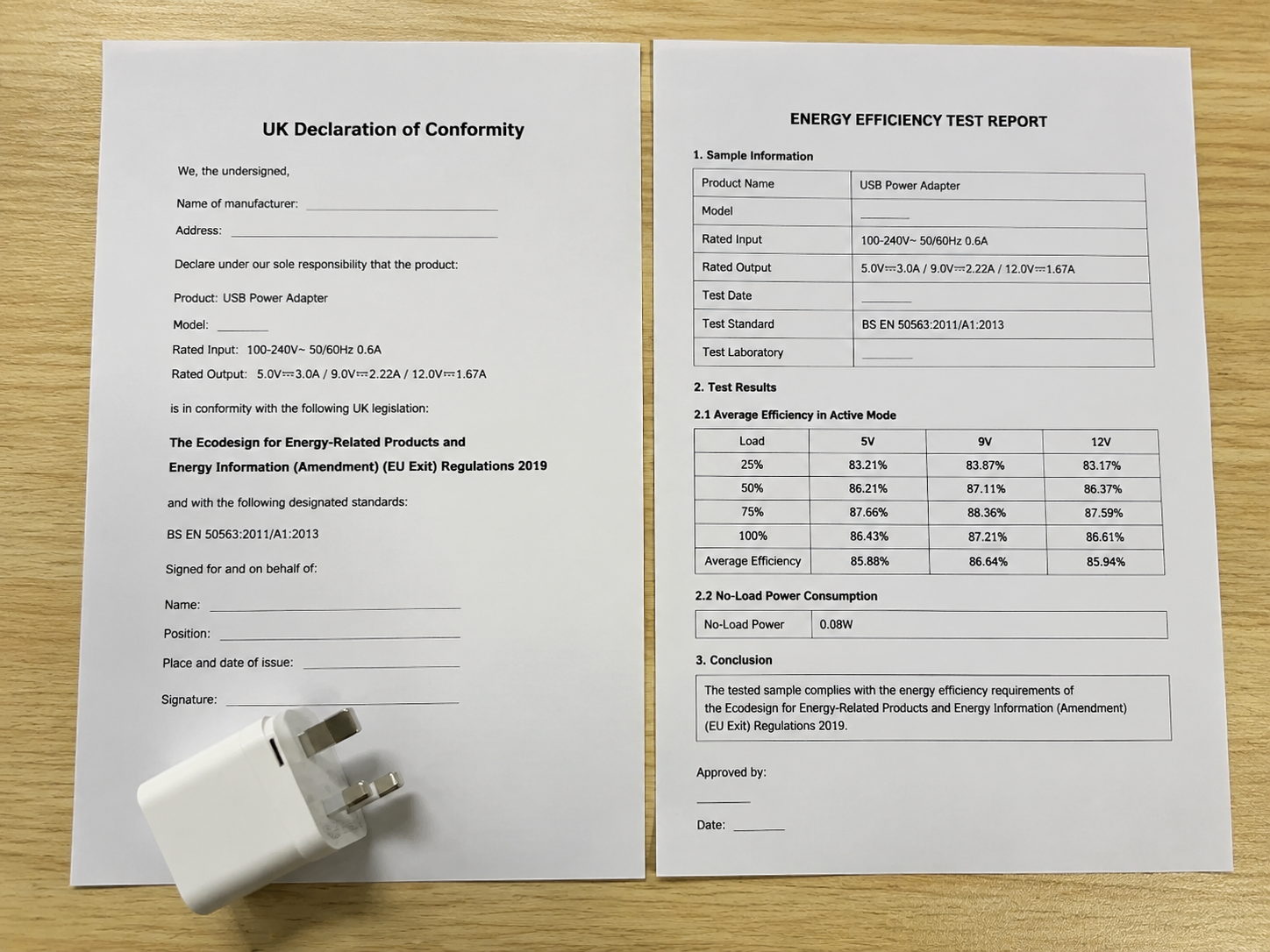
1. Required materials for listing: Energy efficiency test report meeting UK Ecodesign requirements and UK Declaration of Conformity (UK DoC), both are indispensable.
2. Information disclosure requirements: Disclose energy efficiency-related information in the channels and forms specified by regulations, ensure that the product technical documents, packaging, e-commerce pages, and declaration contents are true and consistent, and do not conceal or falsely mark parameters.
3. Consequences of non-compliance: In mild cases, products will be removed from shelves and recalled; in severe cases, fines will be imposed, and even goods will be detained by customs when entering the country. Don’t take chances.
Two Boundary Reminders for Daily Use
There are two other easily confused boundaries, which are clarified here in advance to avoid judgment errors later:
1. Poor quality charging cables will increase losses in actual use (for example, the cable has high resistance, generates heat and consumes power), but this is an external factor and does not affect the energy efficiency assessment result of the charger itself — the energy efficiency assessment only measures the output of the charger body, excluding the transmission loss of the cable.
2. Charger heat can be used as a reference for daily purchase, but cannot be directly used as a basis for judging energy efficiency compliance, because the shell temperature is also affected by many factors such as shell material, heat dissipation design, and ambient temperature. The final compliance depends on the test data under standard laboratory conditions.
V. Common Concepts and Compliance Misconceptions
Whether it is ordinary users selecting products or sellers doing compliance work, many pitfalls are caused by confusion of basic concepts. Here we clarify the most common misconceptions at once:
Common Misconceptions for Ordinary Users When Selecting Products
• High energy efficiency = fast charging? Wrong. Energy efficiency is the utilization rate of electrical energy, which refers to “how much is wasted when charging the same amount of electricity”; charging speed is determined by power and fast charging protocols, and the two are completely unrelated. For example, a 5W high-efficiency charger, no matter how power-saving it is, is slower than a 20W ordinary charger.
• Original chargers must have the highest energy efficiency? Wrong. Many original chargers use old solutions from a few years ago. Third-party formal brands may have higher energy efficiency products because of faster technology updates. As long as they meet UK energy efficiency requirements, they can be used with confidence.
• The higher the power, the lower the energy efficiency? Wrong. For compliant products, the minimum efficiency requirement for high-power chargers is usually higher, and the actual efficiency is often higher than that of low-power chargers. It’s just that because the total power is large, the absolute power consumption at full load is more.
• GaN chargers must meet energy efficiency standards? Wrong. Gallium nitride (GaN) is just a technical route that can reduce switching losses, making it easier to produce high-efficiency products. But whether it can meet the standards depends on the overall circuit design and component selection. Cheap inferior GaN chargers may still be non-compliant.
• Less heat = energy efficiency compliance? Wrong. The shell temperature is affected by many factors such as heat dissipation design, material, and ambient temperature. It cannot be judged solely by hand feel, and must be based on test data under standard conditions.
• Having the UKCA mark = meeting energy efficiency standards? Wrong. UKCA is the UK product compliance mark, used to indicate that the product meets one or more applicable UK regulations. But it itself is not a proof of energy efficiency compliance, nor does it automatically cover all compliance requirements of all categories. Energy efficiency compliance needs to be supported by corresponding test reports, technical documents and declarations of conformity, and cannot be judged solely by the UKCA mark. For the transitional rules on the use of marks, please refer to the description of the cross-regional compliance section later.
Common Compliance Misconceptions for Cross-Border Sellers
• All charging accessories must meet energy efficiency requirements? Wrong. Only external power supplies (chargers, adapters) need to comply with this rule. Passive accessories such as charging cables and plug adapters do not, so don’t do unnecessary tests.
• EU energy efficiency reports can be directly used for UK compliance? Wrong. Products that meet EU ERP requirements cannot directly use EU compliance documents and labels to sell in the UK. They need to complete conformity assessment in accordance with UK rules. For the specific path, please refer to the content of cross-regional compliance judgment later.
• Multi-port chargers only need to test single-port efficiency? Wrong. Multi-port chargers need to cover various output working conditions required by regulations, including scenarios where multiple ports work simultaneously. Only testing single ports is non-compliant, and the specific test matrix shall be implemented in accordance with regulatory requirements.
• Only do safety tests without testing energy efficiency? Wrong. Energy efficiency standards and safety standards are two sets of independent mandatory requirements: energy efficiency manages “whether electricity is wasted”, and safety manages “whether there will be electric shock, fire, short circuit”. Both are indispensable. Meeting safety standards does not mean meeting energy efficiency standards, and vice versa. Both must be tested and assessed as required.
• No need to retest after core parameter changes? Wrong. Changing chips, transformers, or adjusting power and number of ports will affect energy efficiency performance. Reassessment is required, and retesting is necessary if necessary. Old reports cannot be directly used.
• Falsely marked power does not affect energy efficiency? Wrong. Falsely marking rated power is not only an illegal act in itself, but also leads to an increase in the applicable energy efficiency limit (the higher the power, the stricter the limit usually is), which greatly increases the difficulty of meeting the standard; moreover, the power parameters on the nameplate, publicity, and test report must be consistent, and inconsistency directly poses compliance risks.
VI. Advanced: Core Logic of Energy Efficiency Compliance and Cross-Regional Judgment
If you want to make a more in-depth judgment on whether a product is compliant, or make more reliable compliance preparations, the following intermediate-level knowledge will be sufficient.
Key Variables Affecting Energy Efficiency Compliance
Whether energy efficiency can meet the standards does not only depend on a single parameter, but is mainly affected by the following variables:
• Load characteristics: As mentioned earlier, most products have relatively high efficiency in the medium load range, but the final result depends on the measured average value at each load point, and cannot be inferred based on experience.
• Output configuration: Multi-voltage and multi-port chargers need to cover more test levels and working conditions, and the difficulty of meeting standards is higher than that of single-voltage and single-port products, because the loss characteristics of the circuit will change under different output states.
• Technical route: New materials such as gallium nitride (GaN) and silicon carbide have lower switching losses, which indeed make it easier to produce high-efficiency products. But the technical route is only the foundation. Whether the final standard is met depends on the overall circuit design, component selection and production process.
• Nominal consistency: The rated power and output parameters of the product must be consistent on the nameplate, packaging, publicity and test report. False marking or inconsistent parameters are not only illegal in themselves, but also lead to changes in applicable limits, increasing the risk of non-compliance.
Core Judgment Logic for Cross-Regional Compliance
Many people can’t figure out the difference before and after Brexit, and whether EU products can be directly sold to the UK. Here we clarify the core judgment logic:
• Core differences before and after Brexit: After Brexit in 2021, the UK implements the independent UK Ecodesign Regulations. The core energy efficiency indicators are basically consistent with the corresponding requirements of the original EU ERP, but the management system, compliance process and labeling requirements are independent, and conformity assessment needs to be completed in accordance with UK rules.
• Compliance path for EU products to enter the UK: Products that meet EU ERP do not need to be fully retested, but first need to check whether the test standards, regulation versions, product models and technical documents are consistent with UK requirements; if consistent, existing test data can be used as part of the compliance evidence, and then supplemented with UK responsible entity information, updated UK Declaration of Conformity, and use of UK compliance labels as required, then they can be legally listed. If there are differences in test methods or indicators, supplementary testing or adjustment is required.
• Cross-version/cross-regional precautions for energy efficiency label ratings: Many people will bind the A-G energy efficiency label to the compliance of external power supplies. In fact, the core of energy efficiency compliance for external power supplies is to meet the minimum limits of UK Ecodesign (average efficiency, no-load power consumption). Not all external power supplies need to be posted with the A-G energy label — this label only applies to specific categories that are also subject to the UK Energy Labelling Regulations. In addition, the new versions of A-G energy efficiency labels in the UK and the EU have both been recalibrated, with stricter rating requirements than the old version. The highest grade A in the old version roughly corresponds to grade B-C in the new version. Moreover, the energy efficiency label systems of the UK and the EU are independent of each other and cannot be used interchangeably.
• Precautions for the use of marks: UKCA is the main compliance mark in the UK, but it should be noted that it only represents that the product meets the applicable regulatory requirements and cannot be used alone as proof of energy efficiency compliance; in addition, the UK still has transitional acceptance arrangements for the CE mark on some products. Whether it can be used specifically needs to be confirmed in combination with the sales time, product category and corresponding regulations. It is not that only products with the UKCA mark can be sold in the UK. The core support for energy efficiency compliance is still test reports, technical documents and declarations of conformity.
VII. Quick Checklist
3-Step Quick Screening for Ordinary Users Before Buying
• Check the nameplate: Whether there is complete input and output parameters, brand and model, manufacturer/importer information. Unbranded products with no information are directly excluded.
• Check the parameters: Whether you can find the specific values of average efficiency and no-load power consumption, instead of only vague publicity such as “high energy efficiency”.
• Verify information: Whether the advertised power and number of ports are consistent with the nameplate, and whether there is obvious false marking.
4-Step Verification for Cross-Border Sellers Before Listing
• Determine the scope: First confirm whether the product falls under the jurisdiction of UK external power supply energy efficiency, to avoid unnecessary testing.
• Verify parameters: Core parameters such as rated power, number of ports, and output levels are clear, with no ambiguous areas.
• Prepare documents: Have an energy efficiency test report meeting UK Ecodesign requirements and a UK Declaration of Conformity, with document contents consistent with the product.
• Check publicity: All parameters on the product page and packaging are completely consistent with the nameplate and test report, with no exaggeration.
Overall, the UK’s external power supply energy efficiency standards essentially reduce unnecessary power waste at the regulatory level: for users, they can save electricity bills and reduce charger heat; for the market, they are a threshold for eliminating inferior and high-consumption products. After reading this article, you should have the following core judgment abilities: you can quickly identify which products fall under the jurisdiction of the UK’s external power supply energy efficiency rules, understand the meaning of the two core indicators of average active mode efficiency and no-load power consumption and estimate the power saving effect in combination with usage scenarios, distinguish the differences between energy efficiency requirements and other concepts such as fast charging, safety, and UKCA marks, and also check the compliance path of cross-regional products according to basic logic. Whether it is ordinary consumers buying chargers, or new cross-border sellers entering the UK market, these methods can help you avoid the vast majority of pitfalls, choose reliable products, or do a good job of basic compliance.