
Many practitioners in the charging product industry who are expanding into the Australian market often only focus on safety certification when first encounter with compliance. It is not until their goods are detained by customs or e-commerce listings are taken down that they learn energy efficiency registration is also one of the mandatory compliance requirements. This article will systematically sort out the rule boundaries, determination methods, operation procedures and common risks of Australian energy efficiency registration, covering core key points from preliminary determination to practical implementation.
First, Understand the Basics: What is Australian Energy Efficiency Registration
Australian energy efficiency registration is often referred to as GEMS registration, which is a mandatory filing requirement for products included in the GEMS (Greenhouse and Energy Minimum Standards Scheme) regulated product list. Among charging products, external power supplies are the core regulated category. The core of this system is to set minimum energy efficiency red lines (i.e., MEPS standards) for various electrical products, with the ultimate goal of reducing electricity consumption across the whole society and cutting greenhouse gas emissions.
Many people confuse “registration” with “reporting”. In fact, the two are requirements at different stages: registration is the first review completed before supply, and products can be supplied in Australia only after obtaining valid registration; registration remains valid within the specified validity period, while reporting is an ongoing obligation after registration is completed. Only some categories require regular information updates, and the daily maintenance of the vast majority of consumer-grade chargers is relatively simple.
This system is administered uniformly by the Australian federal GEMS regulator, adopting the regulatory logic of “pre-market review + post-market spot check”: before going on the market, a registration application must be submitted online, and sales can only be carried out after passing the review; after going on the market, the authorities may verify compliance through various methods such as online store inspections, offline market spot checks, customs entry inspections, and consumer complaints. The consequences of selling without completing registration, or having inconsistent registration information, are very clear: goods may be detained at customs, e-commerce platforms will forcibly take down listings, and in serious cases, heavy fines will be imposed, and even recall of sold products will be required.
Don’t Confuse It with Other Compliance Requirements
Newcomers to the industry can easily confuse energy efficiency registration with other certifications. Here we clarify the differences between three core concepts:
First, energy efficiency registration and RCM certification are two completely independent systems. RCM covers product safety and electromagnetic compatibility, i.e., whether there are risks such as electric leakage or interference with other devices; energy efficiency registration covers indicators such as product power consumption level and standby energy consumption. When a product falls within both the RCM application scope and the GEMS external power supply regulated list, both obligations must be fulfilled and cannot replace each other.
Second, an energy efficiency test report is not equivalent to completed registration. A test report is a certificate of product energy efficiency compliance issued by a third-party laboratory, while registration is the process of submitting the compliance certificate to the official system for filing and obtaining officially recognized sales qualification. Having a report does not mean that registration has been completed.
Third, do not apply the energy efficiency label logic of large home appliances. Many people think that chargers also need to be affixed with star-rated energy efficiency labels before they can be sold. In fact, the vast majority of consumer-grade chargers do not need labels, and only need to complete registration and filing.
How to Determine Whether My Product Needs Registration
After clarifying the basic definitions, what practitioners are most concerned about is whether their products need registration. The following clarifies the rules from three dimensions: mandatory scope, exemption scenarios and determination methods.
Core Category for Mandatory Registration: External Power Supplies
At present, the core charging category subject to mandatory energy efficiency registration is “external power supplies”, which are independent power supply devices that are plugged into wall household sockets (outputting high-voltage alternating current, i.e., AC) and convert it into low-voltage direct current (DC) usable by electronic devices.
Common USB fast chargers, multi-port charging docks, laptop external power adapters, router power adapters, etc., are all typical consumer-grade regulated products. The above examples are only common references and do not represent the complete product or power boundaries. The specific applicable definitions, coverage scope and exclusion conditions of external power supplies shall be subject to the currently officially released regulated product list and the corresponding external power supply energy efficiency regulatory documents. The latest version can be queried through the “Regulated Products” section on the official Australian GEMS website, and judgment shall not be made solely based on experience or power values.
Products and Scenarios That Clearly Do Not Require Registration
There are several types of products and scenarios that usually do not require registration, but the determination needs to be combined with conditions such as actual use and whether it constitutes “supply” in the regulatory sense:
The first category is passive products, i.e., accessories that do not have active electronic circuits and do not require power to operate. For example, ordinary charging cables, passive USB adapters that only perform mechanical or conductor connection, and plugs without built-in circuits do not fall within the regulated scope. If the adapter device has built-in protocol chips, power management modules, voltage conversion circuits or other active electronic components, it is necessary to re-determine whether it falls within the regulated scope based on actual functions.
The second category is products in non-commercial supply scenarios, with different applicable conditions for different scenarios: exhibition samples that are only used for display and do not involve commercial supply behaviors such as sales/gifting, as well as items purchased overseas by individuals for small-batch personal use and not for resale, usually do not require registration; for original replacement parts for maintenance, it is necessary to simultaneously verify the supply target (whether they are only provided to authorized after-sales outlets), import purpose (whether they are only used for after-sales maintenance of original factory products and not sold separately) and the specific official exemption clauses, and it is not allowed to directly assume that no registration is required.
There are also special rules for sets: if the product is a “charger + charging cable” set, the passive cables inside do not need separate registration, but the power supply (charger) in the set still needs to complete energy efficiency compliance separately.
Boundary Products That Are Uncertain
There are also some products that are currently in the boundary zone, and it is impossible to determine whether they are regulated solely by product name. It is necessary to check against the current GEMS regulated product list, the legal definition of external power supplies and exclusion clauses one by one. When checking, it is recommended to record the queried regulation version and list entries to avoid misjudgment caused by rule updates. The core determination dimensions for different categories are as follows:
Car chargers usually use vehicle DC power input and are not directly connected to Australian mains electricity (AC 230V/50Hz), which does not meet the AC input definition of external power supplies, and are not currently included in the current mandatory list, but need to be confirmed by checking the latest exclusion clauses; for wireless charging pads and power banks, if they themselves use DC input (e.g., only have a USB-C input port and need to be powered by an external power supply), they do not belong to independent AC-to-DC external power supplies and are not currently included in the current mandatory list; if they are integrated products with built-in AC plugs that are directly connected to mains electricity, further determination is required against the definition of external power supplies and the latest list; desktop charging stations, docking stations with power output, and industrial or medical-specific charging equipment need to be evaluated separately based on the product’s input type, whether it is an independent power supply device, output function and the exclusion clauses of the corresponding category.
Special reminder here: regardless of whether the product uses GaN (gallium nitride) technology or USB-C PD fast charging protocol, the technology type and protocol will not change the regulated determination logic — whether registration is required only depends on whether the product’s own attributes are in the official regulated list, and has nothing to do with the technology adopted.
3-Step Quick Determination Method
If you are still unsure, you can use this simple method to quickly determine. If all three conditions are met, the product falls within the mandatory registration scope:
Step 1: Look at the product itself: Is it a wall-plugged AC-to-DC independent charging/power supply product?
Step 2: Look at the purpose: Is it a commercially sold product for Australian consumers?
Step 3: Look at the list: Is it in the officially released list of regulated external power supplies?
After completing the preliminary determination, it is recommended to keep records of the determination basis, including the product input/output structure description, sales scenario definition, corresponding entries in the official list, applicable regulation version, and whether exclusion clauses are involved, to facilitate subsequent verification or recheck when rules are updated.
What Are the Core Requirements for Registration
After confirming that registration is required, you must first figure out what the authorities assess and what materials need to be prepared to avoid detours. There is a core inspection principle that runs through the entire energy efficiency registration process: the actually sold product, product nameplate, test report sample, and registration application information must be completely consistent. Any inconsistency may lead to review failure or registration invalidation, and all subsequent links must be checked against this principle.
Core Assessed Energy Efficiency Indicators
The core assessment standard for energy efficiency registration is the MEPS red line, which mainly focuses on two core indicators. The specific limits and test conditions are determined according to the applicable regulation/standard version, and are implemented in tiers according to the product’s rated output power, with different requirements for different power segments:
The first is no-load power consumption, i.e., the standby power consumption when the product is plugged into the wall but not charging any device. This value must be lower than the limit of the corresponding power segment to avoid wasted power consumption.
The second is average conversion efficiency, i.e., the utilization rate of electric energy from the grid end to the device output end. For example, if 10W of power is input and 8.5W reaches the device end, the conversion efficiency is 85%. This value must be higher than the minimum requirement of the corresponding power segment.
For multi-port output power supply products, they need to cover the specified port combinations, load points and typical operating modes according to applicable standards. Testing only a single mode cannot prove that the overall product energy efficiency meets the standard, and the corresponding test report may not be accepted by the authorities.
Hard Requirements for Energy Efficiency Test Reports
For registration, an energy efficiency test report that meets official requirements must be submitted. This report has several core principles:
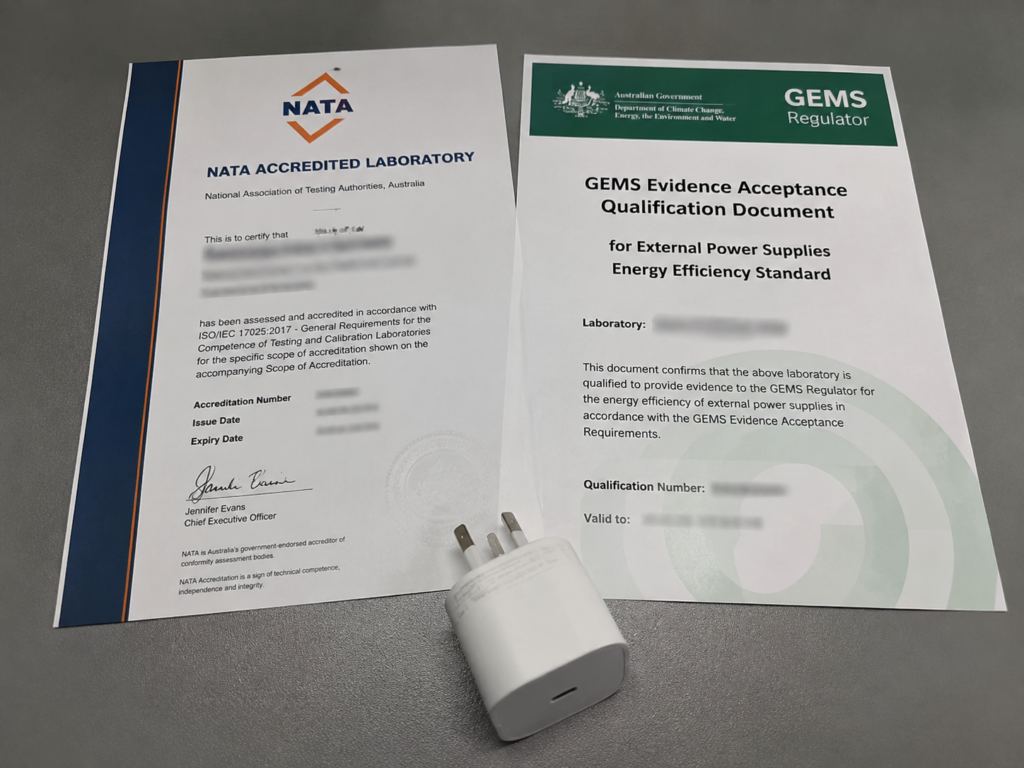
First, laboratory qualifications must comply with GEMS test evidence acceptance rules. You can query the list of accredited third-party laboratories through the GEMS official website, or require the laboratory to provide the NATA (National Association of Testing Authorities, Australia) accreditation certificate for the corresponding external power supply energy efficiency standard and GEMS evidence acceptance qualification documents. Not all reports from third-party laboratories with Australian testing experience can be accepted.
Second, test conditions must meet local Australian requirements. Tests must be based on applicable Australian mains conditions (AC 230V/50Hz, including the fluctuation range specified by the standard), and test methods and load point settings must fully correspond to the current external power supply energy efficiency regulations and the cited standard requirements; test reports issued in other regions cannot be automatically applied, and their validity must be confirmed in accordance with the cross-border report acceptance rules officially published by GEMS.
Third, samples and products must comply with the core inspection principle of the whole process. The product model, rated parameters, and test samples in the report must be completely consistent with the actually sold products. It is not allowed to test the basic model but sell the upgraded model.
Fourth, the validity of old reports is not permanent. If the regulation version is updated, or the product undergoes changes that affect energy efficiency, the old report may become invalid. The specific situation shall be subject to the latest official requirements.
Materials Required for Registration
When applying for registration, the following types of materials need to be prepared:
First, product information, including brand, model, rated parameters, interface configuration, product nameplate photos, appearance photos, and complete specifications.
Then there are compliance documents, that is, qualified energy efficiency test reports.
There is also entity information, including the qualification certificate of the applicant, and relevant information of the Australian local responsible entity/contact person.
If applying for multiple models of the same series together, a difference statement between the models must also be provided to prove that the energy efficiency levels of all models are consistent and meet the requirements for series registration.
Before submission, the inspection must be completed against the core inspection principle of the whole process. Information errors or omissions may lead to review failure.
Who Can Apply for Registration
Brand owners, Australian local importers, local distributors, and cross-border sellers can all serve as registration subjects, but there is one mandatory requirement: if the registration subject is an overseas enterprise, it is necessary to designate a qualified Australian local responsible entity or authorized contact person in accordance with official GEMS requirements, who is responsible for daily liaison with regulatory authorities and relevant responsibilities required by regulations, and cannot complete the entire registration process independently.
There is also a note on OEM branding: if the product is an OEM product and the original factory model has already been registered, it does not mean that it can be used directly with your own brand — private label products must provide a consistency certificate to prove that the core solution and energy efficiency level of the product are completely consistent with the originally registered product before registration can be completed.
Complete Operation Process of Registration
After the materials are prepared, you can proceed with the registration process. The entire process is divided into four stages, with clear key points and checkpoints for each stage, which can help you avoid detours.
Preparatory Stage
Don’t rush to send samples for testing first. Use the 3-step quick determination method mentioned above to confirm that the product does fall within the mandatory registration scope to avoid unnecessary investment.
Then select a third-party laboratory that meets GEMS test requirements and has experience in external power supply energy efficiency testing, and send samples in mass production state for testing — do not send engineering prototypes, otherwise the mass production version will be inconsistent with the prototype, and the report cannot be used for registration.
At the same time, determine the Australian local responsible entity or authorized contact person, and prepare all application materials in advance.
The core checkpoint of this stage: confirm that the test sample is completely consistent with the final mass-produced and sold product against the core inspection principle of the whole process, to avoid subsequent registration failure due to sample differences.
Online Submission Stage
After preparing the materials, first register an account in the GEMS official system and select the “external power supplies” category. Be careful not to select the wrong product category, otherwise the wrong standard will be applied and the application will be directly rejected.
Then, in accordance with the system requirements, truthfully fill in the basic product information and energy efficiency data, and all data must fully correspond to the test report.
After filling in, upload all application materials, pay the official application fee, and then submit.
The checkpoint of this stage: check the consistency of all filled parameters with the test report and product nameplate against the core inspection principle of the whole process, and do not fill in randomly.
Review and Market Launch Confirmation
After submission, it enters the official review stage. In practice, it is usually recommended to reserve 2-4 weeks of scheduling time. This duration is only an experiential reference and not an official commitment; the specific processing time will vary with application volume, material completeness, number of corrections, etc., and shall be subject to the actual progress of the system. It shall not be used as a commitment for a fixed launch time.
If there is a problem with the submitted materials, the authorities will issue a correction notice, and you can modify it according to the requirements and resubmit.
After passing the review, the product will be registered in the GEMS system and obtain a unique GEMS registration number, which serves as the official certificate of energy efficiency compliance.
Note: Products can only be supplied in the Australian market after obtaining a valid GEMS registration number, and the actually sold model must be completely consistent with the registered model. You cannot use the registration number of Model A to sell Model B.
Common Reasons for Review Failure
In practice, there are four main high-frequency reasons for review failure. Avoiding them in advance can save a lot of time:
First, non-compliant test reports, such as laboratories that do not meet GEMS acceptance requirements, test methods that do not comply with regulations, and multi-port products that do not cover the test modes required by the standard. Such reports may not be accepted.
Second, inconsistent information, which violates the core inspection principle of the whole process. The applied model and parameters do not match the information on the test report and product nameplate. Even a single character difference in the model suffix may lead to rejection.
Third, the lack of a qualified Australian local responsible entity or contact person.
Fourth, incorrect product classification, such as applying for products that do not belong to external power supplies under this category, or applying the energy efficiency standards of other categories.
What to Do After Registration
Many people think that once the registration is approved, it will be done once and for all. In fact, this is not the case. There are still some maintenance requirements later, otherwise the registration may become invalid.
Periodic Maintenance Requirements
First is annual reporting: according to current GEMS regulatory requirements, most consumer-grade external power supply categories do not need to submit annual reports, and only some high-energy-consuming regulated categories (such as large home appliances, commercial equipment) need to regularly submit materials such as sales data and energy efficiency confirmation. Whether reporting is required specifically can be checked by logging into the GEMS registration system to view the maintenance reminders of the corresponding product category, or by checking the reporting clauses in the corresponding energy efficiency regulations. There is no need to worry excessively.
Second is renewal requirements: under the currently applicable external power supply energy efficiency regulations, the fixed validity period of GEMS registration is usually 5 years (the specific validity period shall be subject to the one displayed in the registration system). A renewal application must be submitted through the GEMS official system within the specified time window before expiration (usually 3-6 months before expiration). For renewal, energy efficiency confirmation materials must be submitted and the current official fee must be paid as required. Registrations that are not renewed before expiration will automatically become invalid.
There is also record retention: materials such as test reports, registration records, change records, and sales records need to be kept for the duration required by regulations. The specific retention duration shall be subject to the corresponding regulations and official system prompts, and must cover the registration validity period and the possible retrospective verification cycle of the authorities. In case of official spot checks, they must be provided in a timely manner.
Handling Rules for Product Changes
If the product is modified, do you need to re-register? It is necessary to first evaluate whether the change affects energy efficiency level, model identification, applicable definition and series coverage scope, and then handle it accordingly:
- 【Changes that require re-registration in principle】Those involving replacement of core power supply solution, change of rated input/output parameters, brand/model adjustment, or change in energy efficiency level must, in principle, stop using the original registration, resubmit test evidence and apply for a new registration in accordance with official rules; only under special circumstances where there is explicit official permission and it is verified that the energy efficiency level and model identification logic have not changed, can the information update process be followed.
- 【Changes that only require updating registration information】Those only involving changes in entity information such as company address, contact person, Australian local responsible party, or nameplate layout adjustments that do not affect energy efficiency, can directly update the registration information in the system.
- 【Changes that usually do not require adjustment】Different colors of the same model, interface layout adjustments with the same circuit, etc., do not require registration changes only on the premise that they do not affect model identification, internal circuits and energy efficiency evidence, and comply with official series registration rules. It is recommended to verify with the authorities first before confirmation.
Precautions for Status Maintenance
If it is a major change, a notice must be submitted within the time limit specified by the authorities, and reporting cannot be delayed.
If the Australian local responsible party or the application subject changes, the registration information must also be updated in a timely manner, otherwise the authorities cannot contact the relevant person, and the registration may be determined to be invalid.
It is recommended to regularly check your registration status in the official public database to ensure that it remains valid, and to avoid compliance problems caused by negligence.
Verification Methods and Common Pitfalls to Avoid
Whether you do the registration yourself or source goods from suppliers, you must learn how to verify the authenticity of registration information and avoid some common cognitive misunderstandings.
How to Verify the Authenticity of Registration Information
GEMS has a free public database that everyone can query to verify the authenticity of registration information.
The query method is very simple: enter the brand, model or GEMS registration number to search.
When checking, pay attention to three core points: first, whether the registration status is valid, whether it has expired or been cancelled; second, whether the product category matches, do not use registrations of other categories to make up the number; third, model consistency, confirm that the registered model is completely consistent with the actual product against the core inspection principle of the whole process. Pay special attention that similar models do not mean they are covered. For example, an extra letter in the model suffix or an extra interface may mean a different registered model. Be sure to check carefully and do not take it for granted.
5 Most Common Cognitive Misconceptions
Many newcomers to the industry have fallen into these pitfalls, so be sure to avoid them:
- Having RCM/SAA means no need for energy efficiency registration: Wrong. The two are independent compliance systems. When a product falls within the applicable scope of both, both must be completed. For specific differences, see the previous text.
- Low-power chargers (such as 5W) do not need registration: Wrong. As long as they belong to the regulated external power supply category, registration must be completed regardless of power level. There is no “low-power exemption” rule, and common power examples do not represent regulatory boundaries.
- Charging cables and USB adapters also need energy efficiency registration: Wrong. Purely passive cables and adapters that do not contain active electronic circuits do not fall within the regulated scope; adapter devices with active circuits need to be determined separately.
- One registration is valid for life: Wrong. GEMS registration has a fixed validity period, some categories require annual reporting, and product changes may require updating or re-registration. For specific maintenance requirements, see the previous chapter “What to Do After Registration”.
- Overseas factories can directly register by themselves: Wrong. Overseas registration subjects must designate a qualified Australian local responsible entity or contact person as required, and cannot complete the entire registration process independently.
Differences in Requirements for Different Sales Scenarios
The requirements for different sales scenarios are slightly different, and you can correspond according to your needs:
If sold through offline physical stores or e-commerce platforms, you must hold a valid GEMS registration number. Many e-commerce platforms will also require the registration number to be uploaded, and the backend will verify its authenticity.
For small-batch direct mail, items for personal use do not need registration, but if it is for commercial sale, even dropshipping, registration must be completed.
Some people will ask “do free gifts need compliance” — as long as they are free gifts sold together with the main product or chargers in a set, they all fall within the scope of commercial supply, and must also complete energy efficiency compliance. They cannot be exempted just because they are given away.
Advanced: How to Do Registration More Efficiently and Cost-Effectively
If you have already understood the basic rules and want to control compliance costs more efficiently and reasonably, or are unsure about boundary products, you can refer to these practical methods.
Optimal Registration Timing
Many people wait until the products are produced and ready to be launched before starting registration. In fact, this is very risky. The optimal registration timing is after product finalization and before mass production — at this time, if testing finds that energy efficiency does not meet the standard, the solution can still be adjusted. If you wait until mass production is completed to make changes, the loss will be great.
It is usually recommended to reserve a 1-2 month experiential buffer period. This duration is only a conventional reference without official guarantee. The actual total cycle includes multiple links such as sample confirmation, laboratory testing, possible solution rectification, report verification, system submission, official review and correction. The specific duration varies with product complexity, test pass rate, and official application volume. It needs to be planned in advance combined with your own project rhythm, and cannot be used as a fixed launch commitment.
Three Methods to Reduce Costs and Improve Efficiency
During the registration process, costs can be controlled through reasonable planning. The following three methods are proven effective in practice:
First, choose a laboratory that meets GEMS test requirements and has experience in Australian external power supply energy efficiency testing. They are familiar with test requirements and procedures, are less prone to problems, and can reduce the probability of retesting. On the contrary, it is more cost-effective than finding a cheap but unqualified and inexperienced laboratory.
Second, for multiple models of the same series, if the core circuit solution is the same and meets the rules for series registration, you can apply for series registration to share the cost of testing and registration, instead of doing it separately for each model.
Third, before submitting the application, prepare and check all materials at one time to avoid repeated corrections due to missing materials or information errors and omissions, which will prolong the review cycle. Wasting time is also a cost.
Determination Skills for Boundary Products
If you encounter a boundary product and are unsure whether it needs registration, don’t guess blindly based on experience. There are two reliable methods:
First, prioritize checking the latest officially released regulated product list. Regulations may be updated. What was not required before may be required now, and what was required before may have been adjusted now. The latest official list shall prevail.
Second, if you are still unsure after checking the list, you can directly consult the GEMS authorities, or entrust an experienced professional institution to conduct an evaluation. Spending a small amount of money to confirm is better than being fined for missing registration or wasting money on unnecessary registration.
Australian energy efficiency registration is one of the core mandatory compliance requirements for charging products entering Australia. The core lies in accurately determining the regulated attribute of the product, completing testing and registration as required, and doing a good job in subsequent status maintenance. As long as you clarify the rules in advance, carefully check the information, and verify official requirements in time when in doubt, you can effectively avoid compliance risks and reasonably control compliance costs.