
Manufacturers, importers, or cross-border sellers operating in the U.S. market have most likely heard the term “DOE energy efficiency” — some say it is a requirement often checked during customs clearance, some say it is the same thing as ENERGY STAR, and others have had goods detained and fined for not completing it. However, not all products sold to the U.S. need to meet DOE requirements; only products included in the statutory regulated scope must comply with the corresponding rules. What exactly is DOE? Which products need to comply? What specific processes need to be followed? What are the common pitfalls? This article clarifies the core requirements of DOE registration and filing from introductory concepts to practical details, so that even first-time beginners can understand.
Beginner’s Guide: First Understand the Core Logic of DOE Energy Efficiency
What is DOE, and what does it regulate?
DOE is the abbreviation for the U.S. Department of Energy, the federal official agency responsible for product energy efficiency regulation.
It has two core responsibilities: first, to set minimum energy efficiency standards for certain consumer products, commercial equipment, and industrial equipment within the regulated scope through federal regulations; second, to supervise the compliance of regulated products to prevent non-compliant products from entering the U.S. market. Entities that manufacture regulated products in the U.S., import them into the U.S., or sell them in the U.S. may trigger corresponding compliance obligations, but specific requirements require first verifying whether the product is within the statutory regulated scope and the specific rules for the corresponding category; not all energy-using products are regulated.
Core Logic: The Relationship Between Basic Profile Setup, CCMS, Certification Report, and Public Database
Many beginners get confused by terms like “registration”, “filing”, and “certification”. In fact, the four core links of the entire process each have their own positioning, with a clear sequential logic:
- Basic Profile Setup: For most regulated categories that require submission of certification reports, basic profile setup is the pre-step for all compliance operations, referring to the process by which the responsible party registers basic enterprise information and basic product information into the official DOE system.
- CCMS: Full name is Compliance Certification Management System, which is the official online operation platform of DOE. All basic profile setup, filing, and information updates must be completed within this system.
- Certification Report: A document of product energy efficiency test data and compliance declaration submitted in accordance with regulatory requirements, which is the core basis of the entire compliance process.
- Public Database: Full name is Compliance Certification Database, which is the official channel for DOE to publicly announce filing information. DOE does not issue a unified paper “certification certificate”. After the filing information submitted as required is included in the public database according to the rules, it can be used as a query basis for having fulfilled the filing obligation; however, public records only reflect that the responsible party has submitted the corresponding certification information, and do not represent that DOE has made substantive approval or endorsement of the authenticity of product test data or the actual energy efficiency level of the product. DOE may still verify actual compliance through spot checks, law enforcement, and other methods subsequently.
The general sequential order of the entire process is: first complete the basic profile setup of the enterprise entity and products, then submit the certification report for the corresponding product. After the filing information of applicable categories is published, it can be queried in the public database.
Why is it mandatory? Compliance value and violation consequences
Only products that fall under DOE’s statutory regulated categories and are intended to be manufactured, imported, sold, or distributed in the U.S. need to complete testing, submit certification reports, and perform ongoing maintenance in accordance with the corresponding rules. This requirement is a federal statutory obligation in the U.S., not an optional item.
For business entities of regulated products, valid filing records are common compliance verification materials in customs clearance, e-commerce platform entry, and U.S. domestic dealer procurement — if filing is not completed as required, problems such as customs clearance delays, platform listing removal, and dealers refusing to purchase may occur. Specific verification requirements shall be subject to the actual regulations of customs, platforms, or purchasers.
If there is a violation, the consequences also have clear legal basis: DOE has the right to impose fines on non-compliant products, with daily fines for a single product reaching thousands to tens of thousands of dollars. The specific amount will be adjusted with inflation and shall be subject to the final law enforcement discretion; in addition, penalties such as cargo detention and required sales suspension may also apply, and in serious cases, it may even affect subsequent products entering the U.S. market. The specific fine amount and law enforcement measures shall be subject to applicable regulations and DOE’s final law enforcement decision.
Key Terms for Beginners (with Corresponding Regulations)
Before looking at the specific processes, first understand these high-frequency terms, so you won’t get stuck later:
- Covered Product/Equipment: Products included in the scope of DOE energy efficiency regulation, divided into two major categories: consumer products and commercial/industrial equipment, each corresponding to different regulations.
- Basic Model: The smallest unit for DOE filing, referring to products with exactly the same energy efficiency parameters, regardless of details such as appearance, color, and non-energy efficiency functions. The specific consolidation rules will be explained in detail in the subsequent model management section.
- EPCA (Energy Policy and Conservation Act): The top-level legal basis for DOE energy efficiency regulation, equivalent to the “parent law” of all energy efficiency rules.
- 10 CFR Part 429: Part 429 of Title 10 of the Code of Federal Regulations of the United States, which is the general rule for all DOE energy efficiency certification reports.
- 10 CFR Part 430: Federal energy efficiency regulations for consumer products, covering household refrigerators, air conditioners, light bulbs, etc.
- 10 CFR Part 431: Federal energy efficiency regulations for commercial/industrial equipment, covering motors, transformers, commercial air conditioners, etc.
Quick Judgment: Does Your Product/Enterprise Need to File?
Many people are most concerned about “does my product need DOE filing”. You don’t need to flip through hundreds of pages of regulations; you can draw a preliminary conclusion through a 3-step self-check.
3-Step Quick Self-Check Method
Step 1: First confirm the sales market — only products intended for sale in the U.S. domestic market need to consider DOE filing. If they are only exported to other countries/regions such as Canada, the EU, and Southeast Asia, there is no need to worry about it at all.
Step 2: Verify the product category — check whether the product falls within the regulated scope of DOE. Note that the basis for judgment is the actual function, use, and parameters of the product, not the product name or HS code. For example, a product labeled “mini refrigerator”, if it is actually a medical refrigerator for storing medicines, cannot be judged directly according to the rules for household refrigerators, but must correspond to the category according to its actual function.
Step 3: Check for exemption situations — even if the product is a regulated category, if it meets the statutory exemption conditions, it does not need to be filed.
Common Regulated Product Categories
There are dozens of DOE regulated categories, and the most common ones can be divided into two categories: consumer products and commercial/industrial equipment, corresponding to different regulations:
| Corresponding Regulation | Product Category | Examples of Common Regulated Products |
|---|---|---|
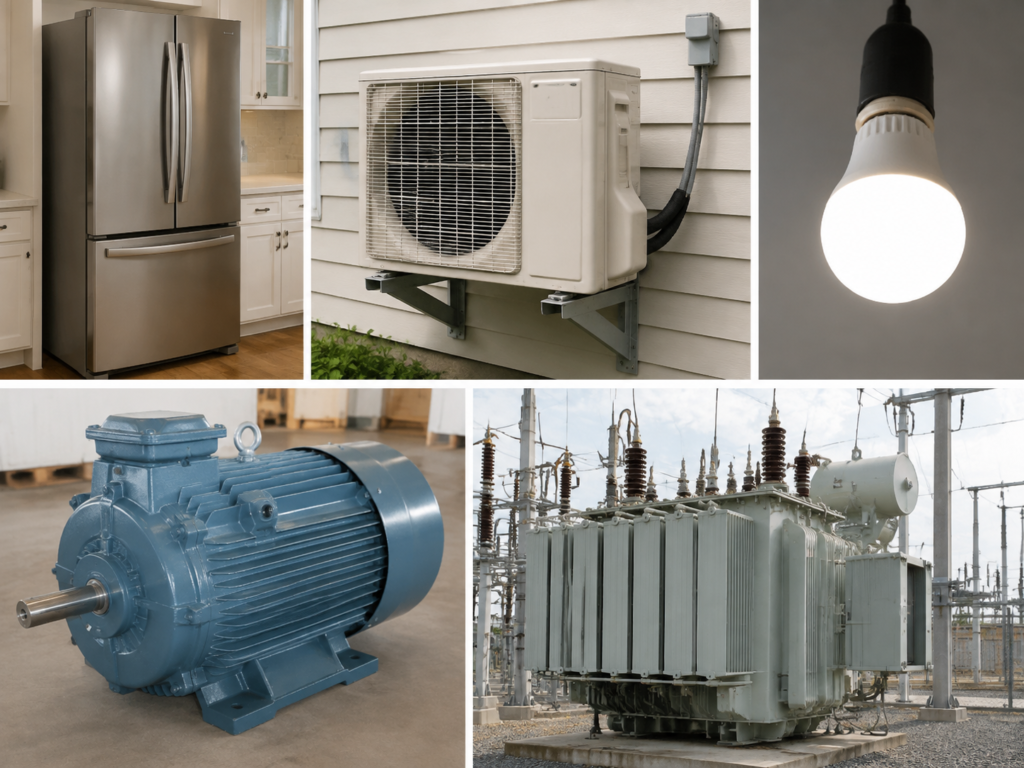
| 10 CFR Part 430 | Consumer products | Refrigerators, air conditioners, washing machines, dryers, dishwashers, water heaters, LED bulbs/lamps, external chargers, televisions, monitors |
| 10 CFR Part 431 | Commercial/industrial equipment | Motors, transformers, commercial refrigeration/air conditioning equipment, pool pumps, heat pumps, boilers, fans, dehumidifiers |
Note: The above list is only for preliminary screening and cannot be directly used as the basis for determining regulated status. Whether a specific product falls within the regulated scope requires further verification of whether its actual function, energy type (e.g., mains power/battery/gas), capacity, rated power, intended use, etc. meet the regulatory definition of the corresponding category. For example, “LED lamps” require verification of lamp type, power, and applicable scenarios; “monitors” require verification of size, input interface, and main use; categories such as “heat pumps”, “dehumidifiers”, and “fans” also need to be confirmed in combination with specific parameters, and conclusions cannot be drawn solely based on product names.
If your product is on the above list, it is most likely necessary to further verify whether the specific parameters meet the regulatory scope, and the final result shall be subject to the regulatory provisions of the corresponding category.
What Situations Qualify for Statutory Exemption?
DOE clearly stipulates several types of situations that may not require filing, but each type has strict applicable conditions, and the scope cannot be expanded without authorization:
- Samples used solely for R&D and testing, not for sale to the public: Must simultaneously meet the quantity, labeling, and use restriction requirements for test samples of the corresponding category, must not enter normal sales channels, and materials such as R&D test certificates and sample flow records must be retained for inspection;
- Customized, non-mass-produced special equipment: Must meet the clear definitions of “not mass-produced” and “customized products” in the regulations of the corresponding category, cannot be judged solely based on “low output”, and the specific judgment criteria must be found in the 10 CFR provisions of the corresponding category;
- Products sold only to markets outside the U.S.: Must ensure that the product does not enter the U.S. domestic sales or distribution channels. If it is later converted to be sold in the U.S., compliance filing must be completed in advance;
- Exemptions/exceptions officially approved by DOE: Must submit an exemption application through official DOE channels and obtain written approval, and cannot claim exemption on one’s own.
A special reminder here: low sales volume and low power do not in themselves constitute grounds for automatic exemption. Even if you only sell 10 units with a power of only a few watts, as long as they are not on the statutory exemption list, you need to file. Don’t take the chance that “small volume won’t be checked”. If you are unsure whether you meet the exemption conditions, you should first check the specific regulatory provisions of the corresponding category, or apply for an official ruling from DOE, and you cannot directly exclude the filing obligation based on the general list.
How to Judge Boundary Products?
If your product is right on the edge of a category, such as a display cabinet with refrigeration function, or a desk lamp with both lighting and charging functions, the judgment should be based on the actual function, energy type, and capacity of the product, matching DOE’s definition of the corresponding category — for example, a refrigerated display cabinet needs to be checked for its refrigeration volume, temperature range, and whether it is used for commercial display, to determine whether it belongs to a household refrigerator, commercial refrigeration equipment, or an unregulated special category; a desk lamp with both lighting and charging needs to be checked for its main function and whether the parameters of the lighting part meet the regulated definition of the lamp category.
If you are unsure, you can refer to the category explanations and frequently asked questions officially released by DOE, or consult professional compliance personnel. In addition, if the product’s design, use, or sales method changes later, you must re-judge whether it falls within the regulated scope, it cannot be done once and for all.
Who is the Statutory Responsible Party?
DOE compliance responsibilities are divided according to the role of the product in placing it on the U.S. market. Under general rules, the core responsible parties include three categories, and the final responsibility attribution shall be subject to 10 CFR Part 429 and specific category provisions:
- Manufacturer: Refers to the entity that designs and produces regulated products and brings them to the market under its own brand, usually the primary responsible party for compliance, not limited to the factory that actually completes the assembly;
- Own-brand Operator (also known as Private Labeler): An entity that sells private label products under its own brand, and shall bear compliance responsibility for regulated products under its brand;
- Importer: If the product is produced overseas and imported into the U.S., the importer may have independent compliance obligations in specific circumstances, which shall be specifically referenced to the regulatory requirements of the corresponding category.
The responsible party can operate CCMS to submit by itself, or authorize a third party to handle it on its behalf, but the statutory compliance responsibility will not be transferred due to entrustment — even if an agency is entrusted, the statutory responsible party will still bear the responsibility if problems arise.
Regarding the role boundaries in the supply chain, OEM/ODM that only undertake production orders, do not own the product brand, and are not responsible for placing the product on the U.S. market usually do not bear the statutory final compliance responsibility, but shall cooperate in providing test data, product configuration and other compliance supporting materials as agreed in the contract; if they also sell products under their own brand, they shall bear the compliance obligations for the corresponding brand. If the same product changes its brand or model, it must be re-filed and cannot use the original filing record.
For responsible parties outside the U.S., they must designate a domestic contact entity that can normally receive official notifications as required by the CCMS system or DOE law enforcement notices, to avoid affecting the compliance verification process due to inability to contact.
Practical Step 1: CCMS Basic Profile Setup Requirements and Process
For most regulated categories, basic profile setup is the pre-step for energy efficiency compliance. Without completing the registration of entity and product basic information, the corresponding certification report cannot be submitted in the system. The following is the general operation path for most categories, and does not represent the unified field requirements or review order of all categories. The specific process shall be subject to the current CCMS system rules and the corresponding category template.
What materials should be prepared before basic profile setup?
The materials required for basic profile setup are divided into three categories, and preparing them in advance can save a lot of time:
The first category is basic entity information, including the name, address, contact information of the responsible party, and documents that can prove the entity’s qualification;
The second category is authorized contact information (if any), for example, if a third party is entrusted to handle it, or a U.S. domestic notification recipient is designated, you need to prepare the information of these entities and formal authorization documents;
The third category is basic product information, including the list of Basic Models to be filed, the brand corresponding to each model, and the DOE category it belongs to.
General Operation Steps for Basic Profile Setup
The specific fields and material requirements of the CCMS system will be adjusted with the entity type, product category, and system updates. The following is the general process, and the actual situation shall be subject to the current CCMS requirements and official DOE instructions:
Step 1: First confirm your statutory responsible party identity and the corresponding DOE regulated product category, to avoid choosing the wrong template later;
Step 2: Register an enterprise account according to the current CCMS system requirements, and submit entity qualification materials to complete identity verification; if there is an authorized agent or domestic contact, submit the authorization documents simultaneously;
Step 3: Enter or link product Basic Model information in the system, and match the regulation template of the corresponding category — choosing the wrong template will cause subsequent filing to fail to meet requirements, so you need to carefully check the category definition;
Step 4: After the basic information entry is completed, you will obtain the filing qualification for the corresponding product, and can enter the certification report submission stage.
It should be noted that basic profile setup only means that the pre-information registration is completed, which is not equivalent to completing the final compliance. You still need to submit the certification report for the corresponding product and complete the subsequent process according to the rules.
Common Precautions for Basic Profile Setup
According to the current public CCMS usage rules of DOE, the official does not charge administrative fees for basic profile setup or filing. The so-called “official registration fee” on the market is usually the service fee of third-party agents. The specific fee policy shall be subject to the latest requirements announced by DOE.
DOE and the CCMS system do not provide a unified guarantee period for general information review. Material correction requirements, entity type, and product category will all affect the processing time. When planning product launch, sufficient buffer time should be reserved, and the progress shall be subject to the current system status.
If the entity information, communication recipient information, or product basic information changes later, you must update them in the CCMS system in time, otherwise compliance may be affected due to mismatched information, inability to contact personnel, and other issues.
Practical Step 2: Energy Efficiency Filing (Certification Report Submission) Requirements
After completing the basic profile setup, you can enter the core filing环节, which is submitting the product’s energy efficiency certification report. This step is the core of compliance and also the link where problems are most likely to occur.
What prerequisites must be met before filing?
You can’t just submit any test report; you must meet three prerequisites:
First, the CCMS entity basic profile setup and the corresponding product basic information setup have been completed;
Second, the product has completed energy efficiency testing in accordance with the current test procedures and sampling plans specified in 10 CFR for the corresponding category;
Third, the test results meet the minimum energy efficiency standard for the corresponding category.
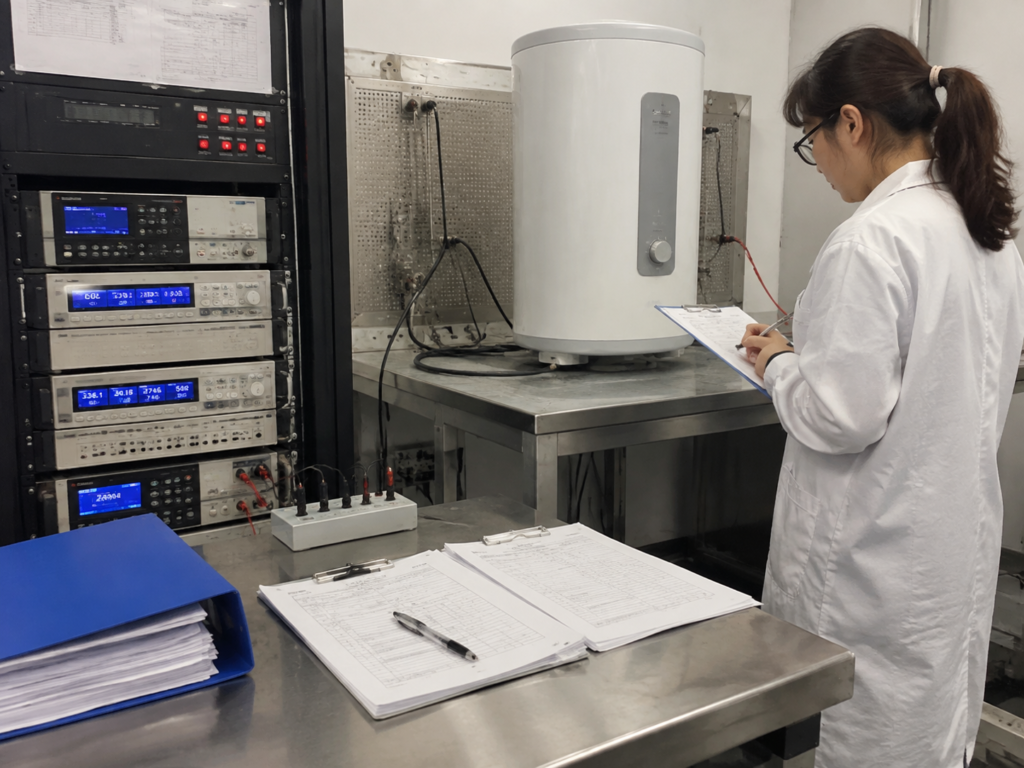
Regarding testing laboratories, many people will ask “do I have to find a third-party laboratory”. The answer is: not necessarily. DOE does not require all categories to use third-party laboratories; own laboratories can also conduct testing. The core requirement is that the test methods, equipment, and original records meet the regulatory requirements and can support DOE’s review. Only a few specific categories require laboratories to have specific qualifications, and the specific requirements need to be found in the 10 CFR provisions of the corresponding category.
What core content should the certification report include?
The certification report templates for different categories are different, but the core content is basically the same, mainly including four parts:
First, basic product information, such as model, brand, nameplate information, appearance marking, etc., must be completely consistent with the information during basic profile setup;
Second, core energy efficiency parameters, that is, the energy consumption or efficiency indicators required by the corresponding category — for example, air conditioners need to report energy efficiency ratio (EER), light bulbs need to report luminous efficacy, refrigerators need to report daily power consumption, and different categories have different indicators;
Third, test-related information, including the test method version used, test conditions (temperature, voltage, load, etc.), sampling plan, test report number and date;
Fourth, compliance declaration, that is, a formal document signed by the responsible party promising that the product meets DOE energy efficiency requirements.
Each category has a dedicated template in CCMS. When submitting, you must select the correct template for the corresponding category, and do not fill in randomly with a general template.
Full-Cycle Time Requirements
DOE filing is not “file once and for all”. Different stages have different time requirements, all of which shall be subject to the regulatory provisions of the corresponding category:
- Initial Filing: Most regulated categories require the submission of certification reports before the first sale or distribution of the product in the U.S.; some newly regulated categories may have transition or effective arrangements. The specific buffer period and effective date need to be found in the final rule provisions of the corresponding category, and cannot be judged solely based on approximate numbers, to avoid penalties for overdue filing;
- Annual Certification: Some regulated categories need to submit annual certification reports in accordance with 10 CFR Part 429 and special provisions of the corresponding category. Even if the product information remains unchanged, confirmation in the system is required as specified. The applicable categories, submission cycle, deadline, and confirmation requirements for unchanged products shall all be subject to the corresponding regulatory provisions;
- Change Filing: If the core energy efficiency components of the product (such as compressor, motor, light source) change, or the rated parameters are adjusted, brand/model/responsible party changes, test standard/procedure is updated, the certification report shall be re-submitted in accordance with the rules. The specific triggering conditions shall refer to the requirements of the corresponding category;
- Discontinuation Report: If a regulated product is no longer produced, imported or sold in the future, a discontinuation notice shall be submitted in CCMS in accordance with the rules of the corresponding category;
- Error Correction: If errors are found in previously filed data, update them in CCMS in a timely manner; if it is a major deviation, also proactively notify DOE, do not wait until it is found during a spot check.
Test Data Compliance Points (to Avoid Filing Failure)
Non-compliant test data is one of the common reasons for filing failure. The following points need to be focused on:
First, the current valid DOE test procedure for the corresponding category must be used; old version test reports may not be accepted;
Second, test conditions must strictly meet regulatory requirements. For example, temperature, voltage, load, and operation mode must be in accordance with regulations, and marketing data from product brochures cannot be used to replace test data;
Third, test samples shall comply with the sampling rules of the corresponding category, and can represent the final mass production configuration of the certified Basic Model. R&D samples can only be used for certification testing if they meet the requirements of the corresponding category rules and their test data can represent the performance of mass-produced products. Prototypes or similar models that have energy efficiency-related differences from the final mass production configuration shall not be used for testing instead, otherwise the test data will have no compliance validity;
Fourth, original test records shall be fully retained, including sample configuration instructions, sampling basis, original data of the test process, equipment calibration records, etc., for DOE spot checks. If they cannot be provided, it will be directly determined as non-compliant.
Advanced Maintenance: Model Management and Compliance Records
Completing the initial filing is just the beginning. Subsequent model management and record retention are also important parts of compliance. Many enterprises step into pitfalls due to inadequate later maintenance.
Consolidation Rules for Basic Models and Derivative Models
Many enterprises confuse “sales SKU” with “Basic Model”. For example, a lamp has 5 colors and 3 types of packaging, so there are 15 SKUs, but if their energy efficiency parameters are exactly the same, they all belong to the same Basic Model and only need to be filed once.
The only premise for derivative models to be consolidated into the same Basic Model for filing is: energy efficiency-related parameters are exactly the same, only details that do not affect energy efficiency such as appearance, color, and non-energy efficiency functions change. If parameters that affect energy efficiency such as power, light source, and motor are different, even if the appearance is exactly the same, they cannot be consolidated for filing. Arbitrary consolidation will be deemed non-compliant.
If the product changes, does it need to be re-filed?
Product iteration is common, but not all changes require re-filing. The only core criterion for judgment is: whether the change will affect energy efficiency parameters, or change the filing entity information.
- Changes that require re-filing: Change of core energy efficiency components (compressor, motor, light source, etc.), adjustment of rated parameters, change of brand/model/responsible party, update of test standard/procedure;
- Changes that do not require re-filing: Non-energy efficiency appearance/packaging changes, adjustment of sales channels, change of enterprise contact information (only need to update the information in the system).
Here is also a reminder for newbies: don’t think that registering a CCMS company account means all products are covered. The account is only the entity identity certificate, each Basic Model needs to submit a certification report separately, it’s not a one-time thing. If you are not sure whether a change will have an impact, the safest way is to compare with the regulations of the corresponding category, or consult a professional compliance personnel, don’t judge by feeling.
How long should compliance records be retained?
DOE requires responsible parties to retain a full set of compliance records for spot checks. The scope of retention includes: original test records, all filing documents, supply chain-related materials, compliance declarations, etc.
The retention period is usually 3-5 years, and the specific duration shall be implemented in accordance with the regulatory requirements of the corresponding category. These records need to be available for DOE inspection at any time, and cannot be forged or tampered with. Once fraud is found, the penalty will be more severe.
Easy-to-Confuse Distinctions and Common Pitfall Avoidance
There are many related statements about DOE energy efficiency, which are easy to confuse with other U.S. compliance requirements, and there are also many common cognitive misunderstandings. Clarifying them in advance can save a lot of detours.
Boundaries with other U.S. compliance requirements
Many people confuse DOE with ENERGY STAR, FTC energy labels, California CEC, FCC, safety certification, etc. In fact, their regulatory bodies and nature of requirements are completely different, and they cannot replace each other:
- With ENERGY STAR: ENERGY STAR is a voluntary high-efficiency label led by the U.S. Environmental Protection Agency (EPA), equivalent to a “top energy efficiency student” certification, only products with energy efficiency far higher than the minimum standard can apply. DOE energy efficiency requirements are the federal mandatory minimum access threshold, and products that do not meet the standards cannot be sold in the U.S. For products that are also subject to DOE minimum energy efficiency standards, the applicable DOE requirements should be met first before applying for ENERGY STAR, but ENERGY STAR certification cannot replace the mandatory DOE filing process.
- With FTC EnergyGuide Label: EnergyGuide is a yellow energy consumption information label required by the U.S. Federal Trade Commission (FTC), used to allow consumers to intuitively compare the energy consumption levels of similar products. DOE is responsible for the compliance filing of energy efficiency data, ensuring that product energy efficiency meets standards and data is true; FTC is responsible for the posting specifications of energy consumption labels, requiring that the data on the label must be based on DOE-recognized test methods. Many regulated products need to meet both DOE filing and FTC label requirements at the same time. They are different requirements from different departments and cannot replace each other.
- With state-level requirements such as California CEC: DOE is a unified federal requirement covering the entire U.S., but some states (such as California’s CEC, i.e., California Energy Commission) may formulate stricter energy efficiency standards, or have their own independent registration requirements. Passing DOE filing does not mean that products can be legally sold in all states. Before entering the market of a specific state, it is necessary to separately check the local energy efficiency rules.
- With FCC and safety certifications: DOE only regulates energy efficiency. FCC (U.S. Federal Communications Commission) regulates electromagnetic compatibility and radio frequency compliance, i.e., products must not interfere with other electronic equipment and their own radiation meets safety requirements; product safety compliance usually involves NRTL (Nationally Recognized Testing Laboratory, a safety testing and certification body recognized by the U.S. government) certification, OSHA (U.S. Occupational Safety and Health Administration) related requirements, state and local regulations, or safety standards specified by the buyer. UL is one of the common NRTL bodies. The three have completely different regulatory directions. DOE requirements cannot be replaced by FCC or safety certifications, and vice versa.
Common reasons for filing failure
In summary, the most common reasons for filing failure are the following. You can self-check before submitting:
- Inconsistent product information and test report content, e.g., wrong model number, mismatched parameters;
- Test method or sampling plan does not meet the 10 CFR requirements of the corresponding category;
- Energy efficiency parameters do not meet the minimum standard of the corresponding category;
- The submitting entity is not the statutory responsible party, e.g., submitting a brand owner’s product using a foundry’s account;
- Wrong category template selected, or an expired standard version used.
3-step self-check for compliance
After completing the filing, you can also check by yourself whether it is really compliant. The core is to verify the consistency of information:
Step 1: Open the DOE Compliance Certification Database, enter product model, brand and other keywords to query. After finding the corresponding record, carefully check the brand, manufacturer/responsible party, Basic Model, product category, report status, report date and other information, confirm that it is consistent with the current sold product configuration. Don’t just see a record and think it’s compliant.
Step 2: Check whether the actual parameters of the product, the parameters on the packaging, and the parameters on the webpage promotion are consistent with the publicly filed data. If not, either modify the promotion content, or correct the filing information according to the process.
Step 3: Confirm that the responsible party and communication contact information in the CCMS system are valid, so that you can receive DOE notifications in time. Don’t leave a deactivated email or invalid address.
If the corresponding record cannot be found, do not directly judge it as non-compliant. You can first troubleshoot through the following paths: try different model and brand writing methods (e.g., distinguish spaces and symbols in the model number), verify whether the product is indeed a DOE regulated category, confirm whether there is a database update delay (newly submitted filings may take some time to be published). If you still cannot confirm after troubleshooting, you should suspend the product launch plan, check the submission status inside CCMS, or consult a professional compliance personnel.
Most common cognitive misconceptions
- Misconception: Having a third-party test report = completing DOE filing.
Correct answer: The test report is only a required material. It is only considered to have completed the statutory filing obligation after it is submitted to the CCMS system, the corresponding filing process is completed, and the relevant information is included in the public database according to the rules. Just having the report in your own hands is useless. - Misconception: Small-batch/trial sale products can be exempted.
Correct answer: Low sales volume is not a statutory exemption reason. Even if you only sell 1 unit, as long as it is a regulated product sold to the U.S., it needs to be filed. - Misconception: It’s okay to file after the product is launched.
Correct answer: Most categories require filing before the first sale. Overdue filing may trigger penalties, don’t take chances. - Misconception: Having an ENERGY STAR label = meeting DOE requirements.
Correct answer: ENERGY STAR is a voluntary label and cannot replace the mandatory DOE filing process. Even if you have obtained ENERGY STAR certification, you still need to do DOE filing separately. - Misconception: Passing DOE filing = valid nationwide in the U.S.
Correct answer: Some states such as California have stricter energy efficiency requirements or independent registration requirements. Passing DOE filing does not mean compliance in these states. - Misconception: DOE will issue a paper certification certificate.
Correct answer: DOE does not have a unified paper certification certificate. The filing record in the public database is the officially recognized public voucher. Don’t believe the saying of “buying a DOE certificate with money”.
How to deal with non-compliance and spot checks?
If you find that your product is non-compliant, or receive a DOE spot check notice, just handle it according to the standardized process:
If you find non-compliance through self-check, first suspend the sale and import of the involved products to avoid the problem from expanding; then check all records of the product, testing, and filing to find the differences; then judge whether it is necessary to correct the filing, re-test, or withdraw the filing; at the same time, evaluate the impact on inventory and channels, e.g., how to handle products that have been sold; if there are many models involved and the energy efficiency deviation is large, it is best to consult a professional compliance agency for handling.
If you receive a DOE spot check notice, first ensure that you have a full set of test and filing documents (retained for 3-5 years as required by the category); then cooperate to submit the materials within the specified time, do not delay; if it is just a data entry error, apply for correction in time; if it is a substantial energy efficiency non-compliance, you need to cooperate with rectification as required by DOE.
Core Competency Summary
After reading this article, you can master the core competencies of DOE energy efficiency compliance from beginner judgment to daily maintenance: you can quickly judge whether a product needs to be filed through the 3-step self-check method, clarify the basic process of basic profile setup and filing, accurately distinguish the boundaries between DOE and ENERGY STAR, FTC labels, state-level energy efficiency, FCC and safety certifications, judge whether product changes require re-filing, identify common cognitive misconceptions, self-check compliance status through the public database, and know the basic handling logic after problems occur.
DOE energy efficiency is a mandatory statutory obligation for regulated products in the U.S. The entire compliance process takes the CCMS system as the core carrier. From early basic profile setup, submission of certification reports to subsequent model maintenance and record retention, each link has clear rule requirements. For enterprises, sorting out product compliance attributes in advance, completing filing in accordance with statutory procedures, and doing a good job in daily maintenance can not only avoid compliance losses such as cargo detention, listing removal, and fines, but also lay a stable foundation for long-term layout in the U.S. market. When encountering boundary products or complex compliance issues, it is recommended to prioritize referring to official DOE rules, or consult professional compliance personnel, to avoid risks caused by empirical judgment.