
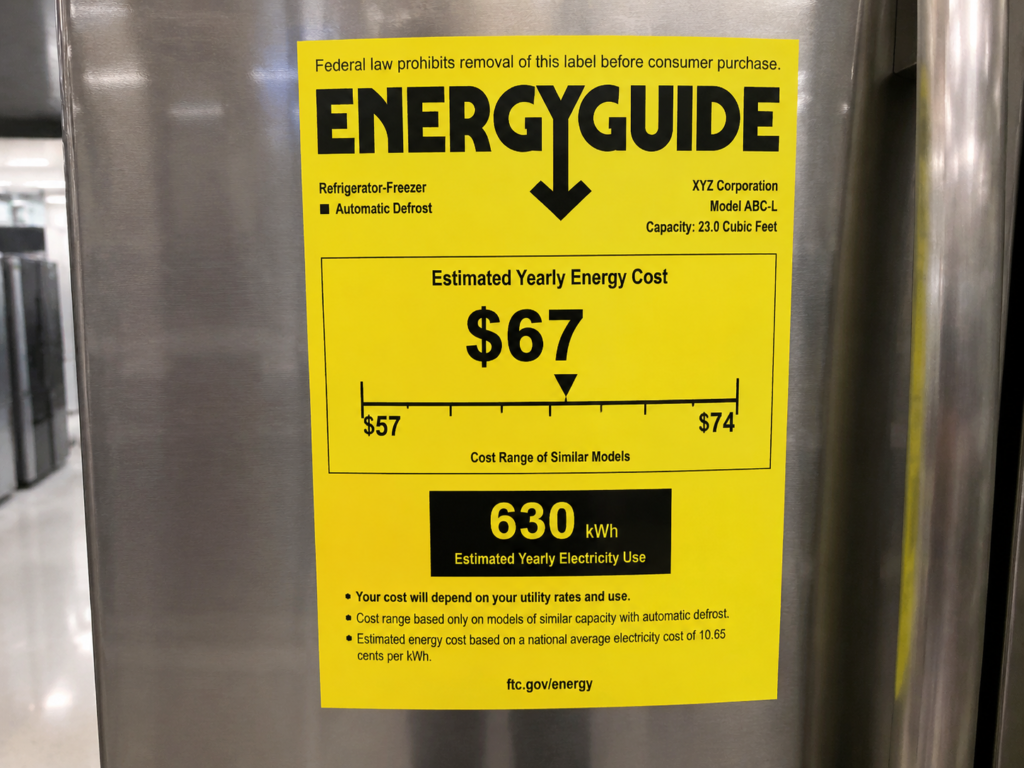
When you buy a refrigerator at an appliance store in the U.S., you have definitely seen the yellow EnergyGuide label affixed to the product, which is printed with annual energy consumption, estimated annual electricity cost, and a scale bar ranging from “most energy-efficient” to “least energy-efficient”. But have you ever wondered how these numbers are measured? Why do some brands promote “30% energy savings” but the values on their labels are similar to those of competing products?
The answer lies in the energy efficiency test methods developed by the U.S. Department of Energy (DOE) — it is not a self-serving promotional standard set by manufacturers, but a set of unified test rules with the force of law. All products in regulated categories must have their energy consumption tested in accordance with these rules before they can be sold in the United States.
This article starts with basic concepts, covers how to read labels, product comparison methods, and preliminary compliance screening logic, to help you systematically understand the core rules of DOE energy efficiency testing.
First, Understand: What Exactly is DOE Energy Efficiency Testing?
Plain-Language Definition and Core Function
You can think of the DOE energy efficiency test method as the “unified exam questions + scoring rules” set by the U.S. Department of Energy for home appliance energy consumption exams: all products of the same type must use exactly the same test questions, the same test environment, and the same scoring standards, and cannot set their own questions and grade their own papers.
Its core function is only one: to eliminate differences in test conditions, so that products of the same type from different brands and different models can be fairly compared horizontally.
It is important to note that DOE energy efficiency testing only measures energy consumption-related indicators, and does not cover product quality, safety, or service life — these are matters regulated by other departments (such as the Consumer Product Safety Commission, CPSC), and should not be confused.
Clarify Easily Confused Related Concepts at Once
Many people confuse DOE testing with energy efficiency labels and ENERGY STAR, but in fact they are completely different links, which can be explained clearly with a table:
| Name | Responsible Agency | Core Function | Nature |
|---|---|---|---|
| DOE Energy Efficiency Test Procedure | U.S. Department of Energy (DOE) | Develop unified energy consumption test methods (“exam rules”) | Federal mandatory regulation |
| Minimum Energy Efficiency Standard | U.S. Department of Energy (DOE) | Set the energy consumption passing line; products that do not meet the standard cannot be sold in the U.S. | Federal mandatory access requirement |
| EnergyGuide (Yellow Energy Efficiency Label) | Federal Trade Commission (FTC) | Print DOE test results on products for easy consumer comparison | Mandatory labeling requirement |
| ENERGY STAR | U.S. Environmental Protection Agency (EPA) | Issue certification for high-efficiency products, usually setting efficiency thresholds higher than federal minimum standards; specific indicators and additional tests are implemented in accordance with EPA program rules | Voluntary certification |
In short: DOE sets the exam rules and passing line, FTC requires merchants to post report cards, and ENERGY STAR is a certificate for students who score high. For most product categories, ENERGY STAR testing is based on DOE test procedures; only a few categories have additional test requirements, which are subject to the specific program rules.
Regulatory Status and Effectiveness
The DOE energy efficiency test method is not an industry-recommended standard, but a U.S. federal mandatory regulation, included in Title 10 (Energy Title, i.e., 10 CFR) of the Code of Federal Regulations (CFR). The specific test methods for each category are usually published in the form of an “Appendix” to the corresponding chapter, and have the same legal effect as the main text.
Note: 10 CFR and Appendix are positioning terms in the regulatory category, used only for finding rule documents, and ordinary consumers may not directly encounter them in daily energy efficiency comparisons.
If products in the regulated catalog are not tested as required or have tampered test data, they will face penalties such as fines and mandatory removal from the market, which is no trivial matter.
Why Should Ordinary Users Learn This?
You might say, I don’t work in home appliances, what’s the use of knowing this? In fact, it is very useful:
First, you can understand the yellow energy efficiency label and will not be fooled by marketing slogans such as “XX% energy savings” or “super first-class energy efficiency”;
Second, you can correctly compare the energy consumption of different brands and models, and choose energy-saving products that are truly suitable for you;
Third, you can distinguish the difference between laboratory test values and your actual home electricity bill, and will not feel cheated due to unmet expectations.
Which Products Need to Be Tested? Five-Step Judgment Method + Official Inquiry
Common Mandatory Test Categories
DOE’s mandatory test categories cover three major categories: residential, commercial, and industrial. Ordinary users only need to focus on residential categories:
- Major home appliances: refrigerators, freezers, washing machines, dryers, dishwashers;
- HVAC and water heating equipment: room air conditioners, central air conditioners, heat pumps, water heaters, dehumidifiers;
- Lighting, electronic display, and power supply products: LED lamps, televisions, external power supplies, battery chargers. Note that DOE’s coverage of such products is subject to the regulated catalog, and cannot be generalized based on the colloquial term “small home appliances”; for example, whether common adapters such as mobile phone chargers are applicable depends on whether they meet the DOE’s definition of external power supplies and exemption clauses.
Commercial and industrial categories such as commercial refrigeration equipment, commercial air conditioners, motors, distribution transformers, etc., are only for ordinary users to understand, and do not need in-depth study.
Five-Step Judgment Method for Applicability
Not all products sold in the U.S. require DOE testing. If you are unsure, you can screen step by step according to these five steps:
Step 1: Check the product type. Is it in the DOE’s regulated catalog? For example, mobile phones and hair dryers are not in the catalog, while refrigerators are;
Step 2: Check the energy type. Is the electricity, gas, heat pump, etc. used by the product within the coverage of the corresponding category? For example, wood-fired water heaters are not covered;
Step 3: Check capacity/installation form. Whether the power, capacity, structure, and installation method fall within the legal definition and threshold range of the product category in 10 CFR. Do not directly judge whether it is exempt based solely on product names such as “mini” or “portable”;
Step 4: Check the end use. Is it a mass-produced general-purpose residential/commercial device? Purely industrial-specific or customized special equipment is not included;
Step 5: Check regulatory exemptions. Is it a category regulated by other special regulations such as automobiles or aircraft? These are not under the jurisdiction of the DOE.
Official Inquiry Channels
If you are still unsure, you can confirm through three official channels, each corresponding to different inquiry needs:
- DOE Energy Efficiency Official Website Product Rules Page: Search by product name to quickly confirm whether the category is under DOE jurisdiction and the entry to the corresponding test rules;
- Corresponding chapters of 10 CFR in eCFR (Electronic Code of Federal Regulations): You can query the legal applicable scope, key definitions, and original text of test procedure appendices for specific categories, which is the most authoritative regulatory source;
- DOE Compliance Certification Database: Enter the specific product model to check registered energy efficiency data, applicable test procedure version, and other information.
Don’t Ignore the Version: Changes to Test Rules Can Lead to Significant Value Differences
You may have seen the same refrigerator model with an old version labeled 280 kWh annual energy consumption, while the new version is labeled 300 kWh. Is the new version more power-hungry? Not necessarily; it is very likely that the version of the test procedure has changed.
Why Are Versions Updated?
DOE test procedures are not static. They are usually updated for three reasons:
First, the application of new technologies. For example, after the emergence of inverter air conditioners, heat pump water heaters, and smart connected functions, old test methods cannot accurately measure new technical routes;
Second, changes in user usage habits. For example, people now have longer TV standby times and use more low-temperature programs for washing machines, so the proportion of weighted calculations needs to be adjusted;
Third, the old calculation formula has too large a deviation from actual energy consumption and needs to be corrected to make test results closer to average usage conditions.
Core Impact of Version on Results
When viewing energy efficiency data, you must pay attention to five core queryable elements at the same time: test procedure version number, corresponding appendix number, effective date, compliance transition period, and product applicable scope. Missing any one may cause the comparison to be invalid.
A new version of the test procedure may change indicator values, but this does not mean that the energy efficiency of the product itself has changed — just like an exam that adjusts question types and scoring standards, a change in scores does not mean a change in student ability. According to regulations, newly launched products must be tested with the latest version after the effective date; already launched old models can continue to comply with the old version during the transition period, and after the transition period, they must update the test to continue selling.
Test results from different versions are not directly comparable. They can only be used for reference under the premise that the rules clearly provide a conversion method; otherwise, version difference is the first-priority explanatory factor for numerical changes.
How to Check Version Information?
Three channels can query the version information of test procedures, ranked from low to high entry difficulty:
- First check the product’s EnergyGuide label or official compliance statement: labels for some categories will indicate the test procedure basis. If the version number is not directly written on the label, it can be verified through the following two channels; the labeling rules of the label are subject to relevant FTC requirements, the DOE certification database, or corresponding clauses of 10 CFR.
- Check the energy efficiency parameter page on the product’s official website, which usually lists the applicable test procedure version in the compliance description section.
- Go to the DOE Compliance Certification Database, enter the product model, and query the registered energy efficiency information, which will have a clear version description.
Core Logic: Why Test Values Differ From Your Home Electricity Bill
Many people find that their actual electricity bill is much higher than the estimate on the label after buying home appliances, and they think the label is fake — but it’s not, because the DOE tests a “unified baseline value”, not your actual home bill.
Unified Operating Conditions: The Basis for Fair Comparison
To ensure that all products can be compared fairly, the DOE requires that products of the same type must be tested under exactly the same standardized conditions: the same ambient temperature and humidity, the same load, the same installation method, the same operating mode, and manufacturers are prohibited from choosing favorable test conditions on their own.
These operating conditions are set with reference to the average usage scenarios of ordinary American households, but they are legal standardized conditions and are not equal to your actual home environment — just like the 1000-meter test in physical education class, which is conducted on a standard track with no wind, not letting you run in your own community.
Weighted Calculation Rules for Operating States
Home appliances do not always work at full load; they have three states: active operation, standby, and plugged-in off. The DOE sets a legal usage time proportion for each state, and after testing energy consumption separately, calculates the total annual energy consumption or average efficiency by weighting.
Many people think that standby power consumption can be ignored, but in fact, the cumulative standby time of home appliances in a year is very long, accounting for a not low proportion of total energy consumption, so the DOE has included the power consumption of standby and plugged-in off states into the test scope of most categories.
Three Types of Core Test Indicators (Plain-Language Explanation)
DOE test indicators are mainly divided into three categories, don’t confuse them:
- Energy consumption type: For example, annual energy consumption (kWh/year) is the amount of electricity used in a year calculated under standard operating conditions; the lower the value, the more energy-efficient;
- Efficiency type: For example, the Seasonal Energy Efficiency Ratio (SEER) of air conditioners and the Uniform Energy Factor (UEF) of water heaters. Simply put, it is how much work can be done with the same amount of energy; the higher the value, the more energy-efficient;
- Related performance type: For example, the cooling temperature of refrigerators and the washing effect of washing machines. These indicators must meet the standards simultaneously to prevent manufacturers from sacrificing the core functions of products to reduce energy consumption.
Note: SEER, HSPF, UEF, IMEF, etc. mentioned later are all efficiency indicators exclusive to each category, only applicable for comparison within the same category, cannot be mixed across categories, and may not all directly appear on every consumer label — ordinary users only need to focus on general energy consumption indicators such as annual energy consumption.
Want to Dig Deeper? How to Read DOE Official Test Documents
If you want to check the specific test rules for a certain category, you can look at the corresponding appendix in 10 CFR. Although these documents are long, their core modules are very clear. You don’t need to read them all, just find the corresponding parts.
First Check the Scope of Application and Key Definitions
When opening the document, first look at the “Scope” section to clarify the product types, energy types, and capacity ranges covered by this rule, and first confirm whether the product you want to check is included.
Then there is the “Definitions” section, which unifies the meanings of terms, indicators, and states used in the test, such as what is “standby state” and what is “standard load”, to avoid different understandings by different people.
Then Check Test Conditions and Sample Requirements
The “Test Conditions” section will clearly state all legal operating conditions: ambient temperature and humidity, voltage/fuel parameters, installation methods, operating procedures, etc., and all manufacturers must strictly follow these.
The “Sample Requirements” are also very important: test samples must be regular mass-produced commercially available models, and specially optimized engineering prototypes are prohibited; moreover, before testing, the product must be run for a sufficient time for pre-treatment to eliminate performance instability caused by production and transportation, and to allow the product to enter a normal working state.
Instruments and Procedures: Details to Ensure Test Fairness
Test instruments must have NIST (National Institute of Standards and Technology) traceable calibration certificates, and their accuracy must meet regulatory requirements — equivalent to the ruler used in exams must be officially calibrated, and you cannot make one yourself casually. (Note: NIST traceability is an instrument requirement for testing institutions, and ordinary consumers do not need to study it in depth)
The test procedure also has strict regulations: it must be run in accordance with legal steps, cannot omit or adjust the order, and energy consumption and performance data must be recorded throughout the process for future reference.
Calculation, Rounding, and Tolerance Rules
The calculation formulas for all categories are uniformly formulated by the DOE. No matter which manufacturer, they must use the same set and cannot modify the formulas on their own.
The number of decimal places and rounding rules (i.e., “numerical rounding”) for final results are also clearly specified to prevent manufacturers from artificially adjusting values.
As for the “allowable error (tolerance)” that everyone cares about, there is no universal unified value. It is separately specified in the regulations of each category and cannot be generalized.
Report Requirements and Retest Rules
After the test is completed, an official report must be issued. The required contents include: sample model and configuration, test environmental conditions, test procedure version number, original data, calculation process, and final result, none of which can be missing.
The document will also clearly specify retest rules: under what circumstances retesting is required, how many samples to draw for retesting, and how to judge the results as qualified, to avoid a single test determining the outcome permanently.
How to Check Energy Efficiency for Common Home Appliances? Detailed Explanation by Category
Ordinary users most frequently contact residential categories. Here, the test points, core indicators, and common misinterpretations of each category are clearly explained, so you can directly refer to them when buying.
First, here is a quick reference table for easy lookup:
| Category | Core Indicator | How to Judge Better Energy Efficiency | Necessary Prerequisites for Comparison |
|---|---|---|---|
| Refrigerators/Freezers | Annual energy consumption (kWh/year) | The lower the value, the more energy-efficient | Same capacity segment, same test version |
| Washing machines/Dryers | Integrated Energy Factor (IMEF for washing machines/IEF for dryers), annual energy consumption | The higher the factor and the lower the annual consumption, the more energy-efficient | Same energy type, same capacity segment, same version |
| Dishwashers | Annual energy consumption, annual water consumption | The lower the energy consumption, the more energy-efficient | Same energy type, same capacity segment, same version |
| Air conditioners/Heat pumps | Seasonal Energy Efficiency Ratio (SEER), Heating Seasonal Performance Factor (HSPF) | The higher the value, the more energy-efficient | Same type (fixed-frequency/inverter, etc.), same cooling/heating capacity segment, same version |
| Water heaters | Uniform Energy Factor (UEF), annual energy consumption | The higher the factor and the lower the annual consumption, the more energy-efficient | Same energy type, same capacity/hot water output rate, same version |
| LED lamps | Luminous efficacy (lm/W) | The higher the value, the more energy-efficient | Same brightness segment, same version |
| Televisions | Annual energy consumption, standby power consumption | The lower the value, the more energy-efficient | Same screen size, same display technology, same version |
| External power supplies | Average conversion efficiency, no-load power consumption | The higher the efficiency and the lower the no-load power consumption, the more energy-efficient | Same power segment, same version |
| Battery chargers | Weighted total energy consumption, charging efficiency | The lower the energy consumption and the higher the efficiency, the more energy-efficient | Same applicable battery type, same power segment, same version |
Refrigerators/Freezers
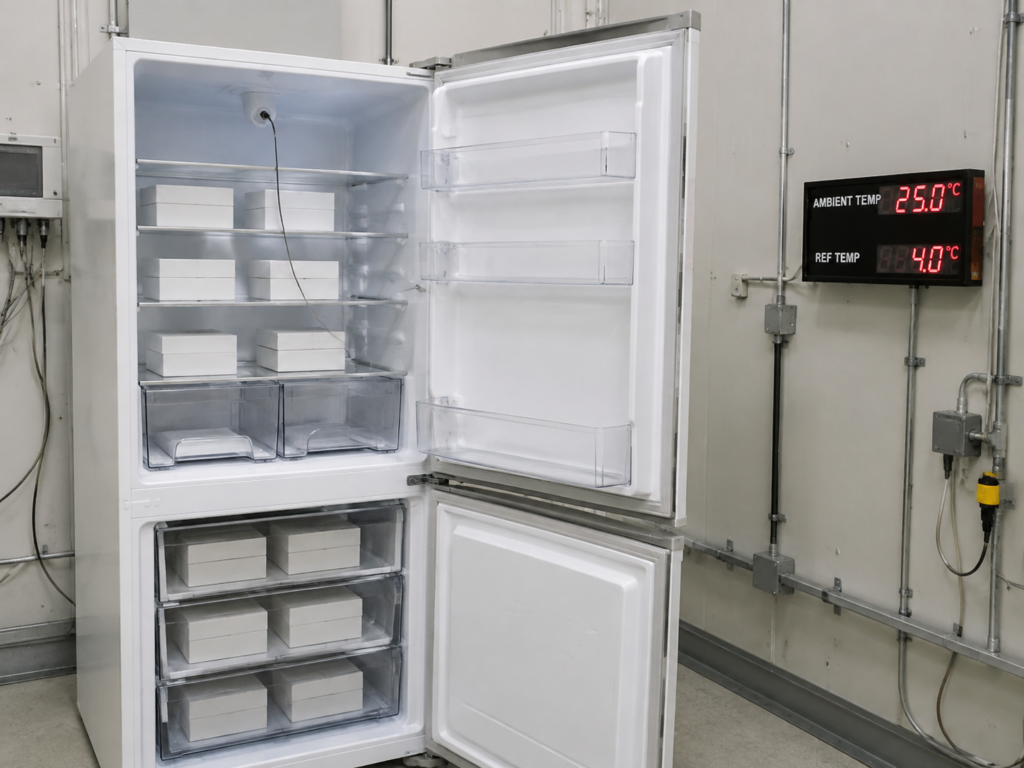
The test objects for refrigerators are household refrigerators, freezers, and refrigerator-freezer combos. Tests usually focus on core operating conditions such as standard ambient temperature, internal target temperature, stable operation cycle, and defrost cycle. Details such as door opening and closing rules and internal load simulation are implemented in accordance with the corresponding 10 CFR appendix, and cannot be determined by manufacturers; the test also requires internal temperature to meet standards to avoid sacrificing cooling performance for power saving.
The core indicator is annual energy consumption, but when comparing, you must look at capacity: for example, a small 18-cubic-foot refrigerator consumes 280 kWh per year, and a large 25-cubic-foot refrigerator consumes 300 kWh per year. It seems that the large refrigerator uses more power, but in fact, the large refrigerator has lower energy consumption per unit volume and is more energy-efficient. Directly comparing annual energy consumption of refrigerators with different capacities is the most common misinterpretation.
Washing Machines/Dishwashers/Dryers
Tests for these types of products use standard-weight clothing/tableware, run default programs, and have unified regulations for inlet water temperature and water hardness. At the same time, they require washing/drying effects to meet standards to avoid sacrificing core performance for energy saving. The core indicators of different categories have different focuses:
- Washing machines: The core indicators are Integrated Energy Factor (IMEF) and annual energy consumption. The higher the IMEF value, the larger the washing capacity per unit of energy consumption.
- Dryers: The core indicators are Integrated Energy Factor (IEF) and annual energy consumption. IEF reflects the drying capacity per unit of energy consumption, and must also meet the legal requirements for drying degree.
- Dishwashers: The core indicators are annual energy consumption and annual water consumption, and must also meet the standard requirements for washing and drying performance.
Many people only look at rated power to judge energy consumption, which is a common misunderstanding: for example, some products have higher rated power, but shorter operation time and higher efficiency, resulting in lower total energy consumption instead.
Air Conditioners/Heat Pumps
Tests for air conditioners and heat pumps do not only measure full-load efficiency, but are weighted according to the annual temperature distribution and operating hours of typical U.S. climate zones to obtain the average efficiency for the entire cooling/heating season, which is SEER (cooling) and HSPF (heating). Some current product labels or registrations may use new version indicators such as SEER2 and HSPF2. When comparing, you must confirm that the indicator name and test procedure version are consistent, and cannot directly mix SEER with SEER2 for comparison.
When comparing, you cannot just look at the SEER value to draw a conclusion directly: fixed-frequency and inverter air conditioners have different technical routes, and the difference in energy consumption performance in actual use cannot be summarized only by the SEER value. You must first confirm that the product type (fixed-frequency/inverter, split/window type, etc.), cooling/heating capacity segment, and test procedure version are consistent, then compare in combination with your own usage scenarios.
Water Heaters
Water heater tests use a standard water usage pattern: how much water is used per day, when it is used, and what the inlet water temperature is, all of which are fixed, and the set temperature must also meet regulatory requirements.
The core indicator is the Uniform Energy Factor (UEF), but storage, tankless, and heat pump water heaters have completely different working principles, and the calculation logic of UEF also differs. UEF of different types of water heaters cannot be directly compared; products of the same energy type, same capacity/hot water output rate should be compared together.
Lighting, Electronic Display, and Power Supply Products
Such products need to complete aging stabilization before testing, and energy consumption is measured under rated input voltage and standard output load. The core indicators of different subcategories vary:
- LED lamps: The core indicator is luminous efficacy (lm/W, i.e., luminous flux emitted per watt of electrical energy). The higher the value, the more power-efficient. The most common misinterpretation is judging brightness only by power. For example, a 10W LED lamp is usually much brighter than a 15W fluorescent lamp, so it must be judged in combination with luminous efficacy and total luminous flux.
- Televisions: The core indicators are annual energy consumption and standby power consumption. The test is based on the standard display mode (not the manufacturer’s custom energy-saving mode), and the total annual energy consumption is calculated by weighting the duration of on, standby, and off states. When comparing, pay attention to consistent screen size and display technology (LCD/OLED, etc.).
- External power supplies: The core indicators are average conversion efficiency and no-load (standby) power consumption. Higher conversion efficiency means less electrical energy loss, and no-load power consumption corresponds to the power consumption when plugged in but not in use.
- Battery chargers: Tests cover multiple operating states such as charging, maintenance (float charge), and standby, and calculate total energy consumption weighted by legal usage proportions. Some categories also require charging efficiency to meet standards.
Universal Taboo for Cross-Category Comparison
Finally, special attention should be paid: the definitions of energy efficiency indicators for different categories are completely different. For example, SEER is exclusive to air conditioners and UEF is exclusive to water heaters. Comparing values across categories is meaningless. All energy efficiency comparisons must follow the basic prerequisites of same category, same type, same capacity/power segment, and same test version.
Practical Skills: Reading Labels, Comparing Products, Identifying False Labeling
After talking about so many rules, it ultimately comes down to practical use. Here are the most practical skills sorted out for you.
Three-Step Method for Reading EnergyGuide Yellow Labels (Must-Know for Beginners)
When you get the yellow energy efficiency label, follow these three steps and you won’t go wrong:
Step 1: Check the core data: annual energy consumption, estimated annual electricity cost, and energy consumption ranking in the same category (that is the scale bar, the more to the left, the more energy-efficient); the estimated annual electricity cost here is converted based on unified electricity price assumptions and standardized usage conditions, only for horizontal comparison, and is not equal to the real bill under your local electricity price and actual usage habits.
Step 2: Check the comparison prerequisites: confirm the product category, capacity/power, and energy type, for example, whether it is an “18-cubic-foot refrigerator-freezer” or a “25-cubic-foot freezer”;
Step 3: Check the version information: see the previous text for the version verification method. In practice, it is subject to the label marking, DOE registration data, and the effective date of 10 CFR.
Four Steps to Correctly Compare Energy Efficiency
To compare the energy consumption of two products, don’t just compare the values right away, follow these four steps:
Step 1: Confirm that they are of the same category and same type, for example, both are storage electric water heaters, both are inverter split air conditioners;
Step 2: Confirm that the capacity/power is similar and the test procedure version is consistent (see the previous text for the rules on the impact of version differences);
Step 3: Compare annual energy consumption or corresponding efficiency indicators, don’t just look at rated power;
Step 4: Calculate the long-term total cost in combination with the purchase price, local energy price, and your own usage frequency — for example, a refrigerator that is $100 more expensive only saves $10 in electricity bills a year, then it depends on whether you will use it for more than ten years.
Why Is There a Big Difference Between Test Values and Actual Electricity Bills?
Many people think the estimated electricity cost on the label is inaccurate, but there are mainly four reasons:
First is environmental difference: the temperature, humidity, voltage, and water quality in your home are different from the standard laboratory conditions. For example, if your home is particularly hot in summer, the refrigerator will definitely use more power;
Second is usage habits: usage frequency, temperature setting, and program selection have a great impact on energy consumption. For example, if you set the air conditioner to 16 degrees vs 26 degrees, the electricity bill can be double;
Third is installation and maintenance: insufficient ventilation, clogged filters, and improper installation will all increase energy consumption. For example, if an air conditioner is installed in direct sunlight, the cooling efficiency will drop significantly;
Fourth is climate difference: cooling and heating equipment are particularly obviously affected by the local climate. For example, if you are in Florida, you use the air conditioner for 8 months a year, which is definitely longer than the average time used in the test, and the electricity bill is higher.
How to Initially Judge Whether There Is False Labeling?
If you think the energy efficiency promotion of a certain product is too exaggerated, you can conduct a preliminary compliance screening according to the following complete steps:
Step 1: Confirm the regulated category: First determine whether the product is in the legal catalog of DOE energy efficiency testing. If it is not within the mandatory scope, it is not subject to the constraints of DOE test rules;
Step 2: Verify version and effective date: Confirm whether the test procedure version and effective date used in the promotion meet regulatory requirements (see the previous text for the rules on the impact of version differences);
Step 3: Compare model and configuration: Verify whether the promoted product model, capacity, energy type, and configuration are completely consistent with the registered product. Products with different configurations inherently have different energy consumption values;
Step 4: Query official registration: Go to the DOE Compliance Certification Database, enter the product model, and verify whether the registered energy efficiency data matches the promoted value;
Step 5: Tolerance and retest judgment: The DOE stipulates different test tolerance ranges for different categories, and there is no universal unified value. If the deviation is within the legal tolerance, it is a normal situation; if the deviation is too large and all the above factors are excluded, you can verify through third-party retesting or feedback to the regulatory authority.
Common false labeling situations include: using non-mass-produced specially made engineering prototypes, tampering with test data, test conditions not meeting regulatory requirements, etc.
5 Most Common Cognitive Misconceptions
Finally, here are some of the most common pitfalls to avoid:
- Misconception 1: The DOE test value is my actual home electricity bill — it is a unified comparison baseline, not a personal bill. Actual electricity bills are affected by many factors;
- Misconception 2: All products sold in the U.S. require DOE testing — only categories in the legal catalog are mandatory, and many small products are not within the scope;
- Misconception 3: ENERGY STAR uses completely independent test methods — most categories are based on DOE test procedures, just with higher thresholds, and a few have additional requirements;
- Misconception 4: The lower the power, the more energy-efficient — it depends on operating time and efficiency. Inverter air conditioners are a typical counterexample: although their maximum power may be higher, they are overall more energy-efficient;
- Misconception 5: The higher the energy efficiency value, the more worth buying — it also depends on whether the capacity is sufficient, whether the performance is good, and whether the price is high. What suits you is the best.
Beginner Purchase Self-Checklist
Before buying home appliances, you can check against this list to avoid pitfalls:
- [ ] The product belongs to a DOE mandatory test category
- [ ] The energy efficiency value is marked with the test procedure version and applicable conditions
- [ ] The compared products meet the prerequisites of same category, same type, same capacity/power segment, and same test version
- [ ] Judge cost-effectiveness in combination with your own usage frequency, installation environment, and local energy price
- [ ] If verification is needed, you can go to the DOE Compliance Certification Database to check the registration information
Summary
After reading this article, you should have mastered the following core abilities: you can distinguish the positioning differences between DOE test procedures, EnergyGuide labels, ENERGY STAR, and minimum energy efficiency standards; you can confirm whether a product is under the jurisdiction of DOE energy efficiency testing through the five-step judgment method; you can understand the energy efficiency indicators of common residential product categories and EnergyGuide labels; you can correctly compare product energy consumption following the principle of “same category, same type, same capacity segment, same test version”; you can distinguish the difference between laboratory test baseline values and actual usage electricity bills, and explain the reasons for the deviation; you can initially screen whether energy efficiency promotions are compliant through the DOE registration database, and avoid common cognitive misconceptions.
Understanding the unified baseline logic of DOE energy efficiency testing allows you to judge the energy consumption level of products based on public rules and establish reasonable energy efficiency expectations.