
Many small and medium-sized merchants and product developers who are newly entering the EU market are often confused by terms such as GPSD and CE when they first encounter compliance issues: some say all products entering the EU must bear the CE mark, some say GPSD is one of the CE directives, and others believe that affixing the CE mark equals getting a “free pass from safety liability”. In fact, these misunderstandings essentially stem from a failure to clarify the positioning and relationship between general product safety rules and specific CE directives.
Starting from basic concepts, this article sorts out the layered application logic of the two, introduces the judgment method of product compliance paths, and organizes common practical misconceptions to help you sort out the safety compliance framework for ordinary consumer goods in the EU.
Clarify Basics First: Plain-Language Definitions of 3 Core Concepts
Let’s first clarify the three most basic concepts, otherwise the subsequent relationship discussion will be empty talk.
1. General Product Safety Rules: The Fallback Safety Law for EU Consumer Goods
The EU General Product Safety Rules we often refer to were first issued in the form of a directive, abbreviated as GPSD (2001/95/EC), and have now been updated to the GPSR in the form of a regulation (Regulation (EU) 2023/988), which is officially applicable from December 13, 2024. The core relationship logic between both versions and specific CE directives is completely consistent. This article uniformly refers to them as “General Product Safety Rules”, and version differences will be explained separately where involved.
You can understand this set of rules as the “minimum safety baseline” set by the EU for all consumer goods — as long as they are ordinary products sold to consumers without special safety rules, they must abide by this baseline to ensure that they will not cause injury under normal use or even foreseeable misuse scenarios by consumers.
Its coverage is very wide: whether it is a brand-new product or a second-hand product that is not an antique, whether it is a paid purchase or a free gift from a merchant, as long as it is a consumer product oriented toward ordinary consumers, it falls within the jurisdiction.
However, there are also clearly excluded categories: food, pharmaceuticals, medical devices, cosmetics, antiques, live animals and plants, and service products are regulated by other special laws and regulations, and are not covered by the General Product Safety Rules, nor are they within the scope of ordinary specific CE discussed today.
2. Specific CE Directives/Regulations: Exclusive Safety Rules for Specific Categories
If the General Product Safety Rules are the general “safety baseline”, then specific CE directives are the “exclusive safety rules” set for a certain category of high-risk or specific-function products. For example, toys are easy for children to bite, low-voltage electrical appliances are prone to electric shock, and radio equipment may interfere with signals. For these products with clear risks, the EU has specifically set more detailed and specific safety requirements for each category.
Common categories covered by specific CE directives include: toys, low-voltage electrical appliances (abbreviated as LVD), radio equipment (abbreviated as RED), electromagnetic compatibility (abbreviated as EMC), personal protective equipment (abbreviated as PPE), mechanical products, etc. These specific directives are the direct legal basis for the CE mark — only when a product meets all the requirements of the corresponding specific directives can the CE mark be legally affixed.
3. CE Mark: Not a “Safety Certification”, but a Self-Declaration Mark for Specific Compliance
Many people’s first impression of CE is “EU safety certification”, but this understanding is wrong. The CE mark is essentially a mark affixed by the enterprise itself to declare that “my product meets all relevant specific CE regulatory requirements”, not a “safety certificate” issued by a third-party institution.
Of course, the CE mark cannot be affixed at will: for most low-risk CE products, enterprises can complete verification by themselves in accordance with the self-conformity assessment process specified in the corresponding regulations; whether a Notified Body (a third-party compliance audit institution officially recognized by the EU, abbreviated as NB) is required must be strictly confirmed item by item against the conformity assessment clauses of the corresponding specific regulations, and cannot be judged solely by product category or risk intuition. Only some high-risk categories (such as specific categories of personal protective equipment, mechanical equipment with specific risk levels, some medical devices, etc.) require mandatory participation of Notified Bodies in the audit.
There is a very important boundary here: only products that fall within the scope of specific CE directives can bear the CE mark. If your product is not within the scope of any specific CE, no matter how good the quality is, how safe it is, or even if it meets all the requirements of the General Product Safety Rules, you cannot affix the CE mark casually, otherwise it will be regarded as false labeling, and the goods may be detained by customs or even fined.
3 Basic Cognitive Misconceptions That Must Be Corrected for Beginners
People who are new to compliance are most likely to fall into 3 conceptual pitfalls. Let’s clarify the correct answers in advance to avoid subsequent understanding deviations:
- GPSD is not a type of CE directive: CE is a specific compliance labeling system for specific categories, and the General Product Safety Rules are fallback safety rules covering all consumer goods. The two are in a parallel relationship, not a subordinate relationship.
- Not all products entering the EU need to bear the CE mark: Only products that fall within the scope of specific CE need to bear the CE mark, and other ordinary consumer goods only need to comply with the general safety fallback rules.
- Having the CE mark does not mean that general safety can be completely ignored: Risks not covered by specific rules still need to meet the fallback requirements of the General Product Safety Rules.
Core Relationship: The Two-Layer Logic of “Specific Rules Priority, Fallback Rules Supplement”
After clarifying the basic concepts, we can sort out the core relationship between the two, which can be summarized in eight words: specific rules take priority, fallback rules fill the gaps. The underlying logic of this is the legal principle of “special law prevails over general law” — in areas with special rules, special rules are applied first, and where special rules do not cover, general rules are used to fill the gaps. The two are not an either-or mutually exclusive relationship.
The official provisions of GPSD clearly state that only products whose “safety requirements are fully covered by specific regulations” are exempted from the obligations of the general safety rules. In practical application, it is divided into three levels of situations:
First Level: When There Are Specific CE Rules and Risks Are Fully Covered, Specific Rules Apply First
If your product falls completely within the scope of one or more specific CE directives, and these specific directives have covered all the corresponding safety risks of the product, then the specific requirements of the specific CE directives shall apply first, and these risks do not need to be separately subject to the General Product Safety Rules.
Take an ordinary mobile phone charger connected to the mains and falling within the applicable voltage range of the Low Voltage Directive (LVD) as an example. It usually needs to meet at least the specific requirements of LVD, electromagnetic compatibility (EMC), etc.; if the relevant specific directives have covered its core safety risks such as electrical safety, heating, and mechanical strength, these risks shall be handled in accordance with the specific rules first. If there are scenarios not covered by specific directives, such as packaging safety, extreme foreseeable misuse, and new material risks, the General Product Safety Rules still need to be used to fill the gaps.
Second Level: When There Is No Specific CE Coverage, the General Product Safety Rules Are the Only Compliance Basis
If your product is not within the scope of any specific CE directive, then the General Product Safety Rules are the only safety compliance basis, and you must meet its general safety requirements.
Most of these products are innovative categories without corresponding specific rules, or ordinary daily small commodities with very low risks, such as ordinary paper notebooks, handmade cotton and linen scarves, home storage boxes without electronic functions, unscented ordinary candles, etc. These products are not regulated by special CE directives, and can be legally sold in the EU market as long as they meet the general safety fallback requirements.
Third Level: For Risks Not Covered by Specific Rules, the General Product Safety Rules Apply as a Supplement
Many people think that as long as the product is within the scope of specific CE, it has nothing to do with the general safety rules, but this is wrong. If the product is within the scope of specific CE, but a certain type of safety risk is not clearly specified in the specific directives, then this part of the risk still needs to meet the requirements of the General Product Safety Rules.
The most common supplementary scenarios include: chronic toxicity of new materials, extreme but foreseeable consumer misuse, insufficient warning in instructions, and safety risks of packaging itself (such as suffocation risk that children can easily open).
For example: a new type of children’s toy uses a degradable new material. The toy directive only clarifies the heavy metal and plasticizer requirements for common plastics, and does not mention the chronic toxicity risk of this new material. Then this part of the risk needs to be evaluated in accordance with the requirements of the General Product Safety Rules to ensure that it will not cause long-term harm to children.
Item-by-Item Comparison: Core Differences Between General Product Safety Rules and Specific CE
To make it more intuitive for you to distinguish the difference between the two, we have compiled a comparison table. All comparisons are for ordinary consumer goods面向 ordinary consumers in the EU, excluding special regulated categories such as food, medical care, and cosmetics, and the core difference logic is not affected by the version change from GPSD to GPSR.
| Comparison Dimension | General Product Safety Rules | Specific CE Directives/Regulations | Conditions for Conclusion Change |
|---|---|---|---|
| Scope of Application | Covers all consumer products whose safety requirements are not fully covered by specific CE rules as a fallback | Precisely covers by product category/function, with clear regulatory boundaries | When product category boundaries are ambiguous, it is necessary to first determine whether it falls within the scope of specific rules |
| Safety Requirements | Only general safety principles, no fixed testing standards; warnings cannot replace necessary design safety measures | Clear Essential Safety Requirements (ESR) + officially recognized harmonized standards; testing according to standards can presume compliance | When a product has new risks not covered by specific rules, it needs to additionally meet the requirements of the General Product Safety Rules |
| Compliance Process | Enterprises complete safety assessments on their own; no third-party Notified Body involvement is required under normal circumstances | Self-certification by enterprises for low-risk categories, Notified Body audit required for high-risk categories | For products of the same category with different risk levels, the compliance processes of specific directives are also different |
| Labeling and Traceability | No mandatory unified label, only need to ensure product traceability (manufacturer information, batch number, etc.) | Mandatory CE marking, some categories require additional warnings (e.g., toy age warnings) | When a product meets multiple specific directives at the same time, the CE mark only needs to be affixed once |
| Supervision and Liability | Enterprises must prove that products are safe under normal or foreseeable use, and keep records of risk assessments, traceability, and corrective measures; may face recalls, notifications, administrative penalties, or product liability investigations after accidents | Requirements for technical documentation, DoC, testing, and labeling are clearer; non-compliance may result in sales restrictions, rectification requirements, recalls, or penalties by customs or market supervision authorities, with specific severity depending on the member state and product risk | The strictness of supervision varies among member states, but the core rules are unified across the EU |
Two easily overlooked details are supplemented here: first, the General Product Safety Rules have no fixed testing standards, which seem to have loose requirements, but enterprises need to retain sufficient safety assessment records to prove product compliance; second, even if a product meets multiple specific CE directives at the same time, the CE mark only needs to be affixed once, and there is no need to repeat it.
Semi-Proficient Judgment: 4-Step Judgment Method for Product Compliance Paths
After understanding the relationship and differences, you can judge the compliance path of any ordinary consumer product by yourself. As long as you follow these four steps, there will basically be no major mistakes.
Step 1: First Confirm Whether It Falls Within the Jurisdiction Scope
The first thing to do is the “method of elimination”: first exclude categories with special supervision such as food, pharmaceuticals, medical devices, cosmetics, live animals and plants, and services. These do not apply to the General Product Safety Rules and ordinary specific CE rules we are talking about today.
Then confirm the use scenario of the product: as long as it is for consumer use, or although it is nominally for industrial use, it can be easily purchased by consumers and may be used reasonably, it falls within the jurisdiction scope. For example, a small cutting machine originally marked for industrial use, if ordinary consumers can also buy it casually and use it at home, it must also comply with the rules for consumer goods.
Step 2: Check Whether It Falls Within the Scope of Specific CE
Next, it is necessary to judge whether the product is within the scope of one or more specific CE directives.
You can first do a quick initial screening against the common specific CE category list. For example, for products with electronic functions, first check the low voltage and electromagnetic compatibility directives; for products with wireless functions, then check the radio equipment directive; for products for children under 14 years old, first check the toy directive.
There is a core principle for judgment here: do not look at the product’s appearance or trade name, but look at its main function, intended use, and core user group. For example, a power bank that looks like a toy cannot be classified into the toy directive just because it looks like a toy. Its main function is charging, and the core user group is ordinary consumers, so it should be classified into specific directives such as low-voltage electrical appliances and electromagnetic compatibility.
There are two types of official auxiliary channels, each with different uses, and should not be mixed:
- Basis for category boundary judgment: Prioritize reading the original texts of various specific regulations issued by the European Commission, application guidelines, and the Blue Guide (Application Guide for New Approach Directives), which have clear category boundary definitions; you can also refer to the classification guidelines issued by the market supervision departments of various member states, which are the most authoritative classification judgment standards.
- Notified Body qualification inquiry: The NANDO database is only used to inquire about the information of compliance Notified Bodies and the regulatory framework under the new approach regulations. You cannot directly enter the trade name to obtain product classification results, and do not misuse it as a classification tool.
For products with particularly ambiguous boundaries, it is recommended to consult an EU Authorised Representative (AR) or a professional compliance institution.
Step 3: Verify Whether Specific CE Covers All Safety Risks
If the product falls within the scope of specific CE, don’t rush to draw conclusions. You need to check one more step: have these specific directives covered all the safety risks of the product?
The verification method is very straightforward: compare the “Essential Safety Requirements” (ESR) list in the corresponding specific directives, and check item by item whether all risks of the product are included.
Common risks not covered by specific directives include the following categories: safety of new materials, extreme but foreseeable misuse (for example, consumers stepping on children’s storage stools to reach high places), insufficiently clear and comprehensive warnings in the manual, and safety risks of the packaging itself. If there are these uncovered risks, it is necessary to supplement the general safety risk assessment in accordance with the requirements of the General Product Safety Rules.
Step 4: Determine the Final Applicable Rule Combination
After completing the first three steps, you can determine the final compliance rule combination for the product. There are four common situations:
- Only specific CE applies: The product completely falls within the scope of specific CE, and all safety risks are covered by the specific rules, so it only needs to meet the corresponding specific requirements.
- Specific CE + general safety supplement: The product completely falls within the scope of specific CE, but there are some risks not covered by the specific rules, so it needs to meet both the specific requirements and the supplementary requirements of the General Product Safety Rules.
- Only General Product Safety Rules apply: The product is not within the scope of any specific CE, so it only needs to meet the fallback safety requirements of the General Product Safety Rules.
- Multiple specific CE + general safety supplement: The product falls within the scope of multiple specific CE directives at the same time, so it needs to meet all relevant specific requirements, and at the same time check whether there are uncovered risks, which are supplemented by the General Product Safety Rules.
Example of Judgment for Products with Ambiguous Boundaries
Let’s practice with three common products with ambiguous boundaries to consolidate the judgment logic:
- Ordinary unscented candle (no electronic function): It is under the jurisdiction of the General Product Safety Rules. First, exclude special regulated categories, and it belongs to ordinary consumer goods; there is no corresponding specific CE directive, so it only needs to comply with the general safety rules.
- Electric toy with Bluetooth function: It applies the Toy Directive + EMC Directive + RED Directive, and uncovered risks are supplemented by general safety rules. First, it is a toy for children under 14 years old, falling within the scope of the Toy Directive; it has electric functions and needs to meet EMC requirements; it has Bluetooth function and needs to meet RED requirements; if there are uncovered risks such as the use of new materials, a general safety assessment shall be supplemented.
- Decorative painting with LED lights: It is necessary to first judge the main function. If the core function is decoration and LED is only an auxiliary embellishment, it may not fall within the scope of lighting-specific directives, and is under the jurisdiction of the General Product Safety Rules; if the core function is lighting and decoration is additional, it needs to meet the specific CE requirements such as low voltage and EMC related to lighting.
Key Practical Points for Typical Scenarios
After talking about the judgment method, let’s look at several scenarios most commonly encountered in actual business, and tell you what to do specifically.
Scenario 1: New Category Entering the EU Market for the First Time
When doing a new category for the first time, don’t rush to find an institution for testing. The first step is to do product compliance classification, and use the four-step method mentioned above to determine whether the product applies the General Product Safety Rules or specific CE, and which specific rules it needs to meet.
After confirmation, prepare compliance documents according to the corresponding requirements: if it is a specific CE product, you need to prepare complete technical documentation and EU Declaration of Conformity (DoC); if it is a product applicable to the General Product Safety Rules, you need to prepare a safety risk assessment report and product traceability-related information (such as manufacturer information, batch number, importer information, etc.).
All compliance documents must be properly kept and provided as required when market supervision conducts random inspections: the retention period of CE technical documents and DoC is usually determined according to the corresponding specific regulations, and the common requirement is to keep them for 10 years after the product is placed on the market; products covered by the General Product Safety Rules should also keep records of risk assessment, traceability, complaint handling, and corrective measures, and the specific period shall be confirmed according to applicable regulations and member state requirements.
Scenario 2: Multi-Functional/Cross-Border Innovative Products
Now many innovative products are multi-functional, such as umbrellas with power banks, water cups with Bluetooth, etc. This type of product is most prone to missing items. The correct approach is: check the applicable specific CE directives respectively according to all functions of the product. As long as one function falls within the scope of a specific directive, it must meet the requirements of that specific directive, and cannot only be calculated according to the main function.
For those innovative risks that are not mentioned at all in the specific directives, such as the risks of new structures and new materials, safety assessments must be carried out in accordance with the requirements of the General Product Safety Rules, and cannot be ignored just because there are no specific regulations.
If you are really unsure about the boundary, don’t guess randomly. You can consult an EU Authorised Representative (AR) or a professional compliance institution. They are more familiar with local regulations and can help you avoid pitfalls.
Scenario 3: Being Subject to Random Inspection by EU Market Supervision
EU market supervision adopts a random inspection system. Whether products are sold online or offline, they may be selected for inspection. If you are selected, don’t panic, just provide the materials as required:
If it is a specific CE product, provide the EU Declaration of Conformity (DoC), corresponding test reports, and complete technical documents; if it is a product applicable to the General Product Safety Rules, provide the safety risk assessment report and product traceability certification materials.
The core principle for responding to random inspections is to actively cooperate. If there are indeed non-compliant issues, rectify them in time as required to avoid being added to the EU’s unsafe product notification system, resulting in a EU-wide sales ban.
Scenario 4: After-Market Safety Issues (Accidents/Recalls)
If a safety accident occurs after the product is sold, or a safety hazard is found and needs to be recalled, it shall be handled in accordance with the corresponding regulatory requirements:
For specific CE products, report serious accidents to the competent authority in accordance with the requirements of the corresponding specific regulations; for products covered by the General Product Safety Rules, corrective measures must also be taken for unsafe products, and the local competent authority must be notified.
In actual operation, such problems are usually handled jointly, but you must be clear about the corresponding legal basis and not get the compliance logic wrong.
Common Misconceptions and Pitfall Avoidance Guide
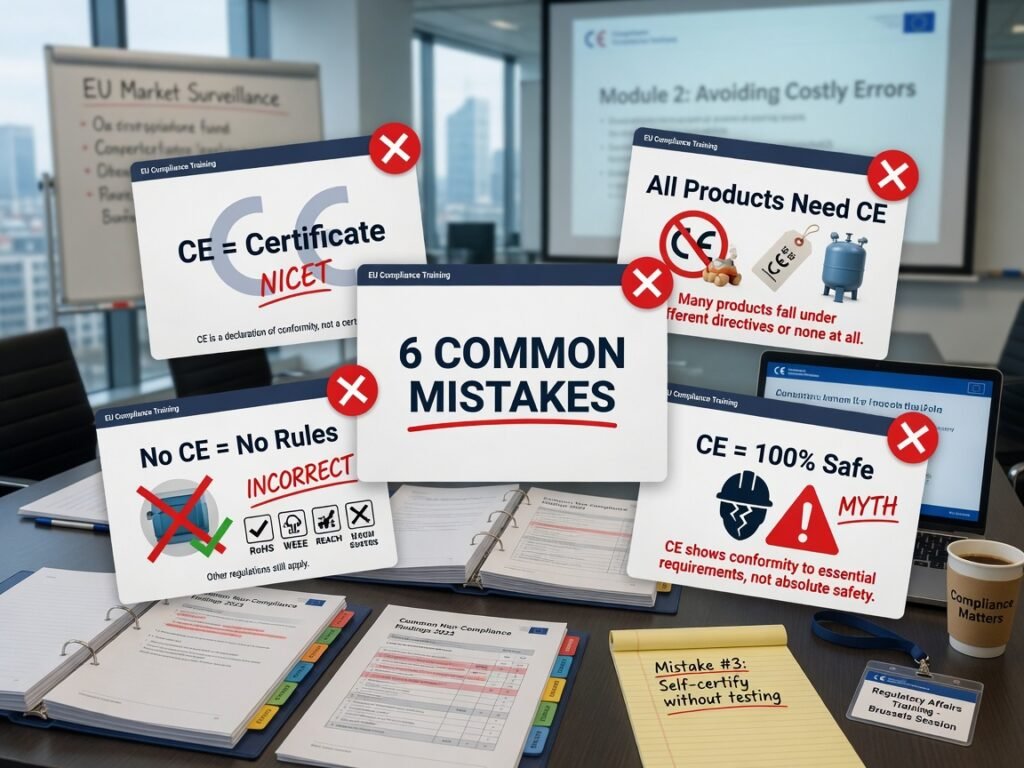
Many compliance pitfalls in practice stem from the misuse of basic rules. Here are 6 most common practical misconceptions to help you avoid 90% of basic mistakes:
Misconception 1: All products entering the EU need CE marking
What’s wrong: Many merchants casually affix the CE mark to products without specific CE requirements in order to “appear compliant”, but instead step on the red line of false labeling — ordinary consumer goods without corresponding specific rules can be legally sold as long as they meet the general safety fallback rules. Randomly affixing CE will result in customs detention of goods, fines, and even EU-wide notification of sales ban. For example, ordinary paper notebooks, handmade cotton and linen scarves, and home storage boxes without electronic functions do not need the CE mark.
Pitfall avoidance reminder: Do category classification first before talking about labeling, and do not affix CE randomly for the sake of “looking good”.
Misconception 2: With the CE mark, general safety can be completely ignored
What’s wrong: Many enterprises think that everything is fine after completing CE compliance, ignoring that specific rules usually only cover the core risks of the category and do not exhaust all general safety scenarios — for example, the chronic toxicity of new materials, extreme foreseeable misuse by consumers, and suffocation risk of packaging are mostly not in the clear requirements of specific directives, and you still have to bear responsibility if problems occur.
Pitfall avoidance reminder: After CE compliance is completed, additional general risk points must be checked, and corresponding safety assessment records must be kept. Do not only focus on testing for specific requirements.
Misconception 3: The General Product Safety Rules have low requirements and can be dealt with casually
What’s wrong: The General Product Safety Rules have no fixed testing standards, which seem to have loose requirements, but after a safety accident occurs, enterprises need to prove by themselves that the product has met the general safety requirements, and the burden of proof is heavier — if you cannot produce sufficient risk assessment and safety verification records, you have to bear the corresponding responsibility.
Pitfall avoidance reminder: Products subject to the general safety rules must also undergo a formal safety risk assessment, try to refer to relevant EU or international voluntary standards, and keep all assessment records well. Do not deal with them casually.
Misconception 4: A product can only apply one rule
What’s wrong: Compliance rules are “superimposed” rather than “either-or”: multi-functional products may apply multiple specific CE directives at the same time. For example, an electric toothbrush with Bluetooth must meet the requirements of multiple specific directives such as low voltage, electromagnetic compatibility, and radio equipment; even if all specific directives are met, if there are uncovered risks, the general safety rules must be supplemented.
Pitfall avoidance reminder: Check applicable rules respectively according to all functions and risks of the product, and do not only judge by the main function to avoid missing items.
Misconception 5: Products without CE requirements do not need to be compliant
What’s wrong: The General Product Safety Rules are mandatory laws in the EU. All ordinary consumer goods not within the scope of specific CE must meet the general safety fallback requirements, otherwise it is illegal. When the regulatory authorities find out, they will also require rectification, recall, and even impose fines.
Pitfall avoidance reminder: Don’t think that no CE means no requirements. The fallback rules are also legally binding, and safety assessment and traceability management must be completed as required.
Misconception 6: Affixing the CE mark means the product is absolutely safe
What’s wrong: The CE mark is a self-declaration of the enterprise, which only proves that the product meets the basic safety requirements of the corresponding specific regulations. It is not a “safety certification” issued by a third-party institution, nor does it mean that the product is absolutely safe in any scenario. For example, a toy that meets the toy directive may still have risks if used by children much younger than the applicable age.
Pitfall avoidance reminder: Compliance judgment cannot only look at the label, but must be comprehensively judged in combination with product risks, instruction warnings, and use scenarios.
Summary
After reading this article, you should be able to independently complete three core judgments:
First, for any ordinary consumer product, you can quickly judge its compliance jurisdiction attribution and whether it needs to apply both general safety rules and specific CE requirements at the same time.
Second, you can distinguish the differences in compliance requirements between the two types of rules, and avoid common practical pitfalls such as false labeling, missed risk judgment, and underestimation of fallback obligations.
Third, when encountering products with ambiguous boundaries, you know what steps to take to verify the classification and risks, will not randomly choose a compliance path, and also know when to seek professional help.