
Cross-border sellers and product manufacturers targeting the Great Britain (GB, i.e. England, Scotland, Wales) market of the UK have most likely heard of the UKCA mark, but many people’s understanding of it remains a vague impression of the “British version of CE” — they either find a random image to print on the packaging, or assume the CE mark can be used indefinitely, which makes it easy to stumble on compliance issues. In fact, there are very clear official rules for the use of UKCA, from the scope of application, appearance standards to affixing requirements, every step follows regulations. Understanding these can help avoid the vast majority of common compliance problems.
I. Basic Cognition of the UKCA Mark
What is the UKCA Mark
The full name of UKCA is UK Conformity Assessed. It is the official product conformity mark for the UK GB market. In essence, it is a self-declaration by the manufacturer that the “product meets the requirements of UK safety, health and environmental protection related regulations”, and its function is similar to the EU CE mark. For regulated products subject to UKCA rules, the manufacturer may use the UKCA mark only after completing the conformity assessment in accordance with the corresponding UK regulations.
Here are a few common misconceptions to clarify first: UKCA is not a quality grade medal, and does not represent how good the product quality is; it is also not a proof of “Made in the UK”, and has nothing to do with the place of production; it is even less equivalent to the government having approved each product one by one, it is only a declaration after the manufacturer has completed compliance in accordance with regulatory requirements.
Core Differences from CE and UKNI Marks
Many people tend to confuse these three marks. In fact, their core applicable markets and rules are completely different, and they cannot replace each other. The core differences can be seen in this table:
| Mark Type | Core Applicable Market | Core Basis | Can Be Used Alone |
| UKCA | Great Britain of the UK (GB: England, Scotland, Wales) | UK related safety/health/environmental protection regulations | Yes |
| CE | EU/European Economic Area (EEA), Northern Ireland of the UK | EU related safety/health/environmental protection regulations | Yes |
| UKNI | Northern Ireland of the UK (only for some products requiring third-party assessment) | Related regulations applicable to Northern Ireland of the UK | No, must be used together with CE |
Special attention should be paid: UKCA is not an “upgraded version” of CE, nor can it cover the entire UK — the Northern Ireland market follows separate rules and does not recognize the standalone UKCA mark; the acceptance rules for CE in the GB market are stipulated separately by each product regulation, and do not belong to a unified temporary transition arrangement, so it cannot be equated with permanent universal use.
Direct Consequences of Improper Use
If the UKCA mark is used arbitrarily without complying with the rules, you may face law enforcement verification at multiple links: non-compliant products may be found in border inspections, online platform verifications or market supervision spot checks. The UK Office for Product Safety and Standards (OPSS) and the corresponding industry competent authorities will, in accordance with applicable regulations, product risks and illegal circumstances, take measures such as ordering rectification, suspending sales, mandatory recall, fines or other law enforcement measures. The specific penalty standards shall be subject to official regulations.
II. How to Judge Whether Your Product Needs to Be Affixed with UKCA
There is a clear logical sequence to judge whether a product needs to use the UKCA mark, starting with the region and product attributes.
First Confirm Where You Are Selling
UKCA is an official conformity mark specifically for the UK GB (England, Scotland, Wales) market, and its applicable objects are regulated products that need to complete UKCA conformity assessment in accordance with the corresponding UK regulations. If your products are only sold to Northern Ireland, you need to follow the rules of CE or CE+UKNI, and do not need UKCA; if you only sell to the EU market, you only need the CE mark. Never say generally “I do the UK market” — the compliance rules for GB and Northern Ireland are completely independent.
As for whether UKCA must be used, it depends on the recognition of the CE compliance path by the corresponding product regulations, and cannot be generalized.
Most of These Common Categories Need to Be Affixed
The vast majority of products with safety risks are within the regulated scope. Common major categories include: electrical and electronic equipment, radio equipment, household appliances, toys, machinery, personal protective equipment, gas appliances, lifting equipment, pressure equipment, measuring instruments, and some construction products.
However, it should be noted that applicability depends on the function, risk level of the product and the corresponding UK regulations, not just the product name. For example, both are called “lights”: a powered desk lamp belongs to electrical and electronic equipment and needs to comply with the rules, while a non-powered handmade decorative candle lamp does not fall under the supervision scope of general UKCA.
Situations Where UKCA Is Not Required
UKCA is a commercial access mark for products placed on the GB market. **Products that are not officially placed on the GB market for commercial circulation generally do not trigger the general UKCA marking obligation**. Common such scenarios include:
• Non-sale items for personal use, such as a mobile phone bought from China and brought to the UK for personal use;
• Equipment used by the enterprise itself and no longer placed on the market for circulation;
• Samples only used for display, testing, research and development, and not placed on the market;
• Personal second-hand items not for commercial resale, such as a used bag resold by an individual on a second-hand platform.
It should be noted that “no need to affix UKCA” does not mean there are no other compliance obligations at all — for example, for high-risk categories such as machinery and electrical equipment, even if they are for internal use of the enterprise and not for resale, their installation, modification or use links may still be subject to the corresponding UK industry regulations, and relevant requirements need to be checked separately. You cannot ignore other compliance just because you do not need to affix UKCA.
In addition, special regulated categories such as food, pharmaceuticals, medical devices, and cosmetics have their own separate compliance and marking rules, and do not apply to the general UKCA requirements introduced in this article — note that this does not mean that these categories do not need to meet the UK market access requirements, but that they must be implemented in accordance with the regulations of the corresponding industry competent authorities (for example, for medical devices, you need to check the rules of the UK Medicines and Healthcare products Regulatory Agency, MHRA).
4-Step Judgment Method for Beginners
If you are still unsure whether your product needs to be affixed with UKCA, you can check step by step according to these four steps:
Step 1: First confirm whether the sales region includes GB. If you only target other markets, you don’t need to consider it at all;
Step 2: Check whether the product has high-risk attributes: whether it is powered, has wireless function, bears pressure, carries weight, contacts gas, or has safety protection functions. Products with such attributes are most likely within the regulated scope;
Step 3: Check the intended use of the product: for example, both are gloves, ordinary warm gloves do not need it, while cut-resistant industrial gloves belong to personal protective equipment and need it; the applicable rules for small household appliances and industrial equipment may also be different;
Step 4: Go to the official website of the UK Department for Business and Trade (DBT) to check the regulatory category of the corresponding product, and at the same time confirm the recognition rules of the regulation for the CE compliance path. This is the most accurate basis for judgment.
III. 4 Prerequisites That Must Be Met Before Affixing UKCA
Affixing the UKCA mark is the final action after compliance is completed. Before that, four core prerequisites must be met, otherwise even if it is affixed, it is illegal.
The Product Meets the Corresponding UK Safety Requirements
First of all, the product must meet the basic safety, health and environmental protection requirements specified in the applicable UK regulations, which is a mandatory core obligation.
The officially designated technical standards of the UK, that is, the UK designated standards corresponding to the applicable regulations (which may be derived from the UK’s own BS standards, or designated versions converted from EU standards), are a common technical path to prove that the product meets the basic requirements — adopting the designated standards of the corresponding category can usually presume that the product meets the basic requirements of the regulations, but this is not the only way to prove compliance. If an enterprise adopts other technical solutions, it needs to keep sufficient test and evaluation evidence to prove that the product meets the basic requirements of the regulations.
Different products correspond to different regulations and standards, there is no “universal standard” that can cover all categories, and the corresponding requirements must be matched according to the product category.
Many people will ask: Can I use the test report I did for CE before? There is no unified answer to this. It depends on whether there are relevant recognition arrangements in the UK regulations for specific categories. You cannot directly default that CE reports are universally applicable, nor can you directly say they are completely useless.
Prepare Complete Compliance Certification Documents
Compliance is not just about affixing a mark, but also requires complete documents as evidence. There are two core types:
The first type is Technical Documentation, including test reports, risk assessment reports, design descriptions, production process records, etc. It should be prepared in English in accordance with the requirements of applicable regulations and be available for inspection by law enforcement agencies.

The second type is the UK Declaration of Conformity (UK DoC), which is a product conformity commitment letter issued by the manufacturer. It must use the declaration format required by the corresponding regulations. The content usually includes the unique identification information of the product, the name and address of the manufacturer or applicable compliance responsible party, the applicable UK regulations and corresponding standards/technical solutions, the identity of the signatory and the date of signing, etc.
The retention period of all compliance records usually needs to be 10 years from the date when the product is last placed on the GB market, but the specific retention period, responsible subject and starting point shall be subject to the clear provisions of the applicable regulations.
It should be particularly emphasized that the UKCA mark itself cannot replace technical documents or the declaration of conformity. “Affixed the mark but cannot produce the documents” is the most common reason for violation.
Implement the Compliance Responsible Entity in the UK
If the manufacturer is outside the UK (such as a Chinese cross-border seller), when placing regulated products on the GB market, it is usually necessary to have an economic operator in the UK who undertakes the corresponding compliance obligations — the most common is the importer responsible for introducing the product into the GB market. As for whether it is necessary to additionally designate an authorized representative (that is, a subject authorized in writing by the manufacturer to undertake specific compliance tasks) or a specific Responsible Person required by regulations, it shall be subject to the clear requirements of the corresponding product regulations, and not all categories mandate an authorized representative.
Importers and authorized representatives are not the same concept: the importer is the business entity that directly places the product on the GB market and bears the primary compliance responsibility after the product enters the market; the duties of the authorized representative come from the written authorization of the manufacturer and only undertake compliance tasks within the scope of authorization.
Regardless of the type of responsible entity, they need to keep the full set of compliance documents, cooperate with the inspection of regulatory authorities, and their name, address and other information must be marked on the product, packaging or accompanying documents in accordance with regulatory requirements, and cannot only mark the information of overseas manufacturers.
Complete the Required Conformity Assessment Process
According to the UK regulations applicable to the product and the selected conformity assessment route, conformity assessment is divided into two situations:
If the corresponding regulations allow the manufacturer to adopt the self-declaration assessment route, the manufacturer can complete internal testing and risk assessment on its own and confirm compliance with the requirements;
If the applicable regulations and the selected assessment route require the intervention of a UK Approved Body (an officially recognized conformity assessment body in the UK, also often referred to as a UK notified body), the manufacturer must entrust a body with the corresponding qualification scope to perform the conformity assessment tasks specified in the regulations, and only after completion can the UKCA mark be used.
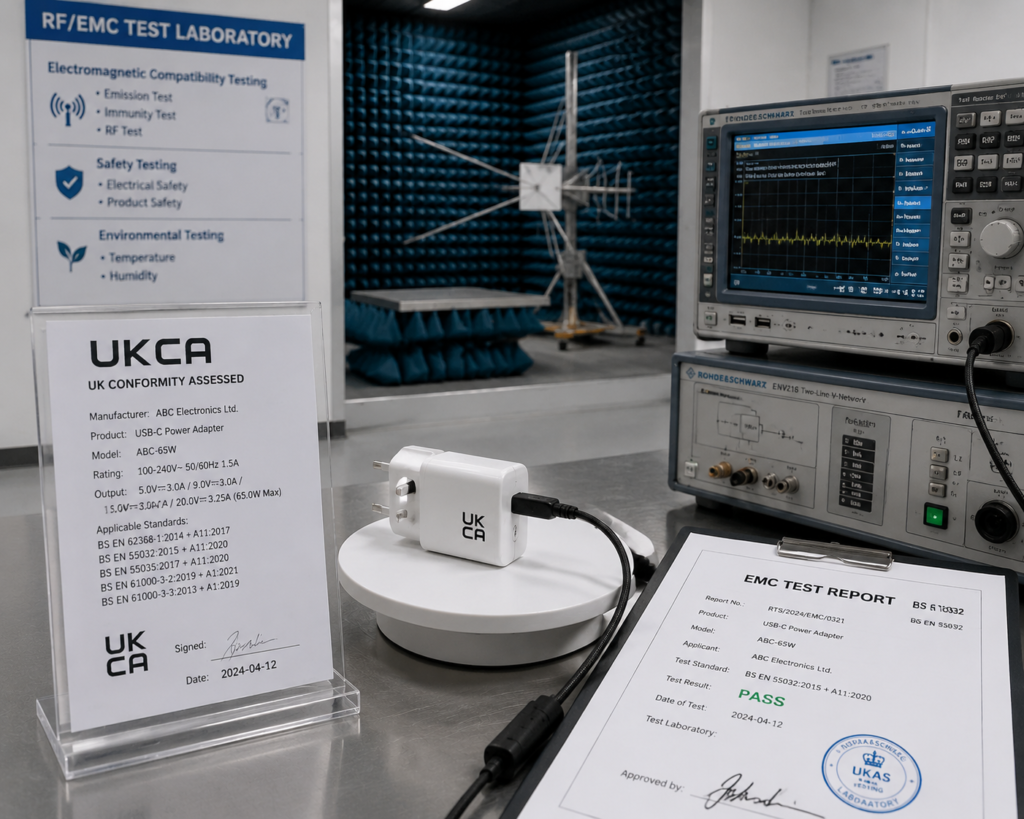
Whether third-party institutions are required to participate is not determined by the subjectively judged “level of risk”, but must be based on the clear requirements of the corresponding product regulations.
IV. What Does a Compliant UKCA Mark Look Like
Many people have their goods detained because the mark itself is incorrect, such as typing three letters casually in ordinary font. In fact, UKCA has strict appearance specifications.
The Official Fixed Style Cannot Be Modified
The official style of UKCA is: the upper parts of U and K are connected as one, C and A are arranged on the right in sequence. It is an overall graphic mark, not three independent letters.
The officially designated style must be used. You cannot change the font, modify the strokes, or add decorative effects by yourself. When scaling, you must also maintain the equal proportion, and cannot stretch, flatten or distort it. It is recommended to directly download the standard vector image from the official UK website, instead of piecing it together with typesetting software by yourself.
Size and Clarity Requirements
The general requirement is that the overall height of the mark is at least 5mm, which is about the size of an adult’s fingernail.
For particularly small micro-products, such as true wireless earphones and small electronic accessories, the size can be appropriately reduced under the premise that the corresponding regulations allow, but the mark must be clear and legible, and cannot be so small that it is invisible to the naked eye. If special categories have stricter size requirements, they shall be implemented in accordance with the provisions of the corresponding regulations.
Color Only Needs to Be Clear Enough
UKCA has no mandatory color requirements, as long as the contrast with the background is sufficient and it is clearly visible. Conventionally, black or dark gray is used with a light background, and for dark products, a reversed white mark can also be used. However, in order to match the product appearance, you cannot make the mark a color similar to the background, making it difficult to identify.
Situations Where the Institution Number Needs to Be Marked
Only when the applicable regulations require a UK Approved Body to participate in the conformity assessment, and clearly stipulate that the institution number needs to be marked next to the UKCA mark, is it necessary to mark the number of the institution. The number must be adjacent to the mark, clear and legible, and cannot be separated by other symbols.
If the regulations do not require it, you must not add the institution number without authorization, let alone forge the number, otherwise it is a violation.
V. How and Where to Affix the Mark
General Rules for Affixing Position
The UKCA mark should usually be preferentially affixed to a conspicuous position on the product body or fixed nameplate, which can be directly seen during normal use of the product, and is not easy to be blocked or worn. Avoid affixing it to parts that can only be seen after disassembly, and do not affix it to positions that are frequently rubbed or easily covered during use, such as under the non-slip mat at the bottom of the product, or the grip of a handheld device.
Exceptions to Mark Position
Only when the corresponding product regulations clearly allow it, or the currently effective official transition arrangement applies, can the UKCA mark be marked on the smallest sales package, product label or accompanying documents. For example, for extremely small micro-products, if the corresponding regulations allow affixing on the package, it can be implemented as required; for large installation equipment (such as industrial machinery, elevators), if the regulations allow marking on the nameplate or the first page of the manual, it can also be implemented as required.
For products sold in sets, if each individual item can be sold independently, each individual item and the outer package need to be marked with the UKCA mark in accordance with regulatory requirements. For example, a set of 6 independently sold sockets, each socket and the outer box must meet the marking requirements.
Requirements for Affixing Methods
Under normal circumstances, the mark should adopt a durable affixing method matching the normal service life of the product to ensure that the mark will not fall off or become blurred during normal use of the product. Common compliant methods include laser engraving, screen printing, stamping, fixed metal or plastic nameplates, etc.
If regulations or transition arrangements allow alternative methods such as labels and accompanying documents, they must be implemented in accordance with the corresponding requirements. Temporary marks that are easy to erase, easy to fall off and do not meet regulatory requirements shall not be used.
Information Display Requirements for Different Scenarios
UKCA-related display obligations are divided into three categories, with different applicable rules, and should not be confused:
The first category is the UKCA graphic mark obligation on the physical product, which is implemented in accordance with the affixing position and affixing method rules mentioned above, and the core is to meet the physical mark requirements of the corresponding regulations.
The second category is the content obligation of the UK Declaration of Conformity (UK DoC): the core of the UK DoC is to include the statutory declaration content. Whether it is necessary to print the UKCA graphic mark shall refer to the document template requirements of the corresponding regulations; if there is no mandatory requirement, it is sufficient to clearly state the compliance status of the product.
The third category is the information obligation for distance sales (including e-commerce): only when applicable regulations and sales platform rules clearly require the display of the UKCA mark on online positions such as product detail pages, is it necessary to display it as required; the displayed mark must be consistent with the actual compliance status of the product, and UKCA shall not be promoted as “British quality certification” or other marketing terms inconsistent with the official definition, so as to avoid misleading consumers.
Rules for Side-by-Side Placement with Other Marks
For products sold in the GB market, the UKCA mark can be placed side by side with other compliance marks or functional marks such as CE and recycling marks, but sufficient spacing must be maintained so that they do not block each other or confuse each other.
It should be noted that UKNI is a mark only applicable to the Northern Ireland market and must be used together with CE. It will not appear in the product compliance mark combination only for the GB market. Do not mix the two.
Your own brand trademark and marketing patterns cannot be made similar to the UKCA mark, so as to avoid misleading consumers. When multiple marks are placed side by side, UKCA must remain independent and complete, and cannot be covered by other marks.
VI. Advanced Rules for Special Scenarios
The above are the general basic rules. If you operate in multiple markets or encounter special categories, you also need to understand these advanced judgment methods.
Differences in Rules for Different Conformity Assessment Routes
Different products are applicable to different conformity assessment routes, and the requirements for the use of UKCA also differ:
For products that the corresponding regulations allow the use of the self-declaration route (such as some low-voltage electronic accessories, ordinary household non-pressure small tools, etc., provided that the product does fall within the scope of a certain UKCA applicable regulation), the manufacturer can affix the mark after completing the testing and risk assessment on its own and confirming compliance with the requirements, without the participation of a third-party institution, and usually there is no need to mark the institution number;
For products that the regulations require must be assessed by a UK Approved Body (such as safety helmets belonging to specific categories of personal protective equipment, specific gas appliances, high-pressure pressure equipment, etc.), a qualified institution with corresponding qualifications must be entrusted to complete the assessment, and if the regulations require marking the institution number, it must be marked next to the mark as required.
The core basis for judgment is the UK regulations corresponding to the product and the selected conformity assessment route, rather than the subjectively felt level of risk. Also note: the same product may be subject to multiple regulations at the same time. For example, a toy with Bluetooth function must meet both the toy safety requirements and the radio equipment requirements, and only after both are compliant can the UKCA mark be used.
Mark Combination Rules for Multi-Market Sales
Many sellers operate in multiple markets at the same time. The mark combination should be judged separately in combination with the regulatory requirements of each market, and should not be mixed:
If sold to both GB and the EU, both CE and UKCA marks can be affixed at the same time. The two marks must meet their respective specifications and cannot replace each other — you cannot default that CE can directly replace UKCA, nor can you use UKCA to replace CE to enter the EU market. The two apply to different regulatory systems and market scopes, and their respective compliance processes need to be completed separately.
If sold to both GB and Northern Ireland, you need to meet the marking requirements of the two regions respectively. You cannot just affix UKCA and say it is universal for the whole UK. Northern Ireland does not recognize the standalone UKCA mark.
If it is cross-border e-commerce direct mail to the GB market, there is no special marking exemption, and the compliance requirements are the same as offline sales. You cannot use “direct mail” as a reason to not mark in accordance with the regulations.
Regarding the acceptance rules for the CE mark in the GB market, do not believe the statements of “unified transition period” or “universal for all categories”. You can judge according to the following steps:
1. First confirm the GB statutory instrument applicable to the product (i.e. the corresponding product regulation);
2. Check whether the statutory instrument recognizes the CE compliance path, whether it recognizes the corresponding EU regulatory requirements or a specific standard version, and whether there is an applicable period or additional conditions;
3. Only when the instrument no longer recognizes the CE path, or the enterprise actively chooses the UKCA compliance route, is it necessary to implement the full UKCA process.
The CE recognition rules and deadlines of different regulations vary greatly, and the specific ones shall be subject to the latest statutory guidelines of the UK DBT.
Exception Judgment for Several Types of Special Scenarios
When encountering these special scenarios, do not directly apply the general rules, but judge separately:
• Second-hand products: non-commercial personal second-hand resale does not need additional UKCA affixing, but if it is commercial resale where merchants collect and resell, it needs to meet the GB compliance requirements when the product was first launched;
• Customized small-batch products: it is necessary to judge whether the simplified process is applicable according to the category. There is no general exemption rule, and you cannot say “I only make 10 pieces so I don’t need to affix it”;
• Inventory products: it should be judged in combination with the time when the product was first placed on the GB market, the regulatory requirements at that time, and the current regulatory transition arrangements. It cannot be generalized that inventory does not need to be re-marked, nor can it be said that all inventory must be re-marked;
• Special regulated categories: such as food, pharmaceuticals, medical devices, and cosmetics, must follow the separate compliance and marking rules of the corresponding industry competent authorities. Do not directly apply the general UKCA requirements, nor mistakenly think that special regulation means exemption from compliance.
VII. Common Misconceptions and Pitfall Avoidance Principles
Many violations are not intentional, but because of stepping on common cognitive pitfalls. Here are the most error-prone points sorted out.
Common Errors in the Mark Itself
Such errors are the most intuitive and the easiest to be directly found during inspections. There are four common types:
• Printing the three letters UKCA by yourself in ordinary font, without using the official standard style;
• The mark size is less than 5mm (except for micro-products where regulations allow reduction), or there is stretching or flattening deformation;
• Affixed to a position that is easy to wear or be blocked, or using a temporary mark that is easy to fall off and does not meet regulatory requirements;
• Products that require the institution number to be marked according to regulations have missing or wrong numbers, or products that do not need to be marked have the institution number added without authorization.
More Hidden Compliance Logic Errors
Such errors are more serious than the problems of the mark itself, and are also the core reason why many sellers are fined. Common ones include:
• The product has not completed compliance testing and has no complete technical documents, but the UKCA mark is affixed without authorization, mistakenly believing that “affixing the mark means compliance”;
• Defaulting that CE of all categories can be used permanently, or believing in a unified CE deadline, without checking the CE recognition rules of the corresponding regulations;
• Failing to implement the compliance responsible entity in the UK in accordance with regulatory requirements, and directly shipping to the GB market;
• Confusing applicable markets, using UKCA alone for the Northern Ireland market, or using UKNI mark to replace UKCA to enter the GB market;
• Only preparing one set of compliance documents for multi-market sales, mistakenly believing that the requirements of different regions can be universal.
Core Principles for Avoiding Pitfalls
If you want to avoid the vast majority of UKCA-related compliance pitfalls, remember four core logics:
First, first confirm the regulatory requirements applicable to the product, then prepare the mark and documents. Do not affix the mark first and then make up for compliance;
Second, all compliance decisions shall be subject to the latest official announcements of the UK Department for Business and Trade (DBT) and the Office for Product Safety and Standards (OPSS). Do not believe information from unofficial channels;
Third, when you are not sure whether a third-party institution is required to participate in the assessment, first check the corresponding regulatory requirements, or consult a UK-recognized professional institution. Do not act based on subjective judgment;
Fourth, if you find that there is already a violation, first suspend sales, isolate the affected inventory, complete the documents or correct the labels before re-launching. Do not continue to sell with a fluke mentality.
VIII. Quick UKCA Compliance Self-Check List
If you are already operating in the GB market, you can use this list to quickly complete a preliminary compliance screening:
Basic Qualification Self-Check
• [ ] The product belongs to the regulated category applicable to UKCA, and the sales region includes GB (it has been confirmed that the corresponding regulation does not apply to the CE compliance path, or the enterprise actively chooses to adopt the UKCA route)
• [ ] The product meets the basic requirements of applicable UK regulations, and has corresponding compliance test reports and complete technical documents
• [ ] The compliance responsible entity in the UK has been implemented in accordance with regulatory requirements, and the information has been marked as required
• [ ] The UK Declaration of Conformity (UK DoC) has been signed in the format required by the corresponding regulations, and the record retention period meets the regulatory provisions
• [ ] If the applicable regulations require a UK Approved Body to participate in the assessment, the assessment has been completed by a body with corresponding qualifications and the corresponding documents have been obtained
Mark Itself Self-Check
• [ ] The style and proportion meet the official requirements, and have not been modified without authorization
• [ ] The size meets the standard (≥5mm, except for micro-products where regulations allow reduction), and the color contrast is sufficient
• [ ] If the regulations require marking the institution number, the correct UK Approved Body number has been marked
• [ ] The mark is clear and legible, without wear or blur
Affixing and Display Self-Check
• [ ] The affixing position of the mark meets the requirements of applicable regulations, preferentially on the conspicuous position of the product body/nameplate, and can be seen without disassembly
• [ ] The affixing method meets the durability required by regulations, and will not easily fall off or become blurred
• [ ] Packaging, accompanying documents, and e-commerce product detail pages all display the mark in accordance with applicable regulations or platform requirements, and there is no misleading publicity
• [ ] When multiple marks are placed side by side, they are clearly separated, without occlusion or misleading
Summary
After reading this content, you can already independently complete the basic judgment and self-check of UKCA mark compliance: you can not only quickly distinguish whether a product needs to be affixed with UKCA, whether the mark style and affixing meet the requirements, but also clarify the applicable market boundaries of UKCA, CE, and UKNI, and avoid the most common usage misconceptions.
If you encounter complex situations such as overlapping of multiple regulations, inventory products, special regulated categories, or need to confirm CE recognition rules, third-party assessment requirements, etc., do not draw conclusions based solely on general rules. Directly check the latest official guidelines of the UK DBT and OPSS, or consult a qualified professional institution.